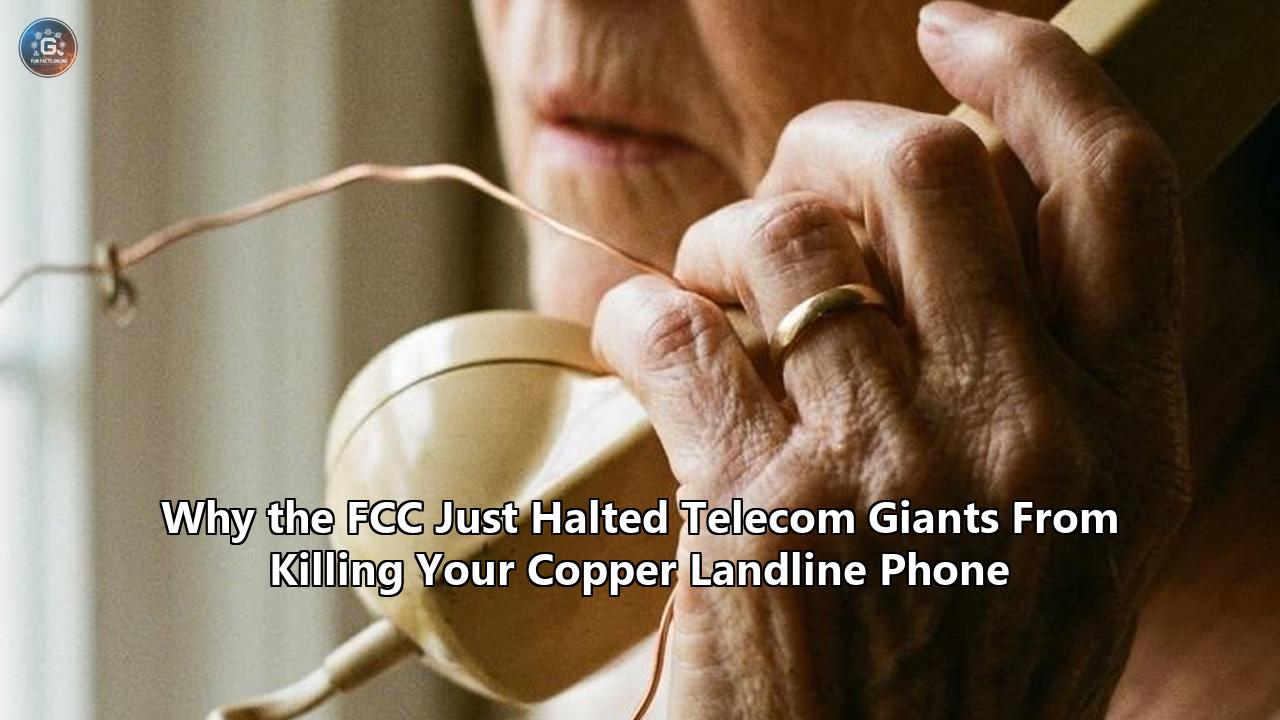
WASHINGTON — In a sudden Friday evening intervention that sent shockwaves through the telecommunications industry, the Federal Communications Commission halted the automatic approval of Verizon’s sweeping plan to shut down legacy copper phone lines across nine states.
The regulatory pause, issued by the FCC’s Wireline Competition Bureau on September 25, 2026, abruptly suspended a 31-day fast-track clock that would have granted Verizon automatic authority by midnight on September 26 to begin decommissioning Plain Old Telephone Service (POTS) networks in Arizona, Delaware, New Jersey, New Mexico, Ohio, Rhode Island, South Carolina, Utah, and Virginia.
The agency’s intervention came after a fierce, eleventh-hour revolt from rural consumers, emergency responders, state utility advocates, and members of Congress. Critics warned that rubber-stamping the carrier’s Section 214 discontinuance application would sever the sole functional lifeline for tens of thousands of households stranded in cellular dead zones where fiber-optic replacements remain nonexistent.
"The Commission requires additional time to complete its review," the FCC stated in its brief order in WC Docket No. 26-227. "Accordingly, the Application as filed with the Commission will not be automatically granted. We emphasize that our removal of Verizon’s application from the automatic grant process is not a final determination on the merits of Verizon’s request for authority to discontinue service."
The move marks the first major federal roadblock thrown in front of telecom giants since the FCC enacted aggressive deregulatory measures earlier in 2026 to speed up network transitions. For months, major carriers led by AT&T and Verizon have accelerated efforts to scrap their sprawling 20th-century copper grids, arguing that maintaining parallel analog infrastructure costs billions of dollars that should otherwise fund next-generation fiber and 5G deployment.
Yet by stepping in just hours before the automatic statutory approval deadline, the FCC signaled that the human, economic, and operational realities of switching off the nation's original telecommunications backbone cannot simply be swept aside by carrier pledges.
Across the country, millions of rural residents, alarm monitoring stations, elevators, water treatment facilities, and emergency dispatch centers remain physically wedded to the analog circuit. The FCC's sudden pause exposes deep fractures in the federal transition plan, spotlighting the growing friction between corporate broadband ambitions and the basic survival needs of communities left beyond the reach of the digital frontier.
The Fast-Track That Broke: Inside Docket 26-227
The standoff in Docket 26-227 was set in motion on August 10, 2026, when Verizon’s incumbent local exchange carrier (ILEC) affiliates—alongside 34 operating companies tied to Frontier Communications—filed an application under Section 214 of the Communications Act of 1934 and Section 63.71 of the FCC’s procedural rules. The filing requested immediate federal clearance to retire traditional time-division multiplexing (TDM) voice service over copper throughout designated portions of nine states.
Docket 26-227: Key Milestones of the Section 214 Standoff
┌─────────────────────────────────────────────────────────────────────────┐
│ Aug 10, 2026: Verizon & Frontier file Section 214 application           │
│               Covering 9 states: AZ, DE, NJ, NM, OH, RI, SC, UT, VA     │
├─────────────────────────────────────────────────────────────────────────┤
│ Aug 26, 2026: FCC Wireline Competition Bureau issues public notice      │
│               Triggers streamlined 31-day clock under modern rules      │
├─────────────────────────────────────────────────────────────────────────┤
│ Sep 08, 2026: Mandatory customer notification letters hit mailboxes     │
├─────────────────────────────────────────────────────────────────────────┤
│ Sep 15–20:    Public backlash surges; Rep. Ben Cline files warning      │
│               Over 277,000 live voice customers flagged as vulnerable   │
├─────────────────────────────────────────────────────────────────────────┤
│ Sep 24, 2026: Verizon files 17-page ex parte defense with concessions   │
├─────────────────────────────────────────────────────────────────────────┤
│ Sep 25, 2026: FCC issues emergency order removing automatic approval    │
├─────────────────────────────────────────────────────────────────────────┤
│ Sep 26, 2026: Original automatic-grant deadline expires without relief  │
└─────────────────────────────────────────────────────────────────────────┘
Under regulatory revisions adopted earlier in the year, such applications were designed to move with unprecedented speed. Where dominant regional carriers previously faced 60-day review cycles subject to lengthy state-level delays, the streamlined framework instituted a uniform 31-day automatic approval window.
Unless the FCC formally intervened, any discontinuance application meeting bare-minimum procedural standards would be deemed granted on the 31st day following public notice. For Verizon's August 26 notice, that guillotine date was Saturday, September 26, clearing the path to begin pulling the plug as early as October 23.
Verizon argued that its copper lines were an obsolete relic maintained at unsustainable expense for a vanishing customer base. Across the twelve million residential and commercial service locations within the nine-state footprint, the company noted that approximately 277,000 legacy voice lines remained active—an adoption rate of barely 2.25 percent.
The carrier asserted that copper is "too slow to meet modern needs, many decades old, costly to maintain, and vulnerable to damage and theft," promising to migrate subscribers to either fiber or its fixed-wireless voice products.
To the thousands of families living on the wrong side of the Appalachian Mountains, across rural desert basins, or within deeply forested hollows, the filing read like an eviction notice from the modern communications grid. Public comments flooded the FCC's Electronic Comment Filing System (ECFS) throughout September.
Seniors living alone described how copper landlines were their only connection to 911 dispatchers because cell phones displayed "No Service" inside their living rooms. Small rural businesses pointed out that their point-of-sale systems, alarm panels, and fax machines could not operate over the thin, inconsistent wireless signals typical of their areas.
Political pressure mounted rapidly. U.S. Representative Ben Cline, a Virginia Republican representing a largely rural district spanning the Shenandoah Valley and Blue Ridge regions, dispatched a scathing letter to FCC leadership demanding that the commission block the fast-track approval.
"First, large portions of my district remain cellular dead zones, where the mobile wireless devices offered as a substitute are unreliable or do not work at all," Cline wrote. "Second, fiber to the home has not yet been built out across these communities, leaving some households with no wireline alternative once copper is retired."
The backlash forced Verizon into a defensive posture. On Thursday, September 24—barely 48 hours before the automatic grant was set to trigger—the carrier submitted an urgent 17-page ex parte letter to the FCC attempting to head off federal intervention.
Verizon insisted that the public had misunderstood the scope of its petition. It had not asked for blanket permission to abandon every customer, the company claimed, but only those for whom an alternative was already available.
"If a Commission-approved solution is not available, Verizon will not take any action, and the customer will continue to be served over the Verizon copper network," the carrier pledged, promising to deploy proprietary mapping tools to measure cellular signal strength at individual parcel boundaries before disconnecting any copper loop.
Verizon urged the FCC to approve the applications via streamlined treatment without attaching binding conditions. The Wireline Competition Bureau refused.
Recognizing that an unconditioned automatic approval would legally forfeit the commission's leverage and leave the determination of whether an alternative was "adequate" entirely in Verizon's hands, regulators pulled the emergency brake. The automatic grant clock was stopped dead.
How the Rules Were Bent: The March 2026 Overhaul
To understand why Verizon’s nine-state application triggered a regulatory crisis, one must trace the FCC's systematic dismantling of analog consumer protections over the past two years. The collision in Docket 26-227 was the direct result of a calculated effort to strip away historic regulatory barriers governing how, when, and where telecommunications utilities can abandon physical copper infrastructure.
For nearly a century, the primary federal check against utility abandonment has rested in Section 214(a) of the Communications Act of 1934. Drafted when AT&T operated as a nationwide regulated monopoly under the Bell System, Section 214 was intended to ensure that no carrier could unilaterally shut down service to an unprofitable or rural enclave without proving to the federal government that the public convenience and necessity would not be adversely affected.
For decades, getting FCC clearance to discontinue a voice service required exhaustive engineering showings. A carrier had to prove that an alternative service offered identical line quality, battery-backup resilience, latency standards, and standalone voice affordability.
Under the leadership of FCC Chairman Brendan Carr, the agency undertook a wholesale rewrite of those protections. The deregulatory campaign began in earnest in March 2025, when the commission issued four related orders waiving long-standing technical hurdles.
Chief among them was a concession granting carriers the right to satisfy replacement mandates with bundled offerings. Previously, an incumbent local exchange carrier seeking to retire copper voice had to demonstrate that a consumer could buy an equivalent, unbundled, standalone voice plan from another provider.
Under the 2025 waivers, USTelecom—the primary lobbying arm for broadband and telephone giants—convinced the commission that a bundle combining voice with fixed broadband or commercial mobile data was an acceptable substitute, even if it forced low-income consumers to purchase expensive data packages they did not want or need.
The deregulation reached its zenith on March 26, 2026, when the commission voted along party lines to adopt the Network and Services Modernization Order (FCC 26-19, presiding over WC Docket Nos. 25-208 and 25-209).
Evolution of Copper Discontinuance Regulations
┌───────────────────────────┬───────────────────────────┬───────────────────────────┐
│ Metric / Requirement      │ Pre-2025 Regulatory Model │ March 2026 Order (FCC 26) │
├───────────────────────────┼───────────────────────────┼───────────────────────────┤
│ Automatic Approval Clock  │ Up to 60 days (Tier 1)    │ Uniform 31 days (all)     │
├───────────────────────────┼───────────────────────────┼───────────────────────────┤
│ Standalone Voice Mandate  │ Strictly required         │ Waived; bundles permitted │
├───────────────────────────┼───────────────────────────┼───────────────────────────┤
│ State COLR Deference      │ States held independent   │ Federal preemption        │
│                           │ authority to delay/block  │ asserted over state rules │
├───────────────────────────┼───────────────────────────┼───────────────────────────┤
│ Grandfathering Approval   │ Formal FCC filing &       │ Blanket federal authority │
│                           │ public notice required    │ via customer notification │
├───────────────────────────┼───────────────────────────┼───────────────────────────┤
│ Technical Line Testing    │ Strict latency, packet    │ Simplified single-tier    │
│                           │ loss, and signal tests    │ standard of comparability │
└───────────────────────────┴───────────────────────────┴───────────────────────────┘
The order delivered the telecom industry nearly everything on its legislative wishlist:
- Uniform 31-Day Clock: Slashed the automatic grant timeline for dominant Tier-1 carriers from 60 days down to a razor-thin 31 days.
- Blanket Grandfathering: Granted carriers blanket federal authority to grandfather copper-based voice, lower-speed data, and copper VoIP services without filing an advance application with the FCC. Carriers could stop offering copper service to any new customer and quietly shift existing customers onto a retirement track using ordinary billing inserts.
- Eviction of State Utility Commissions: In an aggressive assertion of federal authority, the order declared that FCC Section 214 approvals preempt state-level Carrier of Last Resort (COLR) statutes and local utility commission oversight. If a state commission attempted to order an incumbent carrier to keep copper powered under state universal service laws, the FCC claimed federal law superseded that mandate.
- Abolition of Section 251 Notice Filings: Terminated long-standing requirements under Section 251(c)(5) that forced carriers to file formal public disclosures with the FCC before initiating copper retirements, replacing them with a simplified rule allowing companies to merely publish changes to their own public websites.
In official statements, the commission justified the overhaul by framing copper as a resource drain that crippled American competitiveness. Chairman Carr declared that the order would "free up tens of billions of dollars annually for modern networks that otherwise would have been diverted into costly and outdated copper lines." USTelecom President and CEO Jonathan Spalter lauded the vote as a landmark decision that would "cut through red tape and outdated mindsets to accelerate the work of connecting all Americans."
In the agency's calculations, the FCC copper landline rules were intended to create an unobstructed runway for carriers to shutter their copper footprints by the end of the decade.
Instead, the rules created a regulatory pressure cooker. By compressing the review timeline to 31 days, the FCC stripped itself of the breathing room needed to independently verify carrier claims. When Verizon tried to use that compressed clock to push through a nine-state retirement plan, the system choked on its own speed.
The Rural Reality: Cellular Ghosts and Dead Zones
The public fury that broke the automatic grant mechanism was grounded in geographical reality. While telecom executives and urban policy analysts view wireless voice service as a universal utility, millions of Americans living in topographically complex, sparsely populated regions know it is nothing of the sort.
In the Ridge-and-Valley Appalachians of Virginia, the cavernous arroyos of northern New Mexico, and the red rock canyons of southern Utah, wireless cellular signals behave according to the laws of physics, not the assertions of carrier marketing decks. High-frequency radio waves cannot reliably bend around granite ridges, penetrate dense stands of hardwood timber, or survive heavy summer downpours.
RF Propagation vs. Physical Topography in Rural Deployment
─────────────────────────────────────────────────────────────────────────────
[Cell Tower] ───\  (Clear Line of Sight: 3–5 Miles)
                 \
   Forest Canopy  \ ── [Scattered Signal]
   ════════════════\═════════════════════════════════════════════════════════
                    \
      Mountain Peak  \
         /\           \   [RF Shadow / Severe Attenuation]
        /  \           \
       /    \           x ─── No Signal
      /      \
     / Hollow \ ───────────────> [Rural Residence in "Cellular Dead Zone"]
    /          \                 • Zero reliable LTE/5G reception
   /  Village   \                • Fixed-wireless gateway shows packet loss
  /              \               • POTS Copper Wire: Continuous 48V circuit
─────────────────────────────────────────────────────────────────────────────
When an incumbent provider like Verizon approaches the FCC seeking permission to retire its wire centers, it routinely points to coverage maps asserting that 98 percent or more of the population is reached by mobile cellular or fixed-wireless networks. For the remaining two percent, that statistical rounding error represents a terrifying vulnerability.
Consider Augusta County, Virginia, nestled within Representative Cline’s 6th Congressional District. Scores of households situated along narrow hollows maintain zero cellular reception within their homes.
For these residents, the copper wire looping from an aerial terminal down to the interface box on the exterior wall is not a secondary choice; it is their only link to county emergency medical services, local volunteer fire departments, and distant family members.
"If my power goes out and a fire starts or someone has a heart attack, we don't have cell service to call for help," wrote Donald Vance, an Augusta County resident who filed comments in Docket 26-227. "The cell phone in our house has said 'Searching' since 2011. Verizon told us we could buy an internet phone or use their wireless box. But you can't plug a wireless box into a signal that doesn't exist. If they take the copper, they are leaving us to die."
The alternative product Verizon planned to offer to transitioning customers is its Home Phone Connect device—a desktop terminal that converts analog RJ-11 phone jacks into wireless cellular radio transmissions routed over the Verizon Wireless 4G LTE and 5G networks. While functional in suburban neighborhoods boasting dense cell tower grids, the device relies on the exact same cellular spectrum that already fails to reach deep inside rural structures.
Verizon insisted in its September 24 ex parte filing that it would use field verification tools to identify homes lacking adequate cellular signal strength before taking down copper facilities.
Advocacy groups like the National Consumer Law Center and AARP immediately warned the FCC that carrier-run testing programs are historically riddled with self-serving errors. Without objective, third-party signal audits and strict federal enforcement mechanisms, rural households risk being summarily deemed "covered" by computerized propagation algorithms that fail to account for local terrain, seasonal leaf cover, or building insulation materials.
By issuing an emergency halt, the FCC conceded that it could not simply take Verizon’s internal mapping models on faith. Under existing FCC copper landline rules, a replacement service cannot merely exist on an engineer's theoretical coverage map; it must deliver substantially similar levels of network infrastructure, service quality, and emergency accessibility to every actual, living customer slated for disconnection.
The Hidden Analog Backbone: Elevators, Alarms, and Machine Networks
The public backlash against the copper shutdown extends far beyond rural residential voice calls. Behind the drywall of commercial real estate, municipal facilities, and public infrastructure lurks a massive, invisible ecosystem of specialized machines that were engineered exclusively to operate over POTS circuits.
For more than half a century, fire protection systems, commercial building elevators, municipal water lift stations, burglar alarms, and hospital clinical systems were constructed around the immutable mechanical properties of copper wiring. Unlike standard voice communications, which can tolerate minor packet jitter, micro-latency, and digital audio compression, these critical systems rely on precise electrical characteristics:
- Frequency Shift Keying (FSK) and Dual-Tone Multi-Frequency (DTMF): Legacy fire alarm communicators (Digital Alarm Communicator Transmitters, or DACTs) transmit alarm codes to central monitoring stations using specific audio frequencies and DTMF tones. When digitized through standard Voice over IP (VoIP) codecs—such as the highly compressed G.729 protocol favored by cellular carriers—these audio tones frequently suffer digital packet loss, packet clipping, or distortion, resulting in failed alarm transmissions.
- Continuous Line Seizure: Life-safety fire panels are designed to physically "seize" the phone line, instantly terminating any existing voice conversation on the premises to open an uninhibited, dedicated copper channel straight to the central monitoring station. Digital cellular gateways lacking specialized circuitry often fail to support true hardware-level line seizure.
- Low-Voltage DC Loop Power: Copper phone lines are active electrical circuits. A central office sends direct current (DC) through the loop at approximately -48 volts when the line is idle, dropping to around 6 to 12 volts during an active call, accompanied by a 90-volt alternating current (AC) ringing signal. Many legacy sensor arrays and emergency call boxes draw their operating power directly from this continuous current, eliminating the need for an external electrical connection.
The POTS Mechanical Interface vs. Modern Digital Emulation
─────────────────────────────────────────────────────────────────────────────
LEGACY COPPER POTS:
Central Office Battery ──[-48V DC]──> Copper Loop ──> Emergency Call Box /
(Uninterruptible Power)                               Fire Alarm Panel
* No local AC power required
* Constant loop current verification
* Instantaneous DTMF/FSK signaling

DIGITAL REPLACEMENT (POTS-in-a-Box / Cellular Gateway):
Wall Outlet ──[120V AC]──> Power Supply ──> Backup Battery (8–24 hrs max)
                                                  │
                                                  ▼
Analog Endpoint ──[RJ-11]──> Analog Telephone Adapter (ATA) ──> Cellular Modem
                             * Digital packetization (VoIP)     * Dependent on
                             * Potential audio clipping/jitter    cell tower
                             * Algorithmic DTMF translation       line of sight
─────────────────────────────────────────────────────────────────────────────
The regulatory framework governing these systems is not dictated by the FCC alone, but by rigorous, legally enforceable safety standards.
The National Fire Protection Association’s standard for fire alarm systems—NFPA 72—mandates that communication pathways between an alarm panel and the supervising station must be continuously monitored for integrity. If a phone line goes dead, the system must trigger a trouble signal within one hour.
Similarly, the American Society of Mechanical Engineers (ASME) A17.1 / CSA B44 Safety Code for Elevators and Escalators mandates dedicated, two-way emergency communication systems that can automatically verify line continuity and identify the cab's precise physical location to emergency dispatchers.
Migrating these endpoints off copper is an engineering nightmare that carries astronomical costs. Replacing a dual-line POTS fire alarm hookup with a modern, dual-path IP and commercial cellular communicator requires hiring licensed low-voltage fire engineers, securing municipal building permits, undergoing field testing with local Authorities Having Jurisdiction (AHJs), and buying expensive specialized hardware.
To force organizations off the old grid, carriers have engaged in aggressive price rationing. When the FCC granted carriers forbearance from legacy pricing constraints in 2019 via Memorandum Order 19-72, the cost of commercial POTS lines skyrocketed.
Where businesses historically paid $30 to $50 per month per line, monthly carrier rates across the country surged to $800, $1,500, and in documented cases, past $3,300 per line per month.
"Telecom companies created a synthetic financial crisis to force customers off copper, and when that didn't work fast enough, they sought blanket regulatory permissions to walk away entirely," says Sean Sullivan, a telecommunications systems analyst tracking legacy migrations.
"Enterprise clients, school districts, and municipal water authorities are suddenly faced with either paying tens of thousands of dollars a month in punitive line surcharges or rushing through unproven digital retrofits that fail local fire and life-safety inspections," Sullivan points out. "The 31-day fast-track timeline the FCC created was completely decoupled from the physical realities of code compliance and facility engineering."
The Physics of Disaster Resilience: Why the Grid Still Needs Wire
Behind the regulatory battles over copper lies a fundamental engineering reality: the analog telephone network is arguably the most resilient civil infrastructure system ever constructed.
The traditional Public Switched Telephone Network (PSTN) was engineered from its inception to withstand military conflict, catastrophic natural disasters, and total grid collapse. Copper phone lines carry their own electricity.
The power that drives a POTS line does not originate from the local electric utility that lights a consumer’s home; it is generated by industrial battery plants and massive backup diesel generators housed inside heavily fortified telecommunications central offices (wire centers).
Disaster Resilience Profile: Copper POTS vs. Modern Digital Infrastructure
┌──────────────────────────┬──────────────────────────┬──────────────────────────┐
│ Parameter                │ Legacy Copper POTS       │ Fiber / Fixed Wireless   │
├──────────────────────────┼──────────────────────────┼──────────────────────────┤
│ Operating Power Source   │ Central Office -48V DC   │ Local home AC power      │
├──────────────────────────┼──────────────────────────┼──────────────────────────┤
│ Outage Survivability     │ Days to weeks (backed by │ 8–24 hours (consumer     │
│                          │ utility diesel gen-sets) │ lithium-ion backup pack) │
├──────────────────────────┼──────────────────────────┼──────────────────────────┤
│ Network Architecture     │ Dedicated physical loop; │ Shared packet networks;  │
│                          │ non-blocking circuit     │ cellular tower overload  │
├──────────────────────────┼──────────────────────────┼──────────────────────────┤
│ E-911 Location Precision │ Absolute physical wire-  │ Algorithmic, triangulated│
│                          │ center / address binding │ cell-tower or GPS fix    │
├──────────────────────────┼──────────────────────────┼──────────────────────────┤
│ Extreme Cold / Ice Risk  │ Fully operational unless │ Rapid degradation of     │
│                          │ physical poles snap      │ consumer-side batteries  │
└──────────────────────────┴──────────────────────────┴──────────────────────────┘
When an ice storm, hurricane, or wildfire tears down local electric utility distribution poles, cutting off electricity to an entire county, a traditional copper landline plugged into a simple, non-powered analog telephone keeps working. A caller can pick up the handset, instantly hear a dial tone, and contact emergency dispatch. The central office’s massive lead-acid or nickel-cadmium battery banks can maintain line power for days, while on-site fuel reserves keep generators running through extended municipal blackouts.
By contrast, modern broadband alternatives—including fiber-to-the-premises (FTTP), cable DOCSIS networks, and fixed-wireless access (FWA)—rely on local electrical power.
In a fiber network, the Optical Network Terminal (ONT) installed on the side of a house or inside a garage requires 120-volt AC power to translate optical light pulses into electronic voice and data packets. If the power fails, the phone goes dead instantly unless an uninterruptible power supply (UPS) is installed.
Under federal rules (47 CFR § 9.20), carriers selling residential digital voice are required to offer consumers the option to buy 8-hour and 24-hour backup battery systems. In practice, these consumer-grade lithium-ion batteries are fragile compromises:
- Battery Degradation: Consumer UPS batteries have an operational lifespan of two to three years. In remote environments subject to extreme temperature swings, capacity degrades rapidly. When a catastrophic storm hits five years after an installation, the battery often fails to provide even thirty minutes of reserve power.
- Cell Tower Blackouts: While wireless carriers equip cell towers with backup generators, fuel logistics during major disasters frequently break down. Roads blocked by fallen trees or floodwaters prevent diesel delivery trucks from reaching remote mountain towers. Once tower batteries exhaust their standard 4-to-8-hour runtime, cellular sites go dark, turning whole regions into mobile communication deserts.
- Network Congestion and Packet Drop: During civil emergencies, cellular networks suffer severe congestion. When tens of thousands of people simultaneously attempt to place mobile calls or stream video updates, cellular base stations shed connections. Legacy POTS voice circuits operate on dedicated, non-blocking copper loops engineered to prioritize circuit switching, guaranteeing dial-tone access even in localized panics.
This resilience gap was brought into sharp relief during recent disaster seasons across the American West and Appalachia. During California’s recurring wildfire seasons and subsequent public safety power shutoffs (PSPS), when electric utilities preemptively de-energized high-voltage grids to prevent arcing, entire mountain towns lost cellular towers within hours.
The only surviving communication channels in these evacuation zones were the subterranean copper lines operated by local exchange carriers.
When carriers file Section 214 applications asserting that fixed-wireless products offer an "adequate replacement" for copper voice, they are comparing two fundamentally different engineering philosophies.
One is an active, locally powered, best-effort consumer digital network; the other is a self-powered, hardened, fail-safe life-support system. In emergency situations, swapping the latter for the former can mean the difference between life and death.
The Carrier Dilemma: Rusting Wire, Copper Theft, and eBay Scavenger Hunts
While public interest groups and rural consumers view the preservation of copper as a public safety imperative, telecommunications providers face an operational crisis of their own. The economic and physical reality of maintaining the nation's analog copper footprint has reached a breaking point.
At the center of the carriers’ push to decommission copper is the simple problem of scale. Telecommunications networks are capital-intensive operations that depend entirely on massive subscriber volume to amortize the immense fixed costs of outside-plant maintenance. Over the past two decades, that subscriber volume has completely evaporated.
Decline of the U.S. Copper Local-Loop Footprint (2000–2026)
─────────────────────────────────────────────────────────────────────────────
Year   Active Copper Loops       Status / Industry Phase
─────────────────────────────────────────────────────────────────────────────
2000   ~180 million              Peak POTS dominance; DSL rollout era
2010   ~110 million              Rapid mobile voice & cable VoIP substitution
2020   ~ 36 million              Enterprise migration; FCC unbundling relief
2024   ~ 18 million              Accelerated ILEC retirement filings
2026   ~ 12.5 million            Residual base; high rural concentration
─────────────────────────────────────────────────────────────────────────────
Total Net Loop Contraction (2000–2026): -93.05%
According to FCC data, active copper local loops dropped from almost 66 million lines in the mid-2010s to approximately 12.5 million nationwide by early 2026—a catastrophic collapse of more than 80 percent in barely a decade.
Yet the physical plant required to support those remaining lines did not shrink. An incumbent carrier must still maintain the telephone poles, pressurized underground conduits, central office air-conditioning plants, cross-connect cabinets, and high-voltage power supplies regardless of whether a lead-sheathed 900-pair copper cable carries 800 live conversations or just eight.
As subscriber density thins out, the maintenance cost per remaining subscriber increases exponentially. In rural wire centers, carriers report spending upwards of several hundred dollars per month simply keeping individual copper circuits from shorting out due to water ingress, line corrosion, and tree falls.
The equipment running inside central offices has aged into functional obsolescence. The workhorses of the traditional telephone network—switches like the Lucent (now Nokia) 5ESS and Nortel DMS-100—were manufactured in the 1980s and 1990s. The original manufacturers have long since ceased producing replacement line cards, processors, and diagnostic components.
To keep these legacy switches operating, telecom engineering teams must resort to purchasing refurbished circuit boards from third-party surplus liquidators or scouring online auctions like eBay for spare parts.
The technical workforce that understands how to repair this equipment is retiring en masse. A shrinking number of active technicians possess the craft knowledge required to troubleshoot analog loop resistance, trace open faults with time-domain reflectometers, or splice pressurized paper-insulated copper cables.
Adding to the logistical strain is an unprecedented surge in physical copper theft. Spurred by high global commodity prices for scrap copper, organized theft rings across California, Texas, the Pacific Northwest, and the Rust Belt regularly use winches, chain saws, and stolen utility trucks to cut and drag miles of overhead and subterranean copper lines directly out of service.
- In Dallas and Fort Worth, multiple neighborhood wire centers were repeatedly knocked offline throughout 2025 and 2026 as thieves sliced into live telecommunications trunk lines.
- In California’s Central Valley, AT&T crews frequently found that copper cables repaired on a Tuesday were stolen again by Thursday night.
- Replacing a stolen 1,200-pair copper trunk cable requires hundreds of thousands of dollars in emergency labor, specialized cable, and weeks of intricate splicing—only to restore voice service to a handful of customers who generate a fraction of that expenditure in monthly revenue.
For carriers like Verizon and AT&T, pouring finite capital into replacing stolen copper wire or sourcing ancient switch components on digital marketplaces represents deadweight loss. Every million dollars spent keeping obsolete analog loops alive on life support is a million dollars diverted away from stringing gigabit fiber-optic lines to unserved schools, businesses, and residential communities.
"The policy case for allowing copper retirement is economically indisputable," argues Kristian Stout, director of innovation policy at the International Center for Law & Economics (ICLE). "Preserving regulatory barriers that force carriers to pump capital into decaying, energy-inefficient, and theft-vulnerable copper loops creates enormous deadweight loss. It harms consumer welfare by slowing down the deployment of high-speed, resilient fiber networks that can power the digital economy for the next fifty years."
Federal Preemption Meets the States: The Looming Constitutional Battle
The FCC's intervention in Verizon's nine-state docket is merely the opening skirmish in a much broader, high-stakes constitutional clash between federal regulators and state governments over who ultimately controls the fate of the telephone network.
Under the dual regulatory system created by the Communications Act of 1934, jurisdiction over telecommunications is split:
- The FCC holds exclusive authority over interstate communications (Section 214(a)).
- The states retain reserved authority under Section 2(b) to govern purely intrastate communications, tariffing, consumer protections, and Carrier of Last Resort (COLR) mandates.
A Carrier of Last Resort law is a state-level statutory obligation requiring a designated telephone utility to provide basic, reliable, and affordable voice service to any household or business within its assigned service territory that requests it—no matter how unprofitable or physically remote that location may be.
Historically, state public utility commissions (PUCs) enforced COLR rules to ensure universal service across farms, mountain hollows, and impoverished communities.
As carriers seek to sunset copper, they have run directly into these state-level statutes. In California, the collision reached a fever pitch throughout 2024 and 2025 when AT&T filed a formal petition with the California Public Utilities Commission (CPUC) seeking to relinquish its COLR status across thousands of census tracts.
The CPUC rejected AT&T’s request in June 2024, citing overwhelming public testimony from rural residents who lacked reliable cellular coverage and pointing out that no alternative carrier was willing to step in and assume the universal service mantle.
Furious at state resistance, carriers turned to Washington. In the March 2026 Network and Services Modernization Order, the FCC attempted an aggressive administrative maneuver.
Invoking the legal doctrine of federal preemption and the "impossibility exception," the FCC declared that once the federal government authorizes a carrier to discontinue an interstate legacy voice service under Section 214, any state or local requirement that delays, conditions, or impedes that discontinuance is legally preempted.
The FCC's legal theory rests on the physical indivisibility of modern telecommunications infrastructure:
The Federal-State Jurisdictional Clash over Dual-Use Infrastructure
┌────────────────────────────────────────────────────────────────────────┐
│                   PHYSICAL TELECOMMUNICATIONS PLANT                    │
│            A single copper pair running from CO to customer            │
└───────────────────────────────────┬────────────────────────────────────┘
                                    │
           ┌────────────────────────┴────────────────────────┐
           ▼                                                 ▼
┌───────────────────────────────────┐     ┌───────────────────────────────────┐
│     INTERSTATE COMMUNICATIONS     │     │     INTRASTATE COMMUNICATIONS     │
│   (Long-distance, Internet VOIP)  │     │   (Local exchange calls, E-911)   │
├───────────────────────────────────┤     ├───────────────────────────────────┤
│ Regulated by: FCC                 │     │ Regulated by: State Utility Comm. │
│ Statute: 47 U.S.C. § 214          │     │ Statute: State COLR Obligations   │
│ Federal Objective: Retire copper  │     │ State Objective: Preserve basic   │
│ to speed fiber/broadband rollout  │     │ life-safety lifeline service      │
└───────────────────────────────────┘     └───────────────────────────────────┘
                                    │
                                    ▼
       THE LEGAL PARADOX: "THE IMPOSSIBILITY EXCEPTION"
       A carrier cannot physically pull down the copper wire for interstate
       calls while simultaneously keeping that exact same physical copper
       pair electrified to satisfy state-level intrastate COLR orders.
Carriers argue that because a single copper wire carries both local (intrastate) and long-distance (interstate) calls, it is technically impossible to comply with a federal green light to abandon interstate copper without simultaneously abandoning the physical wire used for state service.
Therefore, telecom lawyers argue, state COLR rules directly frustrate a valid federal regulatory objective and must fall under the Supremacy Clause of the U.S. Constitution.
State regulators and consumer protection organizations reject this argument. Groups like The Utility Reform Network (TURN) in California, alongside state attorneys general, argue that Section 214 explicit limits restrict the FCC to interstate matters, and that Congress never granted the commission authority to wipe away state-level basic service safety nets by administrative fiat.
This jurisdictional fight was simmering beneath the surface when Verizon filed its nine-state application in August 2026. By including states like New Jersey, Virginia, and Ohio, the carrier was preparing to test whether the FCC's newly claimed preemption authority would hold up against state pushback.
When the FCC Wireline Competition Bureau unexpectedly halted the automatic approval process on September 25, it effectively sidestepped the showdown.
Faced with concrete, undeniable evidence that rural customers would be left with literally no functioning voice service, federal regulators blinked. Had the FCC allowed Verizon’s application to glide through automatically, state utility commissions would have filed immediate federal emergency stay petitions in the U.S. Courts of Appeals, testing the validity of the FCC copper landline rules under fire.
The Looming Second Wave: Verizon’s 750,000-Line Gamble
The regulatory freeze in Docket 26-227 solved Verizon's immediate problem in nine states, but it simultaneously detonated a time bomb under the company’s broader national copper sunset strategy.
Even as the FCC was preparing its September 25 stop order, Verizon was advancing an even larger discontinuance maneuver. On September 9, 2026, the company filed a second massive Section 214 application covering legacy voice services across an additional nine states and the District of Columbia: California, Connecticut, Illinois, Maryland, Massachusetts, Michigan, New York, Pennsylvania, and West Virginia.
This second wave targets approximately 750,000 remaining copper voice subscribers across an enormous footprint encompassing 28 million service addresses. Verizon and its Frontier affiliates set an aggressive discontinuance deadline of "on or after November 30, 2026."
On September 8, just twenty-four hours before filing the paperwork with federal regulators, the company mailed standardized notification letters to hundreds of thousands of residential and enterprise accounts.
Comparison of Verizon's Twin Section 214 Discontinuance Filings
┌──────────────────────────┬──────────────────────────┬──────────────────────────┐
│ Regulatory Parameters    │ Wave 1 (Docket 26-227)   │ Wave 2 (Sept 9 Filing)   │
├──────────────────────────┼──────────────────────────┼──────────────────────────┤
│ States Involved          │ AZ, DE, NJ, NM, OH,      │ CA, CT, DC, IL, MD,      │
│                          │ RI, SC, UT, VA           │ MA, MI, NY, PA, WV       │
├──────────────────────────┼──────────────────────────┼──────────────────────────┤
│ Customer Scope           │ ~277,000 live lines      │ ~750,000 live lines      │
│                          │ (2.25% of footprint)     │ (2.7% of footprint)      │
├──────────────────────────┼──────────────────────────┼──────────────────────────┤
│ Total Footprint Pop.     │ ~12 million locations    │ ~28 million locations    │
├──────────────────────────┼──────────────────────────┼──────────────────────────┤
│ Target Shutdown Date     │ On or after Oct 23, 2026 │ On or after Nov 30, 2026 │
├──────────────────────────┼──────────────────────────┼──────────────────────────┤
│ Current Regulatory State │ Automatic grant halted;  │ 31-day clock running;    │
│                          │ under extended review    │ massive scrutiny pending │
└──────────────────────────┴──────────────────────────┴──────────────────────────┘
The second wave filing lands in the most heavily regulated, litigious telecommunications jurisdictions in the United States. By including California, New York, and Pennsylvania, Verizon is directly challenging state regulators who have spent years defending universal service obligations and investigating copper disinvestment.
The carrier faces a tactical dilemma. The arguments that prompted the FCC to pause the first application in Virginia and New Mexico apply with equal force across upstate New York, the coal hollows of West Virginia, the rural valleys of central Pennsylvania, and the Sierra Nevada foothills in California.
If the FCC Wireline Competition Bureau concluded that it lacked the technical verification data needed to safely grant the August application, it cannot consistently approve the September filing without demanding the exact same extended review.
At the same time, competitor AT&T is watching the proceedings closely. AT&T has embarked on an aggressive campaign to decommission more than 30 percent of its national copper footprint by the end of 2026, aiming to shutter more than 1,700 central office wire centers across 19 states as it marches toward a complete copper exit by 2029.
If the FCC’s sudden willingness to freeze automatic approvals hardens into binding policy, the entire decommissioning timeline for the American telecommunications sector will be upended.
Carriers had structured their 2026 through 2030 capital expenditure forecasts around the assumption that the fast-track rules adopted in March would allow them to decommission legacy wire centers quickly.
If every Section 214 application now faces prolonged scrutiny, individualized parcel-by-parcel coverage audits, and mandatory field-testing hearings, the cost of operating dual-stack networks—maintaining the rotting copper while building out the fiber—will drain hundreds of millions of dollars out of corporate balance sheets.
Consumer Protections and the Quiet Art of "Grandfathering"
While the battle over formal Section 214 discontinuance orders plays out in public regulatory filings, a quieter, less understood process is dismantling the copper network behind the scenes: the regulatory mechanism of "grandfathering."
Most residential and commercial consumers assume that the first time they will learn about the demise of their copper landline is when they receive an official notice informing them that service is being disconnected. Under existing federal frameworks, that is actually the end of the line. The true phase-out begins years earlier through administrative grandfathering.
The Anatomy of a Copper Line Phase-Out
─────────────────────────────────────────────────────────────────────────────
PHASE 1: Blanket Grandfathering (Current Federal Regime)
• Carrier exercises blanket federal authority without advance FCC filings.
• Copper voice is frozen: no new customers accepted; no feature changes.
• Move to a new home next door? Copper line cannot be transferred.
• Quiet, administrative attrition begins.

PHASE 2: Selective Maintenance & Price Escalation
• Rates for legacy standalone lines rise via commercial deregulation.
• Damaged loops are patched with temporary fixes; major cuts lead to
  forced migrations to digital/wireless alternatives.
• Interconnection unbundling relief ends competitor copper resale.

PHASE 3: Section 214 Discontinuance Application
• Carrier files formal petition with the FCC (e.g., Verizon Docket 26-227).
• Mandatory 90-day retail residential / 180-day enterprise notice window.
• Carrier must identify "substantially similar" replacement services.

PHASE 4: Physical Cutover & Decommissioning
• Central office line cards pulled from switches; power supplies shut down.
• Loop current deactivated; number ported to VoIP/VoLTE or dropped.
─────────────────────────────────────────────────────────────────────────────
Under the deregulatory orders passed by the FCC over the last eighteen months, dominant carriers hold blanket federal authority to grandfather legacy copper voice, low-speed data, and copper-based VoIP services.
Grandfathering means that while existing customers are permitted to keep their service active for the time being, the carrier stops marketing or selling the service to new subscribers, halts all line upgrades, and forbids existing customers from moving their service to a new address down the street.
Crucially, under the March 2026 Network and Services Modernization Order, carriers are no longer required to submit an application to the FCC before putting a community or wire center onto a grandfathered track. They can initiate grandfathering simply by providing notice to affected customers via standard bill inserts or email notices.
This dynamic creates a hidden trap for consumers and enterprise managers:
- Inability to Reconnect: If a homeowner temporarily disconnects their copper landline while renovating a home or falling behind on a single utility bill, the carrier is legally prohibited by its own internal tariff from re-establishing that analog line. The consumer is forced onto a wireless local loop or fiber alternative, whether it functions properly or not.
- The "Dirty Loop" Problem: Because carriers know a wire center is slated for eventual retirement, capital maintenance budgets for grandfathered copper loops are cut to the bone. When heavy rains introduce moisture into an aging aerial splice box, causing audible static, cross-talk, or dropped calls, technicians often inform the subscriber that replacement parts are unavailable, urging them to switch to an internet-based phone.
- Number Porting Pitfalls: If a consumer or business decides to transition away from copper to an independent VoIP provider, federal rules require the original copper line to remain fully active during the entire porting process. If a carrier prematurely turns off the copper circuit before the porting handshake clears, the telephone number—often tied to an established rural business for half a century—can be permanently lost to the digital void.
For consumers navigating this landscape, legal rights under federal law remain narrow but critical.
Under 47 CFR § 51.333, an incumbent carrier must provide direct, written notice of a planned copper retirement at least 90 days in advance to residential customers, and at least 180 days in advance to non-residential enterprise customers, state utility commissions, governors, and Tribal governments.
Furthermore, carriers are expressly forbidden by federal regulations from misleading customers into believing their copper lines are being shut down before formal regulatory clearance has been secured.
What Happens Next: The Road to Final Adjudication
The FCC’s September 25 order did not permanently save copper landlines in Arizona, Delaware, New Jersey, New Mexico, Ohio, Rhode Island, South Carolina, Utah, or Virginia. By its own explicit terms, the order simply pulled Verizon’s application out of the automatic-approval pipeline to buy the commission time to conduct an actual, substantive review.
The fight now transitions into a contested administrative proceeding with monumental stakes for the future of national broadband policy. Over the coming weeks and months, the FCC’s Wireline Competition Bureau must resolve three critical questions:
Upcoming Crossroads for FCC Copper Policy
┌────────────────────────────────────────────────────────────────────────┐
│                        CORE REGULATORY ISSUES                          │
├────────────────────────────────────────────────────────────────────────┤
│ 1. THE MAPPING STANDARD: Will the FCC force Verizon to prove coverage  │
│    via verified physical signal testing, or accept predictive models? │
├────────────────────────────────────────────────────────────────────────┤
│ 2. CONDITIONAL CARVEOUTS: Will the agency grant discontinuance only    │
│    for fiber-served areas, leaving copper active in cellular deserts? │
├────────────────────────────────────────────────────────────────────────┤
│ 3. THE NOVEMBER CASCADE: How will the commission handle Verizon's      │
│    second 750,000-line filing (CA, NY, PA) in light of Wave 1 pushback?│
└────────────────────────────────────────────────────────────────────────┘
The first question involves the technical standard of proof. Verizon has asserted that it will confirm whether an approved replacement service is available at an individual customer’s physical address before pulling the plug on copper.
Consumer advocates and congressional leaders are demanding that the FCC reject self-certification. They want the agency to mandate binding, transparent signal audits—requiring carriers to demonstrate that a wireless replacement maintains a minimum -95 dBm Reference Signal Received Power (RSRP) under dense foliage and adverse weather, with at least 24 hours of verifiable battery backup at the subscriber terminal, before any copper circuit can be decommissioned.
The second question centers on whether the FCC will issue a conditional approval. The commission has the legal authority to grant Verizon’s petition in part while denying it in part.
Regulators could clear the carrier to discontinue copper voice in suburban and urban wire centers where fiber-to-the-home infrastructure is fully deployed, while carving out a strict moratorium prohibiting copper retirement in designated rural census tracts where wireless coverage remains unstable.
Such an outcome would represent a major victory for rural advocates, but an operational headache for Verizon, which would be forced to maintain the high fixed costs of legacy central office switches exclusively for an unprofitable sliver of remote customers.
The third question is how the FCC will manage the impending November 30 deadline for Verizon’s second wave filing covering California, New York, and Pennsylvania. If the commission permits the second filing to proceed along the streamlined 31-day track while holding the first filing in regulatory purgatory, it will face immediate charges of arbitrary and capricious agency action under the Administrative Procedure Act (APA).
State regulators in Albany, Harrisburg, and Sacramento are already preparing legal challenges to prevent their jurisdictions from being swept into an automatic grant.
The era of effortless, rubber-stamped copper retirement has hit an immovable wall. The nation’s legacy telecommunications network was built over a century through monopoly cross-subsidies, government land grants, and universal service mandates designed to guarantee that every American, no matter how remote, possessed a reliable lifeline to the world.
As the telecom industry races into an all-digital future, the dramatic midnight intervention at the FCC proved that disconnecting that historic lifeline is not simply a matter of filing digital paperwork and watching a thirty-day clock run down.
For the millions of Americans still living beyond the reach of reliable cell service, the humble, crackling copper wire running down their dirt road remains the difference between isolation and safety—and for now, Washington has decided that wire cannot be cut in the dark.
Reference:
- https://5gstore.com/blog/2026/09/26/verizon-copper-landline-fcc-pause/
- https://www.pcmag.com/news/fcc-hits-pause-on-verizons-copper-landline-retirement-plan-for-now
- https://docs.fcc.gov/public/attachments/DA-26-1038A1.pdf
- https://www.reddit.com/r/WhatTrumpHasDone/comments/1wr4f24/fcc_hits_pause_on_verizons_copper_landline/
- https://www.reddit.com/r/WhatTrumpHasDone/comments/1wr4f24/fcc_hits_pause_on_verizons_copper_landline/
- https://www.theamericanconsumer.org/2026/03/the-fcc-votes-modern-networks-are-coming/
- https://telcloud.com/fcc-approves-section-214-changes-what-it-means-for-copper-retirement-and-your-customers/
- https://broadbandbreakfast.com/fcc-loosens-copper-retirement-rules/
- https://dataremote.com/newsroom/news/health-data-management-fcc-copper-retirement-rural-hospitals
- https://dataremote.com/resources/research/copper-retirement-bulletin
- https://www.ooma.com/blog/end-of-copper-lines-what-business-owners-need-to-know/
- https://www.reddit.com/r/technology/comments/1wj7jf2/verizon_announces_end_of_landline_coverage/
- https://dataremote.com/newsroom/news/verizon-section-214-application-discontinue-copper-pots-nine-states-dc
- https://rcntechnologies.com/fcc-votes-eliminate-copper-retirement-protections/
- https://rcntechnologies.com/fcc-votes-eliminate-copper-retirement-protections/
- https://www.pcmag.com/news/verizon-moves-to-retire-copper-landlines-across-us-sparking-concerns
- https://www.pcmag.com/news/verizon-copper-landlines-wont-be-removed-without-working-alternative
- https://www.facebook.com/nfauncesoucie/posts/these-landlines-are-a-lifeline-as-telecom-giants-modernize-their-networks-a-stap/1447198840560094/
- https://www.pcmag.com/news/fcc-hits-pause-on-verizons-copper-landline-retirement-plan-for-now
- https://www.fcc.gov/modernizing-telecommunications-networks-what-government-officials-need-know
- https://dataremote.com/blog/fcc-2025-copper-retirement-what-businesses-must-do
- https://laweconcenter.org/resources/icle-comments-to-fcc-on-preemption-of-california-colr-rules/
- https://unblock.federalregister.gov
- https://docs.fcc.gov/public/attachments/DOC-419252A1.pdf
- https://docs.cpuc.ca.gov/PublishedDocs/Efile/G000/M581/K149/581149611.PDF
- https://www.ifaxapp.com/analog-to-digital-fax/fcc-mandate-pots-lines/
- https://mixnetworks.com/pots-replacement-california/
- https://laweconcenter.org/resources/paying-to-stand-still-legacy-copper-mandates-in-a-fiber-world/