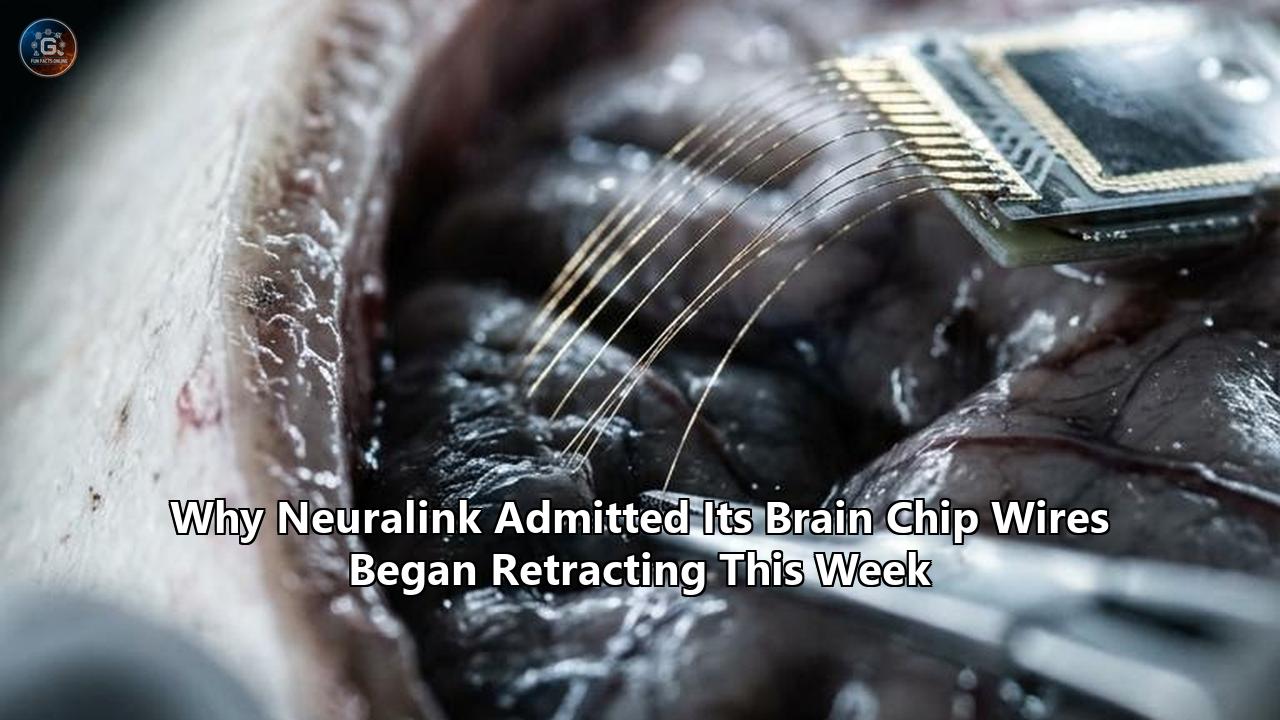
Eighty-five percent of the ultra-thin electrode threads implanted in the brain of Neuralink’s first human clinical trial participant detached within weeks of surgery, disabling approximately 870 of the device’s 1,024 recording channels.
The mechanical failure, which occurred inside the skull of 29-year-old quadriplegic participant Noland Arbaugh, led to a severe collapse in data transmission rates before being stabilized through emergency algorithmic modifications.
The company disclosed the malfunction in a brief update to its clinical trial blog following inquiries from The Wall Street Journal, confirming that the hair-thin polymer filaments inserted into Arbaugh’s primary motor cortex had physically retracted from the tissue. The event slashed the device's operational bandwidth, precipitating a steep decline in bits per second (BPS)—the baseline metric used to calculate the speed and accuracy of neural cursor control. Subsequent interviews with Arbaugh and internal engineering reports revealed that the physical migration of the wires left only about 15% of the array operational inside the parenchyma of the motor cortex.
                     NEURALINK N1 IMPLANT STATUS: PATIENT 1
┌──────────────────────────────┬───────────────────────────────┬────────────────────────────┐
│ Metric                       │ Nominal Design Target         │ Observed Post-Retraction   │
├──────────────────────────────┼───────────────────────────────┼────────────────────────────┤
│ Total Threads Implanted      │ 64                            │ 64                         │
│ Active Electrodes            │ 1,024 (16 per thread)         │ ~154 (~15% functional)     │
│ Inactive / Retracted Sites   │ 0                             │ ~870 (~85% detached)       │
│ Insertion Depth              │ 3.0 mm – 5.0 mm               │ Variable (<1.0 mm to 0 mm) │
│ Initial Peak BPS             │ 4.6 BPS (Initial Trial Record)│ <2.0 BPS (Trough)          │
│ Recalibrated Peak BPS        │ >8.0 BPS                      │ 8.0 BPS (Post-Patch)       │
│ Cortical Brain Motion        │ 1.0 mm – 1.5 mm (Projected)   │ Up to 4.5 mm (Observed 3x) │
└──────────────────────────────┴───────────────────────────────┴────────────────────────────┘
The disclosure has placed intense scrutiny on the mechanical viability of Neuralink’s flagship N1 implant, the physical dynamics of intracranial tissue displacement, and the regulatory oversight that cleared the human trials despite prior observations of thread migration in animal subjects.
The Mechanical Disconnect: 85 Percent Thread Dislodgement and Data Collapse
The N1 implant relies on 64 individual polyimide threads, each measuring between 4 and 6 micrometers in thickness—roughly one-tenth the diameter of a human hair. Distributed along each thread are 16 micro-scale recording sites, creating a 1,024-channel grid intended to capture action potentials from individual pyramidal neurons in the motor cortex. The threads were inserted using Neuralink’s custom R1 surgical robot, which utilizes a 25-micrometer tungsten-rhenium needle to place each filament at depths between 3 and 5 millimeters into cortical tissue.
Thread Cross-Section & Dimensions:
┌────────────────────────────────────────────────────────┐
│ Polyimide Film Substrate: 4 to 6 µm thick              │
│ Trace Metal: Micro-fabricated gold / platinum          │
│ Width: ~16 to 25 µm                                    │
│ Active Recording Sites per Thread: 16 geometric nodes   │
│ Total System Sites: 64 threads x 16 sites = 1,024 nodes│
└────────────────────────────────────────────────────────┘
Following the January 2024 surgery at Barrow Neurological Institute in Phoenix, Arizona, Arbaugh initially demonstrated rapid proficiency. In early research sessions, he established an initial human baseline for high-channel wireless brain-computer interfaces by achieving a continuous communication rate of 4.6 bits per second on a grid-selection task.
Within two weeks of the procedure, Arbaugh’s cursor response began exhibiting substantial latency, high error rates, and dropped targets. Data streaming metrics showed that multiple threads were no longer recording high-frequency action potentials. Thread by thread, the signals degraded into baseline biological and electrical noise.
Internal tracking confirmed that roughly 54 of the 64 threads had pulled out of the cortical layers, drifting into the fluid-filled subdural space. With approximately 870 electrodes severed from direct neuronal proximity, the functional capacity of the physical interface fell by 85%. Arbaugh’s effective bit rate dropped below 2.0 BPS, degrading device operation to levels comparable to legacy non-invasive interfaces.
The crisis prompted emergency meetings within Neuralink’s engineering divisions to debate surgical revision. Surgeons and biomedical engineers weighed a complete explantation of the N1 hardware against secondary revision surgery. Arbaugh expressed severe distress over the potential loss of autonomy, prompting the engineering team to forgo surgical intervention and attempt an algorithmic workaround.
Biomechanical Mechanics: Why Microwires Pulled Away from the Cortex
The failure exposed a fundamental mechanical discrepancy between the dynamic environment of the living human brain and the rigid anchoring of the N1 implant housing. While the coin-sized titanium enclosure of the N1 is fixed directly to the cranial bone via titanium screws, the brain itself floats suspended in cerebrospinal fluid (CSF) within the subarachnoid space.
                 ANATOMICAL ANCHORING MISMATCH

       [ Scalp Surface ]
       ─────────────────────────────────────────
       [ Cranial Bone ]   ===>  [ N1 Titanium Enclosure ] (Rigid Anchor)
       ─────────────────────────────────────────
       [ Dura Mater ]
       [ Subdural Space ] ===>  CSF Fluid Layer (Fluid Dynamics / Shear)
       ─────────────────────────────────────────
       [ Arachnoid / Pia ]
       [ Cerebral Cortex] ===>  Soft Parenchyma (Pulsatile, Non-rigid)
                                (Displacement: 1.0 mm to 4.5 mm)
The human brain exhibits three distinct modes of continuous physical motion:
- Cardiac Pulsatility: Driven by systolic blood pressure waves traversing the cerebral vasculature, displacing cortical tissue by 10 to 50 micrometers per cardiac cycle (occurring 60 to 100 times per minute, totaling roughly 100,000 cycles every 24 hours).
- Respiratory Hydrodynamics: Low-frequency CSF pressure fluctuations generated by respiration, causing bulk cranial-caudal displacements of 100 to 500 micrometers.
- Postural and Inertial Translation: Gravitational and dynamic head accelerations, shifting the brain within the cranial vault across distances of 1.0 to 3.0 millimeters depending on cranial geometry, intracranial pressure, and CSF volume.
Neuralink’s mechanical modeling had accounted for average intracranial displacements of roughly 1.0 to 1.5 millimeters. Arbaugh’s brain, however, displayed mechanical shifts measured at up to 4.5 millimeters—a threefold increase over the company's baseline simulations.
DISPLACEMENT ENVELOPE (Millimeters)
Projected Max Motion:  [===== 1.5 mm =====]
Observed Motion:       [=============== 4.5 mm ===============]
Thread Insertion Depth:[============= 3.0 to 5.0 mm =============]
Safety Margin Deficit: Cortical shifts consumed 90–100% of inserted thread length.
The mechanical tethering problem was further exacerbated by postoperative pneumocephalus. During the craniotomy and subsequent robotic thread insertion, subdural air was trapped between the inner surface of the cranium and the visceral brain tissue. As the intracranial air pocket was slowly absorbed into systemic circulation over a period of 14 to 21 days, the brain underwent a spatial re-expansion and mechanical settling process. This displacement generated shear vectors directly perpendicular to the trajectory of the inserted threads.
Because the flexible polyimide threads were inserted only 3.0 to 5.0 millimeters deep into the gyral crowns of the primary motor cortex, the collective displacement vector exceeded the frictional anchor force of the tissue. Lacking an integrated mechanical anchor (such as micro-barbs, serpentine strain reliefs, or sinus folds), the threads withdrew from the parenchyma under cumulative cyclic tension.
Once a thread slipped by more than 1.5 millimeters, its electrode contacts exited cortical layers II, III, and V—the primary cellular layers housing the large pyramidal cell bodies responsible for voluntary motor output. Suspended entirely in cerebrospinal fluid, the electrodes ceased to record actionable single-unit action potentials.
The phenomenon of the Neuralink chip retraction revealed that mechanical compliance alone is insufficient to stabilize high-density neural interfaces over time without factoring in long-range cranial-cortical translation.
Algorithmic Remediation: Reconstructing Performance from 15 Percent Remnants
Faced with the loss of 85% of physical signal inputs, Neuralink’s software and signal-processing teams executed an over-the-air firmware and algorithmic reconfiguration. The original decoding architecture relied on single-unit activity (SUA): isolating high-frequency action potentials (>300 Hz) generated by individual neurons located within 50 to 100 micrometers of each electrode site.
                       SIGNAL-PROCESSING SHIFT
┌──────────────────────────────┬──────────────────────────────┬──────────────────────────────┐
│ Parameter                    │ Single-Unit Decoding (Pre)   │ Population-Level / LFP (Post)│
├──────────────────────────────┼──────────────────────────────┼──────────────────────────────┤
│ Frequency Bandwidth          │ 300 Hz to 6,000 Hz           │ 1 Hz to 300 Hz (LFPs & MUAs) │
│ Spatial Sampling Radius      │ 50 to 100 micrometers        │ 200 to 1,000 micrometers     │
│ Signal Amplitude             │ 10 µV to 50 µV (Narrowband)  │ 100 µV to 500 µV (Broadband) │
│ Decoding Target              │ Single-neuron spikes         │ Aggregate population dynamics│
│ Sensitivity to Micromotion   │ Extreme (Sub-millimeter drop)│ Low (Resilient to drift)     │
└──────────────────────────────┴──────────────────────────────┴──────────────────────────────┘
When thread displacement carried the recording sites beyond the 100-micrometer threshold, single-unit spikes dropped into the thermal noise floor of the system (approximately 7.2 microvolts RMS). To recover functionality, Neuralink altered the input parameters of its custom application-specific integrated circuits (ASICs) and downstream decoders:
1. Shift from Single-Unit Activity to Local Field Potentials (LFPs)
The decoder switched from tracking isolated action potentials to analyzing multi-unit activity (MUA) and low-frequency local field potentials (1 to 300 Hz). Unlike single spikes, which attenuate rapidly over distance according to the inverse-square law, LFPs represent the synchronized dendritic and synaptic currents of thousands of adjacent neurons. These signals travel through volume conduction across distances up to 1 millimeter, enabling electrodes that had partially retracted toward the cortical surface to capture coordinated movement intentions.
2. Recalibration of the Kalman Filter and Velocity Decoders
The mathematical decoder, which translates raw channel firing rates into continuous 2D cartesian coordinates $(v_x, v_y)$, was recalibrated using an adaptive Wiener filter combined with an unscented Kalman filter (UKF). The algorithm automatically down-weighted channels exhibiting high variance and degraded signal-to-noise ratios, re-allocating decoding weight across the surviving ~154 active channels.
Kalman Decoding Weight Reallocation:
           [ Surviving Channels: ~154 ]  ──>  Increased Gain / Adaptive Bias
           [ Retracted Channels: ~870 ]  ──>  Dynamic Zero-Weight Mask
3. Click-Intent Thresholding via Spectral Power
Discrete selection ("clicking") had originally been paired to distinct single-unit firing bursts. Neuralink’s engineers retooled this mechanism to decode high-gamma band power (70 to 150 Hz) from the remaining channels, establishing a stable, binary threshold that Arbaugh could hit through motor imagery without inducing cursor jitter.
       BPS TRAJECTORY THROUGH RETRACTION AND RECOVERY
 10.0 ─────────────────────────────────────────── Able-Bodied Mouse User (~10.0)
      │
  8.0 ─ ─ ─ ─ ─ ─ ─ ─ ─ ─ ─ ─ ─ ─ ─ ─ ─ ─ ─ ─ ─── Peak Post-Patch (8.0 BPS)
      │                                       ▲
  6.0 ─ ─ ─ ─ ─ ─ ─ ─ ─ ─ ─ ─ ─ ─ ─ ─ ─ ─ ─ ─│─
      │       ▲                               │
  4.0 ────────│───────────────────────────────│──
      │   Initial Peak (4.6 BPS)              │
  2.0 ─ ─ ─ ─ ─ ─ ─ ─ ─ ─ ─ ─ ─ ─ ─ ─ ─ ─ ─ ─│─
      │                   ▼                   │
  0.0 └───────────────────┴───────────────────┴──
       Day 14          Day 30               Day 90
       [Implant]    [Retraction]       [Firmware Patch]
These mathematical adjustments halted the operational decline. Daily research logs indicated that Arbaugh’s throughput reversed its downward trend, climbing through 5.0 BPS, matching his previous record, and ultimately reaching a peak of 8.0 BPS. In sustained testing, Arbaugh managed an average daily operational load of 8 to 10 hours, using the interface to browse the internet, manage digital audio, and play turn-based strategy titles like Civilization VI and fast-paced competitive games like Mario Kart.
Despite the functional recovery, the reality of the Neuralink chip retraction lingered: an engineered computational patch had compensated for an unexpected structural failure.
Animal Testing Precedents and Regulatory Review
Following Neuralink’s public admission, investigative reports confirmed that thread retraction was not an unprecedented phenomenon within the company’s laboratories. Preclinical data gathered between 2019 and 2023 across pigs, sheep, and rhesus macaque subjects revealed continuous challenges with electrode migration, mechanical thread shearing, and post-surgical retraction.
Internal records cited by industry sources indicate that during early sheep and primate trials, necropsy evaluations repeatedly revealed that polyimide filaments had slipped out of cortex tissue or folded back into the subdural matrix, often surrounded by microvascular fibrotic tissue. In multiple test subjects, signals degraded past 60 days post-implantation, exhibiting the identical channel loss profile observed in Arbaugh.
                     PRECLINICAL VS. HUMAN ANATOMICAL SCALING
┌──────────────────────────────┬──────────────────────────────┬──────────────────────────────┐
│ Anatomical Parameter         │ Rhesus Macaque (Macaca mulatta)│ Human (Homo sapiens)         │
├──────────────────────────────┼──────────────────────────────┼──────────────────────────────┤
│ Brain Mass                   │ 80 – 100 grams               │ 1,300 – 1,450 grams          │
│ Cranial Cavity Volume        │ ~90 – 110 cm³                │ ~1,350 – 1,500 cm³           │
│ Cortical Thickness           │ 1.5 – 2.5 mm                 │ 2.5 – 4.5 mm                 │
│ Subarachnoid Space Depth     │ 0.5 – 1.0 mm                 │ 2.0 – 4.0 mm                 │
│ Total CSF Volume             │ 12 – 15 mL                   │ 140 – 160 mL                 │
│ Maximal Brain Translation    │ ~0.3 – 0.5 mm                │ Up to 4.5 mm                 │
└──────────────────────────────┴──────────────────────────────┴──────────────────────────────┘
The physical discrepancy stems from fundamental scaling laws in mammalian neuroanatomy. A human brain weighs approximately 1,400 grams—nearly 15 times the mass of a macaque brain—and floats within roughly 150 milliliters of CSF inside an expansive cranial vault. The mechanical momentum, inertial displacement, and hydrodynamic shear forces acting on human intracranial interfaces scale nonlinearly with brain mass.
In early 2022, the U.S. Food and Drug Administration initially rejected Neuralink’s Investigational Device Exemption (IDE) application, citing dozens of technical and biological concerns. Chief among the agency's inquiries were:
- The risk of thread migration and intracranial detachment.
- The potential for dislodged threads to generate microvascular lacerations or chronic neuroinflammatory responses.
- The thermal dissipation limits of the N1 processing chip and integrated battery (capping localized cortical heating at less than 1.0°C to prevent thermal tissue damage).
- Safe explantation protocols in the event of hardware failure without causing mechanical tearing of cerebral architecture.
Neuralink spent 15 months answering these safety inquiries, delivering additional non-human primate data to demonstrate that the polyimide threads would not shear blood vessels or migrate uncontrollably through the brain parenchyma. In May 2023, the FDA granted conditional IDE approval for the company's first-in-human trial, named the PRIME Study (Precise Robotically Implanted Brain-Computer Interface).
When the Neuralink chip retraction manifested in its very first human patient, the FDA was informed within days. The agency reviewed the mechanical failure and subsequent software remediation, electing not to halt the PRIME clinical program. Instead, regulators required Neuralink to implement verifiable surgical and hardware mitigations before clearing enrollment for its second human subject.
Surgical and Engineering Revisions for Subsequent Human Trials
To prevent recurrent thread detachment in future clinical participants, Neuralink initiated a wholesale revision of its neurosurgical protocol and implantation parameters ahead of its second human procedure, conducted in July 2024 at Barrow Neurological Institute on a participant identified as Alex.
                     PROCEDURAL DESIGN MODIFICATIONS
┌──────────────────────────────┬──────────────────────────────┬──────────────────────────────┐
│ Protocol Element             │ Patient 1 (Noland Arbaugh)   │ Patient 2 (Alex)             │
├──────────────────────────────┼──────────────────────────────┼──────────────────────────────┤
│ Target Insertion Depth       │ 3.0 mm – 5.0 mm              │ 8.0 mm (Deep Sulcal Targeting)│
│ Cranial Seating Architecture │ Standard Flush Mount         │ Contoured Cranioplasty       │
│ Sub-Implant Air Clearance    │ Standard Passive Venting     │ Active CSF Flush / Aspiration│
│ Insertion Speed per Thread   │ 17.0 seconds                 │ 1.5 seconds                  │
│ Insertion Trajectory         │ Straight Orthogonal Vector   │ Angled Gyral/Sulcal Anchoring│
│ Post-Surgical Thread Stability│ 85% Dislodged at 30 Days     │ 0% Retraction at 30 Days     │
└──────────────────────────────┴──────────────────────────────┴──────────────────────────────┘
The procedural modifications addressed the root physical causes identified during Arbaugh’s trial:
        INSERTION DEPTH AND ANCHORING GEOMETRY

        Patient 1: 3-5mm Insertion (Gyral Crown)
        [Cranium] ───┐
                     │
        [Parenchyma] └──> █ █ █ █ (Shallow, subject to shear slip)

        Patient 2: 8.0mm Insertion (Deep Sulcal Bed)
        [Cranium] ───┐
                     │
        [Parenchyma] │    █ █ █ █
                     │    █ █ █ █ (Deeper frictional surface area)
                     └──> █ █ █ █ (Crosses deeper cortical layers)
1. Increased Insertion Depth
The most consequential physical change was expanding the target insertion depth from the initial 3.0–5.0 millimeter range down to 8.0 millimeters. By routing the threads deeper into the sulcal folds and dense internal architecture of the motor strip, the surface area in direct contact with brain tissue expanded significantly. This increased depth provides a substantial frictional anchor that resists pull-out forces generated by surface-level brain translation.
2. Elimination of Cranial-Cortical Air Gaps
The surgical team redesigned the cranial seating method to minimize the gap between the internal face of the N1 enclosure and the visceral surface of the cortex. Surgeons implemented precision cranioplasty sculpting using robotic bone milling to match the inner contour of the cranial bone directly to the patient's dural profile. Intraoperative fluid management was overhauled to ensure complete elimination of subdural air via active sterile CSF flushes, directly neutralizing the mechanical destabilization caused by pneumocephalus.
3. Accelerated Robotic Insertion Cycles
The R1 robotic insertion platform received upgraded optical tracking software and mechanical actuators, reducing the insertion duration per thread from 17.0 seconds down to 1.5 seconds. This 11-fold acceleration shortened the overall window during which the brain was open to atmospheric pressure and ambient vibration, decreasing intraoperative edema and minimizing tissue trauma during thread seating.
These engineering changes proved effective in Patient 2. In August 2024, Neuralink reported that Alex experienced no thread retraction during his first 30 days post-operation. The full array of active channels remained securely anchored inside the motor cortex, enabling him to quickly master 3D computer-aided design (CAD) software and set new benchmarks for complex digital tasks.
The success confirmed that the original Neuralink chip retraction was an engineering and surgical variable that could be managed through adjusted insertion depths and tighter mechanical tolerancing.
Comparative Engineering Architectures: Neuralink vs. Competitors
The mechanical vulnerabilities observed in the PRIME Study highlight an ongoing debate in neuroengineering: the operational balance between channel density, tissue invasiveness, and chronic mechanical stability. Neuralink's approach represents an aggressive push for high channel counts, contrasting with alternative platforms that prioritize mechanical permanence.
                      CROSS-INDUSTRY BCI ARCHITECTURE COMPARISON
┌──────────────────────┬──────────────────────┬──────────────────────┬──────────────────────┬──────────────────────┐
│ Metric / Feature     │ Neuralink N1         │ Blackrock Utah Array │ Synchron Stentrode   │ Precision Layer 7    │
├──────────────────────┼──────────────────────┼──────────────────────┼──────────────────────┼──────────────────────┤
│ Channel Count        │ 1,024 channels       │ 96 to 128 channels   │ 16 channels          │ 1,024 channels       │
│ Physical Substrate   │ Polyimide threads    │ Rigid silicon spikes │ Nitinol self-expand  │ Thin-film polyimide  │
│ Target Site          │ Intracortical (8mm)  │ Intracortical (1.5mm)│ Endovascular (Sinus) │ Subdural Cortical    │
│ Surgical Method      │ Robotic Trephination │ Manual Craniotomy    │ Catheterization      │ Micro-Slit Cranial   │
│ Invasiveness Profile │ Highly Invasive      │ Highly Invasive      │ Minimally Invasive   │ Minimally Invasive   │
│ Dislodgement Risk    │ High (Retraction)    │ Low (Rigid Anchor)   │ Zero (Endothelial)   │ Low (Surface Mount)  │
│ Biological Response  │ Low/Moderate Gliosis │ Severe Encapsulation │ Endothelialization   │ Low Microgliosis     │
│ Peak Throughput      │ 8.0 BPS (Human)      │ ~3.5 to 5.0 BPS      │ 1.2 to 2.5 BPS       │ Scalable ECoG        │
└──────────────────────┴──────────────────────┴──────────────────────┴──────────────────────┴──────────────────────┘
Blackrock Neurotech: The Utah Array
Blackrock Neurotech’s Utah Array remains the historic gold standard of high-density intracortical research, carrying more than 20 years of clinical human track records. The Utah Array uses a 4x4 millimeter rigid silicon block featuring 96 to 128 sharp micro-needles (1.0 to 1.5 millimeters in length).
- The Mechanical Trade-off: The rigid silicon shanks cannot pull out or retract under normal physiologic motion because they are pneumatically driven into the cortex like a bed of nails.
- The Biological Trade-off: The significant mechanical impedance mismatch between rigid silicon (Young's modulus ~150 GPa) and soft cerebral parenchyma (Young's modulus ~1 to 3 kPa) causes relentless microscopic shearing during cardiac and respiratory cycles. Over 12 to 36 months, this shear stress triggers reactive astrogliosis and microglial encapsulation, building an insulating cellular scar around the tips that drives electrical impedance up and progressively extinguishes recording capability.
MECHANICAL COMPLIANCE (Young's Modulus)
Brain Tissue:       ~0.001 to 0.003 GPa (Soft, gelatinous)
Polyimide (Threads):~2.5 to 3.5 GPa     (Flexible, but 1,000x stiffer than brain)
Silicon (Utah Array):~130 to 180 GPa    (Extremely rigid, shear-inducing)
Synchron: The Endovascular Stentrode
Synchron bypasses cranial surgery entirely by deploying its 16-channel "Stentrode" through the jugular vein into the superior sagittal sinus—a large venous vessel running directly over the primary motor cortex.
- The Mechanical Advantage: The device is permanently stabilized by the natural vascular healing process: within 30 to 60 days, endothelial cells grow over the nitinol mesh, integrating the electrodes into the vessel wall. It cannot retract, displace, or induce tissue laceration.
- The Bandwidth Deficit: Because the electrodes record from inside a venous blood vessel, separated from cortical neurons by the vessel wall, dura, and CSF layer, the spatial resolution is low. The Stentrode records aggregate field potentials rather than single-unit spikes, limiting transmission speed to between 1.2 and 2.5 BPS.
Precision Neuroscience: Layer 7 Cortical Interface
Precision Neuroscience balances high channel count with low tissue disruption via its Layer 7 interface, a micro-thin polyimide array carrying 1,024 electrodes spaced across a flexible strip measuring only 400 microns thick.
- The Design Compromise: The device is inserted through an ultra-thin cranial slit (less than 400 micrometers wide) and slipped directly onto the cortical surface within the subdural space. It does not penetrate the cortex.
- The Performance Profile: Because it avoids parenchymal penetration, the Layer 7 interface is physically immune to thread retraction and bypasses intracortical glial scarring entirely. However, because it collects electrocorticography (ECoG) signals from the surface rather than single-neuron spikes from deep layers, it trades fine spatial resolution for mechanical and biological longevity.
Neuralink’s design gamble was that hair-thin, flexible polyimide wires could offer the single-unit resolution of a penetrating array without the destructive shear forces of the Utah Array. Arbaugh’s clinical trial demonstrated that while flexible threads minimize gliosis, their lack of structural anchoring makes them vulnerable to displacement under intracranial fluid dynamics.
The Data Economics and Bandwidth Equation of Human BCIs
The core technical achievement of the PRIME Study was not the initial insertion of the 1,024-channel array, but the mathematical extraction of 8.0 bits per second from roughly 154 surviving channels. This dynamic illustrates a non-linear relationship between raw electrode count and actionable information throughput in neural interfaces.
The mathematical relationship governing neural data transmission is anchored to the Shannon-Hartley theorem, which establishes the maximum theoretical capacity $C$ of an information channel:
$$C = B \log_2 \left(1 + \frac{S}{N}\right)$$
Where $B$ is channel bandwidth and $S/N$ is the signal-to-noise ratio. In an intracortical brain-computer interface, the total continuous system capacity $I_{BCI}$ does not scale linearly with the total number of physical electrodes $N$, but scales instead as a function of the correlated neural manifold:
$$I_{BCI} \approx \sum_{k=1}^{d} \log_2 (1 + \lambda_k \cdot \text{SNR}_k)$$
Where $d$ represents the true intrinsic dimensionality of the motor imagery space (typically $d \approx 10$ to $20$ latent neural modes for 2D cartesian kinematics), and $\lambda_k$ denotes the variance explained along the $k$-th principal eigenvector of the neural population matrix.
Channel Scaling vs. Actual Information Gain:
[ 1,024 Electrodes ] ─── Highly Redundant Sampling Space
         │
         ├──> [ Intrinsic Motor Manifold: 10 to 20 Dimensions ]
         │
[ ~154 Surviving ]  ─── Sufficient to Capture Primary Projection Vectors
Because adjacent motor cortex neurons fire in highly synchronized ensembles during movement planning, the 1,024 electrodes on the N1 array were over-sampling a low-dimensional manifold. Arbaugh’s motor intentions—intended velocity vectors along an X-Y plane—did not require 1,024 independent data channels. They required enough distinct projections into the motor cortex to capture the primary eigenvectors of that manifold.
When 85% of the threads pulled out of the cortex, the system lost substantial redundancy. Once Neuralink shifted its decoders from isolated single-unit spikes to broad-spectrum multi-unit activity and local field potentials, the surviving 154 channels captured sufficient low-frequency population dynamics to reconstruct the intended trajectory vectors.
                    INFORMATION THROUGHPUT EFFICIENCY
┌──────────────────────────────┬──────────────────────────────┬──────────────────────────────┐
│ Operational State            │ Bits Per Second (BPS)        │ Effective Bits/Channel/Sec   │
├──────────────────────────────┼──────────────────────────────┼──────────────────────────────┤
│ Initial Peak (Pre-Retraction)│ 4.6 BPS                      │ ~0.0045 BPS / channel        │
│ Trough (Post-Retraction)     │ ~1.5 BPS                     │ ~0.0097 BPS / channel        │
│ Recalibrated (Post-Patch)    │ 8.0 BPS                      │ ~0.0519 BPS / channel        │
│ Theoretical Target (Mouse)   │ ~10.0 BPS                    │ N/A (Manual Interface)       │
└──────────────────────────────┴──────────────────────────────┴──────────────────────────────┘
The recalibrated firmware improved channel efficiency by an order of magnitude: from 0.0045 bits per channel per second up to 0.0519 bits per channel per second. The decoder extracted more intentional information per surviving site than the original configuration achieved across the entire pristine array.
This dynamic reveals an important threshold in neural engineering. While low-dimensional control tasks (moving a computer cursor, executing a digital click, or moving a wheelchair) can be stabilized using a hundred surviving channels, complex high-degree-of-freedom tasks remain constrained by physical channel counts.
Restoring natural multi-finger grasping, high-speed conversational speech decoding (>90 words per minute), and closed-loop somatosensory feedback require high-resolution single-unit recording across thousands of distinct neuronal sites. For those advanced applications, thread retraction cannot simply be mitigated through algorithmic compensation. The physical hardware must remain anchored in place.
Clinical, Regulatory, and Ethical Roadmaps (2024–2030)
Neuralink's disclosure of the mechanical failure in its first trial participant resolved short-term operational questions while introducing long-term clinical and regulatory challenges. The company aims to move from clinical exploration toward commercial certification, navigating rigorous regulatory hurdles and device-longevity expectations.
                           CLINICAL MILESTONE PIPELINE
  2024                2025                2026                 2028                 2030
───┬───────────────────┬───────────────────┬────────────────────┬────────────────────┬───
   │                   │                   │                    │                    │
[P1: Arbaugh]    [Expansion: 10]     [Pivotal Phase]       [FDA PMA Review]      [Commercial]
Retraction &     8.0mm Insertion     Multicenter           Premarket Approval    Clinical Access
Firmware Patch   Deep Anchoring      Speech & Motor        Safety Endpoints      Indication: ALS
1. Long-Term Histopathology of Dislodged Polyimide Threads
The ultimate medical outcome of the retracted threads inside Arbaugh’s cranial cavity remains an open clinical question. While the company reported that the displaced filaments have not caused adverse neurological events, their chronic presence in the subarachnoid space carries continuous physiological risks.
The brain's natural pulsatile movement causes the free ends of the retracted polyimide threads to brush repeatedly against the visceral pia mater, arachnoid trabeculae, and bridging cortical veins. Over a 5- to 10-year period, this ongoing mechanical contact can generate localized foreign-body granulomas, dural thickening, or micro-vascular abrasions.
Because the retracted threads remain electrically and mechanically linked to the skull-mounted N1 enclosure, unexpected external impacts or significant shifts in CSF volume could translate mechanical tension across the surviving anchored threads, triggering secondary cortical micro-lesions.
CHRONIC SUBDURAL THREAD DISPLACEMENT RISKS
* Micro-vascular Shearing: Mechanical contact with bridging cortical veins.
* Meningeal Fibrosis: Connective tissue encapsulation along the subdural track.
* Progressive Signal Loss: Chronic micro-movements degrading the final 15% of channels.
* Explantation Complexity: Thread entanglement within the subarachnoid trabeculae.
2. The Explantation and Revision Protocol
A core focus for the FDA's long-term review is the feasibility of device explantation. If the remaining 154 electrodes inside Arbaugh's motor cortex fail over time, or if an infection requires device removal, extracting the N1 implant poses distinct surgical hazards.
While withdrawing a pristine, freshly implanted polyimide thread is surgically straightforward, extracting threads that have spent years within neural tissue is complex. Connective fibrotic tissue and astrocytic processes can anchor to the microscopic edges of the threads, meaning traction applied during revision surgery risks shearing delicate surface microvasculature.
Neuralink’s future regulatory submissions for Premarket Approval (PMA) must include validated, multi-year chronic explantation data from non-human primates and human subjects demonstrating that retracted or failed implants can be safely removed without inducing permanent motor or vascular deficits.
3. Patient Enrollment Trajectory and Scaling Metrics
Despite the mechanical failure in Patient 1, the regulatory approval of the deep-insertion mitigation protocol for Patient 2 unlocked the next phase of the PRIME study. Neuralink’s clinical expansion plan outlines a structured ramp:
- Phase I Clinical Trial (Current): Safety and functional feasibility across a cohort of 10 quadriplegic participants, assessing the stability of 8.0-millimeter insertions over a rolling 12-month window.
- Secondary Indication (Speech Prosthetics): Expanding clinical protocols to encompass speech-motor cortex mapping, targeting phoneme decoding rates surpassing 70 words per minute for individuals with severe dysarthria or advanced Amyotrophic Lateral Sclerosis (ALS).
- Next-Generation Hardware (N2 Architecture): Transitioning toward higher channel counts (2,048 to 4,096 channels) utilizing integrated micro-barb mechanical geometries or undulating strain-relief configurations designed to lock threads into place permanently without requiring manual deep-tissue plunging.
                      NEURALINK CLINICAL EVOLUTION
┌──────────────────────────────┬──────────────────────────────┬──────────────────────────────┐
│ Generation / Trial Phase     │ Physical Hardware Specs      │ Functional Clinical Goal     │
├──────────────────────────────┼──────────────────────────────┼──────────────────────────────┤
│ N1 (Prime Study: Patient 1)  │ 1,024 channels / 3-5mm depth │ Proof of Concept (Cursor)    │
│ N1 (Prime Study: Patient 2+) │ 1,024 channels / 8.0mm depth │ High-Speed Control (CAD/GUI) │
│ N2 Architecture (Targeted)   │ 2,048+ channels / Barbed/Wave│ Restoring Gross Motor/Speech │
│ High-Density Neuro-Spike     │ 4,096+ channels / Multi-Site │ Full Dexterous Autonomy      │
└──────────────────────────────┴──────────────────────────────┴──────────────────────────────┘
The clinical reality established by Neuralink’s first human trial has reset expectations across the neurotechnology industry. The public admission of thread retraction documented that flexible, high-density neural interfaces face significant mechanical challenges within the dynamic intracranial environment.
While algorithmic updates managed to restore operational control for Noland Arbaugh, maintaining long-term physical stability remains the central engineering challenge Neuralink must resolve to secure eventual regulatory clearance and commercial deployment.
Reference:
- https://www.popsci.com/health/neuralink-wire-detachment/
- https://www.unilad.com/technology/news/first-neuralink-patient-says-85-percent-implant-detached-635152-20240524
- https://neuralink.com/updates/prime-study-progress-update-user-experience/
- https://futurism.com/neoscope/first-neuralink-patient-trouble-implant
- https://www.popsci.com/health/neuralink-implant-detached/
- https://www.fiercebiotech.com/medtech/first-neuralink-patient-sees-some-implanted-electrodes-lose-connection-brain
- https://en.wikipedia.org/wiki/Noland_Arbaugh
- https://www.forbes.com/sites/naveenrao/2024/06/02/dont-lose-the-thread-neuralinks-problems-are-good-for-neurotech/
- https://subconsciousmind.ai/entities/neuralink-corporation/
- https://www.basenor.com/blogs/news/neuralinks-laser-milled-needles-the-precision-behind-brain-implants
- https://www.allaboutcircuits.com/news/behind-elon-musks-neuralink-company-developing-brain-machine-interfaces/
- https://www.reddit.com/r/Futurology/comments/1cyb27d/85_of_neuralink_implant_wires_are_already/
- https://www.popsci.com/health/neuralink-implant-detached/
- https://medium.com/@neuronic_img/a-deeper-look-at-neuralinks-n1-chip-f0763ea0a61e
- https://www.straitstimes.com/world/musks-neuralink-says-second-trial-implant-went-well-no-thread-retraction-issue
- https://kbssidhu.substack.com/p/neuralinks-second-participant-alex
- https://www.popsci.com/health/neuralink-wire-detachment/
- https://www.reddit.com/r/Futurology/comments/1eyvftr/neuralinks_second_paralyzed_patient_plays/
- https://www.pharmalive.com/musks-neuralink-says-second-trial-implant-went-well-no-thread-retraction-issue/
- https://www.reddit.com/r/RealTesla/comments/1cxtxtk/85_of_neuralink_implant_wires_are_already/
- https://www.popsci.com/technology/neuralink-next-volunteer/