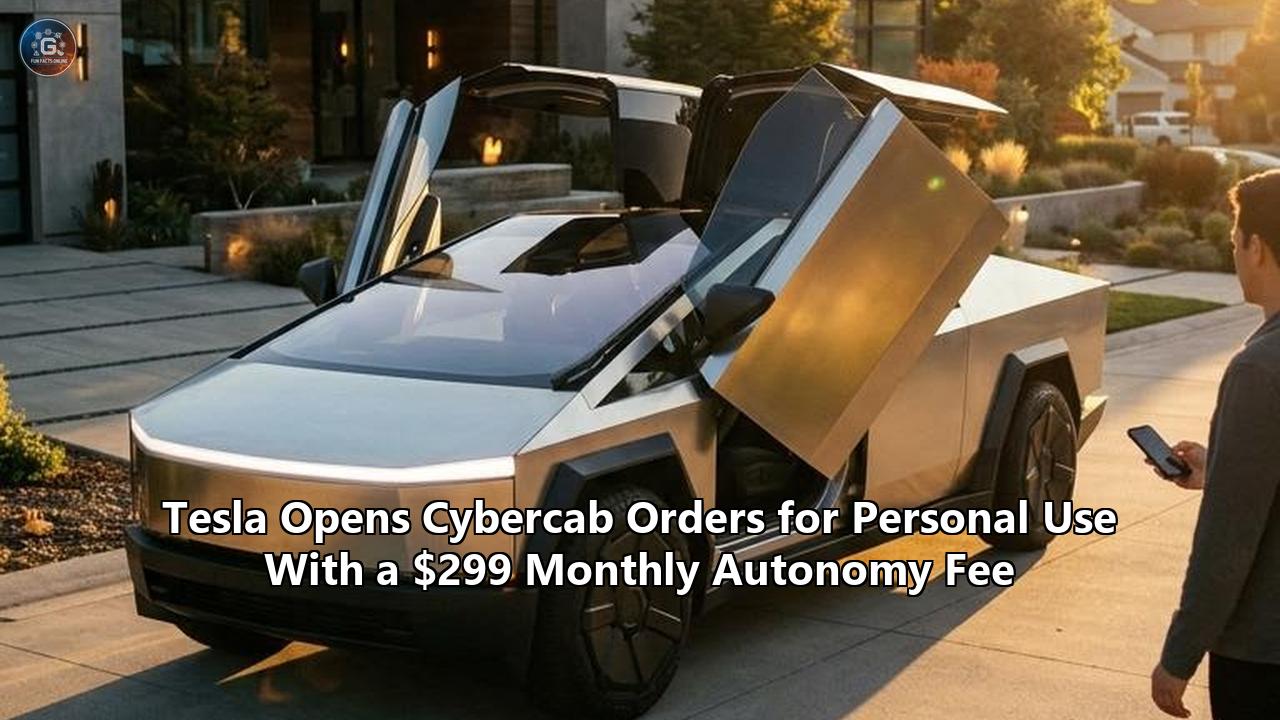
Tesla has officially opened the order book for its purpose-built autonomous vehicle to private buyers, taking its driverless ambitions from proprietary commercial fleets directly into consumer driveways. On November 13, 2026, the company began issuing purchase invitations through its official Robotaxi channels, inviting an initial cohort of customers to configure and purchase the two-seat Cybercab for personal use. The vehicle carries an entry price of $29,990 before taxes and incentives, fulfilling chief executive Elon Musk’s long-standing projection of a sub-$30,000 autonomous vehicle. However, the purchase terms introduce an unprecedented operational caveat: buyers must pay a mandatory $299 monthly "Autonomy Subscription" to use the car at all.
Because the vehicle is manufactured without a steering wheel, accelerator pedals, brake pedals, or side mirrors, it possesses zero manual controls. As stipulated in Tesla’s newly published subscription terms, if the $299 monthly payment lapses, the vehicle cannot be driven.
Initial deliveries are estimated to begin in Austin, Texas, as early as December 2026, backed by a $1,000 non-refundable order deposit. The rollout is strictly limited to customers residing within designated service areas—principally geofenced metropolitan zones across Texas and Florida where Tesla already operates its commercial Robotaxi service.
The decision to open private sales represents a critical fork in Tesla’s autonomous strategy. While competitors such as Alphabet’s Waymo and Amazon’s Zoox have maintained closed, company-owned commercial fleets, Tesla is attempting to commercialize consumer-owned autonomous hardware at scale. By unbundling the physical chassis from the operational intelligence that powers it, Tesla is introducing a consumer transport model that reshapes vehicle ownership, auto financing, liability, and the economics of personal mobility.
+-----------------------------------------------------------------------------------+
|                        TESLA CYBERCAB: THE CORE METRICS                          |
+-----------------------------------------------------+-----------------------------+
| Retail Purchase Price                               | $29,990 (before taxes/fees) |
| Order Deposit                                       | $1,000 (non-refundable)     |
| Mandatory Monthly Autonomy Fee                      | $299 / month                |
| Included Autonomous Operating Period                | 1st month included free     |
| Estimated Initial Deliveries                        | December 2026 (Austin, TX)  |
| Interior Architecture                               | 2 seats, no wheel, no pedals|
| Primary Display & Interface                         | 21-inch center touchscreen  |
| Usable Luggage Capacity                             | 20.1 cubic feet             |
| Initial Operational Footprint                       | Austin, Dallas, Houston,    |
|                                                     | San Antonio, Fort Worth,    |
|                                                     | Miami, Orlando, Tampa       |
+-----------------------------------------------------+-----------------------------+
Deconstructing the Cybercab Terms: Hardware vs. Software Dependency
When the company formally opened Tesla Cybercab orders to select invitation-holders, it uploaded Version 20261112 of its Autonomy Subscription Agreement, outlining the operational boundaries of a vehicle stripped of human driver inputs. The contractual language makes clear that traditional mechanical ownership has been decoupled from the right of movement.
The critical clause states plainly: "Your Cybercab will not operate without an active Autonomy Subscription". In legacy passenger cars, declining a connected service or navigation subscription simply disables infotainment features or automated highway assists, leaving the driver free to steer the car manually. With the Cybercab, terminating or pausing the subscription immobilizes the vehicle entirely.
Beyond the baseline operational fee, the agreement imposes severe constraints on how, where, and by whom the vehicle can be used:
- Geographic Confinement: The Cybercab is software-locked to operate strictly within Tesla-enabled Robotaxi territories. Currently, this encompasses eight cities: Austin, Dallas, Fort Worth, Houston, and San Antonio in Texas, alongside Miami, Orlando, and Tampa in Florida. Venturing outside these boundaries is technically prohibited; the vehicle’s operating system will decline navigation routing or bring the car to a safe stop at the perimeter.
- Commercial Use Blackout: The initial agreement explicitly bars owners from deploying their private Cybercabs on third-party commercial networks, such as Uber, Lyft, DoorDash, or independent courier services. The car is sold for personal transport only, preventing individual buyers from running micro-fleets outside of Tesla’s internal ecosystem.
- Unilateral Price Adjustments: Tesla reserves the legal right to revise the monthly autonomy fee with 30 days’ notice. Owners who buy the $29,990 physical chassis hold no price-lock guarantee on the software required to operate it over a five- or ten-year lifespan.
- Behavioral Auditing and Remote Suspension: The agreement introduces a "strikeout" mechanism. If Tesla’s onboard vision systems—powered by cabin-facing interior cameras—detect improper use, passenger interference with safety equipment, or repeated policy violations, the company can remotely suspend access to autonomous driving for seven days. During this punitive window, the vehicle sits dormant.
- Mandatory Inspection Protocols: Operation requires compliance with scheduled maintenance and remote diagnostic audits. If an owner fails to service critical vision components, tires, or inductive charging receivers at a certified Tesla facility, autonomy permissions can be revoked.
Addressing initial public pushback regarding the pricing structure, Elon Musk commented publicly on X that the $299 monthly fee is "too high" for long-term mass adoption, indicating that the target rate "should match the cost of Tesla [Full Self-Driving] and connectivity for other models, which is more like ~$115/month". Musk reiterated that availability will expand nationwide as state and federal regulators grant approval.
Tesla AI Head Ashok Elluswamy clarified the operational architecture, stating that customer-owned vehicles run "unsupervised inside all the same geo locations as Robotaxi, just serving the owners' needs". Despite these explanations, early adopters face an operational regime governed entirely by corporate servers and geofencing algorithms.
Total Cost of Ownership: Analyzing the $30,000 Headline Price
The marketing appeal of the Cybercab hinges on its $29,990 base price, making it nominally the least expensive new vehicle Tesla has ever listed. However, accounting for the required $299 monthly autonomy charge fundamentally alters the total cost of ownership (TCO) calculus.
+---------------------------------------------------------------------------------------------------+
|                        CUMULATIVE EXPENDITURE OVER TIME (AT $299/MONTH)                           |
+------------------+------------------+-----------------------+-------------------------------------+
| Ownership Period | Paid Subscription| Cumulative Sub. Cost  | Combined Vehicle + Subscription Outlay|
+------------------+------------------+-----------------------+-------------------------------------+
| 1 Year (12 mos)  | 11 months        | $3,289                | $33,279                             |
| 3 Years (36 mos) | 35 months        | $10,465               | $40,455                             |
| 5 Years (60 mos) | 59 months        | $17,641               | $47,631                             |
| 7 Years (84 mos) | 83 months        | $24,817               | $54,807                             |
| 10 Years (120 mos)| 119 months      | $35,581               | $65,571                             |
+------------------+------------------+-----------------------+-------------------------------------+
*Note: Figures exclude initial $1,000 deposit, sales taxes, registration, insurance, power costs, and financing interest.
At $299 per month, an owner incurs $3,588 in annual software expenses simply to maintain the car's basic drivability. Over a conventional 60-month ownership cycle, the autonomy subscription adds $17,641, driving the effective capital expenditure to $47,631 before taxes, delivery fees, or interest. By year ten, the cumulative software payments ($35,581) surpass the original purchase price of the physical hardware.
This dynamic shifts how personal transport assets are amortized. In a standard vehicle purchase, an owner eventually pays off their auto loan, eliminating monthly debt service and enjoying a period of low-cost transportation offset only by maintenance, insurance, and fuel. With the Cybercab, the $299 monthly baseline represents a permanent operational floor.
CUMULATIVE CAPITAL OUTLAY OVER 10 YEARS (Cybercab vs. Conventional $30k EV)

$70,000 |------------------------------------------------------------ Cybercab: $65,571
        |                                                            (Vehicle + Subs.)
$60,000 |                                                ------------
        |                                    ------------
$50,000 |                        ------------
        |            ------------
$40,000 |------------                                                Conventional EV: $30,000
        |============================================================ (Paid off at Year 5)
$30,000 |____________________________________________________________
        |
        +-------+-------+-------+-------+-------+-------+-------+-------+-------+-------+
       Yr 1    Yr 2    Yr 3    Yr 4    Yr 5    Yr 6    Yr 7    Yr 8    Yr 9   Yr 10
For urban commuters traveling fewer than 500 miles per month, paying $3,588 annually for autonomy equates to roughly $0.60 per mile in software fees alone—before accounting for electricity or vehicle depreciation. Conversely, high-utilization suburban commuters traveling 1,500 miles per month within supported zones face a software cost of roughly $0.20 per mile, making the subscription economically competitive against ridesharing services, which typically average $2.00 to $3.50 per mile in major metropolitan markets.
Stakeholder Impact: Who Wins, Who Loses, and What Changes
The opening of personal reservations cascades through multiple sectors of the automotive and technology economies, disrupting customers, legacy automakers, gig-economy networks, and public institutions.
+---------------------------------------------------------------------------------------------------+
|                                 STAKEHOLDER IMPACT MATRIX                                         |
+----------------------+--------------------------+-------------------------------------------------+
| Stakeholder Group    | Primary Disruption       | Net Operational Impact                          |
+----------------------+--------------------------+-------------------------------------------------+
| Early Adopters       | Geofenced mobility;      | Cheap entry price offset by perpetual recurring |
|                      | lack of property agency  | fees and risk of localized software stranding. |
+----------------------+--------------------------+-------------------------------------------------+
| Existing FSD Owners  | Software tier disparity; | Frustration over paid upfront FSD investments   |
|                      | residual value drop      | remaining supervised while Cybercab is hands-off|
+----------------------+--------------------------+-------------------------------------------------+
| Ride-Hailing Drivers | Displacement pressure;   | Long-term erosion of fares; near-term barrier   |
| (Uber / Lyft)        | commercial lockout       | due to Tesla blocking private fleet competition.|
+----------------------+--------------------------+-------------------------------------------------+
| Auto Insurers        | Shift to product liability| Complex liability allocation between passenger  |
|                      | and subrogation disputes | and manufacturer algorithms during crashes.     |
+----------------------+--------------------------+-------------------------------------------------+
| Municipal Regulators | Urban curb congestion;   | Pressure on zoning, curbside pickup spaces, and |
| (NHTSA / Cities)     | certification challenges | FMVSS rule compliance without manual controls.  |
+----------------------+--------------------------+-------------------------------------------------+
1. Early Adopters and Private Consumers
Early buyers gain access to private point-to-point autonomy, freeing up commuting time for work, entertainment, or rest. However, their transport utility remains tethered to a restrictive digital perimeter.
An owner living in central Austin can navigate to the airport or downtown hands-free, but cannot take their Cybercab on a weekend drive to Houston or Dallas without crossing non-supported transit corridors, where the car cannot operate. Furthermore, traditional modifications, independent repairs, and shade-tree diagnostics are obsolete; bypassing any part of Tesla’s sensor suite risks software disqualification and service termination.
2. The Legacy FSD Customer Base
The announcement has introduced immediate friction among Tesla’s existing base of premium electric vehicle owners. For nearly a decade, Tesla sold Full Self-Driving capabilities as an optional upfront purchase (ranging from $8,000 to $15,000) or as a $99-per-month supervised add-on, assuring buyers that their Model 3, Model Y, and Model S vehicles possessed the hardware necessary for unsupervised operation.
The Cybercab runs on the identical AI4 computer and vision architecture deployed across current production Model Y and Model 3 vehicles. Yet, consumer-owned Model Y vehicles operating on the same streets of Austin and Dallas remain legally classified as SAE Level 2 supervised systems, demanding active driver attention and steering-wheel touch inputs.
Owners who invested thousands of dollars under the expectation of driverless capability now find themselves asked to purchase an entirely separate, wheel-less two-seater and commit to an ongoing $299 monthly fee to access the unsupervised functionality they believed their existing vehicles would eventually achieve.
3. Ride-Hailing Platforms and Independent Gig Drivers
For platforms like Uber and Lyft, Tesla’s aggressive private-market strategy represents both an immediate relief and an existential long-term threat.
The immediate relief stems from the commercial use prohibition in the subscription terms. Tesla is preventing Cybercab buyers from flooding third-party rideshare networks with cheap autonomous capacity. Gig-economy drivers face no immediate wave of privately owned, driverless Cybercabs competing on Uber or Lyft.
The long-term threat lies in customer migration. If thousands of daily commuters in dense markets like Austin, Miami, or Dallas transition their routine point-to-point travel to personal Cybercabs or Tesla’s native Robotaxi service, aggregate rideshare demand within those city centers will contract. A private Cybercab, even with its $299 monthly fee, provides predictable, unshared transportation without the surge pricing or driver tipping associated with legacy ridesharing.
4. Federal Safety Regulators and State Agencies
The commercial deployment of consumer-owned vehicles devoid of mechanical controls brings acute regulatory scrutiny.
The National Highway Traffic Safety Administration (NHTSA) has ongoing audit queries evaluating Tesla’s self-certification protocols under the Federal Motor Vehicle Safety Standards (FMVSS). Traditional FMVSS requirements dictate physical controls:
- Part 571.101 establishes standards for steering mechanisms, foot pedals, and dashboard indicator lamps.
- Part 571.111 mandates exterior and interior rearview mirrors.
TRADITIONAL VS. CYBERCAB REGULATORY ARCHITECTURE

[Conventional FMVSS Part 571]                   [Tesla Cybercab Architecture]
  ├─ Manual Steering Wheel (Req.)   =======>       Vision-Only AI4 Compute
  ├─ Mechanical Brake Pedal (Req.)  =======>       Redundant Brake Actuators
  ├─ Accelerator Pedal (Req.)       =======>       Dual Electric Drive Units
  └─ Physical Rearview Mirrors      =======>       External Optical Cameras & Sensors
Manufacturers seeking to bypass these elements typically submit formal petitions for temporary exemption under 49 U.S.C. § 30113, which caps production at 2,500 exempt vehicles per year per manufacturer. Tesla’s strategy has instead relied on self-certifying that its vision architecture and electronic redundancies fulfill the fundamental safety intent of the regulations.
By putting these vehicles into private hands, rather than retaining them in a company-monitored fleet, Tesla increases its exposure to federal intervention. If a customer-owned Cybercab experiences a navigation failure or collision without a backup driver present, liability shifts away from personal negligence toward product defect and systemic algorithmic fault.
Structural Changes to the Automotive Industry
The opening of personal reservations accelerates structural shifts in how vehicles are designed, purchased, insured, and liquidated.
+---------------------------------------------------------------------------------------------------+
|                        STRUCTURAL TRANSITIONS: TRADITIONAL VS. CYBERCAB                           |
+--------------------------+---------------------------------+--------------------------------------+
| Feature Dimension        | Traditional Automotive Model    | Cybercab Operational Model           |
+--------------------------+---------------------------------+--------------------------------------+
| Asset Ownership          | Absolute title over hardware    | Physical hardware locked to a SaaS   |
|                          | and software execution rights.  | operating agreement.                 |
+--------------------------+---------------------------------+--------------------------------------+
| Primary Revenue Engine   | Upfront wholesale/retail margin | Low-margin hardware sale anchoring   |
|                          | supplemented by dealer parts.   | an annuity of $3,588/year.           |
+--------------------------+---------------------------------+--------------------------------------+
| Crash Liability          | Driver fault assessed via tort  | Manufacturer product liability and   |
|                          | and personal auto policies.     | integrated automated fleet coverage. |
+--------------------------+---------------------------------+--------------------------------------+
| Resale & Secondary Market| Market-driven price based on    | Asset liquidity contingent on buyer  |
|                          | mechanical age and mileage.     | software eligibility and terms.      |
+--------------------------+---------------------------------+--------------------------------------+
| Repair & Modification    | Third-party repair networks,    | Monopolized diagnostic repair; zero  |
|                          | aftermarket upgrades, DIY.      | unauthorized physical alteration.    |
+--------------------------+---------------------------------+--------------------------------------+
Automotive Hardware as a Subscription Engine
Historically, automotive manufacturers extracted the vast majority of their profit at the point of sale, capturing between 5% and 15% net margins on traditional internal combustion or electric drivetrains. Ongoing aftermarket revenues were largely conceded to third-party parts manufacturers, independent garages, and insurance companies.
The Cybercab inverts this structure. At $29,990, Tesla is pricing the vehicle near manufacturing cost, relying on its "unboxed" modular manufacturing platform at Gigafactory Texas to keep capital intensity low. The car serves as an acquisition vehicle for a recurring software annuity.
A customer who retains the car for seven years delivers $25,116 in gross software revenue. Because autonomous inference runs locally on the vehicle’s AI4 computer, Tesla’s marginal cost to maintain that subscriber consists primarily of fleet telematics, cellular connectivity, and remote mapping updates. This yields gross software margins estimated between 75% and 85%, fundamentally decoupling Tesla’s cash-generation profile from cyclical manufacturing volume.
ESTIMATED REVENUE COMPOSITION (PER VEHICLE OVER 7 YEARS)

Hardware Revenue (At Delivery):
████████████████████████████████████ $29,990 (54.4%)

Autonomy Subscription Annuity (84 Months):
████████████████████████████ $25,116 (45.6%)

Total Revenue Captured: $55,106
The Upheaval of Residual Value and Secondary Auto Markets
The standard metrics of vehicle depreciation—odometer mileage, cosmetic wear, engine health, and brake wear—become secondary when evaluating an autonomous vehicle. For the Cybercab, residual value is dictated by software support and regulatory compatibility.
If an owner attempts to sell their used Cybercab on the open market, the prospective buyer must qualify for and execute Tesla’s Autonomy Subscription Agreement to drive it away. If Tesla chooses to alter subscription terms for secondary owners, raise the baseline fee to $399, or refuse transferability in non-geofenced territories, the secondary value of the hardware could swing drastically.
Financing institutions face challenges in underwriting these loans:
- Traditional auto lenders secure loans against vehicles that hold salvage and auction value in any zip code.
- A vehicle that cannot operate outside of eight specific urban clusters and becomes inoperable without an optional $299 monthly software fee complicates repossession and collateral recovery.
- If a borrower defaults on their vehicle loan or cancels their autonomy subscription, the asset cannot simply be driven to a regional auction block without specialized towing logistics.
The Reengineering of Auto Insurance and Crash Liability
The disappearance of the steering wheel resolves a decades-old legal debate regarding autonomous collision liability. Under standard tort law governing Level 2 and Level 3 driver-assistance suites, drivers retain shared or primary responsibility for monitoring road conditions and intervening during system dropouts.
In the Cybercab, human intervention is physically impossible. There are no pedals to stomp and no wheel to yank. Consequently, any traffic collision, pedestrian incident, or erratic trajectory falls squarely under strict product liability.
To absorb this risk, personal automotive policies must be redesigned. Traditional insurers (such as State Farm, Geico, and Progressive) are poorly equipped to price risk when human driver demographics (age, credit score, driving record) have no bearing on vehicle operation. This accelerates the adoption of integrated manufacturer coverage, such as Tesla Insurance, where liability risk is bundled directly into the autonomy subscription cost and underwritten using real-time fleet telematics.
Short-Term Consequences (The Next 6 to 18 Months)
The initial phase of private deliveries presents immediate operational and logistical hurdles that will test Tesla's infrastructure.
TIMELINE OF KEY OPERATIONAL MILESTONES

November 2026 ──────> December 2026 ──────> Mid-2027 ─────────────> Late 2027
      │                     │                     │                      │
Orders Open           Austin Deliveries     Cybertruck Phase-Down   Geofence Expansions
(Select Invites)      Commence              at Giga Texas           (Regulatory Dependent)
Production Trade-Offs at Gigafactory Texas
To meet production targets for early Tesla Cybercab orders, the company has begun reallocating manufacturing footprints at its Austin, Texas facility. Tesla recently signaled plans to wind down Cybertruck manufacturing capacity by mid-2027, repurposing factory space, stamping presses, and personnel toward Cybercab production lines.
The transition from stainless-steel exoskeleton manufacturing to Cybercab’s unboxed assembly process represents a capital redeployment. Scaling Cybercab output from low-volume invitation units in late 2026 to tens of thousands of consumer allocations in 2027 requires proving out automated assembly techniques, including structural battery-pack integration and high-speed inductive charging coil installations.
Operational Friction in Initial Delivery Zones
Customers accepting deliveries in Austin, Texas, in December 2026 will face real-world edge cases:
- Charging Infrastructure: Because the Cybercab lacks a standard North American Charging Standard (NACS) charge port and relies entirely on automated inductive charging pads, private owners must install dedicated high-output wireless ground plates at their residences or depend on Tesla-operated automated charging hubs.
- Geofence Edge Cases: Owners residing near the boundary lines of municipal service zones will encounter operational dead-ends. Commercial parking garages, private gated communities, and unpaved rural roads not mapped by Tesla’s fleet will reject routing, forcing occupants to exit the vehicle or park outside their destinations.
- Severe Weather Disruptions: Relying strictly on passive optical cameras without lidar or radar exposes the system to visual degradation during torrential Texas rainstorms, fog, or blinding solar glare. In conditions where visibility drops below operational thresholds, vehicles will pull to the curb and remain stopped, leaving passengers stranded without manual fallback controls.
Federal Regulatory Counter-Measures
The National Highway Traffic Safety Administration is likely to step up its oversight before private deliveries scale beyond the initial test group. While states like Texas and Florida maintain permissive regulatory environments for automated driving testing, federal motor vehicle safety rules remain a federal purview.
If early customer operations reveal systematic disengagements, sensor blind spots, or unresolved safety anomalies, the agency has the authority to issue formal recall orders or mandate software revisions. Any formal determination that Tesla’s lack of physical controls violates current FMVSS requirements without an approved exemption could pause deliveries or limit operation to commercial pilot permits.
Long-Term Repercussions: Redefining Mobility Through 2032
Looking toward the end of the decade, the expansion of personal autonomous vehicle ownership will trigger broader systemic shifts across the automotive sector.
THE CYBERCAB SYSTEMIC SHIFT

    Lower Vehicle MSRP ($29,990)
                 │
                 ▼
    Permanent Operating SaaS Fee ($299/mo)
                 │
                 ▼
    Decoupled Asset Liquidity & Monopolized Service
                 │
                 ▼
    Erosion of Dealerships, Third-Party Repair, and Driver Liability
The Inevitable Competitive Counter-Offensive
The commercialization of consumer-owned autonomous vehicles challenges both legacy automotive OEMs and dedicated robotaxi developers to adjust their strategies.
- Commercial Robotaxi Operators (Waymo, Zoox): Alphabet’s Waymo has prioritized operational safety and hardware redundancy by deploying expensive multi-sensor arrays (combining lidar, radar, and cameras) on commercial fleet vehicles. Waymo’s commercial model charges riders per mile or trip. If Tesla proves that consumer-owned vision systems can maintain safety parity at a fraction of the cost, Waymo may be forced to license its autonomous driver suite to third-party automakers (such as Hyundai or Geely’s Zeekr) for direct consumer retail.
- Traditional Automakers (General Motors, Ford, Mercedes-Benz): Legacy manufacturers have concentrated on Level 3 hands-off, eyes-off highway driving systems (such as Mercedes-Benz Drive Pilot), which operate only at limited speeds on pre-mapped interstates and demand that a licensed driver remain ready to take over. The arrival of a fully wheel-less, pedal-less consumer car for under $30,000 exposes the limitations of incremental Level 3 updates. Automakers lacking high-performance computing clusters and massive real-world fleet data may be forced to form software consortiums or purchase turnkey self-driving platforms from outside technology suppliers to stay competitive.
- Chinese Electric Vehicle Manufacturers (Baidu Apollo, BYD, XPeng): In China, autonomous urban driving is advancing rapidly through hybrid vision-and-lidar platforms. Companies like Baidu, with its Apollo Go platform, are already scaling low-cost autonomous cabs. If Tesla secures regulatory approval to scale the Cybercab globally, Chinese manufacturers will accelerate domestic deployment of steering-wheel-free consumer models, driving down hardware costs through high-volume supply chains across Asia and Europe.
Urban Congestion and Infrastructure Strains
The availability of a $30,000 personal autonomous car alters metropolitan transportation patterns.
Historically, car ownership in dense urban cores has been constrained by parking costs, parking availability, and driving stress. A self-parking, driverless personal vehicle eliminates these deterrents. Instead of paying expensive garage rates in commercial downtown districts, an owner can instruct their Cybercab to drive itself home or circle city streets while they attend meetings, compounding municipal traffic density.
PROJECTED COMMUTER BEHAVIORAL CHANGES
Traditional Commute:
  Home ──[Manual Driving]──> Work ──[Paid Parking Garage ($30/day)]──> Drive Home

Cybercab Commute:
  Home ──[Autonomous Transit]──> Work ──[Empty Vehicle Dispatched Home/Circling]──> Return Pickup
  (Net Result: Doubled Vehicle Miles Traveled [VMT] per commuter)
This phenomenon—the proliferation of "zero-occupancy vehicle miles traveled" (VMT)—risks overwhelming urban corridors. City planners and transit authorities in Texas and Florida may be compelled to implement:
- Dynamic congestion pricing models that tax empty autonomous vehicles traveling through core commercial corridors.
- Curbside access fees for driverless passenger pick-ups and drop-offs.
- Revised municipal parking taxes targeting automated staging lots on city outskirts.
The Pricing Trajectory of the Autonomy Subscription
The long-term viability of the Cybercab business model rests on the stability of its software pricing. Elon Musk’s public suggestion that the current $299 rate is "too high" and should gravitate toward $115 per month reflects the tension between corporate margin goals and mass-market affordability.
If Tesla successfully scales fleet size, improves manufacturing yields, and automates remote fleet-management operations, reducing the subscription toward $115 per month would drop annual software overhead from $3,588 to $1,380. Over a five-year ownership term, that adjustment would trim the cumulative software outlay from $17,641 down to approximately $6,785, bringing the total cost of ownership in line with standard consumer budget expectations.
However, if edge-case teleoperation demands, regulatory compliance reporting, and sensor cleaning prove costlier than anticipated, Tesla may instead maintain or raise the $299 fee. Because Cybercab owners possess no mechanical backup to drive themselves, they lack consumer leverage; they must pay the prevailing rate or leave their vehicle parked.
Critical Milestones to Track
As the initial allocation of Tesla Cybercab orders transitions toward customer handoffs, the path forward hinges on several verifiable developments:
- Austin Customer Deliveries (December 2026): Confirmation of the first private handoffs will validate whether Tesla can meet its end-of-year delivery timeline, revealing consumer reactions to daily geofenced operation.
- NHTSA Audit Findings: The federal safety regulator's determination regarding Tesla's self-certification of vehicles built without manual controls will set the legal ceiling for nationwide deployment.
- Home Charging Deployment: The practical rollout of residential inductive charging pads will demonstrate how smoothly owners can integrate wireless charging into standard home garages.
- Geofence Expansions Beyond Texas and Florida: Software updates mapping new transit zones—and regulatory approvals in restrictive markets like California, New York, and Nevada—will determine if the Cybercab remains a regional micro-commuter or becomes a viable national transport platform.
- Software Pricing Revisions: Any movement by Tesla toward the $115 monthly fee mentioned by leadership will signal whether the company prioritizes maximizing near-term software margins or capturing mass-market volume.
Reference:
- https://zecar.com/reviews/tesla-opens-cybercab-orders-us29990-299-month
- https://www.engadget.com/2316848/tesla-starts-taking-cybercab-orders-for-personal-use/
- https://electrek.co/2026/11/13/tesla-cybercab-personal-use-orders-299-subscription-geofence/
- https://paultan.org/2026/11/14/tesla-cybercab-personal-use-orders/
- https://electrek.co/2026/11/14/tesla-cybercab-autonomy-subscription-agreement-terms/
- https://teslanorth.com/2026/11/13/tesla-cybercab-personal-purchase-invitations/
- https://www.reddit.com/r/electricvehicles/comments/1xvo9zk/tesla_invites_select_customers_to_buy_cybercab/
- https://www.notateslaapp.com/news/5012/tesla-opens-orders-for-the-cybercab-for-personal-use-costs-29990-and-requires-a-299-monthly-subscription
- https://www.notebookcheck.net/Tesla-opens-29-990-Cybercab-orders-but-owners-face-299-monthly-fee-to-drive.1450535.0.html
- https://techcrunch.com/2026/11/14/tesla-opens-cybercab-pre-orders-for-personal-use-with-geo-restrictions-and-a-299-monthly-fee/
- https://www.foxbusiness.com/technology/tesla-makes-major-cybercab-announcement-driverless-vehicle-goes-sale
- https://kingy.ai/blog/tesla-cybercab-price-subscription-ownership/
- https://www.reddit.com/r/cars/comments/1xvpf62/tesla_opens_cybercab_orders_to_select_customers/