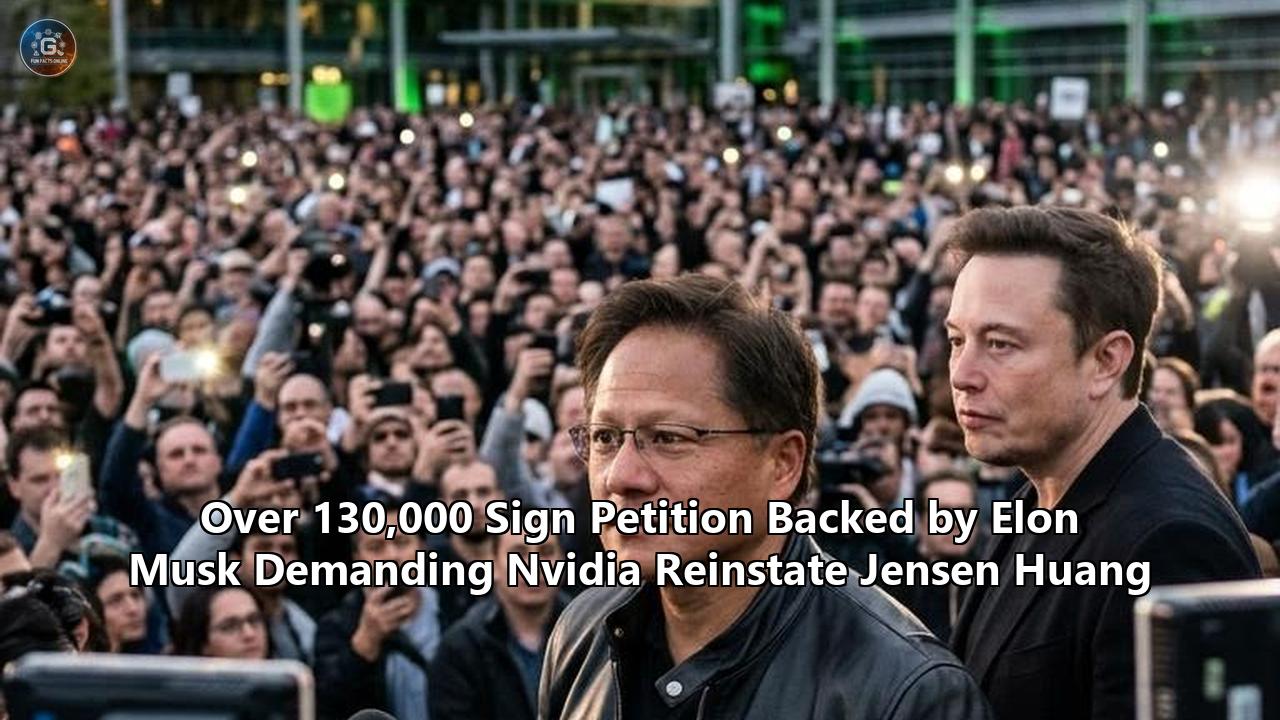
An open rebellion across Silicon Valley and global capital markets accelerated rapidly on Sunday, November 15, 2026, as an online open letter demanding that Nvidia Corp.’s board of directors reinstate ousted co-founder Jensen Huang surged past 136,000 signatures.
The campaign, mobilized under the banner "Stand with Jensen," transformed from a localized engineering revolt into a high-stakes corporate showdown after Tesla Inc. Chief Executive Elon Musk threw his weight behind the effort late Friday. "A petition is underway to reinstate Jensen and I’m signing it too," Musk announced to his 240 million followers on X, triggering an avalanche of support from prominent venture capitalists, rival executives, and institutional investors.
The escalation hits at the most vulnerable moment in Nvidia's history. Huang’s abrupt resignation on Thursday, November 12—which ended a 33-year tenure after disclosures of multiple extramarital relationships, including one with a foreign executive suspected by U.S. intelligence of maintaining ties to Chinese state security—erased more than $180 billion from the chipmaker’s valuation in a single trading session. With Nvidia scheduled to deliver its third-quarter fiscal 2027 earnings report on Tuesday, November 17, the board of directors faces an intensifying standoff: an entrenched executive committee trying to stabilize relations with Washington, pitted against a vocal coalition of shareholders and engineers demanding their founder back.
The Three Demands: Anatomy of an Unprecedented Revolt
The grassroots manifesto at standwithjensen.com, built and hosted on software platform Replit, presents an explicit ultimatum to Nvidia’s board. Rather than disputing the underlying personal controversies, the letter attacks the board's decision-making process, arguing that the directors panicked and severed ties with the architect of the artificial intelligence boom without basic due process.
The open letter outlines three mandatory demands:
- Immediate Reinstatement Pending Findings: Reappoint Huang as chief executive while the independent investigation establishes verified facts, or provide a specific, evidence-based public explanation of why his continued absence serves the company’s best interests.
- Procedural Due Process: Disclose the formal scope, independence, and operational timeline of the inquiry being conducted by outside counsel, granting Huang a formal hearing and opportunity to respond before any final leadership determinations are codified.
- Public Evidentiary Disclosure: Release a comprehensive account of what evidence the board weighed, balancing legitimate corporate confidentiality against shareholders' right to know why three decades of leadership were erased in less than a week.
By Sunday morning, the campaign’s public ledger classified 6,776 signers as current Nvidia personnel, 1,267 as former employees, and 73,181 as verified or self-reported retail and institutional shareholders. The organizers announced they deployed automated artificial intelligence filters to purge malicious entries, joke names, and spam signatures to present a scrubbed roster directly to the board's corporate secretary.
The explosive growth of the Jensen Huang Nvidia petition highlights an intense ideological clash in corporate governance: can public pressure and founder equity force a blue-chip board to undo an ouster driven by federal national security concerns?
THE CRISIS TIMELINE: FROM INTEL WHISPERS TO BOARDROOM SHOWDOWN

June 2024           October 2025        Nov 8, 2026         Nov 10, 2026        Nov 12, 2026         Nov 13-15, 2026
Taipei Sightings    White House Intel   Staff Memo          Outside Counsel     Forced Exit          Tech Elite Backs
Huang & Alice Huang Briefing on         Huang confesses     Wachtell Lipton     Board accepts Huang  Musk signs petition;
at Computex;        Megaspeed; U.S.     marital infidelity; retained; shares    resignation; Kress   investors press board;
chips scrutinized   probes backdoor     internal inquiry    drop 7% at open     named interim CEO;   signers top 136,000
                    GPU diversions      announced                               shares tumble 14%    before earnings
Phase I: The Seeds of Suspicion (June 2024 – October 2026)
To understand how the crisis reached this breaking point, the trajectory must be traced back more than two years, when U.S. export controls on advanced semiconductors began colliding with overseas distribution networks.
In June 2024, Huang appeared at the Computex trade conference in Taipei. Photographed in his trademark black leather jacket at executive gatherings and private dinners, he was accompanied at multiple events by Alice Huang (known in Chinese records as Huang Le), then the managing director of Megaspeed International, a Singapore-based data center infrastructure provider. Megaspeed had been spun out in March 2023 from Chinese gaming firm 7Road Holdings Ltd. Megaspeed soon emerged as one of the fastest-growing buyers of Nvidia computing clusters across Southeast Asia, acquiring hundreds of shipments of high-density graphics processing units.
By autumn 2024, the U.S. Department of Commerce and federal intelligence agencies initiated electronic surveillance on Megaspeed's logistical pipeline. Investigators suspected the firm operated as a secondary conduit, leasing computing capacity directly to Chinese internet conglomerates like Alibaba—a structure designed to navigate export restrictions that prohibited direct sales of frontier accelerators to mainland entities.
Throughout 2025, according to internal communications reviewed by federal investigators, questions about the relationship reached Nvidia’s legal and executive suite. General Counsel Tim Teter and senior marketing officers queried Huang regarding the nature of his interactions with Alice Huang. The chief executive reportedly dismissed concerns, characterizing their meetings as standard commercial interactions with an important regional customer.
The turning point arrived in late October 2025, when intelligence briefings prepared for senior White House officials detailed electronic intercepts linking Alice Huang to Chinese state security apparatuses tasked with gathering technical insights on American advanced compute architectures. Singapore authorities later scrutinized her role; although local police concluded in early 2026 that there was insufficient evidence to charge her with corporate misrepresentation, they determined she had provided inaccurate testimony to downplay her operational authority and barred her from re-entering the country. For months, the intelligence remained classified inside specialized national security channels, while Nvidia's stock surged toward record valuations.
Phase II: The Sunday Confession and the Freefall (November 8 – 10, 2026)
The crisis erupted into the public domain on Sunday, November 8, 2026. Facing an imminent investigative report detailing federal scrutiny into his relationship with Alice Huang, Jensen Huang sent a preemptive memo to Nvidia’s global workforce. In the communication, he made a personal apology, acknowledging he had engaged in an extramarital affair that violated his personal principles and caused pain to his family. He insisted, however, that no proprietary technical roadmaps or classified trade secrets had ever been disclosed.
The board responded hours later, confirming it had initiated an internal inquiry into whether the chief executive had been targeted by a foreign intelligence operation. Seeking to project calm, independent directors noted in an initial statement that they had "no reason to believe that either national security or NVIDIA secrets were compromised".
Financial markets rejected the reassurance. When trading opened on Monday, November 9, Nvidia shares fell more than 7% in pre-market action, wiping out over $7 billion of Huang's personal equity and dragging down the wider semiconductor sector.
By Tuesday, November 10, the board's independent directors recognized the vulnerability of relying on internal compliance teams. They formally retained Joon H. Kim, the former acting U.S. Attorney for the Southern District of New York, alongside prominent corporate law firm Wachtell, Lipton, Rosen & Katz, to launch an exhaustive, independent investigation. Huang’s position was rapidly eroding, but inside company headquarters, senior engineering staff still operated under the assumption that the founder would weather the controversy with a reprimand and governance guardrails.
Phase III: The Forty-Eight-Hour Collapse (November 11 – 12, 2026)
Any prospect of a controlled crisis containment shattered on Wednesday, November 11.
The New York Times published an investigation revealing that Huang’s relationship with the Megaspeed executive was not an isolated incident, reporting that he had engaged in an intimate relationship with a subordinate: Nvidia’s Vice President of Healthcare, Kimberly Powell. When approached by reporters, Huang declined to address the specifics, stating: "I don't think you should be talking to me directly". Simultaneously, Capitol Hill intervened: the Republican leaders of three influential House committees formally requested that Huang appear for a closed-door transcribed interview regarding export control compliance and national security vulnerabilities.
The terminal blow landed on Thursday morning, November 12. In a regulatory filing and press statement issued before market open, Nvidia dropped a seismic announcement: Jensen Huang had resigned as President, Chief Executive Officer, and member of the Board, effective immediately.
The board moved swiftly to fill the vacuum:
- Interim Leadership: Longtime Executive Vice President and Chief Financial Officer Colette Kress was installed as interim CEO while retaining her finance portfolio.
- Board Restructuring: The company established the position of Chair of the Board for the first time in its corporate history, appointing independent director Harvey C. Jones, a board member since 1993 and former chief executive of Synopsys.
- Executive Search: The board launched an immediate search for a permanent successor, stating it would evaluate both internal division leaders and external candidates.
NVIDIA LEADERSHIP RESTRUCTURING (NOV 12, 2026)
┌─────────────────────────────────┐      ┌─────────────────────────────────┐
│        PRE-CRISIS MODEL         │      │       INTERIM CRISIS MODEL      │
├─────────────────────────────────┤      ├─────────────────────────────────┤
│ Jensen Huang                    │      │ Harvey C. Jones                 │
│ • President & CEO               │      │ • First-Ever Board Chair        │
│ • Key Director (33-yr Tenure)   │  ──► │ Colette Kress                   │
│ • Undivided Authority           │      │ • Interim CEO & CFO             │
│ • Single Public Face of Firm    │      │ Joon H. Kim (Wachtell Lipton)   │
│                                 │      │ • External Lead Investigator    │
└─────────────────────────────────┘      └─────────────────────────────────┘
Hours after the resignation was posted, Reuters reported that investigators had identified a third relationship involving another corporate employee. Intraday trading saw Nvidia shares plunge as much as 14%, erasing $180 billion in equity before closing down 4.3% at $166.19. For Wall Street, the unthinkable had materialized: the indispensable man of the computing revolution was gone overnight.
"There is no way to sugarcoat it. It’s a gut punch to the industry that had so much confidence in and praise for him," Yorkville Ives tech analyst Dan Ives said in an analysis for CBS News. "The biggest fear of any competitors, as well as China, is Jensen. You take him out, and it levels the playing field for domestic chipmakers and other players globally".
The Mobilization: How the Jensen Huang Nvidia Petition Gained Velocity
Inside Nvidia’s Santa Clara headquarters, shock quickly curdled into defiance. On Thursday afternoon, an internal feedback portal designed for engineering queries registered over 1,600 comments within hours, with a lopsided majority demanding the board explain why a co-founder who built a multi-trillion-dollar business was dispatched without a shareholder referendum.
By Thursday night, the defiance escaped corporate firewalls. An anonymous collective of current and former engineers launched standwithjensen.com. Within its first six hours, the site collected 20,000 signatures. Traffic climbed so fast that the application crashed its database limits. Replit Chief Executive Amjad Masad intervened personally early Friday morning, working directly with the site’s creators to lift rate ceilings and protect server stability as thousands of visitors tried to sign simultaneously.
The turning point that transformed a tech-sector petition into a global news event arrived at 12:51 p.m. Pacific Time on Friday, November 13. Replying to an X thread discussing Huang’s legacy, Elon Musk posted his endorsement, declaring that he had added his name. The endorsement racked up over 9 million views in 24 hours.
Musk's post broke the dam. Within minutes, Silicon Valley leaders began attaching their names:
- Garry Tan, CEO of Y Combinator, signed and posted on X: "Jensen deserves due process, not whatever is happening right now. I signed. #standwithjensen".
- Tim Sweeney, CEO of Epic Games, added his name, warning that decapitating tech founders without institutional resistance creates dangerous precedents.
- Aidan Gomez, co-founder of Cohere, joined the campaign alongside founders from across the AI ecosystem.
- Blake Scholl, CEO of Boom Supersonic, confirmed his participation, pointing to Huang’s long-term capital commitments across the frontier compute space.
The backing of prominent figures turned the grassroots Jensen Huang Nvidia petition into a rallying cry across global capital markets. By Saturday afternoon, November 14, the tally blew past 100,000. By Sunday morning, November 15, the signature counter breached 136,200.
PETITION ESCALATION VELOCITY (SIGNATURE COUNT)
140k ──────────────────────────────────────────────────────────── 136,200+ (Sun Morning)
120k ────────────────────────────────────────────────── 115,000 (Sat Afternoon)
100k ──────────────────────────────────────── 100,000 (Sat Morning)
 80k ────────────────────────────── 77,900 (Fri Night)
 60k ──────────────────── Musk Endorsement (Fri 12:51 PM PT)
 40k ─────────── 41,900 (Fri Morning)
 20k ─── Site Launch (Thu Night)
      Thu Nov 12       Fri Nov 13       Sat Nov 14       Sun Nov 15
Wall Street Steps In: The $2.1 Billion Institutional Counterweight
While online signatories rallied behind due process, deep-pocketed institutional managers initiated formal legal maneuvers.
Late Friday, Brad Gerstner, CEO of Altimeter Capital Management, and Gavin Baker, Managing Partner and Chief Investment Officer at Atreides Management, took the unusual step of publishing a joint shareholder letter addressed directly to Nvidia's board of directors. As of June filings, the two investment firms collectively managed roughly 10.6 million Nvidia shares, representing a capital stake exceeding $2.1 billion.
Their letter took a calculated approach, avoiding an aggressive demand for immediate reinstatement while warning the board against prematurely selecting a permanent successor:
"In light of Jensen Huang's extraordinary achievements in leading the company for a long time, as well as the significant uncertainty surrounding his potential departure, we believe that the board should adopt a slow, cautious, and thoughtful selection process for NVIDIA's future leadership candidates, keeping all options open (including the possibility of Jensen Huang returning to his position), which is in the best interest of all stakeholders, especially NVIDIA shareholders... Currently, there are far more questions than answers regarding recent events. We believe the board should avoid hastily searching for a successor to Jensen Huang, as such an approach would undermine and deviate from the best interests of shareholders".
Baker described the public filing as "a first" in Atreides Management's operational history. The message to Harvey Jones and the independent directors was unmistakable: institutional asset managers will not tolerate an irreversible succession process while federal facts remain unverified.
The market’s sensitivity to any succession move was laid bare on Friday. Following reports by the Financial Times suggesting Nvidia’s search committee had informally reached out to Arm Holdings CEO Rene Haas as a potential replacement, Arm shares dropped nearly 10% on Wall Street. The volatility forced Nvidia to issue an official denial: "We have not formally engaged with any potential candidates. Any speculation regarding individual candidates, whether internal or external, is premature".
The OpenAI Comparison: Parallels and Critical Pitfalls
The public mobilization around Huang has prompted widespread comparisons across Silicon Valley to the boardroom ouster of Sam Altman at OpenAI in November 2023.
During that episode, OpenAI’s non-profit board dismissed Altman on a Friday afternoon. By Monday morning, over 700 of the startup’s 770 employees signed an open ultimatum threatening to resign and migrate to Microsoft unless the directors resigned and reinstated the chief executive. Within five days, Altman returned victorious, the board was dissolved, and founder dominance was permanently reasserted.
Inside Nvidia, some engineers have explicitly cited the OpenAI precedent. Wei Pang, a research scientist at the chipmaker, posted internally that employees "can also find ways to express our support," drawing a straight line to the 2023 uprising. Over the weekend, mock letters mimicking the OpenAI protest even began circulating on X, falsely claiming that Vice President Ian Buck and Chief Scientist Bill Dally were preparing to lead mass resignations to Elon Musk’s xAI or SpaceX—a fabrication that Nvidia researchers were forced to publicly debunk.
LEADERSHIP CRISIS COMPARISON: OPENAI (2023) VS. NVIDIA (2026)
┌───────────────────────────┬───────────────────────────┬───────────────────────────┐
│ DIMENSION                 │ OPENAI (NOV 2023)         │ NVIDIA (NOV 2026)         │
├───────────────────────────┼───────────────────────────┼───────────────────────────┤
│ Corporate Entity          │ Capped-Profit subsidiary  │ S&P 500 Public Titan      │
│                           │ under Non-Profit Board    │ (~$4 Trillion Market Cap) │
├───────────────────────────┼───────────────────────────┼───────────────────────────┤
│ Core Allegation           │ Lack of candor with board │ Foreign counterintel probe│
│                           │ regarding AI safety       │ & subordinate affairs     │
├───────────────────────────┼───────────────────────────┼───────────────────────────┤
│ Law Enforcement Action    │ None; internal governance │ Active DOJ, FBI & House   │
│                           │ breakdown only            │ Committee investigations  │
├───────────────────────────┼───────────────────────────┼───────────────────────────┤
│ Boardroom Leverage        │ Key backer (Microsoft)    │ Fiduciary compliance      │
│                           │ offered to hire all staff │ under SEC & export laws   │
├───────────────────────────┼───────────────────────────┼───────────────────────────┤
│ Employee Ultimatum        │ >90% staff signed formal  │ ~6,700 unverified staff   │
│                           │ resignation pledge        │ on public petition        │
└───────────────────────────┴───────────────────────────┴───────────────────────────┘
The differences between the two crises are vast and consequential. Unlike grassroots campaigns in consumer tech, the Jensen Huang Nvidia petition faces the rigid framework of Delaware corporate law and federal regulatory enforcement.
First, OpenAI was a privately governed, capped-profit structure governed by an idealistic non-profit board with no public equity responsibilities. Nvidia is one of the most valuable corporations on Earth, subject to the Securities and Exchange Commission, strict Sarbanes-Oxley corporate governance protocols, and Delaware General Corporation Law, which explicitly reserves officer appointments and removals for directors, not public signers.
Second, Altman was dismissed over internal philosophical rifts regarding commercialization and AI safety. Huang's removal stems from counterintelligence concerns involving semiconductor diversions to foreign adversaries and personal relationships with direct subordinates—matters that intersect with Department of Defense contracts, export compliance, and potential federal liability.
"Founder charisma is hard pressed to offset national-security concerns," noted one senior corporate attorney advising tech boards, who spoke on the condition of anonymity due to active client relationships in the sector. "Whether Huang can return to Nvidia ultimately depends on the conclusions of the Federal Bureau of Investigation and the U.S. Justice Department. If problems are found in the flow of Nvidia secrets or chips, the board would find it nearly impossible to open the door for his return, no matter how many hundreds of thousands of signatures are gathered".
The Crucible Ahead: What to Watch as Earnings Loom
The immediate test for both the company and the petition organizers arrives on Tuesday, November 17, at 1:20 p.m. Pacific Time, when Nvidia reports its Q3 fiscal 2027 financial results.
The earnings conference call will represent Colette Kress’s debut as interim chief executive. Regarded on Wall Street as an exceptionally steady operational steward who managed Nvidia’s finances through its ascent over the past 13 years, Kress must reassure global analysts that supply agreements for the Blackwell compute architecture and next-generation roadmaps remain uninterrupted. Yet equity analysts are expected to bypass routine gross-margin modeling to demand clarity on governance:
- Is the search committee actively interviewing external candidates, or has it paused to review preliminary findings from Joon H. Kim’s investigation?
- Has the Department of Justice or Commerce Department issued subpoenas or formal inquiries regarding Megaspeed’s GPU allocations?
- How does the board plan to formally respond to the joint letter submitted by Altimeter and Atreides?
Beyond earnings, the timeline will be dictated by Washington. The House committees pursuing briefings have set a late-November deadline for closed-door testimony. Huang, who has retained legal defense counsel from Paul, Weiss, Rifkind, Wharton & Garrison, has indicated a willingness to cooperate with lawmakers.
If investigators conclude that Huang's relationship with Alice Huang constituted a personal lapse without intelligence leaks or export breaches, the pressure generated by the Jensen Huang Nvidia petition and institutional backers could force the board into a compromise: reinstating Huang to a dedicated executive role—such as Chief Technology Officer or Chief Architect—while leaving corporate compliance and government relations in interim hands.
Conversely, if federal inquiries uncover documented evidence of diverted chip allocations or compromised corporate networks, the campaign to restore him will hit a wall. For now, with tens of thousands of signatures logging every hour and the world's most influential technology voices demanding a reversal, the crisis surrounding Nvidia's leadership has expanded far beyond a corporate personnel dispute. It stands as an unprecedented confrontation between the cult of the Silicon Valley founder and the uncompromising machinery of national security law.
Reference:
- https://mybroadband.co.za/news/trending/677900-elon-musk-signs-petition-for-nvidia-to-bring-back-jensen-huang-and-google-zero-day-research-team-cuts-deadlines.html
- https://www.benzinga.com/markets/tech/26/11/63276610/nvidia-jensen-huang-reinstate-ceo-petition-elon-musk-investors
- https://thedefiant.io/frontier/ai/musk-backs-petition-to-bring-jensen-huang-back-to-nvidia
- https://techcrunch.com/2026/11/14/elon-musk-other-tech-execs-sign-petition-calling-on-nvidia-to-reinstate-jensen-huang/
- https://www.chosun.com/english/industry-en/2026/11/15/EQIDI4HBKNHGXDZ7DJ2RKB4OHA/
- https://www.japantimes.co.jp/business/2026/11/13/companies/nvidia-huang-ousted/
- https://nvidianews.nvidia.com/news/nvidia-announces-ceo-transition
- https://finance.biggo.com/news/84aa0266-7d6e-4dde-9b65-c76784d30eb7
- https://www.reddit.com/r/myclaw/comments/1xw323m/elon_musk_backs_petition_to_reinstate_jensen/
- https://www.businessinsider.com/petition-reinstate-jensen-huang-nvidia-elon-musk-2026-11
- https://standwithjensen.com/?fbclid=IwY2xjawVkl8lleHRuA2FlbQIxMQBwZG9mBWJyaWQRMUhKUHhZcHNEVmliODhYWmpzcnRjBmFwcF9pZBAyMjIwMzkxNzg4MjAwODkyAAEfVllKYJczsUxai3EWzTohjJS5ROeHPwMZGHIrPP7UuI_qLz4clTRRZh996ak_aem_bOrRZbcrKALNWNpTtjGeIg
- https://shiftdelete.net/en/jensen-huang-petition
- https://www.binance.com/en/square/post/388360604112312
- https://www.theguardian.com/technology/2026/nov/12/jensen-huang-affair-timeline
- https://www.thestandard.com.hk/world/article/348523/Reuters-releases-more-intimate-photos-of-Jensen-Huang-and-Alice-Huang
- https://www.caixinglobal.com/2026-11-10/former-megaspeed-executive-draws-scrutiny-over-ties-to-jensen-huang-102502883.html
- https://www.japantimes.co.jp/news/2026/11/07/asia-pacific/china-nvidia-jensen-huang-spy/
- https://mothership.sg/2026/11/alice-husband-jensen-huang-nvidia-relationship/
- https://www.forbes.com/sites/alisondurkee/2026/11/13/jensen-huang-ousted-timeline-of-the-nvidia-scandal/
- https://fortune.com/2026/11/11/nvidia-oust-jensen-huang-spy-affairs/
- https://www.techpowerup.com/354840/open-letter-asking-nvidia-to-reinstate-jensen-huang-passes-115-000-signatures
- https://www.cbsnews.com/news/nvidia-jensen-huang-resigns-competitors/
- https://fr.tradingview.com/news/binance_news:92fb3b436094b:0-nvidia-says-no-ceo-talks-underway-as-stand-with-jensen-petition-tops-77-900-signatures/
- https://videocardz.com/newz/stand-with-jensen-campaign-reaches-100000-signatures-calling-for-nvidia-ceos-return
- https://finance.biggo.com/news/1036225a-8ece-41f4-82a4-67f2bb6126b7
- https://aiweekly.co/alerts/altimeter-atreides-urge-nvidia-board-to-keep-huang-return-open
- https://www.rootdata.com/news/829195
- https://mlq.ai/news/altimeters-gerstner-and-atreides-baker-ask-nvidias-board-to-weigh-a-potential-return-of-jensen-huang/