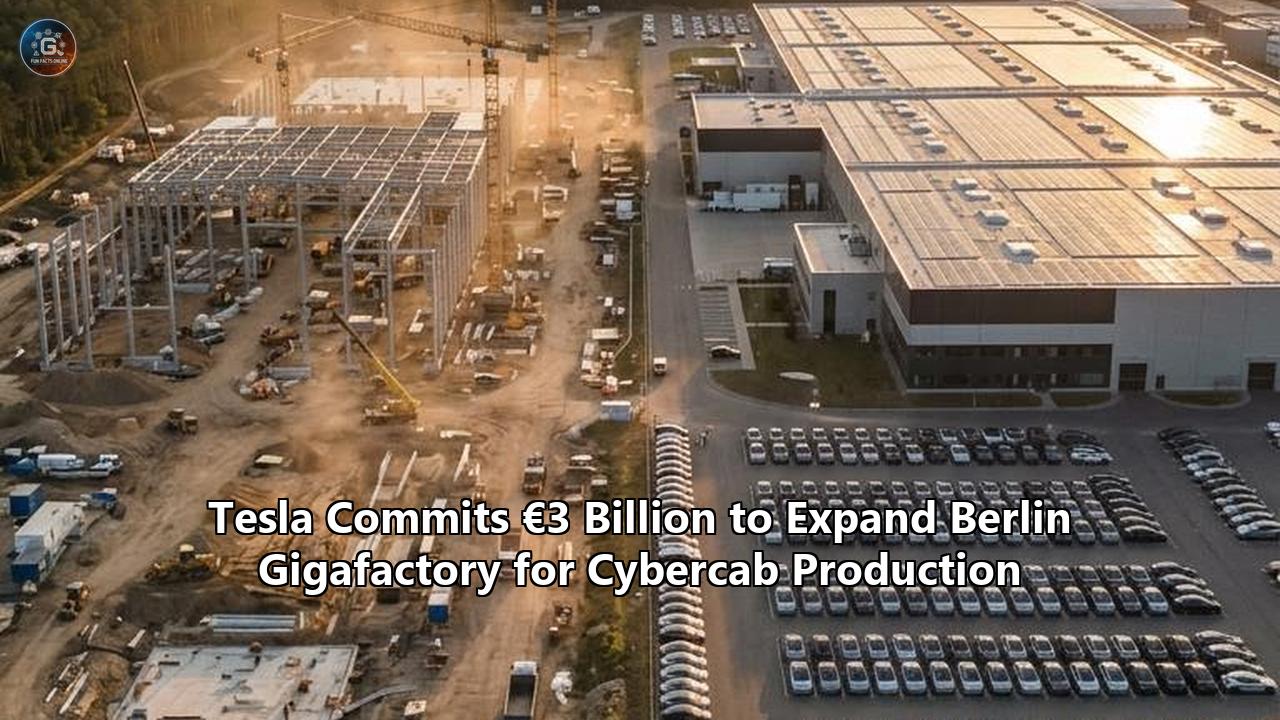
On November 16, 2026, Tesla announced a €3 billion ($3.3 billion) capital commitment to construct a second massive manufacturing facility at its Gigafactory Berlin-Brandenburg complex in Grünheide, Germany. The investment funds a 536,000-square-meter production hall, dedicated ancillary structures, and an on-site wastewater recycling plant. It is engineered to manufacture up to 1 million units annually of the Cybercab—Tesla’s purpose-built, two-seat autonomous vehicle designed without a steering wheel, pedals, or traditional manual controls.
Construction is scheduled to break ground in the first half of 2027, with the first commercial production units slated to roll off assembly lines in 2029. Plant manager André Thierig confirmed the filing schedule via LinkedIn, stating that Tesla plans to formally submit its primary building permit application under Germany's Federal Immission Control Act (Bundes-Immissionsschutzgesetz, or BImSchG) before the close of 2026.
"Today we announced a first investment of around €3 billion in a new manufacturing building with an anticipated start of production in 2029," Thierig stated, adding that the expansion will yield "the most technologically advanced of all Tesla factories".
Brandenburg Minister-President Dietmar Woidke immediately endorsed the project, framing the capital infusion as an anchor of stability for an embattled national industrial base. "The investment of three billion euros and the prospect of producing up to one million Cybercabs in Grünheide is a decision of enormous economic importance," Woidke said in Potsdam. "Especially in economically challenging times, this sends a strong signal: Germany remains an attractive location for major industrial investments".
GIGA BERLIN EXPANSION PROFILE
┌─────────────────────────────────┬─────────────────────────────────┐
│ Metric                          │ Specification                   │
├─────────────────────────────────┼─────────────────────────────────┤
│ Capital Expenditure             │ €3.0 Billion ($3.31 Billion)    │
│ Production Hall Footprint       │ 536,000 m² (Northern Extension) │
│ Planned Annual Capacity         │ Up to 1,000,000 Cybercabs       │
│ Building Application Submission │ Q4 2026                         │
│ Targeted Construction Groundbreak│ H1 2027                         │
│ Targeted Start of Production    │ 2029                            │
│ Battery Integration Target      │ 18 GWh 4680 Dry-Cathode (2027)  │
│ Primary Manufacturing Method    │ "Unboxed" Modular Assembly      │
└─────────────────────────────────┴─────────────────────────────────┘
The announcement lands at a point of friction across the European automotive sector. Legacy German manufacturers are shedding workforce, closing facilities, and scaling back electric vehicle production targets in response to weakening consumer demand and competition from Chinese state-subsidized original equipment manufacturers (OEMs).
Against this backdrop, the Tesla Berlin Gigafactory expansion is not an incremental capacity adjustment. It is a calculated deployment of capital ahead of existing European Union regulatory frameworks for autonomous transport, an aggressive industrial bet on unboxed manufacturing architecture, and a corporate pivot from selling personal passenger cars to dominating algorithmic, software-defined mobility.
Technical Blueprint: Physical Scale and Unboxed Manufacturing Architecture
The physical footprint of the planned northern production hall reveals how Tesla plans to solve the unit-economic challenge of autonomous transit. At roughly 536,000 square meters (5.77 million square feet), the new structure will span more than double the surface area of Grünheide’s original 219,000-square-meter Phase 1 hall, which produces the Model Y.
PLANT FOOTPRINT: CURRENT VS. EXPANSION
Phase 1 (Model Y Assembly):
[████████████] 219,000 m²

Phase 2 (Cybercab Expansion):
[███████████████████████████████] 536,000 m²
The scale is not designed for traditional assembly lines. Conventional automotive manufacturing relies on the continuous-flow stamping, framing, painting, and final assembly methodology pioneered by Henry Ford and refined by the Toyota Production System. In that architecture, a stamped steel and aluminum unibody travels along miles of overhead conveyors and moving tracks. Workers and industrial robots snake wiring harnesses, slip carpets into cabins through door openings, and install heavy interior sub-assemblies through cramped access points before marrying the mechanical chassis to the body shell.
The Cybercab production lines within the new hall will introduce the full-scale industrialization of the "unboxed" manufacturing process. This assembly paradigm discards the single unibody progression in favor of parallel, disaggregated modular production:
TRADITIONAL CONTINUOUS ASSEMBLY FLOW
[Stamping] ──► [Body Framing] ──► [E-Coat & Paint] ──► [Trim Line] ──► [Final Assembly] ──► [End-of-Line QA]
 (High bottleneck vulnerability; interior assembly constrained inside enclosed cabin)

TESLA UNBOXED MODULAR PRODUCTION FLOW
[Front Megacasting] ──────┐
[Rear Megacasting] ───────┼─► Sub-Assembly Cells ──► Single Paint Station ──► Final One-Time Marriage
[Structural Battery Pack] ┘ (Simultaneous Trim) (Panels Only) (Bond & Bolt Module)- Simultaneous Sub-Assembly Modules: The vehicle is split into dedicated, self-contained sections: the front underbody, rear underbody, structural battery floor pan, side door modules, and individual exterior body panels.
- Open-Air Interior Dressing: Seats, computing clusters, electronic steering and drive-by-wire actuators, sound systems, and thermal loops are mounted onto the structural battery pack on an open, flat platform without the interference of side pillars or a roof structure. Technicians and robotic arms access the vehicle from 360 degrees, eliminating cramped cabin work.
- Single-Pass Exterior Panel Finishing: Rather than sending a massive, hollow vehicle shell through multi-dip e-coat tanks, cathodic primer baths, basecoat booths, and bake ovens, exterior panels are processed through compact paint lines or manufactured using colored polymers, cutting paint shop square footage by over 50%.
- Final Integration Marriage: The pre-assembled, fully validated structural battery platform, front casting, rear casting, and pre-trimmed exterior panels merge in a single assembly station at the final stage of production.
By reducing sequential steps, the unboxed approach lowers capital expenditure per unit of capacity to approximately €3,000 per vehicle. Traditional automotive greenfield construction averages €8,000 to €11,000 per unit of installed annual capacity. The reduction in fixed overhead shields the vehicle from low margins, giving the Cybercab an upfront consumer cost of approximately $29,990 and fleet operating costs below $0.20 per vehicle-mile.
On-Site Cell Integration: The 4680 Dry-Cathode Bridge
Factory capacity is dependent on localized energy storage. Grünheide already produces cathode and anode battery electrodes. However, as André Thierig confirmed at the Automobilwoche Congress, complete cell production—incorporating Tesla’s dry-electrode manufacturing process for 4680 cylindrical cells—is scheduled to come online at the site in mid-2027, backed by an initial €1 billion investment.
The dry-process method eliminates the toxic organic solvent N-Methyl-2-pyrrolidone (NMP) and removes the massive gas-fired slurry drying ovens that dominate conventional cell plants. This cuts the physical footprint of the cell production facility by 70% and drastically lowers plant electricity and natural gas consumption.
The planned 18-gigawatt-hour (GWh) mid-2027 annual cell capacity will feed the Cybercab's structural pack assembly line. Because the Cybercab operates as a short-to-medium-range point-to-point urban robotaxi, its energy storage requirement is modest—estimated between 35 kWh and 45 kWh per vehicle, compared to 75 kWh to 100 kWh for a long-range consumer SUV. Consequently, 18 GWh of localized cell manufacturing can supply up to 450,000 to 500,000 Cybercabs annually without requiring transatlantic or transpacific battery supply chains.
Strategy Analysis: Front-Running the Legislative Cycle
The central question raised by the capital commitment is regulatory. Tesla has allocated €3 billion to construct high-volume assembly lines for a vehicle that, under current European statutory limits, cannot be registered or operated commercially at scale anywhere within the European Union.
THE REGULATORY CAPACITY GAP
2026 Statutory Reality:
[█] 1,500 Units / Year (EU Reg 2022/1426 Small-Series Limit)

2029 Planned Plant Capacity:
[████████████████████████████████████████████████] 1,000,000 Units / Year
In 2022, the European Commission introduced Implementing Regulation (EU) 2022/1426, establishing uniform procedures and technical specifications for the type approval of the automated driving systems (ADS) of fully automated motor vehicles. This legislation provides a compliance path for SAE Level 4 passenger shuttles and dual-mode automated vehicles. However, it subjects driverless vehicles lacking conventional manual driver interfaces to a strict small-series limit: a maximum of 1,500 registrations per vehicle model per year across the entire European Union.
A factory capable of building 1 million units per year stands in stark contrast to an annual market ceiling of 1,500 vehicles. This disparity reveals a core element of Tesla's operating strategy: capital allocation as a forcing function for legislative change.
Rather than waiting for regulatory harmonisation at the United Nations Economic Commission for Europe (UNECE) World Forum for Harmonization of Vehicle Regulations (WP.29), Tesla commits capital first to apply pressure on statutory timelines. When a multinational corporation invests billions of euros, creates thousands of domestic industrial jobs, and builds physical manufacturing assets within a member state's jurisdiction, it shifts the regulatory calculation.
THE REGULATORY FORCING CYCLE
Step 1: Irreversible Capital Commitment (€3 Billion at Grünheide)
  └─► Step 2: Regional Economic Alignment (Brandenburg State Backing)
        └─► Step 3: Sovereign Administrative Advocacy (German Federal Government)
              └─► Step 4: Supranational Legislative Revision (EU 2022/1426 Reform)
The political mechanics follow a predictable trajectory:
- The German Federal Ministry for Digital and Transport (Bundesministerium für Digitales und Verkehr, or BMDV) must weigh the friction between local industrial investments and conservative administrative timelines.
- Brandenburg's leadership, motivated to prevent a hollowed-out post-coal regional economy, directly lobbies Brussels and Berlin for regulatory flexibility.
- Federal authorities must choose between modernizing type-approval frameworks to accommodate pedal-less Level 4 passenger transport or forcing a domestic plant to export its output to less restrictive jurisdictions like the United States, the Gulf States, or China.
Tesla deployed this same forcing strategy during the initial 2019–2022 construction of Phase 1 in Grünheide. The company proceeded with construction using temporary advance approvals under Section 8a of the BImSchG—building at its own financial risk while public objections, water usage disputes, and court challenges were still pending. By the time final administrative permits were issued in March 2022, hundreds of millions of euros had been poured into physical concrete, steel, and automated machinery, creating institutional inertia that made administrative rejection difficult for local regulators.
Industrial Geopolitics: Exploiting Germany’s Auto Sector Transition
The announcement's timing is an act of counter-cyclical industrial opportunism. The German automotive establishment—anchored by Volkswagen Group, Mercedes-Benz, and BMW—is managing structural contraction across its primary operating segments.
Rising domestic industrial electricity tariffs following the loss of pipeline-supplied Russian natural gas, alongside software integration challenges and falling vehicle sales volumes in mainland China, have forced legacy OEMs into retrenchment. Volkswagen has engaged in high-profile battles with its central works council over proposed closures of historic domestic assembly facilities, including sites in Osnabrück and Dresden. Major Tier-1 suppliers—including Bosch, Continental, and ZF Friedrichshafen—have announced combined domestic workforce reductions of tens of thousands of roles.
DOMESTIC PASSENGER AUTO PRODUCTION IN GERMANY (ANNUALIZED UNITS)
Year | Volume
2016 | 5,746,800 [████████████████████████████████████████]
2019 | 4,661,300 [████████████████████████████████]
2022 | 3,480,400 [████████████████████████]
2024 | 4,109,000 [████████████████████████████]
2026 | 3,850,000 [██████████████████████████] (Estimate)
By investing €3 billion at Grünheide in this environment, Tesla gains significant leverage over labor acquisition, municipal cooperation, and domestic political capital.
REGIONAL ECONOMIC DYNAMICS
Traditional German OEM Posture (2026):
- Plant closures and downsizing
- Capital preservation and retrenchment
- Tier-1 supplier layoffs
- Shrinking market share in China

Tesla Giga Berlin Expansion Posture (2026):
- Direct €3.0 billion greenfield investment
- Sourcing skilled precision engineering labor
- Expanding from 12,600 to 16,000+ employees
- Positioning plant as Germany's largest site by capacity
Labor Market Realignment
The Tesla Berlin Gigafactory expansion takes advantage of widespread industrial restructuring to capture skilled, high-precision engineering and manufacturing labor. For decades, legacy OEMs and traditional Tier-1 and Tier-2 suppliers held an effective monopoly on Germany’s specialized electromechanical workforce, underpinned by generous collective bargaining agreements (Tarifverträge) negotiated by the IG Metall union.
As legacy assembly lines shutter, that labor market dynamic shifts. Tesla currently employs roughly 12,600 personnel at the Grünheide site, having onboarded over 2,000 staff during 2026 to ramp Model Y output toward 7,500 units per week. The new Cybercab program will require hundreds of specialized manufacturing planners, automation engineers, tooling machinists, and electrical technicians during its engineering phase, followed by thousands of permanent operators at full production capacity.
Tesla’s ability to hire from a contracting regional supply chain allows it to sidestep the structural wage premiums that weighed down Western German automotive factories for decades, all while maintaining an un-unionized direct compensation framework.
The Defensive Geopolitical Shield
The expansion also establishes a hedge against rising global trade protectionism. The European Commission has instituted countervailing import tariffs on battery-electric vehicles imported from the People’s Republic of China, and geopolitical trade tensions with the United States continue to point toward potential cross-border tariff spikes.
Tesla's long-term competitive threats do not originate primarily from Wolfsburg, Stuttgart, or Munich; they come from Shenzhen, Guangzhou, and Beijing. Chinese autonomous vehicle and EV platforms—such as Baidu Apollo, XPeng, and BYD—are moving rapidly toward scalable Level 4 automated services. By placing its dedicated Cybercab mass-manufacturing hub inside the European Single Market, Tesla bypasses:
- The European Union's Carbon Border Adjustment Mechanism (CBAM) liabilities on imported structural materials;
- Potential future import restrictions on software platforms developed in geopolitical rival states;
- Supply chain logistics risks tied to the Suez Canal and maritime transport corridors.
If the European Parliament or individual member states seek to mandate domestic production thresholds, data sovereignty residency, or local labor quotas for automated public transport fleets, Tesla’s Grünheide operation will satisfy those local content criteria by default.
Unit Economics: Shifting from Vehicle Sales to Transportation as a Service (TaaS)
To understand the capital scale of the Tesla Berlin Gigafactory expansion, analysts must examine the underlying shift in automotive unit economics. Traditional automakers earn revenue through single, discrete transactional asset transfers: a car is manufactured, wholesaled to an authorized dealer network or delivered directly to a retail consumer, and monetized at an average gross margin of 7% to 15%. After that point, the OEM extracts limited residual lifetime software revenue, while third-party insurers, fuel providers, and maintenance shops capture recurring operational income.
The Cybercab's economic model shifts automotive manufacturing to a Transportation as a Service (TaaS) model:
AUTOMOTIVE BUSINESS MODEL EVOLUTION
Model A: Traditional Consumer Sale (Model 3 / Model Y)
[Retail Transaction: $45,000 Upfront]
  └─► Gross Margin: 15-18% (One-time: ~$7,200)
  └─► Lifetime Recurring Software: Minimal ($0 - $1,500)
  └─► Asset Utilization: 4% - 5% (Parked 23 hours a day)

Model B: Autonomous Mobility Platform (Cybercab Fleet Integration)
[Direct CapEx Production: ~$20,000 Internal Cost]
  └─► Consumer Fleet Sale: $29,990 upfront + $299/month autonomy fee OR
  └─► Tesla Owned & Operated TaaS Fleet: ~$0.20/mile operational cost
  └─► Gross Revenue at $0.80/mile retail fare over 100,000 miles/yr: $80,000/yr
  └─► Asset Utilization: 40% - 60% (Active 10-14 hours a day)
The financial return on the €3 billion Berlin expansion depends on these operational utilization economics:
1. Capital Utilization Multipliers
A standard passenger vehicle sits parked in garages, driveways, or street spaces approximately 95% of its operating life. Its asset turnover ratio is structurally inefficient.
A Level 4 autonomous fleet vehicle operates on a continuous, dispatchable cycle, achieving 10 to 14 hours of daily fare-earning uptime, interrupted only by off-peak inductive charging, automated interior sanitization, and scheduled maintenance.
At a projected capital cost of less than €25,000 to construct each unboxed Cybercab, deploying an asset that drives 100,000 revenue-generating kilometers annually yields a return on invested capital (ROIC) that outpaces traditional consumer auto manufacturing by multiples.
ANNUAL VEHICLE ACCELERATION: MILES DRIVEN AND ASSET LIFE
┌──────────────────────────────┬──────────────────┬──────────────────┐
│ Operating Metric             │ Privately Owned  │ Fleet-Optimized  │
│                              │ Passenger Car    │ Robotaxi         │
├──────────────────────────────┼──────────────────┼──────────────────┤
│ Annual Operational Distance  │ 10,000 - 12,000  │ 80,000 - 110,000 │
│ Active Operational Daily Use │ 4.5% (1.1 Hours) │ 48.0% (11.5 Hours)│
│ Revenue Architecture         │ Depreciating Buy │ Recurring Yield  │
│ Operating Cost Per Mile      │ $0.72 (All-in)   │ $0.18 - $0.22    │
│ Target Platform Lifespan     │ 150,000 Miles    │ 500,000 Miles    │
└──────────────────────────────┴──────────────────┴──────────────────┘
2. Dual-Channel Monetization Framework
Tesla has established two distribution tracks for the Cybercab, which it began rolling out across testing grounds in Texas in late 2026:
- Direct-to-Consumer Semi-Private Ownership: Commercial sales to approved private buyers for $29,990 upfront, tied to a mandatory $299-per-month recurring autonomy software subscription. Under this model, owners access automated personal transit within designated geofenced operating zones, while Tesla secures a continuous, high-margin software annuity.
- Shared Fleet Fractional Dispatch: Private owners can toggle their vehicles into the Tesla Network fleet when not in personal use. Tesla acts as the network coordinator, dispatch platform, and insurance underwriter, taking a 20% to 30% take-rate on all gross passenger booking fares.
At a 1-million-unit annual capacity run-rate, the facility shifts from an automotive stamping and painting plant into a factory that produces revenue-generating, automated service nodes.
Principle 1: Radical Simplification Over Incremental Automation
A core operational lesson of the Berlin expansion is that meaningful automation requires radical vehicle redesign, not simply retrofitting robots onto a legacy manufacturing process.
In 2018, Tesla nearly collapsed during the Model 3 ramp at its Fremont, California factory. Elon Musk later termed that crisis "production hell," acknowledging that over-automating complex, legacy-style assembly steps had slowed production: "Yes, excessive automation at Tesla was a mistake. To be precise, my mistake. Humans are underrated."
Automating the installation of flexible wiring harnesses, soft interior fabrics, acoustic deadening mats, and complex dashboard assemblies inside an enclosed cabin unibody led to frequent sensor misalignments, machine faults, and line stoppages.
THE EVOLUTION OF PRODUCTION PHILOSOPHY
Fremont Model 3 Era (2018):
Over-Automating Legacy Forms ──► Fragile robots trying to grip flexible wires and trim
                                  inside awkward door frames. High downtime.

Grünheide Cybercab Era (2029):
Radical Simplification       ──► Delete complex parts entirely. Unboxed modular
                                  open-air assembly. High throughput and reliability.
The Cybercab production line in Grünheide applies the engineering lesson of that failure: eliminate parts to eliminate manufacturing bottlenecks.
PARTS ELIMINATION COMPARISON: CONVENTIONAL EV VS. CYBERCAB
Part Category           | Model Y (Phase 1) | Cybercab (Phase 2) | Reduction Strategy
Pedal Mechanisms & Arms | Installed         | Completely Deleted | Direct Autonomy Architecture
Steering Wheel & Column | Installed         | Completely Deleted | Steer-by-Wire Backup Redundancy
Door Handles & Liners   | Multi-piece Motor | Butterfly Single   | Inductive/Phone Actuation
Instrument Panels / HUD | Dash Sub-assembly | Single Screen      | Centralized Console
Wiring Harness Length   | ~1,500 meters     | ~100 meters        | Ethernet-Ring Low-Voltage (48V)
By removing components that exist solely for human driver input:
- The assembly plant cuts hundreds of part numbers from its bills of materials (BOM).
- It eliminates multiple tier-1 supply contracts, transport lines, and quality-inspection stations.
- It deletes complex assembly steps—such as aligning steering columns through firewalls, torque-testing manual brake linkages, and routing complex steering-wheel airbag squibs.
Instead of deploying robots to install difficult dashboard components, the design team simply deleted the dashboard entirely. This mirrors Tesla's hardware approach: simplify the physical product so that remaining robotic assembly steps are fast, reliable, and repeatable.
Principle 2: Manufacturing as a Regulatory Moat
A second strategic takeaway from Tesla’s €3 billion commitment is that large-scale, low-cost domestic manufacturing capacity can function as a protective moat against software-first autonomous competitors.
Silicon Valley's early approach to autonomous vehicles was software-centric. Companies like Alphabet’s Waymo, General Motors’ Cruise, Amazon’s Zoox, and Apple’s defunct Project Titan operated on the assumption that solving computer vision, path prediction, and sensor fusion was the only defensible barrier to entry. They assumed that building the underlying vehicles was a commoditized, low-margin, capital-draining endeavor best outsourced to contract manufacturers like Magna Steyr or traditional OEMs.
THE AUTONOMOUS VALUE PROPOSITION: TWO COMPETING PARADIGMS
Paradigm A: Software-First Platform (e.g., Waymo)
[Compute Platform] ──► [Buy Third-Party OEM Vehicle] ──► [Retrofit Lidars/Sensors]
- High Bill of Materials: $100,000+ per vehicle
- Dependent on third-party supply lines and assembly contracts
- Difficult to scale unit deployment into millions of operating vehicles

Paradigm B: Vertically Integrated Manufacturer (Tesla Giga Berlin)
[Develop FSD AI Engine] ──► [Design Purpose-Built Vehicle] ──► [Mass Manufacture In-House]
- Low Bill of Materials: Under $25,000 internal build cost
- Full control over structural integration, chassis, compute, and capacity
- Direct scale pathway to millions of units via owned Gigafactories
The operational limits of that software-first model become clear when scaling from thousands of pilot vehicles to millions of active fleet units:
- The Retrofit Cost Bottleneck: Equipping a third-party vehicle with custom roof pods, exterior wiring, mechanical backup actuators, and multi-sensor arrays costs between $100,000 and $150,000 per finished vehicle. At that cost basis, achieving sub-$0.50-per-mile consumer pricing requires significant ongoing capital subsidies.
- Manufacturing Vulnerability: Software-first companies lack direct control over assembly line speeds, component revisions, engineering tolerances, or capital prioritization. If an OEM manufacturing partner pivots away from a joint vehicle program, the autonomous operator’s scaling pipeline stalls.
- Pure-Vision Sensor Consolidation: Tesla’s strategy relies entirely on passive optical cameras processed through deep neural networks (Full Self-Driving / End-to-End Neural Networks), omitting expensive lidar sensors, radar arrays, and high-definition localized mapping infrastructure. By packaging this vision-based compute cluster directly into the vehicle's electrical design, the marginal hardware cost of the autonomy suite drops below $1,500 per vehicle.
By investing €3 billion to secure high-volume production in Europe, Tesla insulates itself against the manufacturing bottleneck that software-first competitors face. Once its software reaches the required safety threshold for Level 4 operation, Tesla will have the dedicated tooling and factory capacity ready to produce hundreds of thousands of autonomous units annually.
Principle 3: Mitigating Supply Chain and Energy Volatility
Building a high-volume manufacturing operation in Central Europe requires navigating significant energy cost and supply chain challenges. Following the European energy crisis of 2022–2023, industrial consumers in Germany pay roughly three times more for baseload electricity than industrial operators along the Texas Gulf Coast or in the American Southeast.
ESTIMATED INDUSTRIAL ELECTRICITY TARIFFS (USD EQUIVALENT PER KWH, 2026)
Location | Cost
Brandenburg, Germany (Grid Baseload) | $0.21 [█████████████████████]
Austin, Texas, USA (Direct ERCOT PPA) | $0.06 [██████]
Shanghai, China (Industrial Rate)     | $0.08 [████████]
Tesla’s Phase 2 expansion addresses this structural cost difference through localized generation, closed-loop recycling, and advanced process engineering:
1. Eliminating Thermal Energy Waste
In a standard automotive plant, the paint shop consumes up to 50% to 60% of the entire facility's natural gas intake to power the thermal drying ovens that cure wet layers of solvent-borne paints.
By using pre-colored molded exterior polymers and compact, targeted infrared curing lines for the Cybercab, the new Grünheide hall drastically cuts its natural gas consumption.
Similarly, scaling dry-process 4680 battery electrode production on-site removes the continuous heating and solvent-recovery systems needed for conventional wet-slurry battery coating, avoiding millions of euros in annual energy expenses.
2. Water Conservation and Closed-Loop Reclamation
Environmental opposition to Grünheide's Phase 1 centered largely on water consumption. Local environmental groups (Naturschutzbund Deutschland, or NABU, and Grüne Liga) joined the local water board (Wasserverband Strausberg-Erkner, or WSE) to challenge Tesla's extraction limits, citing risks to the regional drinking water table within an active water protection zone.
WATER EFFICIENCY PER FINISHED VEHICLE (CUBIC METERS)
Conventional Automotive Industry Average:
[████████████████████████████████████████] 3.70 m³

Tesla Giga Berlin Phase 1 (Actual):
[██████████████████████] 2.20 m³

Tesla Giga Berlin Cybercab Target (Closed-Loop Recycle):
[████████████] 1.20 m³
The €3 billion expansion resolves this environmental point of friction by funding a second specialized wastewater treatment plant. This system recovers and re-purifies 100% of process water used in paint shops, cooling circuits, and casting lines, recycling it back through the factory loop.
By operating a closed-loop system, Tesla can expand vehicle production without exceeding the annual freshwater extraction permits already granted for Phase 1. This engineering choice addresses one of the primary legal levers that local environmental campaigns have used to delay operations through the Brandenburg administrative courts.
Friction Points: Bureaucracy, Environmental Resistance, and Labor Politics
Despite its strategic rationale, the Tesla Berlin Gigafactory expansion must navigate three significant points of friction within the German operating landscape:
THE GRÜNHEIDE FRICTION MATRIX
┌───────────────────────┬───────────────────────────────────────────┐
│ Friction Source       │ Core Vulnerability                        │
├───────────────────────┼───────────────────────────────────────────┤
│ Administrative Law    │ Lengthy BImSchG public objection periods  │
│ Environmental Politics│ Tree clearing protests and water disputes │
│ Infrastructure Security│ Substation sabotage and grid disruption  │
│ Labor Organizing      │ IG Metall works council unionization drives│
└───────────────────────┴───────────────────────────────────────────┘
1. Administrative Procedure and Public Participation Risks
Under Section 10 of Germany’s Federal Immission Control Act (BImSchG), expanding a major industrial site requires a public inquiry procedure. When Tesla submitted its initial master expansion proposal in 2023, local citizens and environmental advocacy organizations filed thousands of formal objections (Einwendungen), requiring regional administrative hearings that stretched over several weeks.
Although Brandenburg's State Office for the Environment (Landesamt für Umwelt, or LfU) approved the initial partial building permit in October 2024, the formal permit application scheduled for late 2026 will initiate an additional public comment cycle.
Under German administrative law, environmental associations retain the right to seek preliminary injunctions (Eilanträge) in the Administrative Court of Frankfurt (Oder). These legal challenges risk halting early construction milestones, complicating Tesla's goal of breaking ground in early 2027.
2. Environmental Activism and Direct Action
Tensions around the Grünheide site have extended beyond administrative court filings to include physical demonstrations and acts of sabotage. During the first half of 2024, climate activists established protest camps and treehouses within the adjacent pine forest, opposing any municipal re-zoning intended to clear land for logistics hubs, rail yards, and expanded factory halls.
More critically, in March 2024, far-left extremists belonging to the Vulkangruppe (Volcano Group) set fire to a high-voltage transmission pylon connected to the Steinfurt electrical substation. The sabotage knocked out power to the factory and surrounding towns for nearly a week, shutting down Model Y production and causing hundreds of millions of euros in commercial damage.
Securing the new northern production hall will require extensive physical hardening of high-voltage sub-stations, dedicated rail corridors, and transport routes against direct action by anti-industrial groups.
3. The Unionization Campaign: Tesla vs. IG Metall
A third point of tension lies inside the factory gates. IG Metall, Germany’s largest industrial labor union, has made organizing Giga Berlin a national priority. Unlike legacy OEM facilities, where supervisory boards operate under codetermination rules (Mitbestimmung) with works councils that give union representatives 50% of the board seats, Tesla has maintained an independent, non-tariff-bound (nicht tarifgebunden) compensation system.
FACTORY LABOR COMPARISON: GIGA BERLIN VS. VW WOLFSBURG
Metric                     | Tesla Giga Berlin      | VW Wolfsburg
Union Density Rate         | Minority (Contested)   | Majority (~90%+)
Wage Determination         | Direct Stock / Bonuses | Collective Tarifvertrag
Works Council Dynamics     | Divided / Independent  | IG Metall Controlled
Mitbestimmung Board Seats  | Zero (US Monistic)     | 50% Worker Representation
During works council elections (Betriebsratswahlen), IG Metall pushed aggressively to secure a controlling majority, raising concerns over assembly line work speeds, safety standards, and performance quotas. While independent lists retained leadership in early elections, the addition of thousands of new construction and manufacturing workers for the Cybercab project will turn Giga Berlin into an ongoing battleground between American direct-incentive labor management and German institutional codetermination.
Scenario Analysis: The Grünheide Complex Toward 2030
To evaluate the return profile of the €3 billion expansion, we must model three distinct operational scenarios through 2030:
2030 INDUSTRIAL SCENARIO MATRIX
[Scenario A: Autonomous Alignment] ──► Regulatory reform succeeds; 500k+ Cybercabs/yr; Europe leads robotaxis.
[Scenario B: The Export Conduit]    ──► EU domestic limits persist; Berlin builds for export to UK, Middle East.
[Scenario C: Capital Repurposing]  ──► Software/rules fail; Hall retooled for conventional sub-$25k consumer EV.
Scenario A: Autonomous Regulatory Alignment (Base Case)
- Conditions: By 2028, the European Commission passes sweeping updates to Implementing Regulation (EU) 2022/1426, raising or eliminating the 1,500-unit small-series registration cap for Level 4 automated passenger models. The German BMDV introduces a unified federal liability and licensing pathway for pedal-free vehicles.
- Manufacturing Impact: Giga Berlin completes construction of the northern hall in late 2028 and begins early production in 2029. Output scales to 400,000 Cybercabs annually by 2030, integrated into mobility fleets across major European capitals, including Berlin, Paris, Madrid, and Vienna.
- Financial Return: The facility generates recurring platform revenues, and the €3 billion CapEx investment yields positive operational cash flows within four years of the production start.
Scenario B: The Export Conduit (Contingency Path)
- Conditions: Conservative European regulators delay autonomous passenger transport reforms. The UNECE WP.29 regulatory body extends technical debates over remote operator oversight, leaving the 1,500-unit small-series cap active across the European Union through 2030.
- Manufacturing Impact: Tesla uses Grünheide as a central export hub. While domestic EU deployments remain restricted to small-scale pilot fleets, vehicles manufactured in Grünheide ship out through northern German ports (e.g., Bremerhaven) to markets with faster autonomous regulatory paths—such as the United Kingdom, the United Arab Emirates, Saudi Arabia, and select Indo-Pacific countries.
- Financial Return: Slower volume ramp and maritime logistics tariffs compress margins, extending the capital expenditure payback window by several years.
Scenario C: Capital Repurposing (Downside Pivot)
- Conditions: Technical validation stalls on full driverless safety metrics, and municipal transport lobbies successfully block commercial robotaxi deployment. At the same time, European regulators refuse to license pedal-less vehicles for broad consumer purchase.
- Manufacturing Impact: Tesla exercises the structural flexibility of the unboxed manufacturing architecture. Because the northern hall is built around modular sub-assemblies, Tesla retrofits the line's tooling to build an affordable, steering-wheel-equipped compact consumer electric vehicle (often dubbed the Model 2 / sub-$25,000 passenger vehicle) alongside a limited Cybercab run.
- Financial Return: The plant avoids becoming a stranded asset by capturing high-volume mass consumer EV demand, but it sacrifices the high operating margins of the planned Transportation as a Service (TaaS) fleet model.
Strategic Playbook: Lessons for Industrial and Automotive Leadership
The operational, political, and engineering approaches driving the Tesla Berlin Gigafactory expansion offer concrete lessons for senior corporate executives, manufacturing strategists, and policy planners:
EXECUTIVE STRATEGIC LESSONS
1. Decouple Form from Legacy Heritage
   └─► True cost breakthroughs require deleting redundant human interfaces, not just automating them.

2. Deploy Capital as a Policy Lever
   └─► Tangible, on-the-ground industrial investment can accelerate legislative and regulatory timelines.

3. Build Deep Vertical Integration in Critical Components
   └─► Pair final assembly capacity with localized battery cell and chemical supply chains.

4. Treat Factory Facilities as Strategic Products
   └─► Design factories around structural modularity so lines can pivot if demand shifts.
1. Simplify Product Design Before Deploying Automation
Automation fails when it tries to replicate human manual dexterity on parts built for manual assembly. Industrial engineers must redesign the underlying product so it is easy for machines to assemble. Deleting non-essential components—such as pedal linkages, manual adjusters, and complex interior trim pieces—saves far more capital than buying faster assembly robots.
2. Move Capital Ahead of Regulatory Frameworks
Waiting for total regulatory clarity guarantees entering crowded markets alongside well-capitalized competitors. By making early physical commitments, companies can influence regulatory debates, secure regional political support, and capture prime industrial land, utility access, and regional supply chain capacity.
3. Anchor Energy-Intensive Production Locally
Relying on cross-border supply chains for core components creates exposure to protectionist trade policies and shipping disruptions. Siting dry-process battery cell production, structural casting shops, and closed-loop water treatment on-site protects multi-billion-euro industrial assets from trade volatility and municipal resource caps.
4. Build Factory Reconfigurability into Initial Floor Plans
The primary defense against market, policy, or software uncertainty is physical adaptability. Constructing a modular production hall using open-bay unboxed assembly layouts enables an operator to redirect tooling lines toward traditional passenger vehicle platforms if regulatory delays stall original product plans.
Critical Milestones on the Horizon
The viability of Tesla’s €3 billion capital commitment will be tested across several public operational, environmental, and regulatory milestones over the coming years:
THE ROAD TO 2029 CYBERCAB PRODUCTION
[Q4 2026] ──► Formal BImSchG Permit Filing for Northern Hall
[H1 2027] ──► Target Groundbreaking & Advance Civil Engineering Works
[MID 2027]──► Operational Launch of Dry-Electrode 4680 Cell Production
[2027-28] ──► Review of UNECE WP.29 & Revision of EU Regulation 2022/1426
[2028]    ──► Tooling Installation & Pre-Series Production Validation
[2029] ──► Commercial Start of Production (SOP) for Europe- December 2026: Tesla’s formal submission of its comprehensive partial-permit application to the Brandenburg State Office for the Environment (Landesamt für Umwelt). The filing will reveal the facility's water budget metrics, emission profiles, and structural designs for public inspection.
- First Half of 2027: The anticipated launch of early civil engineering, tree-clearing, and foundation work under Section 8a advance approvals. This phase will gauge regional administrative willingness to fast-track construction amid potential legal challenges from local environmental groups.
- Mid-2027: The scheduled ramp of localized dry-process 4680 battery cell manufacturing at the existing Grünheide facility. Hitting an 18 GWh annual production run-rate is a key prerequisite for low-cost structural battery pack integration into the Cybercab line.
- 2027–2028: Regulatory review cycles at the European Commission and the UNECE Working Party on Automated/Autonomous and Connected Vehicles (GRVA). The outcome of these reviews will determine whether the European Union's 1,500-unit small-series cap will be replaced with a scalable Type Approval framework ahead of the plant's production ramp.
- 2028: Machine tooling integration, installation of heavy gigapress casting machines, and automated robotic sub-assembly calibration within the newly constructed northern hall.
- 2029: The targeted commercial Start of Production (SOP) for the Cybercab, which will test whether Tesla can translate an unboxed, pedal-free design into scaled industrial reality on European soil.
Reference:
- https://techcrunch.com/2026/11/16/tesla-goes-all-in-on-the-cybercab-with-upcoming-e3b-berlin-gigafactory-expansion/
- https://www.teslarati.com/tesla-makes-e3-billion-cybercab-bet-giga-berlin/
- https://electrek.co/2026/11/16/tesla-cybercab-giga-berlin-3-billion-1-million/
- https://teslant.com/en/news/tesla-giga-berlin-second-hall-536000-sqm-december-filing-2026-10
- https://www.basenor.com/blogs/news/tesla-giga-berlin-expansion-plant-manager-hints-at-new-vehicle
- https://superpowerdaily.com/posts/tesla-commits-3-billion-to-berlin-factory-expansion-for-cybercab-production
- https://www.reddit.com/r/teslamotors/comments/1xxxqf5/tesla_will_invest_3_billion_euros_to_expand_giga/
- https://www.notateslaapp.com/news/5020/cybercab-is-coming-to-europe-as-tesla-announces-33-billion-giga-berlin-expansion
- https://www.forbesmiddleeast.com/industry/automotive-and-ev/tesla-to-invest-$33b-in-germany-for-cybercab-production
- https://evwire.com/p/tesla-giga-berlin-3-billion-euro-expansion-cybercab
- https://www.tradingview.com/news/stocktwits:bc27b6e5c094b:0-tesla-targets-2029-cybercab-production-start-in-giga-berlin-with-3-3b-investment-report/