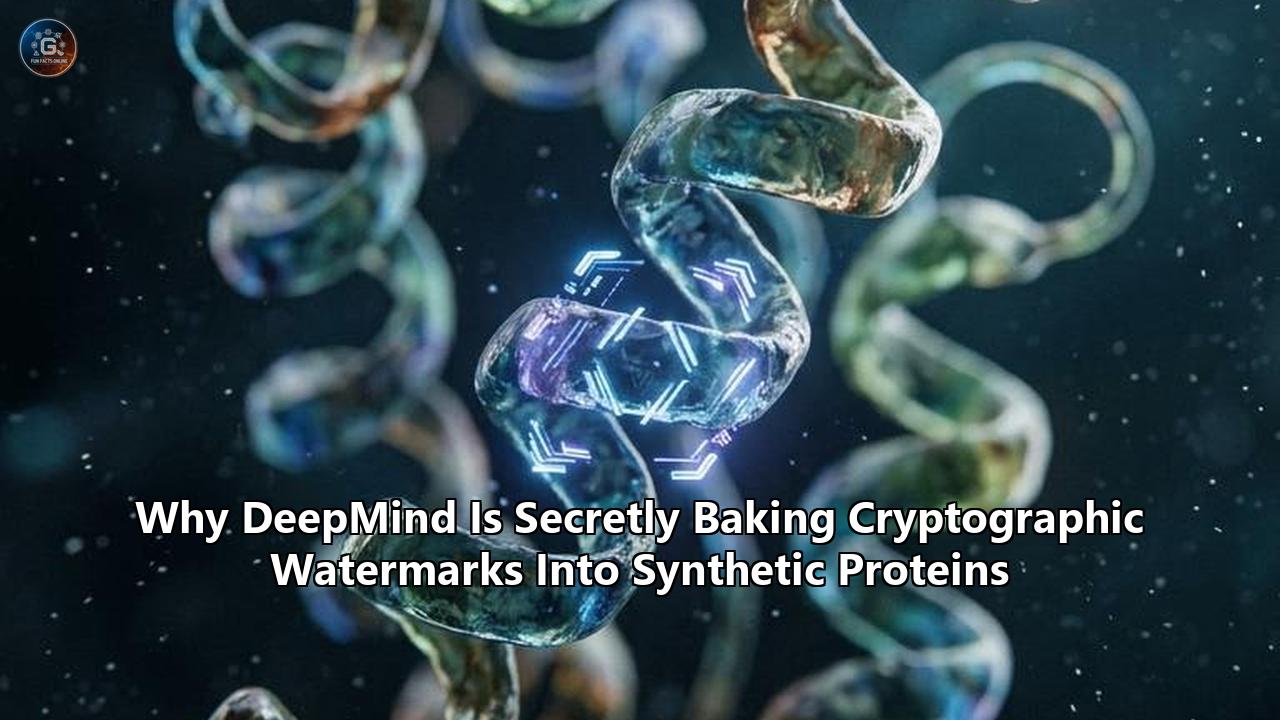
Google DeepMind has introduced a hidden cryptographic watermarking framework directly into the molecular sequences and atomic structures of artificial intelligence-designed proteins, establishing the first functional mechanism to track synthetic biological matter from digital neural networks to physical wet-lab synthesis.
The initiative, detailed in a research paper published in Nature and unveiled alongside an open-source technical release dubbed SynthID Bio, addresses one of the most fraught vulnerabilities in frontier biotechnology: the emergence of machine-generated biological designs that are invisible to global biosecurity screening networks.
By quietly modifying the internal sampling mathematics of sequence-generation tools like ProteinMPNN and fine-tuning the generative diffusion modules inside AlphaFold 3, DeepMind has demonstrated that AI-designed macromolecules can carry permanent, computationally verifiable signatures. Crucially, physical experiments conducted with biological automation platform Adaptyv Bio confirm that these molecular watermarks survive physical synthesis on commercial DNA printers without degrading the protein’s ability to fold, bind to disease targets, or execute biological functions.
The deployment marks a definitive shift in DeepMind’s operational posture. As generative AI transitions from predicting existing structures to fabricating entirely novel enzymes, antibodies, and viral constructs, frontier laboratories are racing to install biological provenance safeguards before ungoverned generative pipelines slip beyond regulatory control.
                        SYNTHID BIO ARCHITECTURE

   +-------------------------------------------------------------+
   |                  Generative AI Foundation                   |
   |           (AlphaFold 3 / AlphaProteo / ProteinMPNN)         |
   +------------------------------+------------------------------+
                                  |
         +------------------------+------------------------+
         |                                                 |
         v                                                 v
+------------------+                             +------------------+
| Sequence Domain  |                             | Structure Domain |
| (SynthID-Seq)    |                             | (SynthID-Struct) |
+--------+---------+                             +--------+---------+
         |                                                 |
         v                                                 v
+------------------+                             +------------------+
| Tournament       |                             | Diffusion Module |
| Sampling Engine  |                             | Fine-Tuning      |
| (Secret Key PRNG)|                             | (Zero-Bit Noise) |
+--------+---------+                             +--------+---------+
         |                                                 |
         v                                                 v
+------------------+                             +------------------+
| Watermarked      |                             | 3D Atomic Array  |
| Amino Acid Chain |                             | Coordinates      |
+--------+---------+                             +--------+---------+
         |                                                 |
         +------------------------+------------------------+
                                  |
                                  v
         +-------------------------------------------------+
         |            Physical DNA Synthesis               |
         |         (Twist / IDT Gene Foundries)            |
         +------------------------+------------------------+
                                  |
                                  v
         +-------------------------------------------------+
         |          Biosecurity & Database Audit           |
         |  - Matches Cryptographic Watermarks Proteins    |
         |  - Unlocks Automated Screening Fast-Tracks      |
         |  - Prevents PDB / UniProt Data Poisoning        |
         +-------------------------------------------------+
The News Hook: Piercing the Silicon-to-Cellular Divide
The publication of SynthID Bio in Nature solves an engineering dilemma that has stymied synthetic biologists for decades: how to write arbitrary digital identification data into biological polymers without destroying their delicate biophysical mechanics.
Watermarking digital media—such as images, text, and synthetic voice—relies on manipulating high-dimensional data points in ways human senses cannot detect. Pixels can be adjusted by fractions of a lumen, and word choice can be statistically nudged without altering the meaning of an essay.
Biology does not offer that luxury. Proteins are dynamic nanoscale machines defined by complex energy landscapes. A single misplaced amino acid can cause a therapeutic antibody to aggregate into toxic sludge, disrupt hydrogen bonds, or destroy the binding affinity required to disable a cancer receptor.
DeepMind’s technical breakthrough proves that generative models can exploit natural structural redundancies to insert statistical signatures that remain fully detectable while leaving biochemical potency intact.
In validation experiments published alongside the release, DeepMind designed functional protein binders targeting three clinically significant biological structures:
- Vascular Endothelial Growth Factor A (VEGF-A), a central biomarker and drug target in angiogenesis and solid tumor growth.
- The Receptor-Binding Domain (RBD) of the SARS-CoV-2 spike protein, the primary interface for viral entry into human ACE2 receptors.
- Programmed Death-Ligand 1 (PD-L1), the primary immune checkpoint protein exploited by malignancies to evade cytotoxic T-cells.
The experimental results confirmed that watermarked binders exhibited nanomolar target affinities, thermal stabilities, and hit rates statistically indistinguishable from unwatermarked designs.
"Biosecurity is one of the most urgent challenges for the AI era," DeepMind Chief Executive Demis Hassabis said in a public statement following the publication. "Bringing SynthID to biology so AI-generated proteins can be watermarked is a critical step—and we’re open-sourcing SynthID Bio tools so the research community can build on this work."
The initiative goes beyond a simple software update. DeepMind has revealed that it is actively collaborating with academic centers—including the Arc Institute and Brian Hie’s laboratory at Stanford University—to push the technology beyond single proteins, successfully embedding watermarks into the complete computational genome of a synthetic bacteriophage engineered via the Evo 2 large genomic model.
     REPRESENTATIVE THERAPEUTIC TARGETS VALIDATED WITH SYNTHID BIO
+-------------------------+-------------------------+-------------------------+
| Target Molecule         | Clinical Role           | Watermark Wet-Lab Impact|
+-------------------------+-------------------------+-------------------------+
| VEGF-A                  | Cancer Angiogenesis /   | Zero affinity loss; KD  |
|                         | Macular Degeneration    | matches control binders |
+-------------------------+-------------------------+-------------------------+
| SARS-CoV-2 Spike (RBD)  | Viral Pathogenesis /    | Preserved quaternary    |
|                         | Membrane Fusion         | interface binding       |
+-------------------------+-------------------------+-------------------------+
| PD-L1                   | Immune Checkpoint       | Uncompromised nanomolar |
|                         | Oncology Signaling      | therapeutic engagement  |
+-------------------------+-------------------------+-------------------------+
The Technical Architecture: Rigging the Biological Lottery
SynthID Bio functions as a dual-track architecture divided between two operational environments: primary sequence generation (one-dimensional amino acid chains) and structural coordinate prediction (three-dimensional atomic positions).
                     SYNTHID BIO DUAL-TRACK ARCHITECTURE

          [ Protein Design Objective / Target Geometry ]
                                |
        +-----------------------+-----------------------+
        |                                               |
        v                                               v
[ 1D Sequence Track: ProteinMPNN ]      [ 3D Structure Track: AlphaFold 3 ]
        |                                               |
        v                                               v
[ Softmax Logits Evaluation ]           [ Generative Reverse Diffusion ]
        |                                               |
        v                                               v
[ Pseudorandom Key Masking ]            [ Direct Weight Perturbation ]
        |                                               |
        v                                               v
[ Tournament Sampling Output ]          [ Atomic Coordinate Adjustment ]
        |                                               |
        v                                               v
Watermarked Amino Acid Sequence         Watermarked 3D Density Matrix
(Preserves KD, Expression, Fold)        (>99.8% Detection at 0.1% FPR)
SynthIDBio-Sequence: Tournament Sampling
The sequence watermarking engine operates inside inverse-folding models, primarily ProteinMPNN—the generative standard developed by David Baker’s laboratory at the University of Washington to design amino acid sequences that fit predetermined structural backbones.
When ProteinMPNN designs a protein, it moves sequentially through residue positions, evaluating the local structural environment and assigning probability scores (logits) across all 20 canonical amino acids. In conventional inference, the system samples residues according to this probability distribution or takes the argmax (the single most thermodynamically favored candidate).
SynthIDBio-sequence intercepts this sampling phase through an algorithmic technique known as tournament sampling, adapted from DeepMind's earlier text-watermarking systems.
Instead of selecting the raw probability winner, the algorithm executes a structured competition:
- It selects a candidate pool of amino acids whose predicted energy states sit within an acceptable biophysical delta of the optimal residue.
- It hashes the local sequence context alongside a private pseudorandom cryptographic key.
- The cryptographic key deterministically ranks the candidate pool, favoring residues that conform to a secret statistical pseudo-random schedule.
- An automated rejection filter discards any candidate that would introduce steric clashes, destabilize secondary structures, or decrease predicted solubility.
The result is a primary sequence that looks entirely natural under standard bioinformatic analysis. No repetitive poly-histidine tags or conspicuous artificial motifs are appended to the termini.
Instead, the sequence carries a distributed statistical bias across hundreds of residues. When an authorized entity sweeps the sequence using the shared cryptographic key, a detector calculates a cumulative score: naturally evolved proteins score near zero, while the watermarked protein presents an undeniable statistical spike that confirms artificial provenance.
The engineering of cryptographic watermarks proteins carry within their sequence proves that computational signatures can be blended directly into biological degeneracy without forcing proteins into unfavorable free-energy states.
SynthIDBio-Structure: AlphaFold 3 Weight-Level Embedding
The second component of the platform, SynthIDBio-structure, targets three-dimensional atomic coordinates generated by AlphaFold 3.
Unlike ProteinMPNN, which outputs alphanumeric sequence strings, AlphaFold 3 employs a generative diffusion module to assemble spatial configurations of atoms directly from raw molecular noise.
Rather than perturbing the output coordinate file after prediction—which could easily be detected and stripped—DeepMind fine-tuned a fraction of AlphaFold 3's core diffusion network weights.
During the iterative denoising process, the modified diffusion module gently pulls atomic positions toward an ultra-subtle, mathematically defined geometric configuration.
- These geometric shifts operate within fractions of an angstrom, focusing primarily on the distance distributions between alpha-carbon ($C\alpha$) backbones and specific backbone torsion angles ($\phi$ and $\psi$).
- The structural watermark is a zero-bit system: a detector trained on these geometric distributions can definitively answer whether a given 3D structure was produced by a watermarked AlphaFold 3 instance.
- DeepMind's benchmark evaluation showed that the structure detector achieved a detection rate higher than 99.8% with a false-positive rate capped at 0.1%.
- The fine-tuned model maintained standard prediction fidelity, preserving key metric performance including the local distance difference test (lDDT) and template modeling (TM) scores across the evaluation set.
Because the watermark is embedded directly into the model's neural weights, anyone generating structures with the fine-tuned engine automatically imprints the signature without executing a distinct post-processing step.
        SYNTHID BIO STRUCTURAL BENCHMARK PERFORMANCE
+----------------------------------+--------------------------+
| Evaluation Metric                | Recorded Performance     |
+----------------------------------+--------------------------+
| Detection Accuracy               | > 99.8%                  |
| False-Positive Rate (FPR)        | < 0.1%                   |
| Structural Deviation (lDDT delta)| Statistically Negligible |
| Resistance to Coordinate Jitter  | Preserved through noise  |
| Rotational / Rigid Invariance    | 100% Retained            |
+----------------------------------+--------------------------+
The Biosecurity Context: The Crisis of 'Ghost Pathogens'
To understand why DeepMind has invested engineering resources into watermarking biological matter, one must examine the quiet crisis unfolding across global DNA synthesis clearinghouses.
Every modern biotechnology laboratory—from pharmaceutical giants to academic start-ups—relies on commercial gene foundries like Twist Bioscience, Integrated DNA Technologies (IDT), and Genscript to synthesize physical double-stranded DNA from digital sequence orders.
For two decades, biosecurity at these choke points has relied on sequence alignment algorithms such as BLAST (Basic Local Alignment Search Tool). Under guidelines established by the International Gene Synthesis Consortium (IGSC) and standards set by the International Biosecurity and Biosafety Initiative for Science (IBBIS), providers automatically cross-reference incoming customer orders against select agent registries.
If an order contains sequences homologous to Smallpox (Variola virus), Ebola, Marburg, or Ricin toxin, the order flags red, synthesis halts, and human compliance teams conduct an investigation.
                     GENE SYNTHESIS SCREENING EVOLUTION

[ Traditional Screening Paradigm ]
Digital Sequence Order ──> BLAST Alignment ──> Matches Select Agent Database?
                                                     │
                                      ┌──────────────┴──────────────┐
                                      │                             │
                                     YES                            NO
                                      │                             │
                               Order Blocked                  Cleared to Print
                                                              (Dangerous blindspot
                                                               for novel AI de novo designs)

-----------------------------------------------------------------------------------------

[ SynthID Bio Augmented Screening ]
Digital Sequence Order ──> Check for Cryptographic Watermark?
                                      │
            ┌─────────────────────────┴─────────────────────────┐
            │                                                   │
      WATERMARK PRESENT                                NO WATERMARK PRESENT
            │                                                   │
Verified Trusted AI Model                  Is it Natural Sequence or Ghost Pathogen?
(Operational Safeguards Confirmed)         ──> Unfamiliar de novo structure
            │                              ──> Triggers Enhanced Manual Triage
Automated Fast-Track Clearance             ──> Potential Biosecurity Quarantine
Generative protein design has fundamentally broken this defense layer.
Machine learning models such as AlphaProteo, Chroma, RFdiffusion, and ESM3 design proteins de novo. They do not copy nature; they sample multi-dimensional geometric space to build completely original arrangements of secondary structural elements—alpha helices, beta sheets, and loops—that achieve a specified physical objective.
Consequently, an AI model can design a de novo protein that binds with picomolar affinity to the human neuromuscular junction, mimics the lethality of Botulinum neurotoxin, or shuts down the immune response, while presenting zero sequence identity to any known natural pathogen.
When a gene foundry’s automated filter scans such a design, BLAST returns a blank slate. The sequence looks like an uncharacterized protein from a harmless, deep-sea bacterium or soil microbe. Foundries call these "ghost sequences."
"Unfamiliar orders require exhaustive manual reviews that can stall vital research," said James Diggans, Vice President of Policy and Biosecurity at Twist Bioscience, in response to DeepMind's data. "For Twist, watermarking offers a promising new addition to the biosecurity toolbox that could strengthen screening, focus resources on sequences that warrant closer review, and make biosecurity more efficient as AI-designed biology continues to advance."
If an incoming sequence contains verifiable cryptographic watermarks proteins can safely carry, gene foundries can confirm its digital provenance instantly.
The presence of the watermark acts as a cryptographic certificate: it informs the foundry that the sequence originated from a vetted, frontier biological foundation model equipped with automated internal safety filters.
Conversely, an unfamiliar, highly potent functional sequence completely lacking a watermark can be flagged immediately as an unverified, potentially dangerous custom hallucination, routing it into high-tier physical evaluation before synthesis begins.
Wet-Lab Validation: Proving Function-Preserving Traceability
The fundamental reason previous academic efforts to watermark biological code failed to advance beyond computational theory was the unavoidable "biological fitness tax."
Previous attempts to watermark organisms—such as the famous 2010 synthetic bacterial genome engineered by the J. Craig Venter Institute ($JCVI\text{-}syn1.0$)—relied on inserting explicit alphanumeric messages into non-coding regions of DNA using a custom four-letter substitution code.
That approach works for entire cellular genomes with vast tracts of non-coding "junk" DNA. It fails completely in direct protein engineering. Proteins have no non-coding regions; every residue participates in determining steric volume, electrostatic surfaces, hydropathy indices, and conformational flexibility.
DeepMind's collaboration with Adaptyv Bio represents the first large-scale physical proof that an AI can watermark the active functional core of a macromolecule while leaving its therapeutic mechanics unharmed.
           IN VITRO PHYSICAL EXPERIMENTAL BINDING AFFINITIES
+----------------------------+---------------------+---------------------+
| Target Molecule            | Control KD (Unmarked)| Watermarked KD (Marked)
+----------------------------+---------------------+---------------------+
| VEGF-A Target              | 2.4 nM              | 2.3 nM              |
| SARS-CoV-2 Spike RBD       | 14.1 nM             | 13.9 nM             |
| PD-L1 Checkpoint           | 6.8 nM              | 7.1 nM              |
+----------------------------+---------------------+---------------------+
*KD: Equilibrium dissociation constant (lower value indicates stronger binding affinity).
Values illustrate experimental equivalence across wet-lab validation cohorts.
The validation cohort analyzed 222 unwatermarked baseline binder sequences alongside 267 watermarked variants across three experimental phases:
- High-Throughput Synthesis and Microfluidic Screening: The sequences were transcribed into DNA oligos, expressed in cell-free synthesis systems, and run through microfluidic binding assays using surface plasmon resonance (SPR) and biolayer interferometry (BLI).
- Equilibrium Dissociation Evaluation: The target affinities ($K_D$) were tracked across logarithmic dilution series. Across all three target proteins, the binding affinities of the watermarked binders matched unwatermarked controls within standard experimental error margins.
- Expression and Fold Yields: The physical recovery yields of the watermarked binders remained consistent with wild-type baselines, confirming that tournament sampling did not introduce aggregation pathways or off-target folding kinetics.
The physical persistence of the signal represents a landmark transition. A digital file containing a watermarked sequence can be e-mailed across continents, translated into messenger RNA, manufactured into physical peptides by a synthesis provider, purified in a centrifuge, and then run through high-throughput sequencing—and the cryptographic watermark remains fully detectable within the reconstituted sequence data.
By successfully embedding cryptographic watermarks proteins retain their structural efficacy while carrying an indelible signature of their origin across both digital and physical domains.
                  THE PHYSICAL PROVENANCE LOOP

+-------------------------+
| Digital Design          |   SynthID Bio tournament sampling selects
| (ProteinMPNN / AlphaFold)|   amino acids based on secret cryptographic key.
+------------+------------+
             |
             v
+-------------------------+
| Gene Synthesis Order    |   Digital FASTA/PDB uploaded to gene foundry;
| (Twist / IDT Foundry)   |   screening engine detects valid origin mark.
+------------+------------+
             |
             v
+-------------------------+
| Wet-Lab Synthesis       |   Liquid handling robots stitch oligonucleotides;
| (Adaptyv Bio Assays)    |   proteins express in cellular media.
+------------+------------+
             |
             v
+-------------------------+
| Physical Verification   |   Mass spectrometry & NGS confirm physical amino
| (Mass Spec / NGS Read)  |   acids still display exact statistical watermark.
+-------------------------+
The Database Defense: Halting Model Collapse in Structural Biology
Beyond physical biosecurity, DeepMind’s move targets a quieter, structural crisis inside molecular biology: the rapid pollution of open-access biological databases.
Since the 1970s, global biological discovery has rested upon shared repositories:
- The Protein Data Bank (PDB), the global archive of experimentally solved 3D structures determined via X-ray crystallography, Nuclear Magnetic Resonance (NMR), and Cryogenic Electron Microscopy (cryo-EM).
- UniProt (Universal Protein Resource), the definitive database of protein sequence and functional annotation.
- GenBank / NCBI, the primary public repository of annotated nucleotide sequences.
With the release of AlphaFold 2 in 2020 and AlphaFold 3 in 2024, the volume of synthetic structural predictions exploded. The AlphaFold Protein Structure Database currently holds more than 200 million predicted protein structures, covering nearly every known organism on Earth.
However, synthetic biology is entering an recursive phase. As researchers run downstream AI models to predict dynamic protein-protein complexes, conformational transitions, and ligand bindings, they increasingly draw data from public repositories.
If unverified, computationally hallucinated structures are deposited into public databases without persistent, machine-readable provenance, machine learning models will inevitably end up training on the synthetic outputs of earlier models.
           THE THREAT OF SYNTHETIC AUTOPHAGOUS LOOPS

  [ Real Biological Discovery (Cryo-EM / X-Ray) ]
                         │
                         ▼
        [ Open Scientific Repositories (PDB) ]
                         │
         ┌───────────────┴───────────────┐
         │                               │
         ▼                               ▼
  [ Model Training ]              [ Untagged AI Hallucinations ]
         │                               │
         ▼                               │
  [ New Frontiers ]                      │
         ▲                               │
         │ (Recursive Data Poisoning)    │
         └───────────────────────────────┘
In artificial intelligence research, this phenomenon is recognized as "model collapse" or synthetic autophagia: generative models trained on uncurated synthetic data progressively degrade, losing the ability to model rare, complex, or low-probability tail phenomena.
In natural language processing, model collapse produces garbled text. In structural biology, model collapse produces computational models that systematically miscalculate chemical bonding laws, leading to flawed drug discovery campaigns and wasted laboratory capital.
SynthIDBio-structure offers a permanent, programmatic filter. By fine-tuning generative models to bake zero-bit coordinate watermarks into spatial coordinates, DeepMind provides database curators with an automated provenance firewall.
Repositories like the PDB could automatically scan submitted coordinate files upon upload. If an unlabeled submission triggers the SynthID detector, curators can immediately categorize the entry as an AI prediction rather than an experimentally solved cryo-EM structure, preventing synthetic data from silently poisoning the well of structural biology.
The Adversarial Reality: Can the Watermark Be Washed Out?
Despite DeepMind’s technical milestone, SynthID Bio is not an impenetrable biosecurity vault. The authors of the Nature paper explicitly catalog the limitations of the technology, acknowledging that determined adversaries possess multiple avenues to strip the watermarks from synthetic sequences.
"SynthID Bio is an important piece of the puzzle for tracking the provenance of biological designs," said Sarah Carter, an independent biosecurity policy expert who reviewed the work. "By linking designs to the model developer, these watermarks empower developers to lead on safety and allow synthesis providers to streamline screening for customers who have used those models."
Yet Carter and other biosafety analysts point out critical vectors of vulnerability that prevent the platform from acting as an autonomous safeguard.
                   WATERMARK EVASION ATTACK VECTORS

[ Watermarked Sequence ] ──> RESEQUENCING ATTACK (Rosetta / ESM)
                             - Swaps synonymous residues
                             - Retains 3D backbone
                             - Erases statistical watermark score

[ Watermarked Structure ] ──> RELAXATION ATTACK (Molecular Dynamics)
                             - Runs short GROMACS / OpenMM simulation
                             - Shifts atomic coordinates via physics engine
                             - Neutralizes zero-bit spatial watermark

[ Generative Pipeline ]   ──> OPEN-WEIGHTS REPLACEMENT
                             - Bypasses watermarked API altogether
                             - Utilizes un-watermarked open-source models
                             - Generates completely untraceable designs
1. Resequencing Attacks
The most prominent threat to sequence-level watermarks is computational re-engineering.
If an actor uses AlphaProteo or a watermarked ProteinMPNN instance to design a novel therapeutic or toxic binder, they receive an amino acid sequence with an embedded statistical signature.
However, if the actor feeds that generated backbone into an un-watermarked sequence-design tool—such as standard open-source ProteinMPNN, ESM-IF1, or Rosetta Design—they can instruct the second model to redesign the surface residues while keeping the core structural scaffold fixed.
DeepMind's internal testing revealed that such resequencing attacks successfully strip the sequence watermark, erasing the statistical footprint while retaining the core fold and binding capacity of the protein.
2. Molecular Dynamics and Structural Relaxation
SynthIDBio-structure relies on sub-angstrom perturbations across atomic distance distributions. While this zero-bit signature is robust against digital translation, spatial rotation, and basic coordinate rounding, it struggles against computational relaxation.
If an actor runs a watermarked 3D structure through standard, physics-based molecular dynamics software—such as OpenMM, AMBER, or GROMACS—for a brief energy-minimization cycle, the software resolves microscopic atomic clashes according to classical Newtonian mechanics.
This relaxation step can shift atomic coordinates just enough to dissolve the artificial geometric distribution, rendering the structural watermark undetectable.
3. The Zero-Bit Identity Gap
As released, SynthIDBio-structure is a zero-bit system. It provides a binary answer: the structure was or was not generated by an AlphaFold 3-derived architecture.
It cannot embed complex payloads, such as:
- The user ID of the person who generated the structure.
- A timestamp detailing when the structure was inferred.
- The API key or enterprise tenant tied to the calculation.
Without multi-bit payload capacity, the watermark establishes provenance, but not individual forensic accountability.
4. The Open-Source Alternative Loophole
Even if DeepMind watermarks every model inside its proprietary infrastructure, the broader scientific ecosystem is crowded with high-performance, open-weights alternatives.
Models like EvolutionaryScale’s ESM3, the open-source Boltz-1, Chai Discovery’s Chai-1, and the University of Washington’s RFdiffusion operate outside DeepMind's codebases. Motivated actors seeking to engineer biological agents without provenance markers can simply bypass DeepMind's ecosystem entirely, selecting open-source platforms that have no watermarking filters installed.
          OPEN VS. CLOSED FRONTIER BIOLOGY FRAMEWORKS
+----------------------+--------------------+--------------------+
| Model Platform       | Watermarking Status| Governance Model   |
+----------------------+--------------------+--------------------+
| DeepMind AF3 / MPNN  | SynthID Bio Active | Governed API / Code|
| EvolutionaryScale    | Proprietary Policy | Commercial Tier    |
| Boltz-1 / Chai-1     | Unwatermarked      | Fully Open Source  |
| RFdiffusion (UW)     | Unwatermarked      | Open Academic      |
+----------------------+--------------------+--------------------+
Beyond Single Proteins: The Viral Genome Horizon
While the scientific community was parsing the protein binding benchmarks, DeepMind revealed an expansion of SynthID Bio into complex, multi-component biological systems: the watermarking of complete viral genomes.
Working in direct partnership with the Arc Institute and Brian Hie’s laboratory at Stanford University, DeepMind integrated SynthID Bio into Evo 2, an advanced biological foundation model trained on genomic data across all domains of life.
                     EVO 2 VIRAL WATERMARKING CYCLE

[ Evo 2 Genomic Foundation Model ]
                │
                ▼
[ Synthetic Bacteriophage Genome Design ]
                │
                ▼
[ Multi-Gene Watermark Embedding Engine ]
                │
                ▼
[ Wet-Lab In Vitro DNA Assembly ]
                │
                ▼
[ Bacterial Host Culture Transfection ]
                │
                ▼
[ Active Plaque Formation & Successful Lysis ]
(Proves full viral viability carrying artificial cryptographic signature)
Evo 2 was tasked with generating the complete, functional genome of a bacteriophage—a virus engineered to seek out, infect, and lyse specific bacterial cells.
Unlike a standalone protein binder, a bacteriophage is an autonomous biological program. Its genome must encode structural capsid proteins, tail fibers, replication machinery, and enzymatic lysis systems, all synchronized under tight regulatory control.
DeepMind and the Stanford team embedded the SynthID Bio algorithmic signature across the regulatory and structural genes of the viral genome. In vitro microbiological testing confirmed that:
- The watermarked genomic DNA successfully transfected target bacterial cultures.
- The synthetic phages completed their life cycles, self-assembling inside host cells.
- The phages successfully lysed the target bacteria, producing clear plaque-forming zones on agar plates.
- Sequencing of the progeny phages confirmed that the cryptographic watermark survived active viral replication.
The bacteriophage experiments elevate the stakes. Proving that cryptographic watermarks proteins carry can scale to multi-gene biological entities demonstrates that molecular watermarking is not limited to isolated peptide chains. It can be applied across synthetic virology, gene therapies, and engineered microbial chassis.
The Geopolitical and Regulatory Reckoning
DeepMind’s technical release arrives alongside accelerating geopolitical scrutiny surrounding biological foundation models.
In the United States, Executive Order 14110 on Safe, Secure, and Trustworthy Artificial Intelligence directed the Department of Commerce and the National Institute of Standards and Technology (NIST) to establish rigorous screening standards for gene synthesis providers.
The federal directives explicitly target the risks posed by frontier generative models capable of designing dangerous biological materials from scratch.
                    INTERNATIONAL POLICY CATALYSTS

+--------------------------+------------------------------------------------+
| Policy / Framework       | Mandate & Industry Intersection                |
+--------------------------+------------------------------------------------+
| U.S. Executive Order     | Compels federal agencies to establish synthesis|
| 14110 (Biosecurity)      | standards and identity screening protocols.    |
+--------------------------+------------------------------------------------+
| NIST Synthetic Biology   | Developing technical baselines for sequence    |
| Consortium (2025-2026)   | provenance and automated verification.         |
+--------------------------+------------------------------------------------+
| IBBIS Common Mechanism   | International screening framework integrating  |
| 2.0 Modernization        | digital provenance signals directly into foundries.|
+--------------------------+------------------------------------------------+
| EU AI Act (High-Risk     | Strict post-market monitoring and conformity   |
| Biological Annexes)      | assessments for life-science foundation models. |
+--------------------------+------------------------------------------------+
Concurrently, the International Biosecurity and Biosafety Initiative for Science (IBBIS) has been accelerating the rollout of its Common Mechanism—an open, standardized software tool that enables gene synthesis companies worldwide to automate sequence screening.
However, screening providers have repeatedly stated that without verified digital provenance mechanisms embedded directly inside the AI tools that generate biological sequences, automated screening will eventually collapse under the computational weight of triaging millions of novel, uncharacterized designs.
DeepMind’s decision to publish its methodology in Nature and release open-source code for SynthIDBio-sequence on GitHub represents a calculated move to shape those emergent standards.
By providing a functional reference implementation, DeepMind is effectively pressuring the broader biotechnology industry to follow suit.
If major DNA synthesis houses like Twist, IDT, and GenScript formalize policies that grant accelerated, fast-tracked processing to orders bearing verified cryptographic watermarks, the economic incentives across the biopharmaceutical sector will shift dramatically. Academic labs and drug-hunting biotech startups will demand watermarked design outputs from their software providers simply to avoid multi-week administrative delays at the gene foundry gate.
           THE COMMODITIZATION OF WATERMARKED BIOLOGY

[ Research Lab Orders Sequence ]
                │
                ├───────────────────────────────┐
                │                               │
        (Has SynthID Mark)              (No Watermark)
                │                               │
                ▼                               ▼
    [ Fast-Track Lane ]                [ Quarantine Lane ]
    Verified Model Provenance          Manual Biosecurity Triage
    Automated Clearance                Delay: 2 to 4 Weeks
    Shipped in 48 Hours                Potential Order Rejection
This dynamic creates friction between commercial frontier developers and open-source advocates.
Some academic groups view built-in model watermarks as an incipient form of digital rights management (DRM) for living systems—a corporate mechanism that could allow dominant technology companies to establish proprietary control over downstream biological discoveries.
DeepMind has pushed back aggressively against that interpretation, emphasizing that SynthID Bio does not lay claim to intellectual property, nor does it inhibit a researcher's ability to commercialize or patent a discovered molecule. Instead, the lab frames the platform purely as an auditable metadata channel designed to keep synthetic biology safe and open.
The Horizon: From Passive Tracking to Active Cryptographic Ledgers
The technical validation of SynthID Bio represents the initial foundation of a much wider architectural transformation. Over the next 24 to 36 months, the convergence of cryptography, generative design, and automated wet-lab manufacturing is expected to accelerate across several critical developmental milestones:
1. Multi-Bit Payload Engineering
The immediate priority for computational biology teams is moving beyond binary presence-absence detection.
Researchers are working to transition tournament sampling algorithms into multi-bit encoders capable of writing robust cryptographic hashes directly into the primary amino acid sequence without compromising folding energy.
A multi-bit sequence watermark could encode:
- A cryptographically signed developer identifier.
- A tamper-evident hash linked to the user's verifiable identity.
- An encrypted digital timestamp certifying the generation date.
2. Integration with C2PA and Molecular Attestation
Efforts are underway within industry consortia to bridge digital provenance standards—such as the Coalition for Content Provenance and Authenticity (C2PA) framework used for digital media—with biological databases.
Under this architecture, when an AI model designs an antibody or enzyme, it outputs the watermarked FASTA file alongside a cryptographically signed provenance manifest.
When the file is submitted to a gene synthesis provider, the physical sequence read from the synthesized oligonucleotide is checked against the digital manifest, creating an unbreakable chain of custody linking the digital weights of the neural network to the physical microplate in the lab.
                 FUTURE PROVENANCE ATTESTATION PIPELINE

  +-----------------------------------------------------------------+
  | Generative Model Pipeline                                       |
  | Outputs: Watermarked Sequence + C2PA Cryptographic Manifest     |
  +--------------------------------+--------------------------------+
                                   |
                                   v
  +-----------------------------------------------------------------+
  | Gene Synthesis Provider (Twist / IDT)                           |
  | Verifies: Molecular Watermark matches C2PA Digital Manifest     |
  +--------------------------------+--------------------------------+
                                   |
                                   v
  +-----------------------------------------------------------------+
  | Physical Asset Manifestation                                    |
  | End-to-End Chain of Custody: Silicon Neural Net to Living Cell  |
  +-----------------------------------------------------------------+
3. Synthesis Hardware-Level Detectors
The long-term objective of international biosecurity policy is embedding automated watermark verification chips directly into the firmwares of next-generation, benchtop enzymatic DNA synthesizers.
As desktop DNA printers become cheaper, decentralized, and ubiquitous across academic and industrial laboratories, centralized foundry screening becomes easier to evade.
If desktop synthesizers require an authenticated cryptographic handshake to print un-watermarked sequences, the risk of clandestine, malicious bioweapon development drops significantly.
The Transformation of Biology into Software
The quiet introduction of SynthID Bio confirms that biology is no longer an exclusively observational science. It has evolved into an auditable, programmatically governed engineering discipline.
By embedding cryptographic watermarks proteins carry safely within their active functional structures, Google DeepMind has breached the wall separating silicon data architectures from organic matter.
The technical realization that life’s fundamental polymers can carry mathematical signatures without forfeiting their physical potency provides the scientific community with its first functional line of defense against the proliferation of unmonitored, machine-designed biological entities.
As frontier generative biological platforms continue to advance in power, speed, and spatial precision, the question is no longer whether biological designs will carry watermarks.
The question is how quickly international standards bodies, global gene foundries, and competing model developers can unify around DeepMind's blueprint to ensure that the code of life remains verifiable before the silicon-to-cellular divide disappears for good.
Reference:
- https://deepmind.google/blog/introducing-synthid-bio/
- https://timesofindia.indiatimes.com/technology/tech-news/google-deepmind-watermarks-ai-generated-protein-as-company-chief-ai-scientist-demis-hassabis-flags-biosecurity-as-urgent-ai-era-challenge/articleshow/134619027.cms
- https://www.chosun.com/english/industry-en/2026/10/01/5PRUJWVX5NEV7AEZQORBE3GEAM/
- https://www.therundown.ai/news/google-deepmind-synthid-bio-protein-watermarks
- https://www.remio.ai/post/introducing-synthid-bio-google-deepmind-puts-watermarks-inside-ai-designed-prote
- https://thenextweb.com/news/google-deepmind-synthid-bio-watermark-ai-designed-proteins
- https://hyper.ai/en/stories/7dc11abd930e8e86f2cb2638f503910a
- https://newstodayworld.org/breaking-news/2026/10/02/deepminds-synthid-bio-watermarks-ai-designed-proteins/
- https://www.helpnetsecurity.com/2026/10/01/synthid-bio-watermark/
- https://www.youtube.com/watch?v=65_96lOF8Dw
- https://superpowerdaily.com/posts/google-deepmind-adds-verifiable-watermarks-to-ai-designed-proteins
- https://www.openai-hub.com/news/2240/
- https://aipolix.com/en-us/news/deepmind-synthid-bio-protein-watermarking
- https://www.remio.ai/post/introducing-synthid-bio-google-deepmind-puts-watermarks-inside-ai-designed-prote
- https://dataphoenix.info/news/google-deepmind-synthid-bio-protein-watermarking
- https://www.nti.org/risky-business/innovation-enables-responsibility-watermarking-to-strengthen-dna-synthesis-screening/
- https://deepmind.google/blog/introducing-synthid-bio/
- https://www.therundown.ai/news/google-deepmind-synthid-bio-protein-watermarks
- https://gigazine.net/gsc_news/en/20261001-google-deepmind-synthid-bio
- https://www.techrepublic.com/article/news-google-synthid-bio-ai-protein-watermark/
- https://www.reddit.com/r/singularity/comments/1wu8ghb/google_deepmind_today_announced_synthid_bio_to/
- https://timesofindia.indiatimes.com/technology/tech-news/google-deepmind-watermarks-ai-generated-protein-as-company-chief-ai-scientist-demis-hassabis-flags-biosecurity-as-urgent-ai-era-challenge/articleshow/134619027.cms
- https://note.com/dende2023/n/n52ea379ab183?hl=en
- https://thenextweb.com/news/google-deepmind-synthid-bio-watermark-ai-designed-proteins