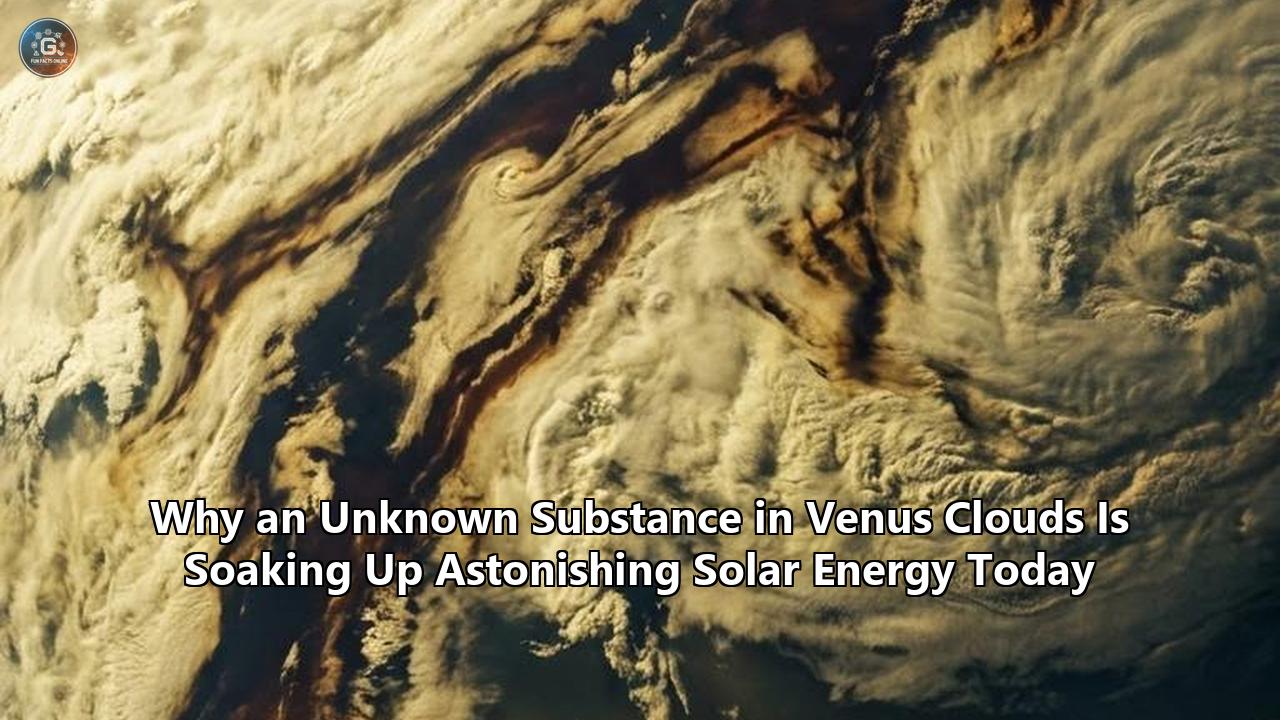
The upper atmosphere of Venus is staging a high-energy spectacle that modern planetary physics cannot fully explain. High above the planet's infernal, lead-melting surface—within the temperate, yellowish-white cloud deck spanning 50 to 70 kilometers in altitude—an unidentified chemical agent is intercepting and absorbing solar radiation at an extraordinary rate. Radiative-transfer models and space-probe measurements reveal that this upper layer absorbs more than half of all the solar energy captured by the entire Venusian system, concentrated predominantly in the near-ultraviolet and blue wavelengths between 320 and 500 nanometers.
Because pure sulfuric acid droplets—which make up the vast bulk of the Venusian cloud deck—are virtually transparent to near-ultraviolet and visible light, this massive energy deposition requires an external agent.
A landmark series of spectroscopic analyses, laboratory geochemical replications, and radiative inversions has calculated the absorption strength required of this phantom material. Radiative-transfer inversions derived from spacecraft observations reveal that if the light-absorbing material is dissolved inside the floating cloud droplets, its decadic absorption coefficient reaches roughly 1,278 $\text{cm}^{-1}$ at a wavelength of 375 nanometers. This means the material possesses an optical absorption strength comparable to concentrated biological pigments or complex conjugated organic dyes.
This localized absorption serves as the thermal powerhouse for the entire planet. The absorbed solar radiation creates immense planetary-scale thermal tides, generating the momentum that propels Venus's upper-atmosphere superrotation—a phenomenon in which high-altitude hurricane-force winds circle the globe in four Earth days, 60 times faster than the solid planet rotates beneath them.
Understanding why this unknown substance in Venus clouds is soaking up such solar energy requires tracing a multi-decade scientific detective story. The investigation spans early twentieth-century optical discoveries, mid-century Soviet and American planetary probes, modern orbital observatories, and new laboratory breakthroughs that are finally narrowing the search to an exotic clash between sulfur chemistry, meteoric iron, and aerial astrobiological theories.
========================================================================================
THE VENUSIAN SOLAR ENERGY BUDGET & THE UNKNOWN ABSORBER
========================================================================================
Solar Constant at Venus:                 ~2,600 W/m²
Planetary Bond Albedo:                  ~0.77 (77% reflected back to space)
Total Solar Energy Absorbed:            ~150–160 W/m² (Globally Averaged)
Absorption by Upper Clouds (55–70 km):  ~70–80 W/m² (Absorbed by the Unknown Substance)
Absorption at the Surface:              <20 W/m² (~2.5% of incident solar flux)
----------------------------------------------------------------------------------------
Primary Spectral Range:                 320 nm – 500 nm (Near-UV to Blue)
Peak Solution Absorption Coefficient:   ~1,278 cm⁻¹ at 375 nm
Primary Dynamic Consequence:            Diurnal Thermal Tides driving 100 m/s Superrotation
========================================================================================
1927–1965: The Early Photographic Signs
The mystery of the Venusian cloud markings began not with space probes, but through early photographic plates at the Mount Wilson Observatory. In 1927, American astronomer Frank E. Ross turned the 60-inch and 100-inch reflectors toward Venus, using newly developed photographic emulsions sensitive to distinct spectral bands.
When photographed in red and infrared light, Venus presented an entirely blank, featureless, and glaringly bright crescent. In visible yellow light, the disk remained opaque and smooth.
When Ross exposed plates filtered for ultraviolet light (around 360 to 380 nanometers), the blank facade vanished. The UV photographs exposed large, dusky, shifting patches, broad equatorial bands, and distinct Y- and V-shaped chevron markings spanning thousands of kilometers.
1927 (Ross / Mt. Wilson)         1960s (Boyer & Guérin)          1974 (Mariner 10 Flyby)
UV Photography reveals           High-speed 4-day                Flyby captures dynamic
dusky streaks on a blank disk    retrograde cloud superrotation   UV chevrons and eddies
       │                                │                                │
       ▼                                ▼                                ▼
[Phase 1: Optical Detection] ──► [Phase 2: Dynamic Mystery] ──► [Phase 3: Spacecraft Fleet]
These markings presented a physical paradox:
- The Reflection Enigma: Venus was known to possess a high Bond albedo, reflecting roughly 76% to 80% of all incident sunlight back into space.
- The Selective Blackout: In the near-ultraviolet range, this reflectivity plunged dramatically. Something sitting in or just above the cloud tops was soaking up ultraviolet wavelengths while reflecting yellow and red light almost untouched.
- Rapid Displacement: By the 1960s, French astronomers Charles Boyer and Pierre Guérin tracked these dark UV markings from the Pic du Midi Observatory. They noticed that individual dark features traversed the entire planetary disk in roughly four days, moving from east to west in a retrograde direction.
At the time, radar tracking of the solid surface by the Goldstone Deep Space Communications Complex and the Arecibo Observatory demonstrated that the planet rotated on its axis once every 243 Earth days.
The clouds were not simply drifting; they were circulating at speeds exceeding 360 kilometers per hour (100 meters per second). The atmospheric dynamics were coupled directly to the dark patches, but the identity of the chemical absorbing the light and driving this circulation remained completely unidentified.
1970–1985: Spacecraft Fleets and the Energy Deposition Crisis
The exploration of Venus accelerated rapidly during the 1970s through the American Mariner and Pioneer programs and the Soviet Venera missions. These missions transformed the unknown UV absorber from an optical curiosity into a central planetary puzzle.
========================================================================================
CHRONOLOGY OF EARLY IN-SITU & REMOTE OBSERVATIONS (1973–1985)
========================================================================================
Year   Mission            Key Instrument         Major Discovery / Constraint
----------------------------------------------------------------------------------------
1973   Ground Spectro.    Polarimetry Studies    Sulfuric acid droplets (H2SO4, 75–96%)
                                                 identified as primary cloud aerosol.
1974   Mariner 10 (NASA)  UV Television Camera   High-resolution global imaging of the
                                                 4-day UV circulation and wave modes.
1978   Pioneer Venus      Cloud Photopolarimeter Discovered distinct aerosol modes (1, 2, 3)
       (NASA)             & Solar Flux Radiometer and confirmed 50% solar energy capture.
1978   Venera 11/12       ISAV Spectrophotometer Measured solar flux vs. altitude; found
       (USSR)             & Optical Spectrometer rapid UV attenuation above 58 km.
1985   Vega 1/2 (USSR)    ISAV-A Nephelometers   Profiled aerosol size distributions and
                                                 confirmed localized chemical layering.
========================================================================================
In 1973, James E. Hansen and James B. Pollack analyzed ground-based polarimetry data and established that the Venusian clouds were composed of concentrated sulfuric acid ($\text{H}_2\text{SO}_4$, roughly 75% to 96% aqueous solution) in the form of micron-sized spherical liquid droplets. Concentrated sulfuric acid is a brilliant white scatterer across ultraviolet, visible, and near-infrared wavelengths; it possesses no electronic transitions in the near-UV or blue range and cannot absorb light between 320 and 500 nanometers.
Solar Spectrum
[ UV-C (100-280 nm) | UV-B/A (320-400 nm) | Visible (400-700 nm) | Infrared (700+ nm) ]
       │                     │                        │                    │
 Absorbed by SO2      ABSORBED BY THE           Reflected by        Absorbed by CO2
 and CO2 gases       UNKNOWN ABSORBER           H2SO4 Droplets      and H2SO4 Clouds
 (High Altitude)     (58 to 68 km Altitude)    (Gives Pale Hue)     (Thermal Blanketing)
In February 1974, Mariner 10 flew past Venus en route to Mercury. The spacecraft’s television cameras returned thousands of high-contrast ultraviolet frames. Mariner 10 showed that the dark absorber was organized into complex planetary-scale structures:
- Symmetrical circumpolar bands at high latitudes.
- Distinct equatorial convective patches.
- Complex wave trains suggesting shear instabilities and turbulence in the upper cloud deck.
The energy stakes were quantified in December 1978 when the Pioneer Venus Orbiter and four atmospheric entry probes entered the Venusian atmosphere. The Pioneer Venus Solar Flux Radiometer (LSFR), designed to measure the downward and upward flux of solar energy as a function of altitude, revealed that the planet’s energy budget was upside-down compared to Earth’s.
On Earth, roughly 50% of incoming solar energy passes through the atmosphere and is absorbed directly by the surface, which subsequently warms the lower troposphere from below.
On Venus, the Pioneer probes found that less than 2.5% of incident sunlight reaches the basaltic surface. Instead, roughly 50% of all solar energy absorbed by the planet is intercepted in the upper clouds between 58 and 68 kilometers above the surface.
Soviet Venera 11, 12, 13, and 14 descent landers confirmed this finding using spectrophotometers. As the Soviet probes descended through 65 kilometers down to 55 kilometers, solar flux in the 320–450 nm wavelength range decayed rapidly. The data proved that a massive thermal engine was operating in the upper atmosphere, absorbing hundreds of petawatts of power directly within a narrow, acidic atmospheric stratum.
Altitude (km)
   80 ─── Upper Haze Layer (Small sub-micron aerosols)
      ─────────────────────────────────────────────────────────────
   70 ─── Top of Upper Cloud Deck (0.1 bar, ~ -40°C)
      │   =========================================================
   65 ─── [ MAXIMUM SOLAR ABSORPTION ZONE: 320–500 nm ]
      │   [ Unknown Substance intercepts >50% absorbed solar flux ]
   60 ─── [ Temperature: 0°C to 40°C; Pressure: ~0.5 to 1.0 bar    ]
      │   =========================================================
   55 ─── Middle Cloud Deck
      ─────────────────────────────────────────────────────────────
   50 ─── Lower Cloud Deck (Dense, larger aerosols; Mode 3 particles)
      ─────────────────────────────────────────────────────────────
   45 ─── Cloud Base (~1.5 bar, ~100°C)
      │
    0 ─── Planetary Surface (92 bar, 465°C / 870°F, Lead-Melting Heat)
The Pioneer Venus Large Probe Nephelometer (LCPS), led by Robert Knollenberg, categorized the cloud droplets into three distinct morphological populations:
- Mode 1: Fine aerosol particles with radii around $r \approx 0.2\,\mu\text{m}$, populating the upper haze and cloud tops.
- Mode 2: The primary cloud droplets with radii around $r \approx 1.0\,\mu\text{m}$, consisting of classic liquid sulfuric acid droplets.
- Mode 3: Large, dense particles with radii spanning $r \approx 3.0\,\mu\text{m}$ to over $7.0\,\mu\text{m}$, concentrated in the middle and lower cloud decks (50 to 56 km).
Nephelometer and mass-spectrometer readings indicated that the unknown substance was concentrated within the Mode 1 and Mode 2 aerosol populations of the upper cloud deck, but might also be tied to the chemistry of the Mode 3 particles.
1986–2010: The Candidate Deadlocks
Between the mid-1980s and 2010, researchers proposed several chemical candidates to explain the mysterious absorption profile. Each candidate was tested against observational spectra and laboratory experiments, and each ran into severe chemical or physical bottlenecks.
========================================================================================
THE HISTORICAL BOTTLENECK: EVALUATION OF CANDIDATE ABSORBERS
========================================================================================
Proposed Candidate        Theoretical Strength           Critical Failure / Bottleneck
----------------------------------------------------------------------------------------
Sulfur Dioxide (SO2)      Abundant in upper atmosphere;  Absorption cuts off sharply at
                          strong UV absorber.            320 nm; completely transparent
                                                         between 320 and 500 nm.
----------------------------------------------------------------------------------------
Elemental Sulfur (S8)     Natural product of sulfur      Condenses into yellow crystals;
                          photochemistry; UV active.     absorption slope is too shallow;
                                                         rapidly precipitates out.
----------------------------------------------------------------------------------------
Disulfur Monoxide (S2O)   Fast photochemical intermediate; Absorption peaks too far in
                          broad UV band.                 deep UV; thermally unstable in
                                                         lower cloud regions.
----------------------------------------------------------------------------------------
Ferric Chloride (FeCl3)   Extremely strong UV/blue       Extremely low solubility in 85%
                          absorption in acidic solution. H2SO4; requires unknown crustal
                                                         transport mechanism to reach 65 km.
----------------------------------------------------------------------------------------
Phosphorus Compounds      Volcanic source candidate;     Incompatible with observed
(P4O6, P4O10)             UV active.                     spectroscopic bandwidth and
                                                         atmospheric oxygen fugacity.
========================================================================================
1. The Sulfur Dioxide ($\text{SO}_2$) Threshold
Gaseous sulfur dioxide is ubiquitous in the Venusian mesosphere, with mixing ratios ranging from 0.1 to hundreds of parts per million. $\text{SO}_2$ is a potent absorber of ultraviolet light, but its electronic absorption bands ($\tilde{A}^1\text{A}_2 \leftarrow \tilde{X}^1\text{A}_1$ and $\tilde{B}^1\text{B}_1 \leftarrow \tilde{X}^1\text{A}_1$) are restricted to wavelengths shorter than 320 nanometers.
Beyond 320 nanometers, $\text{SO}_2$ becomes completely transparent. It explains the high-altitude UV absorption below 300 nm, but leaves the wide 320–500 nm spectral sink unresolved.
2. The Elemental Sulfur Allotrope Hypothesis ($S_x$)
Atmospheric chemists hypothesized that the continuous photolysis of $\text{SO}_2$ by solar UV radiation produces free sulfur atoms ($S$), which polymerize into elemental sulfur allotropes:
$$\text{SO}_2 + h\nu \longrightarrow \text{SO} + \text{O}$$
$$\text{SO} + h\nu \longrightarrow \text{S} + \text{O}$$
$$\text{S} + \text{S} + \text{M} \longrightarrow \text{S}_2 + \text{M}$$
$$\text{S}_2 \xrightarrow{+\text{S}} \text{S}_3 \xrightarrow{+\text{S}} \text{S}_4 \dots \longrightarrow \text{S}_8$$
Cyclooctasulfur ($\text{S}_8$), the most stable form of elemental sulfur, forms yellow crystals and absorbs light in the near-UV. When researchers measured the optical constants ($n, k$) of amorphous and crystalline sulfur in the laboratory, the absorption edge proved too gradual.
$\text{S}_8$ could not reproduce the steep, distinct decline in absorption between 380 and 480 nm observed in the Venusian cloud deck. Smaller allotropes like disulfur ($\text{S}_2$), trisulfur ($\text{S}_3$), and tetrasulfur ($\text{S}_4$) offered stronger absorption features, but photolysis and thermal destruction rates meant their steady-state concentrations were orders of magnitude too low to account for the total missing energy.
Photolysis Cycle:
SO2 ──(hν < 220nm)──► SO + O
SO  ──(hν < 200nm)──► S  + O
S + S + M ──────────► S2 + M ──► S3 ──► S4 (Trace concentrations, fast thermal decay)
3. The Ferric Chloride ($\text{FeCl}_3$) Impasse
In the 1980s, planetary scientist Vladimir Krasnopolsky proposed that ferric chloride ($\text{FeCl}_3$), dissolved within the sulfuric acid cloud droplets, could act as the primary absorber. In laboratory solutions, trivalent iron ($\text{Fe}^{3+}$) dissolved in sulfuric acid produces a steep absorption profile matching Venus's observed UV-to-blue spectrum.
The hypothesis suffered from geochemical and microphysical barriers:
- Solubility Limits: Concentrated sulfuric acid (85–95%) dramatically suppresses the solubility of iron chlorides, precipitating iron sulfates that alter the required optical cross-section.
- Transport Difficulties: Ferric chloride has negligible vapor pressure at the cloud tops. Transporting millions of tons of iron from the surface up to an altitude of 65 kilometers without producing massive, detectable dust hazes in the lower atmosphere was physically problematic.
2011–2019: Decadal Albedo Swings and Coordinated Orbital Probes
Between 2006 and 2014, the European Space Agency’s Venus Express orbited the planet, carrying high-resolution instruments including the Venus Monitoring Camera (VMC), the SPICAV UV/IR spectrometer, and the VIRTIS imaging spectrometer. In late 2015, the Japan Aerospace Exploration Agency (JAXA) placed its Akatsuki orbiter into Venusian orbit, equipped with the Ultraviolet Imager (UVI) and the Longwave Infrared Camera (LIR).
========================================================================================
MODERN OBSERVATIONAL CAMPAIGN: ALBEDO VARIATION & DYNAMICS
========================================================================================
Platform          Operational Window    Core Findings / Spectroscopic Focus
----------------------------------------------------------------------------------------
Venus Express     2006–2014             Mapped long-term cloud top UV contrasts; tracked
(ESA)                                   polar vortex dynamics and SO2 variability.
----------------------------------------------------------------------------------------
Akatsuki (UVI)    2015–Present          Continuous dual-channel UV monitoring (283 nm SO2,
(JAXA)                                  365 nm Unknown Absorber); discovered thermal tides.
----------------------------------------------------------------------------------------
BepiColombo       2020 & 2021 Flybys    Simultaneous PHEBUS UV and MERTIS mid-IR global
(ESA/JAXA)                              mapping; cross-calibrated with Akatsuki.
========================================================================================
In 2019, an international research team led by Yeon Joo Lee (then at the University of Tokyo / CESSAR, later at South Korea's Institute for Basic Science) published an 11-year analysis combining data from Venus Express, Akatsuki, MESSENGER, and the Hubble Space Telescope. The study revealed that Venus’s ultraviolet albedo is not static: between 2006 and 2017, the planet’s reflectivity at 365 nanometers dropped by roughly 50% before rebounding.
Normalized 365 nm UV Albedo
1.2 ├───┐
1.0 ├───┼───\                 /───\
0.8 ├───┼────\               /     \
0.6 ├───┼─────\             /       \───── (Albedo halved between 2006 and 2017,
0.4 ├───┼──────\___________/                causing massive changes in wind speed)
0.2 ├───┼─────────────────────────────────
0.0 └───┴───────┴───────┴───────┴───────┴──
       2006    2009    2012    2015    2018
This massive change in UV albedo altered the amount of solar energy absorbed at the cloud tops, causing measurable shifts in the planet's atmospheric dynamics:
- When the concentration of the unknown substance venus clouds harbor increased, the cloud deck absorbed more solar energy.
- This increased thermal heating accelerated the high-altitude zonal winds, increasing wind speeds by 20 to 30 meters per second (over 70 km/h).
- When the albedo rebounded, the winds slowed down accordingly.
The observations confirmed that the unknown absorber directly controls the weather and climate of Venus.
Simultaneously, a research group led by Takeshi Horinouchi at Hokkaido University used Akatsuki's dual-channel UV camera (tracking $\text{SO}_2$ absorption at 283 nm and the unknown absorber at 365 nm) and infrared imagery to resolve the angular momentum paradox of Venus's superrotation.
Horinouchi’s team demonstrated that thermal tides—planetary-scale atmospheric waves driven by the day-to-night solar heating cycle—continuously pump angular momentum from the equator toward high latitudes and from lower altitudes upward.
Because the unknown absorber deposits huge amounts of heat specifically into the dayside cloud tops, it amplifies these thermal tides, acting as the primary engine driving Venus’s superrotation.
2018–2023: The Modern Chemical Divergence
As the energetic role of the unknown absorber became clear, laboratory chemists and astrobiologists explored contrasting theories to identify the molecule.
               ┌────────────────────────────────────────────────────────┐
               │    THE THREE COMPETING HYPOTHESES (2018–2023)          │
               └──────────────────────────┬─────────────────────────────┘
                                          │
       ┌──────────────────────────────────┼──────────────────────────────────┐
       ▼                                  ▼                                  ▼
[EXOTIC SULFUR CHEMISTRY]    [HETEROGENEOUS GEOCHEMISTRY]    [AERIAL BIOSPHERE HYPOTHESIS]
• Disulfur Monoxide (S2O)    • Ferric sulfates               • Aerial microbial biospheres
• OSSO Isomers (cis/trans)   • Meteoric iron salts           • Biological light harvesting
• High-order sulfur rings    • Suspended mineral dust        • Squalene / Porphyrin shields
The $OSSO$ and Disulfur Monoxide Pathway
In 2018, atmospheric chemists evaluated disulfur dioxide ($\text{S}_2\text{O}_2$) and its structural isomers. Sulfur monoxide ($\text{SO}$), formed via $\text{SO}_2$ photolysis, combines with itself to produce disulfur dioxide:
$$\text{SO} + \text{SO} \rightleftharpoons \text{S}_2\text{O}_2$$
Theoretical and spectroscopic calculations by Frandsen, Kjaergaard, and colleagues showed that disulfur dioxide exists in two primary conformational isomers: cis-$\text{OSSO}$ and trans-$\text{OSSO}$. Both isomers absorb near-ultraviolet radiation, photodissociating back into $\text{SO}$ radicals.
In 2022, Joseph S. Francisco (University of Pennsylvania), James R. Lyons (Planetary Science Institute), and collaborators published computational models in Nature Communications describing an atmospheric pathway:
$$\text{SO} + \text{S}_2\text{O} \longrightarrow \text{S}_2 + \text{SO}_2$$
They showed that chlorine compounds ($\text{ClCO}$, $\text{ClSO}_2$) catalyze the formation of disulfur monoxide ($\text{S}_2\text{O}$) and disulfur ($\text{S}_2$) much faster than unassisted pathways.
While this explained the formation of short-lived sulfur species, it faced a key limitation: $\text{OSSO}$ isomers and $\text{S}_2\text{O}$ have short photochemical lifetimes under the intense Venusian solar flux. They could not easily account for the sustained, stable absorption features extending out past 420 nanometers into the blue spectrum.
Catalytic Cycle of Sulfur-Chlorine Intermediates:
Cl + CO + M ────────► ClCO + M
ClCO + O2 ──────────► ClOO + CO
ClSO2 + hν ─────────► Cl + SO2
SO + S2O ──(Chlorine Catalysis)──► S2 + SO2 ──► Polysulfur Allotropes
The Astrobiological Provocation
In 2018, a team led by Sanjay Limaye of the University of Wisconsin–Madison's Space Science and Engineering Center published a paper in Astrobiology evaluating whether the unknown absorber could have a biological origin.
Building on early ideas from Harold Morowitz and Carl Sagan (1967) and planetary scientist David Grinspoon, Limaye noted that the Venusian clouds between 50 and 65 km altitude possess:
- Atmospheric pressures between 0.5 and 1.1 bar.
- Temperatures between $0^\circ\text{C}$ and $60^\circ\text{C}$ ($32^\circ\text{F}$ to $140^\circ\text{F}$).
- An abundance of solar radiation and sulfur-based chemical energy.
Limaye, along with researchers including Sara Seager (MIT) and Clara Sousa-Silva, suggested that microorganisms utilizing sulfur-based metabolisms could float in the cloud droplets. The dark UV markings could represent biological pigments—similar to terrestrial retinal, carotenoids, or porphyrin-ring systems—absorbing ultraviolet and blue sunlight for anoxygenic photosynthesis or as a protective shield against UV damage.
========================================================================================
HABITABILITY COMPARISON: EARTH SURFACE VS. VENUS CLOUD DECK (55–60 km)
========================================================================================
Parameter                   Earth Surface (Mean)        Venus Clouds (55–60 km)
----------------------------------------------------------------------------------------
Pressure                    1.013 bar                   0.5 – 1.0 bar
Temperature                 +15°C (288 K)               +10°C to +40°C (283–313 K)
Liquid Medium               Aqueous H2O                 Concentrated H2SO4 (75–90%)
Primary Gas Matrix          N2 (78%), O2 (21%)          CO2 (96.5%), N2 (3.5%)
Solar UV Flux (300–400 nm)  Attenuated by Ozone Layer   Extremely high unshielded flux
Energy Source for Life      Oxygenic Photosynthesis     Abundant UV / Chemical Redox
========================================================================================
The 2020 detection of trace phosphine ($\text{PH}_3$) in the Venusian atmosphere by Jane Greaves, Sara Seager, and their team fueled intense debate. While phosphine's abundance, persistence, and origin remain contested, the discussion highlighted how little is known about the non-equilibrium chemistry operating within the clouds.
2024–2026: The Laboratory Breakthroughs and Meteoric Dust
The investigation took a decisive step forward through targeted laboratory geochemistry and atmospheric modeling.
January 2024                    April 2026                      August 2026
Jiang, Rimmer, Tosca et al.     Karyu, Kuroda, Terada et al.    Spacek, Lee, et al.
Synthesize Rhomboclase & AFS;   Meteoric cosmic dust acts as    Radiative inversion sets
match UV/blue absorption edge.  Fe3+ feeder and aerosol nuclei. absorption ceiling at 1,278 cm⁻¹.
       │                                │                                │
       ▼                                ▼                                ▼
[Mineral-Acid Solution] ──────► [Meteoric Fe Infall] ─────► [Physical Absorption Limits]
1. Iron-Sulfur Minerals in Concentrated Acid (January 2024)
In a study published in Science Advances, Clancy Zhijian Jiang, Paul B. Rimmer, and Nicholas J. Tosca from the University of Cambridge, collaborating with Harvard University researchers, approached the problem by synthesizing iron-bearing sulfate minerals directly inside concentrated sulfuric acid solutions.
The Cambridge team recognized that iron could exist in the clouds not as simple dissolved ferric chloride, but as complex crystalline and solvated mineral phases. By suspending iron salts in sulfuric acid concentrations ranging from 70% to 95% and monitoring the resulting mineralogical transformations, they identified two stable mineral phases:
- Rhomboclase: $[(\text{H}_5\text{O}_2)\text{Fe}(\text{SO}_4)_2 \cdot 3\text{H}_2\text{O}]$
- Acid Ferric Sulfate (AFS): $[(\text{H}_3\text{O})\text{Fe}(\text{SO}_4)_2]$
Mineral Phase Formation in Cloud Droplets:
Fe³⁺ + H2SO4 + H2O ───(High Acidity, Variable H2O Activity)───►
      ├──► Rhomboclase [(H5O2)Fe(SO4)2 · 3H2O]
      └──► Acid Ferric Sulfate [(H3O)Fe(SO4)2]
When Jiang and Rimmer placed these synthesized minerals into Rimmer’s FlareLab spectrometer at the Cavendish Laboratory, the combination of rhomboclase, acid ferric sulfate, and dissolved $\text{Fe}^{3+}$ ions accurately matched the two-pronged absorption profile of Venus: strong absorption between 200 and 300 nm, and a steady, steep drop-off between 300 and 500 nm.
The researchers showed that the shifting balance between these mineral phases, driven by local variations in atmospheric humidity and sulfuric acid concentration, could explain the temporal and spatial changes in the cloud markings.
Absorption Coefficient (Arbitrary Units)
1.0 ├───\
0.8 ├───┼\  <-- Pure Rhomboclase + AFS Solution Spectrum
0.6 ├───┼─\
0.4 ├───┼───\
0.2 ├───┼────\___________________  <-- Matches Venusian Cloud UV-Blue Cliff
0.0 └───┴─────┴─────┴─────┴─────┴──
       300   350   400   450   500 Wavelength (nm)
2. The Meteoric Infall Mechanism (April 2026)
A major missing link in the iron model was the transport mechanism: how could millions of kilograms of iron reach the upper clouds without filling the lower atmosphere with dense iron dust?
In April 2026, a team led by Hiroki Karyu, Takeshi Kuroda, and Naoki Terada at Tohoku University, working with the Royal Belgian Institute for Space Aeronomy, published a paper in Nature Astronomy demonstrating that the iron is delivered from above, not below.
Meteoric Iron Delivery Model (Karyu et al., 2026):
Interplanetary Cosmic Dust / Meteors
                 │
                 ▼ (Ablation at 100–120 km)
Nanometer-Sized Metallic Smoke Particles (Fe, Mg, Si)
                 │
                 ▼ (Downward Sedimentation)
Enters Upper Cloud Deck (60–70 km)
                 │
                 ▼ (Dissolution & Reaction with H2SO4 Droplets)
Formation of Rhomboclase, AFS, and Fe³⁺ Complexes (The UV Absorber)
                 │
                 ▼ (Droplet Coalescence & Sinking)
Evaporation of H2SO4 in Lower Atmosphere (45–50 km)
                 │
                 ▼
Residual Solid Mineral Cores Form the Persistent Sub-Cloud Haze Layer
Meteors burning up in Venus's upper atmosphere (between 100 and 120 kilometers) leave behind metallic smoke particles rich in iron, magnesium, and silicon. These particles drift downward into the sulfuric acid clouds, where they dissolve to form iron sulfates, acting as nucleation seeds for cloud droplets.
The model showed that cosmic dust enhances Venus's cloud production by 20% to 30%, while supplying the iron required to sustain the upper cloud UV absorber.
The Absorption Ceiling and Modern Constraints
In August 2026, Dr. Jan Spacek from the Foundation for Applied Molecular Evolution, along with Dr. Yeon Joo Lee and an international consortium, published an analysis setting rigorous physical constraints on the unknown absorber.
The researchers used a radiative-transfer model accounting for multiple scattering across millions of cloud droplet paths, translating decades of astronomical and spacecraft observations into a standard laboratory metric: the decadic absorption coefficient ($\alpha$) of the bulk cloud liquid.
Spacek et al. (2026) Radiative Transfer Inversion:
Observed Planetary Reflectance ──► Inversion Model ──► Decadic Absorption Coefficient (α)
                                                       α = 1,278 cm⁻¹ at λ = 375 nm
========================================================================================
DECIMAL ABSORPTION COEFFICIENTS AND REQUIRED CONCENTRATIONS (AT 375 nm)
========================================================================================
Material Class Typical Extinction Coeff. Required Liquid Concentration
----------------------------------------------------------------------------------------
Inorganic Sulfur Compounds Low to Moderate (10–100 M⁻¹cm⁻¹) 100 to >500 g/L (Chemically Unfeasible)
Iron Sulfates (AFS/Rhomb.) Moderate (500–2,000 M⁻¹cm⁻¹) 10 to 50 g/L (Near Upper Solubility)
Conjugated Poly-Organics High (10,000–50,000 M⁻¹cm⁻¹) 1 to 10 g/L (Feasible)
Porphyrinoid / Bio-Pigments Ultra-High (>100,000 M⁻¹cm⁻¹) 0.1 to 1.0 g/L (Highly Efficient)
========================================================================================The study's findings narrowed the physical parameters:
- The Absorption Peak: To produce the observed ultraviolet darkness, the liquid within Venus’s cloud droplets must have a decadic absorption coefficient of approximately $1,278\text{ cm}^{-1}$ at 375 nanometers.
- The Concentration Problem: If the absorber is a standard inorganic sulfur compound, it must be present in concentrations so high that the droplets would no longer be sulfuric acid solutions, violating polarimetry observations.
- The Organic/Pigment Alternative: If the absorber consists of conjugated organic molecules or porphyrin-like structures with very high molar extinction coefficients ($\epsilon > 50,000\,\text{M}^{-1}\text{cm}^{-1}$), it could achieve this absorption at concentrations of only 1 to 10 grams per liter of cloud liquid.
- The Spectral Cutoff Rule: The study showed that random organic mixtures exposed to concentrated sulfuric acid form brown or black tar-like solutions that absorb broadly across the entire visible spectrum. Because Venus reflects green, yellow, and red light cleanly, the unknown absorber cannot be generic organic residue; it must be a specific chromophore with a sharp electronic cutoff between 375 and 450 nanometers.
Atmospheric Dynamics: How Solar Absorption Drives Venusian Superrotation
The concentration of absorbed solar energy in the upper cloud deck creates extreme atmospheric motions. On Venus, the solar constant is roughly $2,600\,\text{W/m}^2$, nearly double that of Earth.
With an overall planetary Bond albedo of $A \approx 0.77$, the globally averaged absorbed solar flux is roughly $150\,\text{W/m}^2$. More than $70\,\text{W/m}^2$ of this energy is deposited directly into the cloud tops (55 to 68 km) by the unknown absorber.
Incoming Solar Energy: ~2,600 W/m²
      │
      ├── [77% Reflected Back to Space (Albedo ~ 0.77)]
      │
      └── [23% Absorbed by the Planet (~150 W/m² globally averaged)]
            │
            ├── >50% (~75 W/m²)  ──► Upper Clouds (Absorbed by the Unknown Substance)
            ├── ~40% (~60 W/m²)  ──► Middle Clouds & Gas Columns
            └── <10% (<15 W/m²)  ──► Surface Basalt
This heating profile generates atmospheric superrotation:
Solar Heating of the Unknown Absorber (Dayside Cloud Deck)
                         │
                         ▼
Localized Atmospheric Expansion & Strong Thermal Tides
                         │
                         ▼
Upward and Equatorward Momentum Flux Divergence:
          ∂(u'v')/∂y  and  ∂(u'w')/∂z
                         │
                         ▼
Acceleration of Upper Cloud Zonal Flow to >100 m/s (Superrotation)
                         │
                         ▼
Global Heat Redistribution from Dayside to Nightside within 4 Days- Thermal Expansion and Pressure Perturbations: The absorbed energy heats the dayside cloud tops, causing the atmosphere to expand and producing large diurnal and semi-diurnal thermal tides.
- Momentum Transport: These thermal tides create phase-tilted atmospheric waves. As these waves propagate vertically and horizontally, their Reynolds stress components ($\overline{u'v'}$ and $\overline{u'w'}$) deposit net westward momentum into the equatorial upper cloud deck.
- Equatorial Acceleration: The momentum deposition accelerates the zonal winds at the equator until they reach an equilibrium speed of roughly 100 meters per second, balancing eddy diffusion and planetary wave dissipation.
- Global Redistribution: The 4-day superrotation carries heat rapidly to the nightside, preventing extreme day-to-night temperature drops and maintaining a nearly uniform cloud-top temperature across the planet.
Without this high-altitude solar absorption, the thermal tides would weaken, and the 60:1 superrotation of the atmosphere would collapse into a slower, classical circulation system.
2026–2035: Planned In-Situ Exploration
Solving the identity of the unknown absorber has become a primary objective for a fleet of international missions scheduled to visit Venus over the coming decade.
========================================================================================
UPCOMING MISSION TIMELINE TARGETING THE VENUSIAN CLOUDS
========================================================================================
Launch Target   Mission / Agency         Payload / Architecture  Key Measurement Target
----------------------------------------------------------------------------------------
Late 2020s      Venus Life Finder (VLF)  Private/Rocket Lab;     Single-channel Autofluor-
                / Morning Star (MIT)     Entry Probe             escence Nephelometer (AFN);
                                                                 organic detection in clouds.
----------------------------------------------------------------------------------------
~2031           DAVINCI                  Descent Sphere;         VMS (Mass Spectrometer) &
                (NASA Discovery)         VCS, VASI, DISCO        VFX; in-situ noble gases, trace
                                                                 metals, iron-sulfur profiling.
----------------------------------------------------------------------------------------
~2031           VERITAS                  High-Res Radar &        Global gravity, deformation,
                (NASA Discovery)         Infrared Emissivity     and volcanic gas source tracking.
----------------------------------------------------------------------------------------
~2031–2035      EnVision                 Polar Orbiter;          VenSpec-U suite: high-res UV
                (ESA)                    VenSpec Suite, VenSAR   spectroscopy of cloud markings.
========================================================================================
Late 2020s ~2031 ~2031–2035
Rocket Lab / MIT Probe Plunge NASA DAVINCI Descent Sphere ESA EnVision Orbit
Measures cloud autofluorescence In-situ mass spec & chemistry VenSpec-U maps absorber
for organic signatures profiles Mode 1-3 droplets dynamics globally
│ │ │
▼ ▼ ▼
[Probe Direct Descent] ───────► [In-Situ Gas/Aerosol MS] ─────► [Global High-Res Mapping]1. Rocket Lab / MIT Venus Life Finder (VLF)
The Morning Star / Venus Life Finder mission series, spearheaded by Sara Seager at MIT and funded in part through Rocket Lab, features a small descent probe designed to plunge into the Venusian cloud deck.
The primary instrument, the Autofluorescence Nephelometer (AFN), directs a 440-nanometer polarized laser into individual cloud droplets during its five-minute descent through the 48-to-65-kilometer layer.
If the unknown substance in Venus clouds contains complex organic ring systems, conjugated polyenes, or aromatic minerals, the laser will induce characteristic fluorescence, measuring both droplet size and chemical character in real time.
Laser Transmitter (440 nm Polarized) ──► Cloud Droplet ──► [Reflected Light (Size/Shape)]
                                                      └──► [Fluorescence (Organic/Mineral Signature)]
2. NASA's DAVINCI Mission
NASA’s DAVINCI (Deep Atmosphere Venus Investigation of Noble gases, Chemistry, and Imaging) mission features an atmospheric descent sphere that will fall through the clouds for 63 minutes. DAVINCI carries the Venus Mass Spectrometer (VMS) and the Venus Tunable Laser Spectrometer (VTLS), which will ingest cloud droplets, volatilize their chemical components, and measure the molecular mass of trace sulfur allotropes, iron complexes, and chlorine species.
DAVINCI will directly measure whether the Mode 3 particles in the lower clouds carry the chemical seeds of the upper-atmosphere UV absorber.
Descent Path:
Altitude 70 km ──► Probe Deployed ──► VMS & VTLS Ingestion of Droplets
                                  ──► Direct Flash-Pyrolysis Mass Spec
                                  ──► Resolves Fe, S, Cl, and Organic Isotopes
Altitude 0 km  ──► Surface Impact
3. ESA’s EnVision Mission
The European Space Agency’s EnVision orbiter will carry the VenSpec suite, including VenSpec-U, an ultra-high-resolution ultraviolet spectrometer specifically designed to map the unknown absorber and sulfur dioxide concurrently from orbit.
VenSpec-U will monitor twin absorption bands at high spatial resolution, tracking how planetary waves, volcanic plumes, and solar flares alter the distribution of the unknown absorber across seasons and latitudes.
Unresolved Questions and Implications for Exoplanetary Science
The century-long search for the unknown absorber has expanded beyond solar system boundaries. As the James Webb Space Telescope (JWST) and upcoming ground observatories (such as the Extremely Large Telescope and the Giant Magellan Telescope) characterize the atmospheres of terrestrial exoplanets orbiting M-dwarf stars, Venus has become a primary analog.
========================================================================================
CURRENT STATUS OF HYPOTHESES & CRITICAL RESOLUTION TESTS
========================================================================================
Hypothesis               Leading Evidence                Crucial Test Required
----------------------------------------------------------------------------------------
Meteoric Iron Sulfates   Lab spectra of rhomboclase and  Direct in-situ mass detection
(Rhomboclase / AFS)      acid ferric sulfate match the   of dissolved Fe3+ inside upper-
                         300–500 nm profile accurately.  cloud droplets by DAVINCI / VLF.
----------------------------------------------------------------------------------------
Photochemical Sulfur     Rapid catalytic formation of    Laboratory synthesis of stable
Chains (OSSO, S2O, S4)   S2O and OSSO isomers via        sulfur polymers matching the
                         chlorine-assisted chemistry.    steep 380–480 nm absorption drop.
----------------------------------------------------------------------------------------
Aromatic Organic /       Unprecedented absorption cross- Measurement of droplet autofluor-
Biological Pigments      section (1,278 cm⁻¹) requires   escence by the Rocket Lab / MIT
                         high molar extinction dyes.     Nephelometer during cloud descent.
========================================================================================
Many exoplanets in the habitable zones of red dwarf stars are tidally locked or rotate very slowly, similar to Venus's 243-day rotation period. If these worlds develop thick, cloud-forming atmospheres containing sulfur, iron, or carbon-based UV absorbers, their global circulation will be dominated not by planetary spin (Coriolis forces), but by absorber-driven thermal tides.
The presence of a strong upper-atmosphere absorber can drive atmospheric superrotation, redistributing heat from the permanent dayside to the frozen nightside and fundamentally altering planetary habitability.
Slow Planetary Rotation + Upper Cloud UV Absorber
                       │
                       ▼
Absorber-Driven Thermal Tides Dominate Atmospheric Dynamics
                       │
                       ▼
Fast Global Superrotation (Dayside-to-Nightside Heat Transfer)
                       │
                       ▼
Prevents Atmospheric Collapse / Freezing on Nightside of Exoplanets
Whether the unknown substance venus clouds harbor turns out to be meteoric iron sulfates, exotic sulfur-chlorine polymers, or complex organic chromophores, its impact remains undisputed: a mysterious trace chemical, suspended in droplets of sulfuric acid, is capturing hundreds of petawatts of solar power, controlling the planetary albedo, and driving the wind systems of Earth's nearest planetary neighbor. The answer now awaits direct in-situ sampling by upcoming probes.
Reference:
- https://www.sci.news/space/unknown-uv-absorber-venus-clouds-15023.html
- https://nautil.us/seeking-signs-of-life-on-venus-1238038
- https://arxiv.org/html/2506.06164v1
- https://www.space.com/venus-sulfur-clouds-mystery-computer-model
- https://www.cam.ac.uk/research/news/mysterious-missing-component-in-the-clouds-of-venus-revealed
- https://www.facebook.com/AmericanGeophysicalUnion/posts/clouds-around-venus-rotate-much-more-quickly-than-the-planet-itself-new-research/1240566001450937/
- https://www.smithsonianmag.com/smart-news/forces-behind-venus-super-rotating-atmosphere-180974762/
- https://www.scielo.org.mx/scielo.php?script=sci_arttext&pid=S0187-62362026000100107
- https://www.sci.news/space/unidentified-absorbers-venus-07560.html
- https://www.universetoday.com/articles/stardust-in-the-clouds-of-venus
- https://skyandtelescope.org/astronomy-news/venus-clouds-puzzle-scientists/
- https://elib.dlr.de/131761/1/EPSC-DPS2019-68-1.pdf
- https://planetpailly.com/2018/03/12/molecular-monday-venuss-formerly-unknown-absorber/
- https://penntoday.upenn.edu/news/new-analysis-shows-how-sulfur-clouds-can-form-venus-atmosphere
- https://www.esc.cam.ac.uk/news/mysterious-missing-ingredient-clouds-venus-revealed
- https://pmc.ncbi.nlm.nih.gov/articles/PMC10776003/