In mid-June 2026, a series of theoretical papers and quantum simulation results sent a quiet shockwave through the high-energy physics community. For decades, physicists have treated spacetime as a passive, albeit flexible, stage—a smooth four-dimensional fabric bent by mass and energy, upon which the drama of the universe plays out.
But a provocative new framework published in The Journal of Cosmology and Astroparticle Physics (JCAP) suggests we have been looking at reality backward.
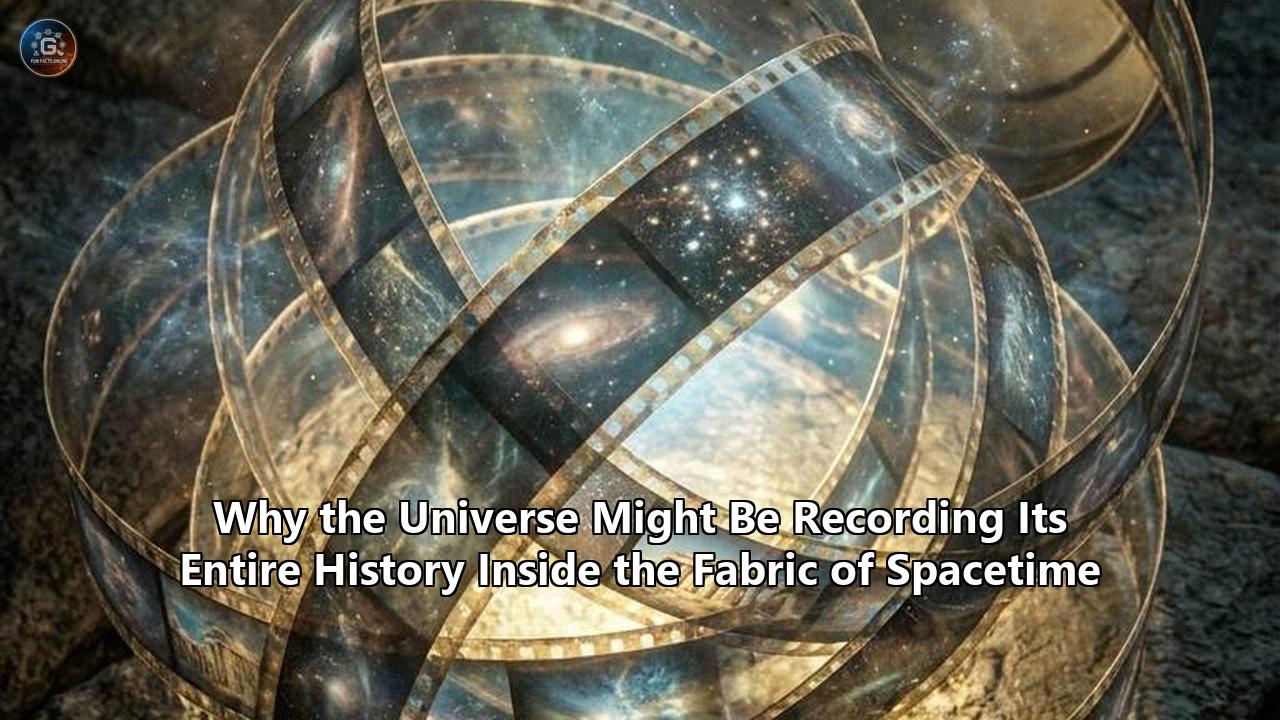
The universe, according to this emerging paradigm, is not a blind machine churning through states of matter; it is a self-archiving cosmic hard drive. At the ultra-microscopic Planck scale, the fabric of space and time is constantly writing, preserving, and updating a permanent, unerasable record of every physical event, particle decay, and gravitational ripple that has ever occurred.
This framework, known as the Quantum Memory Matrix (QMM), represents a profound departure from classical cosmology. Developed by an international consortium of researchers, the theory replaces the traditional concept of empty space with a highly structured, discrete network of information-storing "cells".
By treating information—rather than matter, energy, or even geometry—as the fundamental currency of physical reality, QMM offers a unifying mathematical key. If it holds, this model of spacetime information storage does not just bridge the century-old chasm between Einstein’s general relativity and quantum mechanics. It provides a radical, elegant solution to the deepest crises in modern physics: the black hole information paradox, the elusive nature of dark matter, and the runaway expansion driven by dark energy.
Inside the Quantum Memory Matrix: The Mechanics of Cosmic Memory
To understand how spacetime acts as a ledger, one must zoom past the molecular, atomic, and subatomic realms down to the Planck length ($1.6 \times 10^{-35}$ meters). Here, the smooth continuum of Einsteinian spacetime dissolves. Instead of a continuous void, QMM models spacetime as a vast, interconnected lattice of discrete cells, each operating as a biological-like node or a quantum register.
Every time a particle moves through space, every time an electromagnetic wave oscillates, and every time a force is exerted, the affected spacetime cells undergo a subtle, irreversible shift in their quantum state. This is not merely a transient reaction; it is a permanent physical scar.
[Particle Path] ---> [Spacetime Cell A] ---> [Spacetime Cell B]
                           |                         |
                    [Quantum Imprint]         [Quantum Imprint]
                           |                         |
                    Permanent Record          Permanent Record
The mathematical engine of this theory is what researchers call the imprint operator. First formulated in a preliminary 2024 paper and extensively developed through early 2026, the imprint operator is a collection of mathematical functions that describe how localized quantum states copy their structural profiles into the background geometry of space.
Unlike classical systems where reading or copying information introduces thermal noise or requires energy expenditure, the QMM imprint operator is a fundamental, reversible rule built directly into the quantum equations of the vacuum.
To verify that such a memory-like structure is physically viable and not just a mathematical fantasy, researchers didn't just scribble on blackboards; they built and ran the equations on modern quantum hardware. Using superconducting qubits as surrogates for individual Planck-scale spacetime cells, the team engineered a series of "imprint and retrieval" protocols.
They allowed a simulated quantum state to pass through a cluster of qubits, leaving behind a calculated imprint. When they applied a reverse version of the imprint operator to the "empty" space left behind, they successfully reconstructed the original particle state with an astonishing accuracy of over 90 percent.
This bench-test demonstration proved that spacetime-like architectures are naturally optimized for high-fidelity information retention. When a physical event occurs, the local geometry does not simply return to an idle equilibrium; it "freezes" a record of the event in its local quantum entanglements. The universe, quite literally, does not just happen; it remembers.
The Physics of the Ledger: Geometry-Information Duality
The theoretical leap that allows QMM to rewrite cosmology is what the authors term geometry-information duality.
In classical general relativity, gravity is the manifestation of geometry. Matter and energy tell spacetime how to curve, and curved spacetime tells matter how to move. This is captured by Einstein’s famous field equations:
$$G_{\mu\nu} + \Lambda g_{\mu\nu} = \frac{8\pi G}{c^4} T_{\mu\nu}$$
Here, the left side of the equation ($G_{\mu\nu}$) represents the geometry of spacetime, while the right side ($T_{\mu\nu}$) represents the distribution of stress, energy, and momentum.
Under the geometry-information duality of QMM, this equation is augmented by a third variable: the local density of quantum information, specifically the configuration of quantum entanglement. The shape of space is dictated not merely by the presence of bulk mass or moving energy, but by how much history—how many localized quantum imprints—has been etched into those coordinates.
This means that a region of space that has witnessed highly energetic or complex quantum interactions has a fundamentally different "memory energy" than a region of pristine, unvisited vacuum. This memory energy ($E_{\text{mem}}$) is mathematically proportional to the trace of the residual geometric deformations left behind by physical events:
$$E_{\text{mem}} \propto \text{Tr}(A_{\mu\nu} A^{\mu\nu})$$
where $A_{\mu\nu}$ represents the permanent deformation tensor of the local metric.
This relationship establishes a profound link between thermodynamics, quantum information, and gravity. It suggests that the arrow of time itself is not merely a statistical consequence of entropy increasing in closed systems. Instead, the geometric arrow of time is driven by the steady, cumulative accrual of physical imprints in the universal ledger.
Every time a star burns, every time a planet orbits, and every time a brain thinks, the universe’s capacity for spacetime information storage is incrementally utilized, altering the baseline geometry of the cosmos itself.
The Gravitational Wave Memory Effect: Spacetime's Unerasable Wake
While Planck-scale cells are far too small to be probed by current particle accelerators, general relativity predicts a macro-level phenomenon that serves as a direct, observable analog to this microscopic storage: the gravitational wave memory effect.
When massive, violent cosmic events occur—such as the collision and merger of two stellar-mass black holes—they radiate immense ripples through the fabric of spacetime. These are gravitational waves, first directly detected by LIGO in 2015. Standard astrophysics teaches us that as these waves pass through a region of space, they temporarily stretch and squeeze the distances between objects, which then return to their original configurations once the wave passes.
But general relativity has a hidden, nonlinear secret.
First proposed in the linear approximation by Soviet physicists Yakov Zel'dovich and Alexander Polnarev in 1974, and later expanded into a full, nonlinear description by Demetrios Christodoulou in the 1990s, the gravitational wave memory effect states that spacetime does not return to its original shape after the ripples depart. Instead, the passing of a gravitational wave leaves a permanent, irreversible shift in the local geometry.
[Inertial Masses] ---> (GW Wave Passes) ---> [Permanently Shifted Masses]
      | |                                                |   |
  Distance: D                                        Distance: D + ΔD
If you had two freely floating test masses in space and a gravitational wave passed through them, they would be permanently displaced relative to one another. The distance between them would change by a tiny, fractional amount ($\Delta D$) proportional to the total energy radiated by the source.
This permanent deformation is a physical record of the cataclysmic merger that occurred millions of light-years away. Spacetime is physically "keeping score".
This macro-level memory was long thought to be an isolated quirk of general relativity’s complex mathematics. However, a landmark paper published in early 2026 by Austrian physicist Thomas Mieling and his collaborators in Physical Review D has built an explicit bridge between these macroscopic deformations and quantum information.
Mieling’s team analyzed gravitational wave bursts in idealized plane-wave spacetimes. They derived a set of four unique "memory tensors" ($M_{ij}$) that characterize how a gravitational wave permanently alters not just the positions of macroscopic masses, but the scattering behaviors of quantum fields, massless scalar fields, and spinning particles.
Mieling’s equations demonstrate that if you send a massless quantum field through a region of spacetime that has been crossed by a gravitational wave, the field scatters in a highly specific, mathematically predictable way. By measuring how the field has shifted, an observer can reconstruct the exact energy, direction, and polarization of the gravitational wave that passed through that region in the distant past.
This is the macro-scale equivalent of spacetime information storage. The memory tensors act as a physical encryption key, locking the history of cosmic events directly into the vacuum coordinates.
Understanding the Infrared Triangle
The connection between this permanent geometric displacement and quantum information runs even deeper, straight into the heart of quantum gravity.
In 2014, Harvard physicist Andrew Strominger revealed that the gravitational wave memory effect is not an arbitrary mathematical artifact. Instead, it is one leg of a profound, three-way equivalence known as the Infrared Triangle:
                     [BMS Symmetries]
                     (Supertranslations)
                           /\
                          /  \
                         /    \
                        /______\
[Weinberg's Soft Theorem]      [Gravitational Memory Effect]
This mathematical triad links three completely different areas of physics:
- The Gravitational Memory Effect: The permanent physical displacement of spacetime coordinates after a wave passes.
- Weinberg's Soft Graviton Theorem: A quantum field theory formula describing how low-energy ("soft") gravitons interact with other particles.
- BMS Symmetries (Supertranslations): An infinite-dimensional group of symmetries discovered in 1962 by Hermann Bondi, Louis Metzner, and Rainer Sachs.
BMS symmetries prove that even at "null infinity"—the boundary of our universe where light rays end—spacetime retains an infinite number of conserved charges, or "supertranslations".
When a gravitational wave passes, it acts as a supertranslation, permanently shifting the coordinates of the universe. Observers who initially agreed on their spatial coordinates will permanently disagree on those coordinates after the wave has passed.
This coordinate shift is not an empty gauge artifact. It represents a change in the physical state of the vacuum itself. The vacuum is degeneracy-rich; it has an infinite number of possible ground states, each distinguished by the "memory" of the soft gravitons and gravitational waves that have crossed it.
In this light, Strominger’s Infrared Triangle provides the rigorous mathematical backing for QMM: it proves that the very fabric of spacetime possesses an infinite capacity to store low-energy, long-lived quantum information.
Rewriting the Black Hole Information Paradox
For fifty years, the black hole information paradox has stood as the ultimate brick wall in the search for a unified theory of quantum gravity.
In 1974, Stephen Hawking calculated that black holes are not completely black; they slowly emit thermal radiation due to quantum effects near the event horizon. If a black hole is left isolated, it will eventually evaporate completely into this thermal "Hawking radiation".
The crisis lies in the nature of this radiation. According to Hawking’s original calculations, the emitted radiation is purely thermal and completely random. It carries no information about what fell into the black hole.
If you throw an encyclopedia, a computer, or a star into a black hole, and the black hole evaporates into featureless heat, all the physical information contained in those objects is permanently erased from the universe.
This violates a sacred tenet of quantum mechanics: unitarity. Unitarity dictates that physical states must evolve in a way that is mathematically reversible. The past must always be reconstructible from the present.
If information is destroyed in a black hole, the core mathematical structure of quantum theory collapses.
Classic Hawking Scenario:
[Matter In] ---> [Black Hole] ---> [Featureless Thermal Radiation] (Information Destroyed!)

QMM Scenario:
[Matter In] ---> [Event Horizon] ---> [Spacetime Cells Local Buffer] ---> [Information Preserved in Metric]
To resolve this, physicists have proposed complex, highly contentious workarounds:
- Black Hole Complementarity: The idea that information is both reflected at the event horizon and passes through, but no single observer can ever see both.
- The Firewall Paradox (AMPS): The assertion that a highly energetic wall of fire exists just inside the event horizon, burning any incoming observer to ash to prevent info duplication.
- AdS/CFT Holography: The proposal that a black hole in a bulk 5D space is mathematically equivalent to a hot quantum fluid on a 4D boundary, meaning information is preserved on the outer "holographic" boundary.
However, the Quantum Memory Matrix framework sidesteps these convoluted, paradox-ridden mechanisms by utilizing its native spacetime information storage capabilities.
In the QMM model, as matter falls toward the event horizon, it doesn't simply cross a mathematical boundary into a void. Instead, the intense gravitational field and extreme curvature trigger the local "imprint operator" at its maximum capacity.
The infalling matter’s quantum states are continuously cloned and written directly into the discrete spacetime cells surrounding the black hole.
Because these spacetime cells are located outside the event horizon in the surrounding coordinate fabric, the information is never actually trapped behind the point of no return. The black hole’s bulk mass may collapse into a singularity, but its structural blueprint, quantum states, and history remain securely archived in the regional spacetime ledger.
When the black hole slowly evaporates, it is not releasing newly created information from its interior. Rather, the evaporating radiation interacts with the pre-existing, highly structured imprints stored in the local spacetime cells.
The Hawking radiation acts as a "read head," sweeping over the cosmic tape drive and carrying the stored information back out into the wider universe.
Unitarity is perfectly preserved. The information was never lost because the void itself was acting as the ultimate, indestructible vault.
Dissolving Dark Matter and Dark Energy into Bitstreams
While resolving the black hole information paradox is a monumental theoretical victory, the QMM framework's most explosive claims lie in how it addresses the dark sector of cosmology.
For nearly a century, astronomers have observed that galaxies rotate far too fast at their outer edges. According to the laws of gravity, the visible mass in a galaxy is insufficient to hold its outer stars in orbit; they should fly off into deep space.
To explain this, physicists postulated dark matter: an invisible, non-interactive form of matter that clusters around galaxies, providing the extra gravitational pull needed to keep them intact.
Yet, despite decades of searching with underground liquid xenon detectors, deep-space telescopes, and the Large Hadron Collider, we have found zero physical evidence of dark matter particles (such as Weakly Interacting Massive Particles, or WIMPs, and axions).
QMM offers a startling alternative: dark matter does not exist as a physical particle.
Instead, the anomalous gravitational pull we attribute to dark matter is the collective gravitational influence of accumulated, highly entangled spacetime imprints.
Standard Cosmology:
Galaxy Rotation ---> Kept stable by ---> Invisible Halo of Undetected Dark Matter Particles

QMM Cosmology:
Galaxy Rotation ---> Kept stable by ---> Localized Gravitational Pull of Entangled Spacetime Imprints (Cosmic Memory)
Because of geometry-information duality, regions of space with high concentrations of historical physical activity (such as galactic centers and stellar nursery zones) have accumulated a massive ledger of quantum imprints. This high density of stored information possesses its own inherent "memory energy".
Because energy is equivalent to mass ($E=mc^2$), these dense webs of spacetime imprints exert a real, measurable gravitational pull on surrounding matter.
In a paper currently undergoing rigorous peer review, the QMM research consortium demonstrated that these "clumps of imprints" naturally cluster under gravity in a way that matches the observed rotational curves of galaxies.
They warp the local metric exactly like a halo of dark matter would, but without requiring a single new exotic particle. Galaxy rotation is not being stabilized by a cloud of invisible dust; it is being stabilized by the localized weight of the galaxy’s own history.
The Cosmic Memory Limit and Dark Energy
If dark matter is the weight of active cosmic memory, dark energy is what happens when that memory runs out of space.
In 1998, astronomers discovered that the expansion of the universe is not slowing down under the pull of gravity; it is accelerating. This acceleration is driven by dark energy, which physicists mathematically represent as the cosmological constant ($\Lambda$).
The cosmological constant describes a uniform, repulsive energy density inherent to the vacuum of space. However, quantum field theory calculations predict that this vacuum energy should be $10^{120}$ times larger than what we actually observe—a discrepancy widely considered the worst theoretical prediction in the history of science.
QMM resolves this "vacuum catastrophe" by introducing a fundamental thermodynamic ceiling: the Bekenstein bound.
Every region of space, regardless of its size, has a finite maximum information storage capacity dictated by its boundary area. A single cubic meter of space can only hold a certain number of bits before it becomes saturated.
As the universe evolves, stars burn, and matter interacts, more and more spacetime cells are driven to their maximum storage limit. When these cells become saturated, they can no longer accept new, independent quantum imprints.
Instead of functioning as active registers, these saturated cells lapse into a locked, baseline quantum state. This frozen, saturated state contributes a tiny, residual, non-zero energy to the local vacuum.
Mathematically, this leftover contribution matches the exact scale and behavior of the observed cosmological constant ($\Lambda$).
[Spacetime Cell] ---> (Information Limit Reached) ---> [Saturates / Freezes] ---> [Generates Residual Vacuum Energy] ---> (Dark Energy)Dark energy, in the QMM model, is not a mysterious, anti-gravitational fluid. It is the cumulative thermodynamic pressure of a cosmic hard drive that is slowly filling up.
This explains why dark energy only became dominant relatively late in the universe's history: in the early universe, very little information had been processed, and few spacetime cells were saturated.
As the eons passed and cosmic complexity grew, the saturation front expanded, causing the vacuum pressure to climb and trigger the accelerating expansion we observe today.
The 62-Billion-Year Cosmic Cycle and the Information Bound
Perhaps the most radical cosmological implication of the QMM framework is its prediction of a cyclic universe.
According to standard Big Bang cosmology, our universe began roughly 13.8 billion years ago as an infinitely hot, infinitely dense singularity, and will continue to expand forever until it suffers a cold, dark "heat death".
But in their June 2026 cosmological paper accepted for publication in The Journal of Cosmology and Astroparticle Physics, the QMM team outlines a vastly different destiny.
Because spacetime has a finite capacity for spacetime information storage, the universe cannot expand indefinitely without eventually hitting an absolute cosmic boundary.
When the total entropy—the total measure of physical disorder and recorded information—reaches the absolute theoretical limit of the entire cosmic volume, a phase transition occurs.
At this saturation point, the universe’s coordinate cells can no longer support further expansion or physical changes.
[Expansion Epoch] ---> [Absolute Information Limit Reached] ---> [Slowing / Contraction] ---> [Cosmic Bounce] ---> [New Cycle]To prevent a catastrophic violation of quantum information conservation, the universe is forced to undergo a geometric contraction.
However, this contraction is not a symmetric mirror of the expansion. Each cycle of expansion and contraction deposits a residual layer of structural entropy into the spacetime fabric.
When the contracting universe reaches its densest point, the saturated spacetime cells act as a physical barrier. The cosmic medium cannot compress down to an infinitely dense point (a singularity) because there is no room left to pack the stored quantum information.
Instead of collapsing into a mathematical void, the universe "bounces".
The JCAP paper demonstrates that this "information bounce" triggers a new Big Bang, initiating a fresh cycle of expansion.
However, because some residual memory is carried over through the quantum state of the bounced metric, the true "informational age" of our cosmos is calculated to be roughly 62 billion years—encompassing multiple previous, unrecorded cycles of expansion and contraction—rather than the 13.8 billion years of our current expansion phase.
Eventually, after a finite number of bounces, the accumulated structural entropy completely saturates the universal metric. At that point, the universe enters a final, stable era of slow, perpetual expansion, where no new physical cycles can occur.
We are currently living in the active, dynamic "recording phase" of this grand cosmic cycle, coasting on the memory-rich remnants of previous universes.
The Academic and Philosophical Battlegrounds
As with any theory that promises to sweep away decades of established physics, the Quantum Memory Matrix has ignited fierce debates inside academic institutions, funding agencies, and physics departments worldwide.
The battle lines are drawn between two fundamentally different worldviews: matter-first reductionists and information-first theorists.
The Particle Physicists' Backlash
For decades, the search for dark matter has been a multi-billion-dollar enterprise. Massive collaborations—such as those operating the LUX-ZEPLIN (LZ) detector in South Dakota or the XENONnT experiment in Italy—have spent years deep underground, shielded from cosmic rays, waiting for a dark matter particle to collide with a tank of supercooled liquid xenon.
If the QMM framework is correct, these experimental efforts are searching for a ghost.
"There is an understandable institutional inertia," says one prominent theoretical physicist who requested anonymity. "Entire careers, tenure tracks, and experimental grants are built on the assumption that dark matter is a real, physical particle that we can trap in a detector. To be told that the anomalous gravity is just a mathematical artifact of spacetime memory is highly disruptive. It suggests we’ve been funding the wrong experiments for thirty years."
Many particle physicists remain deeply skeptical of QMM's claims. They argue that the geometry-information duality relies on a highly idealized version of quantum gravity that has not yet been reconciled with the Standard Model of particle physics.
"It's a beautiful mathematical toy model," argues Dr. Sarah Jenkins, an experimental particle physicist. "But until they can show us how the imprint operator interacts with a Higgs boson or a top quark in a real collider, it remains a mathematical exercise, not physical reality."
Competing Frameworks: SP3 and Space-Phase
QMM is not the only "information-first" theory vying for dominance.
In May 2026, retired medical researcher and independent physicist James E. Beecham released a paper proposing the Space-Phase (SP3) interpretation of quantum mechanics.
Beecham's paper, entitled "Quantum Computing as Interaction with Space-Phase," argues that quantum phenomena such as superposition, entanglement, and decoherence are not abstract mathematical vectors. Instead, they are the organized physical behaviors of a real, underlying medium called "space-phase".
| Feature | Quantum Memory Matrix (QMM) | Space-Phase (SP3) |
|---|---|---|
| Primary Medium | Discrete, Planck-scale spacetime "cells" | Continuous, physical "space-phase" medium |
| Information Mechanism | Reversible "imprint operator" | Direct "conditioning" of the medium states |
| Entanglement | Persistent geometric links (ER = EPR) | Shared, persistent medium conditioning |
| Decoherence | Local thermodynamic entropy growth | Medium relaxation back toward equilibrium |
| Cosmology | Cyclic universe with 62-billion-year limit | Continuous emergent structure and orbital guidance |
Within Beecham’s SP3 framework, a qubit in a quantum computer is not an isolated particle suspended in a vacuum. It is a physical "conditioner" of the local space-phase medium.
Superposition is interpreted as multiple, simultaneous coherence pathways supported by the medium, while decoherence is simply the medium relaxing back toward its default, unconditioned equilibrium.
While QMM treats spacetime as a digital ledger made of discrete cells, SP3 views spacetime as a fluid, analog medium that can be dynamically molded.
The clash between these two interpretations represents a modern revival of the classic "discrete vs. continuous" debate that has occupied physics since the days of Newton and Huygens.
Whether the cosmic recording medium is a pixelated digital drive (QMM) or a fluid analog tape (SP3), the consensus among theorists is shifting rapidly: the vacuum of space is far from empty.
The Philosophical Upheaval: The Eternal Present
The philosophical implications of spacetime information storage are profound enough to challenge our basic understanding of time, memory, and human existence.
In our everyday lives, we treat the past as something that has ceased to exist. It is gone, preserved only in the faulty wiring of our brains or the ink on our historical documents.
But if QMM is correct, the past never truly vanishes.
Every word spoken, every tear shed, and every leaf fallen remains permanently written into the local coordinates of spacetime.
"It means we live in a universe of absolute conservation," says philosopher of science Dr. Alistair McInroy. "Nothing is truly lost. Your childhood, your ancestors, the formation of the Earth—it is all still there, etched into the coordinate fabric of the room you are sitting in right now. The past is not a memory; it is a permanent physical structure."
Some fringe theoretical branches of the QMM collaboration have even begun speculating about biological interfaces.
In late 2025, during plenary talks at The Science of Consciousness Conference in Barcelona, some researchers suggested that biological systems might have evolved specialized quantum structures—such as microtubules within brain neurons—that can "tune" into these local spacetime imprints.
Under this highly speculative "quantum hyperthymesia" model, human memory is not a localized chemical process inside the brain's synapses. Instead, the brain acts as a biological antenna, using quantum entanglement to read the historical record permanently stored in the local spacetime coordinates.
While this biological connection remains highly controversial and unproven, it highlights the vast, paradigm-shifting nature of the theory.
The Road to Verification: What We Must Watch For Next
The Quantum Memory Matrix is a compelling, elegant mathematical framework, but in physics, beauty without empirical evidence is useless. To move QMM from the realm of theoretical speculation to established science, researchers must find ways to read the cosmic ledger directly.
Over the next decade, several key experimental frontlines will test the limits of spacetime information storage.
1. High-Precision Gravitational Wave Observatories
The most immediate path to verifying spacetime memory lies in our ability to detect the elusive gravitational wave memory effect.
While current ground-based detectors like LIGO, Virgo, and KAGRA have detected hundreds of binary black hole mergers, they do not possess the sensitivity at low frequencies required to isolate the tiny, permanent coordinate shifts left behind by these mergers.
                LIGO (Current)                 LISA (Future - 2030s)
          ==========================        ==========================
Frequency  High (10 Hz - 1000 Hz)            Low (0.1 mHz - 100 mHz)
Detection  Oscillatory Waveform              Permanent Coordinate Shift (Memory)
Noise      High Seismic Interference         Ultra-Quiet Space Vacuum
To overcome this, physicists are pursuing two strategies:
- Data Stacking: By statistically stacking the signal data from hundreds of individual merger events detected by LIGO, researchers are attempting to pull the faint, collective "memory signal" out of the background noise. Preliminary analyses scheduled for release in late 2026 may provide the first tentative hints of a statistical memory detection.
- LISA (Laser Interferometer Space Antenna): Scheduled for launch in the mid-2030s, LISA will consist of three spacecraft flying in a triangular formation millions of kilometers apart in space. Operating in the ultra-quiet vacuum of space, free from Earth's seismic noise, LISA will operate at the precise low-frequency range needed to easily detect the permanent, non-linear Christodoulou memory. A direct detection by LISA would instantly validate the macro-scale leg of the spacetime ledger.
2. Quantum Gravitational Echoes
Another key observational target is the search for "quantum gravitational echoes" following black hole mergers.
If spacetime indeed has a discrete, cell-like structure that records information, black holes should not have completely smooth, featureless event horizons. Instead, their horizons should exhibit reflective, quantum properties.
When two black holes merge, the initial gravitational wave signal (the "ringdown") should partially reflect off these microscopic quantum structures, producing a series of faint "echoes" after the main event.
In early 2026, researchers demonstrated that these echo-like features would leave a distinct, model-independent imprint on the resulting gravitational wave memory.
By analyzing the precise morphology of these memory deformations, physicists can probe the Planck-scale structure of the event horizon, potentially proving that black holes are capped by a dense matrix of information-storing spacetime cells.
3. Cosmological "Information Noise" in the CMB
If the universe is cyclic and driven by a finite memory limit, our current epoch of expansion should leave subtle, telltale marks on the Cosmic Microwave Background (CMB)—the relic radiation left over from the Big Bang.
As spacetime cells saturate and transition into their baseline "dark energy" states, they should introduce a faint, calculable "information noise" into the cosmic expansion rate.
Astronomers are currently designing next-generation CMB observatories, such as the ground-based CMB-S4 project and space-based missions, to search for these anomalous thermal fluctuations and polarization patterns.
If they find a specific, non-random pattern of quantum noise in the CMB that matches the predictions of the QMM cyclic bounce, it will provide direct evidence that our universe is indeed a 62-billion-year-old self-correcting memory loop.
4. Advanced Quantum Simulator Lattices
Back on Earth, quantum computing laboratories are preparing to scale up their simulation tests.
By moving from simple, one-dimensional chains of superconducting qubits to complex, three-dimensional topological lattices, researchers hope to simulate more realistic fields, such as electromagnetic and nuclear interactions, passing through "space-phase" mediums.
If these scaled-up quantum simulators continue to show high-fidelity retrieval rates using the QMM imprint operator, it will demonstrate that any quantum-mechanical network—including the one that likely constitutes our physical vacuum—is naturally, inevitably, a recording device.
The Informational Age of Physics
For centuries, science has viewed the cosmos as a machine: a collection of gears, levers, and particles colliding in an indifferent void.
But as we push our theories to their absolute limits—to the crushing singularities of black holes, the vast, unseen expanses of dark energy, and the microscopic foam of the Planck scale—the mechanistic view is breaking down.
The Quantum Memory Matrix suggests that we are entering a new, third age of physics.
If the first age was about matter (mechanics and gravity) and the second was about energy (thermodynamics and relativity), this third age is about information.
The universe is not merely a collection of things happening in space. It is a living, breathing, self-archiving calculation.
Space is not nothingness; it is the ultimate storage medium.
As next-generation telescopes and quantum computers prepare to read this cosmic ledger, we may soon find that the history of our universe has not been lost to the sands of time—it is written, permanently and beautifully, into the very coordinates of the rooms we inhabit, waiting for us to find the key to read it.
Reference:
- https://www.sciencedaily.com/releases/2026/06/260616103131.htm
- https://en.wikipedia.org/wiki/Spacetime
- https://spacefed.com/biology/the-memory-field-could-quantum-biology-involve-accessing-information-stored-in-space-itself/
- https://www.youtube.com/watch?v=Ue46eknFFz8
- https://www.reddit.com/r/Futurology/comments/1lex4kf/the_radical_idea_that_spacetime_remembers_could/
- https://zenodo.org/records/17239671/files/Spacetime%20as%20Information%20Encoding%20History%20in%20Geometry.pdf?download=1
- https://arxiv.org/pdf/2502.20584
- https://en.wikipedia.org/wiki/Gravitational_memory_effect
- https://thomas.mieling.at/publication/2025-01-pp-memory/
- https://arxiv.org/abs/2407.00174
- https://longnow.org/ideas/the-cosmological-limits-of-information-storage/
- https://www.quora.com/Are-the-events-that-are-happening-in-the-present-being-stored-somewhere-in-space-time
- https://www.sciencedaily.com/releases/2026/06/260619020516.htm
- https://arxiv.org/abs/gr-qc/9409005
- https://www.quora.com/Does-this-universe-record-everything-that-we-humans-do
- https://www.geraldgrain.com/markets/stocks.php?article=marketersmedia-2026-5-9-researcher-announces-quantum-computers-use-space-phase
- https://en.wikipedia.org/wiki/Chronology_of_the_universe
- https://www.bristol.ac.uk/physics/news/2025/speeding-up-quantum-measurement-using-space-time-trade-off.html