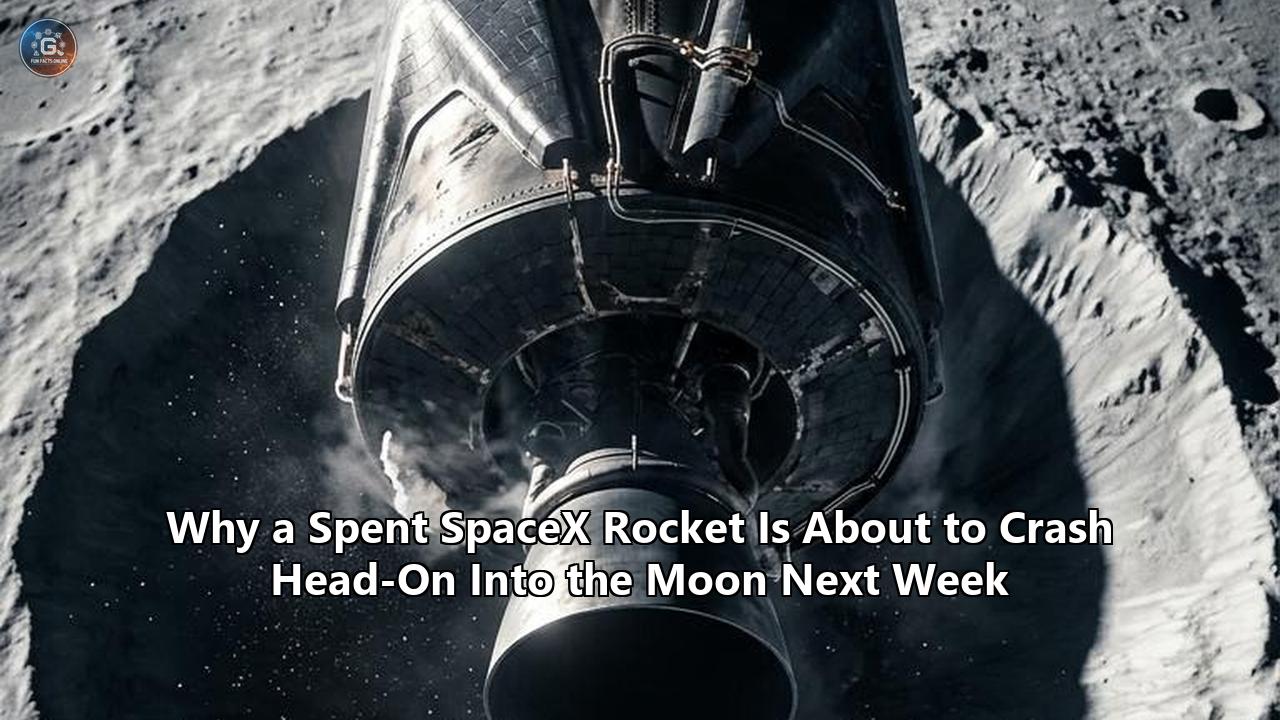
In the early morning hours of Wednesday, August 5, 2026, a 13-meter-long piece of derelict aerospace hardware will slam head-on into the surface of the Moon at roughly 8,700 kilometers per hour (5,400 mph). The projectile—a spent upper stage from a SpaceX Falcon 9 rocket launched more than 18 months ago—is scheduled to impact near Einstein Crater on the Moon's sunlit western limb around 06:35 to 06:44 UTC (2:35 to 2:44 a.m. EDT).
The impending impact delivers energy equivalent to detonating three tons of TNT, carving out a fresh crater up to 30 meters (98 feet) wide and sending a plume of lunar dust and regolith miles above the surface. While unseen by the naked eye, the collision is being tracked by orbiters around the Moon and telescopes across North and South America, turning an accidental space debris event into an unprecedented, real-time scientific experiment.
SPACEX FALCON 9 UPPER STAGE (2025-010D) IMPACT PROFILE
--------------------------------------------------------------------------------
Impact Date/Time  : August 5, 2026 — ~06:35–06:44 UTC (2:35–2:44 a.m. EDT)
Target Location   : Einstein Crater (Western Limb, Near Side/Far Side Boundary)
Velocity          : ~8,700 km/h (5,400 mph / ~Mach 7)
Mass / Dimensions : 4,000 kg (8,800 lbs) | 13.8 m length x 3.7 m diameter
Expected Crater   : 20–30 meters (66–98 ft) wide, ~5 meters (16 ft) deep
Ejecta Plume      : Multi-kilometer high regolith plume, visible to telescopes
Primary Observers : NASA LRO, South Korea Danuri (KPLO), LANL / Ames tracking
--------------------------------------------------------------------------------
This collision was never part of the flight plan. Instead, it is the climax of an eighteen-month gravitational dance through the Earth-Moon system. The trajectory traces an orbital chain reaction that began with a commercial lunar lander delivery, drifted through a tracking blind spot in deep space, and ultimately escalated into an international scientific push and a warning signal for lunar traffic management.
January 15, 2025: The Launch That Left a Ghost in Deep Space
The chain of events leading to next week's lunar impact began on January 15, 2025, atop Space Launch Complex 40 at Cape Canaveral Space Force Station. A SpaceX Falcon 9 rocket lifted off into the Florida night sky carrying a high-stakes commercial payload: Firefly Aerospace’s Blue Ghost Mission 1 lander and Japanese firm ispace’s Hakuto-R Mission 2 (Resilience) lander.
The mission was a cornerstone of NASA’s Commercial Lunar Payload Services (CLPS) initiative alongside private international deep-space commercial efforts. The Falcon 9 first stage executed its standard recovery burn and landed on a autonomous drone ship in the Atlantic Ocean. The second stage—powered by a single Merlin Vacuum engine—ignited twice: first to enter a low-Earth parking orbit, and second to execute a high-energy translunar injection (TLI) burn that hurled both landers toward lunar orbit.
After successfully deploying both spacecraft, the 4,000-kilogram (8,800-pound) upper stage, cataloged in satellite registries as object 2025-010D (NORAD ID 62719), had fulfilled its primary mission objectives. However, its physical state created a long-term orbital hazard:
- Fuel Exhaustion: The TLI burn depleted virtually all usable liquid oxygen and RP-1 kerosene propellant, leaving the stage without sufficient delta-v to perform a deorbit burn back into Earth's atmosphere.
- Trajectory Dynamics: Unlike missions in Low Earth Orbit (LEO), where atmospheric drag gradually pulls discarded hardware down within weeks or years, the booster was left in a highly elliptical "chaotic" orbit extending hundreds of thousands of kilometers into deep space.
- Mass Properties: Though measuring 13.8 meters long and 3.7 meters wide, the stage was essentially an empty, thin-walled aluminum-lithium shell. This light, hollow structure made it unusually susceptible to faint external forces like solar radiation pressure.
With its cold gas thrusters vented and tanks safe-boosted against internal explosion, stage 2025-010D began drifting through the Earth-Moon system as a dormant, 4-ton ghost.
February to August 2025: Drifting Through the Deep-Space Tracking Blind Spot
For months following its launch, the spent rocket stage faded from public view, even as its payloads made headlines. In March 2025, Firefly’s Blue Ghost lander touched down smoothly in Mare Crisium, completing two weeks of surface science. In June 2025, ispace’s Hakuto-R2 attempt ended in a hard landing on the lunar surface. Yet while active spacecraft were tracked continuously by deep-space antennas, the spent Falcon 9 stage drifted through a gap in global orbital surveillance.
    EARTH-MOON GRAVITATIONAL REGIME & TRACKING LIMITATIONS

    [Low-Earth Orbit] ------> [Cislunar Orbit] ------> [Lunar Orbit]
    0 - 2,000 km              2,000 - 350,000 km       384,400 km

    Military Radar            Radar Signal Drops       Blind Spot:
    Tracks Object < 10cm      by Factor of 1/r^4       Optical Only /
    High Precision            Radar Signal ~25M x      Independent
    Continuous Data           Fainter at Moon Distance Trackers Needed
The United States Space Force’s Space Surveillance Network (SSN) maintains precision tracking for tens of thousands of objects in LEO using ground-based phased-array radars. However, radar signal strength degrades exponentially according to the inverse-fourth power of distance ($1/r^4$). At the Moon's distance—roughly 384,000 kilometers away—a radar echo from an object is 25.6 million times fainter than it would be in low Earth orbit.
Consequently, objects in cislunar space (the expanse between Earth and the Moon) are rarely monitored continuously by military systems unless they pass near Earth at perigee. The Falcon 9 stage was subject to four-body gravitational dynamics, influenced simultaneously by:
- Earth's primary gravitational well, which pulled the stage into wide, eccentric loops.
- Lunar gravity, which acted as a periodic sling, altering the stage's orbital inclination and eccentricity during close passes.
- Solar gravity, which nudged the orbit's semi-major axis over long timeframes.
- Solar radiation pressure (photon pressure), which pushed continuously against the wide surface area of the tumbling aluminum cylinder.
Because the stage was tumbling unpredictably, its surface reflected varying amounts of sunlight, introducing small, non-gravitational accelerations. Over the spring and summer of 2025, these combined forces gradually drew the booster's perigee outward and adjusted its trajectory toward an intersection with the lunar orbital plane.
September 2025: The Discovery — Bill Gray Calculates the Collision
The turning point in the story of the SpaceX rocket moon crash came in September 2025, when independent orbital analyst Bill Gray—creator of the widely used Project Pluto celestial tracking software—ran routine orbital determinations on cislunar debris datasets.
Gray, who specializes in computing orbits for near-Earth asteroids and high-altitude space hardware, cross-referenced sparse optical observations collected by automated sky surveys like the Catalina Sky Survey and Pan-STARRS. These astronomical surveys frequently catch unknown "asteroids" that turn out to be human-made rocket stages tumbling through deep space.
ORBITAL TRAJECTORY ESCALATION TIMELINE
--------------------------------------------------------------------------------
Jan 15, 2025 : Falcon 9 launches TLI mission; upper stage 2025-010D left in TLI.
Mar-Jun 2025 : Payloads complete missions; 2025-010D loops in chaotic cislunar orbit.
Sep 15, 2025 : Bill Gray runs Project Pluto models; identifies Aug 5, 2026 impact course.
Apr-May 2026 : Optical observations refine impact location to near Einstein Crater.
Jul 22, 2026 : NASA CNEOS publicly confirms impact window and target zone.
Aug 01, 2026 : NASA LRO and KPLO Danuri orbiters finalize observation geometry.
Aug 05, 2026 : Scheduled high-velocity impact at 06:35–06:44 UTC.
--------------------------------------------------------------------------------
When Gray fed the astrometric observations of object 2025-010D into his numerical integration software, the mathematical projection converged on a single outcome: the upper stage was locked into an unstable orbit that would terminate with a direct impact on the Moon.
"In September 2025, my software for computing orbits analyzed the observations and projected an impact with the moon on 2026 August 5," Gray wrote on his tracking platform, Project Pluto.
Gray's initial calculations indicated that the 4-ton stage would strike the Moon at over seven times the speed of sound. However, predicting the exact impact point on a tumbling, light-pressured object nearly a year in advance required continuous refinement. Throughout late 2025 and early 2026, Gray and a global network of volunteer observers gathered additional position measurements whenever the booster reflected enough sunlight to be detected by ground telescopes.
Spring 2026: Official Confirmation and the Shift to Science
By April and May 2026, the trajectory calculations had stabilized. The impact location was pinpointed near Einstein Crater—a 170-kilometer-wide impact structure located on the threshold between the Moon's near side and far side (roughly 10 o'clock on the lunar disk as viewed from the Northern Hemisphere).
In May 2026, NASA’s Center for Near Earth Object Studies (CNEOS) at the Jet Propulsion Laboratory independently verified Gray’s orbital solutions using federal tracking assets.
"Using publicly available data, independent astronomers were the first to note the upcoming lunar impact event of a SpaceX Falcon 9 rocket's upper stage from a mission launched in January 2025," Jimi Russell, public affairs officer at NASA, confirmed to news outlets. "NASA's Center for Near Earth Object Studies subsequently has confirmed the upper stage will impact the Moon on August 5. There is no danger to Earth and NASA will continue to track the booster for training purposes, as well as later observe the impact site for scientific purposes."
                     IMPACT GEOMETRY & TARGET ZONE

                            [ North Pole ]
                                 |
           ( Impact Site: Near Einstein Crater )
                 [ 10 o'clock Position ]
                           \     /
                            \   /
      [ Far Side ]           \ /           [ Near Side ]
    (Sunlit Hemisphere)       O           (Visible from Earth)
                             / \
                            /   \
                           /     \
                          /       \
                    [ South Pole ]
The realization that the SpaceX rocket moon crash would occur on the illuminated near-side limb of the Moon—rather than the hidden far side—triggered a shift across planetary science institutions.
While accidental crashes of space hardware into the Moon are rare, known impacts with precisely calculated times, masses, and entry vectors are even rarer. Scientists at Los Alamos National Laboratory, NASA Ames Research Center, and international space agencies recognized an unprecedented opportunity: using a known kinetic impactor as a controlled experiment to calibrate planetary impact physics.
July 2026: Physics of the Strike — What Happens When Mach 7 Shell Hits Lunar Regolith
In late July 2026, a team of researchers led by Dr. Benjamin Fernando of Los Alamos National Laboratory posted a detailed physics study analyzing the upcoming collision mechanics. The paper, submitted alongside observations from NASA and international researchers, broke down what occurs when a hollow human-made object hits a airless celestial body.
Unlike dense iron or stone meteorites that remain intact until cratering, the upper stage of a Falcon 9 is largely hollow space. Constructed out of aluminum-lithium alloy, the structure holds empty cryogenic tanks, stainless steel plumbing, titanium grid fin mounting structures, and a single Merlin Vacuum engine composed of niobium-alloy nozzle extensions.
                     IMPACT DYNAMICS COMPARISON

  METEORITE IMPACT                   SPACEX UPPER STAGE IMPACT
  ----------------                   -------------------------
  • Density: 3.0–8.0 g/cm³ (Solid)   • Density: ~0.05 g/cm³ (Hollow)
  • Velocity: 12,000–72,000 km/h     • Velocity: 8,700 km/h (~Mach 7)
  • Impact Mechanism: Deep kinetic   • Impact Mechanism: Structural
    penetration, high shockwave        crushing, shallow excavation
  • Crater Shape: Classic bowl       • Crater Shape: Irregular, shallow
    with high rim ejecta               oval with asymmetric plume
When the stage strikes near Einstein Crater at 2.4 kilometers per second (5,400 mph), the impact energy will unfold through distinct physical stages:
- Initial Contact & Buckling (0 to 5 Milliseconds): The engine nozzle and lower tank dome make first contact with the lunar surface regolith. At 8,700 km/h, the forward momentum crushes the thin aluminum walls of the rocket like an aluminum soda can long before shockwaves propagate through the surrounding rock.
- Kinetic Transfer & Thermal Flash (5 to 50 Milliseconds): The kinetic energy of the 4,000 kg mass—approximately $1.15 \times 10^{10}$ Joules (equivalent to 3 tons of TNT)—is converted into heat, mechanical deformation, and seismic shockwaves. A brief, sub-second impact flash occurs as friction vaporizes small portions of aluminum and localized surface minerals.
- Excavation & Regolith Ejection (50 Milliseconds to 3 Seconds): The crushing booster transfers its kinetic energy to the top layers of fine lunar soil, excavating a crater estimated between 20 to 30 meters (66 to 98 feet) in diameter and roughly 5 meters (16 feet) deep.
- Plume Expansion (3 Seconds to 20 Minutes): Because the Moon lacks an atmosphere and has only one-sixth of Earth's gravity, pulverized dust and regolith particles are ejected in an unhindered ballistic cone. The dust cloud is projected to rise several kilometers above the lunar surface before settling back down.
"The gravity on the moon is low and there is no wind to blow the dust away," explained Dr. Benjamin Fernando in an analytical update. "Part of the reason for our interest in this event is to figure out how much of a hazard debris impacts pose to future astronauts and lunar infrastructure."
Late July to August 1, 2026: Orbital Choreography for T-Minus Days
As of August 1, 2026, space agencies and astronomical observatories around the globe are mobilizing to capture the SpaceX rocket moon crash from both lunar orbit and Earth’s surface.
                     AUG 5, 2026 OBSERVATIONAL CAMPAIGN

   [ NASA Lunar Reconnaissance Orbiter ]        [ Korea Danuri (KPLO) ]
      Positioning for post-impact                 Sweeping within miles
      high-resolution imaging                     2 minutes before impact
                 \                                     /
                  \                                   /
                   v                                 v
   +------------------------------------------------------------------+
   |                  IMPACT ZONE: EINSTEIN CRATER                    |
   |   - Velocity: 8,700 km/h       - Plume Height: Several km      |
   |   - Flash Duration: < 1 sec    - Crater Size: 20-30 meters     |
   +------------------------------------------------------------------+
                                   ^
                                   |
                  [ Ground-Based Optical Telescopes ]
                  Americas Nighttime Horizon Coverage
1. In-Situ Spacecraft Alignments
Two active lunar orbiters are adjusting their observation schedules to capture the event:
- South Korea’s Danuri (KPLO): In a cosmic coincidence, orbital modeling indicates that South Korea’s Korea Pathfinder Lunar Orbiter (Danuri) will pass within just a few kilometers of the falling Falcon 9 upper stage roughly two minutes before impact. Danuri’s high-resolution cameras will attempt to snap close-range imagery of the tumbling booster during its final descent.
- NASA’s Lunar Reconnaissance Orbiter (LRO): LRO, which has been mapping the Moon since 2009, is currently adjusting its imaging sequence. While LRO will not be directly overhead at the exact millisecond of impact, it will sweep over Einstein Crater on subsequent orbits, taking "before-and-after" narrow-angle camera shots to measure the exact crater dimensions, ejecta pattern, and surface disturbance.
2. Ground-Based Telescopic Coverage
The impact time—August 5 at ~06:35 to 06:44 UTC—is tailored for observers in the Western Hemisphere.
OBSERVER VISIBILITY MAP (AUG 5, 2026 — 06:35 UTC / 2:35 AM EDT)
--------------------------------------------------------------------------------
Region                        Local Time            Visibility Status
--------------------------------------------------------------------------------
U.S. East Coast / Canada      02:35 AM EDT          OPTIMAL (Moon High, Dark Sky)
U.S. Midwest / South          01:35 AM CDT          OPTIMAL (Moon High, Dark Sky)
U.S. West Coast               11:35 PM PDT (Aug 4)  GOOD (Moon Above Horizon)
South America (Brazil, Chile) 03:35 AM - 04:35 AM   OPTIMAL (Dark Sky, High Elevation)
Europe / Africa               06:35 AM - 08:35 AM   POOR (Daylight / Sunrise)
Asia / Australia              Afternoon/Evening     NO VISIBILITY (Moon Below Horizon)
--------------------------------------------------------------------------------
Because the Moon will be in a waning gibbous phase (more than half illuminated) and positioned high in the night sky over the Americas, professional observatories and advanced amateur skygazers equipped with specialized high-speed optical sensors are preparing to record the impact site.
While the thermal flash itself will last less than a second and be difficult to detect against the sunlit surface, the expanding plume of dust—reflecting direct sunlight against the dark backdrop of space—could remain visible through medium-to-large backyard telescopes for 10 to 20 minutes following the impact.
Escalation Analysis: Planetary Protection and the Legal Vacuum of Lunar Debris
While planetary scientists view the SpaceX rocket moon crash as an exciting opportunity, space law analysts and policy experts view it as a warning sign.
The impending strike highlights a glaring gap in international space governance: there is currently no international framework regulating the disposal or abandonment of rocket stages in deep space.
HISTORICAL HUMAN-MADE LUNAR IMPACTS
--------------------------------------------------------------------------------
Year   Object / Mission                   Type          Impact Cause
--------------------------------------------------------------------------------
1959   Luna 2 (USSR)                      Spacecraft    Intentional Impact (First)
1970–72 Apollo Saturn V S-IVB Stages (USA) Rocket Stage Intentional Seismic Calibration
2009   LCROSS / Centaur (NASA)            Probe/Stage   Intentional Water-Ice Hunt
2019   Beresheet (Israel)                 Lander        Unintentional Soft-Landing Crash
2022   Chang'e 5-T1 Booster (China)*      Rocket Stage  Unintentional Orbital Decay
2026   Falcon 9 Stage 2 (SpaceX)          Rocket Stage  Unintentional Orbital Decay
--------------------------------------------------------------------------------
*Note: Chinese officials disputed identification of the 2022 impact object.
The Legal Framework: Outer Space Treaty of 1967
Space activities are governed primarily by the 1967 Outer Space Treaty (OST). While key articles establish basic principles, none directly address the issue of spent upper stages hitting the Moon:
- Article VI: States bear international responsibility for national activities in outer space, including those conducted by non-governmental entities like SpaceX.
- Article VII: Launching nations are liable for damage caused by their space objects on Earth or in space. However, because the Moon is uninhabited and has no private property, "damage" in a legal sense is virtually impossible to claim unless a spent rocket strikes an active lander or historical site.
- Article IX: States must conduct exploration to avoid "harmful contamination" of the Moon and celestial bodies. However, "harmful contamination" historically refers to biological contamination (microbes), not clean kinetic strikes by inert metal structures.
                    CISLUNAR DEBRIS GOVERNANCE GAPS

  CURRENT REGULATORY REALITY             EMERGING OPERATIONAL RISKS
  --------------------------             --------------------------
  • LEO: 25-Year / 5-Year Deorbit Rules  • Cislunar space lacks tracking radar
  • Cislunar: Zero formal rules          • Crowded orbital corridors near Moon
  • Abandonment in TLI is legal          • Risk to Artemis / lunar bases
  • No requirement for heliocentric      • Irreversible alteration of surface
    disposal maneuvers                     heritage sites (Apollo, probes)
"SpaceX has unintentionally acquired the power to permanently alter the moon," noted legal and policy experts analyzing the event. "There is almost no international process for deciding whether, when, or where that should happen."
Had the trajectory of object 2025-010D differed by just a fraction of a degree, it could have struck near historic sites like Tranquility Base (Apollo 11) or active commercial installations at the lunar South Pole. Because the Moon lacks an atmosphere and weathering, impact scars, dust contamination, and mechanical disturbance remain permanently etched into the surface for millions of years.
Technical Prevention: How Future Lunar Missions Plan to Avoid the Moon
The imminent collision of the Falcon 9 booster underscores why mission designers are changing how deep-space upper stages are managed.
Preventing spent rocket stages from becoming uncontrolled lunar impactors requires deliberate trajectory design during the initial launch phase:
                    UPPER STAGE DISPOSAL OPTIONS

  1. HELIOCENTRIC DISPOSAL (Gold Standard)
     [Stage 2] === Burn ===> Slingshot past Moon ===> Permanent Sun Orbit
     * Requires extra propellant reserves (~50–100 m/s delta-v)

  2. EARTH RE-ENTRY BURNS
     [Stage 2] === Retro-Burn ===> High-Speed Atmospheric Destruction
     * Requires heavy heat shield / cold gas storage for long coasts

  3. UNCONTROLLED CISLUNAR DRIFT (2025-010D Status)
     [Stage 2] === Fuel Vent ===> Chaotic Orbit ===> Eventually Hits Moon/Earth
     * High risk of orbital collision or lunar impact over 1–5 years
1. Heliocentric Graveyard Orbits
The most common mitigation method is nudging upper stages into a solar orbit. By reserving a tiny fraction of propellant (roughly 50 to 100 meters per second of delta-v), the upper stage can perform an engine reignition after payload separation. This burn uses a lunar gravity assist to slingshot the booster out of the Earth-Moon system entirely, placing it into a permanent orbit around the Sun where it will never hit Earth or the Moon.
2. Targeted Earth Atmospheric Re-entry
For missions with high fuel margins, the upper stage can execute a retro-burn to lower its perigee deep into Earth's atmosphere, causing the structure to incinerate harmlessly over an ocean footprint. However, for high-mass lunar lander missions, every kilogram of propellant reserved for stage disposal reduces the payload mass that can be sent to the surface, creating a trade-off between commercial delivery performance and orbital debris control.
What to Watch for Next Week: Timeline of the Crash
As August 5, 2026 approaches, final tracking runs from Bill Gray's team, NASA CNEOS, and Los Alamos National Laboratory will continuously refine the collision window down to exact seconds.
COUNTDOWN TIMELINE TO IMPACT (ALL TIMES UTC — AUGUST 5, 2026)
--------------------------------------------------------------------------------
T-2 Hours (04:35 UTC) : Final orbital tracking state vector updated by CNEOS.
T-10 Min  (06:25 UTC) : Observatories across Americas align high-speed sensors.
T-2 Min   (06:33 UTC) : KPLO Danuri makes closest pass (within kilometers of stage).
T-0 Min   (06:35 UTC) : IMPACT WINDOW OPENS. 4,000 kg stage hits Einstein Crater.
                       - Impact Velocity: 8,700 km/h (5,400 mph)
                       - Thermal Flash: Sub-second duration
                       - Ejecta Plume: Expands multi-kilometers high
T+20 Min  (06:55 UTC) : Ejecta cloud begins settling back onto lunar surface.
T+2 Hours (08:35 UTC) : NASA LRO executes first post-impact orbital pass.
T+48 Hours            : High-resolution "before-and-after" imagery released.
--------------------------------------------------------------------------------
When the spent rocket stage makes its final dive into Einstein Crater next week, it will mark the second time in four years that human space junk has unintentionally carved out a new crater on the Moon—following the 2022 Chinese Chang'e 5-T1 booster impact.
Yet this time, the scientific community is prepared. By transforming an abandoned piece of rocket hardware into a real-time physics laboratory, astronomers hope to gather valuable data on crater formation, regolith dynamics, and plume behaviors that will inform humanity's return to the Moon under the Artemis program.
At the same time, the spectacle of a 4-ton SpaceX rocket moon crash serves as a stark reminder: as human industry expands into cislunar space, the debris problems that plague Earth's orbit are following us to the Moon.
References & Data Sources
- Associated Press (July 31, 2026). Drifting SpaceX Rocket Stage Set for August 5 Lunar Impact near Einstein Crater.
- Astronomy Magazine (July 30, 2026). Abandoned SpaceX Rocket Stage Collision Dynamics and Impact Physics.
- Forbes Science (July 31, 2026). Falcon 9 Upper Stage (2025-010D) Scheduled for Unplanned Moon Crash.
- Newsweek / NASA Public Affairs (July 22, 2026). CNEOS Confirms SpaceX Upper Stage Trajectory and Lunar Impact Vector.
- Nautilus Journal of Space Policy (July 28, 2026). Cislunar Space Debris, Outer Space Treaty Gaps, and Lunar Environmental Protection.
- ScienceAlert / Project Pluto (May 12, 2026). Orbital Calculations and Radiation Pressure Modeling for Falcon 9 Booster 2025-010D.
- BBC Sky at Night Magazine (May 13, 2026). Bill Gray Discovery: Project Pluto Predicts August 2026 Lunar Impact.
- arXiv Preprint / Los Alamos National Laboratory (July 23, 2026). Observational Geometry and Impact Physics of Structural Rocket Shells on Lunar Regolith.
- Sky & Telescope (May 8, 2026). Tracking Cislunar Objects: The January 2025 CLPS Launch and Deep-Space Orbital Surveillance Limits.
Reference:
- https://mynorthwest.com/national/a-discarded-spacex-rocket-is-on-a-high-speed-collision-course-with-the-moon/4262000
- https://www.forbes.com/sites/jamiecartereurope/2026/07/31/dead-spacex-rocket-to-smash-into-the-moon-on-wednesday/
- https://www.sciencealert.com/spacex-falcon9-rocket-crash-into-moon-this-summer
- https://finance.biggo.com/news/e1558458-67ce-44a9-acc2-256c8de5ffed
- https://skyandtelescope.org/astronomy-news/spacex-booster-will-hit-the-moon-this-august/
- https://www.newsweek.com/elon-musk-spacex-rocket-set-to-crash-into-moon-everything-we-know-12228799
- https://nautil.us/an-abandoned-spacex-rocket-is-about-to-crash-into-the-moon-the-real-problem-comes-next-1283069
- https://www.astronomy.com/space-exploration/an-abandoned-spacex-rocket-is-about-to-crash-into-the-moon-the-real-problem-comes-next/
- https://www.skyatnightmagazine.com/news/space-x-falcon-9-upper-stage-moon-impact-august-2026