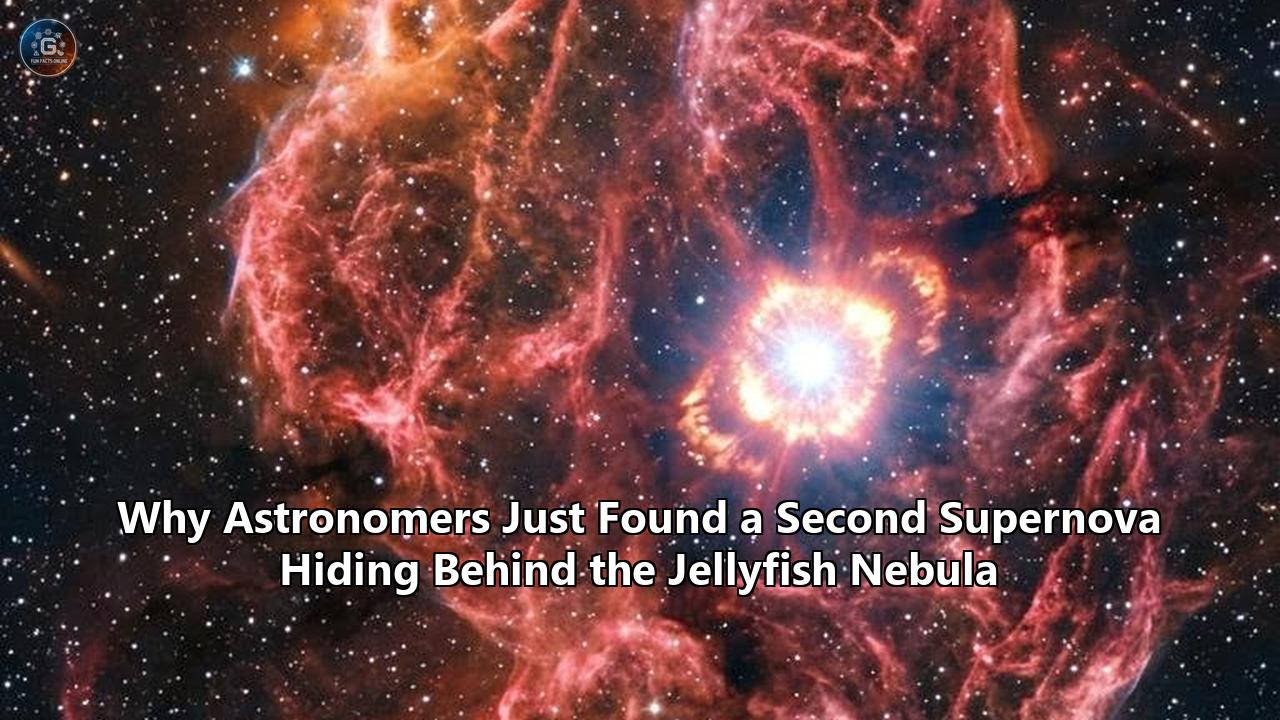
In a landmark breakthrough for observational astrophysics, an international team of researchers has discovered that the iconic Jellyfish Nebula is not a solitary cosmic ruin, but rather one half of the first confirmed binary supernova remnant ever detected in our galaxy.
Hidden in the blinding high-energy glare of the famous nebula—cataloged as IC 443—lies the expanding, ghostlike debris of a second, older supernova event. The findings, published in Nature Communications by a collaboration led by Stanford University astrophysicist Miltiadis Michailidis, present compelling multiwavelength evidence that two massive stars, born as gravitational partners millions of years ago, both ended their lives in catastrophic explosions tens of thousands of years apart.
For decades, astronomers have observed the Jellyfish Nebula as a textbook specimen of a supernova shock wave plowing through surrounding interstellar gas. Situated approximately 5,900 light-years from Earth in the constellation Gemini, IC 443 shines intensely across the electromagnetic spectrum, making it one of the brightest sources of cosmic gamma rays in the Milky Way.
Yet that very brightness obscured its binary twin. By analyzing 16 years of continuous observations from NASA’s Fermi Gamma-ray Space Telescope alongside X-ray imagery from the Spektrum-Roentgen-Gamma (SRG)/eROSITA satellite, Michailidis and his colleagues successfully peeled back the luminous veil of the primary nebula. Beneath it, they isolated the distinct gamma-ray footprint of G189.6+3.3—a long-debated candidate remnant first hinted at in 1994 by the German ROSAT mission.
"Using 16 years of data from NASA's Fermi Gamma-ray Space Telescope, our analysis uncovered gamma rays associated with a supernova remnant that was hidden in the glare of its neighbor, the Jellyfish Nebula," explained Miltiadis Michailidis, a postdoctoral fellow at Stanford University and SLAC National Accelerator Laboratory. "We found compelling evidence that this object, alongside its famous neighbor IC 443, may be the remnants of two massive stars that were born together in a binary system millions of years ago."
The discovery solves a longstanding cosmic puzzle: while more than half of all massive stars in the universe exist in binary or multiple systems, astronomers had never before verified a pair of overlapping supernova shells created by two sibling stars that both detonated.
BINARY SUPERNOVA TIMELINE: THE IC 443 / G189.6+3.3 SYSTEM
┌─────────────────────────────────────────────────────────────────────────┐
│ ~10-20 Million Years Ago                                                │
│ Two massive stars (>20 M☉) form in a tight binary orbit in Gemini       │
├─────────────────────────────────────────────────────────────────────────┤
│ Mass Transfer Phase                                                     │
│ Primary star expands, shedding hydrogen gas onto its companion          │
├─────────────────────────────────────────────────────────────────────────┤
│ ~20,000 - 110,000 Years Ago: FIRST SUPERNOVA                             │
│ Primary star runs out of nuclear fuel and explodes                      │
│ ➔ Creates supernova remnant G189.6+3.3                                  │
│ ➔ Asymmetric explosion kicks companion star across space at high speed │
├─────────────────────────────────────────────────────────────────────────┤
│ ~8,000 - 9,000 Years Ago: SECOND SUPERNOVA                              │
│ Escaping companion star exhausts its own fuel and detonates             │
│ ➔ Creates the bright Jellyfish Nebula (IC 443)                          │
├─────────────────────────────────────────────────────────────────────────┤
│ Present Day                                                             │
│ Both expanding shells sit 30-50 light-years apart, interacting with    │
│ the same molecular gas cloud (Sharpless 249)                             │
└─────────────────────────────────────────────────────────────────────────┘
Dissecting the Glare: How 16 Years of Gamma-Ray Data Revealed G189.6+3.3
The primary hurdle in identifying binary supernova remnants stems from the extreme physical brightness of young stellar explosions. IC 443 is a energetic powerhouse, glowing so fiercely in gamma rays—the most energetic form of electromagnetic radiation—that it stands out alongside the Crab and Geminga pulsars as a dominant fixture of the night sky.
When the German-led ROSAT satellite conducted an X-ray survey of the region in 1994, it caught a faint, arc-like whisper of thermal X-rays sitting just east of the Jellyfish Nebula. Astronomers designated the structure G189.6+3.3 and added it to a list of candidate supernova remnants. However, for nearly 30 years, the object remained unconfirmed. Traditional astronomical criteria require a candidate shell to exhibit a distinct radio ring produced by accelerated electrons in a magnetic field. G189.6+3.3 lacked a clear radio outline, leading many researchers to assume the faint X-ray shell was merely an erratic feature of the complex interstellar gas surrounding IC 443.
The breakthrough came when Michailidis's team turned to high-energy gamma rays. NASA’s Fermi Gamma-ray Space Telescope, launched in 2008, operates by collecting individual high-energy photons with its Large Area Telescope (LAT). The key to Fermi's resolving power lies in energy selection: at lower gamma-ray energies (below 1 gigaelectronvolt, or GeV), IC 443 and its surrounding environment merge into an unresolved, blurry glow. But at energies above several gigaelectronvolts, the telescope’s directional precision sharpens dramatically.
Analyzing Fermi LAT data gathered between August 2008 and October 2024, the team applied advanced spatial modeling algorithms to mathematically subtract the intense light emitted by the main Jellyfish Nebula supernova shell.
Once IC 443’s contribution was excised from the map, an unmistakable, extended gamma-ray structure emerged. The spatial morphology of this newly isolated gamma-ray source aligned perfectly with the faint X-ray shell mapped by eROSITA. What had previously been cataloged as four separate, unrelated point sources of background radiation was reclassified as a single, cohesive, expanding shell of high-energy cosmic debris.
Anatomy of a Twin Explosion: Reconstructing the Stellar Genealogy
To establish whether IC 443 and G189.6+3.3 were genuine astrophysical siblings or merely an accidental alignment along Earth's line of sight, the team had to measure two fundamental parameters: their physical distance from Earth and their relative ages.
Distance determination in the Milky Way is notoriously challenging, but the researchers leveraged a crucial environmental anchor: both remnants are slamming into the exact same giant interstellar cloud complex, known as Sharpless 249 (S249). Ultraviolet data from NASA's Swift observatory, infrared maps from the WISE space telescope, and 3D dust models derived from ESA's Gaia mission confirmed that the northern shock front of G189.6+3.3 and the eastern edge of IC 443 are both physically impacting gas clouds situated approximately 5,900 light-years (1.8 kiloparsecs) away.
On the plane of the sky, the geometric centers of the two supernova explosions sit between 30 and 50 light-years apart. To determine if two unrelated stars could independently explode this close to one another within the same galactic neighborhood, the team collaborated with theoretical astrophysicist Reinhold Willcox at KU Leuven in Belgium.
Willcox ran Monte Carlo simulations modeling the birth, evolution, and spatial distribution of 1 million hypothetical binary and isolated stellar systems across the Milky Way. The statistical analysis demonstrated that the probability of two completely unrelated supernova events occurring within 50 light-years of each other and hitting the same molecular cloud by pure chance is roughly 1 in 1,000 (0.1%).
PROBABILITY ANALYSIS OF THE SYSTEM
───────────────────────────────────────────────────────────────────────────
Chance Alignment (Unrelated Stars):      0.1% (1 in 1,000)
Binary Origin Hypothesis Confidence:    99.9%
Estimated Progenitor Star Masses:       >20 Solar Masses (M☉) each
Primary Explosion Age (G189.6+3.3):     20,000 to 110,000 years ago
Secondary Explosion Age (IC 443):       8,000 to 9,000 years ago
Separation Distance between Centers:    30 to 50 Light-Years
───────────────────────────────────────────────────────────────────────────
"This low probability strongly indicates that our discovery is in fact the first known binary-system supernova pair," Michailidis stated.
With distance and proximity established, the team turned to evolutionary modeling to piece together the life story of the progenitor stars. Both stars were massive giants—likely each exceeding 20 times the mass of our Sun—born together within a dense star-forming region millions of years ago.
As the more massive primary star aged, it expanded, initiating a period of heavy mass transfer where its outer hydrogen envelopes were stripped away and funneled onto the companion star. Eventually, the primary star ran out of nuclear fuel. Its core collapsed into a dense neutron star or black hole, triggering a violent Type II supernova explosion between 20,000 and 110,000 years ago. This explosion created the remnant now known as G189.6+3.3.
The asymmetric recoil energy of that first supernova blast broke the gravitational tether holding the two stars together. The surviving companion star was ejected into space at high speed—a phenomenon known as a runaway star. For tens of thousands of years, this lonely survivor coasted through the interstellar medium, covering tens of light-years.
Finally, roughly 8,000 to 9,000 years ago, the secondary star reached the end of its own nuclear life cycle. It exploded in a second, highly luminous blast, giving birth to the classic Jellyfish Nebula supernova remnant. Today, the expanding shells of both stellar corpses overlap in Gemini, offering humanity a front-row view of a two-stage cosmic tragedy.
"Protons North, Electrons South": The Asymmetric Physics of G189.6+3.3
Beyond proving its binary heritage, the multiwavelength analysis of G189.6+3.3 revealed an extraordinary physical anomaly that has astounded cosmic-ray physicists.
Supernova remnants are the primary engines responsible for accelerating cosmic rays—high-energy charged particles that constantly bombard Earth's atmosphere. These particles are accelerated through a mechanism called Diffusive Shock Acceleration (DSA), where charged particles bounce back and forth across a moving shock front, gaining energy with each passage until they escape into the galaxy.
When these accelerated particles interact with their environment, they produce gamma rays through two distinct physical mechanisms:
- Hadronic Emission (Proton-Dominated): Accelerated protons collide with ambient hydrogen atoms in dense gas clouds, producing neutral pions ($\pi^0$) that instantly decay into energetic gamma-ray photons.
- Leptonic Emission (Electron-Dominated): Accelerated electrons collide with low-energy ambient photons (such as cosmic microwave background radiation) and boost them to gamma-ray energies via Inverse Compton scattering.
In almost all known supernova remnants, these two processes are mixed together or dominated by a single particle species throughout the structure. G189.6+3.3, however, displays a clean physical split across a single remnant shell—a spatial dichotomy never before observed in astrophysics.
SPATIAL DICHOTOMY OF PARTICLE ACCELERATION IN G189.6+3.3

             NORTHERN HEMISPHERE
      ┌──────────────────────────────┐
      │  • Dense Gas Cloud Impact    │
      │  • Slowed Shock Wave         │
      │  • HADRONIC EMISSION         │
      │  • Accelerated PROTONS       │
      └──────────────┬───────────────┘
                     │
            SHOCK WAVE DIRECTION
                     │
      ┌──────────────┴───────────────┐
      │  • Low-Density Environment   │
      │  • Unimpeded Fast Shock      │
      │  • LEPTONIC EMISSION         │
      │  • Accelerated ELECTRONS     │
      └──────────────────────────────┘
             SOUTHERN HEMISPHERE
Across the northern half of G189.6+3.3, where the shock wave is plowing directly into the dense gas of the Sharpless 249 molecular cloud, the gamma-ray spectrum bears the precise spectral signature of hadronic collisions. High-speed protons crashing into dense atomic targets generate a sharp spectral bump at 67.5 megaelectronvolts (MeV)—the classic "pion-decay threshold".
Conversely, across the southern half of the remnant, where the shock front extends into a diffuse, low-density void of interstellar space, there are no dense gas targets for protons to hit. Here, the gamma-ray spectrum shifts entirely to a smooth, power-law distribution characteristic of relativistic electrons scattering light via Inverse Compton emission.
"Along the northern edge, the light carries the mix of energies that appears when protons slam into dense gas. Across the southern half, where there is no dense gas to hit, fast electrons make the gamma rays instead," noted team members. "It is the first time such a clean split between proton and electron acceleration has been spotted within a single supernova remnant."
The 40-Year-Old Filament Resolved
This detailed mapping also solved a 40-year-old observational mystery. In 1984, radio astronomers detected a faint, curved thread of glowing ionized gas running along the boundary between IC 443 and G189.6+3.3. At the time, astronomers could not determine whether this filament belonged to the Jellyfish Nebula or was an independent structure.
Theoretical modeling by Stefano Gabici at the Université Paris Cité provided the physical explanation. Gabici demonstrated that as G189.6+3.3's primary shock wave traveled through open space at roughly 310 miles per second (500 km/s), it eventually struck the outer wall of the Sharpless 249 cloud.
Upon hitting the dense hydrogen barrier, the shock wave decelerated rapidly to about 31 miles per second (50 km/s). This sudden deceleration compressed and cooled the gas behind the shock front, causing it to glow brightly in ultraviolet and optical light. Fermi LAT data confirmed that the highest-energy gamma rays in the entire complex originate precisely from this collision point, proving that the mysterious 1984 filament is the physical contact zone where G189.6+3.3 is grinding against the interstellar cloud.
Why Binary Supernova Remnants Are So Hard to Find
The discovery of a binary companion to the Jellyfish Nebula supernova raises a crucial question for modern astronomy: if binary star systems are so common in the universe, why has it taken until 2026 to discover the first overlapping pair of binary supernova remnants?
Astronomers point to four major physical and observational barriers that make candidate pairs extraordinarily rare and difficult to detect:
1. Massive Age Disparities and System Disruption
Massive binary stars rarely explode simultaneously. Even a small difference in initial mass between two stars causes them to evolve at different rates. As demonstrated by the IC 443 / G189.6+3.3 system, tens of thousands of years can elapse between the first and second explosions.
During this delay, the runaway companion star—propelled by the asymmetrical momentum kick of the first explosion—can travel hundreds of light-years away from the site of its sibling's death. By the time the second star finally explodes, the two remnants are separated by vast distances, erasing any obvious spatial relationship.
WHY BINARY SUPERNOVA PAIRS REMAIN ELUSIVE
┌───────────────────────┬─────────────────────────────────────────────────┐
│ Obstacle              │ Astrophysical Explanation                       │
├───────────────────────┼─────────────────────────────────────────────────┤
│ Spatial Dispersal     │ Supernova kicks send surviving companion stars  │
│                       │ flying light-years away before they explode     │
├───────────────────────┼─────────────────────────────────────────────────┤
│ Short Lifetime        │ Supernova remnants expand and dissipate into    │
│                       │ the interstellar medium in ~100,000 years        │
├───────────────────────┼─────────────────────────────────────────────────┤
│ Overwhelming Glare    │ Younger, brighter remnants swamp the faint      │
│                       │ thermal emission of older sibling shells        │
├───────────────────────┼─────────────────────────────────────────────────┤
│ Morphological Blending│ Close explosions merge into a single asymmetric │
│                       │ bubble, hiding their dual origins               │
└───────────────────────┴─────────────────────────────────────────────────┘
2. The Fleeting Lifetime of Remnants
Supernova remnants are transient features in galactic history. After a star detonates, its expanding shock wave glows brightly for only 50,000 to 100,000 years before cooling, slowing down, and merging invisibly into the general interstellar medium. For astronomers to see two remnants from the same binary system simultaneously, both explosions must occur within a very tight observational window before the older remnant fades away entirely.
3. Glare and Contrast Limitations
Younger supernova remnants are overwhelmingly bright across radio, optical, and X-ray wavelengths. Older remnants, like G189.6+3.3, are low-density, diffuse bubbles whose faint thermal emissions are easily drowned out by the glare of a younger, highly energetic neighbor. Without high-resolution, long-duration gamma-ray surveys capable of penetrating cosmic gas, faint companions remain hidden in plain sight.
4. Physical Merging and Blending
If two stars in a tight binary explode in rapid succession without traveling far apart, their expanding shock waves eventually collide, merge, and form a single, distorted bubble. To an observer on Earth, such a merged structure appears as an irregular single supernova remnant rather than the product of two separate stellar deaths.
Broader Implications for Stellar Evolution and Cosmic Ray Origin
The confirmation of the IC 443 / G189.6+3.3 binary remnant system provides an invaluable empirical benchmark for multiple fields of high-energy astrophysics.
Refining Binary Population Models
Computer models of stellar evolution rely heavily on assumptions about how massive binary systems interact, transfer mass, and experience asymmetric supernova kicks. Until now, these models were constrained almost entirely by observing active binary stars or isolated neutron stars and black holes.
The physical parameters extracted from the Jellyfish Nebula supernova pair—such as the 30-to-50 light-year spatial separation and the ~20,000 to 100,000 year delay between detonations—provide direct observational data. Astrophysicists can now calibrate stellar population synthesis codes to better predict the rates of neutron star mergers and gravitational wave events detected by observatories like LIGO and Virgo.
SCIENTIFIC IMPLICATIONS AT A GLANCE
• Binary Mass Transfer: Validates models of envelope stripping in massive binary pairs
• Supernova Kicks: Measures real-world momentum transfer imparted on surviving companion stars
• Cosmic Ray Origins: Confirms that shock-cloud interactions are primary drivers of galactic proton acceleration
• Multi-Messenger Astronomy: Highlights the necessity of combining Fermi gamma-ray data with X-ray surveys (eROSITA) to uncover hidden galactic structures
Unraveling the Galactic Cosmic Ray Puzzle
A central debate in high-energy astrophysics concerns whether supernova shock waves primarily accelerate protons or electrons. The discovery that G189.6+3.3 isolates proton acceleration to its cloud-interacting northern shock wave while electron acceleration dominates its free-expanding southern shell gives scientists an unprecedented laboratory to test shock acceleration theory in two distinct physical regimes within the exact same object.
What Comes Next: Targets for Next-Generation Observatories
The identification of G189.6+3.3 hiding behind the Jellyfish Nebula is already driving new observational campaigns across the world's most advanced astronomical facilities.
Key upcoming milestones include:
- Cherenkov Telescope Array Observatory (CTAO): Scheduled to begin full operations in the late 2020s, CTAO’s ground-based gamma-ray dishes will target the IC 443 / G189.6+3.3 complex at ultra-high energies (above 1 teraelectronvolt, or TeV). This will map the precise sub-arcminute acceleration sites of protons along the Sharpless 249 cloud boundary.
- JWST Infrared Spectroscopy: Astronomers are preparing proposals for the James Webb Space Telescope to conduct high-resolution infrared spectroscopy of the 1984 shock filament. JWST will trace molecular hydrogen cooling lines to measure the exact velocity and density compression of gas behind G189.6+3.3’s shock front.
- Deep Radio Interferometry with MeerKAT and the Square Kilometre Array (SKA): Ultra-sensitive low-frequency radio surveys aim to map the faint synchrotron emission across G189.6+3.3’s southern hemisphere, tracing its subtle magnetic field structure.
- Archival Re-Analysis of Galactic Surveys: Inspired by the discovery, research teams are deploying automated machine-learning algorithms to re-examine Fermi LAT and eROSITA sky maps. Scientists suspect that several other known "isolated" supernova remnants may also be hiding faint binary companions obscured by high-energy glare.
As multiwavelength and high-energy observations continue to sharpen our view of the cosmos, the Jellyfish Nebula complex stands as a powerful reminder that even the most thoroughly studied corners of our galaxy still hold profound secrets waiting to be uncovered.
Reference:
- https://www.scimex.org/newsfeed/jellyfish-nebula-may-be-the-scene-of-two-stars-going-supernova
- https://www.earth.com/news/first-ever-binary-star-supernova-pair-discovered-in-the-jellyfish-nebula/
- https://en.wikipedia.org/wiki/IC_443
- https://www.thebrighterside.news/post/scientists-find-evidence-of-a-rare-double-supernova-in-the-jellyfish-nebula/
- https://www.astronomy.com/science/is-this-the-first-known-binary-system-to-produce-two-supernova-remnants/
- https://www.space.com/astronomy/stars/scientists-may-have-found-the-1st-twin-star-system-where-both-stars-exploded
- https://www.livescience.com/space/in-a-cosmic-first-astronomers-detect-2-sibling-supernovas-that-came-from-a-pair-of-bound-stars