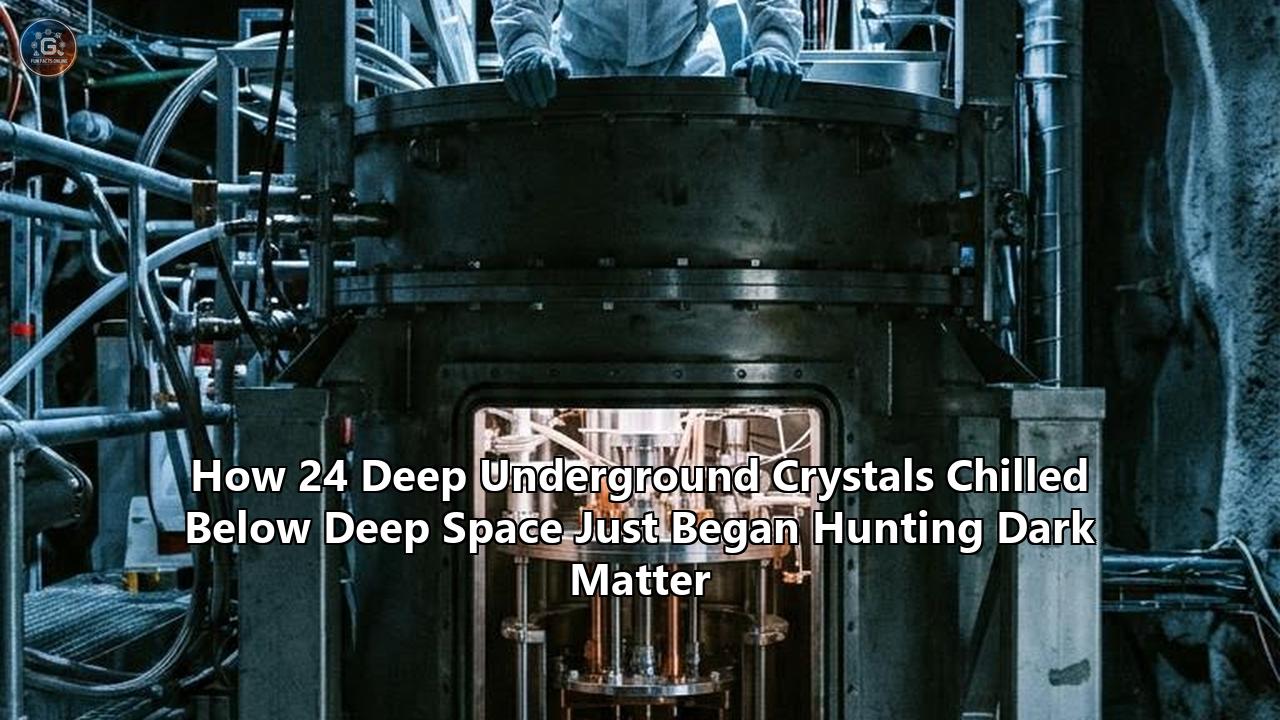
Two kilometers beneath the Canadian Shield, inside an active nickel mine where the surrounding rock radiates ambient heat of nearly 40 degrees Celsius, a cluster of 24 synthetic crystals has reached thermal equilibrium just a few thousandths of a degree above absolute zero.
The Super Cryogenic Dark Matter Search (SuperCDMS) SNOLAB experiment has officially initiated its early scientific data-taking campaign. Housed inside a multi-layered cryostat located 6,800 feet underground near Sudbury, Ontario, the 24 ultra-pure germanium and silicon crystals have been cooled to roughly 15 millikelvin—more than a hundred times colder than the 2.7 Kelvin background temperature of deep space.
The milestone transitions the multi-million-dollar experiment from years of underground construction and mechanical calibration into active search operations. Managed by the U.S. Department of Energy’s SLAC National Accelerator Laboratory alongside an international consortium of 28 institutions, SuperCDMS SNOLAB is engineered to hunt for a hypothesized class of low-mass particles that have completely eluded earlier generations of massive, liquid-xenon-based experiments.
========================================================================================
                      SUPERCDMS SNOLAB: CORE ARCHITECTURE
========================================================================================
 Location:                SNOLAB (Vale Creighton Mine, Sudbury, Ontario, Canada)
 Overburden Depth:        2,070 meters (6,800 feet) / 6,000 m.w.e. rock shield
 Target Core:             24 High-Purity Crystals (18 Germanium, 6 Silicon)
 Payload Configuration:   4 Towers × 6 Detectors (~1 kg per crystal, ~30 kg total)
 Base Operating Temp:     15 – 30 milliKelvin (0.015 K – 0.030 K)
 Primary Target Regime:   Light Dark Matter (0.5 to 10 GeV/c² Nuclear; sub-GeV Electron)
 Sensor Technologies:     Tungsten Transition Edge Sensors (TES) & SQUID Amplifiers
 Readout Modes:           Athermal Phonons + Ionization (NTL Voltage Amplification)
========================================================================================
"The search for dark matter at SuperCDMS SNOLAB is finally underway," confirmed Tina Cartaro, SuperCDMS operations manager at SLAC. "Even in this early phase, our most sensitive detectors have the potential to deliver breakthrough discoveries. At the same time, we're preparing and testing the entire system, learning how our detectors and cryogenic cooling perform together so we can unlock their design sensitivity".
This initial science run, extending through late autumn, allows physicists to analyze real-time background noise, calibrate superconducting sensor channels, and probe uncharted cross-sections for sub-GeV dark matter candidates before a planned warm-up and final noise-optimization cycle leading into full-scale 2027 operations.
The WIMP Stalemate: How the Heavy-Mass Search Reached Diminishing Returns
To understand how 24 solid crystals in an Ontario mine became the vanguard of dark matter detection, one must trace the structural bottleneck that gripped experimental astrophysics over the past fifteen years.
For more than three decades, the leading theoretical candidate for dark matter was the Weakly Interacting Massive Particle (WIMP). Originating from supersymmetric extensions of the Standard Model, the canonical WIMP was predicted to possess a mass between 100 and 1,000 times that of a proton (100 GeV/c² to 1 TeV/c²). If such particles existed in the galactic halo that envelops the Milky Way, they would occasionally collide with atomic nuclei in terrestrial detectors, creating detectable nuclear recoils.
       +-------------------------------------------------------------+
       |             THE DARK MATTER SPECTRUM PARADIGM               |
       +-------------------------------------------------------------+
                                      |
         +----------------------------+----------------------------+
         |                                                         |
         v                                                         v
  [ LIGHT REGIME ]                                          [ HEAVY REGIME ]
  Sub-GeV to 10 GeV/c²                                      10 GeV/c² to 10 TeV/c²
  - Low-mass WIMPs                                          - Classical WIMPs
  - Dark Photons                                            - Heavy SUSY particles
  - Axion-like Particles (ALPs)
  - Target: SuperCDMS SNOLAB                                - Target: Liquid Xenon/Argon
    (Cryogenic Solid-State Phonons)                           (LZ, XENONnT, PandaX-4T)
         |                                                         |
         +----------------------------+----------------------------+
                                      |
                                      v
       [ THE NEUTRINO FOG: Theoretical boundary where solar and atmospheric
         neutrino interactions mimic coherent dark matter recoils ]
Physicists responded by building colossal liquid noble-gas detectors. Facilities like LUX-ZEPLIN (LZ) in South Dakota, XENONnT in Italy's Gran Sasso laboratory, and PandaX-4T in the China Jinping Underground Laboratory filled multi-ton titanium tanks with purified liquid xenon. These detectors achieved remarkable sensitivity in the 10 GeV/c² to 10 TeV/c² mass window, tracking scintillation light and ionized electrons.
Yet as the xenon targets expanded from kilograms to metric tons, the expected heavy WIMP signals never materialized. Instead, the experimental boundaries pushed closer to the "neutrino fog"—the threshold where coherent elastic neutrino-nucleus scattering from solar and atmospheric neutrinos produces indistinguishable background events.
Crucially, liquid xenon detectors suffer from a fundamental kinematic handicap. When a lightweight dark matter particle—possessing a mass below 5 or 10 GeV/c²—collides with a heavy xenon nucleus (atomic mass around 131), the collision resembles a ping-pong ball striking a bowling ball. The xenon nucleus barely recoils, depositing energy well below the detection threshold of scintillation photomultipliers.
KINEMATIC ENERGY TRANSFER COMPARISON

Light Particle (1 GeV/c²)  -->  Strikes Heavy Xenon (A ≈ 131)  --> Tiny Energy Recoil (< 0.1 keV)
Light Particle (1 GeV/c²)  -->  Strikes Silicon (A ≈ 28)       --> Measurable Recoil (~ 1 keV)
A vast theoretical landscape remained completely unprobed: the low-mass regime. If dark matter particles have masses on par with or lighter than a proton (0.5 to 10 GeV/c²), or interact primarily through electron scattering at sub-GeV scales, detecting them requires target atoms with low atomic mass numbers and energy thresholds down to tens of electron-volts (eV).
That physiological requirement dictated a return to solid-state cryogenic physics.
The Lineage: Soudan, CDMSlite, and the Move to SNOLAB
The technology operating at SNOLAB is the direct descendant of a methodical progression that began in an underground tunnel at Stanford University in the late 1990s (CDMS I), followed by deep operations inside the Soudan iron mine in northern Minnesota.
+---------------------------------------------------------------------------------------+
|                       EVOLUTION OF CRYOGENIC DETECTOR SENSITIVITY                     |
+---------------------------------------------------------------------------------------+
|  1998–2002  | CDMS I (Stanford Tunnel, ~10 m depth)                                   |
|             | Demonstrated basic phonon-charge athermal detection.                    |
+-------------+-------------------------------------------------------------------------+
|  2003–2009  | CDMS II (Soudan Mine, 700 m depth)                                      |
|             | Introduced interleaved ionization-phonon collection in Ge/Si pucks.    |
+-------------+-------------------------------------------------------------------------+
|  2011–2015  | SuperCDMS Soudan & CDMSlite                                            |
|             | Pioneered Neganov-Trofimov-Luke (NTL) voltage phonon amplification,     |
|             | achieving sub-kiloelectronvolt thresholds for light WIMP exploration.   |
+-------------+-------------------------------------------------------------------------+
|  2018–2024  | SuperCDMS SNOLAB Engineering & CUTE Prototyping                         |
|             | Construction of custom dry dilution fridge; deep transit to 2 km depth; |
|             | single-tower validation at CUTE facility achieving 70–80 eV resolution. |
+-------------+-------------------------------------------------------------------------+
|  2026       | SuperCDMS SNOLAB Cooldown & Science Turn-On                             |
|             | 24 crystals (30 kg payload) chilled to 15 mK; early-science run begins.  |
+---------------------------------------------------------------------------------------+
During operations at Soudan from 2011 to 2015, the collaboration devised CDMSlite (Low Ionization Threshold Experiment). By applying a strong electrical bias across their germanium crystals, researchers converted small ionization signals into large cascades of vibrational phonons via the Neganov-Trofimov-Luke (NTL) effect.
This allowed CDMSlite to dramatically lower its energy threshold, proving that cryogenic crystals could detect recoil energies far below the reach of liquid xenon systems.
However, the Soudan mine—situated 700 meters underground—lacked the rock overburden necessary to shield next-generation detectors from cosmic-ray muons. Muon-induced spallation was generating high-energy neutrons that could mimic dark matter collisions in the ultra-low energy domain.
To eliminate this cosmic noise, the collaboration designed an entirely new experiment from the ground up and selected SNOLAB: an ultra-clean physics facility built inside Vale’s Creighton nickel mine in Sudbury, Ontario.
2018–2021: Subterranean Engineering and the Cryogenic Challenge
Building a millikelvin laboratory inside an active industrial mine presented an extraordinary set of engineering obstacles.
SNOLAB sits under 2,070 meters of solid norite rock, providing an effective shielding thickness equivalent to 6,000 meters of water (m.w.e.). This reduces cosmic muon flux by a factor of roughly 50 million compared to the surface, down to approximately 0.27 muons per square meter per day.
========================================================================================
                          THE OVERBURDEN SHIELD AT SNOLAB
========================================================================================
 Surface Muon Flux:           ~10,000 muons / m² / minute
 SNOLAB Muon Flux (2,070 m):  ~0.27 muons / m² / day (50,000,000× reduction)
 Rock Overburden:             6,000 meters water equivalent (m.w.e.)
========================================================================================
The environment inside the Creighton mine is severe. Miners and physicists travel down Shaft No. 9 in a steel elevator cage running at 40 miles per hour. At the 6,800-foot level, personnel trek nearly two kilometers through dark, dusty drifts where wall temperatures hover near 40°C.
Before entering the SNOLAB science corridor, researchers must wash their boots, take showers, and don cleanroom suits and hairnets. The laboratory itself is maintained as a Class 2000 cleanroom to exclude mine dust containing natural uranium and thorium decay chains.
Between 2018 and 2021, teams from Fermilab, SLAC, and Pacific Northwest National Laboratory designed a cryogenic infrastructure capable of achieving millikelvin temperatures without introducing mechanical vibrations that would ruin the sensitive crystal measurements.
       +-------------------------------------------------------------+
       |               THE SEPARATION-OF-SOURCES DESIGN              |
       +-------------------------------------------------------------+
       |                                                             |
       |  [ CRYOGENIC SERVICE SYSTEM ]      [ THE SNOBOX CRYOSTAT ]  |
       |  - Pulse tube compressors          - Ultra-pure OFHC Copper |
       |  - Dilution fridge circulation     - 24 Germanium/Silicon   |
       |  - Mechanical pumps                  detectors              |
       |  - Noisy mechanical components     - Zero-vibration zone    |
       |                 \                         /                 |
       |                  \                       /                  |
       |                   +---[ THERMAL BUS ]---+                   |
       |                       (Superconducting                      |
       |                        Thermal Bridges)                     |
       +-------------------------------------------------------------+
Traditional dilution refrigerators locate their cooling elements directly above the detector volume. For SuperCDMS SNOLAB, engineers separated the cooling engine from the detector payload.
The dilution refrigerator—built and tested at Fermilab, where it reached an internal baseline of 5.3 millikelvin in late 2019—was mounted several meters away from the main vacuum chamber. Heat from the detectors is extracted via custom ultra-pure copper thermal links, isolating the delicate crystal towers from the microphonic vibrations of mechanical pulse-tube compressors.
2022–2025: Proving the Detectors at CUTE and NEXUS
Before lowering the full 24-detector array underground, the collaboration validated the sensor physics at two dedicated testbeds:
- NEXUS (Northwestern EXperimental Underground Site): Located in the MINOS service cavern at Fermilab, NEXUS was used to calibrate detector responses to radioactive sources and optimize readout electronics.
- CUTE (Cryogenic Underground TEst facility): Installed directly inside SNOLAB, CUTE allowed physicists to test complete detector towers in deep underground conditions.
+---------------------------------------------------------------------------------------+
|                    THE DETECTOR ARRAY: 4 TOWERS, 24 CRYSTALS                          |
+---------------------------------------------------------------------------------------+
|                                                                                       |
|   TOWER 1 (HV)          TOWER 2 (HV)          TOWER 3 (iZIP)        TOWER 4 (iZIP)    |
|  +--------------+      +--------------+      +--------------+      +--------------+   |
|  | Ge Crystal 1 |      | Ge Crystal 7 |      | Ge Crystal 13|      | Si Crystal 1 |   |
|  | Ge Crystal 2 |      | Ge Crystal 8 |      | Ge Crystal 14|      | Si Crystal 2 |   |
|  | Ge Crystal 3 |      | Ge Crystal 9 |      | Ge Crystal 15|      | Si Crystal 3 |   |
|  | Ge Crystal 4 |      | Ge Crystal 10|      | Ge Crystal 16|      | Si Crystal 4 |   |
|  | Ge Crystal 5 |      | Ge Crystal 11|      | Ge Crystal 17|      | Si Crystal 5 |   |
|  | Ge Crystal 6 |      | Ge Crystal 12|      | Ge Crystal 18|      | Si Crystal 6 |   |
|  +--------------+      +--------------+      +--------------+      +--------------+   |
|                                                                                       |
|  Total Target Mass: ~30 kg (18 Germanium Crystals @ ~1.4 kg / 6 Silicon @ ~0.6 kg)    |
|  HV Towers: Maximize energy resolution via NTL phonon amplification (sub-GeV focus)   |
|  iZIP Towers: Maximize electron/nuclear recoil discrimination (1 to 10 GeV/c² focus)   |
+---------------------------------------------------------------------------------------+
In early 2024, the collaboration concluded a major operational run of a single High-Voltage (HV) detector tower inside CUTE.
The results, presented at the International Cosmic Ray Conference (ICRC), confirmed baseline energy resolutions of 70 to 80 eV in germanium targets. This proved that the superconducting transition edge sensors and NTL voltage amplification circuits could maintain target stability in an underground environment without electrical breakdown.
With the CUTE operational data verified, the way was cleared to assemble the full 24-crystal core inside the central cryostat, designated the SNOBOX.
Spring 2026: The Deep Cooldown to Millikelvin Base
Achieving operating temperature inside the SNOBOX required a complex, multi-week cryogenic sequence.
Cooling 30 kilograms of crystal substrates—surrounded by thousands of kilograms of nested copper vessels, lead shields, and structural steel—cannot be rushed. Rapid temperature transitions induce mechanical stresses that can fracture crystalline lattices or shear microscopic superconducting wire bonds.
       +-------------------------------------------------------------+
       |               THE MULTI-STAGE COOLDOWN CASCADE              |
       +-------------------------------------------------------------+
                                      |
                                      v
       [ STAGE 1: 300 K --> 50 K ]
       Helium gas convection and thermal radiation shields purge bulk
       ambient heat across copper cryostat vessels.
                                      |
                                      v
       [ STAGE 2: 50 K --> 4 K ]
       Closed-cycle pulse tube cryocoolers take over; crystal lattices
       lock into rigid low-temperature configurations.
                                      |
                                      v
       [ STAGE 3: 4 K --> 1 K ]
       Mechanical refrigeration transitions to internal vacuum 1-Kelvin pot;
       boil-off pump clears residual thermal excitations.
                                      |
                                      v
       [ STAGE 4: 1 K --> 15 mK ]
       Helium-3 / Helium-4 Dilution Refrigeration cycle initiates;
       circulating quantum phase transition pulls detectors to base.
"Base temperature is the temperature our cryogenic system reaches under the full thermal load of the experiment," explained Kelly Stifter, a Panofsky Fellow at SLAC and SuperCDMS collaborator. "It's the point where the detectors can actually function the way they were designed to".
In late March 2026, telemetry from SNOLAB showed the internal SNOBOX copper housing reaching 15 millikelvin (0.015 K).
At this temperature, thermal vibration within the silicon and germanium crystals drops to near zero. The atoms in the crystal lattice form an exceptionally quiet acoustic medium. A single sub-atomic collision depositing even a fraction of an electron-volt creates a thermal pulse that stands out against the cold lattice background.
"The detectors simply don't function unless they're cold enough to enter the superconducting transition," noted Richard Partridge, long-time SLAC researcher and installation lead. "For us, that means roughly 15 to 30 millikelvin. When everything is that cold, the crystals are basically quiet. Even very small energy deposits become detectable".
Physics of the Crystals: How a Particle Strike Is Detected
The core of SuperCDMS SNOLAB consists of 24 cylindrical crystals, each 100 millimeters in diameter and 33 millimeters thick, resembling polished hockey pucks. Eighteen crystals are grown from hyper-pure germanium, and six from hyper-pure silicon.
========================================================================================
                      INSIDE A SUPERCDMS DETECTION EVENT
========================================================================================

         ( Incoming Dark Matter Particle / WIMP )
                           \
                            \
                             v
                 [ CRYSTAL NUCLEUS / ATOM ]
                            / \
                           /   \
                          /     \
                         v       v
         [ LATTICE PHONONS ]   [ ELECTRON-HOLE PAIRS ]
           (Athermal sound       (Ionization charge drifted
            waves propagate)      under electric bias)
                  |                      |
                  |                      v
                  |             [ NTL EFFECT PHONONS ]
                  |             (Work done by electric field
                  |              generates secondary phonons)
                  \                      /
                   \                    /
                    v                  v
         [ SUPERCONDUCTING TRANSITION EDGE SENSORS (TES) ]
         - Tungsten thin-film biased at superconducting edge (Tc ≈ 40 mK)
         - Phonon absorption heats tungsten, spiking electrical resistance
                                |
                                v
         [ SQUID (SUPERCONDUCTING QUANTUM INTERFERENCE DEVICE) ]
         - Amplifies micro-resistance changes into digitizable voltage pulse
========================================================================================
The experiment exploits two distinct detection channels: athermal phonons (quantized acoustic lattice vibrations) and ionization (electron-hole pairs created during a collision).
1. The Superconducting Transition Edge Sensor (TES)
On the top and bottom faces of each crystal, photolithographic techniques have deposited micro-patterned arrays of tungsten thin films coupled to aluminum collector fins.
Tungsten exhibits a superconducting phase transition at approximately 40 millikelvin. The detectors are biased so the tungsten sits directly on the sharp boundary between normal resistance and superconductivity.
When a particle hits a germanium or silicon nucleus, the recoil releases high-frequency athermal phonons that travel through the crystal at the speed of sound. When these phonons strike the aluminum fins on the surface, their energy is channeled into the tungsten strips.
This micro-deposit of thermal energy raises the tungsten's temperature by a fraction of a millikelvin, knocking it out of superconductivity and generating a sharp increase in electrical resistance.
These tiny resistance changes are read out through Superconducting Quantum Interference Devices (SQUIDs), yielding precise measurements of total deposited energy.
RESISTANCE vs. TEMPERATURE: THE SHARP TES BOUNDARY

 Resistance
     ^
     |                     / (Normal Conducting State)
     |                    /
     |                   /   <-- BIAS POINT: Detectors held right on this knife-edge
     |                  /
     |                 /
     |________________/ (Superconducting State: Zero Resistance)
     +------------------------------------------------------------> Temperature (mK)
                    ~40 mK
2. High-Voltage (HV) Detectors and the NTL Effect
Twelve of the crystals operate as High-Voltage (HV) detectors. In these units, an electric potential of up to 100 volts is applied across the crystal faces.
When a collision frees electrons and holes, the electric field drifts them across the crystal lattice. As these charge carriers move through the semiconductor, they scatter off the lattice, generating a large burst of secondary phonons.
This process—the Neganov-Trofimov-Luke (NTL) effect—amplifies the tiny ionization signal into a massive, detectable phonon signal:
$$E_{\text{total}} = E_{\text{recoil}} + q \cdot V_{\text{bias}} \cdot \left(\frac{E_{\text{recoil}}}{\epsilon}\right)$$
Where:
- $E_{\text{total}}$ is the total measured phonon energy,
- $E_{\text{recoil}}$ is the primary nuclear or electron recoil energy,
- $q$ is the elementary charge,
- $V_{\text{bias}}$ is the applied voltage across the crystal,
- $\epsilon$ is the average energy required to create an electron-hole pair (~3.0 eV in Ge, ~3.8 eV in Si).
By applying $V_{\text{bias}} \approx 100\text{ V}$, the initial ionization signal is magnified by a factor of 25 to 30, allowing the HV detectors to register sub-100-eV energy deposits that would otherwise be lost in readout noise.
3. Interleaved Z-Sensitive Ionization and Phonon (iZIP) Detectors
The remaining twelve crystals are configured as iZIP detectors. Instead of maximizing voltage amplification, iZIPs feature alternating interleaved sensor traces of charge electrodes and phonon sensors across both faces.
iZIP DISCRIMINATION PRINCIPLE

Nuclear Recoil (Dark Matter / Neutrons):
--> Poor ionization yield / High phonon yield
--> Low Charge-to-Phonon Ratio

Electron Recoil (Gamma Rays / Beta Radiation):
--> High ionization yield / Moderate phonon yield
--> High Charge-to-Phonon Ratio

Surface Events (Alpha / Beta Background from walls):
--> Asymmetric charge/phonon collection on one face
--> Instantly rejected by interleaved top/bottom sensor logic
This dual-channel readout provides background rejection. Normal radioactive backgrounds (such as gamma rays or beta decay) strike atomic electrons, creating high ionization relative to phonons.
Dark matter particles and neutrons strike the atomic nucleus, yielding poor ionization efficiency but strong primary phonon waves.
By comparing the ratio of charge to phonons, iZIP detectors reject more than 99.999% of ambient electromagnetic background events while identifying true nuclear recoils.
Shielding Architecture: The Russian-Doll Defense
The 24 crystals sit inside an elaborate nesting of shields designed to eliminate environmental radiation, the primary limiting factor in low-mass dark matter detection.
========================================================================================
                      SUPERCDMS SNOLAB SHIELDING STRATIGRAPHY
========================================================================================

 [ SOLID ROCK ]                 2,070 meters of norite overburden (6,000 m.w.e.)
       |
       v
 [ WATER SHIELD ]               Large external water tank to moderate rock neutrons
       |
       v
 [ POLYETHYLENE SHIELD ]        High-density polyethylene (HDPE) thermal neutron absorber
       |
       v
 [ LEAD SHIELD ]                Ultra-low-background lead (inner archaeological lead layer)
       |
       v
 [ COPPER CRYOSTAT (SNOBOX) ]   Low-activity Oxygen-Free High Thermal Conductivity (OFHC) Copper
       |
       v
 [ CLEAN PURGE REGIME ]         Radon-free boil-off gas environment (< 0.1 Bq/m³)
       |
       v
 [ 24 CRYSTAL CORE ]            18 Germanium + 6 Silicon Targets at 15 milliKelvin
========================================================================================
Even after cosmic rays are blocked by 6,800 feet of rock, trace amounts of uranium-238 and thorium-232 in the laboratory walls emit fast neutrons and gamma rays. Furthermore, radon gas ($^{222}\text{Rn}$) permeating mine air can plate radioactive daughter isotopes onto metal surfaces.
To counter this, SuperCDMS SNOLAB employs a multi-tiered shielding envelope:
- Outer Water and Polyethylene Tanks: Fast neutrons generated by spontaneous fission in the surrounding rock collide with hydrogen atoms in water and high-density polyethylene (HDPE), moderating them to harmless thermal energies.
- Layered Lead Shields: Beneath the polyethylene sits a thick shell of refined lead. The innermost lead layer is crafted from archaeological lead salvaged from ancient sunken vessels; centuries underwater have allowed its radioactive isotope $^{210}\text{Pb}$ (with a half-life of 22 years) to decay away entirely, making it radiopure.
- The SNOBOX OFHC Copper Vessels: The cryostat itself is constructed from custom-machined Oxygen-Free High Thermal Conductivity (OFHC) copper. To prevent cosmetic copper from activating under surface cosmic rays, the raw material was sourced from underground storage, tracked throughout manufacturing, and cleaned in acid baths before descending into SNOLAB.
- Radon Purge Barrier: An airtight sealing envelope flushed continuously with radon-scrubbed boil-off nitrogen gas isolates the detector core from mine air.
The Low-Mass Landscape: What SuperCDMS Will Probe
With science data collection now active, SuperCDMS SNOLAB is targeting several unexplored dark matter candidates that fall outside standard high-mass models:
+---------------------------------------------------------------------------------------+
|                    DARK MATTER TARGET PROFILES & MASS REGIMES                         |
+---------------------------------------------------------------------------------------+
| CANDIDATE              | MASS RANGE         | TARGET / INTERACTION MECHANISM         |
+------------------------+--------------------+-----------------------------------------+
| Light WIMPs            | 0.5 – 10 GeV/c²    | Nuclear recoils on Germanium & Silicon  |
|                        |                    | via weak-force/mediator portal.         |
+------------------------+--------------------+-----------------------------------------+
| Sub-GeV Dark Matter    | 1 MeV/c² – 1 GeV/c²| Inelastic scattering off atomic valence |
|                        |                    | electrons; probed via HV-NTL channels.  |
+------------------------+--------------------+-----------------------------------------+
| Dark Photons           | 100 eV/c² – 1 keV/c²| Direct absorption by semiconductor       |
| ($A'$)                 |                    | electrons, analogous to photoelectric.  |
+------------------------+--------------------+-----------------------------------------+
| Axion-Like Particles   | 100 eV/c² – 1 MeV/c²| Axio-electric effect on bonded crystal  |
| (ALPs)                 |                    | electrons within the silicon lattice.   |
+------------------------+--------------------+-----------------------------------------+
PROJECTED SENSITIVITY: CROSS SECTION vs. MASS
Cross-Section (cm²)
^
10⁻³⁸ |
| [ PAST CDMS / SOUDAN LIMITS ]
10⁻⁴⁰ | \
| \
10⁻⁴² | \ [ LIQUID XENON EXPERIMENTS ]
| \ (LZ, XENONnT: Highly sensitive > 10 GeV)
10⁻⁴⁴ | ======================\===========================
| | SUPERCDMS SNOLAB | \
10⁻⁴⁶ | | DESIGN REACH | \
| | (World-leading | \
10⁻⁴⁸ | | 0.5 - 10 GeV/c²) | \__________
| ======================
+----------------------------------------------------> Dark Matter Mass (GeV/c²)
0.1 0.5 1 5 10 100"Our detectors will explore, with unprecedented sensitivity, regions where the lightest-mass dark matter particles may be lurking," stated Priscilla Cushman, SuperCDMS spokesperson and professor of physics at the University of Minnesota. "This opens up new avenues in the search for dark matter".
Probing Beyond Nuclear Recoils
While nuclear recoil searches focus on particles with masses above 500 MeV/c², the high electric bias in the HV detectors makes SuperCDMS SNOLAB capable of detecting sub-MeV electron recoils.
If dark matter consists of dark photons or axion-like particles (ALPs), they can be absorbed directly by electrons in the germanium and silicon lattices.
Because the semiconductor bandgap is just 0.67 eV in germanium and 1.12 eV in silicon, even tiny energy deposits from absorption will kick valence electrons into the conduction band.
Under NTL voltage amplification, that single electron ionization produces a detectable phonon pulse, granting the experiment sensitivity to dark matter absorption models spanning from 100 eV/c² up to 1 MeV/c².
Operational Roadmap: The Path to Full-Scale Operations
The start of early-science operations marks the beginning of an incremental campaign. Experimental physicists divide the deployment of cryogenic infrastructure into distinct operational stages to prevent systematic artifacts from distorting early physics runs.
========================================================================================
                      SUPERCDMS SNOLAB OPERATIONAL TIMELINE
========================================================================================

 [ LATE AUGUST 2026 ]
 Launch of Early-Science Run; 24 detectors online at 15–30 mK; baseline noise calibration.
                         |
                         v
 [ AUTUMN 2026 ]
 Initial science data collection run; live background mapping; early constraint analysis.
                         |
                         v
 [ LATE 2026 ]
 Planned warm-up and maintenance cycle; thermal anchoring adjustments; SQUID tuning.
                         |
                         v
 [ EARLY 2027 ]
 Final cooldown to base; initiation of full multi-year primary science exposure.
                         |
                         v
 [ 2027 – 2029 ]
 Target exposure accumulation; world-leading cross-section constraints or first detection.
========================================================================================
The current early-science phase will run through the autumn months.
During this initial window, the Operations Working Group—spanning SLAC, Fermilab, the University of Minnesota, the University of Toronto, and SNOLAB—is running in-situ calibration sources (including $^{252}\text{Cf}$ neutron sources and low-energy gamma lines) to map the individual response curves of every superconducting transition edge sensor channel.
Real-time analysis algorithms, developed under the leadership of University of Minnesota professor Jing Liu and the SuperCDMS data analysis team, are processing data streams routed through underground optical fibers to surface computing clusters at SLAC and secondary archival pipelines at Fermilab.
Following this initial science cycle, the team plans to deliberately warm up the experiment in late 2026.
This maintenance window allows engineers to address thermal shorts identified during the initial run, optimize grounding loops, adjust SQUID amplifier biases, and fine-tune cryostat isolation.
Once re-chilled in early 2027, SuperCDMS SNOLAB will begin a continuous, multi-year science data-taking campaign designed to deliver definitive measurements on sub-GeV dark matter detection.
The Broader Landscape of Subterranean Physics
The activation of SuperCDMS SNOLAB arrives amid a broader transformation in experimental particle physics.
For decades, the search for physics beyond the Standard Model was dominated by a single strategy: build larger particle colliders to manufacture heavy new particles, and construct larger underground liquid noble tanks to intercept them.
As the Large Hadron Collider at CERN completed its high-luminosity runs without discovering supersymmetric partner particles, and multi-ton xenon tanks continued to return null results for 100-GeV WIMPs, theoretical physics has shifted focus toward dark sectors, hidden photons, and sub-GeV particles.
THE GLOBAL UNDERGROUND LANDSCAPE
----------------------------------------------------------------------------------------
 FACILITY         DEPTH            PRIMARY TARGET               DETECTOR MEDIUM
----------------------------------------------------------------------------------------
 SNOLAB (Canada)  2,070 m          Light Dark Matter (<10 GeV)  Cryogenic Ge / Si Crystals
                                   (SuperCDMS SNOLAB)           (24 Crystals at 15 mK)

 Sanford Lab (US) 1,480 m          Heavy WIMPs (>10 GeV)        Liquid Xenon
                                   (LUX-ZEPLIN / LZ)            (7-ton active target)

 LNGS (Italy)     1,400 m          Heavy WIMPs (>10 GeV)        Liquid Xenon
                                   (XENONnT)                    (5.9-ton active target)

 CJPL (China)     2,400 m          Heavy WIMPs & Light DM       Liquid Xenon / Point Contact Ge
                                   (PandaX-4T / CDEX)           (4-ton Xenon / Germanium array)
----------------------------------------------------------------------------------------
SuperCDMS SNOLAB occupies a unique position in this global ecosystem. It is not designed to compete with multi-ton liquid xenon detectors at higher mass scales.
Instead, it operates as a complementary search, covering the lighter, low-recoil parameter space that noble liquid detectors are physically incapable of exploring.
If an unexpected signal registers across multiple channels in Sudbury—producing clear phonon signatures in both silicon and germanium crystals with matching rates—it will provide unambiguous evidence of dark matter interacting via fundamental forces outside the Standard Model.
Conversely, if the experiment detects no collisions down to its design limits, it will decisively rule out a wide range of light WIMP, dark photon, and sub-GeV dark sector theories, permanently reshaping particle physics models.
What to Watch Next
As data flows from the Vale Creighton mine to data centers across North America, several operational milestones will determine the trajectory of the experiment over the next twelve months:
- Initial Background and Noise Profiles (Late Autumn 2026): Publication of early baseline energy resolutions from the full 24-crystal array, confirming whether all channels match the 70–80 eV performance achieved during tower testing at CUTE.
- Early Science Cross-Section Limits (Winter 2026–2027): Release of first-pass exclusion limits on sub-GeV dark matter-electron scattering and dark photon absorption based on data collected during the current campaign.
- Optimization Warm-Up Cycle (Late 2026): Execution of the scheduled thermal warm-up to fine-tune cryostat isolation and sensor electronics before sealing the system for the multi-year science run.
- Full-Scale Science Run Launch (Early 2027): Re-cooldown of the 24-crystal payload to 15 millikelvin, marking the start of a multi-year continuous exposure run targeting design sensitivity across the 0.5 to 10 GeV/c² mass parameter space.
Two kilometers below the surface, insulated by layers of ancient lead, copper, and solid rock, 24 motionless crystals are listening for the faintest whispers of the unseen universe.
The early science data now streaming out of SNOLAB marks the beginning of an exacting search that will finally map—or definitively close—one of astrophysics' most elusive frontiers.
Reference:
- https://www.reddit.com/r/InterstellarKinetics/comments/1rxfw9w/breaking_scientists_just_turned_on_24_detectors/
- https://mcdonaldinstitute.ca/news/supercdms-snolab-reaches-target-temperature-near-absolute-zero/
- https://news.fnal.gov/2020/01/its-chilly-here-lowest-temperature-at-fermilab-reached-in-equipment-for-dark-matter-experiment/
- https://massandmotion.com/news/supercdms-begins-hunt-light-dark-matter/
- https://www6.slac.stanford.edu/news/2026-08-26-supercdms-snolab-begins-preliminary-phase-dark-matter-hunt
- https://kipac.stanford.edu/super-cryogenic-dark-matter-search
- https://www.snolab.ca/news/snolab-officially-becomes-one-of-the-coolest-places-on-earth/
- https://www.facebook.com/physorg/posts/more-than-a-mile-underground-supercdms-has-begun-collecting-its-first-scientific/1551815103640539/
- https://www.researchgate.net/publication/395795193_SuperCDMS_Experiment_at_SNOLAB_Current_Status_and_Recent_CUTE_Results
- https://en.wikipedia.org/wiki/Cryogenic_Dark_Matter_Search
- https://pos.sissa.it/501/482/
- https://red.library.usd.edu/cgi/viewcontent.cgi?article=1276&context=honors-thesis
- https://www6.slac.stanford.edu/news/2026-03-17-supercdms-cools-down-near-absolute-zero-setting-stage-one-worlds-most-sensitive
- https://www.artsci.utoronto.ca/news/search-dark-matter-u-t-physicists-achieve-frigid-milestone-supercdms-experiment-sudbury-mine