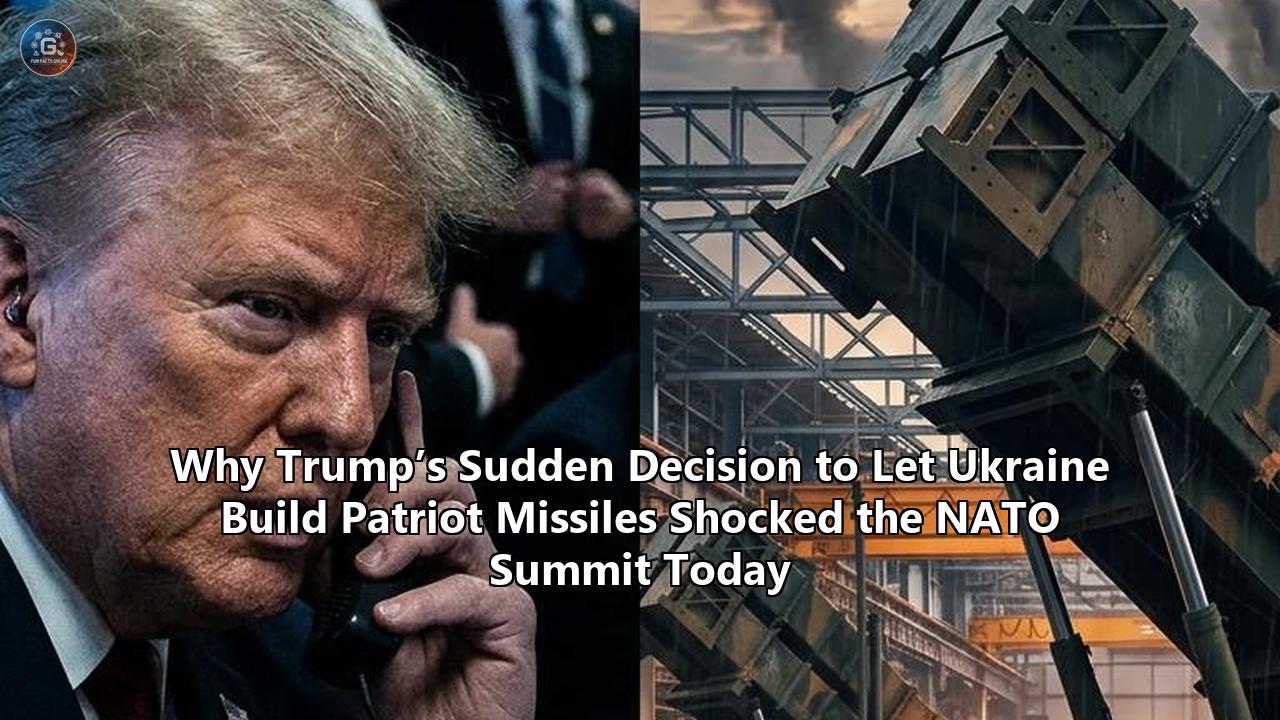
On the final day of the tense NATO summit in Ankara, Turkey, President Donald Trump delivered an unexpected announcement that reshaped the security landscape of Eastern Europe. Sitting next to Ukrainian President Volodymyr Zelenskyy at the Beştepe Presidential Compound, Trump declared that the United States would grant Ukraine a production license to build Patriot air defense systems and interceptors on its own soil.
"We’re going to give a license to you to make Patriots," Trump said, turning to Zelenskyy on July 8, 2026. "That’s pretty cool. This way, you can't complain that we're not giving 'em enough." He added, with characteristic bluntness, "I say, make them yourself. We haven't informed the company of that yet, but that’ll work out all right. I’m sure they will be thrilled".
The announcement sent shockwaves through the summit halls in Turkey and reverberated across the global defense industry. For years, Washington had fiercely guarded the proprietary, highly classified technology underlying its premier air-defense network. The decision to allow the domestic manufacture of Ukraine Patriot missiles represents a monumental pivot in American military export policy, bypassing decades of bureaucratic red tape and technology transfer restrictions.
Yet, the move is far from a straightforward victory for Kyiv. It comes with a major catch: Trump made it clear that the U.S. will not be sending more Patriot interceptors from its own heavily depleted stockpiles. "We have Patriots, but we don't have that many," Trump told reporters. "We need them for ourselves, too".
This sudden decision highlights a profound strategic shift. It is a tangible manifestation of the Trump administration's "NATO 3.0" doctrine, which demands that allies assume the primary burden of their conventional defense. By offering Ukraine the blueprint rather than the weapons, Washington is attempting to offload the industrial burden of the war while fundamentally rewriting the rules of transatlantic security.
The Ankara Summit: A Study in Transatlantic Whiplash
The bilateral meeting between Trump and Zelenskyy occurred against the backdrop of one of the most volatile NATO summits in recent history. Upon arriving in Ankara, Trump had immediately clashed with European leaders. He revived his highly controversial demand for the United States to take control of Greenland from Denmark, lashed out at European allies for refusing to allow U.S. forces to use their bases during recent strikes in the war against Iran, and threatened to pull American troops out of Europe if allies did not immediately meet their defense spending targets.
   NATO Summit Ankara (July 7-8, 2026)
   ┌─────────────────────────────────────────────────────────┐
   │ Day 1: Trump clashes with allies over Greenland, Iran,  │
   │ and demands immediate path to 5% GDP defense spending.  │
   └────────────────────────────┬────────────────────────────┘
                                │
                                ▼
   ┌─────────────────────────────────────────────────────────┐
   │ Day 2: Bilateral meeting with Zelenskyy; Trump pivots   │
   │ to praise Ukraine and announces Patriot licensing deal. │
   └─────────────────────────────────────────────────────────┘
The friction on Day 1 was palpable. Trump openly questioned Denmark’s sovereignty over Greenland, claiming "Denmark doesn't spend money to really help Greenland, but it's an important part for the U.S... We need it for protection of the world". Danish Prime Minister Mette Frederiksen fired back, reiterating that Greenland was not for sale, while British and Italian officials privately seethed over Trump's public complaints regarding their lack of support for the Persian Gulf theater.
But on Day 2, the mood inside the presidential palace shifted dramatically. Emerging from a closed-door session, Trump struck a warm, optimistic tone, praising Zelenskyy’s leadership and the adaptability of the Ukrainian military.
"We've actually developed a good relationship. It's hard to believe," Trump said with a grin.
The sudden policy shift regarding Ukraine Patriot missiles caught European diplomats, the Pentagon, and defense executives entirely by surprise. For years, Ukraine had pleaded for more air defense to protect its cities from Russian ballistic and hypersonic missile strikes. In May 2026, Zelenskyy had made a direct public appeal on CBS News’ Face the Nation, asking the U.S. for production licenses so Ukraine could build its own interceptors.
By granting this request in Ankara, Trump bypassed the traditional, multi-year foreign military sales review process. The decision was a masterful piece of political theater: it silenced critics who accused Trump of abandoning Ukraine, while simultaneously reinforcing his core position that the United States is no longer the bottomless well of free military hardware.
Systematic Impact Analysis: Who is Affected?
To understand the scale of this decision, it is necessary to analyze the cascading effects across the international community, the defense industrial base, and the battlefields of Eastern Europe.
                     ┌──────────────────────────────────────┐
                     │    Trump's Patriot Licensing Deal    │
                     └──────────────────┬───────────────────┘
                                        │
         ┌──────────────────────────────┼──────────────────────────────┐
         ▼                              ▼                              ▼
┌─────────────────┐            ┌─────────────────┐            ┌─────────────────┐
│     UKRAINE     │            │ DEFENSE SECTOR  │            │   NATO ALLIES   │
│Diplomatic coup; │            │RTX & Lockheed   │            │Pressure shifts  │
│must build high- │            │bypass; complex  │            │to Europe to     │
│tech supply chain│            │IP transfer and  │            │fund and secure  │
│under active fire│            │supply bottlenecks│           │local production │
└─────────────────┘            └─────────────────┘            └─────────────────┘
1. Ukraine: A Diplomatic Triumph Encumbered by Industrial Reality
For Kyiv, securing a license for domestic Patriot production is an extraordinary diplomatic coup. It signals a transition from being a passive recipient of Western military aid to becoming a peer-level industrial partner.
"I am grateful for the strong emphasis placed on strengthening Ukraine's air defense to better protect people's lives," Zelenskyy said in a statement following the bilateral meeting.
However, the operational reality is daunting. Ukraine’s air defense network is currently in a state of critical exhaustion. Russia has been firing close to 100 ballistic and cruise missiles per month into Ukrainian territory, systematically targeting power grids and urban centers.
While Ukraine has shown unmatched speed in deploying domestic long-range strike drones, manufacturing highly complex, radar-guided surface-to-air missile interceptors is an entirely different technological challenge. Kyiv must now build a high-tech precision manufacturing supply chain inside a war zone, under constant threat of Russian airstrikes.
2. The Defense Industrial Base: RTX and Lockheed Martin Caught Off Guard
The prime contractors for the Patriot system—RTX Corporation (which manufactures the ground-based radar and command stations) and Lockheed Martin (which builds the highly sought-after PAC-3 Missile Segment Enhancement interceptors)—were not briefed on Trump's announcement before it was made.
The licensing of Patriot technology is incredibly sensitive. The PAC-3 interceptor uses active radar seeker technology and complex solid-fuel rocket motors that are among the most closely guarded military secrets in the U.S. inventory.
The corporate reaction is a mix of panic and cautious alignment with the executive branch. Defense executives must now scramble to figure out:
- How to transfer proprietary tooling, software, and manufacturing knowledge without compromising intellectual property.
- How to manage the export of critical components that cannot be made in Ukraine, such as specialized microchips and rocket propellant.
- Who will bear the liability if a Ukrainian-produced interceptor fails on the battlefield or if classified blueprints are stolen by Russian intelligence or cyber-espionage units.
3. European Allies: The "NATO 3.0" Burden Shift
For European members of NATO, this decision is a stark wake-up call. It demonstrates that under the Trump administration, the U.S. is aggressively shifting the financial and material responsibility of European security onto Europe itself.
If Ukraine is to manufacture Ukraine Patriot missiles, European allies will likely be expected to fund the construction of these industrial facilities and supply chains. Under the newly reaffirmed Hague Defence Investment Pledge—which commits NATO allies to spending a massive 5% of their GDP on defense and security infrastructure by 2035—European capitals are already under immense pressure to boost spending. Trump’s move effectively tells Europe: We gave them the license; now you write the checks to build the factories.
4. Russia: A New Calculation for the Long War
The Kremlin’s military strategy has relied on a war of attrition, calculated on the assumption that Western stockpiles of high-end interceptors would eventually run dry. The global shortage of Patriot missiles—worsened by the U.S. deployment of air defenses to the Middle East during the war in Iran—had given Moscow a window of opportunity to overwhelm Ukrainian air defenses.
Trump's decision disrupts Russia's long-term calculus. If Ukraine successfully establishes domestic production of Patriot interceptors, the Kremlin faces the prospect of a self-sustaining Ukrainian air defense umbrella that cannot be starved out by shifts in Washington's political winds. Consequently, Russia’s immediate military priority will likely shift toward identifying and destroying any potential manufacturing sites before they can produce their first operational missile.
What Changes? The Policy Shift Behind "NATO 3.0"
To analyze the strategic consequences of this decision, one must look at how it fits into the broader concept of "NATO 3.0" championed by Secretary of War Pete Hegseth and the Trump administration.
| Concept Dimension | NATO 2.0 (Post-Cold War Model) | NATO 3.0 (2026 Model) |
|---|---|---|
| Primary U.S. Role | Underwrite Europe's conventional defense with massive troop deployments and direct hardware donations. | Provide a strategic nuclear umbrella; draw down conventional forces to focus on the Indo-Pacific and homeland defense. |
| European Obligation | Aim for 2% of GDP defense spending (frequently missed by many allies). | Enforce a strict 5% GDP target under the Hague Pledge, with U.S. dues tied to compliance. |
| Military Assistance | Direct transfers of U.S. stockpiles, straining American readiness and defense industrial depth. | Transfer of intellectual property, licenses, and co-production rights to build localized resilience. |
| Allied Integration | Deep integration where European forces rely heavily on American command, control, and logistics. | De-integration of conventional forces; Europe must build independent, interoperable conventional capabilities. |
This policy shift represents a move from "Donor NATO" to "Producer NATO". The White House is signaling that the era of unlimited material aid is over. Instead, the U.S. will weaponize its intellectual property and industrial dominance, giving allies the legal and technical authority to defend themselves, provided they build the capacity.
As Barry Pavel, Managing Director of Pavel Global Strategies and former National Security Council director, observed, this move is more than symbolic:
"Where American manufacturing hits bottlenecks in critical munitions, enabling allied production could become a template for the alliance," Pavel noted. "It eases U.S. constraints on manufacturing high-value munitions, unlocks allied co-production wherever the capacity exists, and strengthens Kyiv’s defensive posture without crossing Trump’s line on offensive arms".
By framing the Patriot system strictly as a "defensive weapon," Trump is able to maintain his stated goal of seeking a negotiated end to the Russia-Ukraine war while still providing Kyiv with a powerful long-term deterrent.
Short-Term Consequences: The Interceptor Drought and the Security Gap
While the licensing agreement is a landmark strategic development, its short-term impact on the battlefield is virtually nonexistent. The disconnect between political announcements and industrial capability will create a dangerous security gap over the next 12 to 24 months.
The Global Munitions Chokepoint
The United States and its European allies are currently facing an unprecedented shortage of air-defense interceptors. This deficit has been severely exacerbated by the war in Iran, which has sucked up massive quantities of American air defense assets, including Patriot batteries and THAAD systems, to protect U.S. forces and partner nations in the Middle East.
  U.S. Patriot Interceptor Production & Demand Dynamics (Estimates)
  ┌────────────────────────────────────────────────────────┐
  │ Monthly Global Demand (Ukraine, Middle East, Allies)    │ 150+ / month
  ├────────────────────────────────────────────────────────┤
  │ Current U.S. Production Rate                           │ ~50-60 / month
  └────────────────────────────────────────────────────────┘
The U.S. only produces about 50 to 60 Patriot interceptors per month. At this rate, the Pentagon estimated even before the Ankara summit that it would take until 2028 just to replenish depleted American stockpiles for its own national security requirements.
Consequently, Trump’s refusal to supply additional interceptors directly from U.S. stocks means Ukraine must survive on its dwindling current inventory. In the short term, Russian ballistic missile strikes will continue to exploit this vulnerability, threatening to inflict severe damage on Ukraine's remaining energy grid and industrial hubs.
The Vulnerability of the Assembly Line
The most immediate tactical challenge of building Ukraine Patriot missiles domestically is the physical defense of the manufacturing facilities.
A facility capable of assembling precision-guided missile interceptors is not a small, concealable workshop. It requires large, specialized cleanrooms, advanced diagnostic equipment, and highly secure storage for volatile rocket propellants and explosive warheads.
To prevent these factories from being destroyed by Russian Kalibr or Kinzhal missiles, they will need to be heavily protected. This creates a paradox: Ukraine must expend its precious remaining Patriot missiles to protect the very factories that are being built to produce those same missiles.
To mitigate this risk, defense planners are exploring alternative co-production strategies:
- Sub-component Dispersion: Manufacturing different parts of the interceptor (guidance systems, rocket motors, airframes) in highly secure, underground, or geographically dispersed locations across Ukraine, with final assembly occurring in deeply fortified bunkers.
- Cross-Border Assembly: Producing major sub-components in Ukraine, but transporting them across the border to Poland, Romania, or Germany for final integration and testing, thereby leveraging the protection of NATO's Article 5. However, this would require complex legal arrangements under the U.S. export control regime.
Long-Term Consequences: Re-engineering the Transatlantic Defense Ecosystem
In the long run, the decision to license the production of Ukraine Patriot missiles could fundamentally alter the global defense industrial base, paving the way for a more decentralized, resilient, and Allied-driven arms manufacturing network.
                     TRADITIONAL DEFENSE MODEL (Pre-2026)
  ┌─────────────────┐        Weapons         ┌─────────────────┐
  │  United States  ├───────────────────────>│  Allied Nations │
  │  (Manufacturer) │                        │   (Recipient)   │
  └─────────────────┘                        └─────────────────┘

                       "NATO 3.0" MODEL (Post-2026)
  ┌─────────────────┐        Licenses        ┌─────────────────┐
  │  United States  ├───────────────────────>│  Allied Nations │
  │   (IP Holder)   │      Technology        │  (Manufacturer) │
  └─────────────────┘                        └────────┬────────┘
                                                      │
                                                      ▼
                                             Domestic Production
                                             & Regional Defense
Breaking the ITAR Monopoly
The United States has historically used the International Traffic in Arms Regulations (ITAR) to tightly control the distribution of advanced military technology. While ITAR has successfully prevented state-of-the-art weaponry from falling into the hands of adversaries, it has also created massive bureaucratic bottlenecks that prevent allies from rapidly scaling up their own defenses.
By breaking this monopoly for one of the most advanced defensive weapons systems in the world, the Trump administration is setting a powerful precedent. If Ukraine can build Patriot missiles under license, other highly capable allies—such as Japan, South Korea, Poland, and Australia—will undoubtedly demand similar licensing agreements for high-end American systems. This could lead to a democratization of Western defense technology, with the U.S. acting as the primary research and development hub while regional allies operate as the primary production engine.
Financial and Technical Scalability
Establishing a domestic Patriot production line is an astronomical financial undertaking. A single PAC-3 interceptor costs between $3 million and $4.5 million to produce. Setting up a fully certified factory, training the workforce, and securing the supply chain is estimated to cost upwards of $2 billion and take at least 18 to 24 months under optimal conditions.
However, Ukraine possesses unique advantages that could accelerate this timeline:
- A Highly Skilled Workforce: Over more than four years of intensive, full-scale warfare, Ukraine’s defense technicians and engineers have demonstrated unparalleled ingenuity, successfully integrating Western missiles onto Soviet-era jets and developing a world-class domestic drone industry.
- Real-time Combat Feedback: Ukrainian production lines will be able to iterate and improve the technology based on direct, daily combat feedback from the front lines, potentially producing variations of the Patriot system that are more resilient against Russian electronic warfare and jamming techniques.
- Cost Efficiency: Manufacturing in Ukraine, where labor costs are significantly lower than in the United States, could eventually drive down the per-unit cost of these interceptors, making the Patriot system more financially sustainable for both Ukraine and other international buyers.
Geopolitical Implications: The Winner and Loser Ledger
Trump’s dramatic Ankara announcement has created clear winners and losers across the geopolitical chessboard.
Winners
- Donald Trump: The U.S. President successfully deflected criticism over his soft-on-Russia rhetoric and pressure on Ukraine, while advancing his "NATO 3.0" agenda of reducing direct U.S. military commitments in Europe. He can tell his domestic base that he is saving taxpayer dollars by refusing to give away expensive U.S. missiles, while still looking strong on defense.
- Volodymyr Zelenskyy: Despite the lack of immediate missile deliveries, the Ukrainian President secured a highly coveted strategic asset. The licensing agreement is a powerful symbol of Western trust and a vital building block for Ukraine’s post-war security architecture.
- The Polish and Eastern European Defense Hubs: Countries like Poland, which have aggressively expanded their defense spending to 4.5% of GDP and are physically close to Ukraine, will likely serve as the primary logistical and industrial transit routes for this co-production effort, solidifying their positions as the new industrial heart of NATO's eastern flank.
Losers
- Vladimir Putin: The Russian President’s strategy of waiting out Western military aid has suffered a major long-term blow. Even if a ceasefire is negotiated in the near future, Russia must now contemplate a future where Ukraine possesses the independent, localized industrial capacity to deny Russia air superiority indefinitely.
- The "Nostalgic" European Core: Western European nations that have struggled to meet even the old 2% of GDP defense target now face a double whammy: they must rapidly scale up their own spending to meet the new 5% Hague Pledge, while simultaneously finding the resources to bankroll Ukraine's localized defense industry under the "NATO 3.0" paradigm.
- The Pentagon Bureaucracy: The Department of Defense and its export control agencies have had their highly structured, deeply risk-averse tech-transfer regulations bypassed by a single verbal commitment from the Commander-in-Chief, forcing them into a frantic, reactive scramble to write the policy rules on the fly.
Looking Ahead: What to Watch Next
As the dust settles from the Ankara summit, the international community will be watching closely to see if Trump’s verbal promise translates into tangible industrial reality.
                                  Timeline to Watch
  ┌───────────────────┐       ┌───────────────────┐       ┌───────────────────┐
  │   Late 2026       │       │    Mid-2027       │       │    Late 2027      │
  ├───────────────────┤       ├───────────────────┤       ├───────────────────┤
  │ Pentagon-Industry │       │ Supply Chain &    │       │ First Domestic    │
  │ Negotiations      │       │ Factory Setup     │       │ Interceptor Tests │
  │ IP transfer,      │       │ Fortified assembly│       │ Initial run of    │
  │ regulatory hurdles│       │ sites established │       │ Ukrainian PAC-3s  │
  └───────────────────┘       └───────────────────┘       └───────────────────┘
The coming months will reveal the true viability of this bold initiative, with several critical milestones on the horizon:
1. The Pentagon-Manufacturer Negotiations
The first test of this policy will occur in Washington, where the War Department must sit down with RTX and Lockheed Martin to hammer out the legal framework of the licensing agreement. Watch for whether the administration uses executive authority—such as the Defense Production Act—to pressure these companies into transferring their highly classified IP, and how these companies negotiate protections for their commercial interests.
2. The Capital and Funding Sources
Because the U.S. is not funding the construction of these factories, the financial burden falls squarely on Ukraine and its European partners. A key indicator of success will be whether the European Union allocates portion of its multi-year Ukraine Support Loan or if individual European nations step forward with direct industrial grants to fund the setup of the manufacturing facilities.
3. The Drone-for-Patriot Barter
During the bilateral meeting, Trump also floated the idea of a trade: the U.S. licensing Patriot technology to Ukraine, in exchange for the U.S. purchasing advanced Ukrainian combat and surveillance drones, where Ukraine is currently a world leader. Watch for whether a formal "Drones-for-Patriots" bilateral defense trade agreement is signed, which would represent a highly innovative, reciprocal security partnership.
4. The Kremlin's Kinetic Response
As Ukraine begins to identify potential sites for Patriot assembly, the Russian military will undoubtedly prioritize these locations for deep precision strikes. The physical survival of these early-stage industrial facilities will be a crucial test of Ukraine's ability to protect its critical infrastructure under the most intense wartime conditions.
Trump’s decision in Ankara has permanently shattered the old assumptions of transatlantic defense. By offering Ukraine the license to build its own Ukraine Patriot missiles, the United States has launched a bold, risky experiment in decentralized warfare. If it succeeds, it could create a powerful, self-sustaining Ukrainian deterrent and establish a new blueprint for the future of the NATO alliance. If it fails under the weight of industrial complexity and Russian bombardment, it may leave Ukraine exposed to a devastating aerial onslaught at a time when Western stockpiles have run dry.
Reference:
- https://www.latimes.com/world-nation/story/2026-07-08/trump-says-u-s-will-give-license-to-ukraine-to-produce-patriot-defense-systems
- https://www.nato.int/en/news-and-events/articles/news/2026/07/08/secretary-general-on-the-ankara-summit-nato-delivers
- https://breakingdefense.com/2026/07/trump-leaves-summit-praising-nato-unification-floats-ukraine-made-patriots/
- https://time.com/article/2026/07/08/trump-zelensky-ukraine-patriot-missile-interceptors-russia-nato/
- https://www.act.nato.int/activities/nato-summit/
- https://www.sfgate.com/news/world/article/the-nato-summit-was-supposed-to-focus-on-defense-22336813.php
- https://www.theguardian.com/world/2026/jul/08/trump-zelenskyy-vague-promise-licence-manufacture-patriot-missiles
- https://decode39.com/15576/patriots-by-license-trumps-ukraine-offer-and-the-great-burden-shift/
- https://www.pbs.org/newshour/world/nato-chief-demands-allies-present-credible-plans-to-reach-defense-spending-targets
- https://www.conference-board.org/research/policy-backgrounders/nato-toward-the-ankara-summit
- https://www.theguardian.com/world/2026/jul/07/trump-renews-call-us-take-over-greenland-nato
- https://www.theguardian.com/world/live/2026/jul/08/trump-nato-summit-greenland-us-turkey-rutte-marine-le-pen-europe-latest-news-updates?page=with%3Ablock-6a4e09698f08465104a54f49
- https://www.pbs.org/newshour/world/why-trump-wants-greenland
- https://www.friendsofeurope.org/insights/critical-thinking-the-nato-summit-in-ankara-moving-towards-the-alliance-3-0/
- https://www.cbsnews.com/news/trump-ukraine-license-patriot-missiles-zelenskyy/
- https://turner.house.gov/media-center/press-releases/congressman-turner-advocates-for-and-president-trump-authorizes-patriot-missile-interceptor-licensure-in-ukraine
- https://www.defensenews.com/global/europe/2026/07/08/ukraine-to-get-license-for-making-patriot-interceptors-trump-pledges/
- https://www.delawarepublic.org/npr-headlines/2026-07-07/trumps-nato-pressure-campaign-continues-as-summit-begins
- https://tvpworld.com/94241528/ankara-summit-and-patriots-pledge-signal-new-role-for-ukraine-in-nato-security
- https://uk.diplomatie.gouv.fr/en/european-leaders-commit-euro-atlantic-security-and-transatlantic-bond
- https://www.nato.int/en/what-we-do/introduction-to-nato/nato-summits
- https://www.war.gov/News/News-Stories/Article/Article/4521330/war-department-review-to-ensure-nato-30-becomes-europe-led-defense-alliance/
- https://www.thenationalnews.com/news/2026/07/08/nato-announces-50bn-defence-boost-at-ankara-summit/
- https://www.turkishminute.com/2026/07/08/nato-leaders-reaffirm-ironclad-commitment-to-mutual-defense-at-ankara-summit/
- https://www.lawfaremedia.org/article/nato-3.0--a-tagline-in-search-of-a-concept
- https://www.nato.int/en/about-us/official-texts-and-resources/official-texts/2026/07/08/the-ankara-summit-declaration