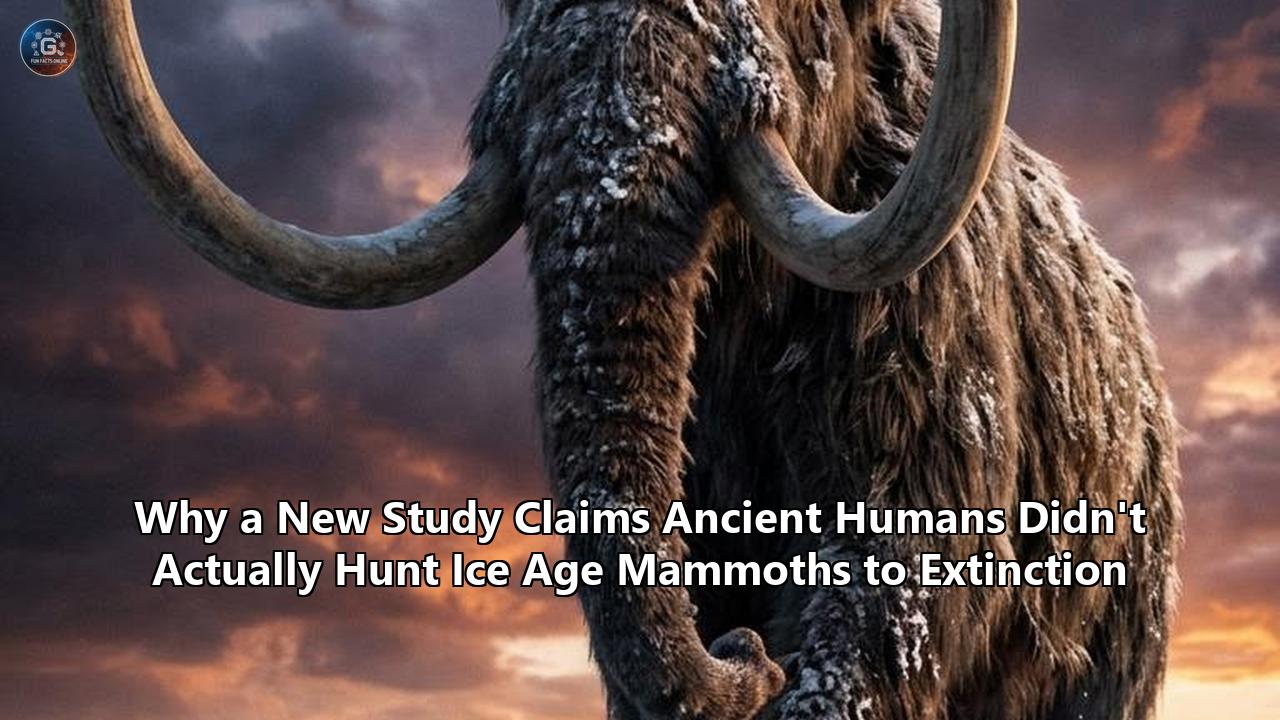
The discovery of stone spear points resting alongside the massive, fossilized bones of Ice Age mammoths has long been presented as archaeology’s ultimate smoking gun. For decades, this striking image served as the foundation for a dominant historical narrative: that the first humans to colonize the Americas were highly specialized, hyper-lethal big-game hunters who swept across the continents and rapidly slaughtered the reigning megafauna.
A pair of competing studies published simultaneously in highly prestigious journals has thrown this long-standing consensus into chaos, sparking a fierce academic battle over the ultimate fate of the Ice Age’s most iconic giants.
On one side of this intellectual duel is a study published in the Journal of Archaeological Science: Reports. Led by Dr. Metin Eren of Kent State University and a team of distinguished researchers from the Smithsonian, Southern Methodist University, the University of Utah, and the University of Michigan, the paper takes aim at the very core of the "overkill" model. Eren and his colleagues meticulously re-examined all 15 archaeological sites in North America where the distinct fluted stone tools of the Clovis culture have been found in direct physical association with the remains of proboscideans—the family of trunked mammals that includes woolly mammoths, Columbian mammoths, mastodons, and gomphotheres.
The team’s conclusion is nothing short of a scientific bomb-throw: not a single one of these famous "kill sites" actually contains definitive evidence of a human kill. Instead, the researchers argue, every single site can be explained by "facultative scavenging"—the opportunistic processing of animals that were already dead or dying of natural causes.
"If this were a trial for murder, Clovis murdering mammoths, we’d have to acquit," Eren remarked, summing up the team's findings.
But on the very same day, a contrasting study was published in Science Advances. Led by Dr. Ben Potter of the University of Alaska-Fairbanks and co-authored by a heavy-hitting team including Dr. Todd Surovell and Dr. Robert Kelly of the University of Wyoming, this second paper presents an entirely different picture. By synthesizing the zooarchaeological records of 50 sites across three vast regions—stretching from Eastern Beringia (ancient Alaska) down through North America and into the tip of South America—Potter’s team argues that early Paleoindians were, in fact, dedicated big-game specialists. According to their analysis, massive megaherbivores like mammoths, giant ground sloths, and gomphotheres made up an astonishing 83% to 88% of the meat and fat these early human groups consumed.
How can two groups of world-class scientists look at the exact same physical record and arrive at such fundamentally opposite conclusions? To make sense of this profound scientific divide, we have to look past the dramatic museum murals of hunters hurling spears at roaring mammoths and unpack the complex biology, physics, and philosophy behind the ultimate question: did humans hunt mammoths to extinction?
The Birth of Prehistory's Cold Case
To understand why this current academic clash is so intensely fought, we must first trace the origins of the "overkill hypothesis". The debate began in earnest during the late 1960s, pioneered by the late geoscientist Dr. Paul S. Martin of the University of Arizona. Martin looked at the fossil record of the Late Pleistocene—the epoch ending roughly 11,700 years ago—and saw a biological catastrophe of staggering proportions. Across North and South America, some 35 genera of large mammals, weighing over 100 pounds, vanished forever in a geological blink of an eye.
Among the lost were:
- Columbian and Woolly Mammoths: Towering giants weighing up to 10 tons.
- Mastodons: Shorter, stockier forest-dwelling cousins of the mammoth.
- Gomphotheres: Strange, four-tusked relatives of modern elephants.
- Giant Ground Sloths: Slow-moving leaf-eaters the size of modern grizzly bears or even elephants.
- Saber-Toothed Cats: Hyper-specialized predators that preyed on the young of these massive herbivores.
Martin noticed a suspicious chronological coincidence: these massive animals seemed to disappear almost precisely when the first anatomically modern humans, carrying highly sophisticated stone weaponry, began to spread across the Western Hemisphere. To explain this, he formulated the "blitzkrieg" model of human overkill.
In Martin’s vision, a small, highly mobile band of human hunters crossed the Bering Land Bridge from Siberia into Alaska and eventually made their way south through an ice-free corridor into the heart of North America. Upon entering this pristine, predator-rich wilderness, they encountered vast herds of megafauna that had evolved for millions of years in the complete absence of human beings. These animals possessed no "learned wariness" of the two-legged ape. They did not run, they did not hide, and they were utterly defenseless against coordinated, technologically advanced ambush hunting.
               [ Humans Cross Bering Land Bridge ]
                              │
                              ▼
               [ Entry into Subglacial Americas ]
                              │
                              ▼
           [ Encounter with Unwary Megafauna ] (No learned wariness)
                              │
                              ▼
            [ Rapid Human Population Growth ] (Abundant meat & fat)
                              │
                              ▼
            [ Swift Southern Migration Wave ] (The "Blitzkrieg" front)
                              │
                              ▼
               [ Mass Megafaunal Extinction ] (Within ~1,000 years)
According to the blitzkrieg model, this abundance of high-energy food triggered an explosion in the human population. As hunters moved rapidly southward in a rolling wave of predation, they left a trail of empty ecosystems in their wake. Within approximately 1,000 years, the largest mammals on the continents were driven to extinction.
For decades, this narrative was treated as near-dogma in many archaeological circles. It possessed a clean, dramatic narrative arc and carried a poignant moral lesson about humanity's innate capacity for environmental destruction. Yet, many archaeologists and paleontologists remained deeply skeptical, pointing out that the physical evidence for such a systematic slaughter was surprisingly thin. The simultaneous publications by Eren's and Potter's teams represent the culmination of this 50-year-old debate, utilizing advanced modern technologies—from stable isotope mass spectrometry to experimental ballistics—to argue whether did humans hunt mammoths to extinction.
The Skeptic's Case: The Philosophy of Equifinality
At the heart of Dr. Metin Eren’s paper in the Journal of Archaeological Science: Reports is a profound warning about how scientists interpret physical clues left behind in the dirt. He invokes a core scientific and philosophical concept known as equifinality.
Equifinality is the principle that a single, observed end state or physical result can be produced by multiple, entirely different processes or histories.
In forensic science, if a body is found at the bottom of a cliff, the end state is a dead body with broken bones. However, that physical result could have been caused by three completely different histories: an accidental trip, a suicidal jump, or a homicidal push. Without further, highly specific evidence, a forensic examiner cannot definitively choose one scenario over the others.
Eren and his co-authors, including Southern Methodist University's legendary archaeologist Dr. David Meltzer, argue that American archaeology has long suffered from a failure to account for equifinality. When an archaeologist digs up a mammoth skeleton and finds a beautifully crafted Clovis stone projectile point lying nearby, they almost instinctively label the locality a "kill site". But Eren’s team argues that this label is an untested assumption.
               ┌─────────────────────────────────────────┐
               │ PHYSICAL END STATE:                      │
               │ Mammoth bones associated with stone tools│
               └────────────────────┬────────────────────┘
                                    │
                  ┌─────────────────┴─────────────────┐
                  ▼                                   ▼
        [ SCENARIO A: HUNTING ]             [ SCENARIO B: SCAVENGING ]
     Humans tracked, ambushed, and       Humans found a carcass of an
     killed a healthy mammoth.           animal that died of natural
                                         causes and butchered it.
                  │                                   │
                  └─────────────────┬─────────────────┘
                                    ▼
               ┌─────────────────────────────────────────┐
               │    ARCHAEOLOGICAL TRACES LEFT BEHIND:   │
               │  - Cut marks on bones                   │
               │  - Scattered skeletal elements          │
               │  - Discarded or broken stone points     │
               │  - Microscopic wear on tool edges       │
               └─────────────────────────────────────────┘
                    Both scenarios produce identical clues!
To test this, Eren's team systematically reviewed the data from all 15 universally accepted North American Clovis-era localities containing both Clovis points and proboscidean remains. They evaluated every piece of evidence commonly used to prove a hunt, including:
- The spatial positioning of the stone tools relative to the bones.
- The presence of cut marks and impact fractures on the skeleton.
- Microscopic wear patterns on the edges of the stone points.
- Fractures on the stone points themselves, which are often interpreted as "impact damage" from being thrown as weapons.
Their findings were startling: at every single site, the physical evidence could just as easily have been left by humans scavenging a carcass as by humans killing a live animal.
For example, when a stone projectile point is found broken, archaeologists have historically assumed it snapped when hitting a mammoth's rib or shoulder blade during a high-stakes hunt. However, Eren’s team points out that when people use stone knives to butcher a massive, mud-caked, tough-skinned carcass, the blades frequently snap in ways that produce identical fracture patterns.
Furthermore, microscopic wear patterns on the edges of stone tools—long thought to be a reliable indicator of tool use—can be incredibly misleading. Experimental work has shown that these microscopic polishes and scratches can form not just from cutting flesh, but from a tool rolling around in the dirt, being stepped on by animals, or being used to scrape mud-caked hides during butchery.
The Missing "Smoking Gun" of North America
One of the most powerful arguments raised by Eren’s team is the complete absence of a specific type of evidence that is actually quite common across the Atlantic.
In Europe and northern Asia (Eurasia), there are numerous, undisputed mammoth kill sites. At these Eurasian localities, archaeologists have found the ultimate, unambiguous proof of hunting: stone projectile points deeply embedded directly into the bones of the mammoths.
                                EURASIA vs. NORTH AMERICA:
                            A Tale of Two Archaeological Records

          EURASIA                                     NORTH AMERICA
          ┌───────────────────────────┐               ┌───────────────────────────┐
          │ - Embedded spear points   │               │ - ZERO embedded points in │
          │   lodged deep inside      │               │   proboscidean bones.     │
          │   mammoth bone tissue.    │               │                           │
          │ - Clear evidence of active│               │ - Tools lie NEXT to bones,│
          │   human-inflicted trauma. │               │   consistent with both    │
          │                           │               │   hunting & scavenging.   │
          └───────────────────────────┘               └───────────────────────────┘
In places like Russia and Ukraine, spear tips remain lodged in mammoth vertebrae, ribs, and pelvises, surrounded by healed or unhealed bone growth that proves the animal was struck while alive. These embedded points are the physical equivalent of a bullet lodged in a murder victim's skull.
Yet, in North America, despite the discovery of thousands of Clovis points and dozens of mammoth skeletons, not a single stone point has ever been found embedded in a proboscidean bone.
"We're not saying that they didn't occasionally hunt mammoth," Eren explained. "But if you can't definitively tell at any single site that Clovis killed that mammoth, then you can't then argue that they overkilled mammoth to extinction".
If early Americans were not systematically hunting these beasts, what were they doing? Eren and his colleagues argue they were "facultative scavengers". A single dead mammoth, mastodon, or gomphothere would have been an absolute biological jackpot for a family of hunter-gatherers. A decaying, multi-ton carcass would have provided:
- Hundreds of pounds of easily accessible meat and fat (if found before major carnivores stripped it).
- Massive, durable bones perfect for carving into needles, awls, and pry-bars.
- Enormous, thick hides that could be used for shelter, clothing, or heavy-duty cordage.
- High-quality ivory from the tusks, which was a prized raw material for toolmaking.
For a small human population traversing a dangerous, unfamiliar landscape, actively attacking a healthy, protective, 10-ton mammoth herd would have been a high-risk, low-reward gamble. Finding an animal that had died of disease, old age, bog-trapping, or predator attacks, however, would have been incredibly safe, highly lucrative, and biologically sensible.
Isotope Chemistry and the Wild "Maggot Hypothesis"
The debate over the early American diet took an even more bizarre turn when Eren's team offered a radical re-interpretation of a high-profile 2024 scientific discovery.
In December 2024, a team of researchers led by Dr. Ben Potter and Dr. Jim Chatters published a study that was widely hailed as the first direct, biological evidence that ancient Americans relied heavily on mammoths as a dietary staple. The team had analyzed stable isotope data extracted from the collagen of a 13,000-year-old skeleton known as Anzick-1.
Anzick-1 is the skeletal remains of an 18-month-old Clovis boy found in 1968 on a ranch in western Montana, buried alongside more than 100 red-ochre-covered stone and bone tools. It is the only known human burial directly associated with the Clovis culture.
                     ANZICK-1 CHILD (Montana, ~13,000 BP)
                                      │
                     [ Extract Bone Collagen Proteins ]
                                      │
                     [ Run Stable Isotope Mass Spectrometry ]
                                      │
               ┌──────────────────────┴──────────────────────┐
               ▼                                             ▼
        [ CARBON ISOTOPES ]                          [ NITROGEN ISOTOPES ]
     Identify type of plants at                   Reveal trophic level (position
     base of the local food web.                  on the food chain).
               │                                             │
               └──────────────────────┬──────────────────────┘
                                      ▼
                        [ OBSERVED CHEMICAL RESULT ]
                    Extremely high Nitrogen-15 values (δ15N),
                    matching an extinct hypercarnivore.
To reconstruct what the Anzick child’s family was eating, the 2024 researchers looked at stable isotopes of carbon and nitrogen. When an animal eats, the chemical elements from its food are incorporated into its growing tissues, leaving a permanent, diagnostic chemical signature in its bones.
In particular, nitrogen isotopes ($^{14}N$ and the heavier, rarer $^{15}N$) undergo a process called trophic fractionation. Every time you move one step up the food chain—from a plant, to a herbivore, to a carnivore—the concentration of the heavier $^{15}N$ isotope increases by roughly 3 to 5 parts per thousand (expressed as $\delta^{15}N$).
   [ Trophic Level 4: Hypercarnivore ]  <-- (Extreme δ15N enrichment)
                  ▲
                  │  (+3‰ to +5‰ Fractionation)
                  │
     [ Trophic Level 3: Carnivore ]     <-- (Significant δ15N enrichment)
                  ▲
                  │  (+3‰ to +5‰ Fractionation)
                  │
     [ Trophic Level 2: Herbivore ]     <-- (Moderate δ15N enrichment)
                  ▲
                  │  (+3‰ to +5‰ Fractionation)
                  │
      [ Trophic Level 1: Plant ]        <-- (Baseline δ15N)
Because a breastfeeding infant builds its tissues directly from its mother’s milk, the infant’s bones are essentially a chemical mirror of its mother’s diet, shifted up by one additional trophic step.
The 2024 isotopic analysis of the Anzick-1 child revealed exceptionally high $\delta^{15}N$ values. In fact, the child's chemistry placed his mother at the absolute peak of the prehistoric food chain—chemically comparable to an extinct, hypercarnivorous saber-toothed cat. The 2024 study authors concluded that the only way to achieve such a hyper-elevated nitrogen signature was if the mother was consuming massive, nearly exclusive quantities of mammoth meat, which itself carried high nitrogen levels due to the specific, cold, dry climate of the Late Pleistocene.
But in their July 2026 paper, Metin Eren and his colleagues pointed out a major flaw in this interpretation, rooted in basic human biology.
The Biological Limit of the "All-Meat" Diet
Humans, unlike true carnivores such as cats or wolves, have a strict biological ceiling on how much protein they can safely metabolize. This physiological limit is known historically as rabbit starvation or protein poisoning.
The human liver can only synthesize a maximum of about 35% to 40% of its daily energy requirements from protein. The remaining 60% to 65% of daily calories must come from either carbohydrates (plants, roots, berries) or fats. If a human attempts to survive on a diet composed almost entirely of lean, high-protein meat, the liver becomes overwhelmed, unable to safely convert excess nitrogen into urea for excretion.
This leads to a rapid, life-threatening buildup of ammonia and amino acids in the bloodstream, resulting in:
- Severe nausea and diarrhea.
- Extreme fatigue and headaches.
- Low heart rate and low blood pressure.
- Death within weeks.
Eren’s team argued that for the Anzick mother to have achieved a nitrogen signature comparable to a saber-toothed cat solely by eating mammoth meat, she would have had to consume an mathematically impossible, highly toxic amount of pure protein.
So, how did her nitrogen values get so high? Eren’s team proposed a startling, biologically plausible alternative that fits perfectly with their scavenging model: maggots.
                     THE PREHISTORIC MAGGOT PATHWAY

                  [ Giant Megafaunal Carcass Dies ]
                                  │
                                  ▼
                     [ Blowflies Lay Millions of Eggs ]
                                  │
                                  ▼
                   [ Fly Larvae (Maggots) Develop ]
                     - Feed directly on decomposing carcass.
                     - Rapidly concentrate & enrich Nitrogen-15.
                                  │
                                  ▼
                     [ Human Scavengers Harvest Maggots ]
                     - Gather in massive, easy-to-harvest clumps.
                     - Extremely high in healthy fats & proteins.
                                  │
                                  ▼
                        [ Hyper-Elevated δ15N ]
                     Mother eats maggots -> Nurseries Anzick child ->
                     Anzick child displays extreme nitrogen-15 levels.
When a multi-ton mammoth died, its carcass would have quickly become a massive breeding ground for blowflies and other carrion-feeding insects. Within days, the carcass would be writhing with millions of fat, protein-rich fly larvae—maggots.
Crucially, because maggots feed on decomposing, rotting proteins, they undergo an extreme, rapid localized nitrogen fractionation of their own. They carry incredibly high, concentrated $\delta^{15}N$ values.
Ethnographic and historical records show that many hunter-gatherer groups around the world regularly harvested and consumed insect larvae. Maggots are incredibly rich in essential fatty acids and lipids, providing a highly concentrated source of the dietary fats that are critical for preventing protein poisoning.
"Scavenging also could possibly explain the high $\delta^{15}N$ values recently reported for the Anzick child," noted co-author Dr. David Meltzer, "which could readily result from his mother eating maggots and not mammoth meat".
The Hunter's Counter-Case: The Continental Sweep
While Eren’s scavenging and maggot-harvesting model paints a fascinating picture of opportunistic survival, Dr. Ben Potter and his colleagues at the University of Alaska-Fairbanks are not buying it. Their study, published simultaneously in Science Advances, mounts a powerful defense of the classic big-game specialist model, utilizing a vast, continent-spanning dataset.
                        THE SCIENTIFIC DUEL (JULY 2026)

   [ SKEPTICS: Eren et al. ]               [ HUNTERS: Potter et al. ]
   - Journal of Archaeological             - Science Advances
     Science: Reports                      - Focuses on 50 sites across
   - Focuses on 15 North American            Beringia, North, & South America.
     proboscidean sites.                   - Early Americans were specialized
   - Early Americans were opportunistic      big-game hunters.
     scavengers.                           - Extreme megafauna diet (83%-88%
   - Equifinality makes kill sites           of total consumed fat and meat).
     unprovable.                           - Uniform toolkits show adaptation
   - High nitrogen values might be           to prey, not local plants.
     from scavenging maggots.              - Hunting drove extinctions.
Potter's team argues that looking at a few isolated sites in isolation missed the forest for the trees. To truly understand early American behavior, they argue, you have to analyze the entire western hemisphere’s zooarchaeological record as a unified system.
The team examined 50 archaeological sites representing the three earliest, widespread, contemporaneous cultural complexes in the Americas:
- Eastern Beringia (Alaska/Yukon): Dating to roughly 14,000 to 13,300 years ago.
- Clovis Culture (North America): Dating to roughly 13,400 to 12,800 years ago.
- Fishtail Projectile Point Culture (South America): Dating to roughly 12,900 to 11,600 years ago.
By analyzing measures such as species abundance, the minimum number of individual animals present at each site, and the total estimable edible biomass, Potter's team calculated that megaherbivores (animals weighing over 1,000 kilograms, or 2,200 pounds) were the absolute core of the Paleoindian economy.
In Beringia, diets were dominated by the woolly mammoth. In North America, the focus shifted to the Columbian mammoth and mastodon. In South America, the Fishtail populations targeted giant ground sloths and gomphotheres.
"The test of dietary specialization isn't just how many of a given animal you find at an ancient campsite," Potter explained. "It's what the record looks like relative to natural abundance".
The Technology of Monotony
One of the most compelling pieces of evidence Potter’s team raises is the striking uniformity of early American toolkits.
When human hunter-gatherers move into a new, unfamiliar landscape, they typically adapt their survival strategies to the local environment. If they move into an area rich in fish and wild grains, they develop nets, fishhooks, and grinding stones. If they move into a dense forest, they adapt their tools to woodcarving and hunting small, forest-dwelling game like deer. This process of local adaptation normally results in a highly diverse, regionalized archaeological record.
But the early American record shows the exact opposite: technological monotony.
               [ Uniform Clovis Point Technology ]
            (Found in Maine, California, Florida, Texas)
                                │
                                ▼
         [ Uniform Fishtail Point Technology in South America ]
                                │
                                ▼
        HOW DID THEY EXPAND SO FAST WITHOUT LOCAL ADAPTATION?
                                │
                                ▼
         [ EXPLANATION: Megafauna Specialization ]
         - They didn't adapt to local plants/ecosystems.
         - They tracked & hunted the exact same giant migratory
           herbivores across thousands of miles of diverse terrain.
The beautifully fluted Clovis points found in the forests of Maine are virtually indistinguishable in design, size, and manufacturing technique from those found in the deserts of Arizona, the plains of Texas, or the coasts of Florida. The same pattern repeats in South America with the Fishtail points, which maintain a highly consistent design from the high Andes to the wind-swept plains of Patagonia.
How could human groups spread across thousands of miles of radically different ecosystems—ranging from subarctic tundra and temperate deciduous forests to tropical grasslands and arid deserts—without changing their basic tools?
Potter’s team argues there is only one logical answer: they didn't need to adapt to the local plant life or small game, because they were tracking and hunting the exact same massive, migratory animals across the entire hemisphere.
"Mammoths, for example, can cover a tremendous range and occupy vast territories," said co-author Dr. Mat Wooller of the University of Alaska Fairbanks. "In effect, specialist hunter-gatherers used their knowledge of megaherbivores, like mammoths, to expand successfully across the continents rather than learning about each localized ecosystem they encountered".
This specialization allowed humans to sweep from the Arctic Circle to the southern tip of South America in a few hundred years. They were, in essence, the ultimate biological specialists, carving out a continent-spanning niche built entirely on the backs of the Ice Age’s greatest beasts.
The Chronological "Rolling Wave" of Collapse
If humans were indeed specialized big-game hunters, we should expect to see a clear relationship between the arrival of humans and the disappearance of their prey. Potter and his team argue that this is precisely what the chronological record shows—a highly suspicious, time-transgressive, rolling wave of extinction that perfectly mirrors the path of human migration southward.
                     THE ROLLING WAVE OF EXTINCTION

                     [ Human Arrival in Beringia ]
                          (~14,000 years BP)
                                  │
                                  ▼
                    [ Mammoths Vanish in Alaska ]
                          (~13,300 years BP)
                                  │
                                  ▼
                    [ Human Arrival in Subglacial NA ]
                          (~13,400 years BP)
                                  │
                                  ▼
                   [ Clovis Megafauna Gone in NA ]
                          (~12,800 years BP)
                                  │
                                  ▼
                     [ Human Arrival in South America ]
                          (~12,900 years BP)
                                  │
                                  ▼
                   [ South American Giants Vanish ]
                          (~11,600 years BP)
This chronological pattern is difficult to explain by climate change alone. The transition from the Ice Age to our modern warm epoch (the Holocene) was globally tumultuous, but it did not occur in a neat, rolling, north-to-south wave over several thousand years. Yet, the extinctions of these giant animals did.
"The same sequence of arrival, overlap and extinction played out again and again, each time a little further south, making a strong circumstantial case for human hunting as a major contributing factor to megafauna extinction," Potter asserted.
Furthermore, Potter’s team notes that these giant herbivores were biologically highly vulnerable to even low levels of hunting pressure. Like modern elephants, mammoths and other megaherbivores:
- Had exceptionally long gestation periods (likely around 22 months).
- Spaced births widely (often 3 to 5 years between calves).
- Reached sexual maturity very late in life (often not until their teens).
- Had exceptionally low natural mortality rates as adults, meaning they had no natural predators before humans arrived.
Because their reproductive rate was so slow, mathematical modeling shows that even a tiny increase in adult mortality—such as a small human band killing just a few pregnant female mammoths a year—would have pushed the population growth rate into a permanent negative spiral, inevitably leading to extinction over a few centuries.
The Physics of the Kill: How Did Humans Hunt 6-Ton Giants?
If we accept Potter’s model that early Paleoindians were actively hunting these enormous animals, it raises a daunting physical question: how exactly did a collection of small, fragile, 190-pound humans manage to safely and regularly bring down a furious, 6-ton, thick-skinned, protective elephant-like beast?
                         THE SIZE DISPARITY

             🚶                                  🐘
      Modern Human                       Columbian Mammoth
      Weight: ~190 lbs                   Weight: ~12,000 lbs (6 tons)
      Height: ~5'9"                      Height: ~13 feet
      Armor: Skin                        Armor: Thick hide & fur, heavy bone
      Weapons: Stone-tipped spears       Weapons: 14-foot spiraled ivory tusks
For generations, the popular assumption was that hunters chased mammoths until they were cornered, trapped them in deep muddy bogs, or drove them off steep cliffs, before launching a barrage of thrown stone-tipped spears.
However, recent scientific breakthroughs in the study of early weaponry have thrown cold water on this Hollywood-style depiction.
The UC Berkeley "Pike Hunting" Study
In August 2024, a team of archaeologists at UC Berkeley, led by Scott Byram, published a study in PLOS One that completely revolutionized our understanding of Pleistocene weaponry.
Byram’s team conducted extensive ballistic testing on replica Clovis points and investigated historical accounts of indigenous hunting and military defensive strategies. They discovered that throwing a spear at a mammoth’s massive, muscular body would have been remarkably ineffective.
A human muscle-powered thrown spear simply cannot generate enough kinetic energy to reliably penetrate the incredibly thick, dense hide, underlying fat layers, and heavy rib cages of a giant proboscidean. Ballistic gel testing showed that a thrown spear would feel like little more than a painful "pinprick" to a mastodon or mammoth, likely doing nothing more than provoking an incredibly angry, highly lethal retaliatory charge from a protective 6-ton beast.
Instead, Byram and his colleagues proposed that early Americans used a highly sophisticated, terrifyingly simple technique known as pike hunting.
                              PIKE HUNTING PHYSICS

          [ Hunter Plants Spear Butt Deeply in Ground ]
                                  │
          [ Angle Sharp Clovis Point Upward at Charging Beast ]
                                  │
          [ Charging Mammoth Impacts the Planted Spear ]
                                  │
               ┌──────────────────┴──────────────────┐
               ▼                                     ▼
      [ MOMENTUM TRANSFER ]                 [ HOLLOW-POINT EFFECT ]
    The animal's own 6-ton mass           The impact forces the point
    and speed drive the spear deep        deeply into internal organs
    into its chest or underbelly.         as the shaft resists or collapses.
In pike hunting, a hunter does not throw their weapon. Instead, they find a sturdy, heavy wooden shaft, tip it with a razor-sharp, durable Clovis point, and plant the butt-end of the spear firmly and deeply into the soil. They then angle the sharp stone tip upward, bracing the spear with their body or a natural feature, and deliberately provoke a charge from the target animal.
When the charging mammoth impacts the stationary, ground-braced pike, the physics of the collision change dramatically.
Instead of relying on the limited kinetic energy of a human arm, the weapon harnesses the colossal momentum ($p=mv$) and kinetic energy ($KE=\frac{1}{2}mv^2$) of the charging 6-ton beast itself. The animal’s own massive weight and forward speed drive the razor-sharp stone point deep through its tough hide, slicing through dense muscles and penetrating deep into vital thoracic organs.
Byram's team notes that the unique engineering of the Clovis point—which features a thinned, fluted base—acts almost like a modern hollow-point bullet. When the point impacted the animal, the lashing holding it to the wooden shaft would have been designed to slip or release slightly, allowing the stone point to slide further and deeper into the wound cavity as the animal moved, maximizing internal tissue damage and hemorrhaging.
"This ancient Native American design was an amazing innovation in hunting strategies," Scott Byram explained. "This distinctive Indigenous technology is providing a window into how people lived among these incredible animals during much of human history".
While the pike hunting theory solves the physical mystery of how early humans could take down such massive prey, it remains a hypothesis. As Metin Eren pointed out in response to the Berkeley study, "The major problem is that archaeologists have never discovered any sort of Clovis wooden spear or dart shaft, much less any hard evidence that spears were actually used in a pike-like fashion".
Climate Change: The Silent Accomplice
While the debate between Eren’s "scavenging maggots" model and Potter’s "specialized mammoth killers" model represents a stark academic divide, many scientists argue that both sides are missing a crucial, non-human culprit: the climate.
The end of the Pleistocene epoch was not a stable, peaceful transition into our modern warm climate. Instead, it was marked by a series of incredibly abrupt, violent climate swings that completely redrew the ecological map of the planet.
The most dramatic of these climate events was the Younger Dryas, a period of sudden, intense cooling and drying that began roughly 12,900 years ago and lasted for about 1,200 years.
                               THE YOUNGER DRYAS
               (Abrupt cooling & drying: ~12,900 to 11,700 BP)
                                       │
                                       ▼
                     [ Collapse of the "Mammoth Steppe" ]
                     - Vast, high-productivity grasslands dry up.
                     - Replaced by low-nutrient tundra & dense forest.
                                       │
                                       ▼
                        [ Severe Habitat Fragmentation ]
                     - Mammoths forced into small, isolated pockets.
                     - Genetic health plummets due to inbreeding.
                                       │
                                       ▼
                       [ The Double-Whammy Extinction ]
                     Climate stress + human hunting/scavenging = Collapse.
Before this transition, much of northern Eurasia and North America was covered by a unique, highly productive ecosystem known as the mammoth steppe. Unlike the barren, wet, modern moss-dominated arctic tundra, the mammoth steppe was a vast, dry, fertile grassland. It was kept highly productive by the constant grazing, trampling, and fertilizing of millions of giant herbivores—which acted as natural ecological engineers, preventing the growth of woody shrubs and promoting the spread of nutrient-rich grasses.
As the climate rapidly fluctuated during the Younger Dryas, this vast grassland began to fragment and collapse. The dry, cold winds that maintained the steppe died down, and rising moisture levels turned the firm, dry grasslands into waterlogged, boggy tundra dominated by acidic, unpalatable mosses and low-nutrient woody shrubs.
This ecological shift was a death sentence for the mammoth. A mature woolly or Columbian mammoth needed to consume up to 400 pounds of fresh grass every single day just to survive. As their vast, highly nutritious grazing pastures dissolved into bogs and dense forests, the mammoth populations were forced into smaller, increasingly isolated refugia—pockets of remaining suitable habitat where they could still find food.
The Synergistic Collapse: A Prehistoric "Double Whammy"
In these isolated refugia, the giant herds were highly vulnerable. Small, fragmented populations are highly susceptible to:
- Inbreeding Depression: A rapid loss of genetic diversity that leads to birth defects, high infant mortality, and weakened immune systems.
- Localized Natural Disasters: A single severe drought, winter freeze, or bog-flooding event could wipe out an entire local population.
- Low-Level Human Pressure: In a healthy, continent-spanning population of millions, occasional human hunting or scavenging has virtually zero impact. But in a highly stressed, fragmented population of a few thousand struggling to survive, even the occasional loss of a few breeding adults to human hunters (or the exclusion of herds from critical watering holes by human camps) can easily tip the species over the edge into extinction.
                     THE EXTINCTION SYNERGY MODEL

     [ SEVERE CLIMATE CHANGE ]               [ ADVANCED HUMAN INTRUSION ]
    - Younger Dryas cold/drought.           - Clovis & Fishtail weapon systems.
    - Loss of nutritious steppe grass.      - Specialized or opportunistic hunting.
    - Severe habitat fragmentation.         - Displacement of herds from water holes.
                 │                                       │
                 └───────────────────┬───────────────────┘
                                     ▼
                       ┌───────────────────────────┐
                       │   THE SYNERGISTIC COLLAPSE│
                       │   (Prehistoric Double Whammy)│
                       └───────────────────────────┘
Many modern paleontologists argue that focusing solely on "humans vs. climate" is a false dichotomy. The extinction of the mammoths was likely a team effort. Climate change acted as the primary executioner, severely weakening, fragmenting, and cornering the giant beasts. Humans, armed with razor-sharp stone spears and perhaps utilizing opportunistic scavenging and low-level pike hunting, delivered the final, fatal coup de grâce.
The Ultimate Prehistoric "Cold Case"
The fierce debate sparked by these simultaneous July 2026 publications reveals that the question of how the Americas’ greatest beasts vanished is far from settled. Instead, it has evolved into a highly nuanced, multi-disciplinary scientific investigation that challenges our most basic assumptions about the prehistoric past.
To appreciate the vast scientific landscape of this ongoing prehistoric mystery, we can summarize the core arguments, evidence, and key figures of each competing school of thought:
| School of Thought | Key Leaders / Researchers | Core Hypothesis | Primary Evidence Cited | Major Unresolved Questions |
|---|---|---|---|---|
| The Scavenging / Anti-Overkill Model | Dr. Metin Eren, Dr. David Meltzer, Dr. Briana Pobiner | Early humans were highly opportunistic "facultative scavengers". There is no definitive proof of active hunting at any North American site. | Equifinality of bone wear/fractures; complete lack of embedded spear points in North American bones; protein poisoning limits; maggot isotopic chemistry. | If humans only scavenged, why did they develop highly uniform, high-investment fluted weapon technology across the entire hemisphere? |
| The Specialized Hunting / Overkill Model | Dr. Ben Potter, Dr. Todd Surovell, Dr. Robert Kelly, Dr. Jim Chatters | Early Paleoindians were specialized big-game hunters who tracked megafauna. Their intense predation drove the rolling wave of extinctions. | Synthesized zooarchaeological records from 50 sites; extreme megafaunal biomass in diets (83%-88%); technological monotony of toolkits; rolling wave of extinctions matching human migration. | Why is there a complete absence of direct, physical evidence like embedded stone weapon points in North American mammoth bones, which is common in Eurasia? |
| The Climate-First / Synergy Model | Dr. Jens-Christian Svenning, European & Eurasian paleontologists | Abrupt climate shifts at the end of the Ice Age (Younger Dryas) fragmented habitats and starved the giants. Humans delivered the final blow. | Deep ice cores; fossil pollen records showing the rapid collapse of the mammoth steppe grassland; genetic evidence of late-Pleistocene inbreeding and genetic bottlenecks in remaining herds. | How did mammoths manage to successfully survive multiple previous, equally severe interglacial warming and cooling events over the past 2.6 million years? |
Why This Prehistoric "Whodunit" Matters Today
This debate is not merely an academic exercise for archaeologists arguing over dusty bones in university hallways. The resolution of this question has profound, high-stakes implications for how we understand our modern world and how we manage our ecological future.
If we accept the overkill model, it means that humanity has been an inherently destructive, hyper-lethal ecological force from the very moment we stepped onto new continents. It suggests that "the anthropocene"—the current geological epoch defined by human-caused planetary changes—did not begin with the Industrial Revolution or the rise of agriculture, but rather tens of thousands of years ago with the systematic slaughter of the world's megafauna.
This perspective directly shapes the modern rewilding movement. If human hunting was the primary cause of the mammoth’s extinction, then modern projects to bring back extinct giants—such as Colossal Biosciences’ highly publicized efforts to genetically resurrect the woolly mammoth, or the establishment of the "Pleistocene Park" reserve in Siberia—can be viewed as a form of ecological restoration, a moral duty to repair a ancient environmental crime we committed.
But if we accept the scavenging and climate model, a very different picture emerges. It suggests that the massive, complex ecosystems of our planet are highly sensitive, delicate networks that can completely unravel in response to rapid climate transitions. In this light, early humans were not all-powerful, continent-conquering destroyers, but rather fragile, highly adaptable survivalists who were simply trying to navigate a collapsing world by any means necessary—even if that meant harvesting maggots from rotting carcasses.
Future Frontiers: What to Watch For Next
As this extraordinary academic duel continues to unfold, several upcoming milestones, research fields, and unresolved questions will likely determine which side ultimately prevails:
- Proteomics and Ancient Residue Analysis: Archaeologists are now utilizing cutting-edge paleoproteomics to extract and sequence microscopic protein residues trapped inside the microscopic pores of Clovis and Fishtail stone points. By identifying whether these tools carry the chemical residues of mammoth blood and muscle tissue, or the proteins of blowfly larvae and soil bacteria, scientists may finally bypass the problem of equifinality and identify exactly what these tools were used for.
- High-Resolution Chronological Modeling: Advanced Bayesian radiocarbon modeling is currently being applied to narrow the gap between the exact moment humans arrived in specific valleys and the exact moment megafauna disappeared. If the "overlap window" is shown to be a few decades rather than a few centuries, it will strongly support the rapid "blitzkrieg" hunting model.
- Experimental Archaeology and Replicas: Research groups are currently planning to conduct highly advanced ballistic experiments using replica Clovis and Fishtail weapons on synthetic animal models, and even real elephant carcasses from natural deaths in Africa. These tests will help determine the physical feasibility of both throwing spears and bracing pikes against thick hides.
- Ancient DNA from Lake Cores: Rather than relying on rare, hard-to-find skeletal remains, geneticists are now extracting environmental DNA (eDNA) directly from ancient lake sediment cores. This allows them to track the exact presence of both mammoths and humans in specific watersheds, revealing whether the two species coexisted in peace for thousands of years, or if the mammoths vanished the very instant human DNA appeared in the water.
Until these new lines of evidence can provide a definitive answer, the magnificent, long-lost giants of the Ice Age will continue to guard their secrets, leaving us to wonder whether our ancestors were the fearsome killers of prehistory's greatest legends, or simply clever opportunists scavenging a rapidly changing world.
Reference:
- https://www.sci.news/archaeology/clovis-mammoth-hunting-14892.html
- https://www.iflscience.com/if-this-were-a-murder-trial-wed-have-to-acquit-did-the-earliest-american-cultures-hunt-mammoths-to-extinction-83973
- https://www.sci.news/archaeology/clovis-mammoth-hunting-14892.html
- https://www.eurekalert.org/news-releases/1134070
- https://popular-archaeology.com/article/early-hunter-gatherers-in-the-americas-likely-targeted-large-prey-such-as-mammoths-instead-of-smaller-animals/
- https://www.zmescience.com/science/news-science/did-the-first-americans-hunt-mammoths-or-did-they-just-scavenge-them/
- https://www.archaeology.wiki/blog/2026/07/02/early-paleoindian-megaherbivore-specialization/
- https://www.uwyo.edu/news/2026/07/uw-other-researchers-find-early-americans-primary-diet-was-mammoths-other-large-mammals.html
- https://www.sci.news/archaeology/paleoindian-megafauna-hunters-14894.html
- https://www.sci.news/archaeology/paleoindian-megafauna-hunters-14894.html
- https://www.popularmechanics.com/science/archaeology/a61985254/clovis-point-pike-mammoth-hunting/
- https://pubmed.ncbi.nlm.nih.gov/33846353/
- https://faculty.washington.edu/grayson/jas30req.pdf
- https://en.wikipedia.org/wiki/Paul_Schultz_Martin
- https://www.eurekalert.org/news-releases/1049981
- https://www.earth.com/news/ancient-americans-relied-on-mammoths-for-food-and-survival/
- https://www.iflscience.com/if-this-were-a-murder-trial-wed-have-to-acquit-did-the-earliest-american-cultures-hunt-mammoths-to-extinction-83973
- https://www.smithsonianmag.com/smart-news/how-did-ice-age-humans-kill-huge-animals-like-mammoths-probably-not-by-throwing-spears-study-finds-180984958/
- https://www.newsweek.com/prehistoric-american-diet-rich-mammoth-meat-toddler-remains-reveal-1995643
- https://popular-archaeology.com/article/
- https://www.sci.news/archaeology/clovis-mammoth-hunting-14892.html
- https://en.wikipedia.org/wiki/La_Prele_Mammoth_Site
- https://wyoarchaeo.wyo.gov/index.php/learn/wyoming-archaeology-awareness-month/project-a-day/72-september-17-the-la-prele-mammoth-site
- https://fm.kuac.org/science/2024-12-10/ancient-americans-ate-a-lot-of-mammoth
- https://www.eurekalert.org/news-releases/1066451
- https://pmc.ncbi.nlm.nih.gov/articles/PMC6142201/
- https://www.nationalgeographic.com/culture/article/140212-anzik-skeleton-dna-montana-clovis-culture-first-americans
- https://www.uwyo.edu/news/2026/07/uw-other-researchers-find-early-americans-primary-diet-was-mammoths-other-large-mammals.html
- https://www.uwyo.edu/news/2026/07/uw-other-researchers-find-early-americans-primary-diet-was-mammoths-other-large-mammals.html
- https://en.wikipedia.org/wiki/Fishtail_projectile_point
- https://www.zmescience.com/science/news-science/did-the-first-americans-hunt-mammoths-or-did-they-just-scavenge-them/
- https://www.sciencedaily.com/releases/2021/11/211111130304.htm
- https://www.reddit.com/r/science/comments/1dwlaps/human_hunting_not_climate_change_played_a/
- https://www.researchgate.net/publication/350812448_Late_Pleistocene_South_American_megafaunal_extinctions_associated_with_rise_of_Fishtail_points_and_human_population
- https://pmc.ncbi.nlm.nih.gov/articles/PMC3035616/
- https://www.researchgate.net/publication/360129747_Changes_in_Projectile_design_and_size_of_prey_reveals_the_role_of_Fishtail_points_in_megafauna_hunting_in_South_America
- https://arkycalgary.com/lecture-series/