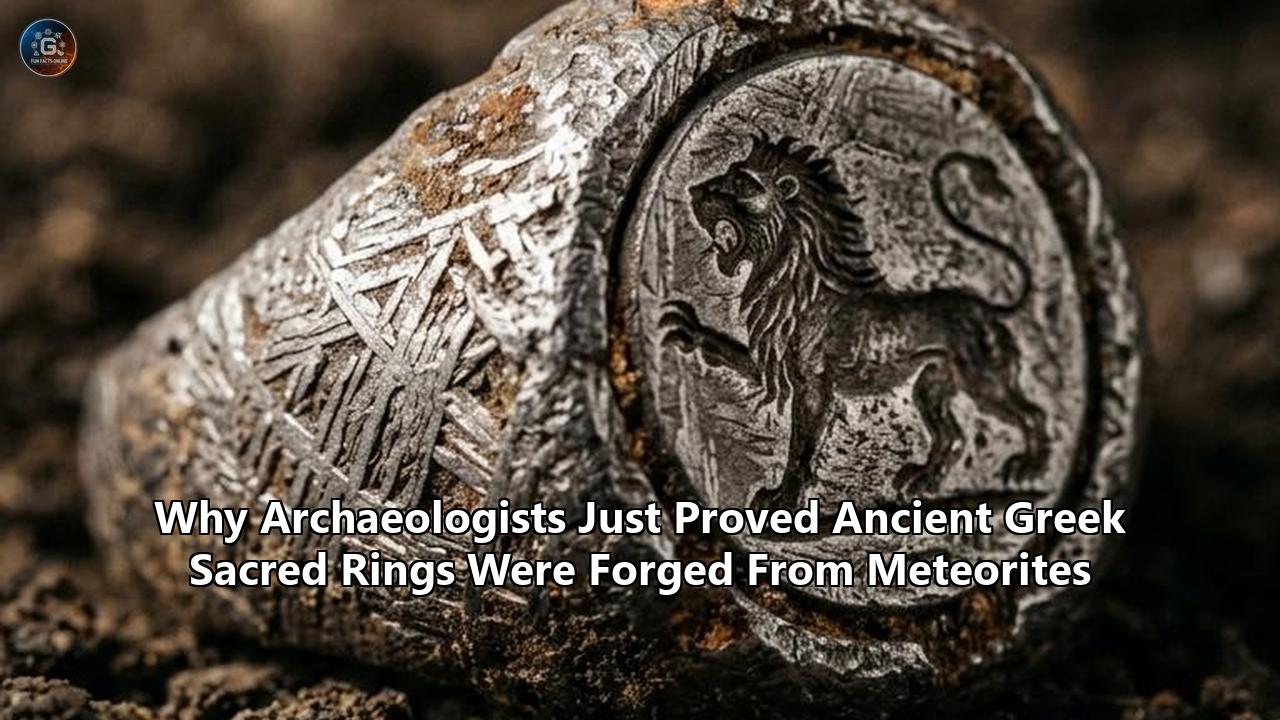
For more than a century, inside the climate-controlled display cases of Greece’s premier archaeological museums, lay a handful of heavily corroded metal bands that quietly defied the timeline of human technology.
Unearthed from the opulent Bronze Age tombs of Mycenae, Vapheio, and Dendra, as well as the ruins of Minoan sanctuaries on Crete, these small finger rings were forged between 1700 BCE and 1200 BCE. To the archaeologists who first excavated them in the late 19th and 20th centuries, their very existence was an unsettling puzzle. The rings were made of iron—yet during the Aegean Late Bronze Age, the high-temperature furnaces required to smelt terrestrial iron ore into usable metal did not exist in Greece. Copper and bronze reigned supreme. True ironworking was still centuries away.
Now, a five-year scientific investigation has solved the mystery. In a study published in the Journal of Archaeological Science, a team of French and Greek researchers revealed that these sacred ornaments were not made from mined terrestrial ore. They were forged from iron that literally fell from the cosmos.
By deploying advanced, non-destructive chemical analysis across 19 museums and 33 archaeological sites, researchers confirmed that Aegean elites wore signet rings crafted from nickel-rich meteorites. The findings provide the first physical proof that the rulers and priests of Bronze Age Greece deliberately sought out extraterrestrial metal, treating cosmic iron not as a practical utility, but as a sacred status symbol reserved for the highest echelons of society.
"This was not an accidental discovery of a single odd stone," says Dr. Eleni Mantzourani, professor of prehistoric archaeology at the National and Kapodistrian University of Athens and co-lead author of the study. "What we are looking at is a deliberate, highly selective tradition. Long before the Aegean world knew how to extract iron from the earth, its rulers were wearing celestial metal on their fingers".
The discovery rewrites our understanding of Bronze Age trade, ancient pyrotechnology, and the spiritual world of the early Greeks, uncovering an evidence trail that spans from the sands of North Africa to the royal tholos tombs of the Peloponnese.
┌─────────────────────────────────────────────────────────────────────────┐
│                      THE METEORITIC IRON TRAIL                          │
│                                                                         │
│  [COSMIC FALL] ──────► [EGYPTIAN DESERTS] ───► [AEGEAN TRADE ROUTES]    │
│  Fe-Ni Meteorite       Natural Collector        Maritime Exchange       │
│                                                        │                │
│                                                        ▼                │
│  [ROYAL TOMBS & TEMPLES] ◄─── [BIMETALLIC FORGING] ◄───┘                │
│  Mycenae, Anemospilia          Iron + Gold/Silver                       │
└─────────────────────────────────────────────────────────────────────────┘
The Evidence Trail: A Five-Year Hunt Across Nineteen Museums
The effort to unlock the origin of these ancient artifacts began five years ago when Mantzourani partnered with Dr. Matthieu Gounelle, an astrophysicist and cosmochemist at the French National Museum of Natural History (Muséum National d'Histoire Naturelle) in Paris.
For decades, scholars had debated whether rare iron objects found in Bronze Age contexts across the Aegean were early experiments in smelting terrestrial ores or artifacts crafted from meteoric iron. Early 20th-century archaeologists, lacking chemical testing tools, often made educated guesses based on visual inspection alone. However, heavy oxidation and rust made visual identification impossible.
To resolve the debate, Gounelle and Mantzourani launched a systematic survey across Greece. They obtained permission from the Greek Ministry of Culture to examine 105 Bronze Age and Early Iron Age artifacts, including 91 distinct iron objects held in 19 museum collections.
The primary challenge was analytical: museum curators were understandably unwilling to allow destructive sampling—such as cutting or drilling—on priceless 3,500-year-old royal artifacts.
To bypass this hurdle, the research team relied on portable X-ray Fluorescence (pXRF) spectroscopy.
                                pXRF ANALYSIS

   [X-Ray Emitter] ───────────────► [Ancient Iron Ring Surface]
                                            │
                                            ├─► Fe Photons (Primary Iron)
   [Spectrometer Detector] ◄────────────────┴─► Ni Photons (High Nickel = Meteorite)
The technique works by bombarding the surface of an object with high-energy X-rays, causing the atoms within the metal to fluoresce and emit characteristic secondary X-rays. By measuring the energy and intensity of these emitted rays, pXRF calculates the precise elemental composition of the object without leaving a single scratch.
"Portable XRF transformed how we conduct cosmic archaeology," explains Gounelle. "We were able to bring our laboratory directly into museum storage vaults in Athens, Heraklion, and Nauplion. We could shoot a non-destructive photon beam into the rusted metal and immediately read its chemical signature".
What the photon beam revealed in vault after vault stunned the team.
Layer 1: The Nickel Fingerprint
To distinguish between terrestrial iron and space iron, cosmochemists look for one primary chemical marker: nickel.
When iron ore mined from the Earth is smelted using primitive furnace techniques, the resulting metal contains almost zero nickel—typically far less than 0.1 percent. Terrestrial iron ores simply do not concentrate nickel alongside iron during low-temperature smelting.
Iron meteorites, by contrast, are remnants of the metallic cores of protoplanets that broke apart during the early formation of the Solar System 4.5 billion years ago. They consist of native iron alloyed with substantial amounts of nickel, usually ranging from 5 percent to more than 30 percent, alongside trace signatures of cobalt, iridium, and gallium.
When Gounelle and Mantzourani analyzed the dataset of 91 iron objects, the results fell into two clear categories.
┌─────────────────────────────────────────────────────────────────────────┐
│                       METALLURGICAL FINGERPRINTS                        │
├───────────────────────────┬─────────────────────────────────────────────┤
│ Terrestrial Smelted Iron  │ Nickel Content: < 0.1%                      │
│                           │ Objects: Daggers, Blades, Utility Tools     │
├───────────────────────────┼─────────────────────────────────────────────┤
│ Meteoritic Extraterrestrial│ Nickel Content: 1.0% to 50.0%               │
│ Iron                      │ Objects: EXCLUSIVELY Finger Rings           │
└───────────────────────────┴─────────────────────────────────────────────┘
The vast majority of functional tools, blades, and scrapers tested showed virtually no nickel, marking them as products of early, terrestrial smelting experiments.
However, 13 specific objects contained high concentrations of nickel. Nine were confirmed as definitive matches for meteoritic iron, one was classified as highly probable, and three were marked for further testing.
Then came the crucial realization: every single one of the 13 nickel-rich, meteoritic objects was a finger ring.
Not a single sword, spearhead, chisel, or utility blade made of space iron was found in the dataset. The ancient artisans of the Aegean were not using meteoritic metal to forge weapons. They were deploying ancient greek meteorite rings exclusively as high-status, personal ornaments.
"When the data settled, the pattern was absolute," says Gounelle. "We weren't seeing random distribution. Terrestrial iron was used for crude, functional objects. Meteorite iron was reserved for the finger rings of the elite".
Layer 2: Unearthing the Sacred Sites
The context of where these rings were found adds another layer to the narrative. Eleven of the thirteen nickel-rich rings were excavated from prestigious tholos (beehive) and chamber tombs across the Peloponnese, including the famous archaeological sites of Mycenae, Vapheio, Kakovatos, Aidonia, and Dendra.
These tholos tombs were monumental stone structures built for Mycenaean kings, warlords, and high nobility. When excavated, they yielded extraordinary wealth: solid gold funerary masks, silver rhytons, carved agate sealstones, and Baltic amber beads. Resting alongside these treasures were the meteoritic iron rings.
                     AEGEAN METEORITIC RING LOCATIONS

                          [PELOPONNESE]
                   ┌────────────┴────────────┐
               Mycenae                   Vapheio
               Dendra                    Aidonia
               Kakovatos
                                │
                                ▼
                           [CRETE]
                   ┌────────────┴────────────┐
              Anemospilia                Phaistos
             (Sacred Temple)          (Minoan Palace)
The twelfth ring was discovered on the island of Crete, at the Minoan palace site of Phaistos. The thirteenth ring came from a site that offers a compelling look into Bronze Age religion: the Minoan shrine of Anemospilia, perched on the slopes of Mount Juktas.
Anemospilia is widely considered one of the most remarkable religious sites in the ancient Mediterranean. Excavated in the late 1970s by archaeologists Yannis Sakellarakis and Efi Sapouna-Sakellarakis, the temple was destroyed by a massive earthquake and fire around 1700 BCE. The collapse froze a moment in time, trapping four human skeletons inside the shrine.
One of those skeletons, found near an altar in the temple’s west room, belonged to a high-ranking Minoan priest. On his finger was a multi-metallic signet ring. The new 2026 chemical analysis confirms that the iron core of that priest’s ring was forged from a meteorite.
                     ANEMOSPILIA TEMPLE SNAPSHOT (c. 1700 BCE)

   ┌───────────────────────────────────────────────────────────────────────┐
   │  Mount Juktas Sanctuary, Crete                                        │
   │                                                                       │
   │  [HIGH PRIEST SKELETON] ───► Wore bimetallic signet ring              │
   │                              - Inner Band: Meteoritic Iron (Space Metal)
   │                              - Sheathing: Precious Gold & Silver      │
   │                                                                       │
   │  Context: Catastrophic earthquake seal preserved shrine contents      │
   └───────────────────────────────────────────────────────────────────────┘
"The Anemospilia ring is critical because it takes meteoritic iron out of the purely political realm and places it inside the sacred sphere," notes Mantzourani. "This wasn't just gold-plated jewelry worn for show at a palace banquet. It was worn by a priest performing rites at a sanctuary. To the Minoans, this metal carried spiritual power".
Layer 3: The Craftsmanship of Interstellar Metal
Forging a meteorite into a wearable ring presented extraordinary challenges to ancient blacksmiths.
Iron meteorites are notoriously tough and unforgiving. Unlike pure gold or copper, which can be easily annealed and cold-hammered, meteoric iron contains a crystalline intergrowth of two nickel-iron alloys: kamacite (low nickel) and taenite (high nickel). This crystalline arrangement—known as the Widmanstätten pattern—makes raw meteoritic metal prone to cracking or shattering under a hammer if struck at improper temperatures.
How did Bronze Age metalworkers overcome this?
Researchers suggest that Aegean artisans likely adapted cold-hammering and low-heat annealing techniques similar to those used by indigenous Inuit metalworkers in Northwest Greenland. For centuries, Inuit craftspeople harvested fragments from the massive Cape York iron meteorite, using basalt hammerstones to gradually cold-forge small, usable flakes into tools without melting the metal.
┌─────────────────────────────────────────────────────────────────────────┐
│               METALLURGICAL COMPARISON: ANCIENT VS. MODERN              │
├───────────────────────────────┬─────────────────────────────────────────┤
│ Inuit Cape York Processing    │ Cold-hammering using basalt stones to   │
│                               │ flake off fragments without melting.     │
├───────────────────────────────┼─────────────────────────────────────────┤
│ Mycenaean/Minoan Processing   │ Low-heat forging combined with          │
│                               │ multi-metallic fusion (iron + gold/silver)│
└───────────────────────────────┴─────────────────────────────────────────┘
In the Aegean, however, metalsmiths took the process further by combining celestial iron with terrestrial precious metals.
Almost all of the nickel-rich rings identified in the study were bimetallic or trimetallic. Craftsmen constructed composite signet rings where the meteoritic iron formed the central band or bezel, which was then layered, wrapped, or framed with beaten gold, silver, or bronze.
"The level of craftsmanship is extraordinary," says Dr. François de Callataÿ, a specialist in ancient metallurgy who was not involved in the study. "These smiths were working with an unfamiliar, stubborn material that behaved unlike anything else in their workshops. Yet, they successfully worked it into composite signet rings alongside gold leaf and silver wire".
The chemical data revealed another clue: the nickel percentages across the 13 rings were far from uniform.
The nickel content varied from as low as 1 percent to as high as 50 percent. In cosmochemistry, such drastic variations prove that the iron did not originate from a single meteorite fall. Instead, Aegean artisans were working with material harvested from multiple distinct meteorites over several centuries.
                     NICKEL VARIATIONS IN TESTED RINGS

   [Ring Sample A]  ██ 5% Ni
   [Ring Sample B]  ████████ 18% Ni
   [Ring Sample C]  ██████████████████ 48% Ni

   Conclusion: Represents multiple meteorite falls gathered over centuries.
Layer 4: The Trade Route Hypothesis — Sourcing Cosmic Iron
Where did Bronze Age Greeks find meteorites?
The geography of Greece makes finding fallen meteorites exceptionally difficult. Greece and Crete are dominated by mountainous terrain, dense vegetation, and extensive coastlines. A meteor falling into the Aegean Sea is lost forever, while one landing in damp, acidic soil rapidly oxidizes into a pile of rust.
Before this study, only seven Bronze Age sites in the entire Eastern Mediterranean had produced confirmed meteoritic iron artifacts—located in Egypt, Syria, Lebanon, and Türkiye. The new study added seven new sites in Greece alone, roughly doubling the map of known meteoritic ironwork in the ancient world.
                  EASTERN MEDITERRANEAN METEORITE MAP

   BEFORE 2026 STUDY:
   - 7 Sites Total (Egypt, Syria, Lebanon, Türkiye)

   AFTER 2026 STUDY:
   - 14 Sites Total (+7 New Sites in Greece & Crete)
   - Identified meteorite rings increased roughly tenfold.
Given the local scarcity of meteorites in the Aegean, Gounelle and Mantzourani hypothesize that raw space iron was imported into Greece through long-distance maritime trade networks, with New Kingdom Egypt being the most likely source.
Unlike Greece, Egypt's vast, arid deserts serve as ideal preservation fields for meteorites. Dark metallic space rocks stand out against yellow desert sands and remain preserved for thousands of years without corroding.
Ancient Egyptians were well aware of meteoritic metal. As early as 3200 BCE, Egyptians crafted iron beads from meteorites, found at the Gerzeh cemetery. Centuries later, King Tutankhamun (reigned c. 1332–1323 BCE) was buried with a gold-hilted dagger whose blade was confirmed in 2016 to be forged from a nickel-rich iron meteorite. Ancient Egyptian hieroglyphs referred to iron as ba-n-pet—literally translating to "metal from heaven."
                 BRONZE AGE MEDITERRANEAN COSMIC TRADE

   ┌───────────────────┐               ┌───────────────────┐
   │ NEW KINGDOM EGYPT │               │ MYCENAEAN GREECE  │
   │                   │               │                   │
   │ Desert Meteorites ├──────────────►│ Sacred Signet     │
   │ (ba-n-pet)        │  Maritime     │ Rings & Status    │
   │ King Tut Dagger   │  Trade        │ Symbols           │
   └───────────────────┘               └───────────────────┘
"The Aegean world was connected to Egypt through sophisticated diplomatic and trade channels," explains Mantzourani. "We know Mycenaeans traded olive oil, wine, and pottery for Egyptian gold, ivory, and semi-precious stones. It is highly probable that small ingots or raw nodules of ba-n-pet were traded across the Mediterranean as ultra-luxury gift exchanges between royal courts".
Layer 5: The Sudden Extinction of Celestial Fashion
As the team charted the ages of the 13 rings, they uncovered a final, perplexing pattern: around the late 13th and early 12th centuries BCE, the production of ancient greek meteorite rings abruptly vanished.
Not a single meteoritic iron ring from the period after 1150 BCE has been identified in Greece.
                                TIMELINE

  1700 BCE                  1300 BCE          1177 BCE          1000 BCE
     │                         │                 │                 │
     ▼                         ▼                 ▼                 ▼
 [EARLY RINGS] ────────► [PEAK FASHION] ───► [PALACE COLLAPSE] ──► [IRON AGE]
  Anemospilia               Mycenae,          Trade routes        Terrestrial
  Priest Ring               Vapheio Tombs     severed             smelting expands
This sudden disappearance coincides with one of the most chaotic chapters in human history: the Late Bronze Age Collapse. Around 1200 BCE, a cascade of earthquakes, droughts, invasions, and social unrest tore through the Eastern Mediterranean. Within a few decades, the Mycenaean palaces were burned, writing systems like Linear B were lost, and long-distance trade routes across the Mediterranean collapsed.
With the destruction of international trade, the supply of raw meteoritic iron from abroad likely dried up. But something else happened as Greece emerged from its dark age and entered the Early Iron Age (c. 1000 BCE): local iron smelting technology finally arrived.
As local blacksmiths mastered high-temperature furnaces capable of extracting terrestrial iron from abundant local ores, iron transformed from a rare, sacred metal into a common, utility material. It was forged into farm tools, nails, spearheads, and mass-produced swords.
Once iron became widespread, its association with divine power faded.
"When iron came from the sky, it belonged to gods and kings," says Gounelle. "When iron started coming out of a dirt pit down the road, the magic was gone. The elite stopped wearing iron rings because iron was no longer special".
Deepening the Analysis: Bimetallic Signets and the Power of Cosmic Metal
To fully grasp why these artifacts mattered to Bronze Age rulers, one must examine how the rings were constructed and used.
In Mycenaean and Minoan society, signet rings were not simple bands. They featured large, oval bezels carved with intricate heraldic imagery. Pressed into wet clay, signet rings functioned as official signatures used by palatial administrators to seal storerooms, trade shipments, and royal decrees.
                     CROSS-SECTION OF A BIMETALLIC RING

                       [Engraved Bezel] (Gold/Silver)
                              │
                    ┌─────────┴─────────┐
                    │  Meteoritic Iron  │  <-- High-Nickel Core
                    │   Central Band    │      (Space Metal)
                    └─────────┬─────────┘
                              │
                       [Outer Gold Leaf]
The decision to craft signet rings from meteoritic iron combined with gold was a calculated display of power. A king or priest stamping a royal seal with a ring forged from space metal was literally imprinting his authority with a piece of the heavens.
Consider the specific objects identified in the 2026 study:
- The Mycenae Chamber Tomb Ring: Found in Tomb 58 at Mycenae, this ring features an iron core containing 14 percent nickel, sheathed in gold leaf. The bezel depicts a ritual procession of women offering lilies to a seated goddess.
- The Vapheio Tholos Ring: Excavated from the same Peloponnesian tomb famous for its gold cups, this ring's iron band registered over 11 percent nickel.
- The Dendra Bimetallic Ring: Recovered from a royal chamber tomb alongside complete Bronze Age plate armor, this ring combined meteoritic iron with beaten silver and gold wire.
┌─────────────────────────────────────────────────────────────────────────┐
│                     NOTABLE METEORITIC RINGS TESTED                     │
├─────────────────────┬──────────────────┬────────────────────────────────┤
│ Site                │ Nickel Content   │ Construction                   │
├─────────────────────┼──────────────────┼────────────────────────────────┤
│ Mycenae (Tomb 58)   │ ~14% Ni          │ Iron core, gold leaf sheathing │
│ Vapheio Tholos      │ ~11% Ni          │ Bimetallic iron and gold band  │
│ Dendra Tomb         │ ~9% Ni           │ Iron, silver, and gold wire    │
│ Anemospilia Shrine  │ ~18% Ni          │ Iron band with gold bezel      │
└─────────────────────┴──────────────────┴────────────────────────────────┘
"In the Bronze Age, metal choice was never purely aesthetic," notes Dr. Sophia Koukouli-Chrysanthaki, an expert in Aegean prehistory. "Gold represented the sun, silver the moon. Iron—which literally descended from the night sky with a flash of light and thunder—was seen as a physical manifestation of celestial power".
What Comes Next: Synchrotron Testing and Cosmic Fingerprinting
While the 2026 study definitively proved that these ancient rings were made of meteorite iron, it also opened up new questions that archaeologists and cosmochemists are eager to explore.
The next phase of research will aim to match the specific chemical fingerprints of the Greek rings to known meteorite falls around the world.
                           FUTURE RESEARCH STEPS

  [pXRF Scanning] ──────► [Synchrotron Radiation] ───► [Isotopic Ratios]
  Confirmed Nickel        Structural Micro-imaging     Match to Exact
  Presence (2026)         (Non-Destructive)            Meteorite Class
To achieve this, researchers plan to use high-energy synchrotron radiation facilities, such as the European Synchrotron Radiation Facility (ESRF) in Grenoble, France. Synchrotron X-ray micro-tomography can penetrate deep beneath the oxidized surface rust of ancient artifacts, creating 3D maps of the internal metallic structures.
This high-resolution imaging will allow scientists to search for preserved Widmanstätten micro-patterns hidden within the rings' uncorroded cores. Furthermore, precision mass spectrometry of trace elements like osmium, tungsten, and platinum isotopes could allow researchers to trace a ring's metal back to a specific class of iron meteorite—such as octahedrites or ataxites—or even link it directly to known meteorite craters in Egypt or North Africa.
"We have proven what these rings are made of," Gounelle says. "The next step is to prove where on Earth—or rather, where in space—they came from. We want to reconstruct the exact path a fallen star took from the sky, through the hands of ancient traders, onto the forge of an Aegean blacksmith, and finally onto the finger of a Mycenaean king".
The Legacy of the Celestial Rings
The discovery that ancient Minoan and Mycenaean elites wore ancient greek meteorite rings changes how we view the technological and spiritual lives of the Bronze Age Aegean.
It shows that long before humans learned to extract iron from terrestrial rock, ancient craftspeople were capable of recognizing, trading, and working extraterrestrial metal with impressive sophistication. They recognized that this rare material coming from the sky possessed unique properties, framing it with gold and reserving it for priests and kings.
┌─────────────────────────────────────────────────────────────────────────┐
│                      EVOLUTION OF AEGEAN METALLURGY                     │
│                                                                         │
│  BRONZE AGE (c. 1700–1200 BCE)          EARLY IRON AGE (c. 1000 BCE+)   │
│  ─────────────────────────────          ─────────────────────────────── │
│  • Primary Metal: Bronze                • Primary Metal: Smelted Iron   │
│  • Iron Source: Meteorites (Space)      • Iron Source: Terrestrial Ore  │
│  • Iron Role: Sacred Status Symbol      • Iron Role: Utility Tools/Arms │
│  • Form: Bimetallic Rings               • Form: Swords, Axes, Nails     │
└─────────────────────────────────────────────────────────────────────────┘
For over three thousand years, those silver-and-gold wrapped bands lay buried in the dark moisture of Greek tholos tombs and earthquake-shattered mountain shrines. Today, modern science has finally allowed their true story to be told—a story that bridges the gap between ancient craftsmanship and the cosmos.
Reference:
- https://colombiaone.com/2026/08/02/bronze-age-elite-rings-meteorite-iron/
- https://www.sciencenews.org/article/bronze-age-greek-rings-iron-meteorites
- https://arkeonews.net/bronze-age-greek-rulers-wore-space-bling/
- https://dailygalaxy.com/2026/08/bronze-age-greek-rings-meteorite-iron/
- https://www.facebook.com/GreeceHighDefinition/photos/a-remarkable-new-study-has-revealed-that-some-of-the-most-prestigious-rings-worn/1630093538570457/
- https://greekreporter.com/2026/07/10/bronze-age-elites-greece-wore-rings-meteorite-iron/
- https://thedebrief.org/these-curious-ancient-greek-artifacts-have-extraterrestrial-origins-why-they-vanished-3000-years-ago-remains-a-mystery/
- https://www.truenorthforge.co.uk/blogs/news/genuine-meteorite-rings-everything-you-need-to-know
- https://arkeonews.net/bronze-age-greek-rulers-wore-space-bling/