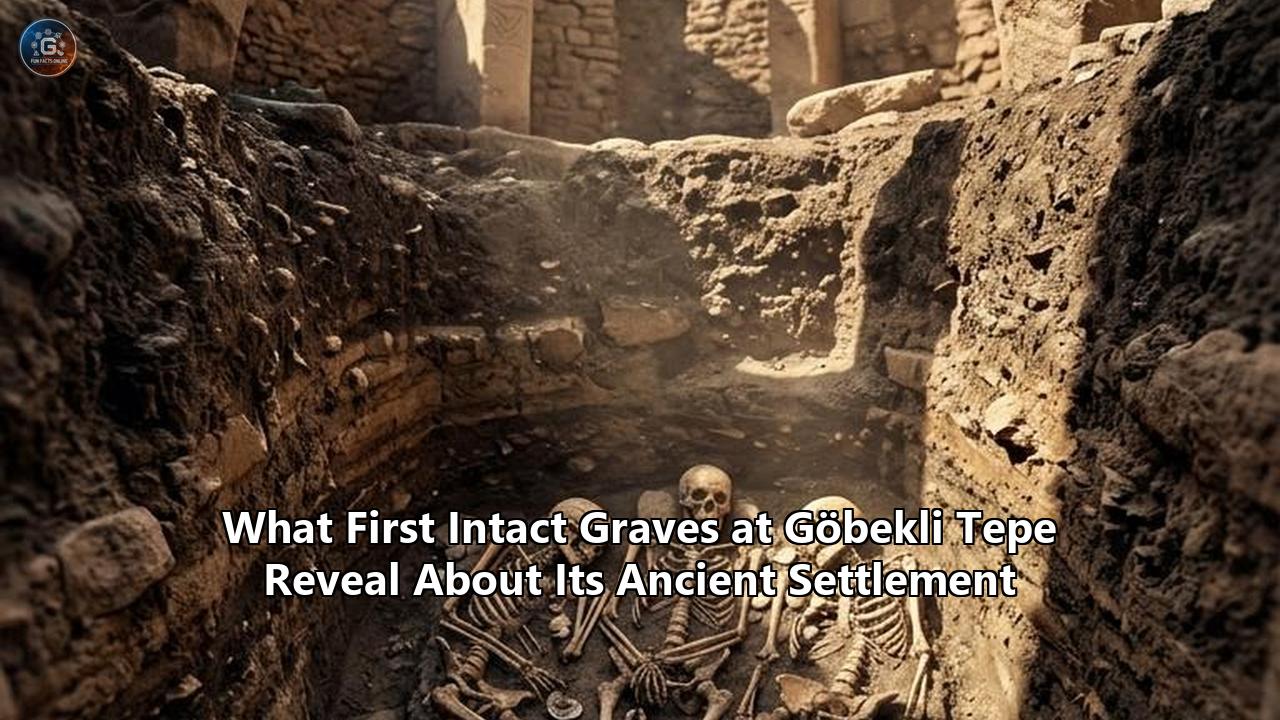
Beneath the lime-plaster floor of a rectangular stone room in southeastern Turkey, tucked between the foundations of an ancient building and the concrete footings of a modern shelter, excavators have uncovered the dead.
For thirty years, the 11,500-year-old site of Göbekli Tepe—perched on a bare limestone ridge fifteen kilometers northeast of Şanlıurfa—has carried a singular, almost mythic reputation. Ever since German archaeologist Klaus Schmidt began systematically uncovering its monumental megaliths in 1995, popular and scholarly narratives alike framed the location as the "world’s first temple": a solitary, mountain-top sanctuary built by nomadic hunter-gatherers who gathered from hundreds of kilometers away to carve monumental T-pillars, feast, commune with spirits, and vanish back into the wilderness. Central to that myth was an eerie absence. Despite decades of excavation, archaeologists had never located a single intact human grave. The dead only appeared as 928 isolated, broken bone fragments dredged from the deep rubble filling the megalithic enclosures, feeding decades of speculation about sacrificial chambers, sky burials, and a gruesome Pre-Pottery Neolithic "skull cult".
That foundational narrative has just unraveled.
In a forensic study published in the journal PLOS One, a team of bioarchaeologists and excavators led by Julia Gresky and Lee Clare of the German Archaeological Institute (DAI) documented the first two intact burial contexts ever recorded at the site. Dating to the Pre-Pottery Neolithic B (PPNB) period, between roughly 8700 and 8000 BCE, the skeletons were not found tucked inside the monumental circular enclosures, nor were they displayed on sacrificial pedestals. Instead, they were found buried directly underneath the floors of domestic houses.
The forensic data trail reconstructed from these burials does far more than add two mortuary pits to the archaeological record. By tracking the mechanical, biological, and chemical damage on these intact skeletons and matching it against the hundreds of loose bone fragments recovered across the mound, the researchers have exposed a mundane physical explanation for one of archaeology’s most sensationalized puzzles. The discovery of the first intact Gobekli Tepe graves firmly establishes that the monumental complex was not a vacant cathedral, but a living, settled prehistoric community where everyday families lived, slept, renovated their homes, and interred their relatives directly beneath their feet.
The Trench in the Shelter Footings
The forensic trail began not with a targeted search for tombs, but with an engineering problem.
In 2017, workers and archaeologists were cutting a drainage ditch on the southwestern slope of the mound to manage storm runoff from the immense steel canopy erected to protect Göbekli Tepe’s central excavation area. Near the edge of the trench, within a standard rectangular PPNB building known as Room L9-67, the trowels struck a white, polished lime-plaster floor. Below it lay an intentional, kidney-shaped cut.
Carefully brushing back the sediment, the team revealed an articulated human foot, followed by the delicate phalanges of a hand. It was an immediate departure from the isolated skullcaps and splintered femur shafts that had perplexed excavators since the 1990s. As the pit was cleared layer by millimeter layer, osteologists realized they were looking at a collective primary grave holding the remains of at least three individuals:
- Individual 1: An adult woman aged at least 35, identified by pelvic morphology and cranial markers.
- Individual 2: A young adult male aged between 20 and 30, showing robust muscle attachment sites on the long bones.
- Individual 3: An adolescent girl, roughly 11 to 14 years old, whose unfused epiphyses and dental development revealed her youth.
- Displaced elements: Fragmentary infant bones and isolated teeth, pointing to the possibility of a fourth, extremely young child.
           MORTUARY ANATOMY: ROOM L9-67 COLLECTIVE GRAVE
           =============================================

                  [ WEST ]                     [ EAST ]
             +-------------------------------------------+
             |                                           |
             |   (Skull 1)                               |
             |      (Skull 2)       Long Bones & Pelves  |
             |         (Skull 3)   [Stacked Anatomically]|
             |                                           |
             |   Three crania gathered     Articulated   |
             |   in western corner         hands & feet  |
             +-------------------------------------------+
             | <-- Successive Interments: Pit Reopened ->|
The anatomical arrangement told a complex domestic story. The skeletons were not thrown in haphazardly, nor were they neatly laid out side by side. Instead, the three crania were clustered closely together in the corner of the pit, while the long bones, pelves, and ribs were stacked in bundles nearby.
"This is classic prehistoric vault management," explains Dr. Julia Gresky, paleopathologist at the DAI and the study’s lead author. "When you find intact, articulated bones of the hands and feet alongside shifted long bones, it proves that complete, fleshy cadavers were placed in the grave originally. As time passed and another member of the household died, the occupants reopened the plaster floor, carefully pushed the dry, skeletonized remains of their forebears into the corner to make room, and laid the newly deceased relative inside."
Crucially, microscopic examination of the bone surfaces under oblique light revealed no cut marks, no scraping striations, and no chop scars. The bodies had not been defleshed by human knives or picked clean by vultures on open excarnation platforms—a popular hypothesis long maintained by early excavators seeking to explain depictions of headless bodies and raptors on the monumental pillars. They had decomposed naturally in the dark, under the daily footsteps of their kin.
Five years later, in 2022, a second context was systematically cleared just west of the monumental enclosure known as Building A. Originally located during conservation stabilization a decade earlier, this burial revealed a solitary young woman, roughly 20 to 30 years old, resting on a deliberate bed of fist-sized limestone rocks. Her body was curled in an intentional, tightly flexed "hocker" position on her left side, oriented directly toward the east. Although the overlying structure had suffered heavy erosion over millennia, the underlying stone bedding and architectural alignment indicated that she, too, had originally been laid to rest beneath the floor of a domestic terrace room.
The discovery directly challenged thirty years of received wisdom.
Dismantling the "Cathedral on the Hill"
To understand why two modest burial pits have sent shockwaves through the archaeological community, one must examine the legacy of Klaus Schmidt.
When Schmidt began excavating Göbekli Tepe in the mid-1990s, he recognized that the site upended conventional timelines of human development. Orthodox archaeological models held that agriculture led to permanent villages, which created food surpluses, which in turn fostered social hierarchy and organized religion. Schmidt argued the inverse: Göbekli Tepe’s soaring, ten-ton pillars, intricately carved with lions, foxes, scorpions, and vultures, seemed to demonstrate that monumental ritual complexes arrived before farming.
In Schmidt’s view, the site was an empty ceremonial acropolis—a "mountain sanctuary." He maintained that there were no domestic houses, no domestic hearths, no water sources, and no permanent population. Nomadic bands of hunter-gatherers, he posited, congregated periodically at Göbekli Tepe for seasonal feasts, built immense circular stone temples, buried them intentionally when their ritual lifecycle ended, and walked away.
Because Schmidt saw no domestic life, the absence of regular graves seemed natural. When thousands of animal bones—primarily wild gazelle and aurochs—were unearthed alongside occasional fragments of human skeletons inside the debris of the round enclosures, researchers assumed the dead were handled through complex, liminal rituals: sky exposure, ritual cannibalism, or the selective display of severed heads.
           THE PARADIGM SHIFT AT GÖBEKLI TEPE
           ==================================

           THE TRADITIONAL MODEL (1995–2014)
           * Pure ritual sanctuary / empty acropolis
           * Nomadic hunter-gatherers visit seasonally
           * No domestic settlement or permanent houses
           * Human remains restricted to loose fragments
           * Radical skull-cult and excarnation theories

                          VS.

           THE NEW EMPIRICAL MODEL (2020–PRESENT)
           * Year-round, permanent agropastoral settlement
           * Extensive domestic architecture with hearths
           * Rainwater cisterns and industrial grinding tools
           * Subfloor primary burials of men, women, and children
           * Natural slope erosion explains scattered debris
"For years, Göbekli Tepe was treated as an absolute anomaly, totally isolated from the rest of Southwest Asian prehistory," says Dr. Lee Clare, coordinator of the DAI’s research at Göbekli Tepe and co-author of the mortuary study. "The narrative of the 'cathedral in the desert' was incredibly seductive. But it was largely an artifact of where people chose to dig. Schmidt excavated the lowest points of the site, where the monumental enclosures were built into natural bedrock depressions. The team did not dig extensively into the domestic terraces surrounding them."
Over the past decade, the current German-Turkish excavation team has uncovered extensive evidence of continuous domestic habitation:
- Dozens of rectangular living quarters featuring hearths, storage bins, and thick plaster floors.
- Vast battery networks of basalt grinding stones, pestles, and mortars used for daily processing of wild cereals.
- Massive rock-cut cisterns on the limestone plateau capable of holding over 150,000 liters of seasonal rainwater.
- Thousands of everyday processing tools, bone needles, and domestic butchery discard.
The final missing piece of a true Neolithic village was the dead. With the identification of the Gobekli Tepe graves, the site no longer stands outside history. It conforms precisely to the domestic and funerary behaviors observed throughout the contemporary Pre-Pottery Neolithic world.
The Forensic Counter-Investigation: The Case of the 928 Bones
Establishing that people were buried in houses was a significant milestone, but it introduced a secondary, far sharper forensic mystery: If the inhabitants buried their dead beneath their floors, where did the 928 scattered, broken human bone fragments inside the monumental temples come from?
For decades, those fragments were the smoking gun for sensational interpretations. In 2017, Julia Gresky herself led a study identifying deep, carved grooves on three cranial fragments and a drilled perforation on another. The findings swept global headlines: Göbekli Tepe was hailed as the center of a prehistoric "skull cult," where the heads of ancestors or enemies were systematically decapitated, stripped of flesh, carved with flint tools, and suspended by cords from the T-shaped pillars.
By extension, researchers assumed that the other 900-plus fragments found loose in the rubble of the monumental structures had been intentionally smashed, desecrated, or scattered as part of ecstatic closing rituals when the enclosures were abandoned.
To test that hypothesis, Gresky and Clare conducted a systematic, side-by-side taphonomic audit comparing the skeletal remains from the two newly excavated subfloor graves against the database of the 928 loose fragments. They inspected the surfaces under high-magnification stereomicroscopes, tracking four key taphonomic variables:
- Post-mortem fracture patterns (spiral fractures vs. dry-bone transverse breaks).
- Surface weathering, root etching, and carnivore/rodent gnawing.
- Mineralization (calcium carbonate encrustations).
- Spatial distribution along the mound’s topography.
       TAPHONOMIC COMPARISON: INTACT GRAVES VS. LOOSE BONE FILL
       ========================================================

       Metric / Marker        Intact Graves (L9-67 / A)   Loose Fragments (Fill)
       --------------------   -------------------------   ----------------------
       Post-mortem breaks     Severe (dry-bone, crushing) Severe (dry-bone, snaps)
       Calcium crusts         Heavy calcitic coatings     Heavy calcitic coatings
       Rodent gnaw marks      Present on cortical bone    Present on cortical bone
       Defleshing cut marks   Absent                      Absent (except 5 crania)
       Sediment matrix        Slope-wash & decayed lime   Slope-wash & rubble fill
       Taphonomic origin      In-situ subfloor burial     Displaced subfloor wash
The results dismantled the ritual-violence hypothesis.
The skeletons in the intact Gobekli Tepe graves were shattered in almost exactly the same way as the loose fragments. In the grave of the young woman beside Building A, the femur, tibia, and humerus bones were snapped clean in multiple places, yet every piece remained in anatomical alignment. The breaks were not caused by prehistoric people smashing bones with hammerstones; they were dry-bone fractures caused by the immense downward pressure of centuries of settling earth, stone rubble, and collapsing walls.
Furthermore, both the loose bones and the intact skeletons were heavily coated in identical thick, white calcium carbonate encrustations, formed when rainwater seeped through the lime-rich sediments of the mound. Both sets exhibited identical parallel tooth striations left by small burrowing rodents that had nested in the hollow spaces of the burials long after the flesh had turned to dust.
"When we looked at the taphonomy, the realization hit us," Clare says. "You do not need a ritual explanation for the vast majority of those 928 fragments. You only need gravity, rain, and architectural decay."
The topography of Göbekli Tepe explains the rest. The monumental enclosures sit in natural depressions near the base of the knoll. The domestic quarters, constructed during the subsequent PPNB period, were terraced higher up the hill.
Over centuries, as upper domestic rooms were abandoned, their plaster floors degraded. Heavy seasonal torrents, seismic tremors, and slope slides undermined the terrace retaining walls. The earth gave way, sliding down the hill and sweeping the shallow, subfloor graves along with it. The burials were ripped open, their bones broken and tumbled down into the hollow ruins of the older, semi-subterranean monumental enclosures below.
What previous excavators interpreted as deliberate ritual backfill containing sacrificial debris was, in large part, natural slope-wash: centuries of domestic terrace collapse washing into abandoned monumental hollows.
Living Above the Ancestors: Domestic Life in PPNB Anatolia
By grounding the mortuary practices in everyday domestic architecture, the study aligns Göbekli Tepe with the broader cultural world of the Early Neolithic Near East.
During the ninth millennium BCE, communities across the Fertile Crescent were navigating the monumental transition from mobile foraging to sedentary village life. From Tell Halula and Jericho in the south to Çayönü and Nevalı Çori in upper Mesopotamia, human groups adopted an intimate relationship with their dead: they buried them inside their houses.
              EARLY NEOLITHIC SUBFLOOR BURIAL NETWORK
              ========================================

                       [ Çayönü Tepesi ]
                      (Skull Building &
                       subfloor interments)
                              |
                              | ~120 km north
                              v
   [ Nevalı Çori ] <--- [ GÖBEKLI TEPE ] ---> [ Karahan Tepe ]
   (Domestic subfloor   (Intact subfloor      (Terraced domestic
    plaster burials)     graves in PPNB)       enclosures)
                              |
                              | ~400 km southwest
                              v
                      [ Tell Halula / Jericho ]
                     (Multi-person family vaults
                      under living rooms)
Subfloor burial was not a macabre curiosity; it served as the physical and ideological mortar of prehistoric society. In an era before written land titles, legal codes, or deeds, the presence of your ancestors beneath your living room floor was the most absolute claim to family property, territory, and community membership.
The collective burial in Room L9-67 at Göbekli Tepe mirrors this widespread tradition. A young girl, a young man, and an older woman—likely generations of a single household—shared the same small vault beneath the floor where the family ground wild emmer wheat, chipped flint arrowheads, and slept. When a family member died, the household peeled back the plaster, buried their dead, smoothed the lime over the pit, and continued their daily routines.
The physical profiles of the individuals provide personal detail to a site often dominated by cold stone monoliths:
- The woman in L9-67 (aged 35+): Reaching past age 35 was an advanced milestone in the Early Neolithic, where high infant mortality, systemic infections, and the physical trauma of childbirth cut many lives short. Her survival into middle age suggests an established status within her household.
- The young man (aged 20–30): His skeleton demonstrates the intense physical exertion demanded by early sedentary life—carrying heavy limestone blocks, hauling water up the ridge from valley springs, and hiking the rocky hills of the Germuş range.
- The adolescent girl (aged 11–14): Her presence alongside adults confirms that family units—not just specialized guilds of male builders or esoteric priesthoods—were living and dying at Göbekli Tepe.
- The young woman west of Building A: Positioned with care on a stone bedding, her flexed position and eastward gaze reflect a formalized, shared cosmological orientation that stretched across dozens of contemporary settlements in Anatolia and the Levant.
The discovery reframes the identity of the people who inhabited the site. Göbekli Tepe was not simply an intimidating stage for ritual theater; it was a home.
What Remains of the Skull Cult?
If the vast majority of human bones at Göbekli Tepe were displaced from normal subfloor graves by natural erosion, a critical question follows: Does the famed Göbekli Tepe skull cult still exist?
The answer from bioarchaeologists is nuanced: yes, but it looks far different than early sensational reports suggested.
Out of the hundreds of bone fragments analyzed at the site, exactly five cranial fragments display indisputable anthropogenic modifications—deep, purposeful incisions cut with sharp flint tools while the bone was fresh or semi-dry, and drilled suspension holes. These carved skulls cannot be explained away by slope erosion or falling ceiling beams.
           THE FUNERARY SPECTRUM AT GÖBEKLI TEPE
           =====================================

     [ 99% OF SKELETAL REMAINS ]        [ < 1% OF SKELETAL REMAINS ]
     ---------------------------        ----------------------------
     * Primary subfloor interments      * Selective secondary retrieval
     * No defleshing or scraping        * Post-mortem cranial modification
     * Multigenerational family pits    * Drilled holes & carved grooves
     * Standard PPNB Anatolian rite     * Display of specific individuals
     * Ordinary domestic continuity     * Exceptional ritual veneration
"The new data does not mean that special mortuary rituals never happened," explains Dr. Gresky. "Rather, it puts those practices into their proper, statistical proportion. The overwhelming norm at Göbekli Tepe was ordinary primary burial beneath house floors. But alongside that everyday practice, there existed a highly selective secondary ritual where the skulls of specific, exceptional individuals were retrieved, modified, and likely displayed."
This dual funerary track is well-documented across the Pre-Pottery Neolithic world. At sites like Jericho, ‘Ain Ghazal, and Tell Aswad, hundreds of people were buried beneath houses, but a select few had their skulls dug up, modeled with facial features in plaster, painted with red ochre, and displayed on shelves or shrines. At Çayönü, north of Göbekli Tepe, the famous "Skull Building" contained hundreds of human bones alongside stacks of over seventy crania that had been separated from their bodies.
Göbekli Tepe fits this exact regional spectrum. The vast majority of its people lived mundane, hardworking lives and were buried beneath their homes by their grieving families. Only a tiny fraction—perhaps revered community elders, lineage founders, or individuals of unique ritual standing—were exhumed after soft-tissue decomposition for secondary skull curation.
Far from an aberrant, blood-soaked exception to human prehistory, Göbekli Tepe was participating in the same symbolic vocabulary as its neighbors.
The Taş Tepeler Network and the Horizon Ahead
The identification of the Gobekli Tepe graves arrives at a turning point for Turkish archaeology.
Under the umbrella of the Taş Tepeler ("Stone Mounds") project, directed by Prof. Dr. Necmi Karul of Istanbul University, researchers are currently excavating twelve contemporary Early Neolithic sites scattered across the Şanlıurfa plateau. Sites like Karahan Tepe, Sayburç, Sefer Tepe, and Çakmaktepe are revealing that Göbekli Tepe did not stand alone in a wilderness. It was part of a dense, interconnected regional network of settlements sharing the same architecture, lithic technology, and artistic traditions.
At Karahan Tepe, just forty kilometers to the east, excavations have revealed monumental enclosures cut directly into bedrock, surrounded by dozens of rectangular and curvilinear domestic structures with stone benches and hearths. At Sayburç, a prehistoric house was discovered with intricate reliefs of humans and leopards carved directly into the interior residential benching.
The hard line that twentieth-century archaeology drew between the "sacred" and the "profane"—between the temple and the village—is collapsing across the entire region. The people of the Pre-Pottery Neolithic did not separate religion from daily existence. They did not leave their houses behind to journey to an empty mountaintop sanctuary; they brought the sacred directly into their living rooms, carving spiritual protectors onto their benches and laying their parents to rest beneath the clay where they slept.
                UPCOMING RESEARCH MILESTONES
                =============================

  [ Ancient DNA (aDNA) ]  ==> Map genetic kinship in L9-67 collective
                              grave (Are they mother, son, daughter?)

  [ Strontium Isotopes ]  ==> Analyze tooth enamel to verify local vs.
                              distant childhood origins.

  [ Paleopathology ]     ==> Screen for prehistoric zoonotic pathogens,
                              nutritional stress, and dental wear.

  [ Target Excavations ]  ==> Systematic sampling of upper residential
                              terraces for further domestic graves.
The investigation is far from over. In laboratories across Germany and Turkey, teams are extracting ancient DNA from the petrous bones of the individuals discovered in Room L9-67. Within the next two years, genomic sequencing will determine whether the older woman, the young man, and the adolescent girl were indeed a biological mother and her children, charting the first verified family tree of the world’s most famous Neolithic site.
Simultaneously, strontium and oxygen isotope analyses of their tooth enamel are underway to determine where these individuals drank their water during early childhood. The results will finally settle whether the residents of Göbekli Tepe were local inhabitants who grew up on the Germuş ridge, or migrants who arrived from across the Mesopotamian plain.
Back on the windswept ridge above the Harran Plain, the protective shelter hums in the afternoon wind. Below it, the monumental stone foxes and vultures on Schmidt’s famous pillars continue to stand guard. But the focus of the trowels has shifted. Archaeologists are no longer looking only at the monumental monoliths in the hollows; they are peering beneath the cracked plaster of the living rooms up the hill, where the real builders of Göbekli Tepe have finally begun to speak.
Reference:
- https://www.heritagedaily.com/2026/09/intact-burials-at-gobeklitepe-reveal-new-clues-to-11000-year-old-burial-rituals/159391
- https://www.iflscience.com/the-first-human-burials-have-been-excavated-at-gobekli-tepe-challenging-old-theories-about-the-11500-year-old-site-84742
- https://www.reddit.com/r/AncientWorld/comments/1wti7q1/archaeologists_found_the_first_intact_burials_at/
- https://archiqoo.com/news/en/buried+beneath+the+floors+gbeklitepe+s+first+intact+graves+explain+scattered+human+bones.php
- https://www.zmescience.com/science/news-science/intact-burials-gobekli-tepe/
- https://ground.news/article/the-first-human-graves-were-dug-up-in-gobecli-tepa
- https://www.ancient-origins.net/news-history-archaeology/gobekli-tepe-burials-00103212
- https://archaeology.org/news/2026/09/25/intact-burials-excavated-at-gobekli-tepe/
- https://unn.ua/en/news/the-first-intact-burials-have-been-found-at-gobekli-tepe-changing-perceptions-of-the-sites-purpose