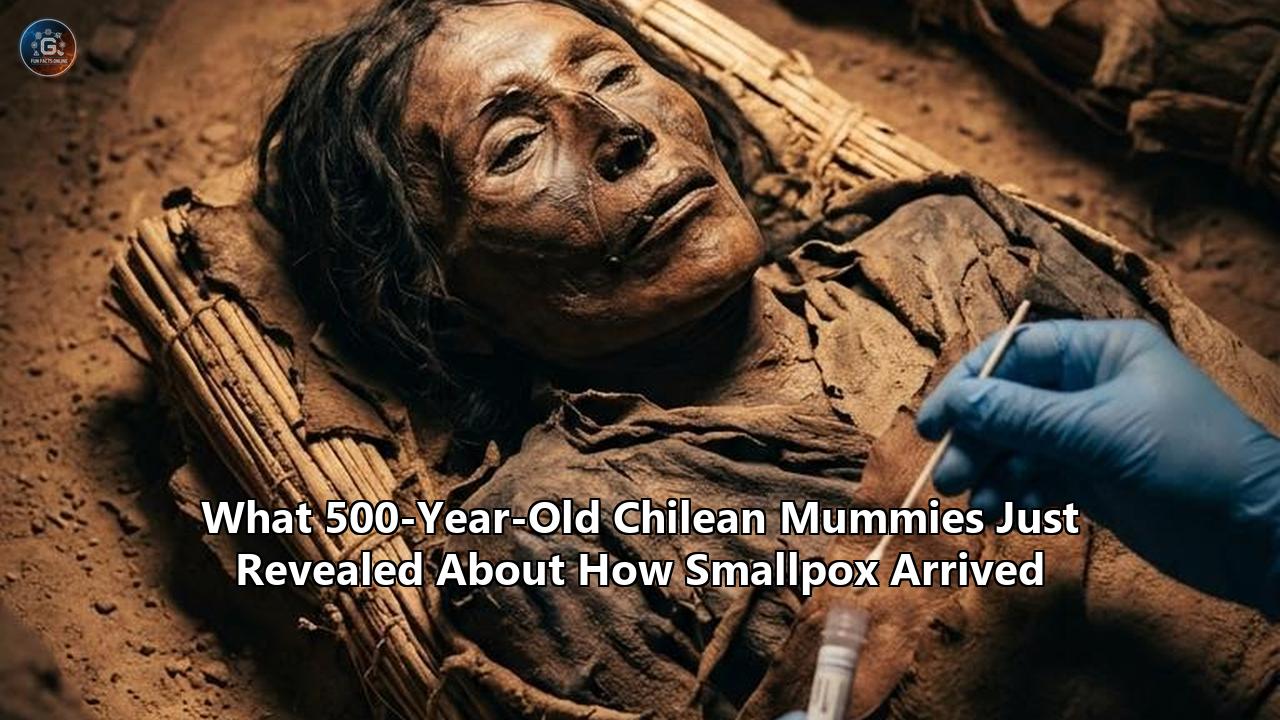
In a discovery that provides the first direct genetic proof of how Old World diseases devastated the Americas, scientists have extracted 500-year-old viral DNA from naturally mummified remains in northern Chile. The findings, published in the journal Science, reveal the oldest variola virus genomes ever recovered in the Western Hemisphere, establishing an undeniable biological link between European colonization and the catastrophic collapse of Indigenous populations.
The breakthrough came when a international research team led by geneticists at Trinity College Dublin and the Universidad de Chile analyzed bone samples from an archaeological site called Camarones 9, located in a hyper-arid coastal ravine near the Atacama Desert. There, buried in camelid wool blankets, lay the naturally preserved remains of a woman in her early 30s and a young man in his late teens. Both lived between 1492 and 1631 CE, during the turbulent early decades of Spanish colonial expansion into the southern stretches of the Inca Empire.
While historical records have long asserted that smallpox arrived with Spanish conquistadors, written documentation from early remote colonial frontiers like southern Peru and Chile is notoriously sparse, conflicting, or written decades after the events occurred. Until now, physical genetic evidence of the pathogen itself in pre-modern American remains had eluded researchers.
The newly reconstructed viral lineage, designated CAM9, fills a critical gap in viral archaeology. It confirms that the pathogen circulating among Indigenous communities in South America was an evolutionary intermediate sitting precisely between medieval European strains and the modern variola lineages that plagued humanity until global eradication in 1980.
               [ Medieval European Strains ]
               (e.g., Viking-era Variola, ~1000 CE)
                               │
                               ▼
                    [ CAM9 Lineage ]
         (Recovered from 16th-Century Chilean Mummies)
                               │
                               ▼
            [ Modern Variola Major / Minor ]
            (Circulated 18th–20th C. / Eradicated 1980)
"None of us expected to find variola virus DNA from the samples we collected," said co-author Shigeki Nakagome, a geneticist at Trinity College Dublin. "We were conducting a broader study on human population history in the region. Discovering this viral DNA gives us the first molecular confirmation that smallpox was directly introduced to the Americas by European colonizers during the early colonial era."
Two Lives Preserved in the Arid Atacama
The archaeological setting of the discovery highlights both the extreme environment of northern Chile and the complex cultural shifts of the 16th century. Camarones 9 is located where a dry riverbed meets the Pacific Ocean, roughly 60 kilometers south of modern-day Arica. The hyper-arid climate of the Atacama region has made it one of the world's premier environments for natural mummification, preserving human soft tissue, textiles, and cellular structures for centuries.
The two individuals whose bones yielded the viral DNA were exhumed alongside 11 others during archaeological excavations carried out between the 1960s and 1980s. They had been buried according to traditional Andean funerary customs: wrapped in woven camelid wool textiles and placed in a flexed, fetal posture inside woven grass bundles.
- The Female Subject: Aged 30 to 35 at the time of death, buried with traditional grave goods including marine shells and textile-making tools.
- The Male Subject: Aged 18 to 20, buried in an adjacent bundle within the same burial context.
- Genetic Ancestry: High-resolution genomic sequencing of the human host DNA revealed that both individuals possessed 100% Indigenous American ancestry, with zero detectable European genetic admixture.
For decades, physical anthropologists examining remains from the Camarones ravine noted skin lesions on several naturally mummified bodies. These dermatological marks were historically attributed to chronic arsenic poisoning—a well-documented environmental hazard caused by high levels of naturally occurring heavy metals in the regional drinking water. However, the genomic discovery in their leg bones suggests an additional, far more lethal cause.
"Some individuals from Camarones 9 show small skin lesions on their torsos," explained Constanza de la Fuente Castro, a biological anthropologist at the Universidad de Chile and study co-author. "While arsenic toxicity was undoubtedly present in this environment, our finding raises the strong possibility that some of these lesions were actually smallpox pustules. These individuals were experiencing a double burden: environmental toxic heavy metals and an introduced European viral epidemic."
The viral sequences recovered from both subjects were more than 99.9% identical across their entire genome. This remarkable degree of genetic identity proves that the young man and woman were infected during the exact same epidemic wave, likely catching the disease from the same index case or circulating strain moving through their village.
Deciphering CAM9: The Missing Link in Viral Evolution
The genetic architecture of the CAM9 strain offers virologists an unprecedented look at how the variola virus adapted as it moved across the Atlantic Ocean. Prior to this study, the oldest variola genomes recovered in the Americas dated back only to the 18th and 19th centuries, long after the initial demographic collapse of Indigenous populations had occurred.
By comparing the CAM9 strain with viral DNA extracted from medieval Scandinavian skeletons (ranging from 600 to 1000 CE) and 20th-century clinical samples, the research team constructed a high-resolution evolutionary tree.
               VARIOLA VIRUS GENOMIC EVOLUTION

    Timeframe             Strain Lineage           Key Genetic Features
 ─────────────────────────────────────────────────────────────────────────
 ~600–1000 CE       Medieval European      Partial gene loss; active animal-like
                    (Viking strains)       replication mechanisms.
 ─────────────────────────────────────────────────────────────────────────
 ~1500–1600 CE      CAM9 (Chilean Mummies) Exactly 49 genes inactivated; host-
                    [NEW DISCOVERY]        specialized exclusively for humans.
 ─────────────────────────────────────────────────────────────────────────
 18th–20th C.       Modern Variola Major   Identical 49-gene inactivation profile;
                    (Pre-Eradication)      high virulence, rapid transmission.
The genetic data showed that CAM9 diverged from a common European ancestor around the year 1296 CE, centuries before Christopher Columbus sailed west. This timing indicates that the strain had been quietly circulating across Europe throughout the Late Middle Ages before being brought aboard Spanish galleons in the early 16th century.
A key revelation from the CAM9 genome involves the process of gene inactivation. Poxviruses are known for having massive double-stranded DNA genomes containing over 200 genes. As poxviruses specialize to a single host species, they undergo a process called genome reduction—gradually turning off or shedding unnecessary genes that were previously used to infect other animals.
"Modern smallpox strains from the 20th century had 49 specific genes that were completely non-functional or deleted," said Antonio Alcamí, a virologist at the Severo Ochoa Molecular Biology Center in Madrid who was not directly involved in the study. "What is fascinating about the CAM9 strain from Chile is that it had already inactivated those exact same 49 genes. This tells us that by the time smallpox crossed the Atlantic in the early 1500s, it had already fully adapted into a human-restricted pathogen."
This structural stabilization means that the virus did not need to mutate dramatically to devastate the populations of South America; it arrived fully equipped for rapid human-to-human transmission.
The Pathogen’s Conquest: Mapping Smallpox Across the Americas
To understand the profound weight of this genetic finding, one must look closely at the history of smallpox across the Western Hemisphere. The introduction of Old World pathogens into the Americas represents one of the most severe demographic shocks in human history.
                              SMALLPOX SPREAD

  1518: First recorded outbreak in Caribbean (Hispaniola)
    │
    ▼
  1520: Arrives in mainland Mexico (Tenochtitlan falls)
    │
    ▼
  1524–1527: Waves move south into Central America & Inca realm
    │
    ▼
  1554–1561: Outbreaks reach southern Inca frontier (Northern Chile)
When Spanish ships arrived in the Caribbean, they carried far more than weaponry and soldiers; they brought an invisible biological payload to which Indigenous Americans had zero inherited or acquired immunity.
- 1518 (Hispaniola): The first documented outbreak of smallpox in the New World erupts among the Taíno people on the island of Hispaniola, wiping out a vast majority of the native population within months.
- 1520 (Mesoamerica): Brought to the Mexican mainland by an infected individual in the fleet of Pánfilo de Narváez, the virus spreads to the Aztec capital of Tenochtitlan. The resulting epidemic kills the Aztec leader Cuitláhuac and incapacitates the city's defenders during the siege led by Hernán Cortés.
- 1524–1527 (The Andes): Travelling faster than European explorers themselves, the disease radiates southward along coastal and highland trade routes. It sweeps through the Inca Empire years before Francisco Pizarro arrives in Cajamarca. The ruling Inca Emperor, Huayna Capac, and his chosen heir die of the disease, triggering a ruinous civil war between his sons Huáscar and Atahualpa.
- 1554–1561 (Chile): The epidemic reaches the far southern fringes of the Inca Empire and the Mapuche territories in modern-day Chile. Spanish colonial chronicles record massive mortality in 1561 in northern towns, matching the precise radiocarbon range of the Camarones 9 mummies.
Prior to this study, historians debated whether these early Andean outbreaks were truly smallpox or other imported viral and bacterial killers, such as measles, typhus, or the enigmatic cocoliztli (a hemorrhagic fever thought to be caused by Salmonella enterica). The isolation of the CAM9 genome provides direct, indisputable physical proof that variola virus was actively spreading through coastal Andean communities during this timeframe.
Molecular Archaeology: How Researchers Extracted Viral DNA from Ancient Bone
Extracting centuries-old viral DNA from human remains is a notoriously difficult task. Unlike human nuclear DNA, which is protected inside host cell nuclei, viral genomes exist in far smaller quantities and degrade rapidly after death.
The research team screened bone and tissue fragments from 13 mummified individuals buried at Camarones 9. To prevent modern contamination, all initial bone drilling and extraction were carried out in dedicated, ultra-clean ancient DNA laboratories.
               ANCIENT VIRAL RECOVERY PIPELINE

   [1. Bone Sampling]   ──►  [2. DNA Extraction]  ──►  [3. Metagenomic Screening]
   Dense femoral bone        Enzymatic digestion       Illumina sequencing of
   powder collected.         and purification.         billions of DNA fragments.
                                                                 │
   [6. Phylogenetic]    ◄──  [4. Map to Reference]◄──  [5. Target Capture]
   Reconstruction            Align sequences against   Enrich variola-specific
   Compare against Old       known poxvirus genomes.   genetic material.
World variola strains.- Sampling: Researchers extracted tiny fragments of dense petrous bone and femur tissue from the 13 mummies.
- DNA Extraction: The samples were enzymatically digested to free ancient nucleic acids from the calcium matrix.
- Metagenomic Sequencing: Using advanced high-throughput sequencing, scientists read billions of individual DNA fragments present in the samples, which contained a mixture of host human DNA, soil microbes, and ancient pathogens.
- Target Enrichment: Using specialized RNA "baits" designed to hook poxvirus sequences, researchers pulled the rare variola fragments out of the broader genomic background.
- Bioinformatic Assembly: Out of the 13 individuals screened, only the young man and woman yielded sufficient coverage to reconstruct near-complete viral genomes.
The fact that viral DNA was successfully recovered from internal leg bone tissue—rather than dried skin or scab tissue—indicates that both individuals were experiencing severe, systemic viral infection at the time of their deaths. When smallpox invades the human body, it travels via the bloodstream (viremia) to internal organs and bone marrow, leaving microscopic viral fragments trapped within the mineral matrix as the bone heals or as the host dies.
Evolutionary Acceleration and Stabilization in Colonial Ecosystems
Beyond proving how smallpox entered South America, the study offers significant insight into viral evolutionary dynamics when a pathogen encounters a massive, non-immune host population.
By analyzing the mutation rate across centuries of smallpox strains, the researchers uncovered a curious pattern in the history of smallpox evolution.
               SMALLPOX MUTATION RATE OVER TIME

  Mutation
    Rate
     ▲
     │  Fast Evolution          Stabilization Period         Rapid Shift
     │  (Host Adaptation)      (16th–18th C. Epidemics)    (Post-Vaccination 1796)
     │       │                            │                       │
     │       ▼                            ▼                       ▼
     │   ┌───────┐                    ┌────────┐               ┌──────┐
     │   │       │                    │        │               │      │
     │───┘       └────────────────────┘        └───────────────┘      └───────►
     ─────────────────────────────────────────────────────────────────── Time
       Pre-1500                    1500–1790                   1796–1980
Before the 16th century, variola was undergoing continuous genetic changes as it adapted to human hosts in Eurasia and Africa. However, once the virus was introduced to the Americas, its evolutionary rate noticeably decelerated.
"When a virus enters a population that has zero immunity, it does not need to mutate rapidly to survive or evade host defenses," explained co-author Lara Cassidy, a microbiologist at Trinity College Dublin. "The Indigenous populations of the Americas provided an environment where the virus could spread effortlessly. It had reached an evolutionary optimum—it was already perfectly adapted to infect humans, and host immunity was virtually non-existent."
This evolutionary plateau persisted for nearly two centuries throughout the height of the colonial era. It was only in the late 18th century—following the widespread adoption of variolation and Edward Jenner’s development of the cowpox-based vaccine in 1796—that the virus faced renewed evolutionary pressure. As human populations developed artificial immunity, variola began mutating more rapidly once again in a race to survive, eventually splitting into the severe Variola major and milder Variola minor strains before its total eradication.
Expert Reactions and the Revision of Colonial Historiography
The publication of the CAM9 genome has sent waves through both the scientific and historical communities, providing empirical physical evidence that resolves long-standing debates regarding the collapse of New World civilizations.
Anne Stone, an anthropologist and paleogenomics expert at Arizona State University who was not involved in the work, highlighted the importance of substituting written history with physical biology.
"We know from European chronicles that smallpox had a devastating impact on Indigenous populations in the Americas, but written records are inherently biased and incomplete," Stone noted. "This paper gives us hard, physical proof. Seeing an identical viral strain present in two individuals buried in a remote coastal valley shows just how rapidly and thoroughly this European pathogen penetrated deep into Indigenous territories."
Patricia Foster, a molecular biologist and professor emeritus at Indiana University, echoed the significance of the finding. "Nobody serious in the field ever questioned that smallpox came to this hemisphere via European colonization, but in science, assumptions are not proof," Foster said. "This discovery provides the physical biological connection. It places a specific Old World lineage right in the tissues of 16th-century Indigenous Americans."
                      HISTORICAL IMPACT SUMMARY

  Chronicle-Based History (Old)          Genomic Paleopathology (New)
 ──────────────────────────────────────────────────────────────────────────
 • Dependent on biased Spanish           • Direct biological evidence from
   colonial accounts.                      Indigenous remains.
 • Unclear diagnosis of specific         • Definitive viral identification via
   pathogens (smallpox vs measles).        high-throughput DNA sequencing.
 • Unknown evolutionary stage of         • Precise phylogenetic mapping (CAM9)
   the introduced virus.                   showing intermediate evolution.
 • Geographic gaps in remote             • Confirms rapid spread to remote
   unrecorded regions.                     outlying communities (Atacama).
Lead author Bruno Romero González emphasized that the study honors the memory of those who died during the pandemic.
"These were real people—a young woman and a teenager—living through an unprecedented collapse of their society," Romero González said. "By recovering their stories through ancient DNA, we are able to reconstruct a crucial chapter in the biological history of the Americas that was previously invisible in the physical archaeological record."
Beyond Camarones: Re-examining Global Mummy Collections
The successful sequencing of the CAM9 strain is set to trigger a broader re-examination of archaeological collections around the world. Natural and artificial mummies stored in museums across South America, Europe, and North America are now being viewed as bio-archives capable of unlocking lost pathogen histories.
                POTENTIAL TARGETS FOR VIRAL DNA SCREENING

  Pathogen Target      Historical Context              Geographic Focus
 ─────────────────────────────────────────────────────────────────────────
 Cocoliztli Agent     1545 & 1576 Mexican epidemics   Mesoamerica (Mexico)
                      (Massive internal bleeding)
 ─────────────────────────────────────────────────────────────────────────
 Early Syphilis       Debate over Old World vs        Global / Pre-1492
 (Treponema)          New World origin                European & American remains
 ─────────────────────────────────────────────────────────────────────────
 Early Measles        16th-century respiratory        Andes & Caribbean
 (Morbillivirus)      demographic crashes
For decades, paleopathologists relied on visible skeletal deformities or preserved skin lesions to diagnose ancient infections. However, many lethal acute infections—including smallpox, influenza, and plague—kill their host before the disease has time to leave permanent marks on the skeleton. The discovery that variola viral DNA can be recovered from internal bone tissue opens the door to screening thousands of seemingly "healthy" ancient skeletons that show no external signs of disease.
Museums in Peru, Bolivia, Ecuador, and Mexico hold vast collections of mummified remains from the early colonial period. Scientists are already planning follow-up studies to search for:
- Co-infections: Investigating whether early colonial victims were simultaneously infected with multiple European pathogens, such as variola and measles or influenza.
- Pre-Columbian Pathogen Profiles: Screening pre-1492 remains to definitively confirm the complete absence of smallpox and other Old World viral strains prior to European contact.
- *The True Identity of Cocoliztli: Applying target-enrichment sequencing to 16th-century Mexican mass graves to determine the full genetic identity of the disease that killed up to 15 million people between 1545 and 1576.
Unresolved Questions in Viral Archaeology
While the CAM9 genome provides definitive answers about how smallpox entered South America, it also raises new questions that scientists are eager to explore in upcoming research cycles.
                     KEY OUTSTANDING QUESTIONS

  1. Entry Route into Peru/Chile?
     Did CAM9 arrive via coastal Pacific shipping or overland
     Inca road networks from the northern Andes?

  2. European Source Strain?
     Which specific Iberian port or expedition carried the ancestral
     CAM9 lineage across the Atlantic?

  3. Host Immunogenetics?
     What specific HLA immune gene variants made Indigenous populations
     exceptionally vulnerable to severe variola infection?
One remaining mystery is the exact geographic entry route of the CAM9 strain into the Atacama region. Was the strain brought southward along the Pacific coast by early Spanish naval expeditions led by Diego de Almagro and Pedro de Valdivia, or did it travel faster than European horses along the extensive Inca road network (Qhapaq Ñan*) from Ecuador and Peru?
Furthermore, geneticists hope to sequence variola strains from early modern Spanish ports—such as Seville and Cádiz—to locate the exact European parent lineage from which CAM9 split. Doing so would allow researchers to trace the exact voyage of individual viral strains from specific European cities to remote Andean villages.
For now, the two mummies of Camarones 9 stand as silent witnesses to a pivotal moment in human history. Their ancient DNA has finally answered a 500-year-old question, confirming that the biological exchange that followed European contact was swift, lethal, and permanently etched into the genetic code of the pathogens that reshaped the world.
Reference:
- https://bdnews24.com/world/americas/dbcc451659e1
- https://www.livescience.com/archaeology/americas/500-year-old-inca-mummies-prove-that-european-colonists-brought-devastating-smallpox-to-the-americas
- https://www.newsday.com/news/nation/smallpox-virus-chile-ancient-mummy-dna-q77235
- https://www.discovermagazine.com/ancient-smallpox-dna-hidden-in-two-chilean-mummies-traces-the-disease-s-colonial-arrival-49481
- https://ground.news/article/chilean-mummies-prove-europeans-brought-smallpox-to-the-americas
- https://www.sciencealert.com/clear-evidence-ancient-dna-from-chilean-mummies-reveals-who-brought-smallpox-to-the-americas
- https://www.popsci.com/science/oldest-smallpox-dna-chilean-mummies/
- https://english.elpais.com/science-tech/2026-07-31/two-500-year-old-mummies-confirm-europeans-brought-smallpox-to-the-americas-it-came-from-the-old-world.html
- https://popular-archaeology.com/article/chilean-mummies-preserve-ancient-smallpox-genome-that-traces-disease-to-european-colonization/
- https://news.az/news/smallpox-dna-recovered-from-500-year-old-mummies-in-chile