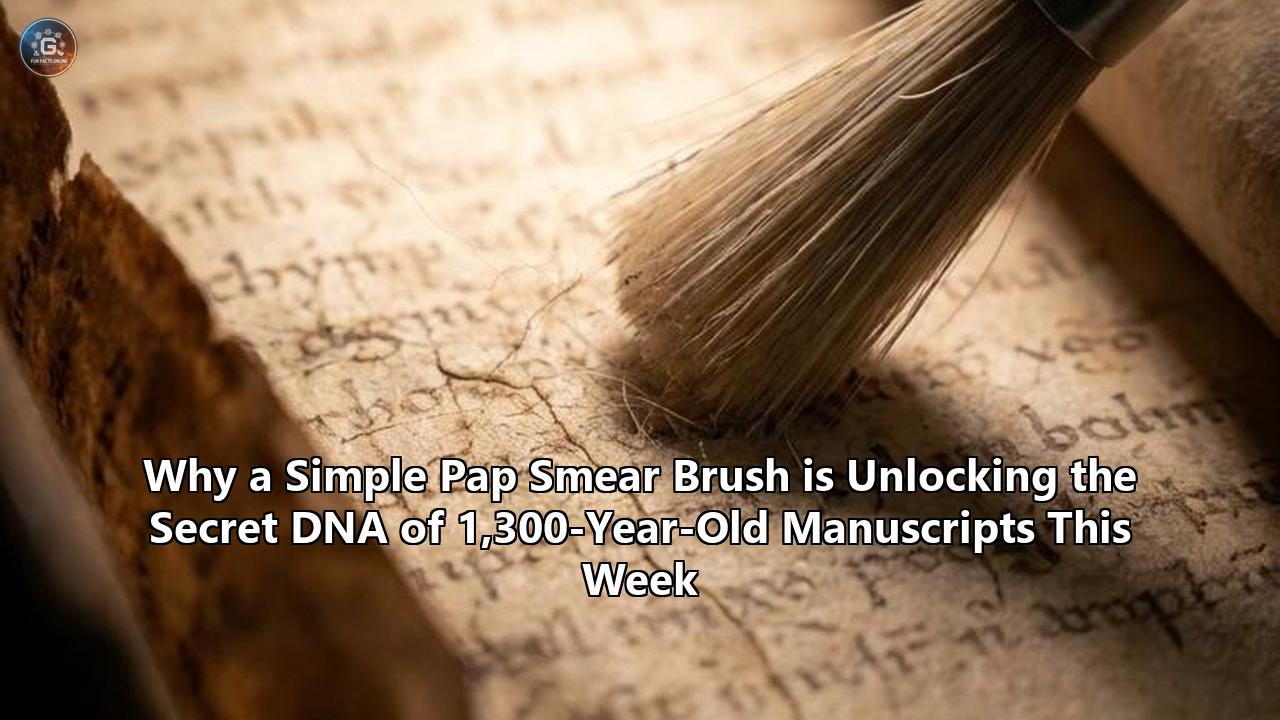
A clinical tool designed for modern gynecological oncology has unexpectedly become the most sought-after instrument in the field of medieval history.
This week, conservation laboratories and rare book archives around the world are adapting their preservation protocols to accommodate a stunning scientific breakthrough. Scholars have demonstrated that a simple, dry cervical cytology brush—the exact instrument used globally for routine Pap smears—can safely extract ancient animal DNA from 1,300-year-old parchment manuscripts without leaving a trace of damage behind.
The landmark study, titled "Adventures in the Animal Archive: New Techniques for the Genetic Analysis of Parchment Manuscripts," published in the journal Manuscript Studies, outlines how an interdisciplinary team successfully harvested high-quality genetic material from invaluable historical documents. Led by Timothy L. Stinson, an associate professor of English at North Carolina State University, alongside Matthew Breen, a professor of comparative oncology genetics, and Kelly Meiklejohn, an associate professor of forensic science, the team has solved a paradox that has plagued archival science for decades: how to look inside the biological fabric of our written history without destroying the very artifacts we seek to study.
Historically, parchment—which served as the primary medium for legal documents, maps, religious texts, and literature across Europe, the Middle East, and North Africa from the fourth century until the rise of paper—was manufactured from the skins of sheep, goats, and calves. Locked within these dried, scraped, and stretched animal skins is an unedited biological diary of medieval agriculture, livestock evolution, trade networks, and scriptorium practices. Yet, because traditional paleogenetic sampling required drilling, cutting, or scraping precious pages, archivists have historically kept their vaults sealed to geneticists.
The introduction of the cytology brush changes everything. By utilizing electrostatic friction to collect microscopic cellular residue from the surface of parchment, this non-invasive approach establishes a secure, rapid, and entirely invisible method for the DNA analysis of manuscripts.
The implications are unfolding rapidly this week as major libraries prepare to pilot the technique, promising to turn millions of surviving medieval documents into a massive, decentralized biological archive.
The Physics of the Brush: Why Erasers Failed the Test of Time
To understand why a dry cervical brush is causing such a stir in conservation circles, one must look at the limitations of previous non-destructive sampling methods.
For years, the only accepted non-invasive method for collecting DNA from historic documents was the PVC eraser technique. Developed in the 2010s, this process involved gently rubbing a synthetic eraser over the surface of a manuscript, generating tiny crumbs that picked up surface proteins and cellular material via static electricity. The crumbs were then gathered, and the DNA was extracted from the rubber debris.
While the eraser method was a massive leap forward from destructive sampling, it carried severe practical drawbacks that made large-scale studies almost impossible:
- The White Spot Problem: Ancient manuscripts are rarely clean. Over centuries, they accumulate a natural patina of dirt, soot, oils, and handling residue. When a conservator rubs a PVC eraser across a page, it cleans the parchment, lifting away this historical grime and leaving behind highly visible, bright white spots. This visually compromises the uniform appearance of the manuscript.
- The Labor Bottleneck: Rubbing a single book thoroughly using an eraser is a grueling, exhausting physical process. "It took me two full days of work to test one book thoroughly," Stinson observed regarding the eraser method. "And it's tiring."
- The Contamination Risk: If a researcher does not meticulously clear away every single microscopic eraser crumb from a page before moving to the next, those crumbs can migrate, resulting in cross-contamination between folios or entirely different manuscripts.
+-----------------------------------------------------------------------------------+
|                            DNA SAMPLING METHOD COMPARISON                         |
+----------------------+----------------------------+-------------------------------+
| Feature              | PVC Eraser Method          | Dry Cytology Brush Method     |
+----------------------+----------------------------+-------------------------------+
| Visual Impact        | Leaves clean "white spots" | Entirely invisible; no marks   |
| Extraction Time      | Hours to days per volume   | Minutes per folio             |
| Physical Labor       | High (intensive rubbing)   | Low (gentle, uniform swabbing)|
| Contamination Risk   | High (migrating crumbs)    | Negligible (single-use brush) |
| Patina Preservation  | Destroys surface grime     | Leaves historical soot intact |
+----------------------+----------------------------+-------------------------------+
The cytology brush bypasses these issues entirely. The brush features tiny, flexible nylon or plastic bristles designed to harvest cells from delicate mucosal membranes without causing tissue damage. When applied dry to historical parchment, these bristles act as micro-sweepers. They exert just enough localized friction to dislodge loose, microscopic epithelial cells and hair follicle fragments trapped on the rough surface of the animal skin, drawing them into the bristle matrix through static charge.
The process takes only a few minutes per page, leaves no chemical residue, does not alter the document’s coloration, and preserves the historical patina. Under a high-powered microscope, a brushed parchment page is indistinguishable from an unbrushed one. Crucially, because the brush heads can be easily detached and dropped directly into DNA isolation tubes, the risk of sample-to-sample cross-contamination is virtually eliminated.
The Collagen Time Capsule: How Parchment Preserves Ancient Biology
The preservation power of parchment is a direct result of how it was made. Unlike modern paper, which is composed of plant cellulose, parchment is an organic animal product.
To manufacture parchment, medieval artisans first soaked animal skins in an alkaline lime bath for several days to loosen the hair and fat. Next, the wet skin was scraped clean of flesh and hair using a curved, crescent-shaped knife called a lunellum. The remaining dermis layer, primarily composed of collagen, was then stretched tightly onto a wooden frame.
As the skin dried under tension, the gelatinous collagen fibers realigned into highly organized, parallel sheets, trapping any remaining cellular structures—including epithelial cells, blood vessels, and hair roots—inside a dense, protective protein matrix.
[Animal Skin] ---> [Alkaline Lime Bath] ---> [Scraping (Lunellum)] ---> [Stretching on Frame] ---> [Collagen Realignment (DNA Trapped)]This structural realignment is what makes parchment an incredible biological time capsule. Once dried and kept away from excess moisture, the collagen matrix shields the embedded DNA from the environmental factors that typically accelerate decay, such as oxygen and enzymatic activity.
However, extracting this genetic material is not without its hurdles. The harsh chemical treatment of the lime bath, coupled with centuries of exposure to fluctuating temperatures and human handling, shears the animal's nuclear DNA into tiny, highly degraded fragments.
To overcome this, the NC State and Western Sydney research team targeted the mitochondrial genome (mtGenome). Because animal cells contain thousands of copies of mitochondrial DNA but only two copies of nuclear DNA, targeting the mtGenome significantly increases the likelihood of recovering a complete genetic sequence from highly degraded medieval specimens.
By pairing the dry cytology brush sampling method with forensic-grade, next-generation sequencing (NGS) and hybridization capture techniques, the scientists can isolate, amplify, and reconstruct complete ancient mitochondrial genomes. This level of genetic resolution allows them to identify not just the family of the animal (such as Ovis aries for sheep or Capra hircus for goat), but its specific maternal lineage, regional breed, and geographic origin.
Stakeholder Impact: Who Gains from the Animal Archive?
The validation of this non-destructive sampling method has triggered a wave of excitement across a diverse range of academic and institutional disciplines. By converting library collections into genetic repositories, this breakthrough reshapes the relationship between science and the humanities.
                       +-----------------------------------+
                       |      THE ANIMAL ARCHIVE IMPACT    |
                       +-----------------+-----------------+
                                         |
         +-------------------------------+-------------------------------+
         |                               |                               |
+--------v--------+             +--------v--------+             +--------v--------+
|   Librarians    |             |    Historians   |             |   Geneticists   |
|  & Conservators |             | & Palaeographers|             | & Veterinarians |
+--------+--------+             +--------+--------+             +--------+--------+
         |                               |                               |
 - Zero-damage trust             - Map scriptoriums              - 1,300-yr herd lineage
 - Open locked vaults            - Detect palimpsests            - Track ancient pathogens
 - Rapid cataloging              - Reconstruct trade             - Map selective breeding
Librarians, Conservators, and Archivists
For generations, rare book curators have operated under a strict mandate: preserve the material integrity of their collections at all costs. This duty has naturally made them highly protective, often leading to friction with geneticists who requested snippets of pages for analysis.
This new brushing technique removes this structural bottleneck. Because the process leaves absolutely no visible footprint and preserves the delicate, historic surfaces of medieval books, librarians can confidently grant scientific access to their most precious volumes.
This breakthrough in the DNA analysis of manuscripts solves the conservator's dilemma, establishing a collaborative framework built on mutual trust.
Historians and Palaeographers
For humanities scholars, the physical book is much more than a vehicle for text. The material properties of parchment offer clues about when, where, and how a manuscript was produced. However, classical methods of determining manuscript provenance—such as analyzing dialect, handwriting styles (palaeography), and decoration patterns—are often subjective or incomplete.
The ability to extract high-fidelity genetic data directly from the pages allows historians to build empirical maps of medieval trade and book production. If a manuscript written in a northern English monastery is found to be written on the skins of sheep genetically native to southern Europe, it reveals a hidden economic network of animal skin trade.
Additionally, this technique can help detect palimpsests—manuscripts where older text was chemically scraped away so the parchment could be reused—giving historians a way to look beneath the visible ink to trace the earlier life of the material.
Evolutionary Biologists, Veterinarians, and Agricultural Historians
To geneticists, parchment represents an uninterrupted, precisely dated, and geographically localized record of domestic livestock spanning over a millennium. Traditional archaeology and paleontology are limited by the fossil record; bones recovered from excavations are often degraded by acidic soils, poorly dated, and highly fragmented.
Parchment, by contrast, has been protected from the elements inside climate-controlled libraries for centuries. Many legal deeds, wills, and administrative rolls are marked with the exact day, year, and village of their creation.
By swabbing these dated documents, geneticists can trace the genetic history of sheep, goats, and cattle year-by-year. This allows them to map how selective breeding practices developed, identify when specific livestock diseases first emerged, and trace how modern domestic breeds evolved.
Case Study 1: Duke University’s Rubenstein Library (The Global Skin Map)
To test the real-world viability of the dry cytology brush protocol on a diverse and historically significant scale, the research team analyzed 91 premodern manuscripts housed in the David M. Rubenstein Rare Book & Manuscript Library at Duke University.
                               DUKE RUBENSTEIN COLLECTION
                       (91 Manuscripts, 8th to 20th Century)
                                         |
         +-------------------------------+-------------------------------+
         |                               |                               |
+--------v--------+             +--------v--------+             +--------v--------+
|     ENGLAND     |             |    ETHIOPIA     |             | SOUTHERN EUROPE |
+-----------------+             +-----------------+             +-----------------+
|  80% Sheepskin  |             |  100% Goatskin  |             | Mixed Herd Skins|
| (Local Herds)   |             | (Arid Climate)  |             | (Sheep/Goat/Cow)|
+-----------------+             +-----------------+             +-----------------+
The sample set was carefully selected to cover a vast chronological and geographic range, stretching from the late eighth century to the early 20th century, and originating from regions as far-flung as England, continental Europe, and Ethiopia.
The results of this study confirmed that the non-invasive brushing method could reliably recover high-quality mitochondrial genomes while revealing striking regional patterns in medieval livestock economies:
The English Sheep Monopoly
In the authenticated English manuscripts analyzed, approximately 80 percent of the pages were made from sheepskin (Ovis aries). This biological finding aligns perfectly with what historians know of medieval England's agrarian economy, which was heavily dominated by the wool and mutton trade.
The extensive grazing lands of the English countryside supported vast herds of sheep, making their skins the most affordable and abundant source of parchment for local scribes.
Ethiopian Goat Specialization
In sharp contrast to the English samples, the manuscripts from Ethiopia were composed almost entirely of goatskin (Capra hircus). Goats are highly resilient, drought-resistant animals that thrive in the rugged, arid highlands of East Africa.
The DNA analysis of these manuscripts shows that Ethiopian monastic centers relied heavily on their local pastoral economies, utilizing goatskin almost exclusively for the production of their beautifully illustrated Ge'ez religious texts.
Southern European Mixing
Manuscripts sampled from Italy, Spain, and southern France displayed a diverse mixture of animal skins, utilizing a combination of sheep, goat, and cattle parchment. This genetic variety suggests a more complex, integrated livestock market in southern Europe, where scribes utilized whatever animal skins were locally available at the market, reflecting a highly diversified Mediterranean agricultural system.
The Pig DNA Mystery
One of the most unexpected findings in the Rubenstein collection was the presence of pig DNA (Sus scrofa) on a select few manuscript pages. Historically, pigskin was rarely used for parchment because its high fat content and uneven pore structure make it difficult to scrape thin and write upon.
The researchers hypothesized that this signature could indicate two possibilities: either medieval scribes in certain resource-poor regions occasionally resorted to using pigskin, or the manuscript was bound, handled, or stored in close proximity to swine products, leaving behind a trace of environmental DNA.
This unexpected finding highlights how expanding the scope of the DNA analysis of manuscripts can reveal hidden agricultural realities that do not appear in the historical written record.
Case Study 2: UPenn’s Ms. Codex 1629 and the AI-DNA Palimpsest Interface
While identifying the animal species used for a manuscript is a major achievement, researchers have pushed the dry cytology brush technique even further by integrating it with artificial intelligence to solve one of the most difficult challenges in palaeography: palimpsests.
A palimpsest is a document that has been reused. Because parchment was expensive to manufacture, medieval scribes frequently took older, less relevant manuscripts, chemically washed or scraped away the original ink, and then wrote a new text over the blank surface. To the naked eye, these erased undertexts are often completely invisible, yet they frequently hold lost classical or early Christian writings.
[Original Parchment with Text] ---> [Chemical Wash / Scraping] ---> [New Text Overlaid] ---> [AI-DNA Classifier Analysis] ---> [Palimpsest Detected (98.9% Acc)]In a study published in Manuscript Studies, researchers applied the dry cytology brush technique to a fourteenth-century manuscript held at the University of Pennsylvania’s Kislak Center: Ms. Codex 1629.
This manuscript is a student's commentary on the Rhetorica ad Herennium, a classical Latin treatise on rhetoric. Scribes produced Ms. Codex 1629 on a highly uneven mixture of parchment sheets, including cheap offcuts and visible palimpsests that had been scraped clean of older Italian legal documents.
The researchers sought to answer two critical questions:
- Did the historic chemical washing and scraping process used to make the palimpsests destroy or compromise the DNA trapped within the parchment?
- Could computational biology and machine learning distinguish palimpsests from single-use parchment sheets based on their genetic signatures?
The results were remarkable. The DNA sequencing of samples collected with the dry cytology brush revealed that both the single-use and the chemically washed palimpsested sheets retained high-quality mitochondrial genomes, with no significant differences in genome coverage or depth. The ancient DNA had successfully survived the medieval recycling process.
To analyze this genetic data, the team implemented advanced machine learning classifiers, including logistic regression and neural networks. By training these algorithms on the subtle variations in DNA degradation patterns, sequence mixtures, and minor contamination profiles, the neural networks were able to distinguish between reused palimpsest sheets and single-use pages with a balanced accuracy of 98.9 percent.
This successful application shows that the dry brush technique does not just harvest species data; when paired with modern data science, it can mathematically detect whether a piece of parchment has a hidden, erased past. This offers scholars an objective, automated tool to map out recycled texts across thousands of library volumes.
Short-Term Consequences: Scaling Up the Archive
As this non-invasive swabbing protocol is adopted by the wider academic community, it is poised to trigger several immediate shifts in archival and scientific practices over the next one to three years.
                     +---------------------------------------+
                     |       SHORT-TERM CONSEQUENCES         |
                     +-------------------+-------------------+
                                         |
         +-------------------------------+-------------------------------+
         |                               |                               |
+--------v--------+             +--------v--------+             +--------v--------+
|  Vatican & BL   |             |   Manor Court   |             |   Open Access   |
| Pilot Programs  |             |  Rolls Mapping  |             | Gene Databases  |
+-----------------+             +-----------------+             +-----------------+
| Massive scale-up|             | Continuous, lo- |             | Publicly shared |
| of non-invasive |             | calized, 200-yr |             | genetic maps of |
| library swabs   |             | regional history|             | medieval herds  |
+-----------------+             +-----------------+             +-----------------+
The Archival Gate Opens
For years, the field of biocodicology—the study of biological information preserved in historical texts—has remained a niche discipline restricted to a few pilot studies.
Now, with a validated, zero-damage technique using a dry cervical brush, major international repositories like the British Library, the Vatican Library, and the Bibliothèque nationale de France are positioned to re-evaluate their sampling policies.
This dry-brush method provides a reliable standard for the DNA analysis of manuscripts that other archives can adopt. This shift will allow researchers to sample highly sensitive documents, such as illuminated Bibles, early Quranic fragments, and royal charters, which were previously off-limits to geneticists.
The Manor Court Rolls Breakthrough
One of the most exciting short-term applications of this technique is the systematic mapping of England’s Manor Court Rolls. These documents are continuous, highly detailed legal records kept by local estate courts to track transactions, minor disputes, and agricultural taxes within a specific locality.
Unlike books, which were often bound, rebound, and moved across continents, manor court rolls were produced locally and kept in the same region for centuries. Some roll collections provide an unbroken, year-by-year record of a single English county for over 200 years.
"Manor court rolls present an untapped resource of biological material," notes Kelly Meiklejohn. Because these rolls are precisely dated and anchored to specific villages, swabbing them with cytology brushes will allow geneticists to build localized, highly detailed genetic maps of sheep and cattle herds across medieval Britain.
This will enable researchers to trace the emergence of regional sheep breeds and track how agricultural practices adapted to major historical events, such as the Black Death, with unprecedented chronological precision.
Democratization and Cost Reduction
The simplicity of the dry cytology brush protocol drastically lowers the barrier to entry for genetic manuscript research. PVC eraser testing required extensive training, specialized materials, and days of exhausting manual labor to extract clean samples.
In contrast, a dry cytology brush costs less than a dollar, requires minimal training to use, and can be completed in under five minutes per folio.
This ease of use means that graduate students, rare book catalogers, and local archivists can easily perform the primary sampling themselves, sending the detached brush heads to centralized genetics laboratories for sequencing. This workflow will dramatically accelerate the collection of ancient genetic data.
Long-Term Consequences: Pathogens, Pandemics, and Livestock Evolution
Looking beyond the next few years, the systematic collection of genetic material from parchment manuscripts is set to reshape our understanding of evolutionary biology, human-animal interactions, and the history of disease over a millennium.
                     +---------------------------------------+
                     |        LONG-TERM CONSEQUENCES         |
                     +-------------------+-------------------+
                                         |
         +-------------------------------+-------------------------------+
         |                               |                               |
+--------v--------+             +--------v--------+             +--------v--------+
| Pathogen Map    |             | Evolutionary    |             | Global Bio-     |
| (Zoonotics)     |             | Timeline        |             | codicology Db   |
+-----------------+             +-----------------+             +-----------------+
| Trace historical|             | Continuous, 1k- |             | Centralized DNA |
| outbreaks of    |             | year genetic    |             | catalog linking |
| anthrax & plague|             | map of livestock|             | texts to skins  |
+-----------------+             +-----------------+             +-----------------+
Mapping Medieval Pandemics and Zoonotic Disease
Parchment contains far more than just the host animal's DNA. Because these skins were processed by hand, exposed to the elements, and handled by thousands of readers over the centuries, they also preserve a rich metagenomic record of bacteria, viruses, fungi, and insects.
Crucially, the animals themselves may have been infected with pathogens at the time of slaughter. Diseases like anthrax, brucellosis, and rinderpest leave clear, highly stable genetic signatures within the skin and collagen fibers of infected animals.
By swabbing dated parchments, scientists will be able to reconstruct the historical spread of animal diseases across Europe and Africa.
This can reveal how livestock plagues swept through agricultural populations, how they interacted with human pandemics, and how these pathogens mutated over a 1,000-year timeline. This deep-time disease mapping is invaluable for epidemiologists studying how modern zoonotic diseases cross species barriers to infect humans.
Reconstructing the Evolutionary Timeline of Livestock
Modern farm animals are the product of intense selective breeding programs that began in earnest during the Agricultural Revolution of the 18th and 19th centuries. However, the genetic steps that led to these modern, highly specialized breeds remain obscured by a lack of well-preserved physical specimens.
Because parchment represents an unbroken, dated, and highly localized biological archive, the DNA analysis of manuscripts offers a unique window into the genetic diversity of historic herds.
By analyzing ancient genomes, evolutionary biologists can identify when specific genetic mutations for wool quality, milk production, or disease resistance first arose. This information is not just of historical interest; it can help modern veterinary scientists discover lost genetic traits that could make livestock herds more resilient to climate change and emerging diseases.
Overcoming the Archaeological Soil Gap
In many parts of the world, acidic soil chemistry rapidly dissolves organic remains, leaving archaeologists with very few bones or teeth to study. This "archaeological soil gap" has made it incredibly difficult to reconstruct the agricultural history of regions like sub-Saharan Africa, northern Europe, and parts of the Middle East.
Because parchment was kept dry inside libraries and monasteries, it is immune to this preservation bias. The dry brush technique allows scientists to bypass the gaps in the archaeological record, reconstructing the agricultural history of entire regions solely through the biological material preserved in their written documents.
The Road Ahead: Building the Global Biocodicological Database
The transition from a gynecological oncology tool to an archaeological asset is a vivid example of how technology can transcend its original purpose.
By demonstrating that a dry cervical brush can safely harvest ancient animal DNA without altering the appearance of delicate medieval parchments, the research team has unlocked a massive biological archive that has been hiding in plain sight for centuries.
                     +---------------------------------------+
                     |   THE FUTURE BIOMATERIAL PIPELINE     |
                     +-------------------+-------------------+
                                         |
            +----------------------------+----------------------------+
            |                                                         |
   [Historical Artifact]                                      [Centralized Hub]
            |                                                         |
  +---------v---------+                                     +---------v---------+
  |  - Leather Books  | ---> [Dry Cytology Brush] --->      |  - Species Maps   |
  |  - Silk Garments  |                                     |  - Herd Lineages  |
  |  - Wood Panels    |                                     |  - Scriptoriums   |
  +-------------------+                                     +-------------------+
The success of the Rubenstein and Penn manuscript studies suggests that this non-invasive sampling approach could soon be applied to a wider range of historic organic materials, including:
- Ancient Leather bindings: Safely sampling the animal skins used to bind early modern books.
- Historical Textiles: Swabbing delicate silk, wool, and linen garments to identify the plant and animal species used in their manufacture.
- Wooden Art Panels: Harvesting cellular material from the wood panels used for early Renaissance paintings to identify the tree species and reconstruct historic forest locations.
As libraries, museums, and geneticists begin to coordinate their efforts, the primary focus is shifting toward the creation of a centralized, open-access Global Biocodicological Database.
This database would link the textual metadata of surviving manuscripts—their language, scribe, date, and decoration—with their biological profiles, including animal species, genetic lineage, and associated microbiome.
By integrating humanities research with advanced molecular biology, scholars are poised to read both the ink and the skin of our shared past, offering an unprecedented, dual perspective on the human story.
Study Authors & Citation Metadata
- Lead Study: "Adventures in the Animal Archive: New Techniques for the Genetic Analysis of Parchment Manuscripts"
- Journal: Manuscript Studies: A Journal of the Schoenberg Institute for Manuscript Studies
- Co-authors: Timothy L. Stinson (North Carolina State University), Melissa K. R. Scheible (North Carolina State University), Rachael Thomas (North Carolina State University), Nicholas E. Wagner (Duke University), Matthew Breen (North Carolina State University), Benjamin J. Callahan (North Carolina State University), and Kelly A. Meiklejohn (Western Sydney University / North Carolina State University).
- DOI: https://doi.org/10.1353/mns.2026.a990234
Reference:
- https://scitechdaily.com/scientists-unlock-hidden-dna-from-1300-year-old-manuscripts/
- https://dailygalaxy.com/2026/06/extract-dna-manuscripts-without-damage/
- https://www.medievalists.net/2026/05/medieval-manuscripts-reveal-hidden-animal-dna-archive/
- https://news.ncsu.edu/2025/02/deciphering-the-past-with-dna-from-parchment-pages/
- https://www.breenlab.org/forensic-analysis-of-medieval-parchment/
- https://dailygalaxy.com/2026/06/extract-dna-manuscripts-without-damage/
- https://news.ncsu.edu/2025/02/deciphering-the-past-with-dna-from-parchment-pages/
- https://www.medievalists.net/2026/05/medieval-manuscripts-reveal-hidden-animal-dna-archive/
- https://pmc.ncbi.nlm.nih.gov/articles/PMC11008028/
- https://arxiv.org/pdf/2606.06889
- https://pmc.ncbi.nlm.nih.gov/articles/PMC10954192/
- https://arxiv.org/abs/2606.06889
- https://fhi.duke.edu/blog-post/uncovering-complicated-origins-dukes-manuscript-collections/
- https://uniqueatpenn.wordpress.com/2022/03/09/ms-codex-1630-ms-codex-1629-rhetoric/
- https://www.youtube.com/watch?v=pFUW9NNvFhU
- https://uniqueatpenn.wordpress.com/2020/06/29/in-the-reading-room-with-the-manuscripts-of-the-online-exhibit-a-liberal-arts-education-for-the-middle-ages-texts-translations-and-study/
- https://www.researchgate.net/publication/406351262_From_Genomes_to_Algorithms_Neural_Network_Applications_for_Palimpsest_Detection_in_Medieval_Manuscripts
- https://news.ncsu.edu/2026/05/genetic-analysis-parchments/
- https://muse.jhu.edu/issue/56871