The dry, baking winds of the Egyptian desert have spent millennia preserving the secrets of the dead, but few discoveries have disrupted our understanding of ancient life and death quite like the one unearthed in the sands of Al-Bahnasa.
In late 2025, archaeologists working at the ancient city of Oxyrhynchus, located some 118 miles south of Cairo, made a discovery that has sent shockwaves through the fields of Egyptology and classical philology. Lying inside Tomb 65 of Sector 22—a burial complex consisting of three limestone chambers—was the mummified remains of a non-royal adult male. He had been embalmed and wrapped according to the traditions of Roman-era Egypt.
But it was what lay directly atop his body, sealed beneath the outer linen bandages, that arrested the excavation team.
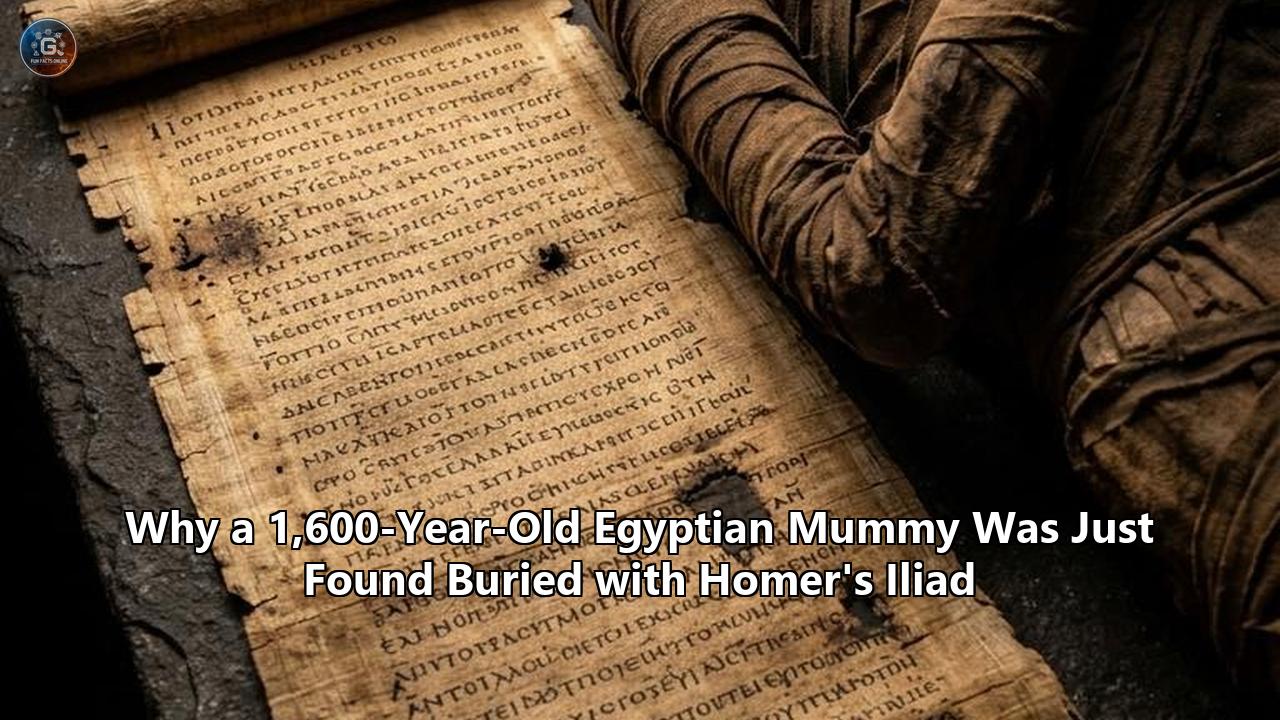
Resting over the area between his abdomen and chest was a tightly folded, fragile packet of papyrus. It was not a standard funerary scroll, nor was it a set of magical spells from the Book of the Dead. Instead, when the team of conservators and papyrologists finally unraveled and analyzed the highly degraded material, they realized they were staring at some of the most famous verses in Western literature: Book II of Homer’s Iliad.
This represents the first time in the history of archaeology that a Greek literary work has been found deliberately incorporated into the physical mummification process of an individual. This exceptional Egyptian mummy Iliad discovery raises a profound and puzzling question: why would a Romano-Egyptian man choose to take a 3,000-year-old epic poem about the Trojan War with him into the afterlife?
The investigation into this mystery reveals a complex web of cultural assimilation, class anxiety, and ancient magic, showing that in the ancient Mediterranean, literature was sometimes valued as something far more powerful than mere reading material.
The Clay Seal on Sector 22
The discovery was made by the Oxyrhynchus Archaeological Mission, a joint project of the University of Barcelona’s Institute of Ancient Near East Studies (IPOA) and the Egyptian Ministry of Tourism and Antiquities. Directed by Ignasi-Xavier Adiego, alongside co-directors Maite Mascort i Roca and Esther Pons Mellado, the mission has been systematically excavating the sprawling necropolis of Oxyrhynchus since 1992.
The site is massive, spanning more than a thousand tombs that date from 700 BCE to 700 CE. But Sector 22, known as the High Necropolis, has proven to be an especially rich vein of Roman-era burials.
"Between 2020 and 2025, our excavations yielded a series of 'sealed papyri,' all deposited in a similar position on the bodies of the deceased," explains Maite Mascort. "They placed the papyri in the chest and pelvic area, under the wrapping, folded and sealed with clay."
Until recently, every single one of these packets contained magical texts written in Greek or Demotic. These were standard amulets, folded tight to protect the deceased from the perils of the underworld. But Tomb 65 offered something entirely different.
The mummy in question belonged to an ordinary, non-royal adult male who likely lived and died during the early Roman period, around the first or second century CE. His burial was modest compared to the grand pharaonic tombs of Egypt's golden age, but his preparation for the afterlife was meticulous.
During the embalming process, after the body was dehydrated using natron salt and wrapped in resin-soaked linens, a priest or embalmer placed the folded papyrus packet directly over his vital organs. Crucially, the packet was secured with a clay seal.
+-------------------------------------------------------------+
|              TOMB 65, SECTOR 22: BURIAL LAYOUT              |
+-------------------------------------------------------------+
|                                                             |
|   [ Head ] -> Often adorned with gold foil                  |
|                                                             |
|   [ Chest/Abdomen ]                                         |
|         |                                                   |
|         +--> [ Folded Papyrus Packet ]                      |
|                    |                                        |
|                    +--> Sealed with Clay Embalmer's Stamp   |
|                    |                                        |
|                    +--> Text: Homer's Iliad, Book II        |
|                         (The Catalogue of Ships)            |
|                                                             |
|   [ Limbs ] -> Wrapped in geometric linen patterns          |
|                                                             |
+-------------------------------------------------------------+
To scholars, the physical placement of the packet was a revelation. It laid to rest early, sensationalized media reports suggesting the papyrus had been stuffed inside the mummy's abdominal cavity.
"The papyrus was not found inside the mummy, but placed on top of it, covering the area between the abdomen and chest," says Leah Mascia, a specialist in the material written culture of Greco-Roman Egypt. "This sealed papyrus bundle may have been part of an alternative funerary procedure."
In the Lab: The Micro-Surgery of Ancient Fiber
Deciphering the papyrus was a masterclass in forensic archaeology. When the packet was first retrieved, it was in a highly degraded, fragmentary state, fused together by centuries of pressure, dust, and the organic residues of the mummification process.
The task of saving the text fell to a specialized team, including conservator Margalida Munar and Leah Mascia, who was then based at the Centre for the Study of Manuscript Cultures (CSMC) in Hamburg. The process took months of delicate laboratory work.
First, the papyrus had to be humidified in a controlled chamber. This relaxed the brittle plant fibers, allowing the conservators to gently unfold the packet without snapping the ancient sheets. Using fine brushes, solvents, and backlighting, they separated the layers and stabilized the ink, which was made of carbon black mixed with gum arabic.
As the letters began to emerge under the microscope, the team expected to find the standard spells of Greco-Egyptian syncretic magic—invocations of Hermes, Osiris, or Thoth. Instead, they recognized the distinct, rhythmic meter of dactylic hexameter, the formal poetic structure of ancient Greek epic poetry.
"This is not the first time we have found Greek papyri, bundled, sealed, and incorporated into the mummification process, but until now, their content was mainly magical," says Ignasi-Xavier Adiego. "The real novelty is finding a literary papyrus in a funerary context."
     Fragmentary Greek script identified under magnification:

     " . . .  θ ’ ο ἳ  τ ’  ἄ ρ ’  Ἀ θ ή ν α ς  ε ἶ χ ο ν . . . "
     (...and those who held Athens...)

     Identified as: Homer's Iliad, Book II (The Catalogue of Ships)
The hand that wrote the text was clean and practiced, typical of a professional scribe or a highly educated individual. Based on the paleography—the style and shape of the Greek letters—the document was written during the early Roman period, aligning perfectly with the estimated dating of the mummy.
The Ship Catalog: Why Homer’s Geography Mattered to the Dead
Once the text was stabilized, the philological team identified the exact lines preserved on the papyrus. It was not a dramatic climax of the Trojan War—it was not the death of Patroclus, nor was it Hector’s final stand. Instead, the fragment preserved a portion of the "Catalogue of Ships" (Neōn Katalogos) from Book II of the Iliad.
In the epic, the Catalogue of Ships is a massive, highly detailed directory listing the Greek forces that sailed to Troy. It enumerates:
- The name of each Greek contingent's commander.
- The precise cities and regions they came from.
- The exact number of ships they brought to the conflict.
To a modern reader, this section can seem dry—a tedious list of names and obscure geography. But to the ancient Greeks and Hellenized Egyptians, the Catalogue of Ships was a sacred map of their ancestral world. It was a poetic monument to collective identity, mapping out the entire geopolitical landscape of mythical Greece.
+----------------------------------------------------------------------+
|             THE GEOGRAPHIC POETRY OF THE "CATALOGUE"                 |
+----------------------------------------------------------------------+
|                                                                      |
|   "Of those who held Athens, the well-built citadel, the land        |
|    of great-hearted Erechtheus... of these the leader was            |
|    Menestheus, son of Peteos..."                                     |
|                                                                      |
|   "And those who held Lacedaemon, lying deep among the hills,        |
|    Pharis and Sparta, and Messe, the haunt of doves..."              |
|                                                                      |
|   "And they that dwelt in Mycenae, the strong-founded fortress,      |
|    and wealthy Corinth, and well-built Cleonae..."                   |
|                                                                      |
+----------------------------------------------------------------------+
Finding this geographical inventory on an Egyptian mummy Iliad bundle presents a fascinating puzzle. Why would this specific list of bronze-age Greek naval vessels be chosen to accompany an ordinary man into his tomb in the middle of the Egyptian desert?
To answer this, archaeologists have had to look beyond the literal meaning of the words and examine how the physical scroll was treated. The document was not merely placed in the grave as a piece of beloved literature; it was folded, sealed with clay, and placed directly over the mummy's chest and abdomen. It was treated exactly like an amulet.
Waste Paper vs. Sacred Armor: Redefining Cartonnage
To appreciate the singularity of this find, one must understand how papyrus was typically used in ancient Egyptian burials.
For centuries, Egyptologists have found Greek and Latin texts inside tombs, but they were almost always used as "cartonnage." Cartonnage was the ancient equivalent of papier-mâché. Embalmers would take discarded papers—old tax receipts, court cases, private letters, and sometimes even old school copies of classical literature—and paste them together to form the stiff outer casing of a mummy.
In those cases, the text itself had no religious or personal value to the deceased. It was literally trash, recycled by undertakers who needed cheap material to stiffen mummy masks and chest plates.
But the Oxyrhynchus Egyptian mummy Iliad is fundamentally different.
"Initially, one might think the Iliad papyrus was simply junk used to stuff the mummy," says Serena Perrone, a philologist at the University of Genoa who has analyzed the discovery. "But if the papyrus was folded, sealed, and placed on top of the mummy—rather than inside it—alongside a series of other sealed papyri, things change significantly! This is certainly not a case of scrap papyrus used as filler."
The presence of the clay seal is the smoking gun. In the ancient world, clay seals were used to secure legal documents, wills, contracts, and private letters. They protected the contents from tampering or prying eyes.
"Seals were typically reserved for documents as a safeguard against manipulation," Perrone notes. "I am unaware of any other literary papyri bearing seals."
This indicates that the Iliad fragment was deliberately prepared in a mummy workshop, folded into a tight protective packet, stamped with the embalmer's official seal (which often featured hieroglyphic designs), and placed over the body as an intentional act of ritual devotion. It was not waste paper; it was sacred armor.
+-------------------------------------------------------------+
|               CARTONNAGE VS. SEALED AMULET                  |
+-------------------------------------------------------------+
|                                                             |
|   [ RECYCLED CARTONNAGE ]                                   |
|   * Papyrus is shredded, pasted, and painted.               |
|   * Text is completely irrelevant (usually administrative).   |
|   * Used purely for structural support.                     |
|                                                             |
|   [ THE OXYRHYNCHUS PACKET ]                                |
|   * Papyrus is kept intact, folded, and sealed with clay.   |
|   * Text is highly specific (Homer's Iliad, Book II).       |
|   * Placed deliberately over vital organs for protection.   |
|                                                             |
+-------------------------------------------------------------+
Oxyrhynchus: The City Built on Words
The site of this discovery, Oxyrhynchus, is legendary in the annals of classical archaeology. Located on the Bahr Yussef, a branch of the Nile that flows into the Faiyum oasis, the city was named after a species of sharp-nosed elephant fish (Mormyrus) that was worshipped by the locals.
          MEDITERRANEAN SEA
               /     \
              /       \
             /  Delta  \
            /___________\
                 |
               Cairo (118 miles north)
                 |
                 |  ~ Bahr Yussef Canal
                 | /
                 |/
           OXYRHYNCHUS (Al-Bahnasa)
                 |
                 |  (Nile River)
                 |
In 1798, Baron Vivant Denon, an artist and scholar accompanying Napoleon Bonaparte’s military expedition, sketched a single, sand-blown column rising from the desert ruins. It was the first modern European documentation of the ancient port city.
A century later, in 1896, two young British scholars from Oxford, Bernard Grenfell and Arthur Hunt, arrived at the site. They were not interested in gold or monuments; they were looking for paper.
Because Oxyrhynchus was located in a region that received virtually no rain, and because its ancient inhabitants threw their trash into dry, sand-covered garbage heaps outside the city walls, the conditions for preserving organic material were perfect. Grenfell and Hunt spent years digging through these ancient trash piles, eventually recovering over 500,000 fragments of papyri.
Their hauls included:
- Lost plays by Sophocles and Euripides.
- Fragments of lyric poetry by Sappho.
- Early Christian gospels and theological treatises.
- Hundreds of thousands of everyday documents, including grocery lists, wedding invitations, tax receipts, and divorce decrees.
Among this mountain of text, Homer was highly represented. Indeed, school children in Roman Egypt were routinely taught to read and write by copying lines from the Iliad and the Odyssey. Over 800 fragments of Homeric poetry have been found in the trash heaps of Oxyrhynchus alone.
But while Homer was common in the schoolroom and the home, finding him sealed on a dead man's chest in a silent tomb is a different matter. It bridges the gap between everyday literacy and the profound, terrifying realm of the afterlife.
The Elite Passport: Hellenism as a Ticket to the Afterlife
To understand why someone would carry Homer’s geography into the grave, we must examine the complex social structure of Roman-era Egypt.
When the Roman Empire annexed Egypt in 30 BCE following the death of Cleopatra, they did not impose Latin culture. Instead, they inherited a highly stratified society where Greek culture—Hellenism—remained the ultimate symbol of wealth, education, and social privilege.
If you were a resident of Roman Egypt and could prove you had a Greek education (paideia) and belonged to the Hellenized elite, you enjoyed significant legal and financial benefits. You paid a much lower poll tax, you were exempt from forced public labor, and you were protected from certain degrading physical punishments, like flogging.
In this world, knowing Homer was not just a sign of intellectual curiosity; it was a legal and social passport that separated the privileged elite from the subjugated Egyptian masses.
Some historians believe this earthly social dynamic was projected directly onto the divine realm.
"The act of burying the Iliad together with the body may have been used as a kind of 'cultural pass' to enter the Greek-style afterlife instead of Egypt’s complex and terrifying underworld," suggests Anna Dolganov, a historian at the Austrian Archaeological Institute.
In the traditional Egyptian view of death, the soul had to navigate a terrifying landscape filled with demons, gates, and tests before reaching the Hall of Ma'at, where their heart would be weighed against the feather of truth. It was an ordeal requiring precise magical spells and extensive ritual knowledge.
But by the Roman period, many wealthy individuals in Egypt were of mixed Greek, Roman, and Egyptian heritage. They lived bilingual, multicultural lives. When they died, they faced a theological choice.
If a deceased man wanted to skip the grueling trials of the Egyptian underworld and present himself directly to the more familiar, anthropomorphic gods of the Greek Elysian Fields, he needed proof of his identity. A beautifully written, clay-sealed copy of Homer's Iliad—the supreme cultural text of the Hellenic world—placed over his heart was the ultimate credential.
It was a physical statement to the gods of the dead: I am a civilized Greek. I belong to the educated elite. Admit me to the company of heroes.
The Sorcery of the Epic: Homer as a Magical Ward
While the "cultural passport" theory is elegant, other scholars suspect the choice of the Iliad was rooted in a more visceral, protective kind of magic.
In late antiquity, Homer was not just read for entertainment or education. The poet was viewed as a semi-divine figure, a prophet who possessed a deep, fundamental understanding of the cosmos. Consequently, his verses were believed to carry inherent magical properties.
               HOMER AS A COGNITIVE SHIELD

        +-----------------------------------------+
        |   "Amulet of the Trojan Fleet"         |
        |                                         |
        |   * Rhythmic hexameter acts as a        |
        |     mantra to soothe restless spirits.  |
        |                                         |
        |   * The listing of massive ships and    |
        |     warriors symbolizes an army of      |
        |     divine protectors.                  |
        |                                         |
        |   * Stamped with the embalmer's seal    |
        |     to lock the protection in place.    |
        +-----------------------------------------+
"This discovery is significant because it finds a papyrus containing Greek literary texts in their original context," says Foy Scalf, an Egyptologist at the University of Chicago. "We have evidence that such Greek literary texts could be used as magical amulets, and Homer was frequently cited not only in such amulets but also in extensive reference books known as 'Greek-Egyptian magical handbooks.'"
These handbooks, often referred to by scholars as the Papyri Graecae Magicae (PGM) or the Greco-Egyptian Formularies, contain recipes for spells designed to do everything from curing illnesses to summoning deities. Crucially, they frequently instruct the practitioner to write down specific lines of Homer onto papyrus, fold them up, and wear them around the neck as a protective charm.
For example, ancient handbooks prescribe writing down verses of the Iliad as a remedy for high fevers or to ward off night demons. The physical words of the poet were believed to act as a shield, keeping negative forces at bay.
But why the Catalogue of Ships? Why list 1,186 Greek vessels sailing to war?
There are several compelling theories:
- The Ultimate Guard Detail: In ancient thought, names carried immense power. The Catalogue of Ships is, at its heart, a massive list of legendary heroes, kings, and mighty vessels. To have this list sealed on your chest was to be surrounded by an army of divine protectors, marching with you into the afterlife.
- Cosmic Order over Chaos: The underworld was a place of chaos, disorientation, and transition. The Catalogue of Ships is a work of extreme, mathematical order. It structures the world into neat geographic, political, and military units. Carrying this text may have been an attempt to impose order onto the chaotic transition of death.
- *The Homeric Oracle (Homeromanteia): In the Roman world, people practiced a form of divination called Homeromanteia, where they would randomly select lines from Homer’s epics to predict the future or find guidance. It is possible that the specific passage from Book II was chosen through such an oracle, deemed by a priest to be the exact formula this specific soul needed to navigate his journey.
Regardless of the exact ritual mechanism, the Oxyrhynchus find provides the first direct archaeological proof that literary scrolls were physically integrated into burials to serve as active magical shields.
Gold Tongues and Limestone Chambers: The Multi-Cultural Grave
The syncretic, hybrid nature of this burial is further emphasized by the other objects found in Tomb 65 and the surrounding chambers.
Alongside the mummy with the Iliad scroll, the Spanish team discovered several other Roman-era mummies that exhibited a fascinating array of classical and Egyptian funerary practices.
Most notably, several of the mummies were equipped with artificial tongues made of solid gold foil and copper.
+-------------------------------------------------------------+
|             THE HYBRID AFTERLIFE OF OXYRHYNCHUS             |
+-------------------------------------------------------------+
|                                                             |
|   [ EGYPTIAN TRADITIONS ]                                   |
|   * Mummification with natron salt and resin-coated linens. |
|   * Golden Tongues: Allowed the dead to speak to Osiris.    |
|   * Clay seals with hieroglyphic stamps.                    |
|                                                             |
|   [ GREEK TRADITIONS ]                                      |
|   * Greek language and script used on funerary amulets.     |
|   * The Iliad Packet: Epic poetry used as a protective ward.|
|   * A bid for entry into the Greek Elysian Fields.          |
|                                                             |
+-------------------------------------------------------------+
The gold tongue is a well-documented, highly specific Roman-Egyptian burial custom. According to ancient Egyptian belief, gold was the flesh of the gods—it was incorruptible, radiant, and eternal.
"They would place this piece on top of the tongue because gold is incorruptible, and thus protect it," explains Maite Mascort. "This made it easier for the deceased to speak and deny having committed a series of sins during the judgment of Osiris."
In traditional Egyptian religion, when a soul stood before Osiris, they had to deliver the "Negative Confession," declaring they had not stolen, murdered, or lied in life. If their physical tongue had rotted away, they would remain mute and be devoured by the monster Ammit. The golden tongue was a divine upgrade, ensuring the voice of the deceased remained powerful and persuasive in the presence of the gods.
To find these golden tongues in the very same tomb complex as the Egyptian mummy Iliad scroll demonstrates how fluid and pragmatic ancient religion truly was.
These people were not purists. They did not feel forced to choose between the ancient traditions of the Pharaohs and the prestigious culture of the Greek Mediterranean. Instead, they combined them into a double-layered insurance policy for eternity.
If the underworld was run by Osiris, the deceased had a golden tongue to speak his way past the weighing of the heart. If the underworld was ruled by Hades, they had a clay-sealed copy of Homer to prove they were civilized Greeks worthy of Elysium.
The Unopened Packets: What Lies Beneath the Sands
The revelation of the Iliad* scroll is not the end of the story—it is merely the opening chapter of a much larger, ongoing investigation.
The excavation team at Oxyrhynchus has recovered at least 20 of these sealed papyrus packets from the High Necropolis, most of which are still undergoing the painstaking process of stabilization and restoration.
"Many other papyri are still undergoing restoration, and we cannot rule out that some other literary text may also appear," says Maite Mascort.
The scientific community is watching closely. If more literary texts are found among these sealed funerary packets, it could fundamentally rewrite our understanding of how classical literature was circulated, read, and valued in the provincial towns of the Roman Empire.
       OXYRHYNCHUS HIGH NECROPOLIS (Sector 22)

       Total Sealed Packets Found:  20+ (and counting)

       [===================>                             ] 25% Restored

       * Packet 1: Homer's Iliad (Book II) - RESTORED
       * Packet 2-20: Undergoing chemical stabilization,
         humidification, and paleographic analysis.
The discovery in Tomb 65 reminds us that the ancient world was not divided into neat, isolated boxes. The people of Roman Egypt walked in two worlds. They lived along the banks of the Nile, but their minds were filled with the exploits of Achilles and Hector. And when they closed their eyes for the final time, they stepped into the dark unknown, clutching the geography of Greece as their shield and their guide.
As Leah Mascia, Margalida Munar, and their colleagues continue to carefully peel back the layers of these ancient papyrus packets, we can only wonder what other voices are waiting to speak to us from the silent depths of the Egyptian sand. For now, the mystery of the Egyptian mummy Iliad stands as a beautiful, haunting testament to the enduring power of the written word—a power that, for at least one ancient soul, was strong enough to conquer death itself.
Reference:
- https://www.zmescience.com/science/archaeology/iliad-mummy-abdomen/
- https://www.livescience.com/archaeology/ancient-egyptians/egyptian-mummy-has-part-of-the-iliad-in-its-abdomen-archaeologists-discover
- https://www.popsci.com/science/egyptian-mummy-iliad/
- https://www.csmc.uni-hamburg.de/news/2026-04-27-iliad-fragments.html
- https://www.chosun.com/english/world-en/2026/05/17/USAZ6CWTGBF2NK7FHGUAUD7JWI/
- https://www.goodnewsnetwork.org/papyrus-fragment-of-homers-iliad-discovered-in-1600-year-old-mummy/
- https://www.smithsonianmag.com/smart-news/archaeologists-unearth-a-papyrus-fragment-from-the-iliad-tucked-inside-the-wrappings-of-a-1600-year-old-egyptian-mummy-180988603/
- https://hyperallergic.com/archaeologists-discover-mummy-buried-with-lines-from-homers-iliad/
- https://www.mk.co.kr/en/world/12050182
- http://www.heraldinsight.co.kr/news/articleView.html?idxno=6447
- https://www.goodnewsnetwork.org/papyrus-fragment-of-homers-iliad-discovered-in-1600-year-old-mummy/
- https://en.ara.cat/culture/they-find-the-iliad-the-abdomen-of-mummy-in-egypt_1_5713068.html
- https://www.nationalgeographic.com/history/article/egyptian-mummy-iliad-papyri
- https://hyperallergic.com/archaeologists-discover-mummy-buried-with-lines-from-homers-iliad/
- https://www.discovermagazine.com/fragments-of-homer-s-iliad-found-buried-with-roman-era-mummy-49030
- https://www.thedailybeast.com/archaeologists-make-stunning-discovery-inside-mummys-tomb/
- https://brentnongbri.com/2017/11/16/the-hawara-homer/
- https://www.openculture.com/2026/05/archaeologists-discover-ancient-egyptian-mummy-buried-with-pages-from-homers-iliad.html
- https://www.chosun.com/english/world-en/2026/05/17/USAZ6CWTGBF2NK7FHGUAUD7JWI/
- https://www.livescience.com/book-of-the-dead-fragments-pieced-together.html