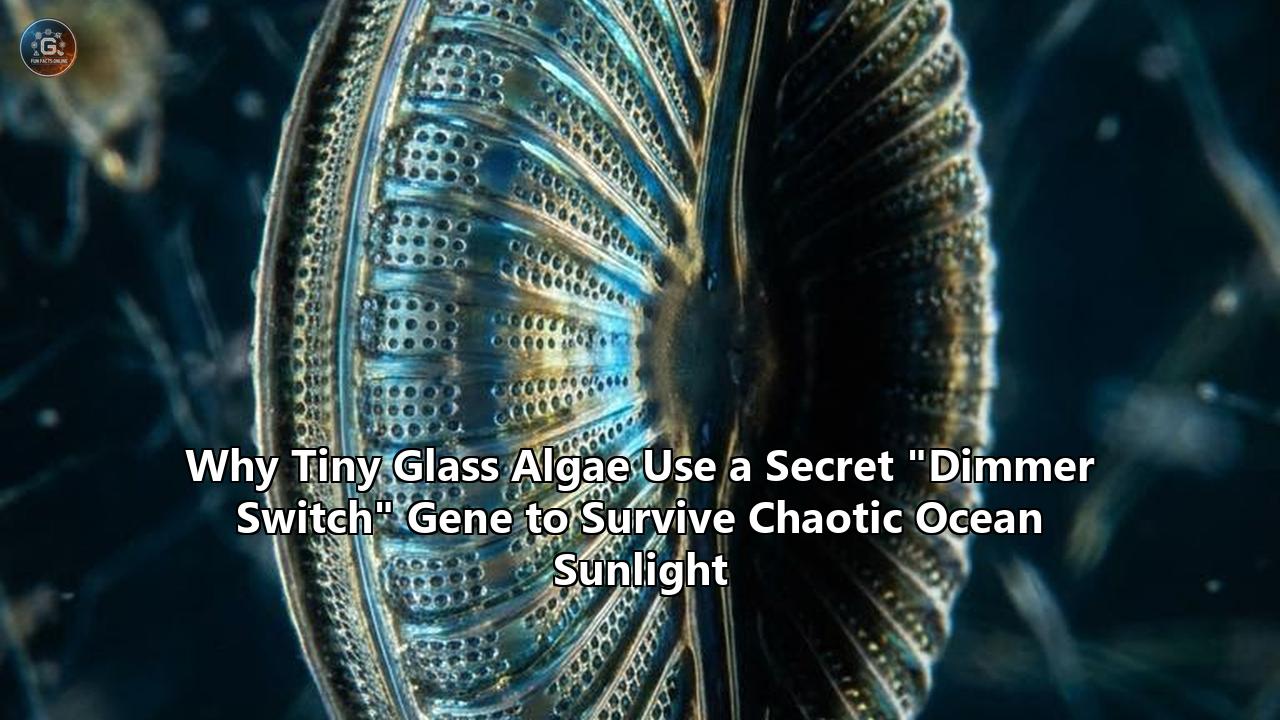
On June 17, 2026, an international research team led by Dr. Adrien Burlacot of the Carnegie Institution for Science and Dr. Ellen Yeh of Stanford University published a study in the Proceedings of the National Academy of Sciences (PNAS). The study identified a previously unknown gene, named STROBE1, that acts as a molecular "dimmer switch". This gene enables marine diatoms—unicellular algae encased in intricate, glass-like silica shells—to survive the chaotic, rapidly fluctuating light of the world’s oceans.
This genetic discovery addresses a long-standing ecological paradox: how diatoms, which generate approximately 20% of the Earth’s oxygen (on par with all terrestrial rainforests combined) and sequester between 10 and 20 gigatons of carbon dioxide ($CO_2$) annually, manage to remain highly photosynthetically efficient despite being subjected to sudden, violent, 100-fold changes in sunlight intensity within seconds.
For photosynthetic organisms, rapid light transitions represent a life-or-death challenge. A sudden surge in light floods the cell with excess energy, risking irreversible damage to the delicate photosynthetic machinery. Conversely, a sudden plunge into darkness starves the cell of the energy required to fix carbon. The discovery of STROBE1 reveals a unique, red-lineage-exclusive algae survival mechanism that acts as a biophysical buffer. It prevents the collapse of the cell's energetic systems during rapid transitions. This mechanism offers new pathways for predicting global climate dynamics and optimizing industrial biofuel bioreactors.
The Physics of Oceanic Light: The 100-Fold Challenge
To appreciate why the STROBE1 gene is critical for diatom ecology, one must examine the extreme physical environment of the upper ocean, known as the photic zone. Unlike land plants, which experience relatively predictable, slow transitions in light due to the sun's path or cloud cover, phytoplankton exist in a state of continuous physical turbulence. Two primary oceanographic phenomena drive this light chaos:
- Vertical Mixing within the Mixed Layer: Wind-driven waves and convective currents constantly circulate diatoms through the water column. The mixed layer can extend from the surface down to depths of 50 to 100 meters. As a single diatom cell is swept vertically, the ambient light intensity it experiences can plummet from full surface radiance—approximately 2,000 $\mu$mol photons $m^{-2} s^{-1}$ on a cloudless midday—down to less than 20 $\mu$mol photons $m^{-2} s^{-1}$ (a 99% reduction) in a matter of minutes.
- Wave Lensing: At the micro-scale, waves at the ocean surface act as temporary, moving lenses. They focus incoming sunlight into intense, concentrated shafts of light. This can temporarily increase local light intensity by up to 300% or 500% for fractions of a second, followed immediately by a return to dim conditions.
When light levels fluctuate this rapidly, the two stages of photosynthesis are thrown out of balance.
                                 THE PHOTOSYNTHETIC IMBALANCE

      Stage 1: Light Reactions                      Stage 2: Dark Reactions (Calvin Cycle)
  [Splits H2O -> Produces ATP & NADPH]               [Uses Rubisco to Synthesize Sugars]

          │                                                          ▲
          │  If Light Surges Rapidly:                                 │
          ├──────────────────────────────────────────────────────────┘
          ▼
  Excess electrons flood the electron transport chain.
  Saturates electron acceptors in Photosystem I (PSI).
  Produces Reactive Oxygen Species (ROS).
  Destroys Photosystem II (PSII) proteins (Photoinhibition).
In land plants, this imbalance is managed by slow-acting regulatory networks that require minutes to hours to adjust. Diatoms, however, must "turn on a dime". This adaptive demand drove the evolution of the STROBE1-dependent algae survival mechanism.
CRISPR-Cas9 Screening: Mapping the Diatom Genome
To isolate the genes responsible for this rapid adaptability, the research team bypassed traditional, slower genetic screening methods. They developed a high-throughput, genome-wide CRISPR/Cas9 knockout library specifically optimized for the model marine diatom Phaeodactylum tricornutum.
P. tricornutum is an ideal genetic model because its genome is fully sequenced, containing approximately 12,233 predicted gene models across 33 to 34 chromosomes. However, historical genetic manipulation of diatoms has been severely constrained by low transformation and editing efficiencies. To overcome this bottleneck, the researchers engineered a transgenic parent strain of P. tricornutum that constitutively expresses a green fluorescent protein (GFP)-tagged Cas9 enzyme.They then synthesized a highly multiplexed single-guide RNA (sgRNA) library designed to target virtually every gene in the diatom genome. The library was introduced into the diatom population using bacterial conjugation with Escherichia coli, a method that allows for highly efficient plasmid transfer into microalgae.
                  GENOME-WIDE CRISPR/CAS9 MUTANT SCREEN FLOW

   [ P. tricornutum Genome ] ──► [ sgRNA Library Synthesis ] ──► [ Conjugation via E. coli ]
     (12,233 Gene Models)          (Targeting Every Gene)         (High-efficiency Transfer)
                                                                            │
                                                                            ▼
                                                                 [ Split Pooled Culture ]
                                                                            │
                         ┌──────────────────────────────────────────────────┴──────────────────────────────────────────────────┐
                         ▼                                                                                                     ▼
             [ Constant Light Control ]                                                                            [ Severely Fluctuating Light ]
             (Static growth conditions)                                                                             (20 ◄──► 2,000 µmol m⁻² s⁻¹)
                         │                                                                                                     │
                         ▼                                                                                                     ▼
             [ Next-Gen Sequencing ]                                                                               [ Next-Gen Sequencing ]
           (Identify guide abundance)                                                                            (Identify depleted guides)
                         │                                                                                                     │
                         └───────────────────────────────────────► [ Comparison ] ◄────────────────────────────────────────────┘
                                                                        │
                                                                        ▼
                                                             [ STROBE1 Identified ]
                                                       (Specific to Fluctuating Light)
The pooled mutant library was split into different experimental chambers and subjected to two distinct light regimes over several generations:
- Control Group: Maintained under continuous, stable light.
- Fluctuating Group: Subjected to severe, simulated marine light fluctuations. This group experienced a repeating cycle of 1 minute of intense light (2,000 $\mu$mol photons $m^{-2} s^{-1}$) followed by 4 minutes of deep shade (20 $\mu$mol photons $m^{-2} s^{-1}$).
Following the selection phase, the team harvested the surviving cells, extracted their genomic DNA, and used next-generation sequencing (NGS) to measure the abundance of each sgRNA. If a gene is crucial for surviving chaotic light, diatoms with that specific gene knocked out would die off rapidly in the fluctuating light chamber. Consequently, their corresponding sgRNAs would be depleted from the final sequence dataset.
The screen identified a narrow set of genes required specifically for survival under fluctuating light. Among these, the gene cataloged as Phatr3_EG00039 stood out. When this gene was disrupted, the diatoms grew normally under constant light, but their growth rates plummeted under fluctuating light. The team named this gene STROBE1.
The Evolutionary Split: Red vs. Green Lineages
A key finding of the study is that STROBE1 is entirely absent in terrestrial plants and green algae (the green lineage). Instead, database searches and phylogenetic analyses confirmed that STROBE1 is highly conserved across, and exclusive to, the red lineage of phototrophs. This lineage includes diatoms, dinoflagellates, haptophytes, and cryptomonads.
This restricted phylogenetic distribution is a direct result of deep evolutionary history. Land plants and green algae descended from primary endosymbiosis, in which an ancestral eukaryote engulfed a photosynthetic cyanobacterium, giving rise to green plastids. Diatoms, however, arose via secondary endosymbiosis roughly 1.5 billion years ago, when a non-photosynthetic eukaryote engulfed a unicellular red alga. This chimeric origin endowed diatoms with a unique genetic toolkit:
| Characteristic / Pathway | Green Lineage (Plants, Green Algae) | Red Lineage (Diatoms, Dinoflagellates) |
|---|---|---|
| Origin of Plastid | Primary Endosymbiosis (2 Membranes) | Secondary Endosymbiosis (4 Membranes) |
| Light-Harvesting Complexes | Chlorophyll a/b Binding Proteins (LHCII) | Fucoxanthin-Chlorophyll a/c Proteins (FCP) |
| Alternative Electron Flows | Flavodiiron Proteins (FLV), NDH complex | Lacks FLV & NDH; relies heavily on PGR5 and STROBE1 |
| STROBE1 Gene | Absent | Present and highly conserved |
Because diatoms lack the flavodiiron proteins (FLV) and the NADH dehydrogenase-like (NDH) complexes that land plants and green algae use to handle light fluctuations, they were long thought to possess a weak capacity for alternative electron flows. The discovery of STROBE1 explains how diatoms compensate for this absence. Rather than copying the green lineage's strategies, red lineage phototrophs evolved a separate, highly efficient biophysical mechanism to stabilize photosynthesis.
The Biophysical Engine: How STROBE1 Regulates the Proton Circuit
To understand the function of STROBE1, we must analyze the electrical and chemical circuits that power photosynthesis inside the diatom's thylakoid membrane.
During the light-dependent reactions of photosynthesis, energy absorbed from photons drives electrons along the Photosynthetic Electron Transport Chain (PETC) from Photosystem II (PSII) to Photosystem I (PSI). This movement of electrons is coupled with the pumping of protons ($H^+$) from the stroma (the outer fluid of the chloroplast) across the thylakoid membrane into the thylakoid lumen (the inner compartment).
This accumulation of protons creates a concentration and charge gradient across the membrane, known as the trans-thylakoid proton gradient ($\Delta$pH), which forms a major component of the proton motive force (pmf). This gradient has two critical jobs:
- ATP Synthesis: It drives the rotary ATP synthase engine, which converts ADP into ATP. ATP, along with NADPH, powers the Calvin-Benson-Bassham cycle to fix $CO_2$ into sugars.
- Photoprotection: A highly acidic lumen ($\Delta$pH) acts as a physical signal that triggers Non-Photochemical Quenching (NPQ). NPQ safely de-excites excess absorbed light energy within the light-harvesting antennas, dissipating it harmlessly as heat before it can generate damaging reactive oxygen species (ROS).
The Two Pathways of Electron Flow
Under normal conditions, electrons flow in a one-way path from water to NADP+ (Linear Electron Flow, or LEF). However, when light levels fluctuate wildly, the cell uses Cyclic Electron Flow (CEF). In CEF, electrons exiting PSI are recycled back to the plastoquinone pool and passed through the cytochrome $b_6f$ complex again. This loop pumps protons into the lumen without generating more NADPH, helping the cell adjust its ATP-to-NADPH ratio and build up a protective $\Delta$pH.
                           THE THYLAKOID PROTON CIRCUIT

      STROBE1 Active (Wild-Type)                    STROBE1 Inactive (strobe1 Mutant)

            Thylakoid Lumen                               Thylakoid Lumen
      ┌─────────────────────────┐                   ┌─────────────────────────┐
      │   H+   H+   H+   H+     │                   │   H+                        │
      │       H+   H+   H+      │     Proton        │      H+                     │
      │  [High Proton Conc.]    │     Leakage       │  [Low Proton Conc.]         │
      └──────┬────────────▲─────┘     Blocked       └──────┬──────────▲───────│───┘
             │            │                                │          │       │  Rapid
        ATP  │            │  Cyclic                   ATP  │          │ Cyclic│  Proton
      Synthase            │  Electron               Synthase          │ Electron Leak
             ▼            │  Flow (CEF)                    ▼          │ Flow  ▼
            Stroma        │                               Stroma      └───────►
      ┌───────────────────┴─────┐                   ┌─────────────────────────┐
      │  [Low Proton Conc.]     │                   │  [High Proton Conc.]    │
      └─────────────────────────┘                   └─────────────────────────┘
The biophysical measurements in the PNAS study revealed that STROBE1 acts as a regulator of proton translocation across the thylakoid membrane. Specifically, it acts as a gatekeeper that prevents protons from leaking out of the thylakoid lumen back into the stroma too quickly.
- In Wild-Type Diatoms: Under sudden dark or low-light intervals, STROBE1 prevents the rapid collapse of the thylakoid proton gradient. When light surges back, the pre-existing gradient allows the cell to immediately resume ATP synthesis and quickly trigger protective NPQ.
- In STROBE1-Deficient Mutants (strobe1): The thylakoid membrane becomes abnormally permeable to protons. Protons leak rapidly back into the stroma, draining the electrochemical gradient. To compensate for this leak, the mutant cells undergo a massive, desperate up-regulation of Cyclic Electron Flow. However, because the membrane is leaky, this accelerated CEF is highly inefficient. It is like pumping water into a bucket with a hole in the bottom; despite running the pump at maximum capacity, the cell cannot build a stable $\Delta$pH.
Without a stable proton gradient, the mutant diatoms cannot generate enough ATP under fluctuating conditions, and they cannot reliably activate NPQ to protect their photosystems when light intensifies. This leaves them highly vulnerable to photoinhibition.
Quantitative Evidence: Growth Rates and Biophysical Metrics
The PNAS study supported its findings with quantitative data, tracking the physiological performance of wild-type, strobe1 mutant, and rescued (strobe1;STROBE1-GFP) strains of P. tricornutum.
Biomass and Growth Kinetics
Under constant low-light conditions (40 $\mu$mol photons $m^{-2} s^{-1}$), the growth rates of the three strains were nearly identical, with all cultures achieving an exponential growth rate ($\mu$) of approximately 0.65 to 0.70 divisions per day.
However, when shifted to severe fluctuating light (sFL), which alternated between 20 and 2,000 $\mu$mol photons $m^{-2} s^{-1}$, a major divergence emerged:
- Wild-type diatoms maintained a healthy growth rate of 0.52 divisions per day, adapting to the chaotic light regime with minimal loss in efficiency.
- Rescued diatoms (the mutant complemented with a functional STROBE1 gene) recovered their growth phenotype, showing a growth rate of 0.50 divisions per day.
- strobe1 mutant diatoms suffered a dramatic growth reduction, with divisions per day dropping to 0.28—a 46% decrease in biomass accumulation compared to the wild-type.
                  GROWTH RATES UNDER DIFFERENT LIGHT REGIMES

  divisions/day
   0.8 ──┬─────────────────────────────────────────────────────────────
         │    █████  █████  █████
   0.6 ──┼────█████──█████──█████──────────────────────────────────────
         │    █████  █████  █████             █████  █████
   0.4 ──┼────█████──█████──█████─────────────█████──█████─────────────
         │    █████  █████  █████             █████  █████     ░░░░░
   0.2 ──┼────█████──█████──█████─────────────█████──█████─────░░░░░────
         │    █████  █████  █████             █████  █████     ░░░░░
   0.0 ──┴──────┬──────┬──────┬─────────────────┬──────┬───────┬───
               WT    Mut   Rescue              WT   Rescue  Mut (strobe1)

               [ Constant Light ]                [ Fluctuating Light ]
Electrochromic Shift (ECS) and Proton Leakage Kinetics
To measure the strength of the proton gradient directly, the researchers utilized Electrochromic Shift (ECS) spectroscopy. ECS measures light absorption changes in the thylakoid membrane's pigment-protein complexes. These absorption bands shift in direct proportion to the electrical field (membrane potential) generated by the translocation of protons.
Upon transitioning cells from dark to light, the total amplitude of the ECS signal (reflecting the size of the proton motive force) was 40% lower in the strobe1 mutant than in the wild-type, despite the mutant exhibiting a 55% increase in raw cyclic electron flow activity.
Furthermore, when the light was switched off, the decay rate of the ECS signal—which measures how fast protons escape the lumen—was more than twice as fast in the mutant cells, showing a half-life ($t_{1/2}$) of just 0.42 seconds, compared to 0.95 seconds in the wild-type. This accelerated decay provides clear physical evidence of the proton leak caused by the absence of STROBE1.
Global Ecological Scaling: The Biological Carbon Pump
The discovery of this particular algae survival mechanism has major implications for our understanding of the global carbon cycle.
Diatoms are the primary drivers of the ocean's biological carbon pump. When these organisms fix carbon dioxide into organic matter via photosynthesis, a portion of that carbon eventually sinks into the deep ocean as "marine snow" when the cells die or are consumed and excreted by zooplankton. This process sequesters carbon away from the atmosphere for centuries or even millennia.
                             THE BIOLOGICAL CARBON PUMP

                     [ Atmospheric Carbon Dioxide (CO2) ]
                                      │
                                      ▼ [Absorption into surface water]
                       [ Dissolved Inorganic Carbon ]
                                      │
                         Diatom       ▼ [Photosynthesis stabilized by STROBE1]
                       [ Particulate Organic Carbon ]
                                      │
                  ┌───────────────────┴───────────────────┐
                  ▼ [Death & aggregation]                 ▼ [Zooplankton grazing]
            [ Marine Snow ]                         [ Fecal Pellets ]
                  │                                       │
                  └───────────────────┬───────────────────┘
                                      ▼
                           [ Gravitational Sinking ]
                                      │
                                      ▼
                        [ Sequestration in Deep Ocean ]
                              (100+ Years Storage)
The scale of this carbon pump is immense:
- Global Net Primary Production (NPP): Marine phytoplankton are responsible for fixing approximately 50 gigatons of carbon each year. Diatoms alone account for 20 to 40% of this total, translating to 10 to 20 gigatons of carbon fixed annually.
- Carbon Export to Depth: Models and observational studies show that the biological carbon pump exports about 10 billion tons of carbon into the deep sea annually. Without this pump, atmospheric $CO_2$ concentrations would be nearly double their current level of ~425 parts per million (ppm), pushing global temperatures significantly higher.
Because diatoms dominate regions characterized by intense turbulence, such as coastal upwelling zones, submesoscale fronts, and the Southern Ocean, their survival depends entirely on their ability to photosynthesize under highly erratic light conditions.
If climate change alters ocean stratification—either by warming surface waters and reducing vertical mixing in some areas, or by increasing storm intensity and wave energy in others—the frequency and intensity of light fluctuations will shift. By revealing that STROBE1 is the genetic master switch regulating this light-acclimation process, marine biologists can now write more accurate equations to model how global carbon sequestration will change in future ocean scenarios.
Industrial Applications: Engineering More Resilient Bioreactors
Beyond its ecological significance, the discovery of STROBE1 provides a powerful new biological design principle for the bio-manufacturing sector.
The Shading Problem in Bioreactors
In industrial photobioreactors used to grow microalgae for high-value compounds (such as eicosapentaenoic acid (EPA) omega-3 fatty acids, or the pigment fucoxanthin), light availability is the primary factor limiting biomass density.
To maximize space and minimize water use, industrial bioreactors are operated at exceptionally high cell densities. In these dense, concentrated cultures, light penetration is highly restricted. While surface-level cells are exposed to saturating, blinding sunlight, cells just a few centimeters deeper are in near-total darkness due to self-shading.
                          LIGHT ZONATION IN A DENSE BIOREACTOR

                       Radiant Light (Saturating Sunlight)
                       ░ ░ ░ ░ ░ ░ ░ ░ ░ ░ ░ ░ ░ ░ ░ ░ ░ ░
      ┌─────────────────────────────────────────────────────────────┐
      │ Surface Zone: High Light (Blinding intensity, photoinhibition)│
      ├─────────────────────────────────────────────────────────────┤
      │ Middle Zone: Rapidly Fluctuating Light (Turbulent mixing)   │
      ├─────────────────────────────────────────────────────────────┤
      │ Deep Zone: Absolute Darkness (Self-shading by dense cells)   │
      └─────────────────────────────────────────────────────────────┘
To ensure all cells receive some light, reactors use active pumps or aeration systems to continuously circulate the liquid, violently moving diatoms between the bright outer surface and the dark core. This creates a highly artificial but intense form of fluctuating light. Under these conditions, the algae's natural mechanisms are pushed to their limits, leading to energy loss from continuous non-photochemical quenching and photoinhibitory damage, which limits the reactor's total efficiency.
Optimizing Strains via Synthetic Biology
With the genetic and physical details of the STROBE1 algae survival mechanism resolved, synthetic biologists can now manipulate this pathway to engineer diatom strains specifically tailored for industrial bioreactors.
- Overexpression of STROBE1: By inserting extra copies of the STROBE1 gene or pairing it with highly active, inducible promoters, researchers can engineer diatoms with a reinforced proton barrier. This would reduce proton leakage even under extreme, artificial mixing cycles, minimizing the need for compensatory cyclic electron flow and directing more absorbed light energy toward target biomass and lipid production.
- Antenna Size Engineering: Combining STROBE1 overexpression with truncated light-harvesting antenna (TLA) mutants—which have smaller light absorption profiles to allow light to penetrate deeper into the reactor—could dramatically increase the light conversion efficiency of high-density cultures.
Preliminary bio-economic models suggest that optimizing light-adaptation pathways in industrial algae could increase total carbon-to-biomass conversion efficiency by 15% to 30%. This improvement could significantly lower the cost of producing carbon-neutral fuels, specialized proteins, and chemical feedstocks from marine microalgae.
Future Research and Unresolved Questions
The Carnegie and Stanford study has opened several new avenues of research. The immediate priority is to determine how STROBE1 interacts physically with other components of the thylakoid membrane.
Because STROBE1 lacks any known conserved functional domains found in other organisms, it represents an entirely new class of protein. Structural biologists are already working to resolve its three-dimensional structure using cryogenic electron microscopy (cryo-EM) to see if it acts directly as a physical proton channel blocker, or if it recruits auxiliary proteins to stabilize the thylakoid lipid bilayer during physical stress.
Another key area of interest is the "100 Diatom Genomes Project," an international consortium funded by the Joint Genome Institute (JGI). Researchers plan to screen these genomes to analyze how STROBE1 sequence variants differ across species adapted to different environments, from warm, stable tropical waters to highly dynamic, ice-dominated polar seas.
Understanding these natural genetic variations will refine our global biosphere models, helping us predict how the oceans’ microscopic engines will respond as global temperatures rise and marine habitats continue to change.
References
- --- Proceedings of the National Academy of Sciences (PNAS), "A genome-wide CRISPR screen reveals how diatoms thrive in dynamic light."
- --- Carnegie Institution for Science, Division of Biosphere Sciences & Engineering / Stanford University, June 17, 2026 Press Release.
- --- National Institutes of Health (NIH), "Dynamics of the Fucoxanthin and Chlorophyll a/c Binding Protein (FCP) and the Transthylakoid Proton Gradient."
- --- ResearchGate, "Overview of ocean carbon cycle and diatom carbon dioxide concentration mechanisms."
- --- Nature Geoscience / National Oceanography Centre, "Influence of diatom diversity on the ocean biological carbon pump."
- --- MDPI, "Strain Improvement Toolkit and Genome Architecture of Phaeodactylum tricornutum."
- ---* National Institutes of Health (NIH), "Response of Marine Diatoms to Severe vs. Mild Light Fluctuations."
Reference:
- https://carnegiescience.edu/diatom-breakthrough-revealing-how-these-jewels-sea-thrive-fluctuating-light-conditions
- https://pubmed.ncbi.nlm.nih.gov/42308031/
- https://www.pnas.org/doi/10.1073/pnas.2532811123
- https://www.researchgate.net/figure/Overview-of-ocean-carbon-cycle-and-diatom-carbon-dioxide-concentration-mechanisms-A_fig1_351048490
- https://www.pnas.org/doi/10.1073/pnas.2532811123
- https://pmc.ncbi.nlm.nih.gov/articles/PMC9706478/
- https://polarjournal.net/does-the-carbon-cycle-in-the-southern-ocean-work-differently-than-we-thought/
- https://pmc.ncbi.nlm.nih.gov/articles/PMC11758497/
- https://pmc.ncbi.nlm.nih.gov/articles/PMC8015109/
- https://pmc.ncbi.nlm.nih.gov/articles/PMC9706478/
- https://www.eurekalert.org/news-releases/972155
- https://www.pnas.org/doi/10.1073/pnas.2216286120
- https://www.mdpi.com/1660-3397/24/2/79
- https://scispace.com/pdf/integrative-analysis-of-large-scale-transcriptome-data-draws-2mvxul5726.pdf
- https://pmc.ncbi.nlm.nih.gov/articles/PMC11910954/
- https://www.pnas.org/doi/10.1073/pnas.2532811123
- https://www.researchgate.net/publication/407228694_A_genome-wide_CRISPR_screen_reveals_how_diatoms_thrive_in_dynamic_light
- https://www.frontiersin.org/journals/plant-science/articles/10.3389/fpls.2021.657821/full
- https://pmc.ncbi.nlm.nih.gov/articles/PMC8015109/
- https://www.researchgate.net/lab/Adrien-Burlacot-Lab-2
- https://pubmed.ncbi.nlm.nih.gov/38956103/
- https://mmab.ca/pubs/treguer-2017-nature-geosciences.pdf
- https://nva.sikt.no/registration/0198e9a96dd0-6f95024a-b8e2-4423-b301-cf8816840da7
- https://pubmed.ncbi.nlm.nih.gov/36149329/
- https://bio-protocol.org/en/bpdetail?id=2442&type=0
- https://www.ovid.com/journals/plantj/fulltext/10.1111/tpj.70102~genetic-engineering-in-diatoms-advances-and-prospects