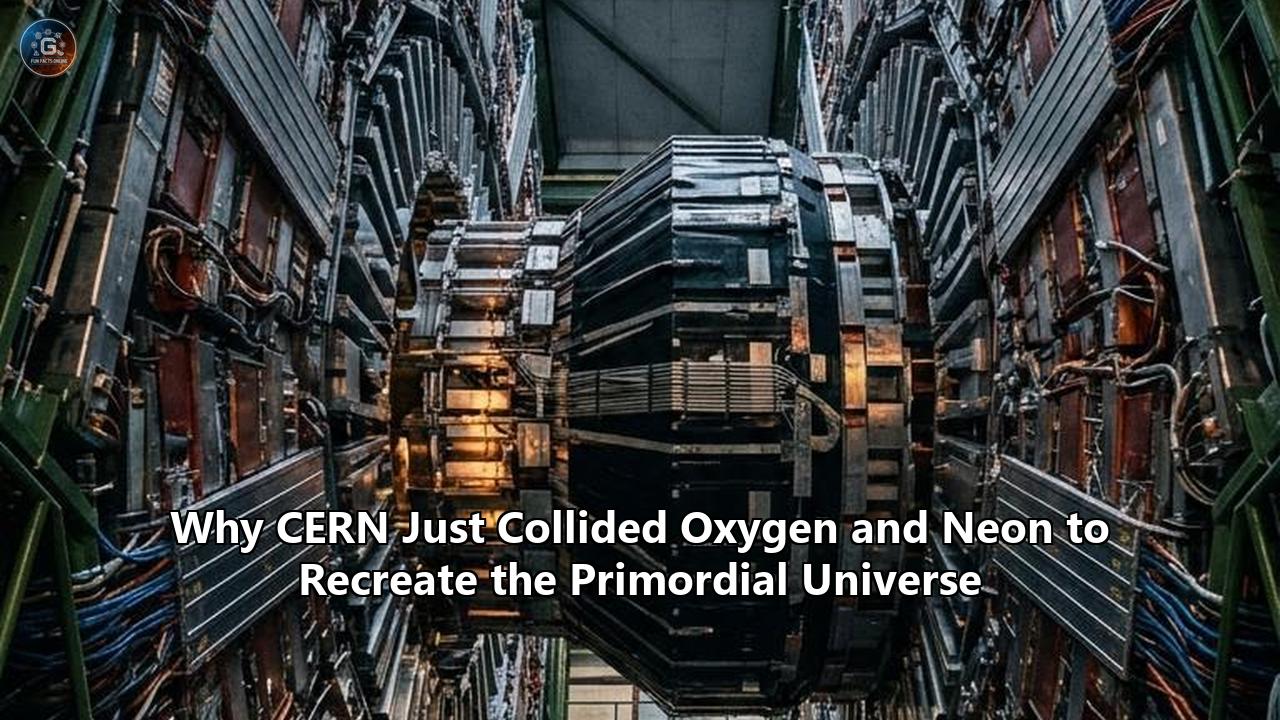
All four major detector collaborations at CERN—ALICE, ATLAS, CMS, and LHCb—have published definitive, joint evidence that colliding light nuclei creates microscopic droplets of Quark-Gluon Plasma (QGP), the primordial state of matter that filled the universe during its first microsecond of existence.
By accelerating oxygen and neon ions to near the speed of light and smashing them together inside the Large Hadron Collider (LHC), physicists observed unambiguous signatures of thermal deconfinement, jet quenching, and collective hydrodynamic flow. The observations challenge a foundational assumption of high-energy nuclear physics: that Quark-Gluon Plasma can only form within massive, heavy-ion collisions such as those involving lead or gold.
The recent experimental run saw the LHC deliver proton-oxygen ($p\text{--}\text{O}$), oxygen-oxygen ($\text{O}\text{--}\text{O}$), and neon-neon ($\text{Ne}\text{--}\text{Ne}$) collisions at a record center-of-mass energy of 5.36 TeV per nucleon pair. Across all four detector systems, the collected data revealed that even the small fireballs produced by colliding light nuclei behave as nearly frictionless, expanding liquid droplets.
Beyond answering core questions about QCD thermodynamics, the results directly impact astroparticle physics by providing the missing baseline measurements needed to resolve longstanding anomalies in cosmic ray interactions within Earth's upper atmosphere.
┌─────────────────────────────────────────────────────────────────────────┐
│                      THE NUCLEAR SIZE SPECTRUM                          │
│                                                                         │
│  Proton-Proton        Light Ions              Heavy Ions                │
│    (p - p)         (O - O, Ne - Ne)            (Pb - Pb)                │
│                                                                         │
│    [•] [•]       [•••••]   [••••••]       [••••••••••••••••]            │
│                  [•••••]   [••••••]       [••••••••••••••••]            │
│                  (A = 16)  (A = 20)           (A = 208)                 │
│  ───────────► ────────────────────────► ─────────────────────────────►  │
│  Elementary      System-Size Scan Range     Traditional QGP Domain      │
│  Baseline        (Onset Threshold)          (Large Volume Plasma)       │
└─────────────────────────────────────────────────────────────────────────┘
Smashing Light Nuclei to Recreate the Primordial Soup
Less than a millionth of a second after the Big Bang, the universe was too hot and dense for subatomic particles to condense into protons and neutrons. Instead, fundamental building blocks—quarks and the gluons that bind them—existed in a deconfined state of matter known as Quark-Gluon Plasma. As the universe expanded and cooled below roughly 2 trillion Kelvin (150 MeV), color confinement locked these quarks and gluons into hadrons, forming the baryonic matter that makes up stars, planets, and human beings today.
For four decades, experimental nuclear physics operated under a firm heuristic: creating QGP required slamming large atomic nuclei together to build a sufficiently large volume of high energy density. Collisions using lead-208 ($^{208}\text{Pb}$) at CERN or gold-197 ($^{197}\text{Au}$) at Brookhaven National Laboratory's Relativistic Heavy Ion Collider (RHIC) involve hundreds of participating nucleons. These collisions produce a fireball large enough to reach local thermal equilibrium and persist long enough to exhibit fluid-like collective expansion.
                 EARLY UNIVERSE TIMELINE & LAB RECREATION

 Time post-Big Bang:
 0                   10⁻⁶ sec             10⁻⁵ sec              Present Day
 |──────────────────────|────────────────────|─────────────────────────|
 Big Bang        Quark-Gluon Plasma       Hadronization             Atoms, Stars,
                 (Deconfined Medium)     (Protons/Neutrons Form)       Galaxies
                        ▲
                        │ Recreated in Lab via:
                        ├── Lead-Lead Collisions (Large Vol.)
                        └── Light-Ion Runs (Small Vol. Onset)
Small system runs—particularly single proton-proton ($\text{p}\text{--}\text{p}$) and proton-lead ($\text{p}\text{--}\text{Pb}$) collisions—frequently served merely as baseline controls. Over the past decade, however, hints of collective flow began appearing in high-multiplicity proton-proton events. This sparked a fiery debate among theorists: were these signals true manifestations of hydrodynamic plasma behavior, or were they artifacts of initial-state quantum entanglement and gluon saturation?
To settle this dispute, accelerator scientists configured the LHC for a specialized light-ion run. By selecting oxygen ($^{16}\text{O}$, with 8 protons and 8 neutrons) and neon ($^{20}\text{Ne}$, with 10 protons and 10 neutrons), physicists targeted a intermediate mass regime. These systems sit precisely between individual protons ($A=1$) and massive lead ions ($A=208$).
The execution of the CERN oxygen neon collision program allowed physicists to perform a systematic size scan. This scan varied the collision volume and nucleon geometry while keeping the center-of-mass energy constant per nucleon pair.
                     SYSTEM SIZE DEPENDENCE SPECTRUM

 Colliding System    Mass Number (A)   Protons (Z)   Neutrons (N)   Geometry
 ─────────────────────────────────────────────────────────────────────────────
 Proton-Proton             1                1             0         Point-like
 Proton-Oxygen            17                9             8         Asymmetric
 Oxygen-Oxygen            32               16            16         Spherical/Alpha-clustered
 Neon-Neon                40               20            20         Prolate "Bowling Pin"
 Xenon-Xenon             258              108           150         Spheroidal
 Lead-Lead               416              164           252         Spherical (Doubly Magic)
Jet Quenching, Parton Energy Loss, and Quarkonium Suppression
To verify the creation of Quark-Gluon Plasma in light-ion collisions, experimenters look for three distinct physical phenomena:
- Parton energy loss (jet quenching)
- Azimuthal anisotropic flow
- Sequential suppression of heavy quarkonium bound states
The combined results across ALICE, ATLAS, CMS, and LHCb confirmed all three signatures in both $\text{O}\text{--}\text{O}$ and $\text{Ne}\text{--}\text{Ne}$ systems.
                   JET QUENCHING IN A QGP DROPLET

                    Hard Scattering
                        \     /
                         \   /
                          \ /
                           *  <--- Initial Hard Reaction
                          / \
                         /   \
  Unattenuated Jet      /     \    Attenuated Jet (Energy Loss)
 ◄─────────────────────●       ●─────────► [Lost energy radiated as
  (Leaves QGP outward)    \   /            soft gluons into plasma]
                           \ /
                        QGP Droplet
ATLAS: Unambiguous Jet Quenching in Light Systems
When high-energy quarks or gluons scatter during the initial moments of a collision, they produce back-to-back collimated sprays of energetic hadrons called jets. If a QGP medium forms, these high-momentum partons lose energy via induced gluon radiation as they traverse the plasma. This phenomenon is known as jet quenching.
ATLAS measured dijet transverse-momentum balance in $\text{O}\text{--}\text{O}$ and $\text{Ne}\text{--}\text{Ne}$ collisions. In head-on (central) collisions, ATLAS observed a distinct momentum imbalance between back-to-back jet pairs. One jet exits near the surface with minimal modification, while its recoil partner traverses the full length of the fireball, losing significant transverse momentum ($p_T$) to the medium.
This energy loss grew systematically stronger in central collisions compared to peripheral ones, establishing that the energy dissipation scales directly with the path length traversed through the dense nuclear matter.
CMS: System-Size Scaling of Nuclear Modification Factors
CMS evaluated charged-particle yields across multiple collision species by computing the nuclear modification factor ($R_{AA}$):
$$R_{AA}(p_T) = \frac{d^2N_{AA}/dp_T d\eta}{\langle N_{\text{coll}} \rangle \cdot d^2N_{pp}/dp_T d\eta}$$
An $R_{AA}$ value equal to 1.0 indicates that the collision is a simple superposition of independent proton-proton interactions. An $R_{AA}$ value below 1.0 indicates particle suppression caused by energy loss in the medium.
                         NUCLEAR MODIFICATION FACTOR (R_AA)

 R_AA
  1.0 ┌───────────────────────────────────────────────────────── Binary Scaling Limit
      │               \                           /
  0.8 │                \                         /
      │                 \   Oxygen-Oxygen       /   Neon-Neon
  0.6 │                  └── Minimum ~0.6 ─────┘  (Deeper Suppression)
      │                      at pT ≈ 6 GeV
  0.4 │
      │
  0.2 └─────────────────────────────────────────────────────────
      0             10            20            30            40  Transverse Momentum
                                                                  pT (GeV)
CMS mapped $R_{AA}$ for charged hadrons as a function of transverse momentum, finding a pronounced suppression dip around $p_T = 6\text{ GeV}$ where $R_{AA}$ fell to approximately 0.6. By comparing $\text{O}\text{--}\text{O}$ ($A=16$) and $\text{Ne}\text{--}\text{Ne}$ ($A=20$) against historical dataset baselines for Xenon-Xenon ($\text{Xe}\text{--}\text{Xe}$, $A=129$) and Lead-Lead ($\text{Pb}\text{--}\text{Pb}$, $A=208$), CMS established a direct scaling law.
The magnitude of parton energy loss maps continuously against the path-length metric $A^{1/3}$ (which is proportional to the nuclear radius) across two orders of magnitude in nuclear mass number.
ALICE: Neutral Pions and Baryon-vs-Meson Flow Anomalies
To rule out cold nuclear matter effects (such as shadow modifications of gluon distribution functions inside the nucleus), ALICE measured neutral pion ($\pi^0$) production in both $\text{O}\text{--}\text{O}$ and $p\text{--}\text{O}$ collisions. Neutral pions decay almost instantaneously into photon pairs ($\pi^0 \to \gamma\gamma$), providing a clean electromagnetic signature.
ALICE observed $R_{AA}$ suppression for high-$p_T$ neutral pions in $\text{O}\text{--}\text{O}$ collisions, whereas $p\text{--}\text{O}$ collisions showed no high-$p_T$ suppression. This contrast proved that high-$p_T$ hadron suppression requires a overlapping hot interaction zone generated by two colliding nuclei, rather than being an intrinsic property of nuclear structure.
                 ANISOTROPIC FLOW FOURIER HARMONICS

 Initial Spatial Asymmetry               Final Momentum Anisotropy
      (Geometry Zone)                          (Particle Emissions)

         ┌──────┐                                    \   /  Preferred
         │  ██  │                                     \ /   Pressure
         │ ████ │   ──────── Hydrodynamic ────────►  ◄──*──► Gradient
         │  ██  │            Expansion                / \   Axis
         └──────┘                                    /   \

   Elliptic (v₂) Flow Mode                 Triangular (v₃) Flow Mode
ALICE also extracted collective flow coefficients ($v_2, v_3, v_4$) by performing a Fourier decomposition of the azimuthal particle distribution:
$$\frac{dN}{d\phi} \propto 1 + 2 \sum_{n=1}^{\infty} v_n \cos\left(n(\phi - \Psi_n)\right)$$
The second Fourier harmonic ($v_2$, elliptic flow) and third harmonic ($v_3$, triangular flow) displayed a characteristic mass ordering at intermediate momentum. Three-quark particles (baryons like protons and $\Lambda$ hyperons) developed significantly larger elliptic flow than two-quark particles (mesons like pions and kaons).
This baryon-meson splitting is a hallmark signature of Quark-Gluon Plasma: it demonstrates that collective pressure gradients push quarks before they undergo hadronization via quark recombination.
LHCb: Heavy Quark Dissociation in Small Volumes
LHCb exploited its forward spectrometer geometry ($2 < \eta < 5$) to study open charm ($D^0$ mesons) and charmonium states. LHCb demonstrated that open charm yield suppression was noticeably stronger in $\text{Ne}\text{--}\text{Ne}$ collisions than in $\text{O}\text{--}\text{O}$ collisions.
Simultaneously, CMS measured the production of bottomonium states—the Upsilon family ($\Upsilon(1S), \Upsilon(2S), \Upsilon(3S)$)—in these light systems. In a hot QGP medium, color screening melts heavy-quark bound states. Tightly bound ground states like $\Upsilon(1S)$ survive higher temperatures, while loosely bound excited states like $\Upsilon(2S)$ and $\Upsilon(3S)$ melt more readily.
CMS confirmed a sequential suppression pattern in $\text{O}\text{--}\text{O}$ and $\text{Ne}\text{--}\text{Ne}$ collisions, offering direct evidence that the thermal medium produced reaches temperatures above the dissociation threshold for excited quarkonium states.
             QUARKONIUM SEQUENTIAL DISSOCIATION IN QGP

 State          Binding Radius     Dissociation Temp (T_c)     Status in O-O / Ne-Ne
 ───────────────────────────────────────────────────────────────────────────────────
 Υ(1S)           ~0.28 fm              ~2.0 T_c              Slightly Suppressed
 Υ(2S)           ~0.56 fm              ~1.2 T_c              Strongly Suppressed
 Υ(3S)           ~0.78 fm             < 1.0 T_c              Completely Melted
Shape-Shifting Atomic Nuclei: Bowling-Pin Neon vs. Spherical Oxygen
A major outcome of the light-ion run was the successful fusion of high-energy QCD physics with low-energy nuclear structure physics. Traditionally, relativistic heavy-ion physics treated colliding nuclei as featureless, smooth spheres of uniform nuclear charge density. The CERN oxygen neon collision program proved that high-energy particle colliders can act as ultra-fast femtometer-scale imaging cameras, capturing internal nuclear deformations on sub-zeptosecond timescales.
                   NUCLEAR GEOMETRY COMPARISON

  Oxygen-16 (¹⁶O) Nucleus                Neon-20 (²⁰Ne) Nucleus
  - Spherical / α-clustered             - Prolate "Bowling Pin" Deformation
  - Quadrupole parameter β₂ ≈ 0          - Quadrupole parameter β₂ ≈ 0.45

            ┌───┐                                  ┌──────┐
           │     │                                │        │
           │  ●  │                                │   ●    │
           └───┘                                  │        │
                                                   └──────┘
      Spherical Overlap                     Elongated Almond Overlap
     (Modest Elliptic Flow)                   (Large Elliptic Flow)
The nuclear density distribution $\rho(r, \theta, \phi)$ is typically parameterized using Woods-Saxon distributions augmented by spherical harmonics:
$$\rho(r, \theta, \phi) = \frac{\rho_0}{1 + \exp\left( \frac{r - R_0 (1 + \beta_2 Y_{20}(\theta) + \beta_3 Y_{30}(\theta) + \dots)}{a} \right)}$$
Where:
- $\beta_2$ represents the quadrupole deformation parameter (ellongation or flattening).
- $\beta_3$ represents octupole deformation (pear-like asymmetry).
- $a$ is the nuclear skin thickness.
Oxygen-16 ($^{16}\text{O}$) is a doubly magic-like nucleus with 8 protons and 8 neutrons. Its ground state is nearly spherical ($\beta_2 \approx 0$), though theoretical nuclear physics models predict subtle internal tetrahedral alpha-particle ($\alpha = \,^4\text{He}$) clustering.
Conversely, Neon-20 ($^{20}\text{Ne}$) possesses a heavily deformed, prolate "bowling-pin" geometry with a strong quadrupole deformation ($\beta_2 \approx 0.45$).
                 OVERLAP GEOMETRY DRIVING COLLECTIVE FLOW

 Head-On Alignment: Neon-20             Random Orientation Average

       ┌───┐                                  ┌───┐
       │   │   <- Colliding Pin              │   │
       └───┘                                  └───┘
         ▲                                      \
         │ Imprints Highly                       \ Imprints Fluctuation-Driven
         ▼ Asymmetric Overlap                     \ Triaxial Fireball
       ┌───┐                                    ┌───┐
       │   │                                    │   │
       └───┘                                    └───┘
         │                                        │
         ▼                                        ▼
   Large Elliptic Flow (v₂)                Elevated Triangular Flow (v₃)
When two prolate neon nuclei collide, their orientation at the instant of impact determines the geometry of the initial energy-density profile:
- If two neon "pins" collide tip-to-tip, they produce a highly compressed, compact fireball.
- If they collide side-to-side, they produce an elongated, almond-shaped interaction zone.
Because hydrodynamic pressure gradients expand fastest along the shortest axis of an almond shape, side-to-side collisions translate spatial asymmetry into momentum anisotropy.
ALICE, ATLAS, and CMS measured elliptic flow ($v_2$) in central collisions and observed a clear hierarchy: $v_2(\text{Ne}\text{--}\text{Ne}) > v_2(\text{O}\text{--}\text{O})$. The exaggerated elliptic flow in neon confirmed the presence of its prolate deformation.
This experimental validation shows that relativistic light-ion collisions can map ground-state nuclear geometries without relying on low-energy Coulomb excitation techniques.
Who Is Affected? A Ripple Effect Across Multiple Fields of Physics
The verification of Quark-Gluon Plasma in light systems affects multiple domains of physical science, extending well beyond experimental particle colliders.
                  CROSS-DISCIPLINARY IMPACT MAP

                 ┌──────────────────────────────┐
                 │  CERN Light-Ion Discovery    │
                 │   (O-O, Ne-Ne, p-O Runs)     │
                 └──────────────┬───────────────┘
                                │
   ┌────────────────────┬───────┴────────┬────────────────────┐
   ▼                    ▼                ▼                    ▼
 Theoretical QCD   Cosmic Ray Science  Astrophysics       Collider Tech
 - Fluidity limit  - Muon Puzzle       - Early Universe   - Transmutation
 - Pre-equilibrium   resolution        - Neutron Stars     crystal optics
1. Theoretical Particle and Nuclear Physicists
For theoretical physicists specializing in Quantum Chromodynamics (QCD), the light-ion data forces a fundamental reassessment of non-equilibrium thermodynamics and fluid dynamics.
Hydrodynamic models like Viscous Relativistic Hydrodynamics (e.g., MUSIC, VISH2+1) operate on the assumption of a separation of length scales: the mean free path of constituent particles ($\lambda$) must be significantly smaller than the macroscopic dimensions of the fluid system ($L$), such that $Kn = \lambda/L \ll 1$ (the Knudsen number).
In an oxygen-oxygen collision, the radius of the system is barely 3 femtometers ($3 \times 10^{-15}\text{ meters}$). Observing hydrodynamic collective flow in a fireball of this scale indicates that the Quark-Gluon Plasma reaches local thermal equilibrium extremely rapidly (in less than $10^{-24}\text{ seconds}$).
This challenges theorists to explain how color fields thermalize almost instantly, driving research into pre-equilibrium dynamics, AdS/CFT string theory duals, and the theoretical lower bounds of shear viscosity-to-entropy density ratios ($\eta/s \approx 1/4\pi$).
2. Cosmic Ray and Astroparticle Physicists
A primary beneficiary of the $p\text{--}\text{O}$ dataset is the astroparticle physics community. Ultra-High-Energy Cosmic Rays (UHECRs)—protons or atomic nuclei travelling from distant galaxies with energies exceeding $10^{19}\text{ eV}$—strike the upper atmosphere and initiate vast cascades of secondary particles called extended air showers.
                    COSMIC RAY EXTENDED AIR SHOWER

 High-Energy Primary Proton (Cosmic Ray)
               │
               ▼  Strikes Atmospheric Nuclei (Nitrogen-14, Oxygen-16)
              / \
             /   \  Primary Inelastic Interaction (Recreated by p-O at LHC)
            /     \
           /       \
          *         *   Multi-Hadron Production (Pions, Kaons)
         / \       / \
        /   \     /   \
       ▼     ▼   ▼     ▼
      π⁺    π⁻  π⁰    K⁺
      │     │   │
      │     │   └──► Decays into Photons (e.m. shower core)
      │     └──► Decays into Muons (μ⁻) + Neutrinos
      └──► Decays into Muons (μ⁺) + Neutrinos

      ================ EARTH'S SURFACE ================
      Muon Detectors (Pierre Auger Observatory / IceCube)
      Historically observed 30-60% MORE muons than models predicted!
Because Earth's upper atmosphere consists mainly of Nitrogen ($A=14$) and Oxygen ($A=16$), modeling cosmic ray air showers requires an accurate understanding of proton-oxygen ($p\text{--}\text{O}$) and nucleus-oxygen interactions. For decades, ground-based observatories—such as the Pierre Auger Observatory in Argentina and the IceCube Neutrino Observatory at the South Pole—faced the "Muon Puzzle".
Air shower simulations built on standard Monte Carlo event generators (such as EPOS-LHC, SIBYLL, and QGSJET-II) consistently underpredicted the total number of ground-level muons produced in high-energy showers by 30% to 60%.
Data from the $p\text{--}\text{O}$ collisions at $\sqrt{s_{NN}} = 5.36\text{ TeV}$ provides direct measurement of forward hadron production, inelastic cross-sections, and strangeness enhancement in oxygen targets. Early analyses indicate that strangeness enhancement and high hadron multiplicity—driven by small-scale QGP formation—divert more reaction energy into charged kaons and pions, which decay directly into muons.
Integrating this real particle data into atmospheric air shower models helps resolve the Muon Puzzle, allowing astronomers to accurately determine the chemical composition of ultra-high-energy cosmic rays hitting Earth.
                 AIR SHOWER MUON MULTIPLICITY COMPARISON

 Muon Yield
  ▲
  │                                     ▲ Pierre Auger Observatory Data
  │                                    /
  │                                   /  <-- Unresolved Gap (30-60% Deficit)
  │                                  /
  │                         ───────/─── Standard Monte Carlo Models
  │                        /            (Without Small-System QGP Effects)
  │                       /
  │                      / ◄── Adjusted Prediction using LHC p-O & O-O Data
  │                     /      (Includes Strangeness Enhancement & Flow)
  └────────────────────/────────────────────────────────────────► Primary Energy (eV)
3. Cosmologists and Neutron Star Physicists
Understanding the exact phase transition boundary between hadron gas and Quark-Gluon Plasma refines models describing the evolution of the early universe. The equation of state (EoS) extracted from light-ion collisions provides empirical inputs for:
- Primordial Black Hole (PBH) Formation: Softening of the equation of state during the microsecond QGP-hadron phase transition lowers the pressure support against gravitational collapse, altering the mass spectrum of primordial black holes formed in the early universe.
- Relic Cosmic Neutrino Background: Precision inputs on the effective degrees of freedom ($g_*$) during hadronic freeze-out improve decoupling timing models for cosmic background neutrinos.
- Neutron Star Mergers: The ultra-dense, hot nuclear matter produced in binary neutron star collisions reaches temperatures ($T > 50\text{ MeV}$) and densities where phase transitions to deconfined quark matter occur. Light-ion collision dynamics supply crucial transport parameters for relativistic magnetohydrodynamic simulations of merger remnants.
4. Accelerator Engineers and Beam Physicists
Accelerating and colliding oxygen and neon beams posed novel operational challenges for CERN's complex injection chain. Unlike proton-proton operations, circulating light-ion beams encounter beam-halo losses and nuclear transmutation.
                     CERN ACCELERATOR INJECTION CHAIN

  Linac3 ──► LEIR ──► Proton Synchrotron (PS) ──► SPS ──► Large Hadron Collider (LHC)
 (Ion Source) (Low Energy)  (Intermediate Boost) (Pre-Injector) (Collision Ring)
During collisions, ultra-intense electromagnetic fields generate intense photon-nucleus interactions. High-energy real and virtual photons emitted by one passing nucleus strike the opposing nucleus, inducing photo-nuclear dissociation:
$$\gamma + \,^{16}\text{O} \to \,^{15}\text{O} + n \quad \text{or} \quad \gamma + \,^{16}\text{O} \to \,^{14}\text{C} + 2p$$
This process changes the mass-to-charge ratio ($A/Z$) of the circulating ions. These transmuted isotopes stray from the central orbit, threatening to impact superconducting magnets and cause thermal quenches.
To manage this, CERN engineers tested bent silicon crystal collimators during the CERN oxygen neon collision run. The crystal lattices channel stray ion halos safely into absorber blocks.
This successful test validated beam collimation techniques essential for future high-intensity light-ion runs at the High-Luminosity LHC.
                  CRYSTAL COLLIMATION OF STRAY ION HALO

  Circulating Pure Beam (A/Z = 2)
  ═════════════════════════════════════════════════════════════► Central Beam Orbit
       \
        \ Transmutation Event (A/Z altered)
         \
          ▼ Stray Halo Particle
       ┌──────────┐
       │ Bent     │  Slightly curved atomic planes of silicon
       │ Silicon  │  channel halo ions via coherent planar channeling
       │ Crystal  │
       └────┬─────┘
            │
            └─── Deviated Angle ───► Absorber Block (Prevents Magnet Quench)
What Changes? Conceptual Shifts in Fundamental Physics
The validation of Quark-Gluon Plasma in light-ion collisions marks a shift in how particle physicists understand quantum chromodynamics and subatomic structure.
                      PARADIGM SHIFT IN NUCLEAR QCD

 OLD ASSUMPTION                                NEW PARADIGM
 ───────────────────────────────────────────   ───────────────────────────────────────────
 • QGP formation requires massive volume       • QGP is a universal liquid state forming
   and hundreds of participating nucleons        in any dense energy zone above threshold
   (Lead-208 / Gold-197 exclusive domain).       regardless of total system volume.

 • Proton-Proton / Light Systems serve         • Light Systems exhibit true fluid dynamics,
   strictly as non-thermal baseline controls     parton energy loss, and jet quenching,
   devoid of plasma energy loss.                 bridging the gap to heavy systems.

 • High-energy colliders measure elementary     • Relativistic collisions act as sub-fm
   parton cross-sections exclusively.            femtoscopic cameras to image ground-state
                                                 deformations of atomic nuclei.
1. The Onset Threshold of Deconfined Matter
Physics textbooks traditionally defined QGP formation as an all-or-nothing threshold dependent on collision size. The LHC light-ion results establish that deconfinement is a smooth, continuous transition.
The critical driver of QGP behavior is local energy density rather than total system volume. So long as energy density exceeds approximately $1\text{ GeV/fm}^3$, color screening occurs and fluid flow develops, even within fireballs spanning only a few nucleon radii.
                 SYSTEM SIZE SCAN: PATH LENGTH VS ENERGY LOSS

 Energy Loss (ΔpT)
  ▲
  │                                                   Pb-Pb (A=208)
  │                                        Xe-Xe     /
  │                                       (A=129)   /
  │                           Ne-Ne      /         /
  │                   O-O    (A=20)     /         /
  │                  (A=16) /          /         /
  │                 /      /          /         /
  │   p-O          /      /          /         /
  │  (A=17)       /      /          /         /
  │ /            /      /          /         /
  └─────────────┴──────┴──────────┴─────────┴─────────────────────► Path Length Metric
  0            2.5    2.7         5.0       5.9                   A^(1/3)
2. High-Energy Colliders as Subatomic Microscopes
Nuclear structure physics and high-energy particle physics historically operated as separate fields:
- Low-energy nuclear structure utilized radioactive ion beams, Coulomb excitation, and electron scattering to map nuclear shapes.
- Relativistic heavy-ion colliders focused on quark-level thermodynamics.
The light-ion run demonstrated that high-energy collisions can resolve nuclear shapes. By measuring multi-particle correlations and azimuthal flow modes ($v_2, v_3, v_4$), physicists can measure nuclear quadrupole ($\beta_2$) and octupole ($\beta_3$) deformations, skin thickness, and alpha-cluster configurations at sub-femtometer scales.
This creates a new interdisciplinary field: ultra-relativistic femtoscopic tomography of ground-state nuclear structure.
Short-Term and Long-Term Consequences
                      CHRONOLOGICAL CONSEQUENCES TIMELINE

 NEAR-TERM (1-3 Years)            MID-TERM (3-7 Years)           LONG-TERM (7-15+ Years)
 ──────────────────────           ────────────────────           ───────────────────────
 • Re-calibration of UHECR        • HL-LHC Light-Ion Program     • EIC Target Design
   Cosmic Air Shower Codes          Integration (Run 4)            (Brookhaven EIC)

 • Refinement of Viscous          • Complete Sub-Femtometer      • FCC-hh Collider Design
   Hydrodynamic Generators          3D Nuclear Tomography          Parameters

 • Crystal Collimator Deployment  • Advanced Strangeness          • Unified Microsecond
   for Heavy Ion Systems            Hadronization Models           Cosmology Framework
Short-Term Consequences (1–3 Years)
- Recalibration of Cosmic Ray Simulation Codes: Astroparticle physics collaborations (Auger, IceCube, Telescope Array) are actively re-tuning their core Monte Carlo event generators using the $p\text{--}\text{O}$ baseline data. This will yield revised cosmic ray chemical composition spectrum maps, clarifying the transition from galactic to extragalactic cosmic ray sources.
- Refinement of Relativistic Hydrodynamics Codes: Theoretical groups are incorporating the $\text{O}\text{--}\text{O}$ and $\text{Ne}\text{--}\text{Ne}$ flow and jet-quenching data into 3D viscous hydrodynamic frameworks. These updates will refine calculations of early-stage initial state momentum anisotropy, initial thermalization times, and the shear viscosity-to-entropy ratio ($\eta/s$) of small QGP fireballs.
- Collimator Upgrades for LHC High-Luminosity Runs: CERN accelerator engineers are using operational data from the light-ion run to finalize the crystal collimators for High-Luminosity LHC (HL-LHC) heavy-ion operations. This technology will safeguard machine components against beam losses during high-intensity runs.
Long-Term Consequences (5–15 Years)
- Establishment of Dedicated Light-Ion Programs for HL-LHC and Run 4: The success of the oxygen and neon run makes light-ion operations a permanent component of future LHC research schedules. Future campaigns will explore isobaric pairs (e.g., Ruthenium-96 vs. Zirconium-96) and lighter nuclei such as Carbon-12 ($^{12}\text{C}$) to map alpha-clustering geometry.
- Impact on the Electron-Ion Collider (EIC) at Brookhaven: The EIC, currently under construction at Brookhaven National Laboratory, will probe the internal gluonic structure of atomic nuclei using high-energy electron beams. High-energy light-ion results from CERN provide baseline nuclear geometry data that will directly inform target selection and physics models at the EIC.
- Design Parameters for Next-Generation Colliders: Physics groups planning the Future Circular Collider (FCC-hh)—a proposed 100 TeV hadron collider at CERN—are incorporating light-ion capability into its baseline designs. Colliding light ions at 100 TeV will generate small-system QGP droplets at higher temperatures, probing the hyper-hot QGP regime where charm and bottom quarks contribute directly to the hydrodynamic pressure gradient.
The Next Frontiers in Light-Ion Physics
The findings from the CERN oxygen neon collision campaign mark the beginning of a broader research initiative. Having confirmed that QGP droplets form in oxygen and neon systems, physicists are now working to identify the precise lower bound of nuclear deconfinement.
                 THE UNRESOLVED LOWER BOUND OF QGP

 Collision System:  Lead-Lead   Xenon-Xenon   Neon-Neon   Oxygen-Oxygen   Proton-Proton ???
 System Volume:      ~300 fm³     ~180 fm³      ~35 fm³      ~25 fm³        ~2 fm³
 QGP Observed:         YES          YES           YES          YES             ???
                                                                                ▲
                                                                  Lower Threshold Boundary
                                                                  Under Active Study
Key questions remain under active investigation:
- Where is the absolute lower limit of QGP formation? Can a Quark-Gluon Plasma droplet form in a single proton-proton collision if the event produces sufficient energy density?
- What is the exact internal geometry of Oxygen-16? Can future high-statistics oxygen runs confirm the theoretical "tetrahedral four-alpha cluster" state of the ground-state oxygen nucleus?
- How does non-equilibrium quantum entanglement transition into thermalized fluid motion? What microscopic quantum chromodynamic mechanisms drive rapid thermalization in femtometer-scale volumes before the system expands and disintegrates?
To answer these questions, experimental collaborations at CERN are completing second-generation multidimensional correlation analyses on the light-ion dataset.
By pushing quantum chromodynamics into unexplored system-size regimes, physicists are expanding our understanding of the primordial liquid that filled our cosmos during the first microsecond of time.
Reference:
- https://home.cern/oxygen-collisions-at-the-lhc-show-new-indications-of-extreme-state-of-matter/
- https://scitechdaily.com/cern-experiments-detect-signs-of-the-universes-primordial-matter/
- https://cms.cern/news/lhcs-first-oxygen-oxygen-and-neon-neon-collisions-cms-spots-interesting-pattern
- https://cerncourier.com/first-oxygen-and-neon-collisions-at-the-lhc/
- https://alice-collaboration.web.cern.ch/2025-ALICE-Oxygen-Neon-Flow
- https://indico.cern.ch/event/1586852/
- https://cms.cern/news/first-ever-oxygen-and-neon-lhc-collisions-are-studied-cms
- https://cerncourier.com/a/run-3-physics-gets-under-way/
- https://home.cern/first-ever-collisions-oxygen-lhc/
- https://atlas.cern/Updates/News/First-Oxygen-Run
- https://atlas.cern/tags/run-3
- https://alice-collaboration.web.cern.ch/2026-oxygen-collisions