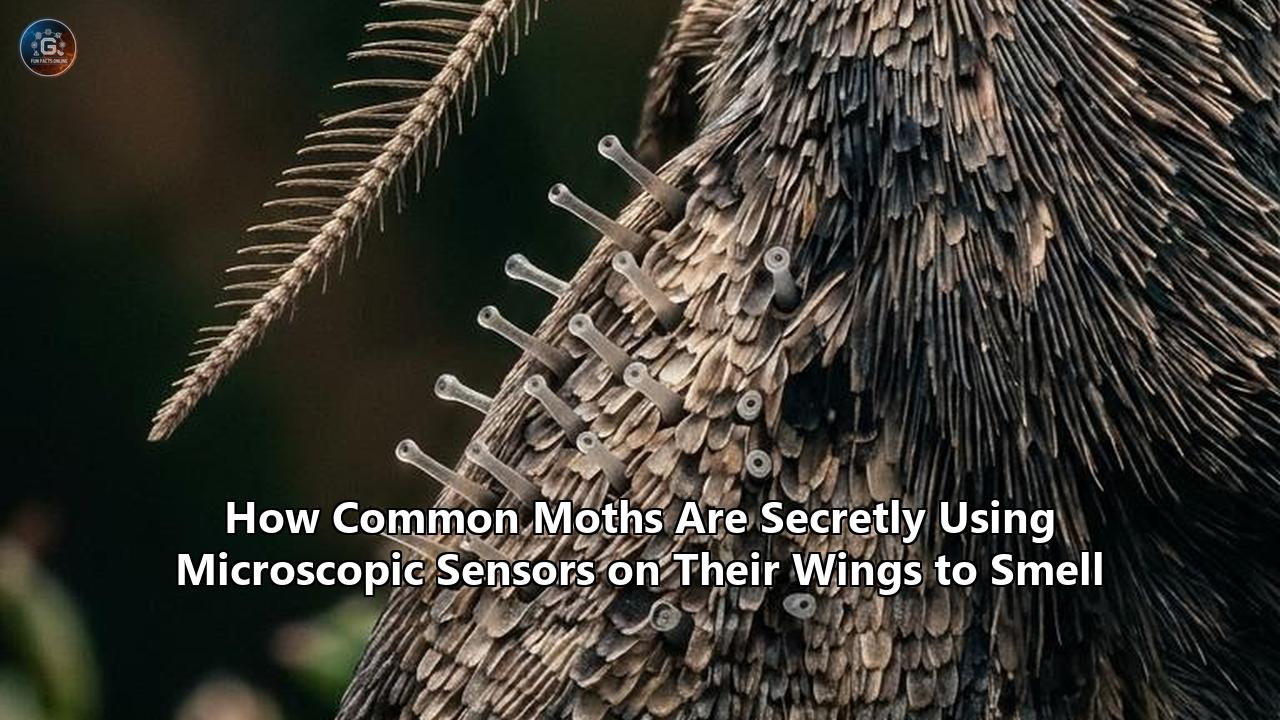
When researchers at the Max Planck Institute for Chemical Ecology published their investigation in the Journal of Experimental Biology on July 27, 2026, they overturned a foundational assumption in insect neurobiology. For more than a century, biological textbook consensus maintained that understanding how moths smell was entirely a matter of dissecting their feathery antennae. While those head-mounted appendages remain masterworks of chemical detection, a team led by Ahmed Reda Ismaieel, Regina Stieber, Bill S. Hansson, and Sonja Bisch-Knaden demonstrated that the tobacco hawkmoth (Manduca sexta) carries a functional, highly specialized secondary olfactory system embedded directly into its wings.
The discovery reveals that insect wings are not merely passive aerodynamic structures driven by flight muscles, nor are their sensory capabilities limited to touch and airflow mechanics. By pairing high-resolution scanning electron microscopy with transcriptomics, electrophysiological recordings, and computational protein docking, the Max Planck team established that hawkmoth wings harbor microscopic, porous sensory hairs capable of detecting volatile airborne chemicals.
Crucially, this wing-based "nose" does not mirror the broad-spectrum sensitivity of the antennae. Instead, it acts as an ultra-selective chemical gatekeeper tuned specifically to volatile amines associated with nightshade plants—the precise vegetation required for female hawkmoths to lay their eggs.
This singular discovery serves as an extraordinary lens through which to analyze larger principles in biomechanics, evolutionary neurobiology, and bio-inspired engineering. Examining this case study reveals how natural selection decentralizes complex sensory hardware, couples fluid dynamics with molecular filtering, and optimizes task-specific neural architecture.
Anatomy of a Wing Nose: Porous Sensilla and Microscopic Hardware
To determine whether moth wings possessed the anatomical infrastructure required for olfaction, the researchers turned to gold-sputtered scanning electron microscopy (SEM). Earlier morphological studies had identified touch-sensitive mechanoreceptors along the wing margins—slender, pointed bristles measuring roughly 120 micrometers in length that detect aerodynamic pressure, turbulence, and physical contact.
The Max Planck team sought microscopic structures containing tiny wall pores. In insect anatomy, wall pores are the defining physical hallmark of olfactory sensilla; they provide microscopic tunnels through which volatile chemical molecules in the air can diffuse into the internal fluid of the sensory bristle to reach underlying nerve endings.
┌────────────────────────────────────────────────────────────────────────┐
│                   HAWKMOTH WING SENSORY HARDWARE                       │
├────────────────────────────────────────────────────────────────────────┤
│                                                                        │
│   Touch Sensillum (Mechanosensory)     Olfactory Sensillum (Chemosensory) │
│                                                                        │
│          /\  ~120 µm length                  /\  ~80 µm length         │
│         /  \ Smooth, solid wall             /  \ Pitted, porous wall   │
│        /    \ Impermeable surface          /:..:\ Wall pores for air │
│       /      \ Flexible socket            /::::..\ Volatile diffusion  │
│      /________\                          /________\                    │
│          │                                   │                         │
│   [Bending Trigger]                   [Chemical Docking]              │
│          │                                   │                         │
│   Flight Balance Nerve                Ionotropic Receptor Neurons      │
│                                                                        │
└────────────────────────────────────────────────────────────────────────┘
The electron micrographs revealed distinct, shorter sensory bristles interspersed among the longer touch hairs along the edges of the hawkmoth wing. Measuring approximately 80 micrometers in length—roughly the thickness of a single human hair—these stubbier bristles featured pitted surfaces perforated by numerous microscopic wall pores alongside a single subapical pore. Across the wing margins, the team counted an average of 21 to 32 of these dual-function chemosensory bristles per wing.
When the team physically trimmed the outer margins off the wings and re-tested the wing membrane's chemical reactivity, the electrical responses to scent molecules persisted. This critical step proved that these microscopic sensors are not confined to the outer fringe of the wing blade. Instead, a distributed array of odor-sensitive sensilla extends across the broad membrane of the wing itself, creating an active chemical sampling surface across the entire flying organ.
The Molecular Blueprint: Transcriptomics and Receptor Selection
Possessing porous hairs is a prerequisite for olfaction, but true scent processing requires functional receptor proteins housed within the dendrites of sensory neurons. To map this internal machinery, the researchers extracted messenger RNA (mRNA) from hawkmoth wing tissue, constructing a transcriptomic profile of the active genes within the wing's sensory apparatus.
The gene sequencing revealed mRNA encoding 33 distinct chemosensory receptors expressed within the wing, with 15 specifically localized along the outer wing edge where the porous bristles are heavily clustered. However, the molecular profile presented a major evolutionary puzzle:
- Absence of Classical Odorant Receptors (ORs): In classical insect olfaction—such as the system operating on the antennae—odorant detection relies heavily on Odorant Receptors paired with an obligatory co-receptor known as ORCo. The transcriptomic analysis of the hawkmoth wing showed zero detectable expression of the ORCo gene.
- Prevalence of Ionotropic Receptors (IRs): Instead of the canonical OR/ORCo pathways, the wing tissues expressed high concentrations of Ionotropic Receptors—an ancient family of chemosensory ion channels.
- Presence of Key Co-Receptors: The wing tissue expressed abundant mRNA for IR76b (a co-receptor known in insects to mediate amine and salt sensing) and IR8a (a co-receptor tied to organic acid detection).
- Enrichment of the IR7d Clade: Gene sequences belonging to the Lepidoptera-specific IR7d receptor clade were particularly prominent.
                     ┌──────────────────────────────┐
                     │   Wing Tissue mRNA Extract   │
                     └──────────────┬───────────────┘
                                    │
              ┌─────────────────────┴─────────────────────┐
              ▼                                           ▼
   Classical Antennal Pathway                 Wing Olfactory Pathway
   ┌────────────────────────┐                 ┌────────────────────────┐
   │ Odorant Receptors (ORs)│                 │ Ionotropic Receptors   │
   │           +            │                 │        (IRs)           │
   │    ORCo Co-Receptor    │                 │           +            │
   │  (NOT DETECTED IN WING)│                 │  IR76b & IR8a Co-Rec.  │
   └────────────────────────┘                 └───────────┬────────────┘
                                                          │
                                                          ▼
                                              ┌────────────────────────┐
                                              │  IR7d Clade Expression │
                                              │ (Targeted Amine Tuning)│
                                              └────────────────────────┘
This molecular fingerprint indicated that the wing sensory system does not attempt to replicate the general-purpose olfactory scanning of the head. Antennae rely on ORCo to drive broad-spectrum receptor arrays that parse complex floral bouquets, sex pheromones, and environmental background scents. The wing, by contrast, bypassed the ORCo architecture entirely, deploying an ancient, highly stable Ionotropic Receptor network designed for targeted chemical sensing.
Electrophysiological Proof: Hyper-Selective Odor Tuning
To prove that these receptors produce actual neural signals when exposed to odors, Ismaieel and his colleagues conducted electrowingography—attaching micro-electrodes directly to the isolated hawkmoth wing to measure changes in voltage potential across the tissue when airborne chemical pulses were delivered.
The researchers exposed the wings to a broad panel of volatile chemical compounds representing various ecological contexts:
- Floral Volatiles: Headspace odors from Datura flowers (a primary nectar source for adult hawkmoths).
- Fruity Esters: Compounds such as methyl hexanoate.
- Decay Products & Heterocycles: Putrid nitrogenous compounds like pyridine.
Despite the high sensitivity of moth antennae to floral scents, the wings showed zero electrical response to Datura flower volatiles, fruity esters, or general environmental odors. The wings remained electrically silent across almost the entire test battery.
Odorant Stimulus Delivered           Electrowingography Signal Response
─────────────────────────────────────────────────────────────────────────
Datura Floral Scents               │ ───────────────────────── (No Response)
Methyl Hexanoate (Fruity)          │ ───────────────────────── (No Response)
Pyridine (Putrid Volatile)         │ ───────────────────────── (No Response)
Pyrrolidine (Nightshade Amine)     │ ───────/\───/\─────────── (STRONG RESPONSE)
Piperidine (Solanaceous Amine)     │ ───────/  \─/  \────────── (STRONG RESPONSE)
─────────────────────────────────────────────────────────────────────────
The electrical potential spiked dramatically only when exposed to two specific volatile amines: pyrrolidine and piperidine.
Both compounds are cyclic nitrogenous amines. To human noses, they emit a harsh, fishy odor. In nature, however, pyrrolidine and piperidine serve as distinct chemical signatures of solanaceous plants—the nightshade family, which includes wild tobacco (Nicotiana tabacum), jimsonweed (Datura stramonium), and tomato plants. Nightshades are the mandatory host plants for Manduca sexta larvae. Adult female hawkmoths must locate these specific leaves to lay their eggs, ensuring their newly hatched caterpillars have immediate access to food.
The electrowingography experiments demonstrated a clear dose-response relationship: lower concentrations of pyrrolidine and piperidine produced small electrical deflections, while higher concentrations elicited sharp, pronounced spikes. Structurally similar molecules—such as pyrrole and pure pyridine—failed to trigger the wing neurons, proving that the sensory hairs are finely tuned to the precise chemical geometries of pyrrolidine and piperidine.
To validate this binding at the molecular level, the researchers used AI-assisted 3D protein structure modeling to construct structural simulations of candidate Ionotropic Receptors from the moth's IR7d gene family. Molecular docking algorithms revealed that pyrrolidine and piperidine fit tightly into the active binding pockets of two candidate IR proteins, triggering conformational changes capable of opening the ion channel and firing a nerve signal.
This uncompromising selectivity fundamentally reframes how moths smell host plants while navigating turbulent night air. Antennae provide long-range, multi-channel olfactory mapping, but the wings act as dedicated, contact-adjacent single-purpose detectors that register host-plant chemistry during close-range flight maneuvers.
Principle 1: The Evolutionary Logic of Decentralized Sensory Hardware
The discovery that hawkmoth wings operate as functional chemical sensors highlights an important organizational principle in biological design: sensory decentralization.
In conventional neurobiology models, animals concentrate their primary sensory inputs into specialized head structures—eyes, ears, noses, and antennae—to minimize signal transit times to the central brain. However, placing sensory systems at peripheral body extremities offers distinct evolutionary advantages when dealing with complex physical environments.
CENTRALIZED SENSORY MODEL                   DECENTRALIZED SENSORY MODEL
   (Traditional View)                          (Observed Hawkmoth Model)

      [ Antennae ]                                  [ Antennae ]
     (Broad Smell)                                 (Broad Smell)
           │                                             │
           ▼                                             ▼
     ┌───────────┐                                 ┌───────────┐
     │   Brain   │ ◄───[Long Transit]───┐          │   Brain   │
     └───────────┘                      │          └─────┬─────┘
           │                            │                │
           ▼                            │                ▼
     [Flight Muscles]            [Wing Sensors]    [Thoracic Ganglion]
           │                      (Touch Only)      (Local Flight Motor)
           ▼                                             ▲
      [ Wing Motion ]                                    │  [Direct Local Loop]
                                                         ▼
                                                   [Wing Sensors]
                                                   (Touch + Host Smell)
In active flight, an insect's antennae project forward into clean, undisturbed air ahead of the body. Antennae excel at picking up dilute odor plumes over long distances. However, as the moth closes in on a target plant, its flapping wings generate massive air displacement, producing localized turbulent vortices around its body.
By distributing micro-sensors across the entire surface and margins of the wings, the hawkmoth gains three major physical advantages:
- Expanded Chemical Sampling Surface: Antennae offer limited surface area. A pair of fully expanded hawkmoth wings provides a surface area several orders of magnitude larger, dramatically increasing the probability that scarce, volatile molecules will collide with a sensory bristle.
- Spatial Gradient Detection: With sensors arrayed across a wingspan that can exceed 10 centimeters, the moth can register microscopic concentration gradients between its left and right wings instantaneously during a single wingbeat, accelerating directional corrections.
- Peripheral Pre-Processing: Integrating chemical sensing directly into flight-control limbs allows local sensory-motor integration. Rather than routing every chemical signal up to the central brain for processing before executing a maneuver, signals from wing sensilla can interface directly with thoracic ganglia—the regional neural clusters controlling flight muscle power—triggering rapid stabilization or hovering adjustments when a host plant's signature amine plume is crossed.
This decentralized architecture demonstrates that biological systems optimize sensory placement around fluid dynamics and motor output rather than consolidating hardware into a single organ.
Principle 2: Functional Gating and Chemical Task-Matching
A major question raised by the Max Planck study is why hawkmoth wings are tuned only to pyrrolidine and piperidine, remaining completely blind to the hundreds of floral volatiles that attract the insect to food. The answer illustrates the biological rule of functional gating: restricting sensory input at the organ level to match specific behavioral tasks.
                       INCOMING CHEMICAL ENVIRONMENT
            ┌────────────────────────┬────────────────────────┐
            │                        │                        │
     Floral Scents            Secondary Scents          Host Amines
  (Linalool, Terpenes)        (Esters, Alcohols)   (Pyrrolidine, Piperidine)
            │                        │                        │
            ▼                        ▼                        ▼
  ┌──────────────────┐     ┌──────────────────┐     ┌──────────────────┐
  │   ANTENNAL ORs   │     │   ANTENNAL ORs   │     │   WING IR MATRIX │
  └─────────┬────────┘     └─────────┬────────┘     └─────────┬────────┘
            │                        │                        │
            ▼                        ▼                        ▼
  ┌───────────────────────────────────────────┐     ┌──────────────────┐
  │         Central Brain Processing          │     │ Thoracic Ganglion│
  │     (Feeding, Navigation, Mating)         │     │ (Host Assessment)│
  └───────────────────────────────────────────┘     └─────────┬────────┘
                                                              │
                                                              ▼
                                                    [Oviposition Trigger]
Insect central nervous systems operate under tight metabolic and computational constraints. Brains with under one million neurons cannot process continuous, high-bandwidth streams of unstructured sensory data from every square millimeter of the body without encountering cognitive bottlenecks.
If every porous hair on a hawkmoth's wing transmitted every background ambient odor—from rotting fruit to pine resins—the thoracic nervous system would be flooded with irrelevant data, interfering with the precise motor commands required to stay airborne.
To solve this, natural selection used molecular gating:
- The Antennae as High-Bandwidth Scanners: Antennal receptors possess broad molecular tuning to detect pheromones, nectar cues, predators, and ambient weather shifts across broad distances.
- The Wings as Narrow-Band Binary Switches: The wing olfactory system acts as a specialized filter. It ignores all background noise, remaining electrically inert until the wing physically cuts through a plume containing pyrrolidine or piperidine.
When those specific host-plant amines dock with the IR7d receptors on the wing, they transmit an unambiguous, low-latency signal: You are directly above a valid egg-laying site.
This task-matching architecture reduces neural processing overhead. The sensory hair itself acts as the primary hardware filter, discarding 99% of environmental chemical signals before an electrical impulse is ever generated.
Principle 3: Aero-Olfactory Coupling in Boundary Layer Dynamics
The discovery of wing olfaction requires re-evaluating how insects interact with airborne volatile molecules during flight. For decades, fluid dynamicists and entomologists analyzed wing flapping purely as an aerodynamic process designed to generate lift and thrust. The Max Planck study establishes that flapping flight doubles as an active chemical sampling mechanism—a process best termed aero-olfactory coupling.
                         FLAPPING WING CROSS-SECTION
                         (Active Boundary Layer Air Stripping)

       Unsampled Air Motion
        ════════════════════►  Vortex Generation
                                 ╭─────────╮
                                ╭╯         │
     ───────────────────────────┼──────────┴────────────────────────────
     [ Wing Surface ]         :..:  <- Boundary Layer Stripped
     ───────────────────────────┬──────────┬────────────────────────────
                                ╰╮         │
                                 ╰─────────╯
                                  Wall-Pore Sensilla
                                  Directly Exposed to Fresh Air Plume
When an insect rests, a static layer of non-moving air—the boundary layer—clings to its body surface, slowing the rate at which broad chemical molecules diffuse into sensory sensilla. On an antenna, flicking or waving helps break through this stagnant air boundary.
On a flapping wing, fluid dynamics work on a vastly larger scale:
- Active Boundary Layer Stripping: As the hawkmoth flaps its wings at frequencies between 25 and 30 Hertz, the continuous acceleration and vortex shedding strip away stagnant air boundary layers across the wing membrane.
- Forced Convective Flow: Rapid flapping forces high-velocity air directly through the outer margins and across the porous bristles. Instead of relying on passive ambient diffusion to carry odor molecules into 80-nanometer wall pores, the mechanical force of the wing stroke drives volatile-laden air directly into the microscopic sensilla channels.
- Pulsatile Air Sampling: Every wingstroke generates a distinct pulse of high-speed air across the wing surface. This creates a rhythmic sampling cycle, allowing the moth's sensory neurons to register distinct chemical pulses with every downstroke and upstroke.
This coupling of movement and sensing illustrates that in nature, motor mechanics and chemical detection are frequently built into the exact same physical structures.
Engineering the Synthetic Wing Nose: Lessons for Autonomous Systems
By demonstrating how moths smell through distributed wing surface arrays, the research provides a direct template for next-generation sensory engineering. Modern autonomous flight systems—from commercial drones to micro air vehicles (MAVs)—typically separate structural systems from sensory systems. Flight controls are driven by motors and propellers, while gas sensors, thermal cameras, and LiDAR modules are mounted as bulky, centralized payloads on the central chassis.
This traditional design approach creates severe weight penalties, structural vulnerabilities, and spatial blind spots. The hawkmoth wing model offers engineers an architectural alternative: multifunctional sensory surfaces.
TRADITIONAL DRONE DESIGN                   BIO-INSPIRED "WING NOSE" DRONE
┌──────────────────────────────┐          ┌──────────────────────────────┐
│  Heavy Centralized Payload   │          │ Integrated Chemical Surfaces │
│  - Chassis Gas Detector      │          │ - Sensor Membrane Flexible   │
│  - Central Processing Unit   │          │ - Edge Microcontrollers      │
│  - Parasitic Structural Mass │          │ - Surface Dynamic Sampling   │
└──────────────┬───────────────┘          └──────────────┬───────────────┘
               │                                         │
               ▼                                         ▼
┌──────────────────────────────┐          ┌──────────────────────────────┐
│ Single-Point Environmental   │          │ Distributed Multi-Point      │
│ Air Sampling                 │          │ Surface Gradient Sensing     │
└──────────────────────────────┘          └──────────────────────────────┘
1. Surface-Integrated Chemical Sensing Arrays
Instead of carrying a dedicated gas chromatograph or electrochemical sensor inside a drone's fuselage, future MAVs can feature flexible wing skins embedded with micro-fabricated, molecularly imprinted polymer sensors or functionalized carbon nanotube matrices. Distributed across flexible drone wings, these sensory coatings can detect trace chemical plumes—such as methane leaks, industrial pollutants, or explosive vapors—without adding parasitic weight.
2. Edge-Compute Sensory Gating
Rather than streaming continuous raw chemical data from millions of surface nodes back to a drone's central flight computer, synthetic systems can adopt the hawkmoth's binary gating strategy. Surface sensors can remain in a zero-power sleep state, waking and firing a digital trigger only when a specific chemical geometry (such as an amine or hydrocarbon chain) contacts the wing. This eliminates data bottlenecks and enables near-instantaneous evasive or tracking maneuvers.
3. Dynamic Vortex Sampling
Roboticists designing flapping-wing bio-drones can optimize wing membrane textures to direct airflow through micro-fluidic collection channels embedded along wing leading edges. By harnessing the physical vortices generated during flapping flight, autonomous drones can sample atmospheric chemistry at high speeds without requiring auxiliary suction pumps or external air sampling fans.
Broader Entomological and Evolutionary Implications
The discovery of functional olfaction in hawkmoth wings forces a fundamental reassessment of insect evolutionary history. For decades, evolutionary biologists viewed insect wings as structures that evolved strictly for locomotion, with sensory capabilities added later solely to monitor wing flexing and flight stabilization.
The identification of functional IR7d ionotropic receptors and porous olfactory sensilla distributed across the wing surface establishes that insect wings have been operating as sophisticated chemosensory interfaces for far longer than previously understood.
┌────────────────────────────────────────────────────────────────────────┐
│                   EVOLUTIONARY CAPABILITY EXPANSION                    │
├────────────────────────────────────────────────────────────────────────┤
│                                                                        │
│   Classical View:                                                      │
│   [Primitive Wing] ──► [Flight Aerodynamics] ──► [Mechanosensory Touch]│
│                                                                        │
│   Updated Integrated View:                                             │
│   [Primitive Wing] ──► [Flight Aerodynamics] ──► [Mechanosensory Touch]│
│                            │                                           │
│                            └──► [Contact Taste (Gustation)]            │
│                                      │                                 │
│                                      └──► [Volatile Smell (Olfaction)] │
│                                           (Targeted Host Amine IRs)    │
│                                                                        │
└────────────────────────────────────────────────────────────────────────┘
This research connects with earlier scattershot findings across other insect orders. In recent years, researchers discovered that yellow fever mosquitoes (Aedes aegypti) carry olfactory receptors on their wings, and taste receptors have been mapped along the wing margins of fruit flies (Drosophila melanogaster) and butterflies.
The Max Planck study unifies these disparate observations into a coherent biological concept: insect wings are comprehensive, multi-modal sensory organs. They integrate mechanoreceptors (feeling turbulence), gustatory receptors (tasting leaf chemistry upon landing), and olfactory receptors (sniffing host-plant volatiles during active flight) into a single continuous membrane.
Comparative Chemosensory Profiles Across Insect Appendages
| Appendage | Primary Receptors | Target Chemistry | Sensory Role | Dynamic State |
|---|---|---|---|---|
| Antennae | Broad ORs, ORCo, IRs | Pheromones, Florals, General Odors | Long-range plume tracking, multi-context environmental scanning | Forward-projected, actively flicked into ambient air |
| Proboscis | Specialized ORs, GRs | Sugars, Bitter Volatiles, Nectar Cues | Feeding assessment, floral contact evaluation | Extended during hovering and nectar feeding |
| Tarsi (Feet) | Gustatory Receptors (GRs) | Non-volatile Salts, Sugars, Plant Wax | Surface contact confirmation post-landing | Direct physical contact with substrates |
| Wings | Ionotropic Receptors (IR7d, IR76b) | Specific Volatile Amines (Pyrrolidine, Piperidine) | Mid-flight host plant validation, immediate egg-laying site confirmation | High-speed flapping (~30 Hz), vortex-driven dynamic sampling |
What Comes Next: Unresolved Questions and Future Frontiers
While the Max Planck Institute’s paper answers the long-standing question of whether moth wings can smell, it opens up new research directions at the intersection of neurobiology, behavior, and ecology.
                     FUTURE RESEARCH HORIZONS
                                │
    ┌───────────────────────────┼───────────────────────────┐
    ▼                           ▼                           ▼
[Thoracic Mapping]      [Live-Flight Tracking]      [Comparative Genomics]
Tracing wing nerve      Optogenetic silencing       Screening thousands
fibers to spinal        of IR7d during active       of moth species for
ganglia pathways        oviposition flight          wing-bound noses
1. Neural Circuit Mapping
How are electrical signals from the wing integrated into the moth's central nervous system? Antennal sensory neurons route directly into the antennal lobes of the brain—highly organized processing centers containing specialized structures called glomeruli.
Sensory neurons from the wing enter the thoracic ganglia—the regional neural centers located in the moth's chest. Neuroanatomists must now trace whether wing olfactory signals loop locally within the thoracic motor circuits to directly alter flight dynamics, or whether ascending interneurons carry these inputs up to the higher processing centers of the central brain.
2. Behavioral Knockout Studies
To establish the exact contribution of wing olfaction relative to antennal olfaction during free flight, future experiments will utilize CRISPR-Cas9 gene editing to selectively knock out the IR7d receptor clade or specific ionotropic co-receptors in wing tissue. Observing whether moths with silenced wing noses can still successfully locate nightshade leaves in turbulent wind tunnels will quantify how much hawkmoths rely on their wings to locate host plants.
3. Broad Ecological Screening
Is wing olfaction a unique adaptation found only in hawkmoths (Sphingidae), or is it widespread across the 160,000 described species of Lepidoptera? Screening agricultural pests—such as the fall armyworm (Spodoptera frugiperda) or the diamondback moth (Plutella xylostella)—for porous wing sensilla and wing-expressed ionotropic receptors could yield new targets for pest control strategies. Disrupting wing-based chemical sensors with synthetic blocking agents could prevent female pests from identifying crop leaves, suppressing egg-laying without requiring broad-spectrum chemical insecticides.
As entomologists re-examine archival specimens and flight dynamics models, the Max Planck study establishes that how moths smell is not a centralized task confined to head appendages, but an integrated, whole-body aerial operation. By turning their wings into microscopic sensor arrays, common moths have spent millions of years silently reading the chemical landscape of the night sky with every flap of their wings.
References
- Ismaieel, A. R., Stieber, R., Hansson, B. S., & Bisch-Knaden, S. (2026). Noses on the wing: the olfactory capacity of hawkmoth wings. Journal of Experimental Biology, 229(14), jeb252047. https://doi.org/10.1242/jeb.252047
- Max Planck Institute for Chemical Ecology. (2026). Hawkmoth wings carry functional odor receptors that detect host-plant amines. Public Research Announcement & Journal Briefing.
- Stocker, R. F. (1994). The organization of the antennal sensory system in Drosophila melanogaster. Cell and Tissue Research, 275(1), 3-26.
- Haverkamp, A., et al. (2016). Functional olfactory receptors on the proboscis of the tobacco hawkmoth Manduca sexta. Max Planck Society Research Reports.
Reference:
- https://www.eurekalert.org/news-releases/1137346
- https://bioengineer.org/moth-wings-detect-smells-using-specialized-chemosensory-structures/
- https://gizmodo.com/these-moths-smell-through-their-wings-study-finds-2000791478
- https://studyfinds.com/how-hawkmoth-wings-might-sniff-out-a-plant-to-lay-eggs/
- https://www.sci.news/biology/moth-wing-olfactory-capacity-14959.html
- https://journals.biologists.com/jeb/article/229/14/jeb252047/372157/Noses-on-the-wing-the-olfactory-capacity-of
- https://www.mpg.de/10541241/hawk-moths-flowers-volatiles
- https://www.ncbi.nlm.nih.gov/books/NBK55976/