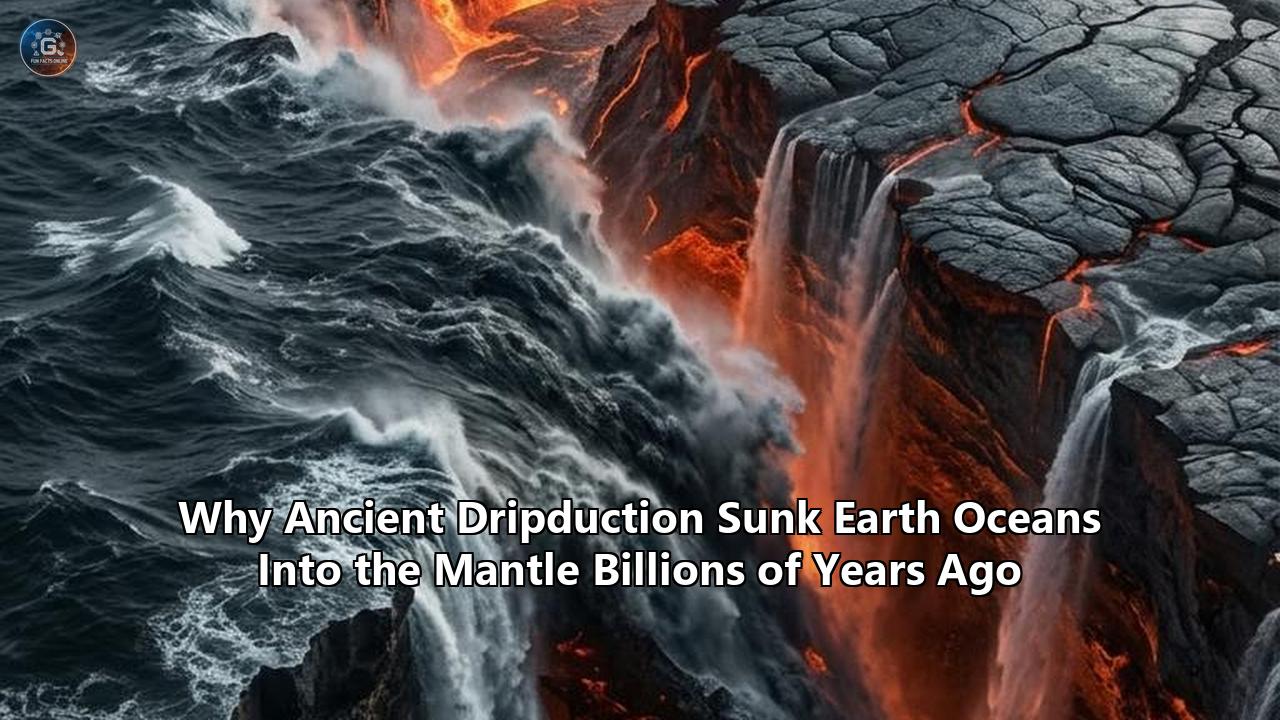
In the remote expanses of Western Australia’s Pilbara Craton, a team of geochemists has identified the chemical fingerprint of a planetary engine that operated more than three billion years ago. Geochemical analyses of volcanic rocks from the Whundo Group, published in Nature Communications, reveal that surface water was plunging dozens of kilometers into the interior of the young Earth. The study, led by Dr. Eric Vandenburg of the University of Adelaide, demonstrates that portions of the planet's primordial outer layer absorbed seawater and periodically collapsed into the glowing asthenosphere through a vertical process known as "dripduction."
The discovery solves an enduring contradiction in deep-time geology. Today, oceans are drawn into the interior at convergent plate boundaries, where cold, rigid slabs of oceanic lithosphere slide under lighter continental crust. Yet during the Mesoarchean Era—between 3.2 and 2.8 billion years ago—Earth was hundreds of degrees hotter than it is now. Under those thermal conditions, the stiff, self-sustaining tectonic plates required for modern subduction could not have existed.
By analyzing lavas erupted 3.13 to 3.10 billion years ago, Vandenburg and his colleagues discovered primitive volcanic suites—including boninites, which require vast amounts of volatile fluids to melt—that carry water concentrations nearly identical to lavas erupted across the modern Pacific Ring of Fire.
"These rocks formed more than three billion years ago, when Earth was a very different place," Vandenburg explained. "The early Earth was too hot for plates to behave that way, so until now it has been unclear whether surface water could have made that journey more than three billion years ago, and if so, how. What surprised us was finding evidence that large amounts of water had already made their way deep into the Earth's interior and influenced the formation of volcanic rocks."
The findings provide physical evidence that Earth possessed a mechanism to swallow its own surface seas long before the modern tectonic conveyor belt assembled. The work challenges reigning hypotheses about Archean geodynamics and reshapes how geoscientists model the volatile budgets, sea-level history, and atmospheric evolution of early terrestrial planets.
                     PRIMORDIAL HYDROSPHERE
                       ~~~~~~~~~~~~~~~~~
                       ~~~~~~~~~~~~~~~~~
                     ===================== (Cool, Hydrated Crust)
                             |   |
          Gravitational      |   |  Sagging of dense,
          Instability        \   /  water-saturated
                              \ /   mafic-ultramafic crust
                               V
                         (             )
                        (  DRIPDUCTION  )  Water stripped & fluxed
                         (    DRIP     )   into hotter mantle wedge
                        (               )
                             |   |
                             V   V
               =====================================
                    HOT MESOARCHEAN ASTHENOSPHERE
                 (High Mantle Potential Temperature)
               =====================================
                                 |
                                 V  Volatile-fluxed melting generates
                             /~~~~~~~\  calc-alkaline & boninite magmas
                            ( Magma   )
                             \ Chamber /
                                 |
                                 V
                      Volcanic Island Arc / Proto-crust
The Thermal Dilemma: Why Modern Slabs Failed on Early Earth
To understand why dripduction has forced a fundamental rethink of early geodynamics, one must examine the physical environment of the Mesoarchean planet. The mantle potential temperature during the Archean was between 1,500°C and 1,650°C—approximately 200°C to 250°C hotter than the modern convective mantle. This surplus heat was generated by the vigorous decay of short-lived radioactive isotopes such as uranium-235, potassium-40, and thorium-232, combined with residual heat left behind by planetary accretion and core segregation.
This intense internal thermal regime dictated the thickness, composition, and rheology of the early lithosphere. In the modern Earth, decompression melting beneath mid-ocean ridges yields an oceanic crust of remarkably uniform basaltic composition, approximately 6 to 7 kilometers thick. The underlying lithospheric mantle cools as it moves away from the ridge, forming a dense, rigid mechanical plate capable of sustaining negative buoyancy. Once this slab bends into a subduction zone, its dense downward mass generates "slab pull," the primary driving engine of modern plate tectonics.
On the young Earth, high mantle potential temperatures produced extensive melting regimes. Upwelling mantle underwent deep, high-degree fractional melting, creating a primary basaltic to komatiitic crust between 25 and 45 kilometers thick—quadruple the thickness of modern oceanic crust.
Paradoxically, a thicker crust did not yield a stronger plate. The extreme heat from below softened the crust's lower sections, while the complementary mantle residues left behind were hot, dehydrated, and buoyant. Numerical calculations indicate that the lithospheric yield stress on the hotter early Earth dropped below 100 megapascals (MPa), compared to modern values exceeding 200 to 500 MPa.
Under these conditions, a descending lithospheric slab could not maintain its structural cohesion. Whenever lateral compression pushed one slab beneath another, the hot, ductile environment caused the slab to tear, break apart, or delaminate at shallow depths.
Furthermore, flat or shallow subduction into an ultra-hot upper mantle would heat the hydrous minerals too rapidly. Rather than ferrying water to depths of 50 to 100 kilometers—where arc volcanoes are born—a shallowly subducted Archean crust would completely dehydrate within the upper 20 to 30 kilometers. Water vapor would boil immediately back up into the shallow ocean crust, severing the path connecting surface water to the deep interior.
For decades, this thermal constraint created a deep rift between petrologists, who saw volcanic rocks with clear subduction-like chemical water signatures, and geodynamicists, whose physical models proved that modern subduction slabs were mechanically impossible on an incandescent world.
Competing Geodynamic Frameworks: Three Paths for Archean Hydrology
Resolving how volatile elements moved through the young planet requires comparing three fundamentally distinct models of Archean tectonics. Each proposes a different physical mechanism for Earth's convective engine, and each yields starkly contrasting conclusions regarding how the interaction of the ancient earth oceans mantle system functioned billions of years ago.
1. The Uniformitarian Subduction Model
Championed by uniformitarian geoscientists, this model asserts that modern-style plate tectonics began nearly 4 billion years ago during the Hadean or early Eoarchean. Proponents point to arc-like trace element patterns—such as the depletion of high-field-strength elements (niobium, tantalum, and titanium) relative to fluid-mobile large-ion lithophile elements (rubidium, barium, and strontium)—found in some of the planet’s oldest greenstone belts, including the Isua belt in Greenland and the Nuvvuagittuq belt in Canada.
- The Mechanism: Rigid oceanic plates formed at divergent ridges, hydrated through hydrothermal interaction with seawater, and slid underneath adjacent plates along continuous, linear Benioff-style subduction zones.
- The Hydrological Claim: Water was carried deep into the mantle continuously and globally, cycling through a conveyor belt identical to the modern Pacific Ring of Fire.
- The Failure Point: Fluid-mechanical modeling shows that a hotter Archean lithosphere was far too weak and buoyant to support continuous, horizontal slab-pull without immediately necking, tearing, and detaching. The uniformitarian hypothesis demands a mechanical rigidity that rocks at Archean temperatures simply could not provide.
2. The Stagnant / Squishy-Lid Degassing Model
At the opposite theoretical pole sits the stagnant-lid or "heat-pipe" hypothesis, supported by researchers who argue that Earth initially operated like Io or Venus. In this framework, the planet was encased in a continuous outer lithospheric shell, broken only by catastrophic volcanic plumbing that rapidly channeled interior melt to the surface.
- The Mechanism: Heat was transported upward primarily via intense, localized mantle plumes. Thick basaltic volcanic plateaus piled up, while the underlying mantle remained largely insulated from surface exchange.
- The Hydrological Claim: The hydrological cycle was strictly one-directional. Volcanism degassed primary water from the interior to the exterior, building a massive surface sea—the Archean "water world"—with minimal return flux. Any crust sinking back down was subjected to shallow contact with ascending plume heads, stripping water before it reached the deeper mantle.
- The Failure Point: This model cannot explain the emergence of hydrous magmas with geochemical traits tied to deep, volatile-fluxed mantle melting. The discovery of boninites—magmas requiring simultaneous mantle depletion, shallow thermal conditions, and abundant water—disproves the concept of an isolated, dry interior that did not cycle water from the surface.
3. The Dripduction / Sagduction Model
The dripduction model bridges the petrological evidence of deep hydration with the physical realities of a hotter Earth. Instead of relying on horizontal plate momentum and rigid slab-pull, dripduction operates through vertical gravitational instabilities.
- The Mechanism: Massive volcanic outpourings accumulated thick piles of hydrated mafic and ultramafic lavas on the ocean floor. Hydrothermal circulation saturated the upper layers with seawater. As the crust grew thicker (exceeding 20 to 30 kilometers), its lower sections cooled the underlying ductile upper mantle, while metamorphic reactions at high pressures transformed the base of the crust into granulite and eclogite. Eclogite is exceptionally dense—significantly denser than the surrounding ambient peridotite mantle.
- The Hydrological Claim: Driven by this negative buoyancy, the heavy, water-logged crustal root detached and sagged vertically downward in a localized, finger-shaped drop. As these drips descended into the hot asthenosphere, their outer shells acted as thermal insulators. This allowed the core of the dripping crust to carry water tens of kilometers down into the mantle before releasing volatile fluids into the surrounding mantle wedge.
- The Critical Advantage: Dripduction operates without requiring horizontal plate rigidity or long-lived plate boundaries. It explains how water penetrated the deep Earth through episodic, self-terminating drips rather than continuous, global conveyor belts.
| Parameter | Modern Horizontal Subduction | Stagnant-Lid / Heat-Pipe Model | Archean Dripduction |
|---|---|---|---|
| Primary Driving Force | Negative slab buoyancy and lateral slab pull | Upward buoyancy of mantle plumes | Rayleigh-Taylor gravitational delamination |
| Lithospheric Requirement | High yield stress (>200 MPa), rigid plate cohesion | Continuous, rigid single-plate outer shell | Low yield stress (<100 MPa), ductile and deformable |
| Water Recycling Mode | Continuous, steady flux along narrow subduction trenches | Nearly zero deep return flux; one-way degassing | Episodic, localized down-wellings carrying hydrated roots |
| Magma Signatures Produced | Calc-alkaline, adakitic, and modern boninite suites | Anhydrous komatiites, ocean-island-type basalts (OIB) | Boninites, calc-alkaline basalts, and TTG granite precursors |
| Structural Expression | Linear volcanic arcs, deep trenches, paired metamorphic belts | Volcanic plateaus, shield volcanoes, circular hotspot trails | Dome-and-keel structures, circular granite-greenstone terrains |
Petrological Evidence: Unpacking the Whundo Rock Record
The evidentiary core of the dripduction case rests on pristine geochemical archives preserved within the Whundo Group of Western Australia. The Pilbara Craton is one of the few places on Earth where volcano-sedimentary sequences from the Mesoarchean remain virtually unaltered by subsequent continental collisions and high-grade regional metamorphism.
The research team analyzed three distinct volcanic series erupting in close temporal and stratigraphic succession within the Whundo Group: tholeiitic basalts, calc-alkaline basalts, and primitive boninites.
Among these suites, the primitive boninites served as the definitive indicator. In modern marine geology, boninites are extremely rare lavas found almost exclusively in forearc settings of newly initiating subduction zones, such as the Izu-Bonin-Mariana arc south of Japan. Their genesis requires unusual, conflicting conditions:
- An extremely depleted mantle peridotite source that has already melted once or twice, stripping out easily fusible basaltic components (such as garnet and clinopyroxene).
- High temperatures at shallow to moderate depths, which usually prevents melting in an already depleted, refractory rock.
- An abundant influx of water to sharply depress the mantle's solidus, triggering melting in a source that would otherwise remain completely solid.
The Whundo boninites represent Earth's oldest known extensive suite of these lavas. Petrographic and trace-element analyses demonstrated that their chemistry could not be explained by shallow crustal contamination—a common alternate theory used to explain subduction-like signatures in ancient rocks.
To quantify the water involved, the team employed thermodynamic forward modeling using phase-equilibrium calculations (temperature-composition or $T-X$ diagrams). To produce the calc-alkaline basalts at pressures of 1.50 gigapascals (GPa)—equivalent to a depth of roughly 45 to 50 kilometers—the mantle source must have contained between 0.16 and 1.98 weight percent (wt%) $\text{H}_2\text{O}$.
Even more demanding were the most primitive boninites. Generating these melts at 1.70 GPa from a clinopyroxene-poor spinel harzburgite residue required a minimum water flux of 0.68 to 1.42 wt% $\text{H}_2\text{O}$ added directly to the mantle source. Total mantle water contents for the boninite source reached 0.79 to 1.53 wt% $\text{H}_2\text{O}$.
These quantities align directly with water contents measured in the mantle wedges of modern island arcs, which typically range from 0.11 to 2.00 wt% $\text{H}_2\text{O}$. By contrast, the primitive, ambient Archean mantle held only about 0.01 to 0.11 wt% $\text{H}_2\text{O}$.
The Whundo rocks also displayed a distinct trace-element footprint known as the "ghost garnet" signature. The heavy rare earth element (HREE) distribution showed a concave-up profile. This signature proved that the refractory mantle source had undergone extensive prior melting within the deep garnet stability field along an ultra-hot mantle adiabat. That depleted peridotite then rose into the shallower spinel stability field, where it met descending, water-rich crustal drips. The water released from the sinking drips fluxed this depleted rock, sparking the eruptions preserved in the Pilbara strata.
                     P-T-X PHASE DIAGRAM (1.70 GPa)

   Temperature (°C)
          ^
   1,400  |                Dry Harzburgite Solidus
          |                       \
   1,300  |                        \    ANHYDROUS (NO MELT)
          |                         \
   1,200  |                          \
          |     FLUXED MELTING        \
   1,100  |        REGION              \
          |   (Whundo Boninite Origin)  \
   1,000  |                              \
          |    Wet Harzburgite Solidus    \
          +-------------------------------------------------->
         0.0        0.5        1.0        1.5        2.0
                            Water Content (wt% H2O)
The thermodynamic phase diagram demonstrates that at 1.70 GPa, dry depleted harzburgite cannot melt at temperatures below 1,350°C. The addition of 0.79 to 1.53 wt% $\text{H}_2\text{O}$ drops the solidus by hundreds of degrees, enabling the extensive flux-melting that generated the primitive Whundo boninites.
Mechanisms and Tradeoffs: Sinking Drips Versus Sliding Slabs
The mechanical differences between a modern subduction slab and an ancient lithospheric drip dictate how, when, and where water is released.
In modern subduction, an oceanic plate enters the trench as an elongated, planar sheet. The plate is relatively cold throughout its thickness, save for its interaction with seawater near the surface. Because the oceanic slab moves sideways at rates of centimeters per year, it carries a deep thermal anomaly with it. The slab warms gradually, allowing hydrous phases—such as serpentine, chlorite, and phengite—to break down sequentially as pressure rises, releasing fluids into the overlying wedge over millions of years.
Dripduction relies on a different physical process: the Rayleigh-Taylor instability. When a dense layer of rock rests atop a lighter, more ductile layer, any small variation in thickness triggers a runaway deformation. In the Archean crust, this process occurred within volcanic centers where mafic-ultramafic sequences accumulated to thicknesses of 30 kilometers or more.
The base of this crust converted to eclogite, a rock dense enough to sink. As the lower crust detached, it formed a downward-sinking cylinder or diaper-like drip.
This geometry creates distinct thermal and mechanical tradeoffs:
1. Thermal Shielding vs. Lateral Heating
Unlike a thin slab sliding horizontally, a sinking drip possesses a high volume-to-surface-area ratio. As the drip plunges vertically into the asthenosphere, its outer margins absorb the brunt of the surrounding 1,500°C heat. The margins shear and melt, but the interior core of the drip remains shielded and comparatively cold.
This thermal insulation enables the center of the drip to carry water-rich minerals past the shallow dehydration trap. By the time ambient heat penetrates the core of the drip, the rock has reached depths corresponding to 1.5 to 2.0 GPa (50 to 65 kilometers), releasing its trapped seawater directly into the mantle wedge.
2. Episodic Overturn vs. Continuous Belts
Modern subduction forms continuous, linear margins that operate steadily for tens to hundreds of millions of years. Dripduction is episodic and localized. A drip develops over several million years as crust thickens, reaches a critical mass, sinks into the mantle over a few million years, and then breaks away.
Once the dense root detaches, the remaining crust rebounds isostatically. This stops the local downward transport of water until subsequent volcanic eruptions build another over-thickened layer.
This pulsed behavior matches the geologic record of Archean cratons. Archean terrains are defined by "dome-and-keel" structures—elliptical domes of granitic batholiths encircled by synformal "keels" of greenstone volcanics—rather than the linear, parallel mountain chains produced by modern plate collisions.
3. Structural and Metamorphic Disconnects
A major challenge to proving ancient subduction has been the absence of high-pressure, low-temperature metamorphic rocks in terrains older than 2.5 billion years. Modern subduction generates paired metamorphic belts, specifically blueschists and lawsonite-bearing eclogites that form only where cold slabs dive deep without heating rapidly.
The complete absence of blueschists in Archean rocks matches the mechanics of dripduction. Because dripduction occurs within an ambient mantle that is 200°C hotter, descending drips are heated more aggressively than modern slabs, precluding the cold subduction geotherms necessary to preserve high-pressure, low-temperature metamorphic phases.
Hydrological Consequences: Regulating the Early Hydrosphere
The chemical exchange linking the ancient earth oceans mantle reservoirs fundamentally dictated the surface topography and climate of early Earth.
Estimates indicate that during the Hadean and early Archean, the planet’s surface oceans held significantly more water than they do today—potentially 1.5 to 4 times the volume of the modern hydrosphere. Because early Earth possessed little to no buoyant continental crust, and because its hotter oceanic crust was thicker and more buoyant, the planet was essentially a water world. Broad, uninterrupted global oceans covered the surface, with only scattered volcanic island chains piercing the waves.
ARCHEAN WATER WORLD (Prior to Dripduction)
-------------------------------------------------------------
Surface Water: 2.0 - 4.0 Modern Ocean Equivalents (MOE)
Continents:    Submerged proto-crust, volcanic island chains
Mantle:        Dry, highly depleted asthenosphere
Convection:    Plume-dominated, low deep recycling
-------------------------------------------------------------
                           |
                           V  Dripduction sinks hydrated crust
                              into the mantle transition zone
                           |
                           V
MESOARCHEAN TRANSITION (3.2 - 2.8 Ga)
-------------------------------------------------------------
Surface Water: Drops as mantle stores up to 2.0 wt% H2O
Continents:    TTG batholiths bloom; subaerial land emerges
Mantle:        Hydrated transition zone (wadsleyite/ringwoodite)
Convection:    Transition toward modern horizontal tectonics
-------------------------------------------------------------
Without an internal drain, this water-world state would have persisted indefinitely. Dripduction served as the initial mechanism that broke this impasse.
As sinking lithospheric drips transported bound seawater into the deep interior, they began charging the mantle transition zone—a vast reservoir spanning 410 to 660 kilometers depth, where minerals like wadsleyite and ringwoodite can store several ocean masses worth of water in their crystal lattices.
This deep drawdown accomplished two shifts:
1. Sea-Level Drawdown and Continental Emergence
By pulling water from the surface into the interior, dripduction helped draw down global ocean levels. Simultaneously, the water released by sinking drips drove widespread partial melting of the descending basaltic roots. Melting hydrated basalt at pressures above 1.5 GPa produces tonalite-trondhjemite-granodiorite (TTG) suites.
TTGs represent the silica-rich, low-density foundation of Earth’s first true continents. The combination of declining surface ocean volumes and the formation of buoyant TTG crust allowed landmasses to breach the sea surface for the first time in significant numbers.
2. Priming Modern Plate Tectonics
The transfer of water through the ancient earth oceans mantle pathway also softened the planet's interior. Incorporating trace hydrogen into nominally anhydrous mantle minerals weakens their crystal bonds, reducing rock viscosity by several orders of magnitude.
Hydrating the mantle lowered convective resistance, altered the strength of lithospheric shear zones, and created the lubricating conditions required for plates to slide laterally past and beneath one another. Dripduction was not an evolutionary dead end; it was the transitional engine that conditioned the planet's interior, making modern horizontal subduction mechanically possible.
Geobiological and Atmospheric Cascades
The discovery that water penetrated the mantle 3.1 billion years ago provides critical boundary conditions for the emergence of life and the evolution of the early atmosphere.
In a world covered entirely by ocean, biogeochemical cycles run slowly. Without subaerial landmasses exposed to rainfall, chemical weathering of silicate rocks—the planet's primary long-term carbon sink—is constrained.
Furthermore, the lack of land limits the delivery of bio-essential nutrients like phosphorus, molybdenum, and zinc to coastal ecosystems.
By driving the ascent of buoyant TTG batholiths and pulling ocean water into the mantle, dripduction created the first stable, subaerial continental platforms. The emergence of these proto-continents exposed volcanic and granitic surfaces to atmospheric weathering, sparking continental runoff that flushed minerals into shallow marine environments.
This input supported the expansive stromatolitic communities that spread across the Pilbara and southern Africa during the Mesoarchean, setting the stage for oxygenic photosynthesis.
Additionally, the magmatic styles produced by dripduction influenced atmospheric chemistry. Volcanism fueled by dry, plume-dominated basalt tends to erupt at deeper, submarine levels, where high hydrostatic pressures keep volatiles dissolved within cooling lavas.
By contrast, arc-like, water-rich volcanism triggered by dripduction generates explosive, subaerial eruptions. These eruptions injected gases—including sulfur dioxide, water vapor, carbon dioxide, and molecular nitrogen—directly into the troposphere, fundamentally altering the early atmosphere's oxidation state and greenhouse balance.
Solar System Analogs and Future Petrological Tests
Understanding dripduction on Earth offers a lens for evaluating the geologic histories of other rocky planets that never developed modern plate tectonics.
Venus, for example, shares Earth’s mass and bulk composition but lacks water-lubricated plate margins. Radar mapping reveals extensive circular structures termed coronae, flanked by sunken basins that lack the linear fault systems of Earth's trenches. Planetary geophysicists have long suggested that Venusian coronae represent surface scars left behind by localized lithospheric drips.
The primary difference lies in the volatile budget: Venus lost its surface water early in its history, leaving its crust dry, rigid, and resistant to deep hydration. On early Earth, the combination of a cool hydrosphere atop a scorching interior created an ideal environment for dripduction to thrive.
                     PLANETARY TECTONIC DIVERGENCE

       [Terrestrial Planet Accretion & Early Degassing]
                              |
              Does liquid surface water persist?
                     /                  \
                   YES                   NO
                   /                        \
      [Early Earth (Archean)]           [Venus / Mars]
       High Mantle Potential Temp        Stagnant-lid regime;
       + Surface Water Hydration         Thermal plume upwelling;
                 |                       Crowns, coronae & rifts;
                 V                       No deep water recycling.
        [DRIPDUCTION REGIME]
       Episodic vertical drips;
       Hydration of mantle wedge;
       Boninites, TTGs, & Arc lavas;
       Isostatic continental emergence;
       Hydration of transition zone.
                 |
        Mantle cools, plates stiffen
                 |
                 V
   [MODERN HORIZONTAL SUBDUCTION]
To establish whether dripduction operated as a global phenomenon or merely as an isolated anomaly in Western Australia, researchers are targeting equivalent Mesoarchean and Eoarchean terrains worldwide.
Teams are deploying high-precision analytical tools across three primary targets:
- The Barberton Greenstone Belt (Kaapvaal Craton, South Africa): Dating from 3.5 to 3.2 billion years ago, these rocks preserve some of the thickest sequences of komatiitic and calc-alkaline lavas on Earth. Geochemists are analyzing these rocks for high fluid-mobile-element ratios (e.g., boron, antimony, and arsenic) that would indicate early water influx.
- The Superior Craton (Canada): Spanning hundreds of kilometers of late Archean greenstone terrains, the Abitibi belt contains volcanic suites that record transitions from mafic oceanic floors to tonalitic intrusions. These sequences offer a window for tracking the shift from vertical dripduction to proto-subduction between 2.75 and 2.65 billion years ago.
- Stable Non-Traditional Isotopes: Beyond elemental ratios, geochemists are using stable isotope systems—including titanium ($\delta^{49}\text{Ti}$), iron ($\delta^{56}\text{Fe}$), and molybdenum ($\delta^{98}\text{Mo}$)—to track fluid mobility. Titanium isotopes, in particular, fractionate distinctly during the crystallization of hydrous, calc-alkaline magmatic series, providing an unambiguous record of water's presence that survives metamorphic overprinting.
The findings from the Whundo Group demonstrate that the cycling of volatile elements across the ancient earth oceans mantle boundary did not require the familiar apparatus of modern plate tectonics. Long before stable continents drifted across the globe, Earth operated a dynamic interior engine.
Through the vertical descent of dense, saturated crustal drips, the young planet pulled its primordial oceans down into the mantle, built its first stable continents, and ignited the volcanism that shaped the course of its evolution.
Reference:
- https://www.sciencedaily.com/releases/2026/09/260911214305.htm
- https://www.thebrighterside.news/post/water-seeping-into-earths-mantle-3-1-billion-years-ago-fueled-early-volcanic-activity-and-plate-tectonics/
- https://www.techexplorist.com/ancient-rocks-reveal-how-water-shaped-early-earth/103495/
- https://connectsci.au/news/news-parent/9705/How-water-helped-shape-young-Earth
- https://physicstoday.aip.org/features/water-in-earths-mantle
- https://scripps.ucsd.edu/news/new-study-helps-pinpoint-when-earths-plate-subduction-began
- http://geology.rutgers.edu/images/stories/faculty/herzberg_claude/Herzberg_Nature_Geoscience_2014.pdf
- http://science20.com/news_articles/archean_eon_and_drip_drip_drip_earths_crust_mantle-127008
- https://www.thebrighterside.news/post/water-seeping-into-earths-mantle-3-1-billion-years-ago-fueled-early-volcanic-activity-and-plate-tectonics/
- https://oceanrep.geomar.de/id/eprint/60692/1/gselements-20-4-253.pdf
- https://www.researchgate.net/figure/Two-stage-mantle-melting-subduction-enrichment-and-mixing-to-produce-primitive-Whundo_fig4_408540826
- https://tos.org/oceanography/article/past-and-future-impact-of-deep-drilling-in-the-oceanic-crust-and-mantle
- https://www.facebook.com/geologypage/posts/ancient-sunken-seafloor-reveals-earths-deep-secretssubduction-occurs-when-one-te/1315862597238629/
- https://www.researchgate.net/publication/346648686_Weaker_lithospheric_dripduction_into_Archean_TTG_crust_formation
- https://www.livescience.com/planet-earth/geology/earths-crust-may-be-building-mountains-by-dripping-into-the-mantle
- https://www.researchgate.net/figure/T-X-diagrams-demonstrate-that-the-Whundo-calc-alkaline-basalts-and-boninites-require-the_fig5_408540826
- https://www.earth.com/earth-science/ancient-rocks-reveal-earth-recycled-water-3-billion-years-ago/
- https://stamp.esci.umn.edu/research/subducting-oceans
- https://en.wikipedia.org/wiki/Lithospheric_drip
- https://www.researchgate.net/figure/T-X-diagrams-demonstrate-that-the-Whundo-calc-alkaline-basalts-and-boninites-require_fig3_408540826
- https://en.wikipedia.org/wiki/Deep_water_cycle
- https://essopenarchive.org/doi/10.1002/essoar.10505034