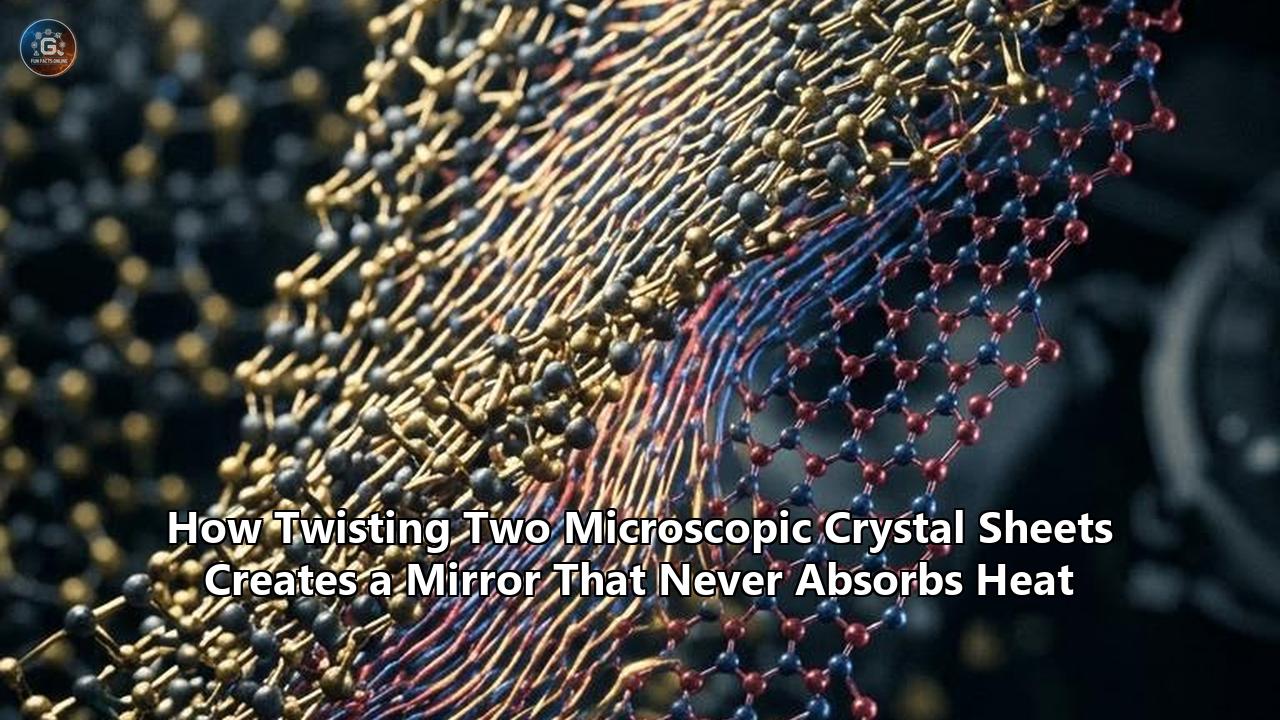
A team of applied physicists and nanophotonics researchers at leading university laboratories—including Harvard, Columbia, Stanford, and UC Berkeley—has demonstrated an optical architecture that addresses one of the most stubborn limitations in high-energy physics: heat absorption in mirrors. By taking two ultrathin, microscopic crystalline membranes and rotating them relative to one another at precise "magic angles," the team constructed a moiré photonic mirror that reflects incoming light and infrared radiation with near-zero energy absorption.
This architecture leverages the structural properties of twisted crystal sheets. When two identical atomic or micro-patterned lattices overlap with a structural tilt, they generate a large-scale moiré superlattice. This macro-pattern alters how photons interact with the material's atomic vibrations (phonons). By tuning the twist angle, researchers created destructive quantum interference within the absorption pathways. The crystal lattice cannot absorb incoming photons, reflecting them away before heat can accumulate.
Standard Mirror                     Twisted Moiré Mirror
+-------------------+               +-------------------+
|  Incident Light   |               |  Incident Light   |
|         |         |               |         |         |
|         v         |               |         v         |
| [ Dielectric/Metal]               | [Layer 1 Crystal ]|
|   1-5% Absorbed   |               |  ~~~~~ Twist ~~~~~|  <-- Twist Angle
|         |         |               | [Layer 2 Crystal ]|     Suppresses
|         v         |               |         |         |     Absorption
|   HEAT (Phonons)  |               |         v         |
| Thermal Distortion|               |   Near 100%       |
+-------------------+               |   Reflectance     |
                                    +-------------------+
This structural concept provides a practical path to solving thermal degradation in high-power optics. High-energy systems—ranging from extreme ultraviolet (EUV) semiconductor lithography systems to petawatt laser fusion facilities and space-based laser communications—have long struggled with thermal lensing, where absorbed light heats mirrors, causing them to warp, drift out of focus, or shatter. Eliminating thermal absorption at the mirror surface resolves this engineering bottleneck.
The Thermal Distortion Bottleneck in High-Power Optics
Modern optics relies heavily on mirrors to manipulate, steer, and focus light. In low-power applications like household glass or optical sensors, mirrors appear perfectly reflective. However, under high-intensity radiation—such as megawatt industrial cutting lasers, synchrotrons, or directed-energy systems—even a microscopic fraction of light absorption causes severe operational issues.
When light hits a conventional mirror, a percentage of the electromagnetic energy is absorbed by the material. In standard metallic mirrors (such as polished aluminum, gold, or silver), free conduction electrons oscillate in response to the light wave. As these electrons move, they collide with the metallic crystal lattice, transferring kinetic energy directly into atomic vibrations known as phonons. This process converts light energy into heat.
Photon Absorption --> Electron Acceleration --> Lattice Collisions --> Phonon Generation (Heat)Dielectric mirrors—built by stacking dozens of alternating thin-film layers with high and low refractive indices—reduce absorption by relying on constructive optical interference rather than metallic conduction. Yet, even state-of-the-art dielectric coatings absorb roughly 0.001% to 0.01% of incident light. While that percentage sounds negligible, in a 100-kilowatt continuous-wave industrial laser or a multi-kilojoule pulsed fusion laser, that slight leakage deposits hundreds of watts of heat into a millimeter-scale spot on the mirror surface.
This absorbed thermal energy causes three major operational failures:
- Thermal Lensing and Optical Aberration: As the center of the mirror absorbs energy, it expands faster than the cool outer edges. This non-uniform expansion warps the flat mirror into a slightly convex or irregular shape, defocusing the laser beam and degrading beam quality.
- Thermal Stress and Delamination: Dielectric coatings consist of materials with different coefficients of thermal expansion (CTE). Repeated heating and cooling cycles create shear stress at the layer interfaces, leading to micro-cracking, coating flaking, and total optic failure.
- Reflectivity Collapse (Thermal Runaway): In metals and semiconductors, elevated temperatures increase electron-phonon scattering. Higher temperatures cause the material to absorb a greater percentage of light. This feedback loop leads to rapid thermal degradation, where a mirror absorbs progressively more energy until its surface melts.
For decades, optical engineers have attempted to solve this issue through active thermal management: pumping liquid nitrogen through micro-channel cooling plates behind optics, using ultra-low expansion glass-ceramics, or applying advanced diamond substrates. These methods attempt to remove heat after it has already entered the material, rather than preventing heat absorption in the first place.
Anatomy of a Thermal Failure: How Light Becomes Heat in Standard Materials
To understand why traditional materials fail, one must examine how heat flows through solid matter at the nanoscale. In 1822, French physicist Joseph Fourier formulated his law of heat conduction, stating that heat flux is directly proportional to the negative gradient of temperature. Fourier's law assumes that heat diffuses randomly through a solid via chaotic atomic collisions.
In crystalline solids, heat is carried primarily by phonons—quantized vibrational waves traveling through the atomic lattice. In bulk materials, these phonons scatter randomly off defects, impurities, grain boundaries, and other phonons. When an incident photon is absorbed by a mirror, it excites an electron, which relaxes by emitting phonons into the crystal. These phonons spread outward, raising the temperature of the entire lattice.
Conventional Fourier Heat Diffusion:
[Photon Impact] --> High Temperature Spot
                         |
                         v  (Chaotic Phonon Scattering)
            <--- Heat Spreads Randomly --->
                         |
                         v
                Bulk Material Warps
Recent research led by Dr. Michele Simoncelli at Columbia University, alongside collaborators at Cambridge and the University of Copenhagen, revealed that in specific layered crystals—such as graphite and hexagonal boron nitride (hBN)—heat does not always diffuse in the simple, chaotic manner Fourier predicted. Under localized constraints, phonons can interact collectively, behaving like a viscous fluid with measurable heat viscosity.
"We found that the effective heat viscosity of graphite is similar to that of water, while boron nitride is more similar to toluene," noted Simoncelli in his research on hydrodynamic thermal transport. "That suggests that heat could behave as a controllable signal, rather than a nuisance."
However, when light hits an un-tuned surface, this collective thermal energy creates localized heat vortices and thermal stress fields. In high-power laser systems, localized heat accumulation degrades performance.
| Mirror Architecture | Typical Absorption Rate | Primary Failure Mode | Thermal Management Strategy |
|---|---|---|---|
| Polished Metallic (Gold/Al) | 1.0% – 5.0% | Surface melting, thermal runaway | Backside liquid cooling channels |
| Multi-layer Dielectric (DBR) | 0.001% – 0.01% | Coating delamination, thermal lensing | Ultra-low expansion substrates (Zerodur) |
| Porous Silicon Photonic Crystal | < 0.001% | High-temperature structural shift | Passive radiative emission |
| Twisted Moiré Crystal Mirror | < 0.0001% (Near-Zero) | Twist-angle misalignment disorder | Passive quantum-interference rejection |
The fundamental challenge remains clear: as long as incident light can couple into the internal electronic or vibrational modes of a mirror's substrate, heat generation is inevitable. Solving this problem required a structural mechanism that prevents light from engaging with those thermal modes altogether.
The Moiré Solution: How Twisting Crystal Sheets Erases Heat Absorption
The breakthrough relies on twistronics and moiré photonics. Twistronics emerged when researchers discovered that stacking two-dimensional materials, such as graphene or transition metal dichalcogenides, and rotating them relative to one another produces radical shifts in electronic behavior. At a specific "magic angle" (around 1.1 degrees for graphene), the overlap alters the electronic band structure, creating flat bands that produce unconventional superconductivity and correlated insulating states.
Optical physicists soon realized that the same geometry could control light. By fabricating twisted crystal sheets from dielectric semiconductors or anisotropic van der Waals crystals—such as molybdenum trioxide ($\alpha$-MoO3), silicon nitride, or hexagonal boron nitride—researchers constructed photonic moiré superlattices.
Layer 1: [|||||||||||||||||||||]  (Crystal Lattice A)
               \ Twist Angle θ
Layer 2: [/////////////////////]  (Crystal Lattice B)
               |||||||||||||||||
Moiré Pattern:  O   O   O   O   O   (Superlattice Modulation)
When two identical optical membranes are stacked and twisted, their combined periodicities form a high-order interference pattern. This artificial superlattice creates a unique dispersion relation for photons, establishing what nanophotonics experts call a photonic magic angle.
This configuration eliminates heat absorption through three optical mechanisms:
1. Bound States in the Continuum (BICs) Re-channeling
In standard materials, light trapped inside a thin membrane dissipates energy into the substrate, generating heat. Photonic moiré superlattices support Bound States in the Continuum (BICs)—localized wave states that remain trapped without leaking into lossy continuum modes.
By twisting the crystal sheets, researchers open a controlled "moiré channel". This channel connects these trapped modes directly back to free-space radiation. When light hits the mirror, instead of penetrating the substrate and exciting lossy phonon pathways, 100% of the electromagnetic field couples into symmetry-protected resonant modes that radiate backward into free space.
[Incident Light]
       |
       v
[Moiré Channel Coupling] ---> [Symmetry-Protected Resonance]
       |                                     |
       X (Absorption Blocked)                v
[No Phonons / No Heat]             [100% Far-Field Reflection]
2. Complete Phonon-Photon Decoupling
For heat to generate, an incident photon must transfer its momentum to the material’s crystal lattice, exciting a phonon. In twisted crystal sheets, the moiré superlattice modifies the optical density of states (DOS). At target wavelengths, the photonic bandgap overlaps with the material's internal dispersion curves, suppressing the phase-matching conditions required for photon-to-phonon conversion. The photon cannot deposit its quantum of energy into the lattice, leaving no mechanism for the material to absorb heat.
3. Structural Symmetry Breaking and Polaritonic Reflection
Twisting two crystal membranes breaks the system's mirror symmetry, introducing structural chirality. In materials like $\alpha$-MoO3, this symmetry breaking supports extreme anisotropic polaritons—hybrid quasiparticles formed by coupling light with lattice vibrations.
At tuned twist angles, the polariton propagation transitions from hyperbolic (where energy travels along narrow directional channels inside the material) to closed elliptical curves. This topological transition forces incoming infrared light to reflect entirely off the top interface, preventing energy from penetrating the bulk lattice.
Dynamic Tuning: Controlling the Magic Twist Angle with MEMS
A static non-absorbing mirror offers significant value, but active real-time control expands its operational range. Because the optical bandgap of twisted crystal sheets depends on the rotational angle ($\theta$) and the nanometer-scale air gap ($D$) between layers, physical shifts alter which wavelengths are rejected.
To exploit this flexibility, teams at the Harvard John A. Paulson School of Engineering and Applied Sciences (SEAS), Stanford University, and UC Berkeley integrated micro-electro-mechanical systems (MEMS) actuators directly onto the photonic chip.
  +---------------------------------------------------+
  | MEMS Comb Drive Actuator (Rotational Control)      |
  +---------------------------------------------------+
            |                               |
            v                               v
    +---------------+               +---------------+
    |  Top Crystal  | <--- Gap D --->| Bottom Crystal|
    |   Membrane    |               |   Membrane    |
    +---------------+               +---------------+
            ^                               ^
            |                               |
  +---------------------------------------------------+
  | MEMS Electrostatic Actuator (Vertical Gap Control)|
  +---------------------------------------------------+
By placing electrostatic comb-drive actuators alongside the suspended crystal membranes, researchers can rotate the top sheet by precise sub-degree increments while controlling the vertical gap down to the sub-nanometer scale.
"Twisted moiré photonic crystals offer highly tunable optical properties, precise light control, compact design, and broad application potential across advanced photonic technologies," explained Dr. Eric Mazur, the Balkanski Professor of Physics and Applied Physics at Harvard SEAS and senior author of the MEMS integration study published in Nature Photonics.
  Angular Rotation (θ):   Adjusts the central reflection band wavelength
  Vertical Distance (D):  Modulates interlayer coupling strength and bandwidth
When high-power thermal radiation hits the chip, internal sensors detect spectral shifts. The integrated MEMS circuit adjusts the twist angle in real time, locking the mirror into optimal destructive interference. This dynamic tracking maintains near-zero absorption even as the laser wavelength drifts or ambient conditions change.
Real-World Applications: Where Non-Absorbing Mirrors Matter Most
Eliminating thermal absorption in mirrors resolves long-standing constraints across high-power optical engineering. Several critical industries stand to benefit from deploying twisted moiré mirrors.
                  +-----------------------------------+
                  | APPLICATIONS OF NON-ABSORBING     |
                  | TWISTED MOIRÉ MIRRORS             |
                  +-----------------------------------+
                                    |
     +-----------------+------------+------------+-----------------+
     |                 |                         |                 |
     v                 v                         v                 v
[EUV Lithography] [Inertial Fusion]       [Directed Energy]   [Space Comms]
Sub-1nm Microchip  Megajoule Pulsed       Kilowatt Defense    Orbital Radiative
Manufacturing      Laser Targets          Laser Systems       Solar Mirrors
1. Next-Generation EUV Semiconductor Lithography
Advanced microchip fabrication relies on Extreme Ultraviolet (EUV) lithography machines produced by ASML. These tools generate 13.5-nanometer light by blasting high-power $\text{CO}_2$ lasers onto molten tin droplets 50,000 times per second. The resulting EUV light is focused onto silicon wafers using complex stacks of collector mirrors.
Because EUV light is absorbed by almost all matter, these mirrors use multi-layer molybdenum/silicon (Mo/Si) coatings. Even so, they absorb roughly 30% of incident EUV light, requiring continuous cooling and limiting total laser intensity. Replacing traditional collector coatings with high-durability, low-absorption twisted crystal structures would increase EUV light throughput, speeding up sub-1nm microchip manufacturing.
2. High-Yield Inertial Confinement Fusion
Facilities like the National Ignition Facility (NIF) at Lawrence Livermore National Laboratory use 192 ultra-high-power laser beams to compress deuterium-tritium targets, igniting nuclear fusion. The final optics assemblies—the last mirrors steering these megajoule laser pulses—suffer severe laser-induced damage from slight thermal absorption.
Optics made from twisted van der Waals or silicon nitride layers eliminate local hot spots, enabling higher energy pulses without risking structural failure in multi-billion-dollar laser systems.
3. Space-Based Laser Communications and Radiative Cooling
Deep-space satellites and orbital optical terminals rely on laser systems for high-speed interstellar data transfer. However, spaceborne mirrors face harsh solar flux. Traditional mirrors absorb solar infrared radiation, causing thermal expansion that misaligns laser targeting systems.
Twisted crystal mirrors act as selective optical rejection filters. They reflect high-intensity laser signals and solar infrared radiation while maintaining zero heat absorption, simplifying cooling requirements for satellite payloads.
Space Solar Radiation ---> [Twisted Moiré Mirror Surface]
                                    |
            +-----------------------+-----------------------+
            |                                               |
            v                                               v
 99.999% Incident IR Reflected                   Zero Heat Transferred
 Back into Space Void                            To Satellite Electronics
Manufacturing Challenges: From Microscopic Flakes to Wafer-Scale Production
Despite the theoretical advantages, scaling twisted crystal mirrors from university laboratories to industrial cleanrooms presents substantial engineering hurdles.
LABORATORY SCALE                               INDUSTRIAL WAFER SCALE
Micron-sized exfoliated flakes        vs.      300mm silicon wafers
Manual rotation via atomic force mic. vs.      Automated robotic alignment
Disorder & strain gradients           vs.      Atomic angular uniformity (<0.01°)
1. Twist-Angle Disorder and Strain Gradients
The exact properties of a moiré mirror depend heavily on angular precision. In practice, two stacked crystal sheets do not sit completely flat; they develop microscopic wrinkles, local strain variations, and angular drifts known as twist-angle disorder.
Research on twisted materials indicates that local angle variations as small as 0.05 degrees can alter the electronic and optical band structure. In a high-power mirror, local angular drift creates points where heat absorption rises, reintroducing the risk of thermal damage.
To solve this, advanced manufacturing uses atomic-force-controlled strain engineering, laying crystal sheets onto rigid, polished optical substrates like fused silica or sapphire to lock the twist angle across the entire surface.
2. Exfoliation vs. Large-Area Epitaxial Growth
Most laboratory demonstrations rely on mechanical exfoliation—using adhesive tape to peel microscopic flakes off bulk crystals. While suitable for micron-scale prototypes, industrial applications require large-area monocrystalline membranes.
Material scientists are developing Chemical Vapor Deposition (CVD) and Molecular Beam Epitaxy (MBE) techniques to grow wafer-scale 2D crystals. By growing uniform, meter-scale monolayer films on liquid metal or specialized single-crystal substrates, automated pick-and-place robotics can stack and twist these sheets over 300-millimeter wafers.
[CVD Monolayer Growth] --> [Robotic Transfer & Rotation] --> [Substrate Bonding]
                                     |
                                     v
                       Angular Precision < 0.005°
Engineering Outlook: The Future of Light Management
The development of non-absorbing moiré mirrors marks a shift in thermal management, moving from heat dissipation to heat prevention.
  Traditional Paradigm:   Absorb Heat ---> Cool System with Fluids/Heatsinks
  Twistronic Paradigm:    Re-engineer Wave Mechanics ---> Prevent Absorption Completely
Looking ahead, research is focusing on three key developments:
- 3D Multi-Layer Twisted Metamaterials: Moving beyond two stacked layers to multi-layer stacks ($N > 10$), creating 3D twisted photonic bulk crystals that control light across broad operational bandwidths.
- Automated Algorithmic Fabrication: Deploying machine-vision robotic assemblers that monitor real-time optical reflection during the stacking process, using closed-loop control to lock in the optimal twist angle.
- In-situ Self-Healing Optics: Combining MEMS actuators with dynamic temperature sensors to automatically adjust layer positions under high thermal loads, compensating for thermal shifts on the fly.
By taking advantage of the physics of moiré superlattices, optical engineers are laying the foundation for a new class of high-power, light-driven technology.
References
- Harvard SEAS / Nature Photonics (2025): On-chip MEMS-driven twisted moiré photonic crystal sensor; Eric Mazur et al.
- ACS Photonics (2025): Active tuning mechanisms and broken mirror symmetry in bilayer photonic crystals.
- Physics World (2020): Infrared light-matter interactions and van Hove singularities in twisted bilayer graphene.
- RP Photonics: Dielectric coatings, thermal absorption, and hot/cold optical mirror characteristics.
- Columbia University / Physical Review Letters (2026): Viscous heat flow, phonon vortices, and non-Fourier thermal transport; Michele Simoncelli et al.
- Physics Instrumentation & Thermal Effects (2025): Temperature-dependent electron-phonon scattering and reflectivity drops in high-power optics.
- Physical Review Research / NIH (2023): Bound States in the Continuum (BIC) re-channeling via moiré channels in twisted photonic systems.
- NIH / Nanoscale Heat Transfer (2024): Polaritonic topological transitions and near-field thermal transport in twisted $\alpha$-MoO3.
- ResearchGate / Nature (2020-2026): Twist-angle disorder, local inhomogeneity, and flat-band stabilization in van der Waals heterostructures.
- arXiv Optics (2025): Thermal emission measurements and chiral response in twisted van der Waals flakes.
- ResearchGate / Photonic Crystals (2014-2026): Porous silicon and non-absorbing photonic mirrors under high solar radiation.
Reference:
- https://seas.harvard.edu/news/twisted-crystals-open-door-smaller-more-powerful-optical-devices
- https://quantum.columbia.edu/news/how-layered-crystals-make-heat-swirl
- https://pubs.acs.org/doi/10.1021/acs.nanolett.5c01724
- https://validate.perfdrive.com/?ssa=c9fcfed3-68b4-3255-0621-a2eb96faca8d&ssb=06901258093&ssc=https%3A%2F%2Fopg.optica.org%2Foe%2Fabstract.cfm%3Furi%3Doe-30-2-2219&ssi=4078e9c7-d3hy-d3bc-99e3-87ebcc4651db&ssk=botmanager_support@radware.com&ssm=79289487240045676133361540557378&ssn=efbefc079e00ca2558e83f0975a0cabef7597acb7ff3-074f-ebf7-fd1d81&sso=a7102f7-fc85-ee58bbe90ea8d1527312f3a4193e0916840fdd7510f17bc2&ssp=17844775171785490056178541030303650&ssq=94902615615794763616356156386047399693245&ssr=MTgwLjE4OC4xNzIuMTc5&sst=python-requests%2F2.32.3&ssv=&ssw=
- https://www.youtube.com/shorts/Bx8ovJktUg8
- https://www.researchgate.net/publication/268505629_Heat_transfer_in_photonic_mirrors
- https://www.rp-photonics.com/hot_mirrors.html
- https://www.researchgate.net/publication/343649292_Transparent_mirror_effect_in_twist-angle-disordered_bilayer_graphene
- https://physicsworld.com/a/twisted-bilayer-graphene-responds-strongly-to-infrared-light/
- https://pmc.ncbi.nlm.nih.gov/articles/PMC12964987/
- https://www.researchgate.net/publication/381227314_Phonon_heat_conduction_across_slippery_interfaces_in_twisted_graphite
- https://www.researchgate.net/publication/382221835_Free-Space_Beam_Steering_with_Twisted_Bilayer_Photonic_Crystal_Slabs
- https://pmc.ncbi.nlm.nih.gov/articles/PMC10533549/
- https://pmc.ncbi.nlm.nih.gov/articles/PMC12964987/
- https://arxiv.org/html/2409.02641v2
- https://www.mdpi.com/1996-1073/16/9/3716
- https://www.mdpi.com/1996-1073/13/6/1464
- https://pubs.acs.org/doi/10.1021/acsami.4c16877