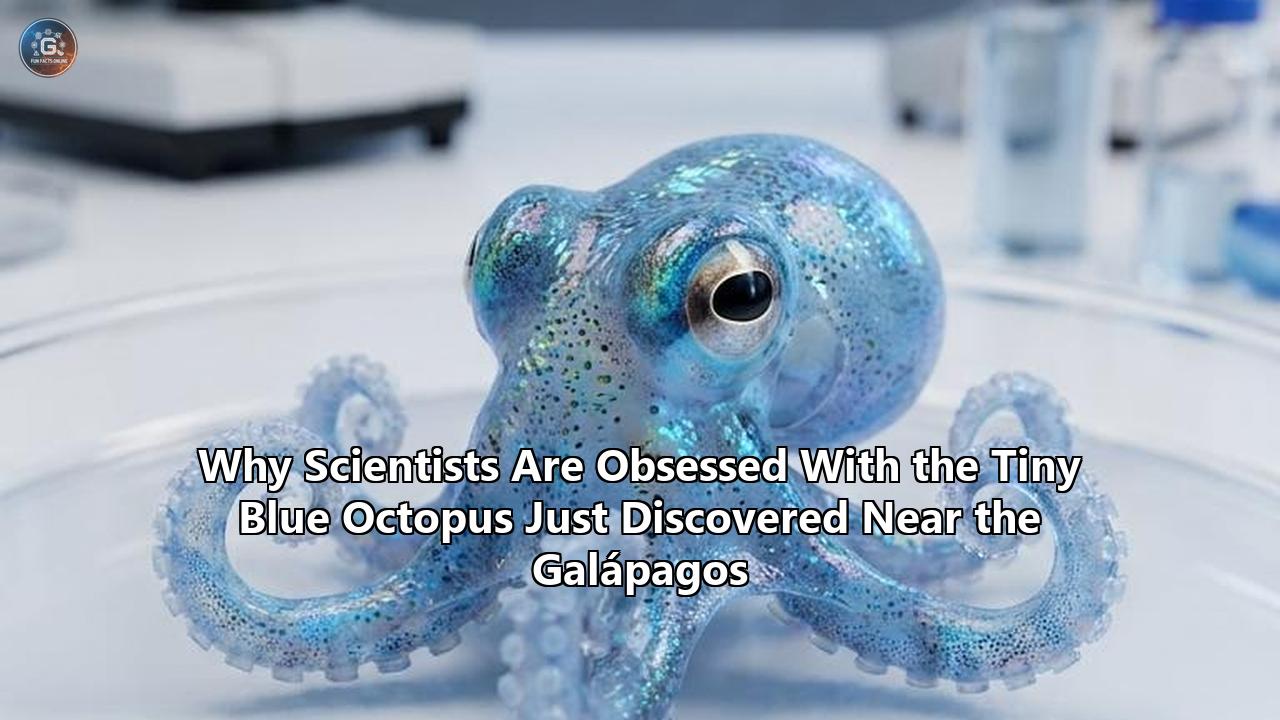
In the perpetual midnight of the deep ocean, nearly 6,000 feet below the surface, sunlight is a distant memory, the water temperature hovers just above freezing, and the pressure is intense enough to crush human bone. Yet, when a remotely operated vehicle (ROV) glided along the basalt slopes of an underwater mountain near the northernmost tip of the Galápagos archipelago, its powerful halogen headlights illuminated something completely unexpected.
Staring back from a patch of deep-sea sand was a tiny, vibrant blue blob.
As the camera zoomed in, the scientific team aboard the exploration vessel E/V Nautilus erupted into collective delight. In recorded audio from the dive, voices crackle with excitement: "He's tiny!" and "It's blue!" The creature, roughly the size of a golf ball and small enough to curl up in the palm of a hand, was an octopus. But it was unlike any species known to science. It moved across the seafloor with its short, stubby arms curled upward, looking almost like a boxer raising their fists.
The formal description of this extraordinary creature—named ---Microeledone galapagensis---—was published in the taxonomic journal Zootaxa. Behind this announcement is an decade-long scientific detective story that reveals how deep-sea biology is conducted. For scientists, the frenzy surrounding the blue octopus Galapagos is not merely about its aesthetic charm. Instead, they are captivated by what this single, golf-ball-sized specimen reveals about evolution, survival in food-scarce environments, and the hidden connections between the tropical Pacific and the icy waters of Antarctica.
+------------------------------------------------------------+
|             MICROELEDONE GALAPAGENSIS AT A GLANCE           |
+------------------------------------------------------------+
| Common Name:        Galápagos Blue Octopus                 |
| Scientific Name:    Microeledone galapagensis              |
| Depth Found:        1,773 to 2,006 meters (approx. 5,800-  |
|                     6,600 feet)                            |
| Size:               ~6 cm total length (golf-ball sized)   |
| Unique Features:    - Striking light-blue dorsal color     |
|                     - Dark-purple inner web/mantle         |
|                     - Lack of ink sac and crop diverticulum|
|                     - Uniserial (single-row) arm suckers   |
|                     - Modified, grooved central tooth      |
+------------------------------------------------------------+
From the Abyssal Seamounts to the Laboratory Bench
The path to identifying Microeledone galapagensis began in 2015. The E/V Nautilus, a state-of-the-art 64-meter research vessel operated by the Ocean Exploration Trust, was conducting a 10-day deep-sea expedition within the Galápagos Marine Reserve. The cruise was a collaborative effort involving the Charles Darwin Foundation (CDF) and the Galápagos National Park Directorate, aimed at exploring unmapped underwater seamounts near Darwin and Wolf Islands.
These seamounts—underwater mountains formed by volcanic activity over the Galápagos mantle hotspot—never break the ocean surface. They represent biological oases in the deep sea, creating rapid upwellings of nutrients that support rich, fragile communities of crystal sponges, cold-water corals, and unique marine invertebrates.
To explore these extreme environments, the Nautilus utilizes a dual-ROV system. First is Argus, a heavy, towed system connected directly to the ship's steel tether. Argus acts as a massive shock absorber, dampening the rolling motion of the surface swells so that the second, highly maneuverable ROV, Hercules, can operate with extreme precision below.
At a depth of 1,773 meters (5,817 feet) on a sediment-covered seamount northwest of Darwin Island, Hercules piloted its high-definition cameras over basalt rock outcroppings. When the cameras picked up the blue octopus Galapagos, the ROV’s hydraulic manipulator arm was deployed. Using a gentle suction sampler, the scientific party successfully collected the specimen. During the same expedition, researchers filmed two other individuals of the same species, confirming that this was not a lone wanderer but part of a resident population living on these deep sandy substrates.
Upon returning to the surface, the specimen was brought to the Charles Darwin Research Station on Santa Cruz Island. It was preserved in a mixture of formalin and alcohol to halt cellular decay. However, as the research team sorted through dozens of deep-sea invertebrates collected during the cruise, the little blue octopus defied every categorization attempt.
"When we were sorting through dozens of specimens collected during the expedition, this tiny blue octopus stood out," says Salome Buglass, a marine scientist at the University of California, Los Angeles, former researcher at the Charles Darwin Foundation, and co-author of the Zootaxa paper. Seeking answers, the team sent high-resolution photographs to Dr. Janet Voight, curator emerita of invertebrates at the Field Museum of Natural History in Chicago and a preeminent global authority on octopus evolution.
Voight recalls the moment she opened the email: "Right away, I knew it was something really special. I’d never seen anything like it." The preserved body was carefully packaged and shipped to Chicago, starting a meticulous, multi-year analysis that would rewrite textbook definitions of deep-sea cephalopods.
The Biological Profile of a Deep-Sea Miniature
In the public imagination, octopuses are characterized by long, flowing arms lined with double rows of powerful suckers, an acute ability to change colors to match their surroundings, and a quick-escape mechanism powered by a thick cloud of dark ink. Microeledone galapagensis possesses almost none of these features.
The Evolution of the Uniserial Sucker
Most shallow-water octopuses (belonging to the family Octopodidae) feature two rows of suckers on each arm—a configuration known as "biserial." In contrast, M. galapagensis has short, stubby arms equipped with only a single row of suckers, or "uniserial" suckers.
This physical trait immediately placed the specimen within a more specialized lineage of deep-sea octopuses. When an octopus relies on a single row of suckers, its arms are less muscular and far more delicate. In the deep sea, where muscular mass is metabolically expensive to maintain, having fewer, larger suckers laid out in a single line is an evolutionary adaptation that prioritizes structural simplicity over sheer gripping strength.
       UNISERIAL SUCKERS (Deep-Sea)             BISERIAL SUCKERS (Shallow-Water)
             [O] [O] [O] [O]                       [O][O] [O][O] [O][O] [O][O]
             ===============                       ===========================
             Single, centralized row              Double, alternating rows
             Found in Megaleledonidae             Common in shallow-water families
             Lower energy cost                    High grip strength, muscular
The Missing Ink Sac and Anal Flaps
An ink sac is an indispensable defense mechanism for an animal living in the sunlit zone. When confronted by a predatory fish or marine mammal, a shallow-water octopus discharges a mixture of melanin and mucus, creating a dark, confusing decoy while the animal jets away to safety.
In the absolute darkness of the benthic zone 5,800 feet down, an ink cloud is biologically useless. Predators do not hunt primarily by ambient sight, and spending precious metabolic energy synthesizing melanin would be an evolutionary dead end. Consequently, M. galapagensis completely lacks an ink sac, alongside other organs typical of shallow-water ancestors, such as anal flaps and a crop diverticulum (a pocket off the esophagus used to store food during periods of excess eating).
The absence of these structures tells a clear evolutionary story: this species has undergone radical physical simplification to adapt to the highly stable, low-energy, and food-poor conditions of the deep seafloor.
A Highly Specialized Mouth and Radula
To understand how a species feeds, biologists must inspect its radula—a chitinous ribbon of tiny, replaceable teeth used to scrape, tear, and puncture prey. Inside the mouth of M. galapagensis is a large, modified central tooth called the rachidian tooth.
In this species, the rachidian tooth is enlarged, sickle-shaped, and curved with a finely grooved tip. This unique structure is a defining trait of the genus Microeledone, distinguishing it from closely related groups such as Thaumeledone. Biologists hypothesize that this specialized tooth acts as a precise cutting tool, allowing the tiny octopus to puncture the hard, calcified shells of small deep-sea crustaceans or the protective sheaths of polychaete worms that dwell in the benthic sediment.
The Mystery of the Coloration: "Reverse Countershading"
Among all the physical characteristics of Microeledone galapagensis, its color pattern has sparked the most intense curiosity. In nature, blue is famously the rarest color. While blue is frequently seen in shallow ocean waters (in the form of blue-ringed octopuses or Portuguese man-of-war jellyfish), finding a vibrant, pale cerulean blue at 1,773 meters depth is highly unusual.
                     BIOLOGICAL LIGHT-SHIELDING STRATEGY

                    [ Pale Blue/Pigment-Free Back ]
                     =============================
                                \     /  <-- Ambient bioluminescent glow
                                 \   /      blends with pale dorsal skin
                                  \ /
                                 [O-O]  <-- Octopus eyes
                                / | | \
                               /  | |  \
                              /   |_|   \  <-- Dark purple inner web drapes
                             /  [GLOW]   \     completely over glowing prey,
                            /  /      \   \    smothering the light from
                           [=============]     external predators.
                          [ Deep Purple Web ]
On its dorsal side (its back), the octopus’s skin is remarkably smooth and almost completely devoid of normal chromatophores (color-changing pigment cells), giving it a light-blue, near-translucent appearance. However, on its ventral side—specifically the underside of its arms, its inner mantle, and the interior webbing between its tentacles—the tissue is a dense, heavily pigmented, very deep purple.
This pigmentation layout is known as reverse countershading.
To appreciate why this is highly unusual, it helps to look at standard countershading. Animals like great white sharks, penguins, and pelagic fish are dark on their backs and pale on their bellies. When a predator looks down at a shark from above, its dark back blends in with the dark depths of the ocean below. When looking up from below, its pale belly blends in with the bright, sunlit surface waters.
In the deep sea, M. galapagensis flips this script. Its upper surface is light-colored and pale, while its underside is heavily dark. Janet Voight and her co-authors have proposed a compelling theory: this reverse countershading acts as a "bioluminescence cloak," serving as an active stealth shield during feeding.
The Bioluminescence Cloak Hypothesis
Many organisms living in the deep sea have evolved the ability to bioluminesce. When a deep-sea shrimp, crab, or marine worm is grabbed by a predator, it does not go quietly. Instead, it often unleashes a brilliant flash of blue or green chemical light. This is known as an "alarm-signal" or "burglar alarm" display.
The purpose of this sudden light show is not to scare the attacker directly, but to illuminate them. By lighting up its captor, the prey broadcasts the attacker's location to even larger predators in the vicinity, effectively saying: "Here is an easy meal. Come eat the animal that is eating me."
For a tiny, golf-ball-sized octopus like M. galapagensis, capturing a glowing prey item is a highly dangerous moment. If a larger fish or a deep-sea shark detects the bioluminescent flashing through the octopus's arms, the octopus itself will quickly be consumed.
To mitigate this risk, the octopus utilizes its deep purple inner web. When it pounces on a prey item, it immediately pulls its arms inward and drapes its dark, heavily pigmented web over the struggling victim. The dense purple tissue acts as a thick blackout curtain, completely smothering and absorbing any light emitted by the bioluminescent prey.
At the same time, its pale, pigment-free back helps it blend seamlessly into the ambient low-frequency light or bioluminescent water column of the deep benthic layer, keeping it hidden from any predators searching for silhouettes from above. This remarkable division of labor between its dorsal and ventral surfaces turns this diminutive cephalopod into a highly efficient, stealthy hunter of the abyss.
Upending Taxonomy: Why this Discovery Rewrites Marine Biology Textbooks
To a general audience, discovering a new animal is exciting because it adds to the catalog of earth's biodiversity. To evolutionary biologists and taxonomists, however, Microeledone galapagensis is a scientific earthquake because it completely upends the established definitions of its taxonomic family, the Megaleledonidae.
The Southern Ocean Monopoly is Broken
The family Megaleledonidae was first established in 1961 by the Japanese malacologist Iw. Taki, based on massive octopuses collected from the freezing, remote waters of the Southern Ocean surrounding Antarctica. For decades, the consensus in marine biology was clear: the Megaleledonidae was a family of large-bodied, heavy-set octopuses endemic to the Southern Ocean and sub-Antarctic waters.
They were viewed as evolutionary products of the Antarctic Circumpolar Current—a cold-water barrier that isolated Antarctic marine life, forcing unique biological adaptations over millions of years.
       ANTARCTIC ORIGINS (Old Consensus)           EQUATORIAL DEEP (New Reality)
       - Sub-Antarctic & Southern Ocean            - Deep Eastern Tropical Pacific
       - Large-bodied, heavy taxa                 - Small-bodied pygmy taxa
       - Cold-water endemics                       - Volcanic tropical seamounts
The discovery of the blue octopus Galapagos near Darwin Island—located virtually directly on the Earth’s equator—shattered this long-held biogeographical rule. Here was a true member of the Megaleledonidae family, yet it was:
- Extremely small-bodied (the "runt" of the family, measuring only 6 cm total length), and
- Living in the tropical Pacific, thousands of miles away from the Southern Ocean.
This unexpected geographical placement has forced scientists to completely revise the formal diagnosis of the Megaleledonidae family in scientific literature. It proves that this lineage of uniserial-suckered octopuses is far more ancient, adaptable, and geographically widespread than previously assumed.
It suggests that millions of years ago, ancestral megaleledonid octopuses migrated out of the Antarctic deeps, riding cold, deep-sea oceanic currents northward into the deep valleys of the Pacific. As they reached the steep, volcanic seamounts of the Galápagos, they adapted, shrunk in size, and successfully colonized a brand-new tropical deep-sea niche.
The Role of Heterochrony: Evolutionary Time-Shifting
The paper published in Zootaxa highlights an evolutionary process known as heterochrony to explain how M. galapagensis developed its unique body plan. Heterochrony refers to a developmental shift in the timing and rate of an organism's growth compared to its ancestors.
                         HETEROCHRONY EVOLUTIONARY PATH

    Ancestral Megaleledonid                    Microeledone galapagensis
    (Antarctic Deep Sea)                       (Tropical Pacific Deep Sea)
  +-------------------------+                +-------------------------+
  | - Large, heavy body     |  Evolutionary  | - Golf-ball sized body  |
  | - Long, muscular arms   |   Transition   | - Stubby, short arms    |
  | - Hundreds of suckers   | -------------> | - Fewer than 31 suckers |
  | - High metabolic cost   | (Heterochrony) | - Retains juvenile form |
  | - Antarctic endemic     |                | - Ultra-efficient metabolism
  +-------------------------+                +-------------------------+
In deep-sea environments, food is incredibly scarce. Benthic animals rely heavily on "marine snow"—a slow, continuous drift of organic debris, dead plankton, and fecal matter sinking from the productive upper ocean. In such an energy-depleted desert, growing a massive body and long, muscular arms lined with hundreds of suckers is a high-risk strategy.
Through heterochrony, the ancestors of M. galapagensis underwent a developmental slowdown, essentially "freezing" their physical growth in a juvenile state while allowing their reproductive organs to mature. This is why the adult female collected near the Galápagos is so small, possessing short arms and fewer than 31 suckers per arm.
By retaining this compact, juvenile-like body plan into adulthood, the octopus dramatically reduces its overall metabolic demand. The energy saved from not having to build or maintain large muscles is redirected into egg production. This metabolic trade-off ensures that the species can reproduce successfully, even when finding food is an infrequent luxury on the barren seamount slopes.
Non-Destructive Taxonomy: The Technology of the Virtual Dissection
The discovery of M. galapagensis is also a celebration of modern imaging technology. Historically, identifying and describing a new marine species was a highly destructive process.
To formally describe a new species of octopus, a researcher must analyze its internal anatomy. They must inspect the shape of the brain, the path of the digestive tract, the presence of various salivary glands, and the highly complex structures of the mouth, beak, and radular teeth. Traditionally, this meant taking a scalpel to the specimen, carefully slicing it open, and peeling back its tissues—an action that permanently alters and partially destroys the physical specimen.
This presents a massive dilemma for rare deep-sea specimens. Because deep-sea exploration is incredibly expensive and difficult, scientists often retrieve only a single, precious specimen of a new species. This single specimen becomes the holotype—the physical standard that represents the species for all of human history, housed securely in a museum collection.
"We only had the one specimen, so I didn't want to take it apart," Dr. Janet Voight explained. Slicing open the only known physical example of M. galapagensis felt like a scientific tragedy.
                     HOW MICRO-CT IMAGING WORKS

     [ X-Ray Source ] ---------> [ Octopus Specimen ] ---------> [ Detector ]
                                    (Rotates 360°)
                                          |
                                          v
                              Compiles thousands of
                              2D X-Ray slices
                                          |
                                          v
                             [ 3D Virtual Reconstruction ]
                             - Non-destructive dissection
                             - Visualizes internal organs
                             - Maps delicate mouthparts & teeth
To resolve this issue, Voight collaborated with Dr. Stephanie M. Smith, manager of the Field Museum’s X-ray Computerized Tomography (CT) laboratory.
Using high-resolution micro-computed tomography (micro-CT), Smith was able to perform a complete, highly detailed virtual dissection of the blue octopus Galapagos. The micro-CT scanner operates by passing a series of highly focused X-ray beams through the specimen as it slowly rotates 360 degrees. The detector captures thousands of individual, paper-thin 2D X-ray slices.
Using powerful computing algorithms, these thousands of slices are digitally compiled into a fully interactive, highly detailed 3D voxel model of the octopus, inside and out.
"Because CT imaging is non-destructive, it's especially important for type specimens like this one," Dr. Smith explained. "And that's great for me because people are often bringing me these incredibly rare and stunningly beautiful specimens that I get the privilege of virtually opening up. There's nothing like spending the day looking at something no other human has ever seen."
The virtual reconstruction allowed Voight and her colleagues to peer deep inside the tiny body of M. galapagensis without ever touching a scalpel.
On their computer screens, the researchers could rotate, slice, and isolate specific organ systems. They mapped out its bipartite stomach, analyzed the size of its posterior salivary glands (which are medium-sized, roughly 70% of the length of the buccal mass), and confirmed the precise arrangement of eggs still nestled inside the female’s body cavity.
Most importantly, they were able to zoom in on the microscopic mouthparts to confirm the presence of the sickle-shaped, grooved central rachidian tooth. This non-invasive technological approach preserved the physical holotype of M. galapagensis in pristine condition, ensuring that future generations of scientists can study the exact physical specimen with even more advanced technologies.
Janet Voight’s 40-Year Scientific Milestone
Behind the formal scientific naming of any creature is the human story of the scientists who dedicate their lives to understanding them. For Dr. Janet Voight, Microeledone galapagensis represents a profound professional milestone.
                     DR. JANET VOIGHT'S TAXONOMIC MILESTONE
  =============================================================================
  - Career Span:          More than 40 years studying cephalopod evolution
  - Research Focus:       Systematics, distribution, and evolutionary morphology
                          of deep-sea octopods
  - Institution:          Field Museum of Natural History, Chicago
  - Current Milestone:    First time officially leading the taxonomic
                          description of a new octopus species
  =============================================================================
Voight has spent over four decades studying the evolutionary history, biogeography, and morphological structures of deep-sea octopuses. She has authored numerous papers on how deep-sea octopuses adapt to shifting ocean depths, how their sucker configurations evolve, and how they survive on remote underwater ridges.
Yet, throughout her illustrious career, M. galapagensis is the very first new species of octopus that she has officially led a team of scientists in describing.
"These are little octopuses that live in the deep sea, and hardly anybody on Earth has ever gotten to see them," Voight reflected. "I just feel lucky that I got to work with them. If you took all the land on Earth and pieced it together, you would not cover the Pacific Ocean. The oceans are so big, and there's so much left to explore."
The fact that a researcher with forty years of specialized experience had never officially led a species description highlights the extreme rarity and isolation of these animals. Finding a new deep-sea cephalopod is not as simple as walking into a forest and turning over a log; it requires millions of dollars in maritime technology, international research collaborations, advanced robotic engineering, and decades of scientific patience.
The Galápagos: A Deep-Sea Frontier
While the Galápagos Islands off the coast of Ecuador are world-famous for their land-based evolutionary wonders—such as the giant tortoises, land iguanas, and Darwin's finches—scientists are increasingly realizing that the archipelago’s most dramatic evolutionary dramas are playing out thousands of feet below the waves.
                THE DEEP-SEA ECOSYSTEMS OF THE GALÁPAGOS
+-----------------------------+----------------------------------------------+
| Habitat Zone                | Biological Characteristics                   |
+-----------------------------+----------------------------------------------+
| Hydrothermal Vents          | Sustained by chemosynthesizing bacteria      |
| (Galápagos Rift)            | converting hydrogen sulfide into energy.     |
+-----------------------------+----------------------------------------------+
| Seamounts                   | Volcanic, steep slopes acting as deep-sea    |
| (Darwin & Wolf Islands)     | coral forests, sponge gardens, and nurseries.|
+-----------------------------+----------------------------------------------+
| Benthic Sandy Plains        | Home to deposit-feeders and miniature        |
| (1,700 - 2,000 meters)      | species like Microeledone galapagensis.      |
+-----------------------------+----------------------------------------------+
The Legacy of Chemosynthesis
The Galápagos has a sacred place in the history of deep-sea science. In 1977, researchers diving in the research submersible Alvin along the Galápagos Rift made a discovery that forever changed biology. They uncovered active hydrothermal vents—cracks in the ocean floor where superheated, mineral-rich water spews directly from the Earth’s mantle.
Surrounding these vents were lush, thriving ecosystems of giant tube worms, blind crabs, and specialized clams. For the first time in human history, scientists discovered a biological food web that was entirely independent of sunlight.
Instead of photosynthesis, the primary producers in these ecosystems were chemosynthesizing bacteria, which converted toxic hydrogen sulfide and other chemicals pouring out of the vents into usable organic energy.
This discovery shattered the scientific assumption that all life on Earth was ultimately powered by the sun. It opened the door to the realization that the deep ocean was not a dead, barren wasteland, but a highly dynamic biological matrix capable of generating entirely unique evolutionary pathways.
Seamounts: The Islands of the Deep
Just as the Galápagos Islands act as isolated oceanic islands on the surface, seamounts act as ecological islands on the deep seafloor. These steep volcanic structures disrupt ocean currents, creating local upwellings of nutrient-rich water.
As currents flow around a seamount, they accelerate, sweeping away fine sediment and leaving behind hard, exposed basalt rock. This hard rock provides the perfect anchor point for sessile (non-moving) organisms like bamboo corals, glass sponges, and cold-water corals.
These organic structures quickly grow into complex, three-dimensional vertical reefs. Just like a rainforest canopy or a shallow coral reef, these deep-sea coral forests provide shelter, hiding places, and hunting grounds for an array of mobile creatures.
It is on the sandy flatlands nestled between these volcanic seamounts that Microeledone galapagensis spends its life. The seamount communities near Darwin Island, where the blue octopus Galapagos was found, represent pristine, unimpacted habitats that have remained virtually untouched by human industrial activity.
Protecting these deep-sea ecosystems within the Galápagos Marine Reserve is not just about preserving the charismatic species we can see from a boat, but safeguarding the ancient, slow-growing, and highly vulnerable communities that exist in the deep, freezing darkness.
What Lies Ahead: Unresolved Questions in the Abyss
While the formal description of Microeledone galapagensis is an important victory for marine taxonomy, it raises far more questions than it answers. Deep-sea biology is currently entering a transition phase, moving from simply cataloging "what" lives in the deep ocean to actively trying to understand "how" they live, reproduce, and interact.
                     REMAINING MYSTERIES TO SOLVE

    [ REPRODUCTION ]  Where do they lay their eggs? Do they form massive
                      communal nurseries like their relatives in Costa Rica?

    [ DIET & HUNT ]   What are their primary prey species? Does their grooved
                      tooth help them slice open specialized deep-sea worms?

    [ LIFE CYCLE ]    How long do they live? Many deep-sea octopuses brood
                      their eggs for several years before hatching.

    [ DISTRIBUTION ]  Are they restricted to the Galápagos seamounts, or do they
                      range across the entire Eastern Tropical Pacific?
Communal Deep-Sea Nurseries?
One of the most exciting areas of modern cephalopod research is the discovery of massive deep-sea octopus nurseries. In 2013, researchers first discovered an "Octopus Garden" on a small, soccer-field-sized rock outcrop called the Dorado Outcrop off the coast of Costa Rica.
Subsequent expeditions in 2023 by the Schmidt Ocean Institute aboard the research vessel Falkor (too) confirmed that this site was an active nursery, where hundreds of female octopuses (belonging to the genus Muusoctopus) gathered together to brood their eggs.
Normally, octopuses are solitary, highly territorial animals. Finding hundreds of them huddled together was a shocking sight.
Scientists discovered that these octopuses were gathering around low-temperature, warm-water hydrothermal springs on the seafloor. In the freezing, near-freezing deep sea, developmental processes are incredibly slow. An octopus mother might have to brood and protect her eggs for up to four or five years, during which she does not eat and slowly starves to death.
By brooding their eggs around these warm-water springs, the heat accelerates the development of the embryos. This reduces the brooding time from years to perhaps just months, dramatically increasing the survival rate of both the mothers and their offspring.
Do Microeledone galapagensis follow a similar strategy? Do they gather around yet-to-be-discovered low-temperature thermal vents on the Galápagos spreading centers to brood their eggs?
As Roxanne Beinart and other lead scientists continue to launch research expeditions to explore the Western Galápagos Spreading Center, answering these questions is a top priority.
The Threat of Human Industrialization
The discovery of the blue octopus Galapagos also highlights the urgent need to expand ocean conservation efforts before we destroy ecosystems we don't even fully understand yet.
The deep seafloor is increasingly being targeted by mining corporations looking to extract valuable mineral deposits, such as polymetallic nodules, cobalt-rich crusts, and seafloor massive sulfides. These mineral deposits, which take millions of years to form, are rich in copper, nickel, manganese, and rare earth elements crucial for manufacturing green energy technologies like electric car batteries and wind turbines.
However, the very seamounts and hydrothermal vents targeted for deep-sea mining are the precise habitats that support rare, slow-growing species like M. galapagensis.
Because seamount organisms grow exceptionally slowly, they are incredibly vulnerable to physical disturbance. A single deep-sea mining operation could wipe out an entire seamount community in a matter of days, destroying fragile sponge gardens, coral colonies, and specialized cephalopod populations that would take thousands of years to recover.
"Every new species helps us better understand these hidden ecosystems and why protecting them matters," Buglass noted. The description of this tiny blue octopus is a powerful, visual reminder that the deep sea is not a silent, empty void, but a highly complex, beautifully adapted world that is actively worth conserving.
As oceanographic technology continues to advance, researchers will undoubtedly discover more wonders in the abyssal depths of the Pacific. But for now, scientists remain utterly obsessed with Microeledone galapagensis—the little blue, golf-ball-sized explorer that successfully conquered the deep tropical sea.
Reference:
- https://www.discoverwildlife.com/animal-facts/marine-animals/microeledone-galapagensis-blue-octopus-discovery
- https://www.sciencedaily.com/releases/2026/05/260525000446.htm
- https://www.cbsnews.com/news/blue-octopus-discovered-galapagos-islands/
- https://www.nationalgeographic.com/animals/article/microeledone-galapagensis-little-blue-octopus
- https://www.popsci.com/environment/blue-galapagos-octopus/
- https://www.zmescience.com/science/tiny-blue-galapagos-octopus/
- https://www.fieldmuseum.org/about/press/this-newly-discovered-blue-octopus-from-the-galapagos-islands-could-curl-up
- https://www.galapagos.org/newsroom/30-new-species-of-marine-invertebrates-discovered-in-galapagos/
- https://nautiluslive.org/cruise/na062
- https://www.sbnature.org/publications/blog/2/posts/54/science-pub-exploring-the-deep-sea-aboard-the-e-v-nautilus
- https://en.wikipedia.org/wiki/Microeledone_galapagensis
- https://oceanographicmagazine.com/news/new-tiny-octopus-species-discovered-in-galapagos-deep-sea/
- https://www.sci.news/biology/microeledone-galapagensis-14792.html
- https://www.sciencealert.com/tiny-blue-octopus-unlike-any-we-know-of-discovered-near-the-galapagos
- https://en.wikipedia.org/wiki/Microeledone_mangoldi
- https://www.researchgate.net/figure/Microeledone-mangoldi-n-gen-and-n-sp-a-f-photographs-of-holotype-and-radula-18-mm_fig2_263021092
- http://novataxa.blogspot.com/2026/05/microeledone.html
- https://www.nationalgeographic.com/animals/article/microeledone-galapagensis-little-blue-octopus
- https://www.nationalgeographic.com/animals/article/microeledone-galapagensis-little-blue-octopus
- https://www.marinespecies.org/rams/aphia.php?p=taxdetails&id=834050
- https://www.fieldmuseum.org/blog/cephalopods-here-there-and-everywhere
- https://www.researchgate.net/publication/237009490_Evolution_of_development_type_in_benthic_octopuses_Holobenthic_or_pelago-benthic_ancestor
- https://mapress.com/zt/article/view/zootaxa.5814.4.5
- https://www.sci.news/biology/microeledone-galapagensis-14792.html
- https://www.bangkokpost.com/world/3260503/hes-tiny-its-blue-scientists-find-new-deepsea-octopus
- https://mapress.com/zt/article/view/zootaxa.5814.4.5
- https://schmidtocean.org/cruises/schmidt-ocean-institute-2023-expeditions/
- https://nautiluslive.org/expeditions/2015
- https://schmidtocean.org/scientists-discover-four-new-species-of-deep-sea-octopus/
- https://ecomagazine.com/news/research/scientists-discover-four-new-species-of-deep-sea-octopus/
- https://www.mdpi.com/2077-1312/14/3/311