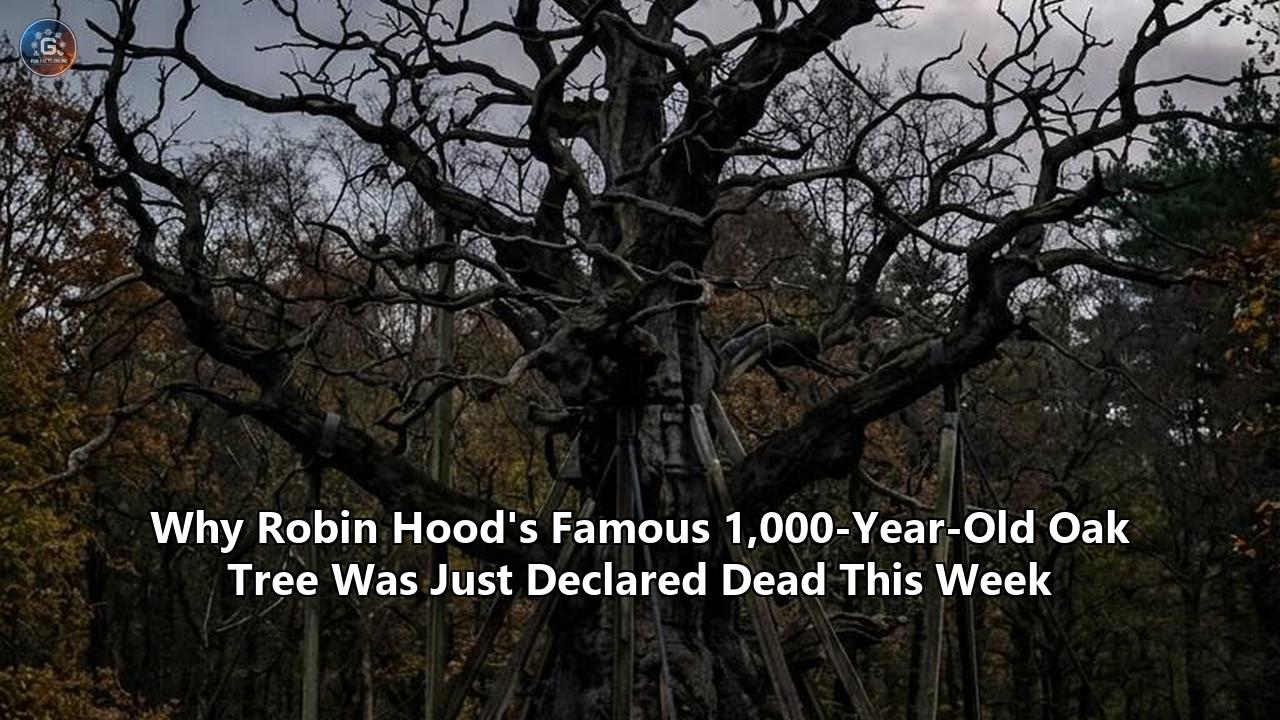
The quiet heart of Nottinghamshire has grown slightly stiller. In June 2026, the Royal Society for the Protection of Birds (RSPB), which manages the Sherwood Forest National Nature Reserve, officially confirmed what local arborists and historians had feared through a dry, barren spring: the Major Oak—the legendary, 1,200-year-old tree widely celebrated as the shelter of Robin Hood—has died.
For several years, the ancient giant had shown signs of progressive, painful decline. But when May turned to June and the tree’s massive, gnarled limbs failed to produce a single green leaf, the biological reality became undeniable. The vascular system of one of Europe's oldest and most famous living organisms had finally shut down.
The announcement triggered an outpouring of grief from conservationists, historians, and the public alike. Robert Brackley, an outdoor educator who has spent years portraying the legendary outlaw for visiting school children, arrived at the site in his traditional woodland furs to hold an informal, impromptu funeral beneath its skeletal boughs.
"The stories it has given us is the legacy," Brackley said as he stood before the silent giant. "It's the most famous tree in the world. The legend always lives on."
Yet, behind the romantic folklore of Robin Hood, Friar Tuck, and the Sheriff of Nottingham lies a sobering scientific post-mortem. The death of the Robin Hood oak tree was not merely a consequence of extreme old age. Instead, a complex array of factors—ranging from the unintended consequences of Victorian-era engineering to the physics of underground soil compaction, historical coal mining, and the escalating pressures of modern climate change—coalesced to starve and strangle the tree's root system.
To fully comprehend why this millennium-old monument perished, one must look beneath the forest floor, tracing the delicate biological feedback loops that sustain ancient trees and examining how humanity’s well-intentioned attempts to "save" the oak ultimately hastened its demise.
The Girth of an Outlaw: A Thousand Years of Growth
To understand the biological significance of the Robin Hood oak tree, one must first understand its immense scale and historical context. Belonging to the species Quercus robur—commonly known as the English oak or pedunculate oak—the Major Oak was a biological marvel. At its peak, the tree weighed an estimated 23 long tons, boasted a staggering trunk circumference of over 11 meters (33 feet), and possessed a sprawling canopy that spread 28 meters (92 feet) across the Sherwood sky.
+-------------------------------------------------------------+
|                     THE MAJOR OAK AT A GLANCE               |
+-------------------------------------------------------------+
| Species:             English Oak (Quercus robur)            |
| Estimated Age:       1,000 to 1,200 years old               |
| Total Weight:        23 Long Tons                           |
| Trunk Girth:         11 Meters (33 Feet)                    |
| Canopy Spread:       28 Meters (92 Feet)                    |
| Custodian:           Royal Society for the Protection of    |
|                      Birds (RSPB)                           |
+-------------------------------------------------------------+
Historically, the tree was not always associated with the legendary bandit. For centuries, locals knew it as the "Cockpen Tree," a name derived from the sport of cockfighting that took place within the natural, hollow bowl of its massive trunk during the 18th century. It was renamed in honor of Major Hayman Rooke, an antiquarian and soldier who published a detailed description of the tree in his 1790 book, Description or Sketches of Remarkable Oakes in Welbeck Park. Rooke wrote of the tree:
"I think no one can behold this majestic ruin without pronouncing it to be of very remote antiquity; and might venture to say, that it cannot be much less than a thousand years old."
Rooke’s writing ignited a wave of early tourism. Victorian travelers, fascinated by the romanticized medieval past, began flocking to Sherwood Forest. It was during this era that the tree became inextricably linked to the legend of Robin Hood.
According to local folklore, the hollow interior of the massive oak served as a base of operations and a hiding place for the outlaw and his Merry Men as they evaded the Sheriff of Nottingham.
Historically, this is anachronistic. The historical or folkloric Robin Hood is traditionally placed in the 12th or 13th century. At that time, the Major Oak would have been a relatively young, mid-sized tree—perhaps only a few hundred years old—and its trunk would have been entirely solid, lacking the hollow cavity that could accommodate a grown man, let alone an entire band of outlaws. It was only as the oak entered its late maturity and ancient phases, several centuries later, that heart-rot fungi naturally hollowed out its center.
Yet, the tree’s geographical placement within Sherwood Forest made it a potent symbol. Sherwood was once a vast royal hunting forest—a Silva Regis—subject to strict forest laws designed to protect the king’s deer ("venison") and the trees that sheltered them ("vert").
Over the centuries, millions of Sherwood oaks were felled to construct the ships of the Royal Navy—including those commanded by Vice Admiral Horatio Nelson—and to provide the massive structural timbers for the roof of St. Paul’s Cathedral in London.
The Major Oak escaped the woodsman's axe for a very specific reason: its highly irregular, gnarled, and twisted shape. To shipbuilders, a straight, tall trunk was highly prized for masts and planks; a sprawling, hollow crown was virtually useless. The very biological quirks that made the tree unsuitable for human industry are what allowed it to survive into the 21st century.
The Biomechanics of Retrenchment: The Hidden Science of "Growing Down"
To understand why the Robin Hood oak tree died, we must first examine the unique biomechanics of how ancient trees age. In forestry and arboriculture, there is a fundamental distinction between a "mature" tree and an "ancient" tree.
An ancient tree is one that has passed beyond maturity and entered a phase of negative morphogenesis—a process known to arborists as "crown retrenchment," or more poetically, "growing down."
An old forester’s proverb holds that a great oak takes 300 years to grow, 300 years to stay, and 300 years to die. During the "dying" phase, which can last for centuries, the tree undergoes a natural rebalancing act.
As an oak tree's root system naturally decays and its inner heartwood hollows out due to fungal colonization, the tree can no longer support the massive hydraulic demands of a towering, expansive canopy. The physical forces required to pump water from the soil, up through the trunk, and out to the tips of branches dozens of meters in the air become unsustainable.
          [ YOUNG / MATURE OAK ]                 [ ANCIENT OAK (RETRENCHED) ]

                / \   / \                                     _.._
               /   \_/   \                                  /      \  <- Secondary,
              |           |                                |  ( )   |    lower canopy
              |     |     |                                 \  ||  /
              |     |     |                                   ||
              |     |     |                                 _`||`_    <- "Stag-headed"
             /             \                               /  ||  \      dead branches
            /               \                             |   ||   |     extending above
           /       ROOTS     \                            |  ROOTS |  <- Severely compacted,
          /  Extensive, deep  \                           \ Shrunk /     restricted roots
To survive, the tree actively initiates crown retrenchment. The tips of the highest branches begin to die back, leaving bare, antler-like wooden spikes protruding above the green canopy—a phenomenon known as "stag-headedness."
Simultaneously, the tree sprouts a secondary, smaller, and much denser canopy lower down, closer to the main trunk and root system. In a natural forest setting, the heavy, dying upper limbs eventually break off in winter storms or gently lower themselves to the forest floor, sometimes taking root themselves and acting as structural buttresses.
By shedding its outer limbs and shrinking its overall volume, the ancient tree drastically reduces its hydraulic workload and its wind resistance, allowing it to survive for several more centuries on a fraction of the water and nutrients it once required.
However, the Major Oak was not allowed to undergo this natural retrenchment process. Because of its immense cultural fame, humans intervened to preserve its iconic, sprawling shape.
Starting in 1904, well-intentioned caretakers began installing metal chains, iron collars, and heavy wooden props to support the tree’s massive, sagging limbs, preventing them from lowering to the ground or breaking off. In the 1960s, these interventions grew even more heavy-handed: the hollow interior of the tree was filled with tons of concrete, and the limbs were clad in lead sheets, fiberglass, and treated with fire-retardant paint.
+-----------------------------------------------------------------------------+
|                   CHRONOLOGY OF HUMAN INTERVENTIONS                         |
+-----------------------------------------------------------------------------+
|  1790:  Named "Major Oak" after Major Hayman Rooke's publication.            |
|  1904:  First installation of metal chains and wooden props.                |
|  1960s: Hollow trunk filled with concrete; limbs clad in lead & fiberglass.  |
|  1970s: Protective fencing installed to restrict direct tourist footfall.   |
|  2018:  RSPB commissions non-invasive root radar survey.                     |
|  2022:  SoilBioLab conducts excavation, finding severe root starvation.     |
|  2025:  Paul-Tech installs real-time soil telemetry station.                |
|  2026:  Tree officially declared dead after failing to produce leaves.       |
+-----------------------------------------------------------------------------+
While these measures successfully preserved the picturesque "Robin Hood" silhouette for millions of tourist photographs, they proved ecologically catastrophic.
By physically propping up the heavy limbs, the scaffolding artificially prevented the tree from shedding those branches. It forced the oak’s struggling vascular system to continue pumping water and nutrients up to the distant, propped-up canopy, wasting its severely limited metabolic energy.
Rather than allowing the tree to gracefully "grow down" and consolidate its resources within a compact, sustainable form, humans forced the Major Oak to maintain a massive, artificial structural footprint that its decaying roots simply could no longer support.
The Strangled Rhizosphere: How Soil Compaction Starved the Roots
While the above-ground canopy was being forced to maintain an unsustainable size, an even more severe crisis was unfolding silently beneath the soil. The ultimate driver of the Major Oak's death was the physical collapse of its rhizosphere—the narrow zone of soil directly influenced by root secretions and associated microorganisms.
           [ UNCOMPACTED SOIL ]                     [ COMPACTED SOIL ]

         (Loose, Aerated, Alive)               (Dense, Suffocated, Sterile)

          O2  H2O   Mycorrhizae                  No O2   H2O Pools   No Fungi
          ↓    ↓       \                           |       |           /
        +-----------------------+                =========================  <- Hard as
        |   .  ·  *  .  ·  *    |                |                       |     concrete
        | *   o   O   o   *   · |                |  === SOLID BLOCK ===  |
        |   ·  *  .  ·  *  .    |                |                       |
        +-----------------------+                +-----------------------+

        • High macropore volume                  • Low pore volume (Anoxia)
        • Active root respiration                 • Restricted water infiltration
        • Rich symbiotic network                  • Strangled, sterile root system
The soil of Sherwood Forest is predominantly sandy, a remnant of the Triassic Bunter Pebble Beds that underlie the region. This sandy soil is naturally free-draining and highly acidic, creating a delicate ecosystem where ancient oaks must work hard to capture moisture and nutrients. Under normal conditions, healthy soil is a porous matrix, composed of roughly 50% solid matter and 50% pore space filled with water and air. These "macropores" are vital; they allow oxygen to reach the roots for respiration and provide channels for rainwater to infiltrate deep into the earth.
For more than two centuries, however, the Major Oak was subjected to unrelenting human foot traffic. Prior to the installation of a protective wooden fence in the mid-1970s, up to 350,000 visitors per year walked directly up to the tree, climbed its low branches, and packed the ground around its base. During World War II, the forest even served as a military camp, subjecting the soil to heavy tank and troop movements.
This continuous mechanical pressure caused severe soil compaction. When soil is compacted, the physical pressure forces the individual sand and clay particles closer together, eliminating the critical pore space. The bulk density of the soil increases, transforming a loose, spongy, living medium into an impenetrable block as hard as concrete.
In 2018, just before the RSPB assumed full management of the site, the Nottinghamshire County Council commissioned a non-invasive root radar survey to assess the health of the oak's underground network. The radar scans generated a highly optimistic model, suggesting that the tree’s feeder roots extended up to 40 meters from the trunk and down to a depth of 2 meters, theoretically providing ample access to water.
However, when the RSPB partnered with SoilBioLab (a leading UK soil health agency) and Treescapes Consultancy in 2022 to physically ground-truth these radar scans, they discovered a far more distressing reality.
The non-invasive radar had misinterpreted buried structural elements and dense clay layers as living roots. When scientists carefully excavated narrow test pits using gentle, non-destructive air-spades, they found that the soil surrounding the tree was heavily compacted to a depth of 1.2 meters.
"The soil was extremely hard and lacking in life," the RSPB explained in their technical briefing. "The root system was far smaller and weaker than earlier scans suggested."
This compaction had several devastating physiological consequences for the Major Oak:
1. Root Suffocation (Anoxia)
Like leaves, plant roots must breathe. They require oxygen to perform cellular respiration, a metabolic process that generates the energy (ATP) needed to actively pump water and mineral nutrients from the soil up into the tree. In the highly compacted, pore-less soil around the Major Oak, oxygen levels plummeted, leading to a state of chronic anoxia. Starved of oxygen, the root cells could not generate energy and gradually suffocated.
2. Mycorrhizal Collapse
Oak trees do not absorb nutrients in isolation. They rely on a mutualistic relationship with ectomycorrhizal fungi. These fungi thread their microscopic hyphae through the soil, effectively expanding the tree's root surface area by orders of magnitude. In exchange for carbon (sugars) produced by the tree via photosynthesis, the fungi deliver hard-to-reach phosphorus, nitrogen, and deep-soil water.
The SoilBioLab analysis revealed that the compacted soil around the Major Oak was almost entirely sterile, showing an absolute absence of mycorrhizal colonization and microbial life. Without its fungal partners, the tree’s water-absorption capacity was crippled.
3. Starvation of Feeder Roots
The thick, woody roots of an oak tree are structural; they do not absorb water. That task falls to the microscopic, highly delicate "feeder roots" at the very tips of the root system. The intense physical resistance of the compacted soil meant that the tree could not push new feeder roots into the earth.
The excavation team found that the soil was completely devoid of these essential feeder roots. The Major Oak was effectively sitting in a sterile, concrete-like bowl, physically unable to grow the very organs required to drink and feed.
The Double Blow: Climate Change and Hydrological Shifts
Had the soil compaction been the only issue, the Robin Hood oak tree might have continued to cling to life, as ancient trees possess remarkable physiological resilience. However, the systemic weakness of its root system left the tree completely defenseless against two external environmental pressures: localized hydrological disruptions and the rapid onset of global climate change.
+-----------------------------------------------------------------------------+
|                      THE DUAL HYDRAULIC SQUEEZE                             |
+-----------------------------------------------------------------------------+
|  UNDERGROUND:                                                               |
|  Historical coal mining alters geology -> Lowers deep water table.          |
|  Compacted soil prevents surface water infiltration -> Feeder roots die.     |
|                                                                             |
|  ATMOSPHERIC:                                                               |
|  Rising global temperatures -> Extreme Vapor Pressure Deficit (VPD).        |
|  Severe, multi-year summer droughts -> Hydraulic cavitation (embolisms).     |
|                                                                             |
|  RESULT:                                                                    |
|  Vessels snap under tension; tree closes stomata, halting photosynthesis.    |
|  Chronic carbon starvation leads to systemic vascular collapse.             |
+-----------------------------------------------------------------------------+
The Nottinghamshire Coalfield Legacy
The first of these pressures was a historical legacy of the region's industrial past: deep coal mining. Sherwood Forest sits directly atop the rich Nottinghamshire coalfield. Throughout the 19th and 20th centuries, extensive underground mining operations, such as those at the nearby Thoresby Colliery, carved out vast subterranean chambers.
These massive excavations profoundly disrupted the local hydrogeology. Over decades, water was pumped out of the mines to keep the shafts dry, permanently lowering the deep water table across the region.
For a healthy, young oak tree with a deep taproot, a lowering water table is a challenge; for an ancient, compromised oak whose deep roots had already begun to decay, it was a critical blow. The deep aquifers that the Major Oak relied upon as a hydraulic safety net during periods of severe drought were dry.
The Rising Vapor Pressure Deficit
Compounding this subterranean drought was a series of unprecedented atmospheric heatwaves. Between 2021 and 2025, the United Kingdom experienced five of the hottest, driest summers on record, punctuated by the historic heatwave of July 2022, which saw temperatures in Nottinghamshire soar to a record-breaking 40°C (104°F).
To understand how extreme heat affects an ancient tree, one must look at the physics of transpiration. Trees draw water up from the soil through a continuous, unbroken column of water held together by hydrogen bonds inside microscopic tubes called xylem vessels. This upward pull is driven by evaporation from the leaves—a process regulated by tiny pores called stomata.
When the air becomes extremely hot and dry, the Vapor Pressure Deficit (VPD)—the difference between the moisture inside the leaf and the moisture in the surrounding air—spikes dramatically. The dry air pulls water out of the leaves with immense force.
If the soil is dry and compacted, the roots cannot supply water fast enough to match this atmospheric pull. The tension within the xylem columns reaches a critical threshold, causing the water column to snap.
This is known as hydraulic cavitation or "embolism." Air bubbles form inside the xylem vessels, permanently blocking the flow of water. It is the botanical equivalent of a heart attack.
To prevent widespread cavitation during these heatwaves, the Major Oak was forced to close its stomata. While this conserved water, it came at a terrible cost: with its stomata closed, the tree could no longer absorb carbon dioxide from the air. Without CO2, photosynthesis ground to a halt.
Over five successive years of prolonged summer heatwaves, the tree was caught in a lethal pincer movement:
- Carbon Starvation: The tree could not produce enough sugars to maintain its basic metabolic functions.
- Hydraulic Failure: The few remaining active xylem vessels were systematically blocked by air embolisms.
       HIGH DRYNESS / HEATWAVE (e.g., July 2022 at 40°C)
                             │
                             ▼
             Spike in Vapor Pressure Deficit (VPD)
                             │
            ┌────────────────┴────────────────┐
            ▼                                 ▼
   Extreme pull on water            Severe soil dryness
     columns in xylem                  and compaction
            │                                 │
            ▼                                 ▼
   Hydraulic Cavitation              Feeder roots cannot
   (Air bubbles block flow)           absorb groundwater
            │                                 │
            └────────────────┬────────────────┘
                             ▼
                  Stomata close to save water
                             │
                             ▼
                Photosynthesis stops entirely
                             │
                             ▼
              SYSTEMIC CARBON STARVATION & DEATH
The Telemetry of a Dying Giant
In a last-ditch effort to understand the tree's real-time water needs, the RSPB partnered with the Estonian precision agriculture company Paul-Tech in early 2025. They installed an advanced soil monitoring station equipped with real-time telemetry sensors directly beneath the Major Oak's canopy.
These sensors continuously measured soil moisture, temperature, nutrient availability, and electrical conductivity at varying depths.
The data returned by the Paul-Tech station in its final months was devastating. It revealed that even during winter rains, the compacted sandy soil around the tree remained extremely dry at depth.
The water simply could not penetrate the compacted layer, instead running off the surface. The nutrient levels in the soil were locked up, chemically unavailable to the tree because there was no water medium to transport them and no active microbial life to break them down.
"The climate is changing so fast in front of our eyes that these very old trees don't seem to be able to keep up," Reg Harris, the director of arboriculture for Urban Forestry who monitored the tree for nearly a decade, observed grimly.
The Ecological Afterlife: Life After Death in the Forest
While the death of the Robin Hood oak tree is a profound cultural loss, ecologists emphasize that in the life cycle of a natural forest, death is not a final full stop, but the beginning of a vital new ecological chapter.
+-----------------------------------------------------------------------------+
|                      THE MAJOR OAK'S DECAY BIOME                            |
+-----------------------------------------------------------------------------+
|  1.  Saproxylic Invertebrates:                                              |
|      - Darkling beetles (Tenebrionidae)                                     |
|      - Rare, threatened wood-decaying flies                                 |
|                                                                             |
|  2.  Fungal Colonizers (Saprotrophs):                                       |
|      - Beefsteak Fungus (Fistulina hepatica)                                |
|      - Chicken-of-the-Woods (Laetiporus sulphureus)                         |
|                                                                             |
|  3.  Cavity-Nesting Vertebrates:                                            |
|      - Brown Long-Eared Bats (Plecotus auritus)                             |
|      - Noctule Bats                                                         |
|      - Tawny Owls and Great Spotted Woodpeckers                             |
+-----------------------------------------------------------------------------+
"Although this marks the end of the Major Oak as a living tree, it does not mark the end of its story," the RSPB said in a statement. "The tree and soil beneath it will continue to be a vital refuge for wildlife."
In healthy forest ecosystems, dead wood—especially large-diameter deadwood from ancient trees—is an incredibly scarce and valuable habitat. Approximately 30% of all forest-dwelling species are "saproxylic," meaning they depend on dead or decaying wood at some stage of their life cycle.
As the massive trunk of the Major Oak slowly decays, it will support an extraordinary diversity of highly specialized life:
1. Saproxylic Invertebrates
The gnarled wood of the Major Oak will become home to some of the UK's rarest insects, including nationally scarce and near-threatened darkling beetles (Tenebrionidae) and rare species of flies. These insects rely on the specific microclimates found within rotting heartwood, where temperature and moisture remain highly stable throughout the year.
2. Wood-Decay Fungi
A succession of saprotrophic fungi will colonize the dead wood. Fungi like the beefsteak fungus (Fistulina hepatica) and chicken-of-the-woods (Laetiporus sulphureus) will slowly break down the complex lignin and cellulose molecules that make up the oak's tough structural timber. This decomposition process will gradually release minerals and nutrients that have been locked away in the tree's wood for over a thousand years, recycling them back into the Sherwood Forest soil to nourish future generations of plants.
3. Bat and Bird Roosts
The cavernous, hollow interior of the Major Oak, which once supposedly hid outlaw archers, will continue to serve as a sanctuary for wildlife. The complex network of cracks, splits, and deep cavities within its dead trunk will provide roosting opportunities for several species of bats, including the brown long-eared bat (Plecotus auritus) and the noctule bat, as well as nesting sites for tawny owls and woodpeckers.
Because of this immense ecological value, there are absolutely no plans to fell or remove the Major Oak. The tree is situated within a Site of Special Scientific Interest (SSSI) and a Special Area of Conservation (SAC).
It will be left standing exactly where it grew, allowed to return gradually and naturally to the earth over the course of the next several centuries, standing as a monumental "skeleton" at the heart of Sherwood Forest.
The Genetic Horizon: How the Major Oak Lives On
Though the physical tree has died, the unique genetic lineage of the Major Oak is far from lost. Over the decades, foreseeing its eventual demise, conservationists have taken extensive steps to preserve its DNA.
The tree’s genetic legacy survives through two primary methods:
1. Cloned Saplings
Because an oak tree is a genetic mosaic, cuttings taken from its living branches can be grafted onto compatible rootstocks to produce exact genetic clones of the parent tree. Over the years, dozens of these cloned saplings have been successfully propagated and planted in prestigious locations across the United Kingdom and around the globe.
These young clones possess the exact same DNA as the parent tree that sheltered Sherwood’s medieval outlaws.
                     [ THE GENETIC PIPELINE ]

        THE MAJOR OAK ──────> Cuttings (Grafting) ───> Exact Clones (Global)
         (Parent DNA)
                      └──────> Acorns (Sprouting) ───> Offspring (Genetic Diversity)
2. Acorn Propagation
In years when the Major Oak managed to produce acorns, rangers and members of the public gathered them to sprout new seedlings. While these offspring are not exact clones—possessing a mix of the Major Oak's maternal DNA and paternal pollen from neighboring Sherwood oaks—they carry its resilient genes forward, adapting to the changing climate of the 21st century.
Conservation groups are currently planning new forestry initiatives to carefully monitor and nurture these offspring, ensuring that the descendents of the legendary tree will grow to form the ancient woodlands of the next millennium.
Rewriting the Rules of Veteran Tree Conservation
The death of the Major Oak has sent shockwaves through the international forestry and arboricultural communities, prompting a fundamental reevaluation of how ancient and veteran trees are managed worldwide. Ed Pyne, a senior conservation adviser with the Woodland Trust, described ancient trees as the "conservation white rhinos of the U.K."
He noted that while their decline is far less visible than that of endangered animals, their ecological and cultural loss is just as permanent.
The hard lessons learned from the demise of the Robin Hood oak tree are already reshaping best practices in several critical ways:
- rhizosphere-First Management: Historically, tree care focused almost exclusively on the visible, above-ground structures—using props, braces, and pruning to maintain shape. Modern arboriculture is shifting its focus underground, prioritizing soil aeration, mycorrhizal inoculation, and the preservation of soil biology long before visible signs of decline appear in the canopy.
- Rejecting Rigid Support Systems: The revelation that the Major Oak's iconic scaffolding actually accelerated its death by preventing natural crown retrenchment has caused a major shift. Arborists are now moving away from rigid props and chains. Instead, they are opting to let heavy limbs gently touch down and rest on the ground, or are utilizing dynamic, flexible cabling systems that allow some natural movement, which stimulates the tree to grow stronger structural "reaction wood."
- Establishing Massive Exclusion Zones: Fencing off ancient trees only after soil compaction has occurred is no longer considered sufficient. Conservationists now advocate for the immediate establishment of wide, permanent exclusion zones—ideally extending well beyond the tree’s drip line—around any tree identified as a potential future veteran, preventing human foot traffic from ever compressing the delicate root zone in the first place.
+-----------------------------------------------------------------------------+
|                  THE EVOLUTION OF CONSERVATION PHILOSOPHY                   |
+-----------------------------------------------------------------------------+
|  OLD PARADIGM:                                                              |
|  - Canopy-focused (aesthetic preservation)                                  |
|  - Rigid steel props, braces, and chains                                    |
|  - Filling hollow cavities with concrete & fiberglass                       |
|  - Small, reactive fences after tourist damage occurs                       |
|                                                                             |
|  NEW PARADIGM:                                                              |
|  - Rhizosphere-focused (soil health, aeration, mycorrhizae)                 |
|  - Allowing natural crown retrenchment ("growing down")                     |
|  - Flexible, dynamic cabling or letting branches touch the ground naturally |
|  - Proactive, massive exclusion zones to prevent compaction entirely         |
+-----------------------------------------------------------------------------+
As the skeletal remains of the Major Oak continue to look over Sherwood Forest, its silent, weathered frame serves as a powerful monument. It is an enduring testament to the legendary past of Robin Hood, a vital sanctuary for the forest’s most specialized wildlife, and a stern ecological warning.
The tree’s quiet demise has made it clear that if we wish to preserve the world's remaining ancient giants, we must learn to love them from a distance, respecting the delicate biological systems that operate silently beneath our feet.
What to Watch For Next
With the official declaration of the Major Oak's death, environmentalists and site managers are turning their attention to the long-term management of both the tree's remains and the wider Sherwood Forest ecosystem. Here are the key developments to monitor in the coming months and years:
- Subterranean Restoration: Even though the tree has died, the RSPB and SoilBioLab will continue their efforts to restore the soil around the Major Oak. Decompacting the ground and encouraging mycorrhizal fungi is vital to ensure that the surrounding forest floor recovers its biological health, preventing the spread of soil sterility to neighboring ancient oaks.
- The "Major's Descendants" Planting Program: Conservation groups are finalizing plans to establish dedicated groves of cloned Major Oak saplings across Nottinghamshire. These new sites will be designed from the ground up with modern ecological principles, featuring large root-exclusion zones and advanced soil monitoring to ensure they can thrive for the next thousand years.
- Policy Shifts on Ancient Trees: The loss of the UK's most famous tree is expected to fuel political pressure from groups like the Woodland Trust and Natural England for stronger legal protections for ancient and veteran trees. Campaigners are calling for ancient trees to be granted the same statutory heritage protections as historic buildings, outlawing damaging developments and agricultural practices near their root protection areas.
Reference:
- https://www.latimes.com/environment/story/2026-06-22/ancient-oak-tree-said-to-have-sheltered-legendary-robin-hood-has-died
- https://www.washingtontimes.com/news/2026/jun/18/ancient-oak-tree-britains-sherwood-forest-featured-legend-robin-hood/
- https://www.ign.com/articles/robin-hoods-tree-the-1000-year-old-legend-of-sherwood-forest-declared-dead
- https://www.theguardian.com/environment/2026/jun/18/most-famous-tree-world-sherwood-forest-ancient-major-oak-dies
- https://www.smithsonianmag.com/smart-news/major-oak-the-1200-year-old-tree-with-ties-to-the-robin-hood-legend-is-presumed-dead-after-failing-to-produce-leaves-180988986/
- https://www.cbsnews.com/news/robin-hood-major-oak-tree-sherwood-forest-dies/
- https://en.wikipedia.org/wiki/Major_Oak
- https://www.theguardian.com/environment/2026/jun/18/most-famous-tree-world-sherwood-forest-ancient-major-oak-dies
- https://en.wikipedia.org/wiki/Major_Oak
- https://indianexpress.com/article/world/robin-hoods-hideout-falls-sherwood-forests-iconic-major-oak-tree-declared-dead-10747334/
- https://www.htreeforum.co.uk/veteran-trees
- https://www.woodlandtrust.org.uk/media/1836/what-are-ancient-trees.pdf
- https://naturalengland.blog.gov.uk/2026/07/14/sherwood-forests-major-oak-an-ending-and-a-beginning/
- https://poorprolesalmanac.substack.com/p/coppicing-and-pollarding
- https://visitsherwood.co.uk/wp-content/uploads/2026/06/Major-Oak-information-document-July-2026-V_17_06_26-3.pdf
- https://nature-recovery-network.org/articles/ancient-trees/
- https://www.woodlandtrust.org.uk/media/4731/ancient-woodland-restoration-survey-and-assessment.pdf
- https://woodcraftschool.co.uk/2020/12/16/ancient-sentinels/
- https://www.reddit.com/r/europe/comments/1uawg26/after_1200_years_the_famed_tree_that_hid_robin/
- https://visitsherwood.co.uk/wp-content/uploads/2025/07/Major-Oak-information-document-July-2025-compressed-1-1.pdf
- https://pods.okstate.edu/fact-sheets/HLA-6429pod.pdf
- https://silvafennica.fi/article/10409/selected/10409
- https://scotlands-yew-trees.org/uncategorized/why-are-ancient-yew-trees-a-special-case-for-management-chris-knapman/
- https://visitsherwood.co.uk/pioneering-soil-station-technology-monitors-sherwoods-iconic-oak/
- https://www.forestryjournal.co.uk/news/25069728.major-oak-pioneering-tech-monitoring-robin-hoods-tree/
- https://www.rspb.org.uk/whats-happening/news/the-major-oak
- https://www.internationaloaksociety.org/content/memoriam-major-oak-sherwood-forest
- http://www.newark-sherwooddc.gov.uk/news/2026/major-oak-update
- https://nsip-documents.planninginspectorate.gov.uk/published-documents/EN020021-000241-6.7.4%20ES%20Appendix%207.4%20-%20Arboricultural%20Survey.pdf