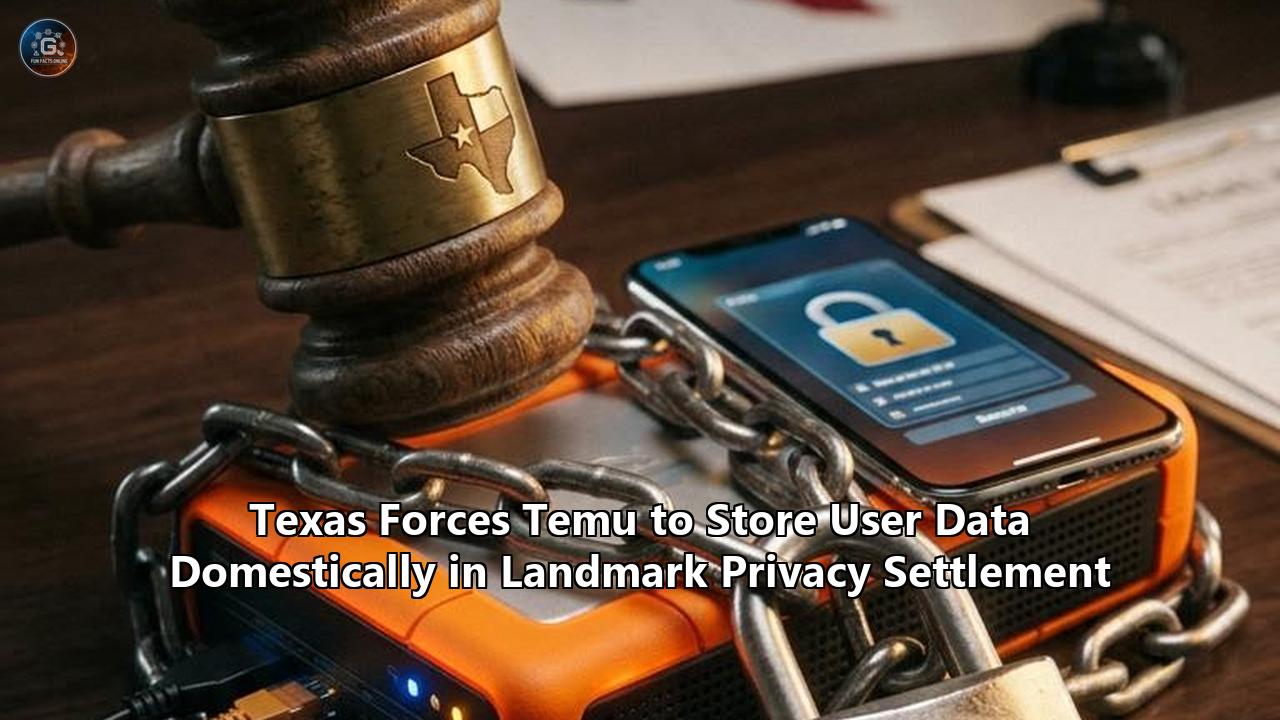
In a decisive enforcement action that redraws the boundaries between state regulatory power and cross-border digital commerce, Texas has secured a court-approved consent judgment compelling e-commerce giant Temu to store Texas residents' personal data exclusively on domestic, American-owned servers.
Announced on October 16, 2026, by Texas Attorney General Ken Paxton, the agreed final judgment in The State of Texas v. PDD Holdings Inc. and WhaleCo Inc. resolves a high-stakes lawsuit filed in Collin County’s 471st Judicial District Court. The 27-page decree imposes a four-year binding permanent injunction on Temu’s corporate parents, Dublin-based PDD Holdings Inc. and its Boston-registered US operational entity WhaleCo Inc. Beyond paying $3 million in civil penalties, attorney fees, and investigative costs within 30 days, the platform must construct a physical and cryptographic firewall between its American user records and personnel based in the People’s Republic of China (PRC).
The decree enforces strict compliance through severe financial consequences. Under the terms of the Temu data privacy settlement, the company must submit its mobile application and internal data pipelines to independent, annual third-party audits. If an audit uncovers what the judgment defines as "Material Noncompliance" within Temu’s app security architecture or sensitive-data handling, the company faces an immediate civil penalty of $8 million per failed audit, accompanied by a mandatory 60-day remediation window. A separate toxicology testing mandate requires Temu to systematically test goods for hazardous chemicals—including toxic per- and polyfluoroalkyl substances (PFAS)—expelling non-compliant vendors under pain of a $600,000 penalty per missed termination.
"This is a historic victory for data privacy, consumer protection, and Texans who deserve to know that the products they purchase are safe," Paxton declared in an official statement following the entry of the decree. "Through this victory, we can now ensure that Temu cannot harvest Americans' sensitive data and expose it to the Chinese Communist Party."
Temu and PDD Holdings signed the agreed judgment without admitting liability or conceding the factual assertions made by the state. The settlement nevertheless establishes the most intrusive data-localization and technical verification regime ever imposed on a foreign-linked platform by an individual American state.
The path to this Collin County decree did not emerge overnight. It is the culmination of a four-year escalation that spanned zero-day exploit discoveries, forensic decompilation of mobile codebases, congressional national-security warnings, and aggressive state consumer protection litigation. Tracing this confrontation reveals how a discount shopping application became the focal point of an international battle over digital sovereignty, code security, and cross-border data transfer.
CHRONOLOGICAL ESCALATION TIMELINE

September 2022 ── Temu launches in US; deploys heavy subsidies & "gamified" viral mechanics
March 2023     ── Google suspends sister app Pinduoduo for zero-day Android malware exploits
May 2023       ── PDD Holdings relocates nominal headquarters from Shanghai to Dublin, Ireland
September 2023 ── Grizzly Research publishes technical dossier alleging Temu contains spyware
June 2024      ── Arkansas AG Tim Griffin files first-in-the-nation state consumer lawsuit
July 1, 2024   ── Texas Data Privacy and Security Act (TDPSA) takes legal effect
January 2026   ── Texas Gov. Greg Abbott bans Temu from state devices and enterprise networks
February 2026  ── Texas AG Ken Paxton files DTPA enforcement action in Collin County District Court
May 2026       ── European Commission fines Temu €200M under the Digital Services Act (DSA)
October 2026   ── Landmark agreed final judgment signed: $3M fine, US servers, $8M audit penalties
The Genesis: The De Minimis Engine and the Pinduoduo Precedent (2022–Early 2023)
Temu’s entry into the American consumer economy in September 2022 was an exercise in pure logistical and marketing force. Operating through WhaleCo Inc., an entity incorporated in Delaware with offices in Boston, the platform was conceived as the international vanguard of PDD Holdings—the Chinese commerce powerhouse behind Pinduoduo.
Temu's retail strategy depended on two structural advantages:
- Direct-from-Factory Logistics: Eliminating domestic intermediaries by linking American buyers directly with Chinese manufacturers.
- The Section 321 Tariff Exemption: Systematically exploiting the US customs de minimis rule, which allows packages valued under $800 to enter the country duty-free and bypass rigorous, time-consuming inspections.
By absorbing massive operational losses—estimated by supply-chain analyses to reach up to $30 per order in customer acquisition, trans-Pacific air freight, and coupon subsidies—PDD Holdings bought market share at record speed. During the February 2023 Super Bowl, Temu spent tens of millions of dollars broadcasting its "Shop like a billionaire" campaign to over 100 million viewers. Within weeks, it vaulted to the top of the Apple App Store and Google Play Store charts, amassing an active US base that soon surpassed 82 million users.
Beneath this retail success, security researchers noted troubling parallels with PDD Holdings’ domestic Chinese platform, Pinduoduo. The first systemic rupture occurred in March 2023.
Google took the extraordinary step of suspending Pinduoduo from the Google Play Store after discovering that active builds distributed outside the Play store contained customized malware. Independent security investigations, corroborated by researchers at Kaspersky and Lookout, identified an array of privilege-escalation exploits embedded within the codebase. The software leveraged known and patched zero-day vulnerabilities in customized Android kernels—specifically targeting devices produced by Chinese original equipment manufacturers (OEMs) such as Xiaomi, Huawei, and BBK Electronics (Oppo/Vivo).
The code did not merely track user behavior within the application. Once installed, it compromised Android’s framework layers:
- Evaded runtime detection by reading kernel system logs (logcat);
- Prevented app uninstallation by exploiting system notification managers;
- Silently injected background processes to monitor clipboard caches, browse private app notifications, and scrape data from rival applications;
- Dynamic code loading: bypassed Google Play Protect scanning by fetching encrypted payloads from remote servers that executed arbitrary bytecode directly in memory.
CNN reported that PDD Holdings had assembled an internal team of roughly 100 engineers and product managers tasked with finding operating-system vulnerabilities to boost user engagement and prevent churn. Following international outcry, PDD disbanded the team, yet many of those developers were reportedly transferred directly to WhaleCo’s international application: Temu.
Attempting to decouple its international identity from Beijing, PDD Holdings shifted its registered principal executive office in May 2023 from Shanghai to Dublin, Ireland, citing corporate restructuring. Yet regulatory authorities viewed the move with skepticism. While the holding entity was now subject to European corporate law, the underlying engineering architecture, server backends, and principal administrative control remained anchored in PDD's sprawling Shanghai and Shenzhen technical hubs.
The Technical Indictment: Reverse Engineering and the Short-Seller Dossier (September 2023–Early 2024)
By late 2023, the scrutiny directed at Pinduoduo migrated squarely to Temu. The turning point arrived on September 6, 2023, when Grizzly Research, a market intelligence firm, published a technical dossier: "We believe PDD is a Dying Fraudulent Company and its Shopping App TEMU is Cleverly Hidden Spyware that Poses an Urgent Security Threat to U.S. National Interests."
Grizzly Research operated from a commercial short position on PDD Holdings stock, giving the firm a clear financial incentive to publish negative research. Yet their technical decompilation of Temu's Android Package Kit (APK) caught the immediate attention of state regulators and enterprise security analysts.
┌─────────────────────────────────────────────────────────────┐
│                 TEMU MOBILE APPLICATION                     │
│  ┌────────────────────────┐    ┌─────────────────────────┐  │
│  │   UI & E-Commerce      │    │  Obfuscated / Dynamic   │  │
│  │   Storefront Engine    │    │  DEX Payload Loader     │  │
│  └───────────┬────────────┘    └────────────┬────────────┘  │
└──────────────┼──────────────────────────────┼───────────────┘
               │                              │
               ▼                              ▼
┌───────────────────────────┐    ┌────────────────────────────┐
│ Legitimate APIs:          │    │ Invasive Telemetry APIs:   │
│ - Payment gateways        │    │ - MAC addresses & BSSID    │
│ - Order placement         │    │ - Geolocation / Cell Tower │
│ - Push notifications      │    │ - System logs & Device ID  │
└───────────────────────────┘    └────────────┬───────────────┘
                                              │
                                              ▼
                                 ┌────────────────────────────┐
                                 │ PRC Legal Jurisdiction:    │
                                 │ Subject to 2017 National   │
                                 │ Intelligence Law & 2021    │
                                 │ Data Security Law          │
                                 └────────────────────────────┘
The report alleged that Temu’s software architecture contained the foundational components of aggressive spyware:
- Dynamic Code Execution: The app contained code branches allowing it to compile and execute unverified DEX (Dalvik Executable) files retrieved dynamically at runtime from external servers, actively circumventing Google Play Protect's static analysis routines.
- Excessive Device Fingerprinting: Temu collected granular hardware metrics unrelated to shopping, such as MAC addresses, baseband processor metadata, screen calibration, and active Wi-Fi network service set identifiers (SSIDs).
- Invasive Manifest Permissions: Early Android builds included requests for ambient camera access, fine-grained GPS location, audio recording, and access to internal device storage.
- Proprietary Obfuscation: Unlike Western e-commerce apps that rely on industry-standard open-source libraries, Temu used custom packers and obfuscation layers that hid how it stored and moved data across system boundaries.
Temu dismissed the report, calling the allegations "completely unfounded" and pointing out that Grizzly was an incentivized short-seller. The company maintained that its application required permissions only to support legitimate marketplace features—such as photo searches, delivery tracking, and fraud prevention.
The technical fallout was immediate. Between October 2023 and January 2024, consumer class actions were filed against WhaleCo in federal courts across Illinois, New York, and California. The suits cited the Computer Fraud and Abuse Act (CFAA), the Electronic Communications Privacy Act (ECPA), and the Illinois Biometric Information Privacy Act (BIPA), alleging that Temu had covertly turned millions of mobile phones into automated telemetry harvesting nodes.
Concurrently, the US-China Economic and Security Review Commission (USCC) released a staff report citing concerns over Temu and Shein. The report highlighted risks surrounding data handling practices, intellectual property infringement, and vulnerabilities in cross-border supply chains. By spring 2024, the issue had moved beyond market research and class-action litigation to become a pressing priority for state law enforcement.
State Attorneys General Escalate: Arkansas, Kentucky, and the Texas Build-up (2024–2025)
The first state law enforcement agency to act was the Office of Arkansas Attorney General Tim Griffin. On June 25, 2024, Griffin filed a lawsuit in Cleburne County Circuit Court against PDD Holdings and WhaleCo.
"Temu is not an online marketplace like Amazon or Walmart," Griffin said during a press conference announcing the suit. "It is a data-theft business that sells goods online as a means to an end... Temu is functionally malware and spyware. It is purposefully designed to gain unrestricted access to a user’s phone operating system."
The Arkansas complaint went beyond mobile app security, introducing an expansive theory under the Arkansas Deceptive Trade Practices Act (ADTPA) and the Personal Information Protection Act (PIPA):
- Temu baited consumers with unsustainably cheap products to acquire systemic access to their sensitive personal data;
- The platform engaged in deceptive pricing, featuring fake countdown timers, manufactured stock scarcities, and misleading reference pricing;
- The app failed to disclose that customer data could be accessed by mainland Chinese entities bound by the PRC’s 2017 National Intelligence Law and 2021 Data Security Law, which mandate that organizations cooperate with state intelligence services upon request.
Temu countered that the Arkansas lawsuit was founded on "misinformation circulated online" without independent state-led forensic inquiry. But the legal dam had broken.
The Texas Data Privacy Machine
While Arkansas relied on its general consumer protection statutes, Texas was preparing a much larger regulatory apparatus. On July 1, 2024, the Texas Data Privacy and Security Act (TDPSA) officially went into effect.
Passed by the Texas Legislature as House Bill 4, the TDPSA gave the state a comprehensive consumer privacy framework. The law granted Texans explicit rights to:
- Know whether a data controller is processing their personal information;
- Access, correct, and delete personal data;
- Obtain a portable copy of digital assets;
- Opt out of data processing for targeted advertising, data sales, or automated profiling.
Unlike California’s privacy framework, which includes a dedicated regulatory agency and limited private rights of action, the TDPSA gave exclusive enforcement power to Attorney General Ken Paxton. That same month, Paxton capitalized on this mandate by creating the Data Privacy and Security Initiative inside the Consumer Protection Division. The new unit brought together computer forensics investigators, system engineers, and specialized trial attorneys, creating one of the best-resourced state-level tech enforcement teams in the United States.
┌─────────────────────────────────────────────────────────────┐
│          TEXAS CONSUMER PROTECTION DIVISION                 │
│          Data Privacy and Security Initiative               │
│                                                             │
│  Enforcement Powers:                                        │
│  ├─ Exclusive jurisdiction under TDPSA (Tex. Bus. & Com.)   │
│  ├─ Broad discovery powers under DTPA (Civil Investigative) │
│  ├─ Statutory penalties: $7,500/violation (TDPSA)           │
│  └─ Civil penalties: $10,000 to $250,000/violation (DTPA)   │
└─────────────────────────────┬───────────────────────────────┘
                              │
               Investigative & Litigative Muscle
                              │
                              ▼
┌─────────────────────────────────────────────────────────────┐
│ TARGET: Big Tech & Cross-Border Sovereign Data Vulnerabilities│
│ - Meta Facial Geometry Settlement: $1.4 Billion (July 2024) │
│ - Google Geolocation Settlement: $8 Million (2023)          │
│ - TP-Link & Smart Device Network Inquiries (Early 2026)     │
│ - Temu / WhaleCo / PDD Holdings Injunction (October 2026)   │
└─────────────────────────────────────────────────────────────┘
The new division moved aggressively. In July 2024, Paxton extracted a record-breaking $1.4 billion settlement from Meta over biometric facial recognition harvesting under Texas’s Capture or Use of Biometric Identifier (CUBI) Act. The message to the technology sector was clear: Texas was willing to litigate complex algorithmic and cloud infrastructure matters, and it would not wait for federal guidance.
Regulatory momentum grew over the next eighteen months. In July 2025, Kentucky Attorney General Russell Coleman filed a parallel consumer protection complaint targeting Temu’s collection of geolocation points, Wi-Fi environment telemetry, and background app activity.
Two months later, in September 2025, the Federal Trade Commission (FTC) took action, hitting WhaleCo with a $2 million fine in the first major enforcement of the INFORM Consumers Act. The FTC penalized the company for failing to verify high-volume third-party marketplace sellers and neglecting to provide mandated identification disclosures to buyers. The global perimeter around Temu's operations was tightening rapidly.
The Collin County Onslaught: Paxton Sues PDD Holdings (January–February 2026)
By early 2026, Texas escalated its strategy from regulatory oversight to administrative and legal confrontation.
In January 2026, Texas Governor Greg Abbott issued a statewide executive directive expanding the list of prohibited technologies on government-managed infrastructure. The Texas Department of Information Resources (DIR) updated its prohibited technologies catalog to bar PDD Holdings, WhaleCo, and Temu alongside Shein, TikTok, and other platforms tied to foreign adversaries. The software was banned from all state-owned mobile devices, laptops, networks, and agency infrastructure.
The main offensive followed on February 19, 2026. Paxton filed an expansive original petition in Collin County’s 471st Judicial District Court (The State of Texas v. PDD Holdings Inc. and WhaleCo Inc., Cause No. 471-01114-2026).
The 52-page petition asserted violations under the Texas Deceptive Trade Practices-Consumer Protection Act (DTPA) and the TDPSA. The state's complaint was structured around five core pillars:
┌─────────────────────────────────────────────────────────────┐
│                 ANATOMY OF THE TEXAS PETITION               │
├─────────────────────────────────────────────────────────────┤
│ 1. Deceptive App Architecture: Undisclosed access to camera,│
│    location, system files, and dynamic code execution.      │
│                                                             │
│ 2. National Security & Data Routing: Concealing that data   │
│    could be accessed by PRC-based entities under Beijing's  │
│    National Intelligence Law.                               │
│                                                             │
│ 3. Deceptive Marketplace Design: Predatory dark patterns,   │
│    false-reference pricing, and gamified reward loops.      │
│                                                             │
│ 4. Defective & Toxic Goods: Marketing consumer items        │
│    tainted with dangerous chemicals, heavy metals, & PFAS.  │
│                                                             │
│ 5. Data Security Failures: Misrepresenting security audits  │
│    and failing to provide mandated data breach notices.     │
└─────────────────────────────────────────────────────────────┘
The filing stood out for its detailed technical claims and direct national security focus. Paxton explicitly characterized the Temu application as a digital "Trojan horse":
"Temu is Chinese Communist spyware disguised as a shopping app. It deceptively markets itself as an innocent online bazaar while surreptitiously harvesting millions of Americans' sensitive private data and routing that information into an infrastructure directly accessible by our foreign adversaries."
Paxton used the DTPA's penalty framework as leverage. The statute authorizes civil penalties of up to $10,000 per violation—and up to $250,000 per violation if the deceptive practice affects consumers aged 65 or older. Given that millions of Texans had downloaded the mobile app, registered accounts, and transacted on the platform, WhaleCo’s potential statutory exposure ran into billions of dollars.
The Pressure Cooker: Procedural Showdowns and Global Enforcement (Spring–Summer 2026)
Following the Collin County filing, WhaleCo and PDD Holdings deployed a defense team led by major American trial and technology law firms. Temu's initial legal responses pushed back hard against Texas's jurisdiction and characterization of the platform:
- It argued that WhaleCo was a distinct American company operating under Delaware law and subject to the US legal system;
- It insisted that the application collected only standard commerce metrics comparable to those gathered by Amazon, Walmart, or eBay;
- It emphasized that Temu was a marketplace, not a manufacturer, and therefore could not be held strictly liable under the DTPA for the chemical composition of products sold by independent offshore sellers.
However, the legal environment deteriorated on multiple fronts simultaneously.
The European Regulatory Hammer
On May 28, 2026, the European Commission hit Temu with a €200 million fine under the Digital Services Act (DSA). The European Commission concluded that Temu had failed to conduct mandatory risk assessments regarding the proliferation of illegal and counterfeit products, maintained addictive design features targeting minors, and operated opaque algorithmic recommendation systems.
European regulators noted that Temu’s rapid seller onboarding relied on self-certifications without basic supply chain verification. This allowed blacklisted merchants to quickly reopen shuttered stores under new shell entities—a practice the European Union formally banned.
Discovery Battles in McKinney, Texas
In Texas, the state pressed for extensive evidentiary disclosures. In Collin County’s 471st District Court, state attorneys demanded the complete production of:
- The source code trees for every iOS and Android build pushed to American users since 2022;
- The complete network routing logs tracking cross-border application programming interface (API) calls between American consumers and servers in Shanghai, Beijing, Hong Kong, and Frankfurt;
- All internal communications between WhaleCo executives in Boston and PDD Holdings leadership in Shanghai regarding data access requests, software security reviews, and telemetry collection.
WhaleCo faced a difficult legal dilemma. Fighting the suit through formal discovery would require opening its proprietary source code, dynamic compiler frameworks, and internal corporate operations to forensic scrutiny by Texas's technical consultants. Furthermore, a public trial in Collin County, Texas, carried immense risk: a single adverse jury finding under the DTPA could trigger existential civil penalties, an outright ban on operations across the state, and irreparable reputational damage.
At the same time, efforts in Washington to pass the SECURE Data Act—a federal bill that would have broadly preempted state-level privacy litigation in favor of unified federal oversight—stalled in congressional committees in the summer of 2026. With federal preemption off the table, Temu had to confront the full force of Texas law enforcement alone.
By July 2026, the parties initiated intensive settlement discussions. Over three months of closed-door negotiations in Austin and Dallas, state attorneys, technical experts, and corporate leadership debated the terms of what would become the agreed final judgment.
Deconstructing the Temu Data Privacy Settlement
On October 15, 2026, the parties executed the formal agreed final judgment, and the Office of the Texas Attorney General published the decree on Friday, October 16. The agreement was signed by Texas Assistant Attorney General Johnathan Stone, WhaleCo President Qin Sun, and PDD Holdings Co-Chief Executive Lei Chen, and submitted for formal entry to District Judge Robert "Bryan" Gantt of the 471st Judicial District Court.
┌─────────────────────────────────────────────────────────────┐
│          CORE PROVISIONS: AGREED FINAL JUDGMENT             │
│        Cause No. 471-01114-2026, Collin County, Texas       │
├─────────────────────────────────────────────────────────────┤
│ 1. Domestic Data Localization: All Texas user data must     │
│    move to US-located, American-owned servers in 180 days.  │
│                                                             │
│ 2. The China Access Prohibition: Zero unencrypted access    │
│    by China-based entities, with narrow, audited exceptions.│
│                                                             │
│ 3. The $8 Million Audit Hammer: Annual independent audits   │
│    trigger $8M fines per instance of Material Noncompliance.│
│                                                             │
│ 4. Toxicology & Seller Bans: Mandatory PFAS testing, seller │
│    terminations, consumer notices, & refunds ($600K fines). │
│                                                             │
│ 5. Account Autonomy: One-click deletion link in privacy     │
│    policy; automated purges of accounts dormant for 2 years.│
│                                                             │
│ 6. Oversight: $3M immediate fine, US Compliance Officer,    │
│    four-year continuing Collin County court jurisdiction.   │
└─────────────────────────────────────────────────────────────┘
The terms of the Temu data privacy settlement go far beyond standard monetary penalties, laying down detailed technical mandates that fundamentally alter Temu's engineering architecture.
1. Mandatory Domestic Data Localization
The most significant operational mandate is the forced migration of Texas consumer data. The decree explicitly requires Temu to store the "Personal Data, Sensitive Data, and Sensitive Personal Data" of Texas consumers exclusively:
"...on commercial servers located in the United States that are owned and controlled by an American company."
The judgment gives Temu an absolute deadline of 180 days from the effective date to complete this migration.
The judgment defines a "Texas Consumer" pragmatically: any account identified through IP geolocation within the state of Texas or through a Texas delivery address. Temu is barred from relying on offshore cloud entities or overseas holding companies to meet this requirement; the physical hardware must reside within the continental United States and be owned by an American enterprise (such as Amazon Web Services, Microsoft Azure, or Oracle Cloud Infrastructure).
2. The China Access Firewall
Building on physical data localization, the settlement establishes strict access controls. The decree prohibits any "Prohibited Person"—defined to include any person or entity based, located, or operating within the People's Republic of China—from accessing Texas personal data:
"...in an unencrypted or decryptable form."
The order sets forth narrow, exhaustively audited exceptions. Data may be accessed by personnel in China only when strictly necessary for:
- Order fulfillment (such as providing an individual manufacturer with a recipient's shipping address);
- Direct payment processing and platform fraud prevention;
- Technical platform security, system maintenance, and legal compliance;
- Instances where the consumer provides clear affirmative consent for an individual transaction.
Outside these narrow parameters, the settlement cuts off direct, read-level administrative access to American user data by engineering teams based in the PRC.
3. The $8 Million Audit Engine
To ensure compliance does not remain on paper, the settlement includes a powerful enforcement mechanism: the threat of an $8 million penalty per failed audit.
Under the judgment, Temu must retain a qualified, independent third-party cybersecurity and forensics firm, approved by the Texas Attorney General, to conduct comprehensive annual audits of its operations. The auditing framework spans two parallel technical evaluations:
┌─────────────────────────────────────────────────────────────┐
│                 ANNUAL COMPLIANCE AUDITING                  │
├──────────────────────────────┬──────────────────────────────┤
│ App Security Audit:          │ Sensitive Data Audit:        │
│ • Decompilation of iOS/      │ • Server traffic analysis    │
│   Android builds             │ • Verification of US storage │
│ • Review for malware/spyware │ • Auditing of China access   │
│ • Detection of hidden APIs   │   and encryption logs        │
└──────────────┬───────────────┴──────────────┬───────────────┘
               │                              │
               └──────────────┬───────────────┘
                              ▼
            ┌───────────────────────────────────┐
            │   Finding of Material Noncompliance│
            │   triggers immediate liability:   │
            │   • $8,000,000 fine per audit     │
            │   • 60-day mandatory cure period  │
            └───────────────────────────────────┘
The app-security review requires auditors to inspect the actual builds distributed via the Apple App Store and Google Play Store for spyware-like behavior, unauthorized dynamic code compilation, hidden keyloggers, and covert data-harvesting functions.
If an auditor uncovers "Material Noncompliance"—defined as a systemic failure to safeguard data or the unauthorized routing of unencrypted information to prohibited foreign jurisdictions—Temu is legally bound to pay Texas an $8 million penalty for that specific failed audit. It must then correct the noncompliance within 60 days. If the sensitive-data audit separately uncovers material failures, another $8 million penalty is triggered.
4. Consumer Autonomy, One-Click Deletion, and Data Purging
The settlement also requires fundamental changes to Temu’s user account lifecycle:
- One-Click Account Deletion: Temu must add a direct, "one-click" link within its privacy policy that allows logged-in Texas consumers to immediately access the account-deletion workflow, eliminating deceptive dark patterns and convoluted unsubscription mazes.
- Quarterly Dormancy Sweeps: Temu must perform quarterly sweeps of its databases to identify inactive Texas accounts.
- Automated Data Purges: The platform is required to permanently delete all personal data tied to accounts that have been inactive for 24 consecutive months—defined as no logins, orders, or affirmative interactions.
5. Toxicology Audits and Merchant Terminations
Addressing the physical consumer safety claims in the Texas petition, the decree establishes a comprehensive product-safety testing and recall program.
Temu must engage independent toxicology laboratories to conduct annual product audits on goods sold to Texas consumers, focusing on high-risk categories such as children's toys, baby products, cosmetics, and apparel. The testing specifically targets hazardous chemicals, including toxic heavy metals (lead, cadmium) and industrial per- and polyfluoroalkyl substances (PFAS).
If laboratory testing confirms that a product contains banned or toxic substances, Temu is subject to strict obligations:
- Immediately remove the item listing from the platform;
- Terminate the offending merchant and all affiliated storefronts controlled by that seller;
- Issue an immediate written safety notice to every Texas consumer who purchased the product;
- Issue complete refunds to all affected consumers.
Failure to terminate an offending seller’s network triggers an immediate civil fine of $600,000 per violation, alongside penalties of up to $10,000 for any other breach of the decree.
6. Corporate Governance and Continued Jurisdiction
To oversee these mandates, Temu must appoint a dedicated, US-based corporate compliance officer who reports directly on decree implementation and serves as the primary liaison to the Texas Attorney General’s office. Temu must also maintain a dedicated contact team and specialized communication channel for Texas-based businesses and intellectual property rights holders.
The permanent injunction remains in effect for four years. Collin County's 471st Judicial District Court retains continuing jurisdiction to interpret, enforce, and penalize violations of the judgment through 2030.
Comparison: The Texas Settlement vs. ByteDance's "Project Texas"
The data segregation regime forced upon Temu naturally invites comparison with the technology sector’s most famous corporate localization effort: Project Texas, the $1.5 billion initiative launched by ByteDance to wall off TikTok’s American user data through a partnership with Oracle.
While the two frameworks share superficial similarities—both attempt to neutralize foreign access risks by establishing domestic server infrastructure—their core structures, operational mechanics, and legal foundations differ sharply.
| Analytical Dimension | TikTok: "Project Texas" (ByteDance / Oracle) | Temu: Collin County Injunction (WhaleCo / Texas AG) |
|---|---|---|
| Originating Mandate | Voluntary corporate defense to avert CFIUS sanctions and federal bans. | Court-approved, legally binding consent judgment resolving an AG lawsuit. |
| Legal Foundation | Federal national security review; International Emergency Economic Powers Act (IEEPA). | State consumer protection (DTPA) and the Texas Data Privacy and Security Act (TDPSA). |
| Jurisdictional Scope | National scope, covering all US user accounts and telemetry across 50 states. | Texas Consumers (defined by IP geolocation and in-state delivery addresses). |
| Storage Architecture | Dedicated Oracle Cloud Infrastructure (OCI) running within domestic data centers. | Commercial servers within the US owned and operated by an American enterprise. |
| Code Verification | Ongoing source-code review conducted by Oracle and third-party monitoring boards. | Mandatory annual mobile code decompilation and product toxicology testing. |
| Enforcement Hammer | Indirect: Threat of federal operational bans or CFIUS enforcement actions. | Direct: Contempt of court and an automatic $8M civil fine per failed annual audit. |
| Physical Scope | Purely digital: Focused entirely on social media video, algorithms, and user telemetry. | Hybrid: Combines digital code/data security with physical consumer safety (toxic PFAS bans). |
The most important distinction lies in legal enforceability. Project Texas was designed as a corporate governance framework meant to satisfy federal regulators, without direct, statutory audit penalties built into state court orders.
By contrast, the Temu data privacy settlement is a judicially binding decree backed by an automatic financial enforcement mechanism. Temu does not have the luxury of protracted administrative reviews if it fails an audit; the finding of Material Noncompliance immediately triggers an $8 million penalty and a court-supervised 60-day countdown to resolve the failure.
PROJECT TEXAS (TIKTOK) ARCHITECTURE:
[US Users] ──► [Oracle Cloud Infrastructure] ──► Algorithmic Training / Routing
                     ▲
                     │ (Subject to CFIUS oversight & voluntary corporate audits)
[ByteDance Global] ──┘

TEMU TEXAS SETTLEMENT ARCHITECTURE:
[Texas Users] ──► [US-Owned Cloud Infrastructure] (Strict 180-day deadline)
                         │
                         ├─► Annual Third-Party App Code Audit  ──► Failure: $8M Fine
                         ├─► Annual Third-Party Data Flow Audit ──► Failure: $8M Fine
                         └─► Independent Product PFAS Testing   ──► Failure: Store Ban
                         ▲
                         │
       [PRC Personnel / Infrastructure]
       (PROHIBITED: Encrypted Only; Strict Operational Exceptions)
Technical and Operational Hurdles to Compliance
Implementing the Collin County settlement presents immense technical, architectural, and financial challenges for PDD Holdings and WhaleCo. Isolating user data, rewriting continuous integration pipelines, and re-engineering cross-border logistical backends within 180 days is an exceptionally difficult task.
┌─────────────────────────────────────────────────────────────┐
│                 ENGINEERING THE DATA CORDON                 │
├─────────────────────────────────────────────────────────────┤
│ 1. Dynamic Request Routing: Identifying Texas-originating   │
│    IPs and destination addresses at the CDN edge layer.     │
│                                                             │
│ 2. Database Partitioning: Migrating multi-tenant global     │
│    databases into isolated US-owned infrastructure.         │
│                                                             │
│ 3. Cryptographic Tokenization: Replacing raw PII with       │
│    irreversible tokens before routing fulfillment orders.   │
│                                                             │
│ 4. Supply Chain Sanitization: Establishing verified API     │
│    gateways for tens of thousands of factory merchants.     │
└─────────────────────────────────────────────────────────────┘
The Database Partitioning Challenge
Modern hyperscale consumer applications rely on microservice architectures and globally distributed multi-tenant databases. User data—ranging from browsing histories, wish lists, and device tokens to payment identifiers and physical shipping locations—is typically distributed across relational and non-relational database clusters (such as Cassandra, MongoDB, or customized MySQL deployments) optimized for high throughput rather than geographic residency.
To satisfy the settlement, Temu cannot simply place a proxy server in Dallas or Ashburn. Its infrastructure team must partition its underlying storage layers.
The system must run edge-level routing filters that identify Texas consumers via IP geolocation or destination zip codes, directing their traffic exclusively into segregated storage clusters hosted on American-owned cloud providers. This requires separating write operations, analytics pipelines, and customer support databases between Texas users and the rest of the world.
Redefining Cross-Border Merchant APIs
Temu’s business model connects tens of thousands of small-scale Chinese factories directly with end consumers. These merchants interact with the platform through supplier portals and bespoke APIs to receive order slips, generate shipping manifests, and manage delivery handoffs.
Under the court order, these APIs can no longer pass unencrypted, readable consumer data to China unless strictly required for shipping.
To comply, Temu will need to deploy cryptographic tokenization frameworks. The platform must replace raw customer identities, contact numbers, and payment details with encrypted, ephemeral tokens that expose only the bare minimum information needed by Chinese logistical hubs to generate customs labels. Developing, testing, and shipping this architectural change across thousands of independent third-party merchants within six months will push the company's software engineering resources to their limit.
Codebase Sanitization and CI/CD Auditing
The threat of an $8 million penalty for app security noncompliance fundamentally changes how Temu manages its software release process.
In modern mobile app development, teams release updates every two to three weeks to add features, adjust UI flows, and optimize conversion funnels. Yet every software update pushed to the Apple App Store or Google Play Store will now be subject to forensic examination during the independent annual audit.
DEVELOPMENT PIPELINE UNDER INJUNCTIVE OVERSIGHT:

[Feature Code Commits]
       │
       ▼
[Internal Automated Security Scans]
       │
       ▼
[External Auditor Pre-Release Review] (Prohibits Dynamic DEX Loading)
       │
       ▼
[Apple / Google App Store Release]
       │
       ▼
[Annual Independent Technical Audit] ──► Material Noncompliance?
                                                │
                                                ├── NO  ──► Ongoing Operation
                                                └── YES ──► $8,000,000 Fine
                                                            60-Day Cure Period
To protect itself from catastrophic penalties, WhaleCo must eliminate all code mechanisms capable of dynamically fetching external executable logic at runtime. It must audit every third-party Software Development Kit (SDK) embedded in its client builds and remove any background telemetry collectors that gather device fingerprints, system log buffers, or Wi-Fi scan histories. The open-ended, rapid-iteration development model that fueled Temu's initial rise must be replaced by a cautious, compliance-first engineering methodology.
The Broader Fallout: The Rise of State-Level Data Borders
The agreed final judgment in Collin County represents a major shift in how the digital economy is regulated. By forcing a multinational e-commerce giant to build an in-state jurisdictional data cordon, Texas has demonstrated that individual states can reshape the technical architectures of global technology firms.
The Fragmentation of the US Digital Market
For years, technology firms and legal scholars warned that the absence of a comprehensive federal privacy statute would inevitably fragment the American internet into fifty separate state regulatory regimes. The Texas Temu settlement shows that this fragmentation has arrived.
Instead of a single, unified national framework, global platforms now face a patchwork of state-level mandates:
- California’s CPRA enforces automated profiling opt-outs and consumer privacy rights;
- Illinois’s BIPA heavily penalizes the unauthorized collection of biometric and facial identifiers;
- Texas’s DTPA and TDPSA framework now forces physical server localization, independent software decompilation, and mandatory domestic cloud hosting.
           THE EMERGING STATE PRIVACY MOSAIC

    CALIFORNIA (CPRA / CCPA)      ◄── Algorithmic Profiling & Opt-Outs
    ILLINOIS (BIPA)               ◄── Private Right of Action for Biometrics
    TEXAS (DTPA / TDPSA)          ◄── Physical Domestic Server Localization,
                                      Source Code Audits, $8M Fine Triggers
    ARKANSAS / KENTUCKY (Pending) ◄── Active Malware & Consumer Litigation
If Arkansas, Kentucky, or other states follow Texas's lead by demanding localized data silos on American-controlled servers, multinational platforms will face compounding infrastructure costs.
Engineering architectures may increasingly need to build geographic routing layers that treat consumers differently depending on which side of a state border they live on. Under the Texas decree, an individual buying goods in Dallas is now protected by mandatory domestic server storage, third-party code verification, and toxic chemical checks—protections that vanish the moment an order is placed from an IP address across the border in Oklahoma or Louisiana.
A Warning Shot to Chinese-Linked Cross-Border Commerce
The Texas settlement sends an unmistakable warning to Chinese technology ventures looking to scale in the American market.
Over the past decade, platforms like Shein, Temu, and AliExpress built successful international consumer businesses by combining direct-from-factory Chinese manufacturing, unbranded supply chains, and aggressive algorithmic mobile marketing. They relied on corporate restructuring—such as establishing legal holding entities in Ireland, Singapore, or the Cayman Islands—to build trust with Western consumers and regulators while keeping their core technical infrastructure, data stores, and engineering talent firmly rooted in mainland China.
The Texas judgment renders that strategy unviable.
State regulators and state courts are looking past offshore corporate registrations to inspect where code is written, where network packets terminate, and who holds the decryption keys. By making physical domestic server storage non-negotiable and imposing severe financial penalties on unencrypted access by personnel in China, Texas has established a new operational minimum for foreign-linked applications. If foreign-linked tech firms want to access the tens of millions of affluent consumers in Texas, they must physically and operationally sever their data infrastructure from authoritarian legal environments.
What Comes Next: Critical Milestones and Unresolved Questions
As the agreed judgment takes effect, the legal and technology sectors will closely monitor Temu's compliance across several crucial deadlines:
COMPLIANCE ROADMAP & CRITICAL DEADLINES

Day 30  ── Temu pays $3,000,000 baseline penalty to the State of Texas
        ── Designates US-based Corporate Compliance Officer
        ── Posts official settlement notice to Texas consumers on platform

Day 90  ── Deploys "One-Click" account deletion link within Privacy Policy
        ── Implements seller pre-listing safety and regulatory certifications

Day 180 ── HARD DEADLINE: Complete migration of Texas user data to US servers
        ── Strict ban on unencrypted data access by PRC personnel takes effect

Yearly  ── Independent cybersecurity firm submits mobile app decompilation audit
        ── Independent auditor submits sensitive data flow and server review
        ── Independent laboratory submits toxicology safety testing report (PFAS)
        ── Any "Material Noncompliance" triggers mandatory $8,000,000 penalty

Year 4  ── Injunction expires; Collin County District Court oversight concludes
Beyond the immediate mechanics of the decree, this enforcement action leaves several major questions unresolved:
1. The Audit Accountability Question
Can independent audits paid for by Temu provide sufficient oversight?
While the settlement requires that the third-party auditing firm be approved by the Texas Attorney General, history shows that corporate compliance auditing can become performative without aggressive regulatory scrutiny. Whether Texas’s Consumer Protection Division will actively review decompiled source code and network packet traces—or simply rely on executive certifications—will determine if the decree’s technical safeguards hold.
2. The Cloud Provider Dilemma
The decree specifies that data must reside on servers "owned and controlled by an American company," but it does not name an approved provider.
WhaleCo must secure commercial contracts with domestic cloud providers such as AWS, Microsoft Azure, Google Cloud, or Oracle. These providers will face their own technical, legal, and reputational responsibilities: they will be hosting an application repeatedly accused by state law enforcement of running aggressive device telemetry and background surveillance code.
3. The National Contagion Effect
How quickly will other state attorneys general adopt the Collin County blueprint?
Arkansas and Kentucky already have active lawsuits against Temu moving through state courts. Attorneys General across the country are watching how the settlement plays out. The Texas decree contains a most-favored-state parity clause covering the first three years of the judgment, ensuring that if Temu grants more favorable privacy or data terms to another state, Texas will automatically receive the benefit of those terms.
A multistate coalition may soon coalesce to demand that the protections secured for Texans—domestic US server storage, annual code decompilation, and strict limits on access from China—be extended to every consumer in the United States.
By taking its fight to a district court in North Texas, the state has achieved what years of federal debate could not. It forced an e-commerce giant with deep operational roots in China to legally surrender its cross-border data pipeline, placing its underlying code and customer records under the supervision of an American state court. As the 180-day clock begins, the tech sector is about to discover whether a digital retail empire built on ultra-fast, cross-border flows can survive behind the strict borders of a domestic data cordon.
Reference:
- https://dallasexpress.com/business-markets/texas-forces-temu-to-rewrite-data-product-safety-rules/
- https://ppc.land/temu-faces-8m-per-failed-audit-under-texas-data-settlement/
- https://ppc.land/temu-faces-8m-per-failed-audit-under-texas-data-settlement/
- https://www.csis.org/analysis/looking-beyond-tiktok-risks-temu
- https://www.texasattorneygeneral.gov/news/releases/attorney-general-paxton-secures-first-its-kind-settlement-temu-protect-texans-data-ccp-and-protect
- https://texasscorecard.com/state/texas-sues-temu-for-deceptive-marketing-and-ccp-linked-data-harvesting/
- https://www.malwarebytes.com/blog/news/2024/06/temu-sued-for-being-dangerous-malware-by-arkansas-attorney-general
- https://investorplace.com/2023/09/pdd-stock-alert-grizzly-research-slams-pinduoduo-in-new-short-report/
- https://grizzlyreports.com/we-believe-pdd-is-a-dying-fraudulent-company-and-its-shopping-app-temu-is-cleverly-hidden-spyware-that-poses-an-urgent-security-threat-to-u-s-national-interests/
- https://www.bizcommunity.com/article/temu-app-considered-malicious-malware-in-new-us-lawsuit-670131a
- https://texasscorecard.com/state/texans-win-new-safeguards-in-temu-settlement/
- https://armoneyandpolitics.com/arkansas-suit-against-temu/
- https://www.kelleydrye.com/viewpoints/blogs/ad-law-access/arkansas-ag-files-suit-labels-temu-a-data-theft-business
- https://hoodline.com/2026/10/texas-forces-temu-to-store-data-in-us-pay-3m-in-landmark-deal/
- https://www.fox7austin.com/news/temu-agrees-new-data-security-product-safety-standards-settle-texas-lawsuit
- https://hoodline.com/2026/10/texas-forces-temu-to-store-data-in-us-pay-3m-in-landmark-deal/