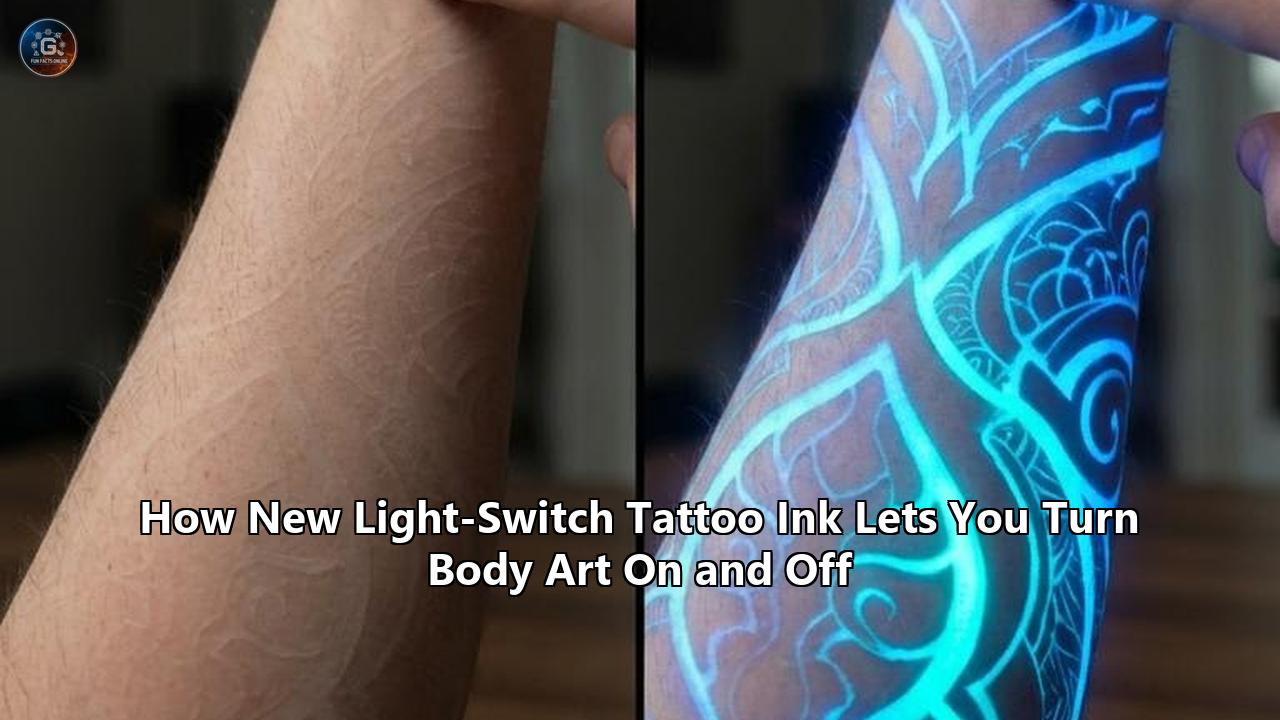
Researchers at the University of Colorado Boulder have developed an intradermal pigment system that can be turned on and off using targeted wavelengths of light, offering an alternative to permanent tattooing and painful laser removal.
The study, published in the journal Matter & Light, details how the technology—named PhotoTat—allows colorful designs to appear under an ultraviolet light source in two to three seconds and disappear under exposure to bright visible light. The pigment particles do not leave the body; instead, they undergo a reversible structural isomerization that renders them transparent or intensely colored on demand.
Carson Bruns, an associate professor of biomedical engineering at CU Boulder and lead author of the study, demonstrated the technology on himself, wearing an array of light-switchable scales on his leg that have remained functional for more than two years.
"This is a tattoo that you can have, and whenever you decide you don't want it to be showing anymore, or you just don't want it there, you just turn it off," Bruns stated upon the paper’s release. "And that's it. You don't have to turn it on again".
The development of light switch tattoo ink marks a definitive departure from thousands of years of irreversible body modification. By decoupling intradermal implantation from lifelong aesthetic commitment, the technology creates ripple effects across elective body modification, clinical oncology, dermatological safety regulations, and forensic identification.
                       PHOTOTAT MOLECULAR LIFECYCLE

       +--------------------------------------------------------+
       |                  RESTING / ERASED STATE                |
       |  - Photochromic dye in open, non-conjugated form       |
       |  - PMMA nanoparticle shell (100–500 nm)                |
       |  - Refractive index matches dermal tissue              |
       |  - Appearance: INVISIBLE / FLESH-TONED                 |
       +--------------------------------------------------------+
                                  |
            [ 365 nm Ultraviolet Light | 2–3 Seconds ]
                                  v
       +--------------------------------------------------------+
       |                  ACTIVATED / DISPLAY STATE             |
       |  - Molecular ring closes into conjugated structure     |
       |  - Selectively absorbs visible spectrum                |
       |  - Stable under indoor ambient lighting (hours to days)|
       |  - Appearance: VIVID CYAN, MAGENTA, YELLOW             |
       +--------------------------------------------------------+
                                  |
            [ High-Intensity White Light / Solar UV Flux ]
                                  v
       +--------------------------------------------------------+
       |                  RETURN TO ERASED STATE                |
       |  - Photo-thermal relaxation breaks conjugation         |
       |  - Dye molecules revert to transparent geometry        |
       |  - Appearance: CLEARED / INVISIBLE                     |
       +--------------------------------------------------------+
The Nanotechnology Behind the Switch
Traditional tattooing relies on heavy metal salts, carbon black, and synthetic industrial pigments that macrophages engulf and trap inside the dermis permanently. These pigments absorb visible light continuously because their chemical configurations remain locked.
The underlying chemistry of light switch tattoo ink relies on photochromic organic dyes housed inside transparent polymeric microspheres. The CU Boulder team engineered three primary inks—cyan, magenta, and yellow—that allow the creation of full-spectrum color palettes within the skin.
Each color relies on distinct photochromic molecules capable of reversible photoisomerization. At rest, these molecules exist in a flexible, open conformation that does not absorb light within the visible spectrum, making them virtually imperceptible against human tissue.
When struck by a narrow band of ultraviolet light—specifically at a 365-nanometer wavelength—the molecules undergo an electrocyclic ring closure. This structural rearrangement locks the compound into an extended conjugated electron system. In this closed-ring configuration, the molecules absorb visible wavelengths and reflect their corresponding colors.
+-------------------+----------------------------+-----------------------------+
| System Property   | Conventional Tattoo Ink    | Light-Switch Tattoo Ink     |
+-------------------+----------------------------+-----------------------------+
| Optical State     | Static (permanently on)    | Dynamic (bistable on/off)   |
| Pigment Core      | Carbon black, metal oxides | Organic photochromic dyes   |
| Carrier Matrix    | Heavy carriers, solvents   | PMMA nanospheres (100-500nm)|
| Display Duration  | Lifetime of dermis         | Hours to days (erased by light) |
| Erasing Mechanism | Nd:YAG Laser fragmentation | Focused high-lumen white light |
| Tissue Retention  | Macrophage encapsulation   | Macrophage encapsulation    |
+-------------------+----------------------------+-----------------------------+
To survive inside living tissue without leaking toxic compounds into the blood, the dye molecules must be chemically isolated. The CU Boulder researchers achieved this by encasing the photochromic agents within solid nanoparticles made of polymethyl methacrylate (PMMA).
PMMA is a rigid, transparent polymer long approved for medical applications, including intraocular lens implants, orthopedic bone cement, and cosmetic dermal fillers such as Artecoll.
The synthesized PMMA beads measure between 100 and 500 nanometers in diameter. This size falls directly into the standard size profile of traditional tattoo inks, ensuring that dermal macrophages can phagocytose and immobilize the beads without migrating into regional lymph nodes.
Furthermore, the refractive index of PMMA closely mimics the optical density of interstitial dermal fluid. When the internal dye is in its open, colorless state, the entire microsphere remains transparent, allowing natural skin tone to show through unimpeded.
Reversing the display requires visible light. While ambient indoor illumination operates at an intensity low enough for the closed-ring dyes to persist for days, intense white light—such as direct, unfiltered sunlight or a concentrated white-light LED flashlight held against the skin—excites the molecules back into their open, non-conjugated state.
This photochemical bleaching resets the skin to a blank canvas within five to fifteen seconds. The pigment never leaves the dermis, but the image disappears completely from view.
Dissecting the Stakeholders: Who Stands to Gain and Lose
The emergence of switchable pigments upends the incentives of consumers, clinicians, regulatory bodies, and a multi-billion-dollar beauty and body art market.
+-------------------------+----------------------------------+----------------------------------+
| Stakeholder Group       | Immediate Impact                 | Structural Shift                 |
+-------------------------+----------------------------------+----------------------------------+
| Elective Ink Consumers  | Eliminates permanence anxiety    | Shift from lifelong designs to   |
|                         | and professional penalty         | situational, dynamic body art    |
+-------------------------+----------------------------------+----------------------------------+
| Radiation Oncology      | Replaces permanent radiation     | Eradicates post-cancer fiducial  |
| Patients                | alignment tattoos                | trauma and visible reminders     |
+-------------------------+----------------------------------+----------------------------------+
| Tattoo Artists and      | Requires new technical skills    | Transition to subscription-based |
| Studio Owners           | (optical blending, dual-state)   | recoloring and maintenance art   |
+-------------------------+----------------------------------+----------------------------------+
| Laser Removal Industry  | Drop in initial consultation     | Loss of market share for simple  |
|                         | demand from younger cohorts      | buyer's remorse cases            |
+-------------------------+----------------------------------+----------------------------------+
| Law Enforcement and     | Complicates visual suspect       | Visual biometric databases must  |
| Biometrics Units        | identification profiles          | adopt UV-spectrum intake scans   |
+-------------------------+----------------------------------+----------------------------------+
The Ink-Hesitant Demographic
Pew Research indicates that roughly 32% of American adults have at least one tattoo, but nearly a quarter of tattooed individuals express regret about their markings. More tellingly, among adults who do not have tattoos, more than one-third report they have considered body art but avoided it specifically because of permanence, social stigma, or fear of employment repercussions.
Switchable pigments unlock this dormant consumer segment. Individuals working in historically conservative corporate, legal, or governmental environments can acquire full sleeves or chest pieces without risking workplace compliance. The art remains inert and invisible Monday through Friday, activated only for weekends, social events, or private viewing.
Tattoo Practitioners and Ink Manufacturers
For the traditional tattoo industry, the technology introduces profound changes. The standard tattoo business model relies on one-time application fees followed by occasional touch-ups. With dynamic inks, studios can offer evolving body art services.
Artists will need to learn how to design in multiple optical states:
- Planning how lines intersect when active
- Considering how the skin looks when the pigment is dormant
- Accounting for how overlapping CMY layers appear under varying lighting levels
Specialized hardware will also emerge, including handheld narrow-band UV stencils and variable-frequency projectors capable of printing intricate, temporary patterns directly onto light-sensitive skin in seconds.
The Laser Removal Industry
The global tattoo removal market, valued at more than $4.5 billion, faces immediate long-term headwinds. Laser tattoo removal relies on Q-switched or picosecond lasers that blast metal-based pigments into fragments small enough for the lymphatic system to clear. The process requires between six and twelve agonizing sessions, often costs thousands of dollars, and carries substantial risks of hypopigmentation and scarring.
If consumers can erase their tattoos with a high-intensity white light torch at home, demand for elective laser clearance could decline across younger demographics. Laser clinics will likely retain their customer base among individuals with legacy permanent ink, but their long-term growth pipeline could shrink.
Transforming Oncology: The End of Permanent Medical Stigmas
While elective body modification commands public attention, the most immediate clinical benefit belongs to oncology.
Every year, hundreds of thousands of cancer patients undergoing external beam radiation therapy receive small, permanent fiducial tattoos. These marks, typically administered with India ink or dark surgical dyes, consist of several pinpoint dots placed across the patient’s torso or extremities.
Radiation therapists use these tattoos as physical crosshairs to align the linear accelerator with millimeter precision during daily radiation fractions. This ensures the beam destroys malignant tumors while sparing adjacent healthy tissue.
                    RADIATION ONCOLOGY WORKFLOW

     Current Standard                 PhotoTat Protocol
+-------------------------+      +-------------------------+
| Patient receives dark,  |      | Patient receives PMMA-  |
| permanent India ink     |      | encapsulated switchable |
| dots on treatment zone  |      | fiducial markings       |
+-------------------------+      +-------------------------+
             |                                |
             v                                v
+-------------------------+      +-------------------------+
| Daily fractions aligned |      | Marks activated with    |
| to permanent dots over  |      | 365 nm penlight inside  |
| a 2–7 week course       |      | the treatment suite     |
+-------------------------+      +-------------------------+
             |                                |
             v                                v
+-------------------------+      +-------------------------+
| Remission achieved;     |      | Daily fraction aligned; |
| marks remain permanent |      | technician shines white |
| scars and trauma cues   |      | light to clear mark     |
+-------------------------+      +-------------------------+
             |                                |
             v                                v
+-------------------------+      +-------------------------+
| Requires costly laser   |      | Patient leaves clinic   |
| surgery or remains a    |      | with zero visible skin  |
| lifelong reminder       |      | markings                |
+-------------------------+      +-------------------------+
Once treatment ends, however, these marks remain indefinitely. For breast cancer survivors and pediatric oncology patients, these permanent black marks often serve as unwanted physical reminders of a traumatic medical crisis.
Laser removal is frequently rejected due to post-radiation skin fragility, while surgical excision produces visible scars.
For dermatologists and oncologists, light switch tattoo ink offers a solution to this clinical challenge.
Under the PhotoTat protocol, a clinician implants the switchable nanoparticles at the required anatomical coordinates. On treatment days:
- The radiation therapist activates the fiducial dots using a handheld 365-nanometer penlight, revealing the precise alignment marks within three seconds.
- The patient receives their targeted radiation dose.
- The therapist shines a bright white LED onto the marks for ten seconds, clearing the dots back to an invisible state before the patient dresses and exits the suite.
When the treatment course concludes, the patient leaves cancer-free with zero visible marks on their body.
The invisible PMMA beads remain isolated within the dermis, requiring no secondary laser interventions or painful cosmetic cover-ups.
Short-Term Friction: Photochemical Fatigue, Sun Exposure, and Toxicological Realities
Despite the successful proof-of-concept demonstrations published in Matter & Light, substantial hurdles stand between laboratory success and commercial adoption.
The technology faces biological and physical limitations that will shape its near-term use:
+-------------------------+----------------------------------+----------------------------------+
| Operational Barrier     | Technical Cause                  | Practical Implication            |
+-------------------------+----------------------------------+----------------------------------+
| Photochemical Fatigue   | Side-reactions destroy the       | Inks shift off-color or freeze   |
|                         | reversible bond over cycles      | into a permanent tint over time  |
+-------------------------+----------------------------------+----------------------------------+
| Sunlight Erasure        | Solar spectrum contains bright   | Wearers lose their designs       |
|                         | visible light that clears dyes   | outdoors within 15 seconds       |
+-------------------------+----------------------------------+----------------------------------+
| Melanin Optical Shield  | High epidermal melanin absorbs   | Reduced activation efficiency    |
|                         | the incoming 365 nm UV flux      | across deeper Fitzpatrick skin   |
+-------------------------+----------------------------------+----------------------------------+
| Toxicity Testing        | Unknown long-term reactivity of  | Lengthy regulatory timelines     |
|                         | cleavage byproducts in vivo      | under FDA and MoCRA frameworks   |
+-------------------------+----------------------------------+----------------------------------+
Photochemical Fatigue and the "Purple Shift"
No photochromic molecule can switch back and forth infinitely. Organic dyes undergo photo-degradation, known as photochemical fatigue, when subjected to repeated photon impacts. Small percentages of the dye molecules fail to reset, locking into permanent conformations or decomposing into secondary byproducts.
The CU Boulder experiments revealed that while magenta and yellow demonstrated reliable reversibility over hundreds of cycles, the blue ink displayed noticeable fatigue. After repeated switching cycles, the blue dye failed to fully return to its open, clear state, leaving a lingering, faint purple hue in the skin.
For personal body art, this means repeated on-off cycling could eventually cause a tattoo to become permanent or off-color. Overcoming this fatigue will require molecular chemists to engineer photochromic dyes with higher bond stabilities.
Environmental Light Interference
The natural behavior of switchable inks presents practical challenges out in the real world. Natural sunlight contains a broad spectrum of radiation, combining ultraviolet with intense visible light.
When a user steps outside on a sunny afternoon:
- The visible spectrum overpowers the ultraviolet activation.
- The tattoo bleaches and vanishes within seconds.
- A wearer who wants to show off their ink at an outdoor gathering or beach would find their tattoo disappearing.
Preventing this unintended bleaching requires applying a heavy mineral sunscreen or wearing specialized cosmetic clear-coats designed to filter out visible wavelengths while passing UV.
Conversely, ambient indoor ultraviolet radiation from counterfeit detectors, blacklights, or industrial curing equipment could trigger the tattoo in professional settings where the wearer intended to keep it hidden.
                     SOLAR SPECTRUM INTERACTION

        Sunlight: Broad Spectrum (UV + Intense Visible Light)
                           |
                           v
        +----------------------------------------------+
        |                 Human Skin                   |
        |                                              |
        |  Incoming 365 nm UV     Incoming Visible     |
        |  tries to turn tattoo   photons trigger rapid|
        |         ON                      OFF          |
        |          \                      /            |
        |           \                    /             |
        |            v                  v              |
        |         +------------------------+           |
        |         | Result: Rapid bleaching|           |
        |         | within 5 to 15 seconds |           |
        |         +------------------------+           |
        +----------------------------------------------+
The Melanin Optical Barrier
Optical performance varies considerably across diverse human skin tones. Melanin—the primary pigment in the human epidermis—acts as a broad-spectrum optical shield that naturally absorbs ultraviolet radiation to protect cellular DNA.
In individuals with Fitzpatrick Type I and II skin, a low-powered 365-nanometer LED penetrates the thin, lightly pigmented epidermis easily, activating the underlying PMMA nanoparticles in the dermis within two to three seconds.
However, in individuals with Fitzpatrick Type V and VI skin:
- Epidermal eumelanin strongly absorbs 365-nanometer photons.
- Activation requires either longer exposure times or higher-intensity UV sources.
- Higher UV intensities heighten risks of cellular DNA damage, erythema, and localized burns.
Calibrating activation wavelengths to longer ultraviolet-A bands or near-infrared two-photon absorption profiles will be essential before these inks can function reliably across all skin complexions.
Toxicology and Biocompatibility
The safety profile of dynamic inks remains an active area of study. The CU Boulder paper documented safety on synthetic skin models, excised porcine tissue, and a single human subject—Carson Bruns himself.
A single-patient trial cannot establish safety across a broad population. While bulk PMMA has a long history of safe use in the body, nanoscale polymers can behave differently in biological systems.
If individual nanospheres break open due to physical trauma, enzymatic oxidation, or localized infection, free photochromic compounds enter the intercellular environment.
Dermatologists will require extensive multi-year toxicological data to confirm:
- Whether these dyes exhibit systemic cytotoxicity
- Whether they trigger allergic contact dermatitis
- Whether photo-cleavage byproducts could be carcinogenic under lifetime exposure
Long-Term Repercussions: Law Enforcement, Ephemeral Culture, and Economic Disruption
As dynamic ink technology matures and overcomes its initial hurdles, its ripple effects will extend far beyond tattoo studios and oncology wards.
+-----------------------------------+-----------------------------------+
| Historical Paradigm               | Emerging Paradigm                 |
| (Permanent Body Art)              | (Switchable Dynamic Ink)          |
+-----------------------------------+-----------------------------------+
| Mark is permanent and static      | Mark is bistable and rewritable   |
| Removal requires laser surgery    | Removal requires high-lumen light |
| Serves as reliable biometric ID   | Requires multispectral inspection |
| Represents lifetime commitment    | Represents situational expression |
| Static business revenue model     | Recurring aesthetic service model |
+-----------------------------------+-----------------------------------+
Biometrics, Forensics, and Border Security
Tattoos have served as primary forensic markers for criminal justice, law enforcement, and international intelligence for more than a century.
Agencies such as the FBI, Interpol, and the Department of Homeland Security maintain extensive visual databases cataloging scars, marks, and tattoos to verify suspect identities, establish gang affiliations, and confirm the identities of missing persons or unidentified remains.
Switchable tattoos complicate these identification systems:
- A criminal suspect could sport prominent, identifiable neck and facial tattoos during an offense.
- Within seconds of fleeing the scene, they could use a high-powered visible light flashlight to erase those markings entirely.
- By the time police stop the individual, their skin would show zero visible ink.
                FORENSIC INTAKE ADAPTATION

      Current Booking Protocol:
      Visible Light Photography (Standard 400–700 nm)
      -> Fails to detect dormant switchable ink

      Updated Biometric Screening Standard:
      1. Baseline standard photography
      2. 365 nm UVA full-body flash sweep
      3. Dermal fluorescence inspection
      -> Reveals and records hidden dynamic ink configurations
To counter this, law enforcement booking protocols and border control biometric checkpoints will need to adapt. Standard visual photography will no longer suffice.
Instead, intake facilities will need multispectral imaging systems that bathe individuals in 365-nanometer UVA light to reveal hidden or dormant dynamic tattoos before entering photographic records into national crime databases.
The Ephemeral Culture of Modification
The cultural value of tattooing has historically drawn strength from its permanence. Choosing to accept physical discomfort for an indelible, lifelong mark imbued tattoos with ritualistic weight, personal significance, and countercultural edge.
Switchable tattoos decouple body art from lifelong commitment:
- Body modification shifts from an indelible mark into an adaptable, temporary aesthetic choice.
- Tattoos could function like interactive fashion or cosmetic makeup, dialed up for social settings and erased for professional or conservative environments.
- Digital artists and fashion houses could sell proprietary light stencils, allowing wearers to flash varying digital patterns onto their skin every weekend.
This flexibility broadens appeal, but it also alters how body art is perceived culturally.
When ink can be toggled like a screen, the permanence that defined the practice for millennia becomes optional.
Regulatory Timelines and the Commercial Horizon
Commercializing light switch tattoo ink requires clearing major regulatory hurdles.
In the United States, the Food and Drug Administration historically exercised minimal oversight over standard tattoo inks, treating them primarily as cosmetics and intervening only when contamination or infection outbreaks arose.
However, that changed with the passage of the Modernization of Cosmetics Regulation Act (MoCRA).
Under MoCRA, the FDA holds expanded authority over cosmetic formulations, including:
- Mandatory facility registration
- Serious adverse event reporting
- Stringent substantiation of product safety
Because PhotoTat involves functionalized nanomaterials and photo-reactive chemical compounds designed to reside within human tissue, regulators will likely subject it to scrutiny far exceeding that of regular ink.
                     REGULATORY PIPELINE

     Phase I: Rodent & Porcine In Vivo Biocompatibility
     - Nanoparticle migration assays
     - Dermal clearance and macrophage stability analysis
     - In vivo cytotoxicity of photochromic cleavage compounds
                         |
                         v
     Phase II: Expanded Multi-Subject Safety Trials
     - Multi-center dermatology trials across Fitzpatrick types I-VI
     - 24-month monitoring for allergic sensitization and granulomas
     - Photochemical fatigue and thermal stability evaluations
                         |
                         v
     Phase III: Targeted Clinical Oncology Validation
     - Accelerated 510(k) or PMA clearance as a Medical Device
     - Testing switchable fiducial markers in radiation oncology
     - Standardized clinical light emission protocols
                         |
                         v
     Phase IV: MoCRA Cosmetic Clearance for Commercial Parlors
     - Broad studio deployment
     - Standardized artist certifications and light-source safety guidelines
The medical application of PhotoTat is moving forward on a faster clinical path than elective cosmetic tattooing.
Because radiation fiducials address a clear medical issue and involve only tiny pinpoint dots, the CU Boulder team can pursue FDA clearance under medical device pathways—such as 510(k) clearance or a Premarket Approval (PMA) route—by proving the PMMA nanospheres match the safety profile of approved PMMA dermal fillers.
Controlled oncology trials could begin within the next two to four years, potentially making switchable radiation markers a standard clinical option before 2030.
Widespread commercial availability in everyday tattoo parlors faces a longer timeline.
Resolving photochemical fatigue in the blue ink channel, validating safety across all skin complexions, and completing multi-subject clinical toxicology trials will require extensive laboratory and clinical development.
Until those trials conclude, dynamic inks will remain within research environments and clinical pilot programs.
The development demonstrates that skin no longer needs to be a static, permanent canvas. By bringing responsive, re-writable chemistry into the dermis, the technology turns body art into an adaptable display—one that can be shown or hidden with a brief flash of light.
Reference:
- https://www.livescience.com/technology/cool-chemistry-trick-allows-new-tattoos-to-turn-on-and-off
- https://www.techlicious.com/blog/tattoo-ink-switch-on-and-off/
- https://www.thebrighterside.news/post/light-activated-tattoo-inks-make-skin-a-rewritable-animated-canvas/
- https://timesofindia.indiatimes.com/science/discovery/researchers-developed-tattoo-inks-that-can-be-switched-on-with-ultraviolet-light-and-made-to-disappear-in-sunlight-tests-found-the-colours-remained-switchable-in-skin-for-up-to-2-2-years-opening-possible-medical-uses/amp_articleshow/134869483.cms
- https://www.perigo.ai/topic/25807-development-of-light-switchable-tattoo-ink
- https://www.geo.tv/latest/685976-scientists-develop-light-activated-tattoo-ink-that-can-be-switched-on-and-off
- https://www.iflscience.com/newly-developed-invisible-ink-can-make-colored-tattoos-that-appear-and-then-disappear-on-demand-84900
- https://www.instagram.com/reel/DeRvFrukTrd/
- https://www.youtube.com/watch?v=xbW1-9Y2Qb8