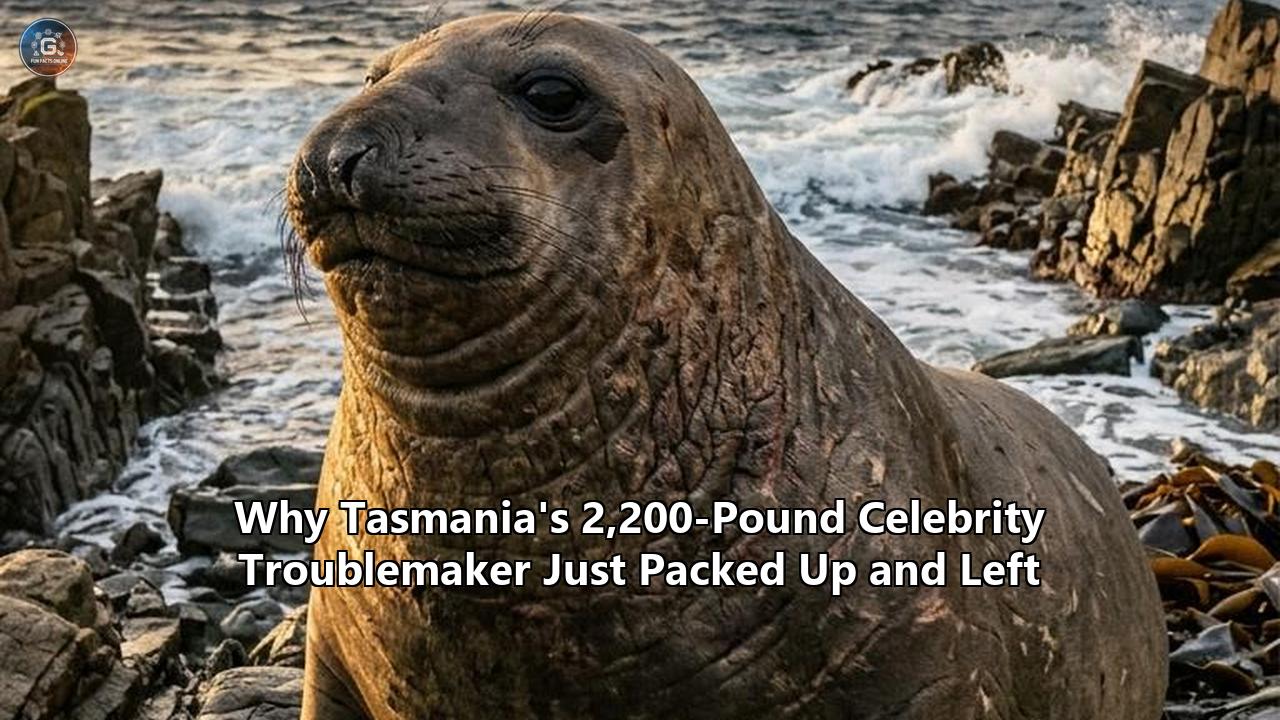
The cold, turquoise waters of the Mercury Passage and the windswept shorelines of Hobart’s southern suburbs are quiet once again. Sometime during the second week of July 2026, without so much as a parting splash of his massive hind flippers, Neil—the 1,000-kilogram (2,200-pound) southern elephant seal who has spent the last several years delighting and disrupting the island state of Tasmania—slipped back into the Southern Ocean. Behind him, he left a trail of dented metal, flattened plastic, and a human population deeply divided over how to handle a wild animal that has become an international internet celebrity.
To his 1.7 million followers on TikTok, Neil is a lovable, unbothered mascot of coastal rebellion—a bulbous "slug" who sleeps on highways, crushes traffic cones, and pickets the driveways of suburban homes. But to the scientists who track him, the local residents who have found themselves trapped inside their houses by a literal ton of blubber, and the government officials tasked with keeping both safe, Neil’s latest departure brings a complicated mix of relief and growing anxiety.
At five and a half years old, Neil is still essentially a teenager in elephant seal terms. He is currently the size of a small car. If he survives the hazards of the open ocean and reaches breeding maturity over the next five years, he could easily grow to five meters (16 feet) in length and weigh up to 4,000 kilograms (8,800 pounds).
As the quiet of the Tasmanian winter settles back over Seven Mile Beach and the Tasman Peninsula, researchers and policymakers are using Neil’s temporary absence to grapple with an urgent, looming question: What happens when a 2,200-pound celebrity troublemaker returns to town weighing four times as much?
The Summer of Our Discontent: Anatomy of a Subadult Tantrum
Neil’s winter 2026 "haul-out"—the biological term for when seals pull themselves out of the water to rest, shed their fur, and molt—was his most chaotic on record. Emerging from the surf in early June, the subadult male immediately made it clear that he had no intention of staying on the wild, isolated beaches where seals normally congregate. Instead, he gravitated toward the concrete, asphalt, and manicured lawns of Hobart's residential fringes.
For six weeks, Neil’s daily activities played out like a slow-motion demolition derby. In Hobart’s suburbs, residents found their daily commutes indefinitely delayed. Rebecca Thomson, a Hobart local, recalled an encounter in late June when she went down to the beach to see if the rumors of Neil's return were true.
"I heard he was back, but I didn't expect to turn around in the parking lot and find him right there," Thomson said. "It’s like this giant, wet, blubbery slug coming at you at a surprisingly fast clip. It was thrilling and incredibly funny, but when he leaned his entire body weight against a nearby van and started rocking it, you realized just how much raw power is packed into that frame."
Thomson’s experience was far from unique. During his latest six-week stay, Neil:
- Dismantled several heavy-duty roadside bollards.
- Successfully body-slammed and dented a parked Toyota Land Cruiser.
- Flattened dozens of orange traffic cones placed by authorities to cordoned him off.
- Climbed over and subsequently destroyed a timber fence belonging to a suburban residence.
- Napped directly in front of garage doors, effectively trapping homeowners inside.
Neil the Seal's Growth & Projected Trajectory
===================================================
Year   | Age (Yrs) | Est. Weight (kg) | Est. Weight (lbs)
---------------------------------------------------
2020   | Pup (0)   | 40 kg            | 88 lbs (Birth/Rescue)
2022   | Subadult  | 300 kg           | 660 lbs (First major Hobart molt)
2023   | Subadult  | 600 kg           | 1,320 lbs (Yard napping incident)
2026   | Subadult  | 1,000 kg         | 2,200 lbs (Current weight)
2032*  | Mature    | 4,000 kg*        | 8,800 lbs* (*Projected adult max)
The viral nature of these encounters turned Neil into a global phenomenon. TikTok compilations of him "arguing" with plastic cones or resting his chin on garden sheds gathered tens of millions of views. Local businesses in southern Tasmania cashed in on the craze, featuring Neil’s likeness in tourism pamphlets and insurance advertisements.
Yet, beneath the whimsical social media veneer lies a biological reality that is much less humorous.
"The public sees a giant, goofy animal playing with toys," says Dr. Sophia Volzke, a marine and Antarctic ecologist at the University of Tasmania who has spent the last five years studying southern elephant seal behavior. "But from a behavioral science perspective, Neil isn't playing. He is practicing for a brutal, highly competitive future that he may not even survive."
Rehearsing for the Harem: The Science of Seal Aggression
To understand why Neil treats roadside infrastructure as a personal gym, one must look at the extreme evolutionary pressures faced by male southern elephant seals (Mirounga leonina).
Southern elephant seals are among the most sexually dimorphic mammals on Earth. While adult females rarely exceed 900 kilograms (2,000 pounds), mature beachmasters—the dominant bulls who control the breeding harems—can weigh up to four metric tons. To earn the right to mate, a male must fight his way to the top of a brutal hierarchy. These battles are bloody, chest-to-chest wrestling matches where bulls slam their massive bodies against one another and use their canine teeth to rip open competitors’ necks.
It is a high-stakes winner-take-all system. A single dominant beachmaster will control a harem of up to 100 females, while the vast majority of males—nearly 90 percent—will never reach breeding age or sire offspring.
"Right now, Neil is five years old," Dr. Volzke explains. "In the wild, on a subantarctic island like Macquarie Island, a male of his age would be surrounded by other young bulls. They would spend their haul-out periods play-fighting, sparring, and testing their strength against one another in the shallow surf. It is how they build the muscle density, cardiovascular stamina, and combat instincts required for adulthood."
But Neil is entirely alone.
"Because there are no other juvenile elephant seals on the beaches of southern Tasmania, Neil has had to improvise," says Volzke. "The street signs, the parked cars, the wooden fences, and the traffic cones are his sparring partners. When he slams his chest into a Toyota Land Cruiser, he isn't being 'naughty'—he is rehearsing the physical dominance displays that his genetics tell him are necessary for his survival."
This behavior also explains his strange affinity for traffic cones. During his annual molt, an elephant seal sheds not just its fur, but its entire outer layer of skin, a process that is highly itchy and physically uncomfortable.
"The plastic traffic cones provide the perfect combination of rigidity and flexibility," Volzke notes. "He uses them as scratching posts to help peel away the dead skin. What looks to us like a funny game of keep-away is actually a highly functional, self-soothing hygienic practice."
The Accidental Tasmanian: Neil’s Unusual Homing Instinct
How did a creature native to the subantarctic end up making Hobart’s suburban streets his personal playground? The answer lies in a combination of biological programming and a series of accidental events that occurred in late 2020.
Under normal circumstances, the southern elephant seals of the southwestern Pacific are born on Macquarie Island, a jagged, UNESCO World Heritage-listed outpost of green rock and black sand located roughly 1,500 kilometers (930 miles) south of Tasmania. It is home to roughly 10% of the global elephant seal population.
In late 2020, however, a pregnant female elephant seal arrived on the shores of Salem Bay, a rural inlet on the Tasman Peninsula.
"We suspect she was a young, first-time mother," says Clive McMahon, a research ecologist at the Sydney Institute of Marine Science who has tracked elephant seals for decades. "She likely miscalculated her migration timing, realized she couldn't make it back to Macquarie Island in time to give birth, and hauled out on the nearest hospitable beach. That beach happened to be in Tasmania."
Out popped Neil.
In the last forty years, only a handful of elephant seal births have been recorded on the Tasmanian mainland. From his very first breath, Neil’s life was atypical. Shortly after his birth, high tides and rough swells threatened to sweep the tiny, 40-kilogram pup out into the deep ocean before he had developed enough blubber to survive. Tasmanian wildlife officers were forced to intervene, physically rescuing the pup and moving him to safer ground.
This early exposure to humans, combined with the absence of his own species, deeply altered Neil’s cognitive map.
"Elephant seals possess an incredibly powerful homing instinct," McMahon explains. "They are biologically hardwired to return to the exact beach where they were born to molt, rest, and eventually mate. Neil is simply doing what every good elephant seal is programmed to do. He is returning to his birthplace. The tragedy of the situation is that his birthplace is a highly populated human suburb."
By the time Neil was two years old, his seasonal returns to Hobart’s beaches were already becoming public spectacles. While other seals spend their lives avoiding human habitation, Neil associated the sights, sounds, and smells of suburban Tasmania with safety and home. He had become, through no fault of his own, the Accidental Tasmanian.
The Logistical Nightmare of Shifting a Giant
As Neil has grown from a 300-kilogram juvenile into a 1,000-kilogram subadult, the question of whether authorities should intervene and relocate him has sparked fierce debate. It is a conversation that highlights the stark limitations of modern wildlife management when applied to marine megafauna.
Tasmania’s wildlife authorities are no strangers to moving massive, stubborn, or dangerous animals. The state has a long and storied history of translocation programs designed to protect native species from disease, habitat loss, and human conflict.
However, there is a massive difference between terrestrial conservation operations and the logistics of managing a marine predator that weighs more than a ton. Under Tasmanian law, moving native animals is a highly regulated, legally complex process designed to minimize stress and prevent territorial displacement.
For example, the protocols surrounding a Tasmania giant wombat relocation—the colloquial term used by some conservationists to describe the delicate, state-sanctioned relocation of large Flinders Island wombats (Vombatus ursinus ursinus) to offshore sanctuaries—are incredibly strict. Wombats are highly territorial, and relocating them incorrectly can lead to fatal territory disputes with resident populations or extreme physiological stress.
Comparative Wildlife Relocation Metrics in Tasmania
========================================================================
Species              | Avg. Weight | Primary Capture Method | Relocation Stress Risk
------------------------------------------------------------------------
Tasmanian Devil      | 8–12 kg     | Baited Trap            | Moderate (territory disputes)
Flinders Wombat      | 25–40 kg    | Hand Netting / Gate    | High (territorial shock)*
Southern Elephant Seal| 1,000+ kg   | Physical Herding/Sled  | Extreme (hyperthermia/asphyxiation)
========================================================================
*Often referred to under regulatory frameworks such as a "Tasmania giant wombat relocation."
If a standard Tasmania giant wombat relocation—which involves moving a highly sensitive, 35-kilogram land mammal—requires months of environmental impact studies, veterinary oversight, and strict geographic isolation, the prospect of moving Neil is a logistical impossibility.
"You cannot simply put a 1,000-kilogram wild seal in the back of a utility vehicle," says Sam Thalmann, a senior wildlife biologist with the Department of Natural Resources and Environment Tasmania (NRE Tas). "In the past, when Neil was smaller, we were occasionally forced to relocate him short distances when he was being harassed by off-leash dogs or aggressive tourists. But even then, it required teams of officers, heavy-duty specialized sleds, and immense physical risk."
Thalmann points out that any attempt to execute a permanent Tasmania giant wombat relocation-style transfer for Neil to a remote island would likely fail. Unlike territorial land mammals that can be contained by predator-proof fencing, elephant seals are superb ocean navigators.
"If we drugged Neil, loaded him onto a ship, and dropped him off on a remote subantarctic island 1,000 kilometers away, he would likely beat the ship back to Hobart," Thalmann says. "He knows where home is. And because his biology demands that he return to his natal beach, he would simply swim right back to the suburbs. A permanent Tasmania giant wombat relocation approach simply does not work for a migratory marine mammal."
Furthermore, chemical sedation of elephant seals is incredibly dangerous. Because of their unique diving physiology, which allows them to dive to depths of over 2,000 meters and hold their breath for up to two hours, their respiratory systems are highly sensitive to anesthetics. A sedated elephant seal can easily suffer cardiovascular collapse or suffocate under its own immense body weight if its breathing is suppressed.
The Shadow of Freya: The Dangerous Reality of TikTok Fame
If relocation is off the table, and Neil refuses to leave of his own accord, then the burden of coexistence falls entirely on human shoulders. It is a burden that Hobart’s residents have not always carried gracefully.
During Neil’s June–July 2026 haul-out, local authorities grew increasingly alarmed by the behavior of the crowds flocking to see him. Despite near-daily warnings from NRE Tas urging the public to maintain a mandatory 20-meter (65-foot) distance, wildlife officers repeatedly observed onlookers committing highly dangerous stunts.
"We have seen some pretty silly, and frankly infuriating, behavior," said Kris Carlyon, a wildlife biologist with NRE Tas, during a press conference in Hobart. "People have been letting their dogs run off-leash near him, approaching him with small children to get selfies, and even trying to touch him while he is sleeping. Neil’s online fame is a double-edged sword. It builds a lot of public affection for marine life, but it also strips away the healthy fear that people should have of a large, wild predator."
"Neil's online fame is a double-edged sword. It builds a lot of public affection for marine life, but it also strips away the healthy fear that people should have of a large, wild predator."
— Kris Carlyon, NRE Tas Wildlife Biologist
For many conservationists, the situation in Tasmania bears a terrifying resemblance to the tragedy of Freya the Walrus.
In the summer of 2022, Freya, a 600-kilogram walrus, captured global attention when she began hauling out in the Oslo Fjord in Norway. Like Neil, she became an instant social media sensation, drawing massive crowds who routinely ignored safety warnings to get close to her. Despite repeated pleas from Norwegian scientists, the public refused to keep their distance. Citing an "imminent threat to human safety" caused by the uncontrollable crowds, the Norwegian Directorate of Fisheries made the controversial and widely condemned decision to euthanize Freya.
"We are desperately trying to avoid a Freya scenario here in Tasmania," says Dr. Volzke. "Neil is not an inherently aggressive animal. He is used to humans, and he mostly just wants to be left alone to sleep and scratch. But if someone corners him, or if a dog bites him, his natural defensive instinct will be to lash out. At 1,000 kilograms, a single defensive swipe of his neck or a bite from his jaws could be fatal. If Neil hurts a human, the political pressure to euthanize him will be immense."
The Policy Battle: Legislation vs. "Common Sense"
The growing friction between Neil’s safety and public interest has sparked a political debate in the Tasmanian Parliament.
In early July 2026, as Neil’s antics reached a fever pitch, an online petition garnering over 60,000 signatures was presented to the state government. The petition called for the immediate drafting of emergency legislation to establish "temporary restricted access zones"—essentially mobile exclusion zones that would legally prohibit anyone other than authorized scientists and wildlife officers from coming within 30 meters of Neil wherever he chooses to haul out.
Under the proposed laws, violating Neil’s personal space would carry on-the-spot fines of up to $5,000 AUD, aligning Tasmania’s marine protection laws more closely with the strict regulations enforced in neighboring Victoria.
However, Tasmanian Premier Jeremy Rockliff quickly poured cold water on the idea of passing seal-specific legislation.
"We don't need to legislate for common sense," Premier Rockliff told reporters when questioned about the petition. "The public knows the rules. The department has clear guidelines. We just need people to do the right thing, keep their distance, and let Neil be a seal."
The Legislative Divide: Protecting Neil the Seal
========================================================================
Pro-Legislation Camp (Scientists/Conservationists)
------------------------------------------------------------------------
* Demand legally enforceable 30-meter mobile exclusion zones.
* Propose on-the-spot $5,000 AUD fines to deter selfie-seekers.
* Argument: Public complacency is an existential threat to the animal.

State Government Camp (Premier Jeremy Rockliff)
------------------------------------------------------------------------
* Rejects new laws, citing existing wildlife protection acts.
* Advocates for public education and "common sense" compliance.
* Argument: Government should not legislate individual behavior on beaches.
========================================================================
The Premier’s stance has drawn sharp criticism from the scientific community, who argue that relying on "common sense" has already proven to be a failure.
"If common sense worked, we wouldn't have parents holding their toddlers next to a one-tonne marine predator for a photo," says Dr. Volzke. "Wildlife management cannot rely on the best behavior of the public, especially in the age of social media, where the incentive for viral content overrides personal safety. We need legal teeth to protect this animal before it is too late."
The Horizon: Preparing for a Four-Ton Future
For now, the debate has been put on ice. With his annual molt completed and his energy reserves replenished, Neil has returned to the vast, cold expanse of the Southern Ocean. He will likely spend the next several months diving to incredible depths, feeding on squid and fish, and rebuilding the blubber layer he lost during his six weeks on land.
But his departure is only a temporary intermission.
"He will be back," says Clive McMahon with absolute certainty. "In late spring or early summer, he will haul out again to rest. And when he does, he won't be 1,000 kilograms anymore. He will be bigger, stronger, and his hormones will be driving him even harder."
The challenge facing Tasmania is one of ecological translation. The island state prides itself on its pristine wilderness and its unique relationship with its endemic fauna. It is a place where people co-exist with pademelons on their lawns, eastern quolls in their gardens, and wombats in their national parks.
But Neil represents a different frontier of coexistence—one that forces a modern, urbanized society to accommodate the raw, disruptive reality of Pleistocene-scale megafauna in its driveways.
As Tasmania enjoys a brief, quiet respite from its most famous troublemaker, the clock is ticking. The state has roughly six months to decide whether it will implement the structural protections, exclusion zones, and public education campaigns needed to secure Neil’s safety—or whether it will continue to watch, amused and anxious, as a viral superstar slowly outgrows the human world he has chosen as his home.
Reference:
- https://www.abc57.com/news/this-chaotic-2-000-pound-seal-has-returned-to-sea-but-leaves-behind-a-conundrum
- https://kioncentralcoast.com/news/national-world/cnn-world/2026/07/10/this-chaotic-2000-pound-seal-has-returned-to-sea-but-leaves-behind-a-conundrum/
- https://www.express.co.uk/news/world/2226028/massive-elephant-seal-goes-rampage
- https://www.fodors.com/news/photos/this-week-in-travel-bison-attack-at-yellowstone-plane-window-incident-and-more
- https://www.futura-sciences.com/en/this-elephant-seal-just-cant-resist-traffic-cones-heres-the-unexpected-reason-why_35579/
- https://www.straitstimes.com/asia/australianz/1000kg-neil-the-seal-returns-to-tasmania-resumes-war-on-bollards-and-traffic-cones
- https://timesofindia.indiatimes.com/etimes/animals/who-is-neil-the-1-tonne-elephant-seal-and-tasmanias-reigning-troublemaker-winning-hearts-across-social-media/articleshow/132175736.cms
- https://en.wikipedia.org/wiki/Neil_the_Seal
- https://www.reddit.com/r/tasmania/comments/1uoik9x/neil_the_seal_is_1_tonne_right_now_what_happens/
- https://time.com/6550164/neil-the-seal-tasmania-background-instagram-tiktok/
- https://a-z-animals.com/articles/how-neil-the-seal-became-tasmanias-most-beloved-troublemaker/
- https://nre.tas.gov.au/wildlife-management/living-with-wildlife/living-with-wombats
- https://www.discoverwildlife.com/animal-facts/mammals/tasmania-maria-island-wild-wombats
- https://nre.tas.gov.au/wildlife-management/fauna-of-tasmania/mammals/possums-kangaroos-and-wombats/wombat