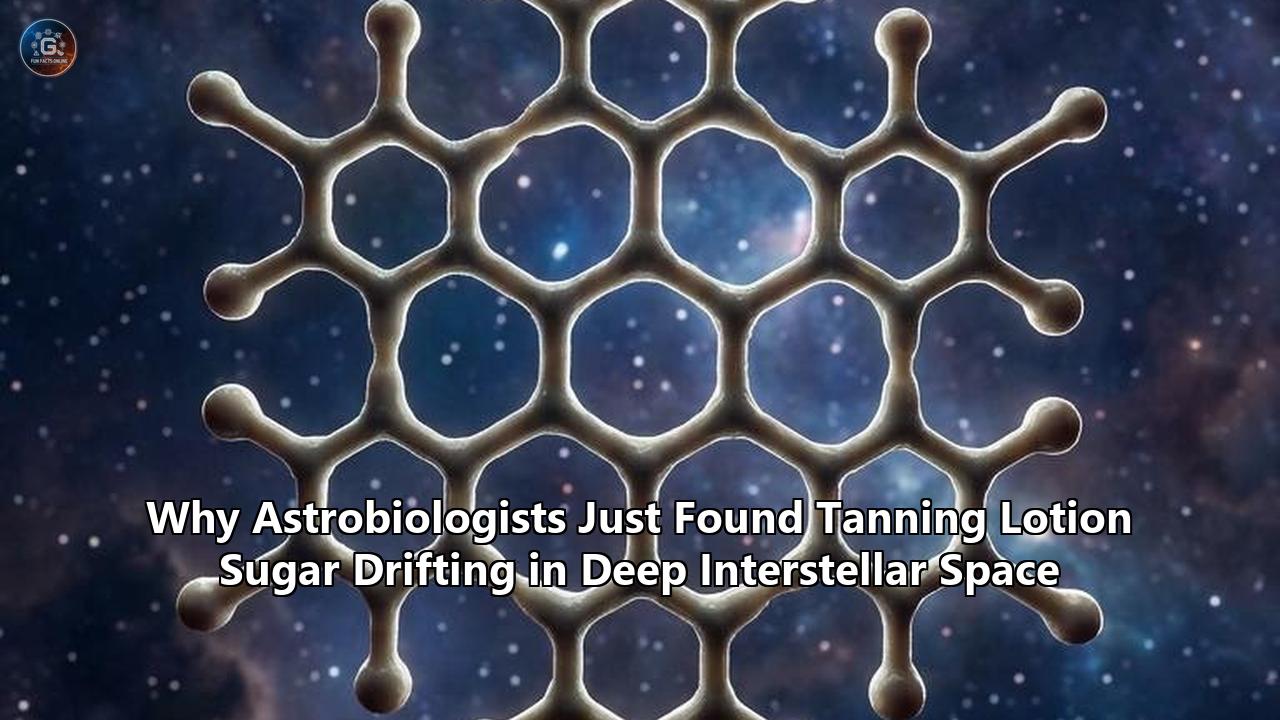
Deep inside a freezing, radiation-swept molecular cloud 26,700 light-years away, astrochemists have detected a chemical compound best known on Earth for giving skin a faux summer glow and sweetening wild raspberries.
An international research team led by Dr. Izaskun Jiménez-Serra at the Spanish Centre for Astrobiology (CAB, CSIC-INTA) confirmed the detection of erythrulose—a complex, four-carbon monosaccharide ketose ($C_4H_8O_4$)—in the massive interstellar gas cloud G+0.693−0.027, situated near the supermassive black hole at the core of the Milky Way. Published in Nature Astronomy, the discovery marks the confirmed detection of a four-carbon carbohydrate monosaccharide in deep interstellar space.
The finding carries a chemical anomaly that has inverted long-held assumptions in astrochemistry. For decades, numerical models predicted that complex organics in space grow through bottom-up, stepwise additions of single carbon atoms ($C_1 \to C_2 \to C_3 \to C_4$). Under that logic, three-carbon sugars like dihydroxyacetone (the active ingredient in most commercial self-tanners) and glyceraldehyde should be vastly more abundant than four-carbon sugars. Instead, the ultra-sensitive spectral survey turned up zero traces of those three-carbon precursors. Erythrulose was detected outright, proving to be at least eight times more abundant than its simpler three-carbon analogs.
The discovery establishes that the chemical machinery responsible for assembling life’s fundamental metabolic carbohydrates operates at temperatures hovering near absolute zero, long before stellar accretion disks collapse into rocky planets.
Understanding how this self-tanning sugar assembled in the void requires examining competing models of cosmic synthesis, divergent observational technologies, and the enduring debate over whether the building blocks of life originated in planetary hydrothermal systems or were seeded from the stars.
The Core Finding: Erythrulose in Cloud G+0.693−0.027
To make the detection, the researchers pointed two of Europe’s premier single-dish radio observatories—the Yebes 40-meter radio telescope in Guadalajara, Spain, and the IRAM 30-meter telescope on Pico Veleta in the Sierra Nevada mountains—toward G+0.693−0.027.
+-----------------------------------------------------------------------------------------+
|                                 DISCOVERY AT A GLANCE                                   |
+--------------------------+--------------------------------------------------------------+
| Detected Molecule        | Erythrulose (C4H8O4, 1,3,4-trihydroxybutan-2-one)            |
| Molecular Classification | 4-Carbon Ketose Monosaccharide (14 Atoms)                    |
| Target Location          | Giant Molecular Cloud G+0.693−0.027 (Galactic Center)        |
| Distance from Earth      | ~26,700 Light-Years                                          |
| Primary Facilities       | Yebes 40-m & IRAM 30-m Radio Telescopes                      |
| Spectral Evidence        | 12 Unblended Rotational Emission Transitions                |
| Key Anomaly              | C4 Sugar detected; C3 Sugars (Dihydroxyacetone) undetected   |
| Estimated Terrestrial    | 0.5 to 50 Million Metric Tons during Late Heavy Bombardment  |
| Deposition               |                                                              |
+--------------------------+--------------------------------------------------------------+
G+0.693−0.027 is a giant molecular cloud containing thousands of solar masses of cold gas and dust. Unlike classic star-forming nurseries such as the Orion Nebula or IRAS 16293-2422, G+0.693 is quiescent. It lacks internal protostellar heating engines. The dust grains remain at a frigid 10 to 20 Kelvin (−263 °C to −253 °C), while low-velocity large-scale shocks—triggered by cloud-cloud collisions within the Central Molecular Zone—gently sputter molecules off interstellar ice grains into the gas phase without destroying their fragile bonds.
By matching observed radio emission peaks against high-precision rotational spectra cataloged at the University of the Basque Country, the team matched 12 distinct, unblended rotational transitions belonging to erythrulose.
With 14 constituent atoms and 4 oxygen atoms, erythrulose represents the largest non-cyclic organic molecule with oxygen detected in deep space to date. It also stands as only the second chiral molecule ever discovered in the interstellar medium, following the 2016 detection of propylene oxide in Sagittarius B2(N).
Competing Chemical Pathways: Stepwise Carbon Addition vs. Modular Block Assembly
The detection of erythrulose alongside the non-detection of three-carbon trioses forces a critical reassessment of interstellar reaction mechanisms. Two competing chemical frameworks attempt to explain how large organic molecules form in molecular clouds.
                              COMPETING CHEMICAL MODELS

MODEL 1: Sequential Carbon Addition (Top-Down / Stepwise)
[ C1: Formaldehyde ]  --->  [ C2: Glycolaldehyde ]  --->  [ C3: Dihydroxyacetone ]  --->  [ C4: Erythrulose ]
                                                          (Predicted High)                 (Predicted Low)
                                                                 X                                |
                                                           NOT DETECTED                    CONFIRMED DETECTED

MODEL 2: Modular "Lego-Block" Dimerization (Ice Grain Mantles)
[ C2: Glycolaldehyde ] + [ C2: Ethylene Glycol / Radical ]  ======================>  [ C4: Erythrulose ]
(Abundant on Ice)        (Abundant on Ice)                     Direct Dimerization     (Abundant in Gas)
The Classical Model: Sequential Carbon Addition
The traditional bedrock of astrochemical modeling has long been sequential radical addition. In this scheme:
- A single-carbon ($C_1$) precursor, such as formaldehyde ($H_2CO$) or a methyl radical ($CH_3$), binds to a dust grain surface.
- Successive hydrogen-addition and carbon-insertion steps build molecules one carbon atom at a time:
$$C_1 \xrightarrow{+C} C_2 \ (\text{Glycolaldehyde}) \xrightarrow{+C} C_3 \ (\text{Glyceraldehyde / Dihydroxyacetone}) \xrightarrow{+C} C_4 \ (\text{Erythrulose})$$
- Because each sequential reaction step has an efficiency ceiling governed by surface diffusion and reactant encounter probabilities, molecular abundances were universally expected to drop exponentially with each added carbon.
In typical gas-grain models, adding a carbon atom decreases column density by roughly one order of magnitude. If erythrulose formed via this pathway, astronomers should have observed dihydroxyacetone and glyceraldehyde at concentrations 5 to 10 times higher than erythrulose. Instead, deep integration runs produced column density upper limits proving that $C_3$ sugars are at least eight times less abundant than erythrulose in G+0.693−0.027. The classical sequential model fails to replicate these observations.
The Modular Dimerization Model: Ice-Mantle Coupling
To resolve the discrepancy, quantum chemical calculations conducted by collaborator Dr. Juan García de la Concepción and laboratory ice-analogs run at Radboud University revealed an alternative mechanism: modular block assembly.
Rather than building one carbon at a time, the chemistry leverages the high abundance of two-carbon ($C_2$) reservoirs frozen onto the sub-micron silicate and carbon grains:
- Abundant Precursors: Glycolaldehyde ($HCOCH_2OH$) and ethylene glycol ($(CH_2OH)_2$) are exceptionally abundant in interstellar ice mantles.
- Radical Recombination: Cosmic rays penetrate deep into the dark cloud, dissociating hydrogen atoms from these frozen $C_2$ reservoirs to generate reactive 2-hydroxyethyl and formylmethyl radicals.
- Barrierless Radical-Radical Coupling: When two $C_2$ radicals diffuse and meet on the ice surface at 10 K, they undergo barrierless radical-radical recombination:
$$\text{C}_2\text{H}_3\text{O}_2^\bullet + \text{C}_2\text{H}_5\text{O}_2^\bullet \longrightarrow \text{C}_4\text{H}_8\text{O}_4 \quad (\text{Erythrulose})$$
Because G+0.693 contains massive reserves of $C_2$ species but lacks efficient routes to assemble $C_1 + C_2$ intermediates at low temperatures, the cloud acts as a selective molecular factory. It bypasses the $C_3$ triose stage entirely, favoring the direct dimerization of $C_2$ building blocks into $C_4$ tetroses.
Terrestrial Synthesis vs. Exogenous Seeding: The Prebiotic Origin Debate
The confirmation of a four-carbon sugar in interstellar space directly impacts the central dispute in origin-of-life biochemistry: Did the essential carbohydrates of early life emerge from endogenous geochemical processes on Earth, or were they manufactured in deep space and delivered via impactors?
+--------------------------------------------------------------------------------------------------------+
|                                  PREBIOTIC ORIGINS: COMPETING PARADIGMS                                |
+------------------------------+------------------------------------+------------------------------------+
| Parameter / Feature          | Endogenous Geochemical Synthesis   | Exogenous Interstellar Delivery    |
+------------------------------+------------------------------------+------------------------------------+
| Primary Environment          | Hydrothermal vents, alkaline pools | Interstellar ice grains, comets    |
| Primary Reaction Engine      | Classical Formose Reaction         | Cosmic-ray radical recombination   |
| Major Biochemical Bottleneck | "Asphalt Problem" (destructive tar)| Survival through atmospheric entry |
| Direct Evidence Base         | Laboratory analog simulations      | Direct radio detection & meteorites|
| Catalytic Requirements       | High pH, borate/mineral catalysts  | Cold grain surface catalysis (10K) |
| Sugar Selectivity            | Highly chaotic, wide distribution  | Selective (favors specific dimers) |
+------------------------------+------------------------------------+------------------------------------+
The Endogenous Dilemma: The Formose Reaction and the "Asphalt Problem"
For over a century, the primary candidate for terrestrial sugar formation has been the Formose Reaction, discovered by Aleksandr Butlerov in 1861. In alkaline aqueous solutions, formaldehyde ($H_2CO$) undergoes auto-condensation to form glycolaldehyde, glyceraldehyde, dihydroxyacetone, tetroses, and eventually pentoses like ribose.
However, the Formose reaction presents severe geochemical challenges:
- Uncontrolled Combinatorial Explosion: The reaction does not stop at useful four- or five-carbon sugars. It rapidly polymerizes into an intractable, brown, complex polymer mixture often called prebiotic "asphalt" or tar.
- Chemical Fragility: Sugars are notoriously unstable in hot, aqueous conditions. Ribose and erythrulose degrade in minutes under typical alkaline hydrothermal vent conditions unless stabilized by rare borate or silicate minerals.
- Primordial Atmosphere Constraints: Early Earth's atmosphere was predominantly $CO_2$ and $N_2$ (neutral to weakly reducing), which limits the natural production of high concentrations of formaldehyde required to ignite the Formose reaction.
The Exogenous Solution: The Interstellar Reservoir
The direct detection of erythrulose in interstellar space provides an alternative mechanism that circumvents the asphalt problem. In cold molecular clouds, low temperatures and solid-state ice chemistry limit uncontrolled runaway polymerization. Molecules form, stabilize in cold grain matrices, and remain preserved in deep-freeze storage.
During the formation of our solar system 4.6 billion years ago, pristine molecular cloud material incorporated directly into comets, asteroids, and planetesimals.
During the Late Heavy Bombardment (4.1 to 3.8 billion years ago), a heavy flux of leftover planetesimals pelted the young Earth.
- Using measured column densities from G+0.693−0.027 and mass-accretion models for the early solar system, Dr. Jiménez-Serra’s team estimated that between 500,000 and 50,000,000 metric tons of erythrulose rained down onto Earth’s surface during this era.
- Rather than relying on a delicate, localized terrestrial reaction to synthesize initial carbohydrates, early Earth received a steady exogenous shower of pre-assembled, stable four-carbon sugars ready to participate in prebiotic nucleotide synthesis.
Observational Strategies: Single-Dish Spectroscopy vs. Interferometric Arrays
Detecting complex organic molecules in the distant reaches of the Milky Way is technically challenging. The discovery of erythrulose highlights the distinct advantages and operational tradeoffs between two primary radio astronomy methods: Large Single-Dish Observatories and Millimeter/Submillimeter Interferometer Arrays.
                           OBSERVATIONAL METHODOLOGIES

SINGLE-DISH SPECTROSCOPY (Yebes 40-m / IRAM 30-m)
+ Large beam covers extended, diffuse cloud emission
+ Broad instantaneous spectral bandwidth (up to 32 GHz)
+ No spatial spatial-filtering losses
- Lower spatial resolution (cannot resolve small proto-planetary disks)
- Susceptible to background continuum confusion

INTERFEROMETRIC ARRAYS (ALMA / NOEMA)
+ Ultra-high angular resolution (resolves down to milliarcseconds)
+ Pinpoints compact protostellar cores and circumstellar disks
- "Filters out" large-scale diffuse emission (spatial flux loss)
- Narrow instantaneous spectral windows increase total search time
The Advantage of Single Dishes for Diffuse Clouds
The discovery was achieved using the Yebes 40m and IRAM 30m telescopes rather than the Atacama Large Millimeter/submillimeter Array (ALMA), despite ALMA's superior collecting power and resolution. This choice reflects the distinct physics of the target cloud:
- Extended Molecular Emission: Giant molecular clouds like G+0.693−0.027 span tens of light-years. Their molecular gas is distributed across large angular areas on the sky. Single-dish telescopes possess wide primary beams (10 to 40 arcseconds), allowing them to collect and integrate photons across these massive, diffuse envelopes.
- The Spatial Filtering Problem in Interferometers: Interferometers like ALMA synthesize an aperture by correlating signals from dozens of individual antennas. While this yields extraordinary spatial resolution, it acts as a high-pass spatial filter. ALMA effectively "filters out" and discards emission that is smooth and extended over scales larger than its baseline beam, making large, quiescent molecular clouds almost invisible to high-resolution array configurations.
- Broadband Spectral Coverage: The receivers on the Yebes 40m (operating across the Q-band, 31.0–50.4 GHz) and IRAM 30m (3mm, 2mm, and 1.3mm bands) allow wide frequency sweeps. The team observed tens of gigahertz of spectrum in single runs, which is necessary to uncover multiple transitions of a complex asymmetric rotor like erythrulose.
The Role of Interferometers in Star Formation
Interferometers remain vital for observing compact, dense environments. When a molecular cloud collapses into a protostar and circumstellar disk (such as IRAS 16293-2422), the chemical footprint contracts into a region only a few hundred astronomical units across.
In those compact zones, single-dish beams suffer from beam dilution—the tiny signal is drowned out across a massive field of view. Interferometers isolate these compact, hot molecular cores, tracking how molecules synthesized in cold clouds survive incorporation into planetary accretion disks.
Spectroscopic Precision: Laboratory Microwave Benchmarking vs. Astrochemical Line Confusion
A key challenge in confirming a four-carbon sugar in interstellar space is the physics of molecular rotation.
A small, rigid diatomic molecule like carbon monoxide ($CO$) has only one moment of inertia. Its rotational energy states are spaced out, concentrating its emitted radio photons into a few bright, easily identifiable spectral lines.
CO (Carbon Monoxide - Rigid Diatomic)
Energy Levels: Simple, linear
Spectral Lines: Few, intense, easily isolated
[ Line 1 ] ------------ [ Line 2 ] ------------ [ Line 3 ]

ERYTHRULOSE (C4H8O4 - Asymmetric Rotor Polyatomic)
Energy Levels: Highly complex, 3 distinct moments of inertia + conformational twisting
Spectral Lines: Spread across thousands of faint transitions; severe line confusion
[| | || ||| || ||| | || |||| || || | ||| |||| || | || ||| | ||| ||||]
Erythrulose ($C_4H_8O_4$), by contrast, is an asymmetric rotor composed of 14 atoms. It can tumble and rotate along three distinct axes ($I_A \neq I_B \neq I_C$), and its hydroxyl ($-OH$) and carbonyl ($=O$) functional groups can adopt multiple three-dimensional shapes, or conformers.
Consequently, its emitted energy is diluted across tens of thousands of weak rotational transitions spanning centimeter to submillimeter wavelengths.
The Laboratory Calibration Phase
Astronomers cannot detect an asymmetric organic molecule in space without laboratory baseline data.
- Pure Synthesis and Vaporization: Pure samples of erythrulose were studied under vacuum at the University of the Basque Country.
- Frequency-Modulated Microwave Spectroscopy: Using broadband Chirped-Pulse Fourier Transform Microwave (CP-FTMW) spectrometers, physicists measured the precise transition frequencies of erythrulose vapor at low pressure.
- Quantum Mechanical Hamiltonian Fitting: The physical parameters—rotational constants ($A, B, C$) and centrifugal distortion parameters ($D_J, D_{JK}, D_K$)—were calculated to generate precise predictive catalogs of every possible rotational emission line across the radio spectrum.
Resolving Interstellar Line Blending
When looking toward the Galactic Center, radio telescopes encounter an extraordinarily crowded environment. The line of sight contains emission lines from hundreds of known species, including formamide, methanol, ethyl cyanide, thioformic acid, and vinyl alcohol.
+--------------------------------------------------------------------------------------------------------+
|                                LINE DECONVOLUTION: ISOLATING ERYTHRULOSE                               |
+--------------------------------------------------------------------------------------------------------+
| Observed Galactic Spectrum:                                                                            |
| 41.25 GHz: [=== Methanol ===]  [=== Vinyl Cyanide ===]  [? Mystery Peak ?]  [=== Formamide ===]        |
|                                                                                                        |
| MADCUBA-SLIM Modeling:                                                                                 |
| 1. Model all known molecules at Tex = 7.5 K                                                            |
| 2. Subtract known inventory from raw data                                                              |
| 3. Fit Erythrulose Hamiltonian: Match 12 unblended transitions (Frequencies, Velocities, Intensities)  |
|                                                                                                        |
| Outcome: Unambiguous statistical confirmation (Signal-to-Noise Ratio > 4.5σ per line)                 |
+--------------------------------------------------------------------------------------------------------+
To establish a verified detection, Dr. Jiménez-Serra and her team utilized the MADCUBA software package (specifically the Spectral Line Identification and Modeling tool, SLIM).
- Synthetic Catalog Matching: They simulated synthetic spectra for every previously identified molecule in G+0.693 at an excitation temperature ($T_{ex}$) of $\sim 7.5\text{ K}$, matching the cloud's cold, sub-thermal environment.
- Line Deconvolution: They removed blended features overlapping with known chemical emissions.
- Multi-Line Concordance: A genuine detection requires observing multiple clean lines whose intensities match the predicted quantum mechanical transition probabilities at that exact temperature. The team identified 12 pristine, unblended transitions with matching radial velocities ($\sim 68\text{ km s}^{-1}$), providing conclusive statistical confirmation.
The Carbohydrate Hierarchy: Trioses, Tetroses, and Pentoses in the RNA World
To contextualize the importance of erythrulose, we must compare its biochemical utility against other sugar families within the framework of the RNA World hypothesis—the theory that early life relied on ribonucleic acid (RNA) to store genetic information and catalyze biochemical reactions simultaneously.
                               THE PREBIOTIC SUGAR HIERARCHY

   TRIOSES (C3)                      TETROSES (C4)                      PENTOSES (C5)
   [Dihydroxyacetone]                [Erythrulose]                      [Ribose]
   [Glyceraldehyde]                  [Threose / Erythrose]              [Deoxyribose]
          |                                 |                                 |
   - Modern Glycolysis Hub           - Intermediary Building Block      - Genetic Backbone of RNA/DNA
   - Lipid Glycerol Core             - Capable of Forming TNA           - High Prebiotic Fragility
   - Undetected in G+0.693           - Confirmed Detected in G+0.693    - Ultimate Astrobiology Target
1. Trioses ($C_3$): Dihydroxyacetone and Glyceraldehyde
- Chemical Nature: Three-carbon monosaccharides. Dihydroxyacetone (DHA) is a ketotriose; glyceraldehyde is an aldotriose.
- Biological Role: DHA-phosphate and glyceraldehyde-3-phosphate are key intermediates in glycolysis and the pentose phosphate pathway. Glyceraldehyde provides the glycerol backbone required for phospholipids in cellular membranes.
- Astrochemical Status: Missing in G+0.693−0.027. While readily synthesized in liquid-phase terrestrial laboratories, their formation pathways appear suppressed or outcompeted in cold interstellar ices.
2. Tetroses ($C_4$): Erythrulose, Threose, and Erythrose
- Chemical Nature: Four-carbon monosaccharides. Erythrulose is the sole four-carbon ketose.
- Prebiotic Role: Tetroses serve as a critical bridge. In synthetic prebiotic chemistry, reaction of erythrulose or its aldehyde isomers with simple amidines leads directly to nucleobase precursors. Moreover, Threose Nucleic Acid (TNA)—an alternative genetic polymer using a four-carbon threose backbone instead of five-carbon ribose—pairs cleanly with RNA and DNA, exhibits higher chemical stability, and is regarded as a plausible evolutionary precursor to RNA.
- Astrochemical Status: Confirmed in the interstellar medium via erythrulose. Its presence proves that the cosmos can assemble the structural backbones needed for early genetic systems before planetary formation.
3. Pentoses ($C_5$): Ribose and Deoxyribose
- Chemical Nature: Five-carbon sugars.
- Biological Role: Ribose forms the structural backbone of ribonucleotides (ATP, RNA); deoxyribose forms DNA.
- Astrochemical Status: Not yet detected in the gas phase of interstellar space. Its complex structure, high atom count (15 atoms in cyclic forms), and distributed rotational partition function push it just past the sensitivity limits of current single-dish radio surveys.
Interstellar Space vs. Asteroidal Samples: Contrasting Cosmochemical Records
The discovery of a four-carbon sugar in interstellar space fills an observational gap between deep interstellar dust clouds and the physical meteorites recovered on Earth.
+--------------------------------------------------------------------------------------------------------+
|                                COSMOCHEMICAL RESERVOIRS COMPARED                                       |
+------------------------------+------------------------------------+------------------------------------+
| Feature / Characteristic     | Interstellar Medium (G+0.693)      | Carbonaceous Meteorites / Asteroids|
+------------------------------+------------------------------------+------------------------------------+
| Observational Technique      | Remote Millimeter Radio Astronomy  | Mass Spectrometry / Wet Chemistry  |
| Material Status              | Free-floating pristine gas         | Solid mineral matrices             |
| Thermal & Fluid History      | Frozen ices (10–20 K); no liquid   | Aqueous alteration (270–350 K)     |
| Detected Carbohydrates       | Glycolaldehyde, Erythrulose        | Ribose, Glucose, Arabinose, Lyxose |
| Secondary Alteration         | None (Pristine Primordial State)   | Heavy processing by liquid water   |
+------------------------------+------------------------------------+------------------------------------+
The Meteoritic Record: Ryugu, Bennu, and Murchison
Over the past decade, high-resolution laboratory analysis of the Murchison meteorite, alongside pristine samples returned by JAXA’s Hayabusa2 (from asteroid Ryugu) and NASA’s OSIRIS-REx (from asteroid Bennu), confirmed that small solar system bodies contain biological sugars, including ribose, arabinose, and xylose.
However, meteoritic evidence comes with an interpretive challenge: parent-body alteration.
Asteroids underwent thermal heating and aqueous alteration driven by the radioactive decay of short-lived isotopes like Aluminum-26 ($^{26}Al$) during the first few million years of the solar system. When ice inside an asteroid melted, liquid water flowed through the rock, driving complex secondary chemistry.
Consequently, scientists could not definitively determine whether the sugars found in meteorites were originally forged in the primordial interstellar cloud or synthesized later inside warm asteroidal groundwater.
The Interstellar Verdict
The detection of erythrulose in G+0.693−0.027 resolves this question.
Because G+0.693 is a pristine molecular cloud at 10 K with no stars, no liquid water, and no hydrothermal networks, complex sugars can clearly assemble in interstellar space via solid-state ice-mantle reactions alone.
Asteroids did not have to synthesize these complex organics from scratch; they inherited a rich inventory of sugars directly from the primordial solar nebula.
The Homochirality Problem: Asymmetry Between the Stars
Erythrulose possesses a crucial chemical property: chirality. It exists in two non-superimposable mirror-image forms: L-erythrulose and D-erythrulose.
       CHIRALITY IN ERYTHRULOSE

          CH2OH              CH2OH
          |                  |
       C = O              C = O
          |                  |
    H --- C --- OH    HO --- C --- H
          |                  |
          CH2OH              CH2OH

     D-Erythrulose      L-Erythrulose
     (Mirror Image)     (Mirror Image)
Life on Earth exhibits strict homochirality:
- Living organisms utilize almost exclusively D-sugars in nucleic acids (RNA and DNA).
- Living organisms utilize almost exclusively L-amino acids in proteins.
If you synthesize sugars in a standard laboratory flask, you obtain a strictly racemic mixture (a 50:50 balance of D- and L-enantiomers). How biology broke this symmetry remains an unsolved mystery in biochemistry.
Circular Polarization in Stellar Nurseries
The presence of chiral sugars in deep space supports the astrophysical origin of homochirality:
- Chiral Photoselection: In massive star-forming regions, synchrotron emission and scattering produce circularly polarized ultraviolet light (UV-CPL).
- Asymmetric Photolysis: Laboratory experiments show that irradiating a racemic mixture of chiral organics with circularly polarized light destroys one enantiomer slightly faster than the other, yielding a net enantiomeric excess (1% to 10%).
- Amplification: If interstellar dust grains harboring an initial enantiomeric imbalance were delivered to Earth, self-amplifying prebiotic reaction networks (such as the Soai reaction) could drive that slight imbalance toward 100% homochirality.
Confirming whether erythrulose in G+0.693 possesses an enantiomeric excess remains a technical frontier. Standard single-dish radio spectroscopy measures scalar energy transition frequencies, which are identical for both D- and L-enantiomers. Disentangling the enantiomeric ratio will require specialized three-wave mixing microwave techniques applied to returned astrophysical samples or advanced radio-polarimetric interferometry.
The Road Ahead: Next-Generation Telescopes and the Hunt for Interstellar Ribose
The detection of erythrulose shifts the baseline for what is chemically possible in the interstellar medium. The focus now turns to upcoming observatories and unresolved frontiers in astrochemistry.
+--------------------------------------------------------------------------------------------------------+
|                                NEXT-GENERATION ASTROCHEMISTRY ROADMAP                                  |
+--------------------------+-----------------------+-----------------------------------------------------+
| Facility / Project       | Operational Horizon   | Scientific Objective in Prebiotic Chemistry         |
+--------------------------+-----------------------+-----------------------------------------------------+
| SKA1-MID (Bands 5 & 6)   | Late 2020s            | Centimeter searches for Ribose (C5) and Glycerol    |
| ngVLA                    | Mid 2030s             | Ultra-deep imaging of large prebiotic rings in cores|
| ALMA Wideband Upgrade    | Late 2020s            | Doubling spectral bandwidth to deblend complex lines|
| Deep Ice Spectroscopy    | Ongoing (JWST)        | Identifying solid-phase sugar reservoirs on grains  |
+--------------------------+-----------------------+-----------------------------------------------------+
The Square Kilometre Array (SKA1-MID)
The biggest hurdle in moving from four-carbon sugars ($C_4$) to five-carbon sugars ($C_5$) like ribose is the partition function. As molecular weight grows, the strongest rotational transitions shift downward into lower microwave frequencies (5 to 25 GHz).
Current telescopes lack sufficient collecting area in this range to pull such faint signals out of background noise.
The Square Kilometre Array (SKA1-MID), currently under construction in South Africa, will change this dynamic:
- Band 5 (4.6–15.3 GHz) and Band 6 (15–24 GHz) will deliver unprecedented sensitivity at the exact centimeter wavelengths where large sugars emit.
- Simulations indicate that SKA1-MID can detect complex $C_5$ sugars like ribose and deoxyribose in G+0.693 in roughly a few hundred hours of integration time, testing whether the full carbohydrate backbone of RNA forms before stars ignite.
The Next-Generation Very Large Array (ngVLA)
Planned by the National Radio Astronomy Observatory (NRAO), the ngVLA will deploy 263 dish antennas across North America, operating between 1.2 and 116 GHz. With ten times the collecting area and spatial resolution of current arrays, ngVLA will bridge the gap between single-dish sensitivity and high-resolution imaging. It will allow researchers to track organic molecules as they travel from large-scale diffuse clouds directly into planet-forming accretion disks.
Cosmic Ingredients for Life
The discovery of a four-carbon tanning lotion carbohydrate floating in a deep galactic cloud demonstrates that complex, life-supporting chemistry is not unique to planetary environments.
The interstellar medium is an active chemical incubator where cold dust grains and cosmic rays assemble sophisticated, chiral sugars. The presence of erythrulose in the galactic core—paired with the surprising absence of smaller three-carbon sugars—rewrites our understanding of cosmic chemical synthesis, highlighting modular radical dimerization as a key driver of organic complexity.
As radio telescopes probe deeper into the galaxy's darkest clouds, the boundary between interstellar astrochemistry and the origins of life continues to narrow.
The molecules that seeded prebiotic reactions on the early Earth were not anomalous, isolated products of a young planet, but part of a broad cosmic inventory of sugar in interstellar space that remains distributed across the galaxy, ready to seed emerging worlds.
Reference:
- https://www.natureasia.com/en/info/press-releases/detail/9384
- https://www.sci.news/astronomy/sugar-interstellar-space-14913.html
- https://www.theguardian.com/science/2026/jul/13/natural-sugar-cloud-dust-gas-milky-way-erythrulose
- https://arxiv.org/pdf/2203.00534
- https://www.researchgate.net/publication/370820668_Amides_inventory_towards_the_G0693-0027_molecular_cloud
- https://www.researchgate.net/publication/371163660_Amides_inventory_towards_the_G0693-0027_molecular_cloud
- https://astrobiology.com/2026/07/13/sugar-erythrulose-discovered-in-interstellar-space/
- https://cdnsciencepub.com/doi/10.1139/cjc-2020-0319
- https://pubs.rsc.org/cs/article/52/21/7359/803911/The-protometabolic-nature-of-prebiotic-chemistry
- https://www.mdpi.com/2075-1729/9/4/84
- https://www.researchgate.net/publication/231058935_13-Dihydroxyacetone_in_Sagittarius_B2N-LMH_The_First_Interstellar_Ketose
- https://newtalk.tw/news/view/2026-07-15/1047315
- https://research.chalmers.se/publication/536330/file/536330_Fulltext.pdf
- https://en.wikipedia.org/wiki/Dihydroxyacetone
- https://astrobiology.com/2024/04/23/prebiotic-vitamin-b3-synthesis-in-carbonaceous-planetesimals-2/
- https://www.zmescience.com/space/astronomers-find-first-interstellar-sugar/
- https://www.facebook.com/10newsplus/videos/scientists-discover-sugar-in-deep-space-10-news/1324263112752781/