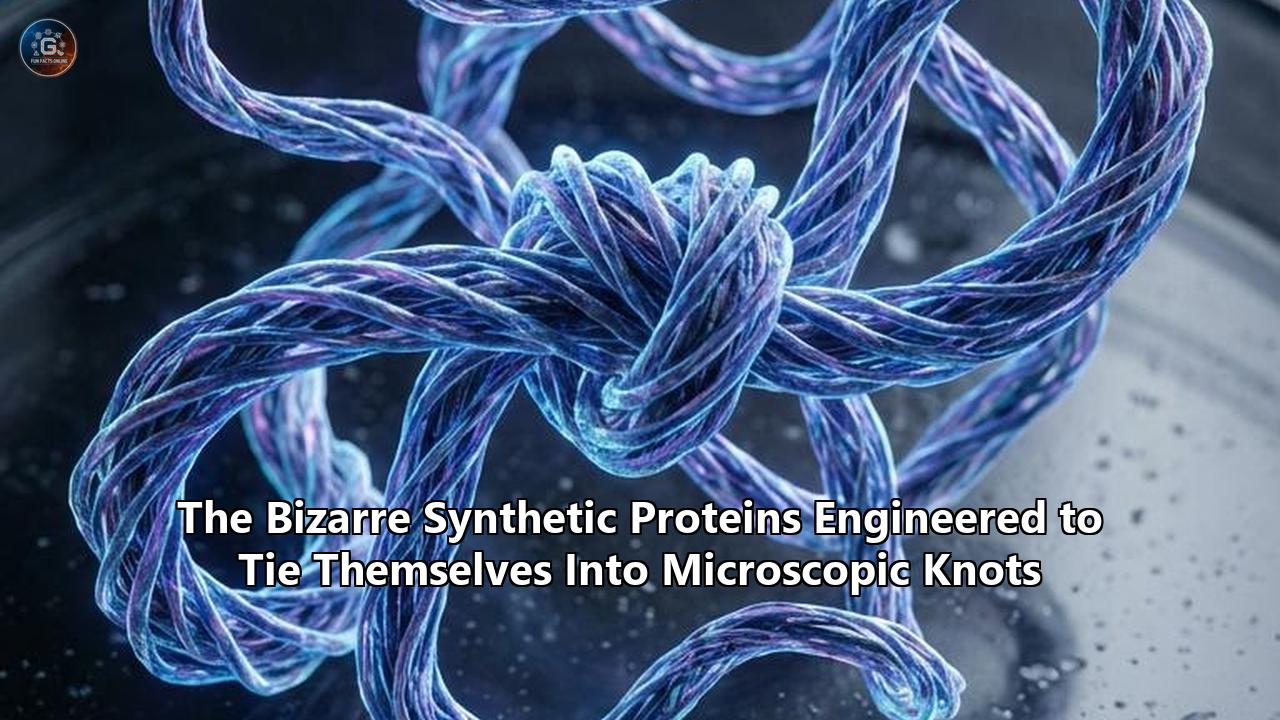
In March 2026, researchers published the results of an exhaustive series of Monte Carlo off-lattice simulations, finally isolating the precise mechanical forces that grant knotted molecules their near-indestructible nature. By separating the effects of chemical sequencing from pure geometric topology, the data proved what biochemists had long suspected: physical entanglement forces a molecule into a restricted energy valley, effectively trapping it in a stable state that resists extreme heat, chemical denaturants, and degradation. This simulation data arrived just months after an entirely separate team of structural biologists managed to freeze and photograph the exact millisecond a biological machine threaded an amino acid chain through its own loop to tie a microscopic knot.
Together, these developments have dismantled one of the most stubborn mysteries in structural biology. The scientific community is no longer just watching this physical impossibility occur in nature. The focus has abruptly shifted toward mass-production. Laboratories are now generating highly complex synthetic proteins engineered to knot themselves upon creation, turning nature's strangest geometric anomaly into a new class of molecular armor.
A typical protein folds much like a crumpled piece of paper. Driven by the hydrophobic effect, water-repelling amino acids collapse into a tight core while water-loving amino acids form a protective outer shell. The molecule slides down a thermodynamic funnel, testing various shapes until it settles into its lowest-energy, native state. It is a chaotic, rapid, and unguided process.
Knotted molecules defy this logic entirely. To tie a knot, one end of a linear string must actively thread the needle of an open loop. Without hands, eyes, or conscious direction, the molecular chain must weave through itself against the intense, vibrating chaos of Brownian motion. For decades, the existence of such structures was considered biologically paradoxical. Now, by reverse-engineering the forces that guide this self-entanglement, investigators are charting a new frontier in bioengineering.
The Shadow of a Tangle: The Mathematics of the Invisible
To understand how researchers are building these structures, you have to trace the investigation back to a fundamental mathematical conundrum. In strict mathematical topology, a knot can only exist within a closed loop. A shoelace with two open ends, no matter how terribly tangled, is mathematically unknotted because you can theoretically grasp both ends and pull them infinitely far apart until the string is straight.
Every single protein in existence is an open chain. They all have a starting point (the N-terminus) and an ending point (the C-terminus). By the strict laws of topology, protein knots cannot exist.
This technicality blinded researchers to their presence until 1994, when biophysicist Marc L. Mansfield developed a computational workaround. Mansfield realized that if you took a folded protein, projected an imaginary sphere around its center of mass, and connected the N- and C-termini to the surface of that sphere via virtual geometric lines, you could artificially close the loop. When he applied this algorithm to the newly digitized Protein Data Bank, an enzyme called Carbonic Anhydrase B suddenly registered as a topological knot.
Since Mansfield's discovery, mathematicians and physicists have refined how we detect these microscopic tangles. In 2017, physicists at the University of Bristol applied the abstract concept of "virtual knots" to protein structures. Instead of drawing arbitrary lines to close the molecule, they projected light through the 3D model of the protein from multiple different angles, creating two-dimensional shadows. By analyzing the sequence of over-and-under crossings in these shadows, they could mathematically prove the existence of a knot without altering the molecule's open-ended reality.
Today, we know that roughly one percent of all naturally occurring proteins contain a knot. These are classified by their depth. If a knot sits right at the end of the chain, requiring the removal of only a few amino acids to untangle, it is considered a shallow knot or a "slipknot." But if the knot is buried deep within the core of the molecule, with dozens of residues trailing on either side—making it utterly impossible to unravel by simply tugging the ends—it is classified as a deep knot.
The existence of deep knots forced a glaring question upon the biological community: how does the molecule reliably navigate the highly restricted conformational space required to thread its own loop?
Arresting the Machine: Catching a Knot in the Act
The sheer speed of molecular folding long prevented scientists from watching a knot form. Proteins synthesize and fold in a matter of milliseconds. Trying to observe the intermediate state of a threading event was like trying to photograph a bullet mid-flight using a nineteenth-century camera.
The breakthrough required sabotage. In late 2025, Dr. Shang-Te (Danny) Hsu and his research team at the WPI-SKCM² institute deployed an engineered ribosome arrest peptide to intentionally jam the cellular machinery.
Ribosomes are the factories of the cell, reading genetic code and extruding a linear chain of amino acids through a narrow exit tunnel. Hsu’s team focused on a specific molecule known to contain a 3_1 trefoil knot—a classic overhand knot with three essential crossing points. To catch it in the act of folding, they introduced the arrest peptide, which wedged itself into the ribosome and stalled the extrusion process precisely as the knot was being tied.
With the machinery locked in place, the researchers flash-frozen the sample in vitreous ice, plunging the temperature so rapidly that water molecules could not form damaging ice crystals. They then used cryo-electron microscopy (cryo-EM)—bombarding the frozen sample with electrons—to piece together a high-resolution, three-dimensional snapshot of the paused reaction.
The images revealed a startling mechanism. The nascent protein chain did not flop around randomly, hoping to accidentally slip through a loop. Instead, while still partially inside the restrictive ribosomal tunnel, the chain adopted a rigid, extended helical structure. This temporary helix acted like a stiffened needle, forcefully driving the trailing end of the protein through the loop before the entire structure collapsed into its final, stable form. Once the threading was complete, the temporary helix dissolved, its purpose fulfilled.
This visualization was the smoking gun structural biologists needed. It proved that knotting is not a thermodynamic accident; it is a highly choreographed sequence of kinetic events explicitly encoded into the amino acid sequence itself.
Hallucinating the Septoil: DeepMind’s Map of the Labyrinth
While experimentalists were freezing ribosomes to watch trefoil knots form, theoretical physicists were deploying artificial intelligence to map the outer limits of topological complexity. If nature could tie a three-crossing knot, what else was hiding in the biological dark matter?
Johannes Gutenberg University theoretical physicist Peter Virnau turned to AlphaFold, the deep learning system developed by Google’s DeepMind. AlphaFold had recently predicted the 3D structures of hundreds of millions of proteins based solely on their genetic sequences. Virnau and his colleagues built an algorithm to comb through this massive database, specifically hunting for complex topology.
They struck gold. Within the AlphaFold databank, they discovered nine entirely new knotted structures that had never been observed in a laboratory. Among them were previously unknown 5_1 and 5_2 knots (five essential crossings) and, most astonishingly, a 7_1 knot—a "septoil" knot featuring seven distinct crossing points, making it the most topologically complex knot ever identified in a biological molecule.
The AI also identified the first composite knots in proteins. These are structures where a single continuous string ties itself into two separate, independent knots—specifically, two distinct trefoil knots residing on the same molecular chain.
The evolutionary data surrounding these discoveries provided a crucial clue regarding their purpose. Knots are extraordinarily rare, yet they are highly conserved across millions of years of evolutionary history. "If a knotted protein exists, for example, in yeast, there is a high likelihood that it is also knotted in the corresponding protein in humans," Virnau observed. Evolution is ruthlessly efficient; it does not preserve a complex, energy-intensive, highly error-prone folding mechanism across hundreds of millions of years unless that mechanism provides a massive survival advantage.
The Laboratory Forges the Unfoldable
Understanding the evolutionary advantage of knots laid the groundwork for the next logical step: building them from scratch. As computational models grow more sophisticated, researchers are moving beyond the catalog of natural anomalies and explicitly designing synthetic proteins with topological features never before seen in biology.
The engineering of these molecules requires a mastery of "de novo" design—creating proteins entirely out of the imagination rather than tweaking existing biological templates. Researchers rely on advanced machine learning architectures, such as EvoDiff and RFdiffusion, to generate artificial sequences capable of threading themselves.
One of the most revealing attempts at this occurred at the University of Cambridge, where researchers utilized algorithms to design deeply knotted tandem repeat backbones. A tandem repeat protein is built by stringing together multiple identical structural motifs, creating highly symmetrical, predictable shapes. The Cambridge team attempted to force these repeats to tie themselves into two specific topologies: a 3_1 trefoil knot using three repeating units, and a 5_1 pentafoil knot using five repeating units.
Following the computational design, the team physically manufactured the amino acid sequences and observed their behavior in solution. The trefoil design was a complete success. X-ray crystallography confirmed that the synthetic chain had autonomously woven itself into the intended three-crossing configuration.
The pentafoil design, however, failed in an incredibly illuminating way. Despite possessing a perfectly five-fold symmetric genetic sequence, the protein could not navigate the massive energy barrier required to thread a loop multiple times. It misfolded. Two of the five repeating units adhered to the blueprint, but the remaining units diverged, collapsing inward to form local contacts. The resulting structure was asymmetrical and ultimately resolved into a simpler trefoil knot rather than the intended pentafoil.
This failure highlighted the delicate balance of the kinetic folding landscape. When an engineer designs a standard protein, they only have to worry about thermodynamic stability—making sure the final folded shape is the lowest energy state. But when designing knotted synthetic proteins, the engineer must also program a precise sequence of temporal events. If the loop closes a fraction of a millisecond before the tail has a chance to thread it, the molecule becomes trapped in a useless, misfolded state.
The Armor of Topology: Why Entanglement Equals Indestructibility
Why endure the immense computational and chemical friction required to build these structures? The answer lies in the findings published in March 2026 regarding kinetic stability.
Proteins are inherently fragile. They denature—unfolding and losing their function—when exposed to high temperatures, acidic environments, or chemical stressors. For decades, bioengineers have tried to stabilize proteins by introducing stronger chemical bonds, such as disulfide bridges, or by packing the hydrophobic core more tightly. These methods offer incremental improvements, but they hit a hard ceiling based on the limitations of chemistry.
Topology bypasses chemical limitations by utilizing mechanical trapping. In the March 2026 Monte Carlo simulations, researchers modeled the unfolding pathways of knotted chains versus unknotted chains. They discovered that a deep knot entirely alters the molecule's kinetic energy landscape.
When a standard protein is subjected to heat, the thermal energy causes the atoms to vibrate violently until the non-covalent bonds holding the shape together shatter. The molecule simply unravels into a useless string.
When a knotted protein is subjected to the same heat, its internal bonds also shatter. But the molecule cannot unravel. The physical constraint of the knot traps the protein chain. To fully denature, the trailing end of the molecule would have to perfectly re-thread itself backwards through the loop while under the chaotic assault of thermal vibration. The statistical probability of this happening is functionally zero. The molecule is kinetically trapped in a restricted energy valley.
Even if the internal chemical bonds are temporarily broken by an environmental stressor, the knot holds the overall architecture in close proximity. The moment the stressor is removed, the protein immediately snaps back into its active native state. Instead of relying solely on the fragile chemical bonds that dictate typical molecular architecture, these deeply knotted synthetic proteins rely on literal, physical entanglement to maintain their structure.
Lasso Peptides and the Clinical Frontier
The ability to predictably manufacture these tangles has transformed synthetic proteins into highly sought-after scaffolds for pharmaceutical development.
The most immediate application of this technology resides in a specific subclass of knotted molecules called lasso peptides. Produced naturally by certain strains of bacteria, lasso peptides are short, linear molecules that tie themselves into a permanent slipknot. Their unusual shape grants them extraordinary stability, and they naturally exhibit potent antibacterial, antiviral, and anti-cancer properties.
However, harvesting natural lasso peptides from bacteria is slow, expensive, and limits researchers to whatever sequences nature has already evolved. The clinical frontier requires custom-built lassos carrying specific drug payloads.
To achieve this, researchers needed to hijack the enzymes responsible for tying the knots. Lasso peptides do not fold themselves spontaneously; they require the collaboration of two specific enzymes—a peptidase and a cyclase. The linear peptide chain is fed into the cyclase, which mechanically loops the chain and seals the slipknot.
In late 2024, researchers from the University of Illinois Urbana-Champaign successfully mapped the structure of FusC, a highly elusive cyclase enzyme, using AlphaFold and another AI tool called RODEO. By pinpointing the exact active site residues where the enzyme grips the peptide substrate, the team modeled the exact biophysical interactions required to tie the lasso knot.
According to Diwakar Shukla, an associate professor of chemical and biomolecular engineering involved in the study, understanding how enzymes tie a lasso knot remains a deeply compelling question. "This study provides a first glimpse of the biophysical interactions responsible for producing this unique structure," he explained. Crucially, the research revealed that the molecular contacts used by FusC are highly conserved across different species and phyla, implying a generalizable model for knot-tying.
With the mechanics of the cyclase enzyme mapped, pharmaceutical engineers can now design custom therapeutic peptides, feed them to synthetic cyclase enzymes in a bioreactor, and force the enzymes to tie the drugs into protective slipknots.
The clinical implications are massive, specifically for oral drug delivery. Currently, most biologic drugs, including insulin and monoclonal antibodies, must be injected. If swallowed, the severe acidity of the human stomach and the aggressive digestive enzymes in the gastrointestinal tract will shred the delicate proteins before they can reach the bloodstream.
A tightly knotted peptide circumvents this biological defense system. The physical entanglement of the lasso prevents digestive proteases from accessing the vulnerable backbone of the molecule. The therapeutic payload survives the acid bath of the stomach, passes intact through the intestinal wall, and reaches the target receptor.
The Fraying Edges of Topological Engineering
The transition from biological curiosity to industrial application is accelerating. Beyond oral therapeutics, bioengineers are actively exploring the use of these hyper-stable scaffolds for environmental and industrial deployment.
Consider the global push to develop plastic-degrading enzymes. The enzymes currently capable of breaking down PET plastics are highly fragile and operate efficiently only within very narrow temperature and pH ranges, making them difficult to deploy in large-scale industrial recycling facilities. By grafting the active sites of plastic-eating enzymes onto deeply knotted topological scaffolds, researchers theoretically obtain catalysts capable of surviving boiling temperatures and highly corrosive industrial vats without denaturing.
Yet, the field remains at the edge of a vast, unmapped territory. The failure of the Cambridge pentafoil design serves as a persistent reminder that our generative AI models, while powerful, still struggle with the complex temporal dynamics of molecular folding. An algorithm can easily draw a 7_1 septoil knot on a computer screen, but engineering the biochemical environment necessary to force a physical string of carbon, nitrogen, and oxygen to successfully execute seven distinct over-and-under crossings remains an agonizingly complex challenge.
Furthermore, researchers are still uncovering exactly how the cell manages to degrade these indestructible molecules once their lifespan is complete. Recent studies on UCHL5, a naturally occurring protein featuring a complex 5_2 Gordian knot, show that specialized cellular machinery is required to recognize and process these tangled structures before they can be recycled by the proteasome. If scientists flood the human body, or the environment, with synthetic variants of these hyper-stable knots, they must also engineer a reliable off-switch—a mechanism to untie the knot when the drug has finished its job, preventing the buildup of indestructible molecular debris.
The investigation into the strange geometry of the microscopic world has proven that nature is capable of feats of engineering that defy conventional thermodynamics. We have successfully caught the biological machinery in the act of threading the needle, mathematically mapped the shadows of the resulting tangles, and begun to forge our own invincible molecules in the laboratory. For the burgeoning field of topological engineering, the eventual mastery over these molecular tangles will represent a definitive leap in how we conceptualize and construct synthetic proteins for real-world applications. The physical constraints of traditional chemistry have been reached; the next generation of materials will be defined not just by what they are made of, but by how tightly they are tied.
Reference:
- https://en.wikipedia.org/wiki/Knotted_protein
- https://arxiv.org/html/2603.12053v1
- https://wpi-skcm2.hiroshima-u.ac.jp/news/understanding-knotted-proteins-from-birth-to-degradation/
- https://physicsworld.com/a/physicists-identify-most-complex-protein-knots/
- https://www.repository.cam.ac.uk/items/ffa3cf5c-c806-4a14-b497-66550064de3a
- https://www.eurekalert.org/news-releases/1058803