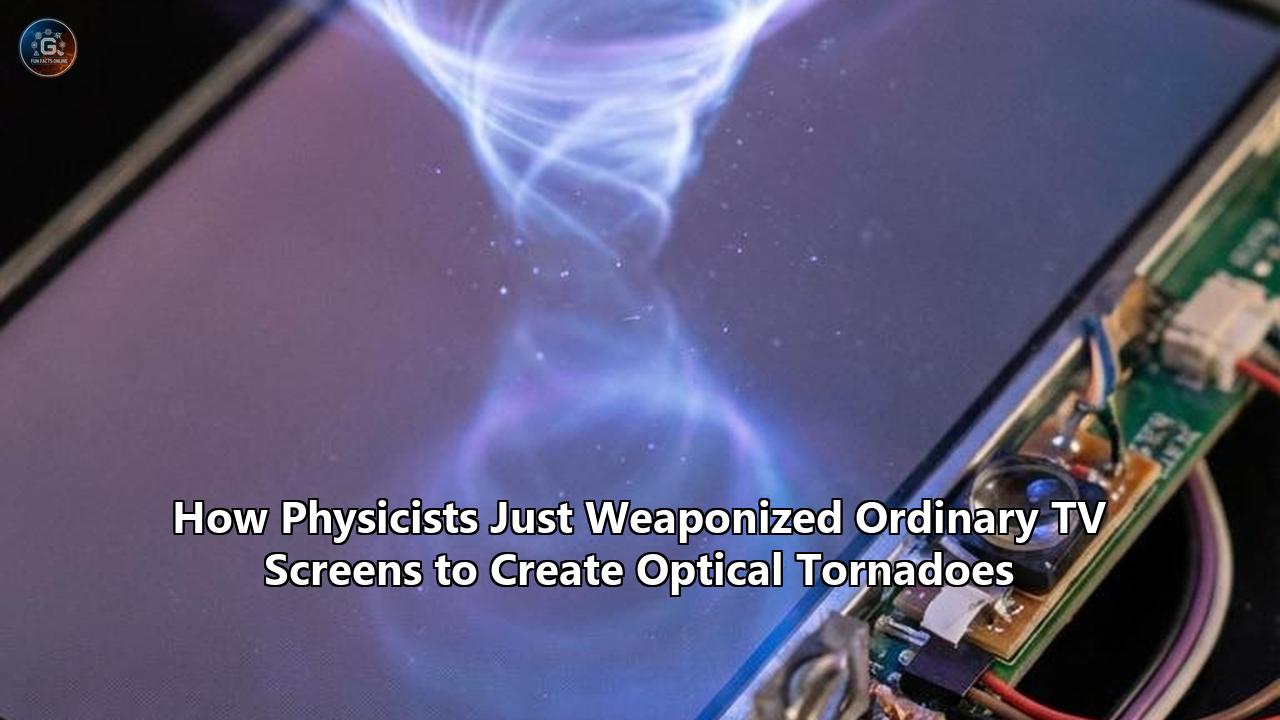
A surprising breakthrough in photonics has just emerged from an international collaboration of researchers who have successfully manipulated light to behave like a microscopic whirlwind. Scientists from the Faculty of Physics at the University of Warsaw, alongside teams from Poland’s Military University of Technology and the Institut Pascal CNRS in France, have managed to twist laser light into stable, swirling structures. By repurposing the same liquid crystal technology that powers ordinary television screens and smartphone displays, these physicists have generated optical vortices in a highly compact, tunable system.
The breakthrough, published recently, bypasses the massive optical tables and expensive nanoscale fabrication previously required to achieve this effect. Instead, the researchers induced self-organizing defects within liquid crystals—structures known as torons—to act as microscopic traps for photons. By combining these traps with an optical microcavity and engineering a synthetic magnetic field, the team forced the light to rotate continuously. Crucially, they achieved this swirling motion in the light's lowest-energy ground state, producing a stable, laser-like beam carrying orbital angular momentum.
This development immediately triggers a reevaluation of how we generate and control structured light. For years, the photonics industry has pursued complex metamaterials and static optical elements to encode information in the shape of a light beam. Now, the realization that an ordinary, commercially ubiquitous material can be weaponized to generate complex optical topologies forces a direct comparison between competing approaches to next-generation optical computing and quantum communication.
The Anatomy of an Optical Vortex: Spin vs. Orbital Angular Momentum
To understand why twisting light is a formidable challenge, one must first contrast the two distinct ways light can carry angular momentum. In classical optics, we are highly familiar with Spin Angular Momentum (SAM). SAM manifests as circular polarization—the property exploited by 3D cinema glasses and anti-glare filters. When light possesses SAM, the electric and magnetic fields rotate as the wave propagates, but the wavefront itself remains a flat, uniform plane. If an absorptive microscopic particle is caught in a circularly polarized beam, it will spin on its own axis, much like a planet rotating.
Orbital Angular Momentum (OAM) is a fundamentally different beast. In an optical vortex, the actual phase front of the light wave twists around the axis of propagation like a corkscrew or a fusilli pasta noodle. At the dead center of this twisting wave, the phase becomes completely undefined, causing the light waves to destructively interfere and cancel each other out. This creates a hollow ring of light with a dark singularity at its core. If a microscopic particle is caught in an OAM beam, it does not merely spin on its axis; it orbits the dark center of the beam, much like a planet revolving around a star.
Generating this orbital rotation typically requires forcing light through physically etched spiral phase plates or computer-generated holograms. These traditional tools operate on a brute-force approach, physically delaying one side of the wavefront relative to the other to induce the twist. The tradeoff with the brute-force holographic approach is rigidity. A spiral phase plate etched into glass is permanent; it can only produce a vortex with a specific "topological charge" (the number of twists per wavelength). If a telecommunications system requires rapidly switching between different topological charges to encode data, physical phase plates are entirely useless.
The Warsaw team's approach directly contrasts with these static methods by exploiting liquid crystals. Liquid crystals represent an intermediate phase of matter—they flow like liquids but maintain the oriented molecular structure of solid crystals. By trapping light within this medium, the researchers transitioned from the static realm of glass optics into the dynamic, tunable realm of electro-optics.
Nanofabrication vs. Self-Organization: A Clash of Methodologies
The generation of optical tornadoes physics researchers have dreamed of for decades has historically been constrained by manufacturing limits. Over the past ten years, the field of nanophotonics championed an alternative to bulky glass optics: metasurfaces. Metasurfaces are two-dimensional arrays of sub-wavelength structures—often microscopic silicon or titanium dioxide pillars—precisely positioned using electron-beam lithography. By carefully calculating the height and width of millions of nanoscale pillars, engineers can manipulate the phase of incoming light to twist it into a vortex.
The metasurface approach offers extreme precision and the ability to combine multiple optical functions (like focusing and twisting) into a film thinner than a human hair. However, this approach carries severe tradeoffs. Electron-beam lithography is notoriously slow, expensive, and difficult to scale to commercial manufacturing volumes. Furthermore, like the spiral phase plates, passive metasurfaces are completely static.
The new methodology pioneered by the University of Warsaw and the Military University of Technology relies on self-organization rather than top-down fabrication. Instead of meticulously etching millions of pillars, the team manipulated the inherent chemical behavior of liquid crystal molecules. They engineered specific defects within the material called torons.
As explained by the researchers, torons can be visualized as tightly twisted spirals of liquid crystal molecules, similar to the double helix of DNA. When the ends of this spiral are forced to join together, they form a closed loop resembling a doughnut. These self-assembling topological defects act as perfect optical traps. Because torons emerge naturally through the thermodynamic properties of the liquid crystal under specific boundary conditions, producing them does not require multi-million-dollar lithography machines. They self-assemble.
Comparing these two paradigms—top-down nanophotonics versus bottom-up liquid crystal self-assembly—reveals a stark divergence in the future of optical device design. Metasurfaces require absolute control over every atom, demanding sterile cleanrooms and rigid environments. The liquid crystal approach harnesses controlled chaos, utilizing the natural tendency of organic molecules to find stable configurations. More importantly, because liquid crystals respond to electrical currents—the exact mechanism that allows a television screen to change pixels from bright to dark—the dimensions of the toron trap can be dynamically adjusted using an external voltage. This creates a real-time, tunable vortex generator, a severe competitive advantage over static metasurfaces.
Engineering the Impossible: Synthetic Magnetic Fields for Photons
Trapping light inside a microscopic doughnut is only half the battle. To create a true vortex, the light must be forced to circulate continuously around the trap. This requirement brings us to one of the most fascinating physical contrasts in modern physics: the behavioral divergence between electrons and photons.
When a physicist wants to force an electron to move in a circle, the solution is trivial. Because an electron has a negative electrical charge, it reacts to magnetic fields. By applying a magnetic field perpendicular to the electron's path, the Lorentz force pushes the particle sideways, locking it into a continuous circular path known as a cyclotron orbit.
Photons, however, have no electrical charge. You can fire a laser beam through the most powerful superconducting electromagnet on Earth, and the light will travel in a perfectly straight line. You cannot use a real magnetic field to twist a laser beam.
To overcome this, the Warsaw team had to engineer a "synthetic" magnetic field. This concept relies on the mathematical equivalence between certain optical properties and electromagnetic forces. The researchers achieved this by exploiting a phenomenon called birefringence. In a birefringent material, the refractive index—the speed at which light travels—varies depending on the polarization of the light.
By precisely controlling the spatial variation of the liquid crystal molecules within the toron, the researchers created a gradient of birefringence. As the light wave propagates through this gradient, different parts of the wave are slowed down by different amounts. Mathematically, the equations governing the propagation of the light through this specific anisotropic medium become identical to the Schrödinger equation describing an electron in a magnetic field. The photons experience a synthetic Lorentz force, causing them to bend and spiral, mimicking the cyclotron orbits of charged particles.
This synthetic approach contrasts sharply with competing methods of inducing photon rotation, such as the magneto-optic Kerr effect or the Faraday effect, which require specific, often opaque magnetic materials and extremely strong external magnets. The liquid crystal toron achieves the same effective rotation without any actual magnetism, utilizing purely geometrical phases and optical path delays. This decoupling of magnetic fields from optical rotation removes a massive barrier to the miniaturization of photonic circuits.
The Energy State Dilemma: Ground vs. Excited Dynamics
Perhaps the most significant technical triumph of the Warsaw experiment lies in the thermodynamic state of the resulting vortex. This introduces another critical comparison: excited-state versus ground-state dynamics.
Historically, when researchers generated light carrying orbital angular momentum in micro-lasers, the light emerged in an excited energy state. In physics, systems naturally seek their lowest possible energy configuration, known as the ground state. An excited state is inherently unstable. When a laser operates in an excited mode, it is constantly battling to decay back down to the ground state. This battle introduces noise, phase instability, and a tendency for the vortex to collapse or switch directions randomly. To maintain an excited-state vortex, continuous and often heavy optical pumping is required, making the device energy-intensive and thermally volatile.
The team led by Prof. Jacek Szczytko and Dr. Marcin Muszyński achieved a configuration where the swirling motion of the light occurs in the ground state. They placed the liquid crystal toron inside an optical microcavity—a structure comprised of highly reflective mirrors placed mere micrometers apart. As light bounces back and forth between these mirrors, the confinement drastically increases the interaction time between the photons and the synthetic magnetic field of the toron.
By adding a fluorescent laser dye to the system, the researchers were able to demonstrate coherent laser emission. Because the synthetic magnetic field mathematically shifts the lowest-energy configuration of the system from a stationary state to a rotating state, the light settles into a continuous swirl simply because that is now the path of least resistance.
Comparing ground-state vortices to excited-state vortices is like comparing a ball resting at the bottom of a bowl to a ball balanced on the rim. The ground-state vortex is robust. Minor thermal fluctuations, mechanical vibrations, or manufacturing imperfections will not cause the vortex to collapse, because the system would have to absorb external energy to stop spinning. This unprecedented stability is the exact characteristic required for deploying such devices in commercial technology, where environments are far less controlled than a university optics lab.
Multiplexing and the Future of Optical Communications
The ability to easily generate and tune ground-state optical vortices via modified television screen technology opens immediate battlegrounds in the telecommunications sector. Currently, the world's internet backbone relies on single-mode fiber optic cables. Data is encoded using a combination of amplitude modulation (making the light brighter or dimmer), phase modulation (shifting the wave timing), and wavelength-division multiplexing (sending multiple colors of light down the same fiber simultaneously).
However, we are rapidly approaching the nonlinear Shannon limit of standard optical fibers. If you pump too much light or too many wavelengths into a tiny glass core, the photons begin to interact with the glass and each other, destroying the signal. To keep scaling global bandwidth, the industry requires a new, independent physical dimension to encode data.
Orbital angular momentum provides that dimension. Because the topological charge of an optical vortex is an integer (e.g., +1, +2, -5, +100), the number of twists is theoretically infinite. More importantly, beams with different topological charges are orthogonal. This means a +2 twist beam and a +3 twist beam can travel down the exact same physical space without interfering with each other. At the receiving end, they can be separated and decoded independently.
The conventional response to the bandwidth crisis has been to lay more cables or develop multicore fibers (fibers with several separate glass channels). Both approaches require immense physical infrastructure investments. OAM multiplexing, by contrast, increases the data capacity of a single channel.
Yet, translating OAM multiplexing from theory to reality has been stymied by the difficulty of generating and detecting these beams at the microscale. Traditional lasers emitting optical vortices are bulky. You cannot fit a complex spatial light modulator or an array of spiral phase plates onto a silicon photonic transceiver chip.
The liquid crystal toron approach directly challenges this limitation. By demonstrating that optical tornadoes physics researchers depend on can be generated in microscopic cavities, the Warsaw team has provided a blueprint for integrating OAM emitters directly onto optoelectronic microchips. Because the size of the trap and the properties of the light can be manipulated with external voltage, a single liquid crystal microcavity could potentially act as an active, tunable transmitter, switching between different topological charges on the fly to encode data streams.
However, comparing OAM multiplexing to traditional wavelength multiplexing reveals unresolved engineering hurdles. While the generation of the vortex has just become significantly easier, the transmission remains complex. Standard optical fibers suffer from "mode coupling." If an optical vortex travels down a standard fiber and the fiber bends or experiences temperature variations, the +2 twist might degrade into a +1 or +3 twist, corrupting the data. Implementing OAM communications at scale will require not just these new liquid crystal emitters, but entirely new classes of specialty optical fibers, such as hollow-core fibers or vortex-supporting ring-core fibers, to maintain the integrity of the synthetic twist over long distances.
The Evolution of Optical Tweezers: From Trapping to Driving
Beyond telecommunications, the ability to shrink and control optical vortices reshapes the landscape of microscopic manipulation. In 2018, Arthur Ashkin won the Nobel Prize in Physics for the invention of optical tweezers—a technique that uses highly focused laser beams to trap and move microscopic objects, such as biological cells, bacteria, and individual atoms.
Conventional optical tweezers operate using the gradient force of a Gaussian beam (a standard laser spot). The light is brightest at the center, and dielectric particles are drawn toward the region of highest intensity. This allows a researcher to grab and hold a bacterium, but it does not easily allow them to rotate it.
By contrast, an optical vortex acts as an optical spanner, or wrench. Because the light possesses orbital angular momentum, the photons exert a physical torque on whatever they strike. If a microscopic object is caught in the ring of an optical vortex, the swirling light will physically drag the object in circles.
Currently, biologists and materials scientists who wish to apply torque at the microscale must use spatial light modulators or massive diffractive elements attached to large microscope objectives. The introduction of liquid crystal torons as micro-vortex generators creates an entirely new paradigm for lab-on-a-chip technologies.
Instead of projecting a vortex from a massive external laser down onto a microfluidic chip, engineers could embed these voltage-controlled liquid crystal microcavities directly into the floor of the microfluidic channels. By applying a voltage, a researcher could turn on an optical vortex locally, creating a microscopic, light-driven centrifuge. This could be used to physically separate diseased cells from healthy cells based on how they respond to the optical torque, or to drive the rotors of micro-electromechanical systems (MEMS) using nothing but twisted light.
The tradeoff here involves intensity and thermal management. Traditional external optical tweezers use powerful lasers that can generate significant heat. The liquid crystal microcavity operates with high efficiency at the ground state, but scaling up the optical power to spin heavier metallic or semiconductor nanostructures without destroying the delicate liquid crystal defects will require careful thermal engineering. The balance between the structural integrity of the toron and the optical power flowing through it remains a critical metric for future application.
The Intersection of Quantum States and Complex Topologies
The realization of ground-state optical vortices also forces a re-examination of quantum computing hardware architectures. The race to build stable quantum networks currently relies heavily on manipulating the polarization (Spin Angular Momentum) of single photons to encode qubits (0 and 1).
Polarization encoding is highly reliable but strictly binary. A photon can be horizontally or vertically polarized, yielding a two-dimensional state space. Orbital angular momentum, possessing an infinite number of discrete states, offers a pathway to high-dimensional quantum systems, often called "qudits". A single photon carrying OAM could simultaneously represent 0, 1, 2, 3, and 4, vastly increasing the information density of quantum key distribution networks.
The challenge hindering high-dimensional quantum networks is the generation of entangled OAM photons at the source. When researchers generate entangled pairs of photons using nonlinear crystals (a process called spontaneous parametric down-conversion), coupling those photons into specific, clean OAM states requires heavy filtering, which destroys efficiency.
The liquid crystal microcavity presents a compelling alternative topology. Because the system generates the swirling light in its most stable ground state, it provides an inherently pure optical mode. If this synthetic magnetic field approach can be integrated with single-photon emitters, it could serve as a highly efficient, miniaturized source of OAM-entangled qudits, sidestepping the immense losses associated with current filtering techniques.
The contrast in developmental maturity, however, is stark. Superconducting qubits and trapped-ion systems are currently receiving billions in corporate funding, with well-established roadmaps for scaling. Photonic quantum computing has lagged due to the physical massive size of the required optical components. The miniaturization achieved by the Polish and French teams does not immediately solve the quantum scalability problem, but it directly addresses the component-size bottleneck that has held photonic architectures back.
The Road Ahead: Materials, Scaling, and Integration
The demonstration of liquid crystal torons creating ground-state optical vortices marks a clear inflection point in structured light research. The physics community has long understood the theoretical behavior of optical phase singularities, but the gap between mathematical theory and practical, scalable engineering has remained wide. By proving that ordinary, commercial-grade display materials can be geometrically manipulated to create synthetic magnetic fields for light, the researchers have drastically lowered the barrier to entry for developing complex photonic systems.
Looking forward, the focus will rapidly shift toward integration and material limitations. The current experiments required precise alignment of the optical microcavity and the exact tuning of the liquid crystal defects. While self-organization is highly advantageous compared to electron-beam lithography, ensuring that billions of torons self-assemble with perfect uniformity across a large-scale commercial wafer will present entirely new manufacturing challenges.
Furthermore, the switching speed of liquid crystals is inherently limited. Television screens typically refresh at 60 to 240 Hertz. For telecommunications and advanced optical computing, device modulation must occur at gigahertz frequencies. The response time of the liquid crystal molecules to external voltage will need to be drastically accelerated, perhaps by exploring entirely new classes of ferroelectric liquid crystals or hybridizing the liquid crystal layers with fast-switching two-dimensional materials like graphene.
We are witnessing a profound collision between atomic physics concepts, solid-state materials, and applied optics. The ability to dictate the precise angular momentum of a laser beam using the same basic components found in a desktop monitor proves that we do not always need to invent new materials to unlock exotic physics; sometimes, we just need to force existing materials to behave in unfamiliar ways. The immediate challenge for the photonics industry is no longer figuring out how to create these microscopic light storms, but deciding exactly where to deploy them next.
Reference:
- https://www.electronicsforu.com/news/optical-tornadoes-enable-next-gen-lasers-breakthrough
- https://www.sciencedaily.com/releases/2026/04/260424233215.htm
- https://scitechdaily.com/scientists-create-optical-tornadoes-that-twist-light-into-a-swirling-vortex/
- https://www.aninews.in/news/health/new-optical-tornado-technology-could-transform-quantum-communication-study20260426231216/
- https://en.wikipedia.org/wiki/Optical_vortex
- https://www.prl.res.in/~isamp/isamp_files/newsletter/Vol1_issue6.pdf
- https://www.youtube.com/watch?v=_p3JtPlw2bc
- https://www.eurekalert.org/news-releases/1121727