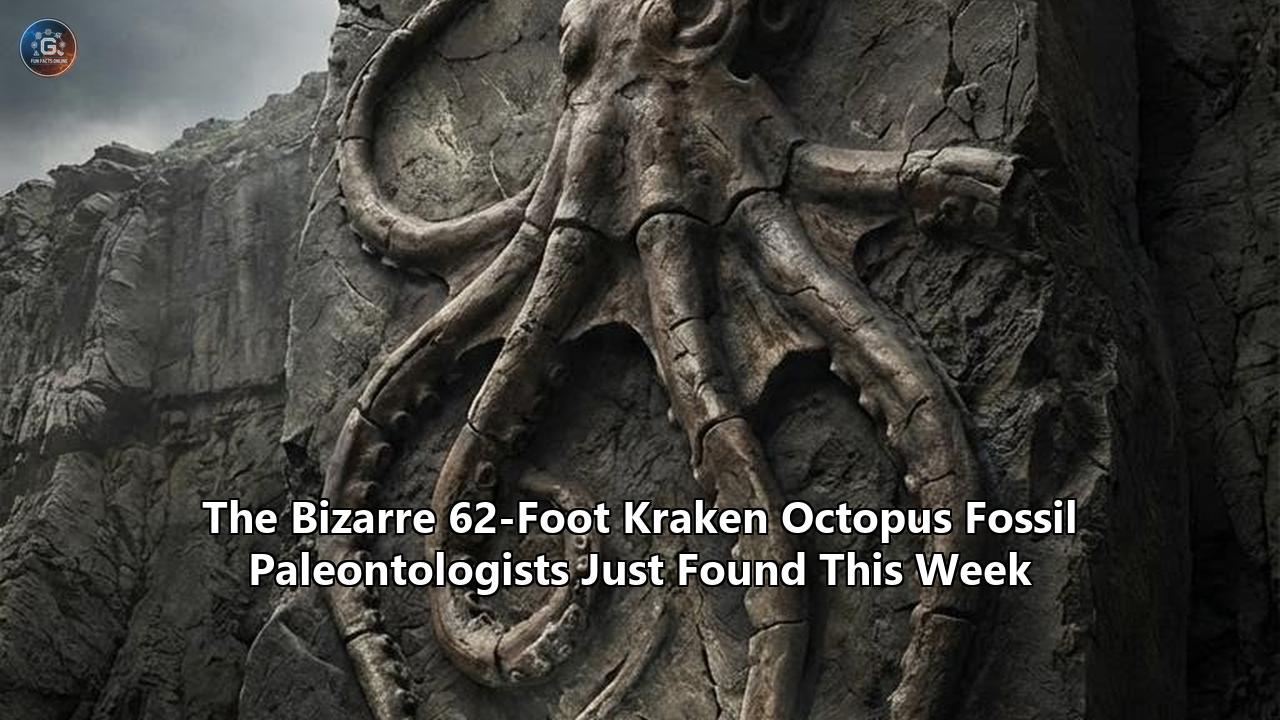
Paleontologists have identified the remains of a prehistoric finned octopus that reached an estimated 62 feet (19 meters) in length, establishing a new maximum size limit for marine invertebrates. Published on Thursday, April 23, 2026, in the journal Science, the findings dismantle the long-standing consensus that vertebrate marine reptiles exclusively occupied the absolute top of the Late Cretaceous food chain.
The research team, led by Shin Ikegami and Yasuhiro Iba of Hokkaido University, quantified the dimensions of the animal by applying advanced allometric scaling equations to 27 fossilized jaws. Extracted from rock formations dating between 100 million and 72 million years ago in Japan and Vancouver Island, British Columbia, these chitinous beaks point to two distinct species of massive predators: Nanaimoteuthis jeletzkyi, which measured between 10 and 26 feet, and the far larger Nanaimoteuthis haggarti, which scaled up to a massive 62 feet.
At an upper limit of 62 feet, N. haggarti surpassed the dimensions of modern giant squid (Architeuthis dux), which typically max out around 39 to 40 feet. More importantly, the measurements place this invertebrate at a size advantage over many prominent Late Cretaceous marine reptiles, including mosasaurs, which reached roughly 56 feet in length. The discovery of this kraken octopus fossil effectively rewrites the quantitative models paleobiologists use to assess marine biomass distribution during the Mesozoic Era.
The Mathematical Scaling of Cephalopod Jaws
Because octopuses possess soft bodies devoid of protective calcified shells, they rarely fossilize intact. Consequently, paleontologists must rely on the only resilient structure these animals leave behind: the beak. The methodology utilized by the Hokkaido University team involved isolating 15 previously collected large fossil jaws and applying advanced 3D digital fossil-mining techniques to late Cretaceous sediment samples to uncover an additional 12 previously undetected specimens.
To translate beak fragments into total body lengths, researchers depend on highly structured proportional data. In modern cephalopods, the lower jaw's hood length maintains a direct, predictable correlation with the animal's mantle length—the central bulbous structure housing the organs above the eyes. By calculating the specific ratio of hood length to mantle length in closely related extant finned octopuses, the team mapped these formulas onto the measurements of the Nanaimoteuthis beaks.
The calculations returned extreme metrics. The largest lower jaws of N. haggarti required a mantle length substantial enough to support an animal stretching 19 meters from the top of the mantle to the tips of its tentacles. This 62-foot estimate carries profound implications for our understanding of Cretaceous metabolic limits. Operating as an active predator at that scale requires massive caloric intake and a highly efficient oxygen transport system. Unlike vertebrates that rely on hemoglobin, octopuses utilize hemocyanin—a copper-rich protein—to transport oxygen through their bloodstream. The presence of a 62-foot cephalopod indicates that the thermal and chemical composition of the Late Cretaceous oceans allowed hemocyanin to function with extraordinary metabolic efficiency, sustaining a body mass previously deemed mathematically impossible for soft-bodied invertebrates.
“These animals were remarkable,” lead researcher Yasuhiro Iba stated following the publication of the data. “They represent what could be described as a real Cretaceous Kraken”.
Quantifying Bite Force and Predatory Wear Patterns
Beyond identifying the raw size of the animal, the team conducted a microscopic analysis of the 27 jaws to quantify the predator's position within the food web. Researchers examined the physical degradation of the chitin structures, seeking wear patterns distinct from post-mortem erosion or damage incurred during human excavation. The data returned a highly aggressive feeding profile.
The fossils exhibited deep chips, heavy scratches, and extensive polishing consistent with the repeated mechanical stress of crushing dense calcified materials. According to the measurements extracted from the 3D digital models, the most heavily utilized jaws suffered an extreme volume reduction.
“In the largest specimens, about 10% of the total jaw length appears to have been lost due to wear,” Iba explained. “This is more severe than what is typically seen in modern octopuses… that feed on hard prey”.
Losing 10% of a primary predatory apparatus to structural wear requires an immense and repeated application of bite force. For a beak to degrade at this rate during the animal's natural lifespan, the octopus must have routinely targeted heavily armored prey. The Cretaceous oceans offered a dense population of shelled ammonites, heavily scaled fish, and massive marine turtles. However, given the 62-foot length of N. haggarti, researchers assess that the predator likely fed on marine reptile bones as well.
The energy required to shatter vertebrate bone with a chitinous beak demands highly specialized musculature around the buccal mass (the jaw and muscle complex). The data suggests that this giant finned octopus allocated a massive percentage of its metabolic output toward jaw strength, effectively mirroring the ecological function of apex vertebrate hunters.
Shifting the Timeline of Cephalopod Evolution
The extraction of these specific fossil specimens alters the chronological markers for cephalopod evolution by millions of years. Prior to this publication, the timeline for early octopuses and specifically finned octopuses was tightly constrained by a lack of soft-tissue preservation.
By confidently dating the Nanaimoteuthis jeletzkyi jaws found in the Vancouver Island and Japanese sediment layers to a window between 100 million and 72 million years ago, the researchers pushed the earliest verifiable evidence of octopuses back by an additional 5 million years. Furthermore, the specific identification of finned anatomy—meaning these animals utilized large, paddle-shaped appendages protruding from their mantles to navigate the water column—pushes the timeline for finned octopuses backward by a massive 15 million years.
The evolutionary strategy required to reach this stage involved a severe biological trade-off. Over millions of years, the ancestors of these octopuses ceased allocating calcium and other resources to heavy, protective external shells. Instead, the data demonstrates a redirection of these resources toward neurological development, visual acuity, and complex muscular systems. The emergence of a kraken octopus fossil at a length of 62 feet proves that sacrificing passive shell defense for high-speed mobility and intelligence was not just successful—it allowed the species to aggressively scale up to apex dimensions.
“The novelty of our study is not simply that large octopuses existed,” Iba stated, outlining the broader implications of the findings. “Some of the earliest octopuses were much larger than we had imagined. Invertebrates — especially soft-bodied animals like octopuses — have remained largely invisible in the fossil record, and their ecological roles have been poorly understood. In that sense, we are just beginning to see parts of ancient ecosystems that were previously almost invisible”.
Geographical Distribution and Environmental Carrying Capacity
The spatial distribution of the 27 fossil beaks provides crucial data points regarding the territorial range of these predators. Specimens were recovered from two distinct geological formations separated by thousands of miles of ocean: the Yezo Group in Japan and the Nanaimo Group on Vancouver Island in British Columbia.
During the Late Cretaceous period, the Pacific Ocean (then part of the super-ocean Panthalassa) maintained different current patterns and temperature gradients than modern oceans. The presence of N. haggarti in both the western and eastern boundaries of the northern Pacific suggests a highly mobile predator capable of traversing immense pelagic zones.
For an ecosystem to support a top-tier predator of this size across such a broad geographical range, the foundational biomass of the Late Cretaceous oceans had to be exceptionally high. In modern marine ecosystems, the population density of apex predators is strictly governed by the available caloric energy at lower trophic levels. A 62-foot cephalopod would require tons of high-density prey annually to survive. The dual-hemisphere presence of this kraken octopus fossil indicates that the North Pacific contained enough prey density to support stable populations of colossal invertebrates concurrently with massive vertebrate hunters like plesiosaurs and great-white-sized sharks.
The fact that N. haggarti overlapped territorially with mosasaurs and other apex marine reptiles forces a recalculation of inter-species competition models. Rather than an ocean dominated sequentially by a single apex species, the quantitative evidence of 10% jaw wear and a 62-foot body length suggests intense, direct resource competition between giant vertebrates and giant invertebrates.
The Role of Advanced Digital Fossil Mining
The statistical viability of this research relied heavily on the application of digital fossil mining—a non-destructive analytical technique that allows paleontologists to extract precise morphological data without physically degrading fragile samples.
When analyzing sedimentary rock from the Late Cretaceous, physical extraction tools frequently cause micro-fractures in chitinous materials. By using high-resolution 3D scanning and advanced algorithmic processing, the research team identified 12 concealed fossil jaws within the sediment blocks that would have otherwise remained undetected or destroyed.
These digital models allowed the team to run complex volumetric analyses on the beaks. They could map the exact curvature of the jaw, measure the precise angle of the cutting edge, and calculate the shearing force the beak could apply to specific materials. This technology generated the primary dataset used to distinguish N. haggarti from N. jeletzkyi, revealing minute architectural differences in the hood length and lateral walls of the beaks.
The integration of artificial intelligence and digital scanning in paleobiology is rapidly altering how researchers assess the fossil record. By prioritizing volumetric data extraction over physical rock splitting, paleontologists are bypassing the historical bias toward heavily calcified bones. The success of identifying the dimensions of a 62-foot cephalopod primarily through digital modeling proves the efficacy of this method for reconstructing the biomechanics of soft-bodied organisms.
Trophic Level Mathematics: Disrupting the Vertebrate Consensus
The fundamental architecture of prehistoric marine food webs has long been modeled around vertebrate dominance. Textbooks and ecological simulations routinely place large marine reptiles—specifically mosasaurs and ichthyosaurs—at the pinnacle of energy transfer equations during the Mesozoic. The discovery of this specific kraken octopus fossil disrupts that hierarchy with hard data.
In ecological modeling, an apex predator sits at Trophic Level 4 or 5, possessing no natural predators of its own. To maintain balance, a Trophic Level 5 species must exert top-down control on the populations of Trophic Level 3 and 4 carnivores. The dimensions and the bite force metrics of N. haggarti verify its capability to exert this top-down pressure.
If a 62-foot octopus was actively hunting the same mid-tier marine life as a 56-foot mosasaur—and potentially hunting juvenile mosasaurs themselves—the mathematical models for prey depletion rates in the Late Cretaceous must be adjusted. The caloric demands of an active, highly intelligent, finned cephalopod moving at high speeds to ambush prey are immense. Unlike modern deep-sea octopuses that rely on slow metabolic rates and opportunistic feeding in frigid waters, a surface- or mid-water finned octopus operating in the warmer Late Cretaceous seas would burn through calories rapidly, necessitating a hyper-aggressive feeding pattern.
The 10% wear metric on the jaws specifically refutes the idea of passive scavenging. Scavenging soft tissue from dead organisms leaves little wear on a cephalopod beak. The heavy damage documented by the Hokkaido University team proves active, violent engagement with resisting, hard-shelled or bone-heavy prey.
Implications for Mass Extinction Survival Rates
The existence of a 62-foot predatory octopus spanning the North Pacific up to 72 million years ago raises immediate questions regarding the Cretaceous-Paleogene (K-Pg) extinction event that occurred 66 million years ago. While octopuses as a broader order survived the asteroid impact and subsequent ecological collapse, the data shows no evidence of giant finned octopuses persisting beyond that boundary.
The extinction of N. haggarti aligns with the measurable collapse of marine biomass carrying capacity. When the primary producers (phytoplankton) experienced a massive die-off due to reduced sunlight following the asteroid impact, the foundational energy of the food web evaporated. A predator requiring the high caloric intake of a 62-foot body mass would face immediate starvation as the populations of large ammonites and marine reptiles plummeted.
The biological trade-off that allowed N. haggarti to reach its massive size—sacrificing a low-energy, passive-defense lifestyle for high-energy, high-mobility predation—rendered the species statistically vulnerable to rapid environmental changes. Modern octopuses survived the K-Pg extinction precisely because smaller, deep-water benthic species required vastly fewer calories and could subsist on detritus and small surviving crustaceans.
However, Yasuhiro Iba notes that the absence of giant finned octopus fossils after the Late Cretaceous does not definitively prove immediate extinction, but rather highlights a limitation in current datasets. Because soft-bodied preservation is an extreme statistical anomaly, the lack of post-Cretaceous kraken octopus fossil evidence could simply be a gap in the excavation record rather than a biological certainty.
Next Steps in Cephalopod Paleobiology
The publication of this data sets a new baseline for targeted paleontological digs over the next decade. Armed with the predictive success of digital fossil-mining, research institutions are re-calibrating their scanning parameters.
Neil Landman, curator emeritus in the division of paleontology at the American Museum of Natural History in New York, reviewed the data and identified the immediate utility of the team's methodology.
“There is a lot of potential here to begin to illuminate ancient worlds,” Landman stated, validating the shift toward analyzing micro-wear on chitinous remains. “The community is very intrigued by their work”.
With the 15-million-year extension to the timeline of finned octopuses now established, researchers are directing their scanning technologies toward older geological formations. By applying the Hokkaido University allometric formulas to sedimentary rocks from the Jurassic era (201 million to 145 million years ago), paleontologists aim to identify the exact inflection point where cephalopods began trading their external shells for increased size and cognitive development.
The ongoing digitization of museum sediment archives worldwide suggests that additional kraken octopus fossil fragments may already reside in storage, previously dismissed as unidentifiable organic debris or misclassified vertebrate material. As AI-driven volumetric analysis becomes standard practice, the statistical models defining prehistoric marine biology will undergo continual revision. Paleontologists now face the mathematical probability that an entirely separate, invertebrate-driven ecological hierarchy existed parallel to the dinosaurs, leaving behind almost no physical trace save for heavily scarred, heavily utilized beaks scattered across the ocean floor.
Reference:
- https://www.charlotteobserver.com/living/article315519369.html
- https://www.livescience.com/animals/octopuses/kraken-octopus-that-lived-at-the-time-of-the-dinosaurs-was-a-62-foot-long-apex-predator-of-the-ocean
- https://gizmodo.com/this-62-foot-kraken-octopus-terrorized-cretaceous-seas-2000749705
- https://japan-forward.com/giant-octopus-may-have-ruled-cretaceous-oceans/