On April 20, 2026, a research paper published in Communications Physics quietly shifted the boundary separating the subatomic realm from the world we can see and touch.
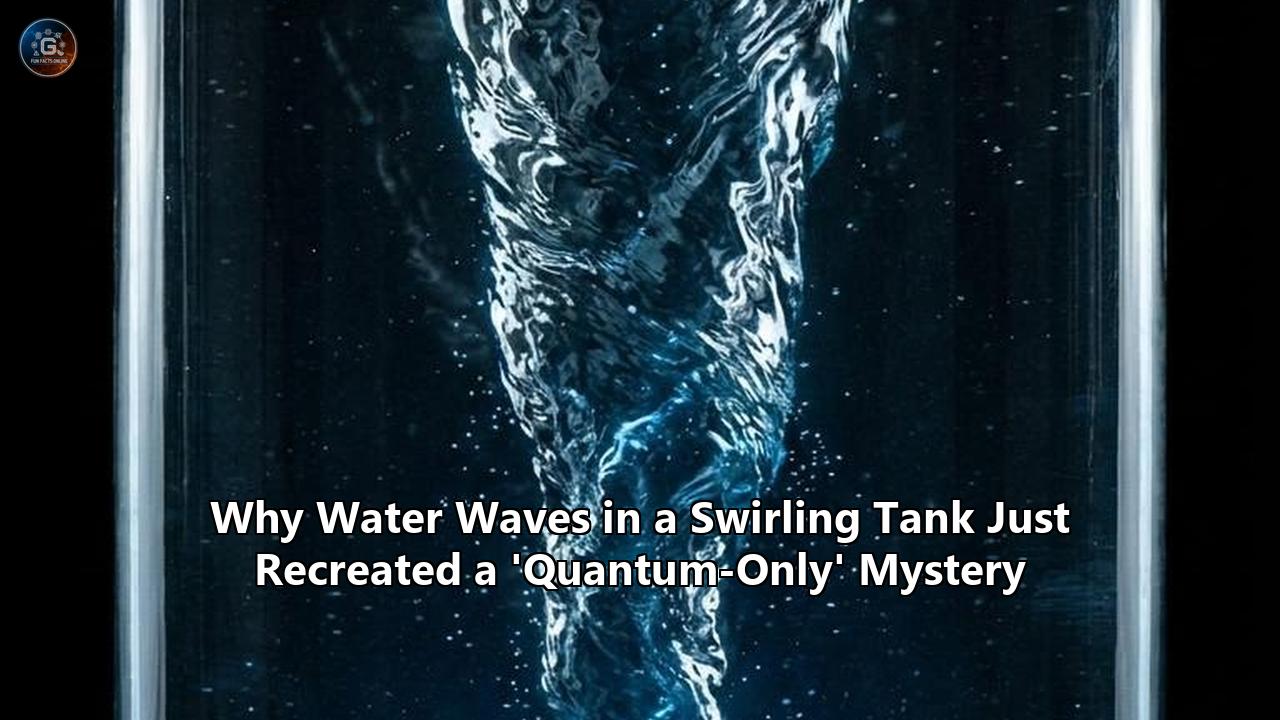
A collaborative team of physicists from the Okinawa Institute of Science and Technology (OIST) in Japan, the University of Oslo in Norway, and the Universidad Adolfo Ibáñez in Chile announced they had successfully replicated a notoriously elusive, "quantum-only" mystery using a remarkably simple, macroscopic setup: a custom-built water tank filled with a swirling vortex.
By sending ripples of water toward a central whirlpool from opposite directions, the researchers did not just mimic quantum behavior—they discovered an entirely new macroscopic phenomenon that had never been predicted, not even by the scientists themselves.
Where two opposing wavefronts would normally collide and form a stationary, fixed standing wave, the presence of the swirling vortex broke the symmetry of the system. Instead of a static pattern, the colliding waves locked into a series of hypnotically rotating, perfectly flat "nodal lines" of completely still water that radiated outward across the entire tank, spinning in the opposite direction of the whirlpool itself.
This experiment did more than turn a famously invisible quantum state into a macroscopic visual display. It established a dual-analogue system that simultaneously mirrors two of the most profound, circulation-driven phenomena in modern physics: the quantum Aharonov-Bohm (AB) effect and general relativity’s Lense-Thirring frame dragging.
The implications of this discovery are sweeping across the scientific community, offering a tangible, highly controllable sandbox for researchers who have spent decades trying to isolate and observe these fragile topological wave behaviors.
The Quantum and Relativistic Double Feature
To fully comprehend the magnitude of this breakthrough, one must look back to 1959, when physicists Yakir Aharonov and David Bohm proposed a concept that challenged the foundational classical understanding of forces.
In classical electromagnetism, physical forces are exerted directly on charged particles by electric and magnetic fields. If a particle never encounters a magnetic field, it should not experience any physical change.
Aharonov and Bohm, however, argued that in the quantum world, the underlying electromagnetic potentials—the mathematical scaffolding used to calculate the fields—possess their own physical reality. They demonstrated that if an electron passes around a tightly wound magnetic coil (a solenoid), it will experience a measurable shift in the phase of its wave function, even if the magnetic field is entirely shielded and confined inside the solenoid.
The electron "feels" the magnetic flux without ever physically touching it, a classic demonstration of quantum nonlocality. Because the shift is incredibly subtle and easily disrupted by the slightest environmental interference, confirming the Aharonov-Bohm effect experimentally took physicists more than two decades of grueling, high-precision quantum mechanics experiments.
Quantum AB Effect:
Electron Path A ----\
                     [ Solenoid (B-field inside) ] ---> Phase Shift (Interference)
Electron Path B ----/

OIST Water-Wave Analogue:
Water Wave A -----\
                   [ Swirling Vortex (Coriolis/Circulation) ] ---> Rotating Nodal Lines
Water Wave B -----/
Meanwhile, in 1918, Austrian physicists Josef Lense and Hans Thirring used Albert Einstein's newly formulated theory of general relativity to predict a wildly different, yet mathematically parallel, phenomenon on a cosmic scale.
They calculated that a massive, rapidly spinning object—such as a black hole or a rotating planet—does not merely sit in spacetime; it actively "drags" the very fabric of spacetime around with its motion, much like a rotating spoon drags thick molasses in a jar. This rotational dragging, known as the Lense-Thirring effect or frame dragging, alters the local definition of "standing still" and forces nearby orbiting satellites, gyroscopes, and light rays to precess.
In 1980, the renowned theoretical physicist Michael Berry proposed that classical fluids could act as a bridge between these two disparate worlds. Berry demonstrated that a simple draining-bathtub vortex could serve as a perfect analogue to the quantum Aharonov-Bohm solenoid.
By sending a single train of water waves past a draining whirlpool, the moving water near the drain would shift the phase of the waves, creating a distinctive, pitchfork-shaped wavefront dislocation centered on the vortex.
While Berry’s proposal was a major step forward, it was limited. Because it relied on traveling waves moving in one direction, the resulting phase shifts were highly localized near the central vortex core and incredibly difficult to map or measure across the rest of the fluid surface.
The OIST-led research team, spearheaded by doctoral student Aditya Singh and former postdoc Jonas Rønning, decided to push Berry's classic paradigm into uncharted territory.
Instead of sending waves from just one direction, they asked a deceptively simple question: what happens if we send waves from both directions simultaneously?
Inside the OIST Lab: How Water Exposed a Hidden Rule
To find out, the research team custom-built a highly specialized, large-scale water tank. The apparatus was equipped with high-precision wave generators on opposite sides, a central drain capable of generating a stable, highly controlled vortex, and a sophisticated diagnostic system.
By shining a intense light source from beneath the tank and mounting a high-speed camera directly overhead, the team could use the water's surface as a giant lens. When the light passed through the water, wave crests focused the light onto the camera sensor, while wave troughs dispersed it, allowing the researchers to track every microscopic fluctuation in surface displacement across the entire tank in real time.
  [ High-Speed Camera ]
         |
  ~~~~~~~~~~~~~~~  <-- Water Surface (Ripples & Vortex)
  [   Water Tank  ]
         |
    [ Light Source ]
When the team initiated the wave generators without a vortex, the system behaved exactly as any high-school physics textbook would predict: the opposing, identical waves collided to form a classic standing wave pattern. In this state, the wavefronts appeared frozen in place, with the water merely bobbing up and down at fixed intervals, separated by stationary lines of still water.
But the moment they opened the central drain and initiated the spinning vortex, the standing wave pattern underwent a dramatic, beautiful transformation.
The vortex shifted the phase of the incoming waves, but because the waves were traveling in opposite directions, the phase shift was asymmetric. Waves traveling in the direction of the vortex's rotation were accelerated, while waves traveling against the rotation were slowed down.
This directional phase difference completely altered how the counter-propagating waves interfered with one another.
Instead of remaining stationary, the lines of zero wave amplitude—known as nodal lines—spontaneously began to rotate. These radiating "lines of stillness" sliced clean, flat tracks through the turbulent, rippling surface of the tank, turning slowly and steadily in the direction opposite to the central vortex flow.
Normal Standing Waves (No Vortex):
   ~~~~~~~~~  |  ~~~~~~~~~  |  ~~~~~~~~~
   Wave Peak Node Wave Peak Node Wave Peak

With Swirling Vortex:
   ~~~\  /~~~  Node Line Rotates Counter to Vortex Flow!
       \/
"When we first saw these lines, we thought they were an experimental artifact," Aditya Singh recalled in a statement. "But when we also saw them in our simulations, we dropped everything and quickly worked out the mathematics underlying how they arise."
As the team dug deeper into the mathematical modeling, they uncovered a even more startling feature: the number of these rotating nodal lines was strictly quantized.
As they smoothly and continuously increased the flow rate of the draining vortex, the number of lines did not change in a smooth, continuous fashion. Instead, the system remained locked with a single rotating line until the flow reached a specific threshold, at which point the pattern suddenly split, producing exactly two rotating lines.
The number of lines stepped up in discrete, whole-number increments (one, two, three, and so on), directly mirroring the quantized energy levels of quantum mechanics experiments.
If the flow rate was set to a non-integer value, the lines would precess and alternate, continuously adjusting to maintain a strict topological balance.
The team realized they had stumbled onto a unified hydrodynamic analogue of both the Aharonov-Bohm and Lense-Thirring effects.
While the traveling waves in their system exhibited wavefront dislocations characteristic of Aharonov-Bohm scattering, the standing-wave superpositions produced a global, system-spanning rotation of the nodal pattern. This rigid, topologically constrained rotation provides a direct macroscopic analogue of Lense-Thirring frame dragging—visualizing the way a rotating cosmic mass twists the local inertial frames of spacetime.
Who Is Affected by This Discovery?
The ripple effects of this classical fluid-mechanics breakthrough extend far beyond the walls of the OIST laboratory, directly impacting several distinct scientific disciplines.
                      +-----------------------------+
                      |   OIST Swirling Tank Lab    |
                      +--------------+--------------+
                                     |
         +---------------------------+---------------------------+
         |                           |                           |
+--------v--------+         +--------v--------+         +--------v--------+
| Quantum & Solid |         | Astrophysicists |         |  Fluid & Earth  |
| State Physicists|         | & Cosmologists  |         |   Scientists    |
+-----------------+         +-----------------+         +-----------------+
Quantum and Solid-State Physicists
For decades, researchers designing quantum mechanics experiments have been severely limited by the scale and fragility of their systems. To study topological phases, synthetic gauge fields, and the wave mechanics of particles like electrons, scientists must typically work at the subatomic scale, using temperatures hovering just above absolute zero, ultra-high vacuums, and extraordinarily sensitive, indirect measurement techniques.
The OIST fluid analogue democratizes this research. It provides quantum and solid-state physicists with a macroscopic, room-temperature platform where they can directly observe, photograph, and manipulate topological wave behaviors that are otherwise hidden from view.
Astrophysicists and Cosmologists
Testing the predictions of Einstein's general relativity is notoriously difficult. Because space-time is not a physical fluid and possesses no physical viscosity, observing the Lense-Thirring frame-dragging effect on a cosmic scale requires tracking the orbital precession of satellites around Earth (such as the Gravity Probe B mission) or monitoring the subtle wobble of stars being torn apart by supermassive black holes millions of light-years away.
By mapping the mathematical equivalence between the shallow-water wave equations and the equations governing curved spacetimes, astrophysicists now have a "tabletop cosmic laboratory." They can simulate the rotational dynamics of spinning black holes, the behavior of space-time near the event horizon (the ergosphere), and the gravitational frame-dragging effect inside a laboratory water tank.
Fluid Dynamicists and Geophysicists
The equations used to model the OIST water tank—the Rotating Shallow Water Equations (RSWE)—are the exact same mathematical tools used by meteorologists and oceanographers to model large-scale fluid flows in the Earth's oceans and atmosphere.
By proving that these classical, macroscopic fluid equations encode a rich, hidden "quantum geometry"—complete with its own Berry curvature and topological invariants—this research opens up entirely new pathways for modeling oceanic and atmospheric wave bands. It suggests that global weather patterns, hurricanes, and massive ocean currents may be governed by the same topological rules that dictate the behavior of subatomic particles.
What Changes in the Study of Wave Physics?
The realization that a classical water tank can so elegantly host a dual-analogue of quantum and relativistic phenomena marks a major paradigm shift in how physicists conceptualize wave mechanics.
| Feature | Conventional Quantum Experiments | OIST Fluid Analogue System |
|---|---|---|
| Observation Method | Indirect (inference via detectors) | Direct (high-speed camera, visualization) |
| System Scale | Microscopic / Subatomic | Macroscopic (centimeter-scale waves) |
| Experimental Setup | Extreme isolation (cryogenics, vacuums) | Standard lab conditions (water tank, room temp) |
| Physical Manifestation | Localized phase shifts | System-spanning, rotating "nodal lines" |
| System Control | Complex, fragile state preparation | Smooth control via water flow rates |
The Visual Power of Global Topology
Historically, one of the most frustrating aspects of quantum mechanics experiments has been the inability to directly image the entire spatial structure of a wave function. When evaluating an electron's phase shift in an Aharonov-Bohm setup, researchers must rely on localized, point-by-point measurements, reconstructing the wave pattern mathematically after the fact.
The OIST fluid system completely bypasses this limitation. Because water is a continuous, visible medium, the resulting rotating nodal lines offer a direct, system-spanning signature of the global topological phase.
Physicists no longer have to guess what a topological phase transition looks like; they can watch it unfold across the surface of a tank as the lines of flat water slowly rotate and multiply.
The Unification of Disparate Fields
The OIST experiment highlights a profound, underlying mathematical unity in the natural world. By showing that a single "draining-bathtub" system can simultaneously model quantum phase shifts (Aharonov-Bohm) and general relativistic frame dragging (Lense-Thirring), the research demonstrates that these seemingly unrelated phenomena are actually governed by the same mathematical concept: circulation.
Whether it is the magnetic flux of a subatomic solenoid, the angular momentum of a rotating supermassive black hole, or the swirling current of a laboratory drain, circulation acts as a global topological constraint that shapes the phase, geometry, and rotation of waves across all physical scales.
Short-Term Consequences: Rapid Benchmarking and Classroom Innovation
In the immediate aftermath of this discovery, several short-term changes are already taking shape within the global scientific and educational communities.
[OIST Publication (April 2026)]
              |
              +---> Immediate Lab Replication (Low-cost tabletop setups)
              |
              +---> Refinement of Classical Wave Equations (RSWE & Wave Bands)
              |
              +---> Integration of Analog Gravity into Physics Curricula
The Demise of Extreme Experimental Constraints
One of the most immediate practical benefits of this fluid system is its accessibility. In the coming months, physics departments and research labs around the world are likely to construct their own versions of the OIST "swirling tank" apparatus.
Because the setup requires only a custom acrylic tank, basic wave generators, a standard drain pump, a light source, and a commercial high-speed camera, it represents a fraction of the cost of building a dedicated quantum lab.
Rather than replacing quantum platforms, these hydrodynamic simulators act as a rapid prototyping sandbox, allowing researchers to stress-test theoretical concepts before translating them into complex, expensive quantum mechanics experiments.
A New Benchmark for Fluid Dynamics Modeling
At the same time, theoretical fluid dynamicists are using the OIST findings to refine their mathematical models of rotating fluids. The discovery that the number of rotating nodal lines is strictly quantized—and that the pattern precesses when the circulation is non-integer—provides a highly precise, easily measurable benchmark for testing numerical simulation codes.
This is already leading to more accurate models of "Poincaré waves" and geostrophic modes in atmospheric and oceanic science, potentially improving our ability to predict the behavior of rotating, large-scale meteorological systems like cyclonic storms.
Revitalizing "Analog Gravity" in the Classroom
For university educators, this experiment is a goldmine. Concepts like quantum phase shifts, topological insulators, nonlocality, and Einsteinian frame dragging are notoriously difficult for undergraduate students to visualize, often relegated to abstract equations on a blackboard.
By introducing simple, tabletop water-vortex experiments into advanced physics laboratories, universities can now provide students with a direct, intuitive grasp of these highly abstract concepts. Students can watch space-time dragging and quantum wave phase-winding happen in real time, right in front of their eyes.
Long-Term Consequences: Supercurrent Lattices and the Future of Computing
Looking further into the future, the OIST-led breakthrough paves the way for several transformative, long-term developments in fundamental physics and advanced technology.
Long-Term Milestones:
1. Multiple-Vortex Lattices (Simulating Superconductors & Supercurrents)
2. Desktop Black Hole Simulators (Studying Hawking Radiation & Backreactions)
3. Topological Acoustic/Fluid Computing Devices (Signal Processing without Backscattering)
Simulating Superconductors in a Water Tank
The most tantalizing future research direction was outlined by the study’s senior author, Professor Mahesh Bandi. "One direction is to make the system more complex by introducing multiple vortices and arranging them into a lattice," Bandi noted. "That setup would mirror conditions in some superconducting materials, with the water waves behaving like a supercurrent."
In Type-II superconductors, an external magnetic field is not entirely excluded; instead, it penetrates the material in the form of tiny, quantized tubes of magnetic flux known as Abrikosov vortices. The superconducting electrons (the supercurrent) flow around these vortices in a complex, collective dance.
By arranging an array of draining vortices in a water tank, physicists will be able to construct a macroscopic, macroscopic simulator of high-temperature superconductors.
This setup would allow researchers to directly watch how waves of "supercurrent" interact with the vortex lattice, potentially unlocking the long-sought, elusive physics behind high-temperature superconductivity—a breakthrough that could revolutionize clean-energy transmission and magnetic levitation technologies.
Desktop Black Hole Simulators and Quantum Backreactions
Draining bathtub vortices have already proven highly effective as "analogue black holes." Near the drain of a swirling tank, the radial flow speed of the water can exceed the maximum speed of the surface waves.
This creates an "acoustic event horizon" (or ergosphere) from which no surface wave can escape, mimicking the gravitational boundary of a cosmic black hole.
Analogue Black Hole (Draining Vortex):
Outer Tank (Slow Flow) ----> Event Horizon (Flow Speed > Wave Speed) ----> Drain (Singularity)
Waves can escape            Waves trapped inside; dragged into drain
By combining this analogue black hole geometry with the OIST counter-propagating wave setup, researchers will be able to perform long-term studies on how quantum fields behave near rotating black holes.
They will be able to test theories regarding Hawking radiation—the theoretical, slow evaporation of black holes via quantum particle-antiparticle emission—and "backreactions," the subtle feedback loops where the waves entering the black hole modify the mass and rotation of the black hole itself.
These experiments could provide vital clues for reconciling general relativity with quantum mechanics, currently the greatest unresolved puzzle in theoretical physics.
The Dawn of Topological Acoustic Computing
While the researchers note that it is too early to predict direct commercial applications for the rotating nodal lines, the underlying physics could inspire entirely new classes of technology.
By mastering the way background fluid circulation shapes, shifts, and steers wave phases, engineers could design novel acoustic and optical metamaterials.
These materials could act as topological wave guides, allowing sound, light, or fluid waves to travel in one direction without any backscattering, reflection, or loss of energy. This could lead to:
- Ultra-efficient acoustic noise-canceling panels.
- High-performance sonar and radar systems.
- Novel, fluid-based signal processing and computing devices that use the phase of waves, rather than electronic currents, to store and process data.
What to Watch Next
As this fresh paradigm in classical-quantum wave analogues gains momentum, several key milestones, upcoming developments, and lingering scientific questions warrant close attention:
- The Multi-Vortex Leap: Keep a close eye on publications from OIST and collaborating global laboratories over the next 18 to 24 months. The transition from a single central vortex to a highly ordered lattice of multiple vortices will be the ultimate test of this system's ability to model high-temperature superconductors.
- The Non-Integer Circulation Puzzle: In the April 2026 paper, the researchers noted that when the vortex circulation is non-integer, the wave mechanics must be mathematically defined on a "universal cover"—a multi-layered, helicoidal geometric space. How a physical, single-layered water tank physically resolves this multi-layered mathematical requirement remains a deep, unresolved theoretical mystery that physicists are actively trying to unpack.
- Miniaturization to "Lab-on-a-Chip" Scales: In late 2025, researchers at the University of Queensland in Australia successfully built a microscopic wave tank that fits on a grain of rice, using laser light to drive and observe waves in an exotic fluid chip. If other research groups can successfully scale down OIST’s swirling vortex and counter-propagating wave setup to these microscopic chip-scales, it could pave the way for entirely new, highly integrated optomechanical wave processors that utilize topological phase shifts for rapid, light-based classical computing.
- Testing "Pilot-Wave" Alternatives: This swirling water tank experiment is part of a broader, ongoing renaissance in "hydrodynamic quantum analogues." Some physicists are using these macroscopic fluid setups to re-evaluate the foundational interpretations of quantum mechanics, asking whether the success of these classical, wave-driven models suggests that the universe's "spookiness" can be explained by a concrete, underlying wave-dominated physical reality, rather than the probabilistic Copenhagen interpretation.
Ultimately, the success of this swirling tank experiment points to a future where classical fluid dynamics and quantum mechanics experiments are no longer seen as separate disciplines, but as two sides of the same topological coin.
By proving that a simple pool of swirling water can lay bare the most deeply hidden, nonlocal secrets of the subatomic and cosmic realms, these researchers have demonstrated that sometimes, the best way to understand the invisible universe is simply to build a bigger bathtub and watch the ripples flow.
Reference:
- https://www.oist.jp/news-center/news/2026/4/20/making-waves-water-simulation-famous-quantum-effect-reveals-unexpected-patterns
- https://scitechdaily.com/scientists-recreate-a-quantum-mystery-in-a-water-tank-and-discover-something-completely-new/
- https://scienmag.com/water-simulation-of-renowned-quantum-effect-uncovers-surprising-wave-patterns/
- https://www.earth.com/news/simple-water-experiment-recreates-complex-quantum-wave-patterns/
- https://www.youtube.com/shorts/9PVgy3jlhYg
- https://timesofindia.indiatimes.com/science/physicists-simulated-a-famous-quantum-effect-in-a-water-tank-and-found-something-nobody-expected/articleshow/131996254.cms
- https://arxiv.org/html/2604.21543v1
- https://www.space.com/astronomy/black-holes/einsteins-right-again-scientists-catch-a-feasting-black-hole-dragging-the-very-fabric-of-spacetime
- https://www.relativity.li/lang?cid=244&lang=en-US
- https://www.researchgate.net/profile/Luiza-Angheluta
- https://scitechdaily.com/scientists-recreate-a-quantum-mystery-in-a-water-tank-and-discover-something-completely-new/
- https://en.wikipedia.org/wiki/Frame-dragging
- https://bioengineer.org/water-simulation-of-renowned-quantum-effect-uncovers-surprising-wave-patterns/
- https://www.researchgate.net/publication/404144412_Unified_Hydrodynamic_Analogue_of_Aharonov-Bohm_and_Lense-Thirring_Effects
- https://www.quora.com/How-does-frame-dragging-differ-from-the-idea-of-a-whirlpool-in-water-and-why-doesnt-it-create-a-preferred-frame-or-velocity
- https://arxiv.org/pdf/1510.01436
- https://quantumzeitgeist.com/quantum-geometry-advances-rotating-shallow-water/
- https://www.sciencealert.com/for-the-first-time-backreaction-has-been-seen-in-a-bathtub-analogue-of-a-black-hole
- https://www.researchgate.net/publication/404144412_Unified_Hydrodynamic_Analogue_of_Aharonov-Bohm_and_Lense-Thirring_Effects
- https://nautil.us/the-worlds-tiniest-wave-tank-1244099
- https://news.mit.edu/2013/when-fluid-dynamics-mimic-quantum-mechanics-0729
- https://www.youtube.com/watch?v=K7xrlRnJmRQ