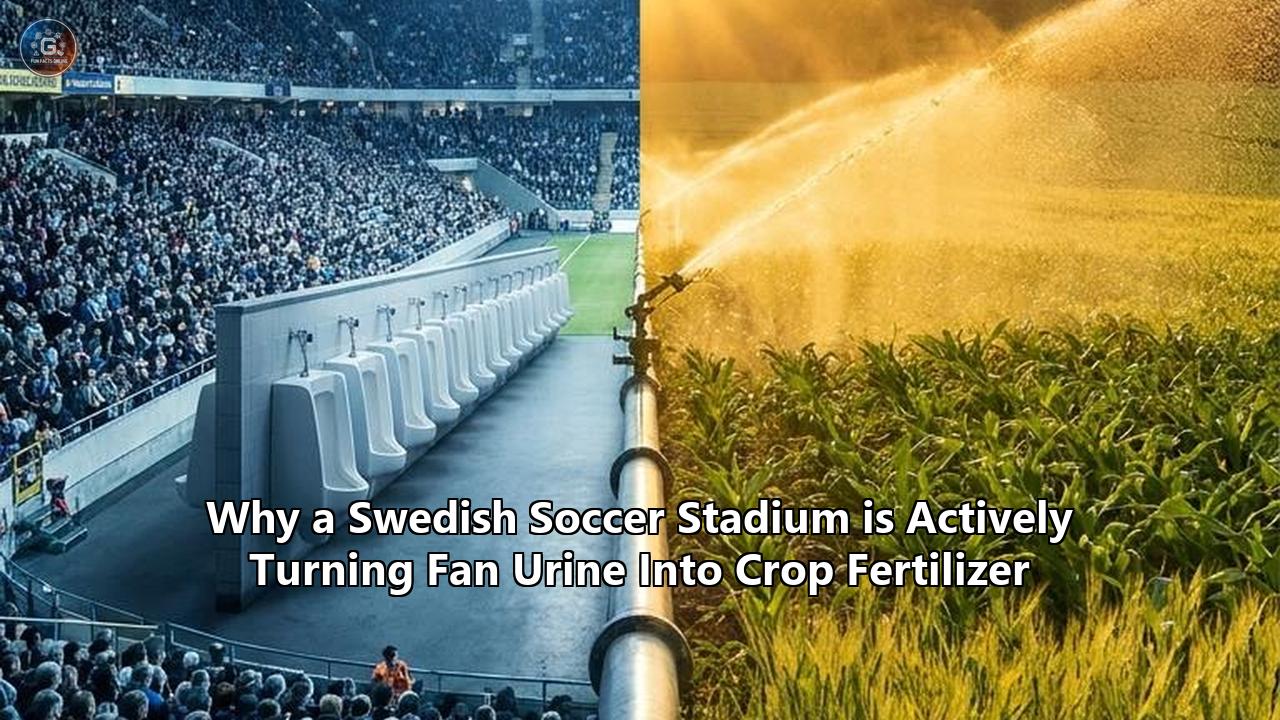
On May 24, 2026, as 22,500 passionate supporters packed the stands of Eleda Stadion in Malmö, Sweden, to watch Malmö FF face off against Västerås SK, a quiet revolution was unfolding beneath their feet. Under the concrete concourses, where fans queued for mid-game beers and snacks, the stadium’s plumbing had been modified to intercept their bathroom breaks.
Every drop of urine collected from a newly installed network of waterless urinals and source-separating toilets was being stabilized, dehydrated, and prepared for a journey to local agricultural fields.
This is the frontline of "Pee for the Planet," an ambitious, multi-partner initiative funded by the Swedish government’s research council, Formas. The two-year project brings together Malmö FF, the oat-milk pioneer Oatly, the Swedish University of Agricultural Sciences (SLU), the regional wastewater utility VA Syd, and the agricultural technology startup Sanitation360. Their collective goal for the season is to collect 1,000 liters of fan urine and prove that human waste can replace fossil-fuel-intensive synthetic fertilizers on a commercial scale.
"It is about utilizing a valuable resource that we currently pay millions to flush away and treat as a pollutant," says Björn Vinnerås, a professor of environmental engineering at SLU and the co-founder of Sanitation360. "If we can prove this works in the high-pressure, high-volume environment of a major soccer stadium, we can prove it works anywhere".
The pilot represents a major milestone in the "peecycling" movement, but it also exposes the massive scientific, geopolitical, and logistical hurdles of scaling up circular sanitation. To understand why a premier European soccer club is actively harvesting its supporters' waste, one must follow a trail of evidence that spans global geopolitical chokepoints, heavy chemical engineering, and the fragile ecology of the Baltic Sea.
The Anatomy of a Dual Crisis: Food Security and Fossil Fuels
To comprehend the urgency of the Eleda Stadion project, it is necessary to look past the novelty of stadium restrooms and examine the global food supply chain. Modern agriculture is fundamentally dependent on synthetic chemical fertilizers, primarily nitrogen, phosphorus, and potassium (N-P-K).
The production of synthetic nitrogen fertilizer relies on the Haber-Bosch process, an industrial chemical reaction that synthesizes ammonia from atmospheric nitrogen and hydrogen gas. This process requires extreme pressures (up to 250 atmospheres) and temperatures hovering around 450°C. Because the hydrogen is almost universally sourced from steam-reforming natural gas, the fertilizer industry has a massive carbon footprint.
According to data compiled by the Center for International Environmental Law (CIEL), synthetic fertilizer manufacturing and application generate approximately 1.13 to 1.3 billion metric tons of greenhouse gas emissions annually. This accounts for roughly 2.1% of global greenhouse emissions—surpassing the total emissions generated by the entire global aviation sector.
GLOBAL CARBON EMISSIONS COMPARISON (Annual CO2 equivalents)
============================================================
Aviation Industry:              ~1.00 Billion Tonnes
Synthetic Fertilizer Industry:   ~1.13 - 1.30 Billion Tonnes
============================================================
While climate scientists have long warned about this carbon footprint, a separate geopolitical crisis has brought the issue to a boil. Sweden, like much of Europe, is highly dependent on imported synthetic fertilizers, sourcing roughly 90% of its supply from abroad.
In 2026, escalating regional conflicts and supply chain disruptions—such as ongoing trade blockades in critical maritime chokepoints like the Strait of Hormuz—have severely restricted the global trade of both natural gas and finished fertilizers. With nearly a third of the global fertilizer supply periodically disrupted or delayed, fertilizer prices have fluctuated wildly, threatening agricultural yields and driving up food prices worldwide.
"For us as a food company, this is about reducing unnecessary dependencies in the food system and showing how circular solutions can strengthen long-term food security," says a representative from Oatly. "Our current reliance on energy-intensive, fossil-fuel-derived inputs is a critical vulnerability".
By capturing the nutrients already present within the human population, Sweden has the potential to insulate its agricultural sector from global supply shocks. Researchers at SLU estimate that if all human urine in Sweden were safely collected and recycled, it could replace up to 30% of the synthetic fertilizer currently imported and applied across the nation’s farms.
The Waste Paradox: Why We Spend Energy to Destroy Nutrients
The second layer of the investigation leads directly to municipal wastewater treatment facilities. Every day, cities pump millions of liters of clean, treated drinking water through sewer pipes simply to transport human excreta to distant treatment plants.
This transport method creates a major engineering problem. Human urine makes up less than 1% of the total volume of municipal wastewater, yet it contains roughly 80% of the nitrogen and 50% of the phosphorus found in the entire waste stream.
URINE'S SHARE OF MUNICIPAL WASTEWATER
============================================================
Wastewater Volume:   [||||] < 1%
Total Nitrogen:      [||||||||||||||||||||||||||||||||] 80%
Total Phosphorus:    [||||||||||||||||] 50%
============================================================
When this diluted mixture arrives at a wastewater treatment plant like those operated by VA Syd, engineers must expend massive amounts of energy and chemical agents to remove these nutrients. Left untreated, nitrogen and phosphorus discharged into waterways trigger eutrophication—a process where nutrient-fueled algae blooms suffocate aquatic life by depleting dissolved oxygen. This has had devastating consequences for the Baltic Sea, which borders southern Sweden and has some of the largest marine dead zones in the world.
"Right now, wastewater treatment plants spend enormous amounts of energy just to remove nitrogen from urine," explains Carol Steinfeld, a prominent wastewater researcher and author of Liquid Gold: The Lore and Logic of Using Urine to Grow Plants. "We are literally throwing away a nutrient that is costing us energy on both ends—removing it from municipal waste at great expense, while simultaneously spending vast sums of fossil energy to manufacture it synthetically".
At a sports stadium, this nutrient load is highly concentrated. When tens of thousands of fans attend a soccer match, they consume large volumes of beverages over a short period. During halftime, thousands of fans use the restrooms simultaneously.
This creates a massive "hydraulic surge" and a concentrated "nutrient shock" for the local wastewater utility. The sudden spike forces treatment plants to maintain expensive excess capacity and run energy-intensive aeration processes at maximum output to handle the temporary load.
By separating and treating the urine on-site at Eleda Stadion, the "Pee for the Planet" project flattens these operational peaks. It intercepts the nutrients before they ever dilute into the sewer system, turning an operational headache for VA Syd into a clean, concentrated resource.
The Breakthrough: Deactivating Urease via High pH
If urine recycling is such an obvious ecological win, why hasn't it been widely adopted? The answer lies in chemistry and logistics.
Raw, untreated human urine is about 95% water. Transporting large volumes of liquid waste from urban centers to rural agricultural fields is economically and logistically unfeasible.
"Historically, farmers would have to haul and spread 15,000 kilograms of liquid urine just to fertilize one single hectare of land," says Prithvi Simha, a lead researcher at SLU and the CTO of Sanitation360. "No conventional farm has the infrastructure or the desire to manage that volume of liquid. To make this work at scale, we had to find a way to extract the water and concentrate the nutrients into a dry, stable, and easily transportable solid".
The primary obstacle to concentrating urine is a natural chemical process called urea hydrolysis. Fresh human urine contains nitrogen primarily in the form of urea, a stable, odorless organic compound.
However, wastewater systems are teeming with urease, an incredibly resilient and fast-acting enzyme produced by common environmental bacteria. The moment urine exits the body and contacts plumbing surfaces, urease rapidly breaks down the urea into ammonia ($NH_3$) and carbon dioxide ($CO_2$).
This reaction has two highly undesirable effects:
- It releases volatile ammonia gas, which creates the characteristically pungent, unpleasant odor of stale public restrooms.
- It causes the precious nitrogen to evaporate into the atmosphere, destroying the material's value as a fertilizer.
During their doctoral research at SLU, Simha, Vinnerås, and Jenna Senecal developed an innovative solution: alkaline urine dehydration. This process forms the core of Sanitation360's urine fertilizer conversion technology.
THE ALKALINE DEHYDRATION CHEMICAL STABILIZATION PATHWAY
========================================================================
Fresh Urine (pH ~6.5) ---> Add Calcium/Magnesium Hydroxide ---> pH Spikes to ≥10
                                                                     |
                                                       [Urease Enzyme Deactivated]
                                                                     |
                                                        [Urea Remains Stable in Liquid]
                                                                     |
                                                    Hot Air Evaporation (30°C - 50°C)
                                                                     |
                                               Dry Solid: 10% N, 1% P, 4% K (Granurin)
========================================================================
The process relies on chemical stabilization. When fresh urine enters the collection system, a food-grade alkalizing agent—typically calcium hydroxide ($Ca(OH)_2$) or magnesium oxide ($MgO$)—is immediately dosed into the holding tank. This raises the pH of the liquid to 10 or higher.
At this highly alkaline level, the urease enzyme is completely and reversibly deactivated. The urea cannot break down into ammonia, locking the nitrogen securely in its liquid form and completely eliminating the foul odor.
Once stabilized, the alkaline liquid is directed into an on-site drying unit. Using convective hot-air drying at relatively low temperatures (between 30°C and 50°C), the water is evaporated, reducing the volume of the waste by more than 90%.
The evaporated water can be condensed on-site and reused to flush toilets or wash hands, creating a closed-loop water system within the building. What remains in the drying bed is a dry, nutrient-dense solid.
"Through this process, we can concentrate urine up to 48 times," Simha explains. "The resulting dry end-product has an impressive N-P-K fertilizer value of approximately 10% nitrogen, 1% phosphorus, and 4% potassium. It is chemically comparable to high-grade commercial synthetic fertilizers, but with a fraction of the carbon footprint".
Behind the Scenes at Eleda Stadion: Implementing the System
Designing a theoretical chemical process in a university lab is one thing; implementing it in a bustling, multi-use municipal stadium is another. The logistical coordination required to install the system at Eleda Stadion took over five months of intense engineering, planning, and regulatory permitting.
The physical infrastructure at the stadium is divided into indoor and outdoor zones to test different collection dynamics:
- Indoor Arena Toilets: Inside the main concourses, eleven waterless urinals and one specialized, urine-diverting toilet have been retrofitted. The waterless urinals save an estimated 720,000 liters of municipal water annually while keeping the urine completely undiluted. The urine-diverting toilet features a dual-basin bowl that separates liquid waste at the source, routing urine into a dedicated collection line while solid waste is flushed conventionally.
- Outdoor Fan Zone: Outside the southeastern gate, four mobile unisex urinals known as Kissamaja are deployed. Designed by Sanitation360, the Kissamaja is a dry, odorless urinal engineered specifically for high-capacity public events, festivals, and sports arenas.
ELEDA STADION EXPERIMENTAL LAYOUT
========================================================================
[11 Waterless Urinals] ---> [Direct Alkaline Dosing] ---> [On-Site Concentrator]
[1 No-Mix Toilet]      ---> [Direct Alkaline Dosing] ---> [On-Site Concentrator]
[4 Kissamaja Urinals]  ---> [Internal Stabilization] ---> [Off-Site Processing]
========================================================================
For the fans utilizing these facilities, the experience is completely seamless. No behavioral change or specialized training is required.
"They simply use the bathroom as they normally would," says Emma Bauer, the sustainability lead for Malmö FF. "But instead of flushing that waste directly into the municipal sewers, our automated system injects a small, precise dose of calcium hydroxide stabilizer directly into the drain pipe".
The stabilized liquid is routed to a compact, modular drying unit housed in a nearby maintenance facility. Once dried, the concentrated powder is transported to Sanitation360’s processing facility on the island of Gotland, where it is compacted and shaped into a standardized, granular product called Granurin.
The Oatly Connection: Closing the Agricultural Loop
The involvement of Oatly elevates the Eleda Stadion project from a waste-management pilot to a complete circular-economy demonstration.
To make Granurin compatible with modern industrial farming equipment, the dried urine solids must be compressed into uniform, dust-free pellets that can be distributed using standard agricultural spreaders. This is where Oatly's manufacturing byproducts play a critical role.
During the production of oat milk, a fiber-rich residue known as "oat okara" or oat draft is left behind. This organic byproduct is highly carbonaceous but low in nitrogen.
By combining the dried, nitrogen-rich urine powder with Oatly's moist oat processing residues, the partners have developed a method to produce a highly balanced, structural organic pellet.
THE CLOSED-LOOP OAT PRODUCTION CYCLE
========================================================================
[Eleda Stadion Pee] ---> Dried Urine Powder (High Nitrogen)
                             +
[Oat Milk Production] -> Oat Processing Residues (High Carbon)
                             |
                             v
                 [Granurin Pelletization]
                             |
                             v
                 [Agricultural Test Farm] (Oat Crops)
                             |
                             v
                 [New Oat Milk Production]
========================================================================
"By blending these two waste streams, we are solving two separate disposal challenges at once," says an SLU researcher. "The oat residues provide the physical binder and organic carbon that the soil needs, while the urine supplies the concentrated plant-available nitrogen, phosphorus, and potassium".
These co-developed pellets are being transported to a dedicated agricultural research farm in Sweden. There, the circular fertilizer is being applied to test plots of oats.
If the yields are successful, Oatly intends to buy back the oats to produce a limited-run batch of circular oat milk, proving that a beverage consumed by a fan at a soccer game can directly nourish the crops that produce their next drink.
"This is food system change in action," says a spokesperson for the project. "We are moving away from linear systems where nutrients flow in one direction from fossil fuel mines to water bodies, and moving toward a model where nutrients are endlessly recycled within the food system".
Addressing the "Yuck" Factor: Safety, Pathogens, and Pollutants
Despite the clear environmental and scientific benefits of this novel urine fertilizer conversion technology, the project frequently encounters a powerful psychological barrier: the "yuck" factor. The prospect of growing human food using human urine often elicits an instinctive, visceral resistance from consumers and regulators alike.
However, sanitarians and epidemiologists note that this aversion, while historically useful for survival, is medically misplaced when it comes to source-separated urine.
"Human feces carry the vast majority of potential pathogens and carbon in our waste stream," says Professor Vinnerås. "In contrast, healthy human urine is virtually sterile when it inside the body. While it can pick up low levels of environmental bacteria during collection, the risk of disease transmission is exceptionally low compared to feces".
To guarantee safety, the alkaline urine dehydration process incorporates multiple built-in biological safety barriers:
- Extreme pH Exposure: The addition of calcium hydroxide spikes the pH to ≥10. This highly alkaline environment is incredibly hostile to microorganisms. Research conducted at SLU has demonstrated that maintaining urine at a pH above 10 for several days completely inactivates viral, bacterial, and parasitic pathogens, including highly resilient species like Ascaris ova.
- Thermal Sanitization: The subsequent drying process exposes the stabilized material to consistent temperatures of 30°C to 50°C for several hours, further pasteurizing the end-product.
- Desiccation: Moisture is a critical requirement for pathogen survival. By dehydrating the material into a dry solid, the process removes the water necessary for microbial life to persist.
PATHOGEN INACTIVATION DYNAMICS IN ALKALINE DEHYDRATION
========================================================================
Pathogen Type      Before Treatment      After Alkaline Drying (pH ≥10)
------------------------------------------------------------------------
Bacteria           Active/Viable         Inactivated (Within hours)
Viruses            Active/Viable         Inactivated (Within days)
Parasites (Ova)    Active/Viable         Inactivated (Within weeks)
========================================================================
Another frequent concern is the presence of micro-pollutants, specifically pharmaceutical residues. When humans consume medications, the metabolized compounds are primarily excreted through urine.
To address this, researchers at SLU and partner institutions are closely monitoring the fate of these compounds during the drying process.
Preliminary studies show that many common pharmaceuticals degrade rapidly when exposed to high alkaline pH and elevated drying temperatures. For more persistent compounds, researchers are testing integrated carbon filters and advanced oxidation processes within the drying modules to capture or break down chemical residues before the fertilizer is applied to the soil.
Public acceptance of the concept is also steadily shifting. A comprehensive global survey on circular sanitation revealed that 68% of respondents supported the general concept of recycling human urine, and 59% expressed a willingness to buy and consume food grown using urine-derived fertilizers.
"Swedish sanitation researcher Jan Olof Drangert has noted that in Western cultures, children do not have an innate, genetic aversion to urine," Steinfeld points out. "It is a learned behavior. Once people understand the science—how it is stabilized, sanitized, and transformed into a clean, dry granule—the aversion quickly evaporates".
The Regulatory Hurdle: A Fragmented Legal Landscape
While the science of urine fertilizer conversion is well-established, the legal framework governing its use remains highly fragmented and restrictive.
Currently, under Swedish environmental law, processed urine-based fertilizers are permitted for use in conventional agriculture. However, the European Union has a far more rigid regulatory structure.
Across much of the EU, using human-derived nutrients in commercial agriculture requires complex, case-by-case municipal approvals and specialized permits, which severely limits market adoption.
Furthermore, organic and KRAV-certified farming (the leading organic certification standard in Sweden) strictly prohibits the use of human-derived sewage sludge or recycled municipal nutrients due to historical concerns over heavy metal contamination from mixed sewage systems.
This creates a frustrating paradox for circular sanitation advocates: the farmers who are most eager to use eco-friendly, circular fertilizers are legally barred from doing so.
"We are actively working through both RECAPTURE and P2Green—two major European research consortia—to support the policy shifts necessary to allow urine-based fertilizers to be used more widely, particularly in organic farming," says Nicola Parfitt, a spokesperson for Sanitation360. "Because source-separated urine does not mix with industrial waste or fecal matter, its heavy metal content is exceptionally low—often far lower than the animal manures that are routinely permitted in organic farming".
To build consumer trust and encourage regulatory reform, Sanitation360 is developing a novel food certification label called LEIF (Low Environmental Impact Fertilizer).
The goal of LEIF is to certify food products—such as bread, beer, or oat milk—that have been grown using certified circular, safe, human-derived fertilizers. By creating a clear, recognizable brand, the initiative hopes to drive consumer demand and pressure policymakers to modernize European agricultural regulations.
Financial Viability: Does the Economics of "Pee" Stack Up?
For municipal governments, stadium operators, and commercial real estate developers, the primary question is whether installing urine-diverting plumbing and drying systems makes financial sense.
Retrofitted plumbing is notoriously expensive. Installing dedicated "yellow pipes" alongside conventional "black" and "grey" lines in an existing concrete building can be cost-prohibitive.
However, Sanitation360’s decentralized technology is designed to minimize these installation barriers.
"Our modular drying units can be installed directly under or adjacent to individual restrooms," Simha explains. "By drying the urine directly at the source, we eliminate the need to run miles of heavy, expensive copper or PVC piping throughout the entire property. We only transport the lightweight, dried solid, which dramatically lowers the capital costs of installation".
FINANCIAL BENEFITS OF DECENTRALIZED SOURCE-SEPARATION
========================================================================
Operational Cost Reductions:
  - Wastewater Utility: Cuts energy spent on denitrification.
  - Water Bills: Waterless urinals save up to 720,000 liters/year.
  - Surcharges: Lowers municipal wastewater peak-load surcharges.

Revenue Potential:
  - Granurin Sales: Fertilizer can be sold directly to local farms.
  - Carbon Credits: Potential offset credits from avoided Haber-Bosch emissions.
========================================================================
Additionally, municipal wastewater treatment plants often levy heavy peak-load surcharges on large entertainment venues like stadiums due to the temporary strain they place on the sewer system. By diverting their urine, stadiums can significantly reduce these municipal sewer fees while slashing their municipal water bills through the use of waterless urinals.
"It is a classic win-win-win," says Bauer. "The municipality avoids costly upgrades to its wastewater infrastructure, the stadium lowers its operating costs and advances its sustainability targets, and local agriculture secures a reliable, climate-positive nutrient source".
The Swedish Heritage of Circular Sanitation
While the Eleda Stadion project feels futuristic, it is actually the modern continuation of a long-standing Swedish research legacy.
Sweden has been at the forefront of ecological sanitation research since the early 1990s. The first modern pilots of urine-diverting toilets were implemented over thirty years ago in eco-villages like Understenshöjden, a co-housing community located just outside Stockholm.
In these early ecovillages, residents separated their urine and stored it in large underground tanks. Local farmers would periodically arrive with tractor-tanks to haul the liquid waste back to their fields.
While these early systems proved the biological efficacy of urine fertilizer, they ultimately failed to scale due to the high logistical cost of hauling heavy liquid, frequent plumbing blockages from mineral scale buildup, and a lack of professional municipal management.
THE EVOLUTION OF SWEDISH URINE RECYCLING
========================================================================
Phase 1 (1990s): Eco-Villages (Liquid storage, high hauling costs, high maintenance)
Phase 2 (2010s): Academic Breakthroughs (SLU discovers alkaline stabilization)
Phase 3 (2020s): Commercial Spin-offs (Sanitation360 launches dry technology)
Phase 4 (Present): Large-Scale Public Infrastructure (Eleda Stadion, festivals, arenas)
========================================================================
Sanitation360's dry, automated technology represents "Phase 4" of this evolution. By automating chemical stabilization and dehydration on-site, the company has solved the primary logistical bottleneck that stalled previous generations of circular sanitation.
"In the medieval era, when Visby built its famous stone walls on the island of Gotland, we did a much better job of recirculating our waste nutrients back to the surrounding fields," says a Sanitation360 representative. "But nobody wants to go back to collecting waste in buckets. Our goal is to use modern chemistry, smart sensors, and modular design to make circular sanitation as clean, convenient, and invisible to the end-user as the modern flush toilet".
Looking Forward: Redesigning Cities Around the Bathroom
As the 2026 Allsvenskan soccer season progresses, the team of researchers from SLU and Sanitation360 will continue to monitor the performance of the Eleda Stadion system, analyzing the chemical composition of the collected nutrients, tracking public acceptance, and optimizing the energy efficiency of the drying units.
The partners have set their sights far beyond Sweden’s borders. By 2035, Sanitation360 aims to equip more than 200 sports arenas and public venues across Europe with its urine collection and processing systems.
They are also working to establish urine-diverting building codes for new commercial developments, transforming how urban architects approach municipal water and waste systems.
SANITATION360'S ROADMAP TO 2035
========================================================================
- Target 1: Equip 200+ major European sports arenas with urine capture.
- Target 2: Secure EU-wide regulatory approval for Granurin in organic farming.
- Target 3: Implement urine-diverting plumbing standards in new commercial real estate.
- Target 4: Establish "LEIF" as a mainstream consumer food-sourcing label.
========================================================================
"The way we currently handle human waste in modern cities is fundamentally unsustainable," says Professor Vinnerås. "We use precious, highly treated drinking water to dilute our nutrients, pump them through miles of energy-intensive sewers, and then spend millions of dollars in chemicals and electricity to remove those same nutrients so we can dump them into the sea. It is a linear, resource-extractive model designed for a world of infinite resources that no longer exists".
As Eleda Stadion demonstrates, the solution to this systemic crisis does not require consumers to radically alter their lifestyle or sacrifice modern conveniences. It simply requires us to rethink our waste.
By installing clever chemistry and modular engineering directly behind the bathroom wall, we can transform our most basic daily bodily function into a powerful tool for climate resilience, national food security, and agricultural independence.
The next time a Swedish soccer fan stands up at halftime to buy a drink and use the restroom, they are doing more than just supporting their favorite team. They are actively participating in a localized, scientific effort to close the nutrient loop, one drop at a time.
References
- "Permanent large-scale nutrient recycling system implemented at Swedish soccer stadium" – Interreg Baltic Sea Region.
- "Sanitation360: Transforming human urine into safe, dry organic agricultural fertilizer" – The Food Planet Prize.
- "Urine Diversion in Sweden: From Ecovillages to Municipal Systems" – Sustainable Sanitation Alliance (SuSanA).
- "Scientists develop high-efficiency alkaline dehydration system for human urine" – Swedish University of Agricultural Sciences (SLU).
- "Eleda Stadion Pee-to-Fertilizer Project Aims to Tackle Synthetic Fertilizer Reliance" – Agroinform.
- "World Toilet Day: The Unisex Urinal Reimagining Circular Sanitation" – Swedish University of Agricultural Sciences (SLU).
- "Regulatory Challenges for Urine-Derived Fertilizers in European Agriculture" – Sanitation360.
- "Pee for the Planet: Stadium Urine Could Reshape European Agriculture" – Broken House Company.
- "Pee for the Planet Project Details" – Oatly Science & Sustainability Division.
- "Pee for the Planet Campaign Launch at Eleda Stadion" – Sanitation360 News.
- "Reclaiming Liquid Gold: The Logic and Potential of Municipal Urine Diversion" – The Packer.
- "Circular Sanitation Takes the Football Field: Managing Peak Wastewater Loads" – Centrum Balticum.
- "Alkaline Urine Dehydration: Doctoral Thesis" – Prithvi Simha, SLU.
- "Low-Temperature Closed-Loop Evaporative Systems for Urine Stabilization" – SLU Environmental Engineering.
Reference:
- https://sanitation360.se/pee-for-the-planet/
- https://interreg-baltic.eu/project-posts/cinurgi/one-football-game-at-the-time-towards-a-circular-economy/
- https://www.brokenhousecompany.it/blog/ilsanitario/2026/06/08/peeing-for-the-planet-swedish-football-fans-join-the-urine-to-fertilizer-experiment/
- https://www.oatly.com/things-we-do/initiatives/pee-for-the-planet
- https://www.slu.se/en/news/2025/11/from-waste-to-wealth-how-toilets-can-become-fertiliser-factories/
- https://www.mff.se/nyheter/eleda-stadion-plats-for-nytt-forskningsprojekt-2026-05-19/
- https://urbantechhelsinki.fi/circular-economy/sanitation360-helps-us-protect-the-environment-by-answering-the-call-of-nature/
- https://insights.tridge.com/speaker-product-news-reports/KJLyFXpzJzgKuB1Gqsm5QUKHGgR43AVdqLMcLkvswL1GH1PSBdfGkmZv
- https://www.reddit.com/r/composting/comments/1tnbi4g/pee_for_the_planet_scientists_collect/
- https://www.tridge.com/ko/news/urine-for-the-planet-football-fans-urine-hel-wpbozzpe
- https://www.thepacker.com/news/sustainability/waste-resource-how-human-urine-fertilizing-future-agriculture
- https://foodplanetprize.org/initiatives/sanitation360-closing-the-nutrient-loop-one-flush-at-a-time/
- https://maaknu.com/2020/11/15/solidurinefertilizer-slu/
- https://centrumbalticum.org/jenna-senecal-prithvi-simha-evelina-vinneras-nicola-parfitt-bjorn-vinneras-circular-sanitation-takes-the-football-field
- https://centrumbalticum.org/nicola-parfitt-jenna-senecal-prithvi-simha-and-bjorn-vinneras-urines-role-in-farm-to-fork-to-farm-cycles
- https://www.youtube.com/watch?v=UNjtIjGqZXE
- https://research.slu.se/files/19350116/fulltext.pdf
- https://research.slu.se/files/19238528/fulltext.pdf
- https://internt.slu.se/en/news-originals/2020/6/alkaline-dehydration-of-source-separated-fresh-human-urine/
- https://swedenwaterresearch.se/en/company-news/urine-diverting-toilet-in-nature/
- https://www.oatly.com/sv-se/things-we-do/initiatives/pee-for-the-planet
- https://www.susana.org/_resources/documents/default/2-1137-en-going-to-scale-with-urine-diversion-in-sweden-20091.pdf
- https://internt.slu.se/en/cv-originals/jenna-senecal/
- https://www.frontiersin.org/research-topics/69901/circular-sanitation-source-separation-and-urine-diversion
- https://sanitation360.se/helpie_faq/is-urine-fertilizer-allowed-in-conventional-and-organic-krav-farming/
- https://www.business-live.co.uk/enterprise/forest-green-rovers-turn-away-24186069
- https://scienceparkgotland.se/vara-bolag/alla-bolag,alumni/sanitation360/
- https://www.slu.se/nyheter/2026/05/forskare-samlar-kiss/