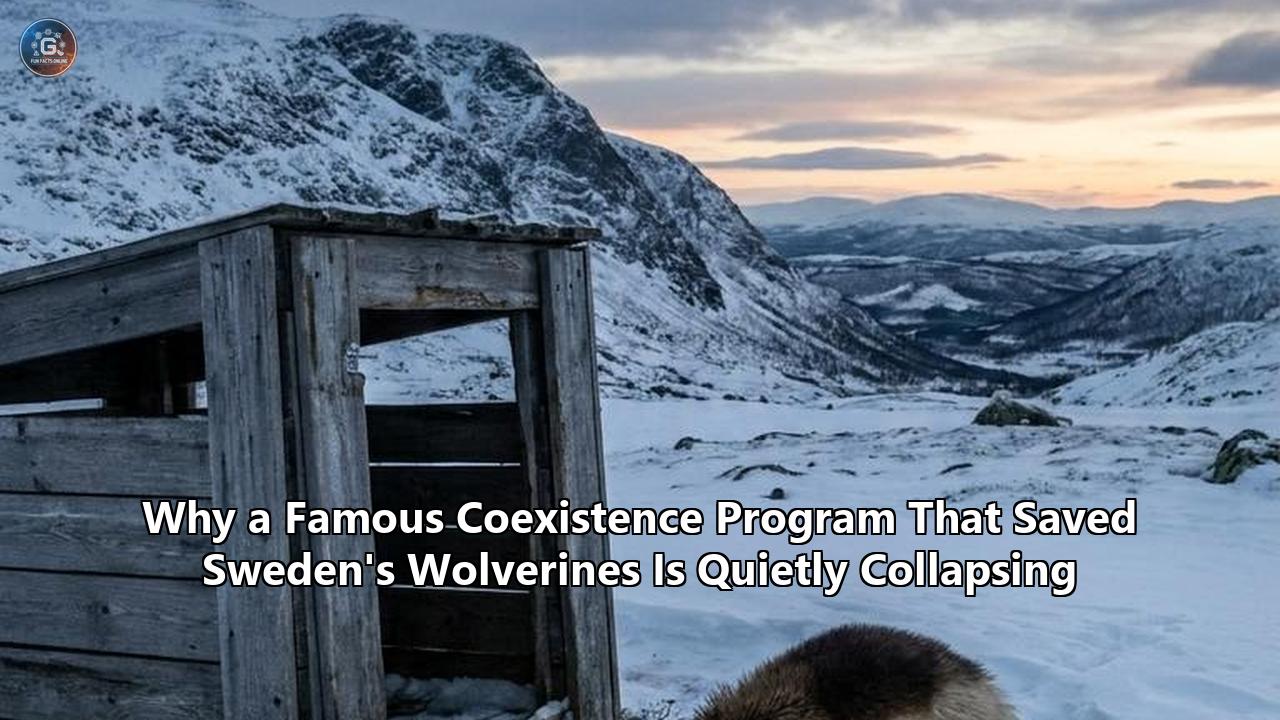
A world-renowned conservation program that once pulled Sweden’s endangered wolverines back from the brink of extinction is quietly unraveling. A comprehensive study published in the journal Conservation Letters reveals that Sweden’s pioneering Conservation Performance Payment (CPP) scheme—long celebrated as a global gold standard for human-wildlife coexistence—is failing to sustain its early successes.
The program was designed as a win-win partnership between the state and the Indigenous Sámi reindeer herders who share the northern tundra with large predators. For years, it achieved the near-impossible: aligning the financial survival of pastoralists with the biological recovery of the wolverine (Gulo gulo). However, the new findings, co-authored by researchers from the University of York and the Swedish Agricultural University (SLU), demonstrate that documented wolverine numbers are falling sharply in their traditional northern strongholds, while local trust in the state-run system has collapsed.
The trouble in the Scandinavian north is more than a localized policy failure; it is a critical case study in the structural vulnerabilities of market-based conservation. By analyzing why this highly acclaimed program is fracturing, conservationists, economists, and policymakers worldwide can extract vital lessons about the limits of incentive-based environmentalism and the hidden socio-economic costs of wildlife recovery.
The Radical Logic of Sweden’s Coexistence Model
To understand the scale of the program's current crisis, one must first understand how revolutionary it was at its inception.
The wolverine, Europe’s rarest large predator, is a solitary, extraordinarily resilient mustelid. Historically, centuries of systematic persecution pushed the species out of Sweden’s boreal forests into the most rugged, inaccessible high-mountain regions of the far north, where they survived in tiny, isolated pockets. Though the species received formal legal protection in Sweden in 1969, its recovery was severely restricted by illegal killings, driven by the intense conflict between wolverines and the Sámi reindeer husbandry industry.
Unlike sheep or cattle, which are often grazed in fenced pastures, Sweden’s semi-domesticated reindeer roam freely across vast expanses of wild forest and mountain tundra. During the brutal Arctic winters, when a thick crust forms on the snow, wolverines use their wide, snowshoe-like paws to run down and kill the heavier, bogged-down reindeer. For Sámi herders, the return of the wolverine was not an ecological triumph; it was a direct threat to their livelihood and cultural heritage.
┌────────────────────────────────────────────────────────┐
│             TRADITIONAL COMPENSATION                   │
│   (Reactive, carcase-based, high conflict)             │
│                                                        │
│  [Predation Event] ──> [Find Carcass] ──> [Verify]     │
│                                              │         │
│  [Hostility Rises] <── [Tension/Dispute] <───┘         │
└────────────────────────────────────────────────────────┘
                           vs.
┌────────────────────────────────────────────────────────┐
│             SWEDEN'S PERFORMANCE SCHEME                │
│       (Proactive, pay-for-presence, cooperative)       │
│                                                        │
│  [Wolverine Den Certified] ───> [Communal Payout]      │
│                                      │                 │
│  [Coexistence Promoted] <────────────┘                 │
└────────────────────────────────────────────────────────┘
In 1996, the Swedish government attempted to resolve this conflict by introducing a "pay-for-presence" model. Under traditional livestock compensation schemes used in most parts of the world, farmers are paid reactively. A herder must find a fresh carcass, preserve it from scavengers, call a state inspector, and prove the animal was killed by a protected predator. This process is plagued by administrative delays, high verification costs, and bitter disputes. It also creates a moral hazard: herders have little incentive to protect their herds because they only get paid when their livestock is dead.
Sweden flipped this dynamic on its head. Instead of paying herders for dead reindeer, the government began paying Sámi herding communities, known as samebyar (Sámi villages), based on the documented presence of reproducing wolverines on their grazing lands, regardless of how much damage actually occurred.
If a sameby successfully documented a wolverine den with cubs on its territory, the state issued a substantial lump-sum payment to the community's collective pool. The logic was elegant:
- Positive Financial Alignment: The presence of a wolverine was transformed from a financial liability into a predictable income stream.
- Collective Stewardship: Because the payout was issued to the sameby as a common-pool resource, it incentivized the entire community to tolerate and protect breeding female wolverines, who were previously the primary targets of illegal poaching.
- Autonomy: The herders could distribute the funds as they saw fit, whether to compensate individual herders for lost stock, invest in predator-proof corrals, or fund community infrastructure.
By 2015, the program appeared to be a stunning success. A landmark study showed that under the CPP scheme, adult female survival rates had risen significantly, allowing Sweden's wolverine population to more than double in a single decade. It was hailed as a shining beacon of progressive environmental policy—proof that Sweden wolverine conservation could successfully harmonize the survival of an apex predator with the preservation of an Indigenous way of life.
The Crack in the Ice: A Population in Retreat
The newly published data in Conservation Letters paints a starkly different and far more troubling picture. Thirty years after the program’s launch, the long-term success of the model has not been sustained.
A collaborative research team led by Dr. Hanna Pettersson of the University of York's Leverhulme Centre for Anthropocene Biodiversity mapped three decades of ecological and financial data, supplementing their findings with extensive fieldwork alongside Arctic wildlife rangers. Their analysis revealed that wolverine numbers have begun to drop significantly in their northern strongholds, where the species was historically most secure.
  NORRBOTTEN COUNTY'S SHARE OF NATIONWIDE WOLVERINE REPRODUCTIONS

  Early 2000s:  [████████──────────────────]  ~ 66% (Two-Thirds)

  Mid-2020s:    [████──────────────────────]  < 33% (Less than One-Third)
In the early 2000s, Norrbotten county—Sweden’s northernmost region and the heart of the Sámi reindeer calving grounds—accounted for approximately two-thirds of all documented wolverine reproductions in the country. Today, that share has plummeted to less than one-third. Norrbotten now consistently fails to meet its minimum regional conservation targets, and the broader Scandinavian wolverine population is under severe demographic strain.
While wolverines have slowly expanded their range southward into the boreal forest lowlands of central Sweden, where reindeer herds are absent, this southern migration is not enough to offset the loss of the core northern populations. According to the latest spatial capture-recapture (SCR) models compiled by Project RovQuant, Sweden's total estimated wolverine population fell from a range of 733–811 individuals in 2023 to just 642–690 in 2024. This decline brings the species perilously close to the Swedish government's legally mandated "Favourable Conservation Status" threshold of 600 individuals.
Furthermore, demographic modeling reveals that a steep decline in adult female survival—the exact metric that the performance payment scheme was designed to protect—has persisted year-over-year. The celebrated coexistence model is no longer working.
Dissecting the Collapse: Four Structural Failures
Why did a program that was structurally sound on paper break down in practice? The collapse of the Swedish model is not due to a single administrative error, but rather the result of four intersecting failures that expose the limits of static policy instruments in a rapidly changing world.
1. The Economic Squeeze: Frozen Funding in an Era of Inflation
The most glaring driver of the program’s decline is financial neglect. The cornerstone of any payment-for-ecosystem-services (PES) program is that the financial incentive must be large enough to offset the real-world costs of conservation. In Sweden, those costs are measured in dead reindeer.
  FINANCIAL DISCONNECT IN REPRODUCTION PAYMENTS (SEK)

  Sámi Parliament Calculated Legal Payout:    480,000 SEK
  ──────────────────────────────────────────────────────────
  Actual Government Payment (Frozen since 2002): 200,000 SEK
  ──────────────────────────────────────────────────────────
  Government Increase Offered in 2024:         25,000 SEK
When the payment level was adjusted in 2002, the state set the compensation at 200,000 Swedish Kronor (SEK) (approximately $19,000 USD) per certified predator reproduction. This sum was calculated based on the estimated lifetime damage a single wolverine litter would cause to local reindeer herds.
For 24 years, that payment remained frozen.
As Dr. Hanna Pettersson points out, the real-world value of that 200,000 SEK payment has approximately halved over the last two decades due to cumulative inflation, rising cost of living, fuel, and the market price of reindeer meat. Today, the Sámi Parliament (Sametinget) calculates that the legally required payout to offset actual reindeer losses should be at least 480,000 SEK. Yet, despite decades of advocacy, the Swedish government offered only a token 25,000 SEK increase in 2024.
By failing to index the payments to inflation, the Swedish state quietly shifted the financial burden of Sweden wolverine conservation back onto the shoulders of the Sámi herders. As the financial reward for hosting wolverines shrank, the direct losses from predation remained painfully high, turning what was once a cooperative partnership into an extractive relationship.
2. The Meteorological Trap: Climate Change and the Verification Bottleneck
The second major failure lies in the mechanics of the monitoring system. Because the CPP is a performance-based scheme, herders only get paid if a wolverine reproduction is officially "certified" by county administrative boards (Länsstyrelsen).
This certification process relies heavily on winter snow tracking. Rangers and herders must traverse vast, trackless wilderness areas on snowmobiles to find fresh wolverine tracks, locate denning sites, and collect genetic samples (feces and hair) for DNA analysis.
  HOW CLIMATE CHANGE DISRUPTS PERFORMANCE PAYMENTS

  [Warmer Arctic Winters] ──> [Early Melts / Rain-on-Snow]
                                    │
                                    ▼
                      [Footprints Melt & Erase]
                                    │
                                    ▼
                 [Rangers Cannot Verify Den Sites]
                                    │
                                    ▼
                [Zero Payout Issued to Samebyar]
                                    │
                                    ▼
               [Herders Suffer Losses Without Funding]
Under the weight of the climate crisis, this tracking methodology has run into a meteorological wall. The Arctic is warming up to four times faster than the rest of the globe. Northern Sweden now experiences highly erratic winters characterized by late snowfalls, frequent rain-on-snow events, and rapid, unseasonal spring melts.
Without consistent, high-quality snow cover, wolverine tracks melt away within hours or fail to form altogether. Consequently, rangers are increasingly unable to locate and document active dens. This has created a profound bureaucratic bottleneck:
- Wolverines are still present on the land, and they are still killing reindeer.
- Because of the altered snow conditions, the state's rigid tracking protocols cannot officially "prove" their existence.
- Under the strict verification rules, clear visual sightings, hair traps, and herder reports are frequently disqualified by state officials.
The result is a devastating double-loss for the Sámi communities. They lose their livestock to active predators, yet they receive zero compensation because the state's climate-compromised monitoring tools cannot verify the dens. This dynamic has bred deep resentment, destroying the fragile foundation of trust that took decades to build.
3. Cumulative Pressures: The "Wicked" Context of Sámi Husbandry
A critical lesson of the Swedish case study is that human-wildlife conflicts cannot be understood in isolation from the broader socio-political landscape. Reindeer herding in Sweden is not just an agricultural business; it is a culturally significant livelihood protected by national and international law.
In recent years, the lands used by the 51 Sámi herding communities have faced unprecedented industrial encroachment. Massive iron ore and copper mining projects, extensive commercial forestry, wind energy farms, and expanding infrastructure have fragmented and degraded the winter grazing pastures that reindeer rely on.
   CUMULATIVE STRESSORS ON SÁMI REINDEER HUSBANDRY

   ┌────────────────────────────────────────────────────────┐
   │  [Industrial Forestry]   ──> High Canopy Loss          │
   │  [Mining & Wind Farms]   ──> Habitat Fragmentation     │  ──> Reindeer pushed
   │  [Climate Change]        ──> Erratic Pasture Access    │      into smaller areas
   └────────────────────────────────────────────────────────┘              │
                                                                           ▼
   ┌────────────────────────────────────────────────────────┐      Predation risk
   │  [Uncompensated Predators] ──> Heavy Economic Payout    │ <──  concentrated
   └────────────────────────────────────────────────────────┘
When commercial forestry clears old-growth forests, it destroys the arboreal lichens that reindeer eat in winter. When wind farms are constructed on pristine mountain ridges, reindeer avoid those areas entirely due to the noise and flashing lights. Forced into smaller, fragmented pockets of remaining pasture, the reindeer herds become highly concentrated, making them incredibly easy targets for opportunistic predators like the wolverine.
Sámi communities are thus caught in a pincer movement. On one side, industrial development—often branded as "green transition" projects, such as fossil-free steel plants and wind parks—shrinks their usable territory. On the other side, an inflexible conservation policy expects them to host growing populations of large carnivores without adequate financial support or institutional respect. This cumulative strain has turned the wolverine from a manageable neighbor into a symbol of state-sponsored marginalization.
4. The Policy Backslide: A Return to the Gun
As the legitimacy of the CPP scheme has eroded, the Swedish state has increasingly retreated from the principles of coexistence, reverting to lethal management to appease local anger.
For decades, lethal control of wolverines was restricted to exceptional, highly targeted "protective hunting" of individual animals that were causing severe, repeated damage to specific herds. However, in 2022, facing immense political pressure from both herding and hunting lobbies, the Swedish government authorized a dramatic policy shift.
Between October 1 and December 31, 2023, Sweden implemented its first licensed quota hunt for wolverines in decades, setting a maximum harvest of 15 individuals. The official justification was to regulate the predator population to protect the reindeer industry. But to conservationists, the introduction of a licensed quota hunt for a species that is strictly protected under the European Union’s Habitats Directive and classified as "Vulnerable" on the Swedish Red List was a massive step backward.
  SWEDEN WOLVERINE MORTALITY BY CAUSE (HISTORICAL SCANDINAVIAN ESTIMATES)

  Illegal Poaching:     [████████████████████████──────]  ~ 60%

  State-Approved Culls: [████████──────────────────────]  ~ 20%

  Natural/Other:        [████████──────────────────────]  ~ 20%
Historically, illegal poaching has been the single largest source of wolverine mortality in Scandinavia, accounting for up to 60% of deaths. The performance payment scheme successfully lowered poaching rates because herders realized that a living wolverine was worth more than a dead one.
Now, with payments frozen and state-sanctioned hunts returning, that equation has broken down. If herders lose faith in the state’s willingness to pay for coexistence, the incentive to tolerate these animals disappears, threatening to trigger a resurgence in illegal killing that could devastate the fragile population.
Broader Lessons for Global Wildlife Policy
The silent collapse of Sweden’s wolverine program is not just a localized tragedy; it is a warning for global conservation. Around the world, from the snow leopard ranges of Central Asia to the lion-dominated savannas of East Africa, performance-based payment schemes are being widely adopted.
By analyzing the vulnerabilities of the Swedish model, we can extract three fundamental principles for the future of human-wildlife coexistence.
┌─────────────────────────────────────────────────────────────────────────┐
│               THREE CORE PRINCIPLES OF COEXISTENCE DESIGN               │
├─────────────────────────────────────────────────────────────────────────┤
│                                                                         │
│  1. DYNAMIC FINANCIAL ARCHITECTURE                                      │
│     * Payments must be indexed to inflation and local meat prices.      │
│     * Static financial models inevitably decay and shift costs.         │
│                                                                         │
│  2. CLIMATE-RESILIENT MONITORING                                        │
│     * Do not rely on fragile physical tracking (e.g., snow).            │
│     * Transition to spatial capture-recapture (SCR) DNA modeling.       │
│                                                                         │
│  3. INTRA-SECTORAL JUSTICE                                              │
│     * Wildlife policies cannot succeed in an industrial vacuum.         │
│     * Must account for cumulative pressures (mining, forestry, wind).    │
│                                                                         │
└─────────────────────────────────────────────────────────────────────────┘
Lesson 1: The Danger of Static Financial Design
The most obvious lesson is that conservation performance payments cannot be "set and forget" policies.
Ecosystems are dynamic, but so are human economies. A financial incentive designed in 2002 cannot successfully function in 2026 without regular, systematic adjustments for inflation and local market conditions. When governments fail to update payments, they are effectively defunding their own conservation programs through inflation.
Any future performance-based conservation scheme must build in automatic indexing. Payouts must be tied to local economic realities—such as the market value of livestock, fuel costs, and general consumer price indexes—to ensure that the financial incentive to protect wildlife remains stable across generations.
Lesson 2: The Vulnerability of Rigid Verification Metrics
The Swedish case highlights the high risk of tying payments to rigid, physical verification methods that are vulnerable to climate change.
As the planet warms, tracking systems that rely on consistent winter snow or predictable animal behavior will inevitably fail. If a program's verification criteria are too rigid, environmental noise will cause the state to undercount the predator population, leading to underpayment and a collapse of local trust.
To build climate-resilient conservation schemes, governments must transition toward probabilistic, model-based payment structures. Rather than requiring rangers to find every single physical den site in a melting landscape, modern programs should leverage advanced spatial capture-recapture (SCR) modeling.
By collecting DNA from non-invasive genetic sampling (NGS) and integrating it with geographic data, scientists can generate highly accurate density maps. Payments can then be distributed based on these modeled densities, decoupling the herders' financial security from the vagaries of a changing climate.
Lesson 3: Environmental Policies Must Be Intersectoral
Conservation does not occur in a vacuum. A wildlife management policy, no matter how well-funded, will fail if other government departments are actively destroying the habitats that make coexistence possible.
In Sweden, the Ministry of Environment’s wolverine recovery goals are in direct, unresolved conflict with the Ministry of Enterprise’s mining and forestry concessions. By failing to develop a cohesive, cross-sectoral policy, the Swedish state has forced the Sámi people to bear the costs of both industrial development and predator conservation.
True coexistence requires socio-cultural justice. Conservation goals must be integrated with robust land-use zoning, protection of indigenous land rights, and an explicit recognition of the cumulative impacts that industrialization has on pastoral communities.
What Happens Next?
The decline of the wolverine in its northern strongholds is an urgent warning sign. To save the system, Sweden's policymakers must act quickly to modernize the CPP program before the remaining trust is permanently lost.
  SCANDINAVIAN WOLVERINE ESTIMATES (TOTAL INDIVIDUALS)

  2023 Estimate: [██████████████████████████████] ~1,122 - 1,210

  2024 Estimate: [██████████████████████████────] ~1,012 - 1,072
In the immediate future, there are several key developments to watch:
- The Funding Battle: The Sámi Parliament and conservation groups will continue to press the Swedish government to raise the reproduction payment from the stagnant 200,000 SEK to the legally justified 480,000 SEK. Whether the state is willing to make this long-overdue investment will determine if herders can afford to tolerate the species.
- The Transition to DNA Modeling: In Norrbotten county, a major pilot project has been testing the use of comprehensive DNA-based genetic monitoring (NGS) to replace traditional snow-tracking. The success of this transition will be a critical milestone. If the county administrative boards can successfully implement an "uncertainty surcharge" to compensate for data gaps caused by bad weather, it could restore trust and provide a blueprint for other climate-affected conservation programs globally.
- EU Legal Intervention: As Sweden continues to authorize licensed quota hunts for strictly protected large carnivores, environmental NGOs are preparing to challenge these decisions in European courts. A ruling by the European Court of Justice could force Sweden to suspend licensed culling, placing the focus back on non-lethal coexistence strategies.
Ultimately, the unraveling of Sweden's wolverine program reminds us that the hardest part of conservation is not achieving an initial recovery, but sustaining it. When a species successfully returns, the work of coexistence has only just begun. Without long-term political commitment, flexible funding, and deep respect for the human communities on the front lines, even the most celebrated conservation triumphs can quietly slide back into conflict.
Reference:
- https://www.sciencedaily.com/releases/2026/06/260601025324.htm
- https://www.miragenews.com/renowned-wildlife-coexistence-scheme-falls-short-1683817/
- http://www.wolverineproject.se/uploads/1/3/9/2/13929225/conservation_letters_2015_perssonpaying_for_an_endangered_predator_leads_to_population_recovery,na-na.pdf
- https://swedensbigfive.org/wolverine/
- https://www.face.eu/wp-content/uploads/2022/10/InfoNotes-30years.pdf
- https://www.reddit.com/r/conservation/comments/138ne23/from_the_brink_of_extinction_the_wolverines/
- https://www.naturetravels.co.uk/blog/wolverines-in-sweden-a-predator-on-the-edge/
- https://www.rbpnetwork.eu/country-infos/sweden/conservation-performance-payments-51/
- https://wolverinefoundation.org/conservation
- https://www.stockholmresilience.org/publications/publications/2025-05-29-investigating-conservation-performance-payments-alongside-human-wildlife-conflicts-the-swedish-lynx-and-wolverine-protection-policies.html
- https://www.rbpnetwork.eu/country-infos/sweden/conservation-performance-payments-51/
- https://www.researchgate.net/publication/258929469_Performance_Payments_for_Groups_The_Case_of_Carnivore_Conservation_in_Northern_Sweden
- https://www.miragenews.com/renowned-wildlife-coexistence-scheme-falls-short-1683817/
- https://www.researchgate.net/publication/387785525_Estimates_of_wolverine_density_abundance_and_population_dynamics_in_Scandinavia_2015-2024
- https://www.sciencedaily.com/releases/2026/06/260601025324.htm
- https://reindeerherding.org/sami-sweden
- https://www.researchgate.net/publication/309302625_Mismatch_between_goals_and_the_scale_of_actions_constrains_adaptive_carnivore_management_The_case_of_the_wolverine_in_Sweden
- https://www.york.ac.uk/anthropocene-biodiversity/news/mouldingthefuture/2023-24/pick-up-wolverine/
- https://relationalthinkingblog.com/2025/02/17/plain-language-summary-investigating-conservation-performance-payments-alongside-human-wildlife-conflicts-the-swedish-lynx-and-wolverine-protection-policies/
- https://sciprofiles.com/profile/559075
- https://swedensbigfive.org/wolverine/
- https://egulo.wordpress.com/2017/02/20/sweden-incidents-in-wolverine-research/
- https://www.researchgate.net/publication/5449292_Conservation_Performance_Payments_for_Carnivore_Conservation_in_Sweden
- https://etheses.whiterose.ac.uk/id/eprint/37921/1/Hamm_J_Earth%20and%20Environment_PhD_2025.pdf
- https://www.researchgate.net/publication/404482479_Large_mammal_recovery_in_the_wake_of_human_population_decline
- https://static02.nmbu.no/mina/publikasjoner/mina_fagrapport/pdf/mif100.pdf
- https://www.researchgate.net/publication/371761013_Estimating_abundance_of_wolverines_in_Sami_reindeer_herding_villages_and_herding_areas_in_Sweden
- https://www.stockholmresilience.org/research/research-stories/2025-09-18-time-to-stop-crying-wolf---on-both-sides-of-the-debate.html
- https://metsastajaliitto.fi/system/files/inline-files/Presentation%20SAHW%202025.02.19%20Final%20presented%20in%20the%20Finnish%20Parliament%2019%20Feb%202025.pdf