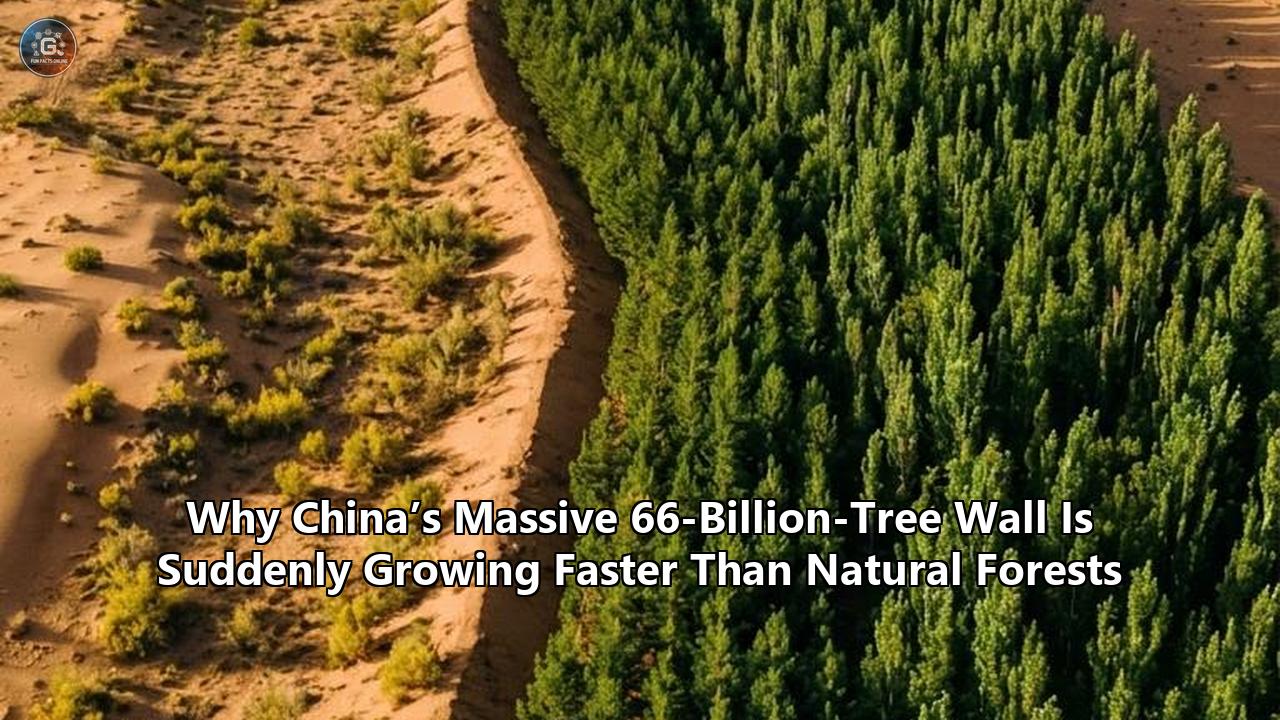
A quiet scientific revelation has upended the global understanding of ecological engineering. A study published in the journal Geophysical Research Letters has revealed that the human-planted forests of China’s massive desert-fighting tree barrier are growing significantly faster and absorbing carbon dioxide more rapidly than natural, undisturbed woodlands.
The finding comes from a comprehensive analysis of satellite data led by Yuhang Luo, a landscape ecologist at Peking University’s Shenzhen campus. Luo and his team set out to decode how the gargantuan forest belts created under the Three-North Shelterbelt Forest Program—historically known as the China Great Green Wall—differ from natural forests in their response to a warming world and rising atmospheric carbon dioxide.
The results are striking. By analyzing decades of satellite records tracking "leaf area index" (LAI)—a critical metric of canopy density and a primary driver of a forest’s carbon-capturing capacity—the researchers discovered that China's planted forests expanded their leafy canopies 66% faster than nearby natural forests.
Even when the scientists strictly adjusted their data to compare planted and natural forests of the exact same age, growing under identical environmental conditions, the human-engineered forests still maintained a 4.6% growth advantage.
This hyper-growth offers a potent, short-term boost for global carbon sequestration efforts. However, it also introduces a profound ecological paradox. While these engineered forests are sprinting ahead in the short term, scientists caution that their rapid growth may mask long-term vulnerabilities in biodiversity, water consumption, and climate resilience, making natural forests irreplaceable in the long-run fight against climate change.
The Foliage Spurt: Inside the Peking University Study
To understand why these human-planted forests are outpacing nature, the Peking University research team looked beyond simple tree counts. They utilized advanced remote sensing data and machine learning to isolate how different forest types behave under identical climate pressures.
The primary metric of the study, the leaf area index, measures the one-sided green leaf area per unit of land horizontal ground surface. Because leaves are the engines of photosynthesis, a rapidly expanding leaf area index directly correlates with a forest's capacity to pull carbon dioxide out of the atmosphere.
Planted vs. Natural Forest Growth Dynamics
┌────────────────────────────────────────────────────────┐
│ Planted Forests (Young, Managed, Selected Species)     │
│ ──► Leaf Area Index growth: +66% (Unadjusted)          │
│ ──► Age-Adjusted Growth Advantage: +4.6%               │
│ ──► Growth Peak: 30-40 Years (Sharp decline after)     │
├────────────────────────────────────────────────────────┤
│ Natural Forests (Diverse, Self-Seeded, Unmanaged)      │
│ ──► Growth Rate: Slower but highly consistent          │
│ ──► Carbon Storage: Superior deep soil & wood biomass  │
│ ──► Resilience: High long-term stability               │
└────────────────────────────────────────────────────────┘
The data revealed that the sheer speed of the China Great Green Wall's canopy development is largely driven by tree age. The vast majority of China's planted forests are young, and young trees naturally channel their energy into rapid growth and foliage production.
Yet, the 4.6% baseline advantage that persisted after adjusting for age points to a deeper, more complex mechanism. The study revealed that these managed forests are highly sensitive to "CO2 fertilization"—the process by which elevated levels of atmospheric carbon dioxide act as an accelerator for plant growth. Under high-emission scenarios, the planted trees capitalized on the excess carbon in the air far more aggressively than natural forests.
According to Luo, this hyper-responsiveness was most pronounced in mixed and evergreen planted forests. By selecting specific species and managing the spaces between them, human intervention has accidentally created an ecosystem that acts like a highly tuned carbon-absorbing machine.
The Mechanics of Acceleration: Why Managed Trees Grow Faster
Natural forests are battlegrounds of biological competition. Trees of varying species, heights, and ages fight intensely for access to sunlight, groundwater, and soil nutrients. In contrast, the planted forests of the China Great Green Wall are designed to minimize this friction.
Several key factors explain why human-planted trees are outgrowing their wild counterparts:
1. Species Selection
Historically, the Three-North Shelterbelt Program relied heavily on fast-growing, highly resilient species such as poplars (Populus), eucalyptus, and various species of pine and willow. These species are evolutionary sprinters, genetically wired to allocate resources toward rapid vertical growth and massive leaf canopy production.
2. Active Silvicultural Management
Unlike natural forests left to grow on their own, China's planted forests are actively managed. Forestry workers routinely clear away competing undergrowth, shrubs, and weeds that would otherwise steal water and nutrients from the young trees. In many critical zones, these forests are also fertilized and selectively irrigated during their fragile early years.
By eliminating the natural competition for light and soil resources, human management amplifies the positive effects of rising CO2 levels. The trees do not have to waste energy fighting for survival; instead, they can maximize their photosynthetic output.
3. Uniform Canopy Structure
Because planted forests are typically established all at once, their canopies are highly uniform. This even spacing allows sunlight to penetrate the outer layers of the forest more systematically, maximizing the collective photosynthetic activity of the entire stand compared to the chaotic, multi-layered, and self-shading structure of an old-growth natural forest.
From Sandstorms to Carbon Sinks: The Historical Scope of the Wall
To appreciate the scale of this rapid growth, one must look at the history of the Three-North Shelterbelt Forest Program.
Launched in 1978, the program was not originally conceived as a climate change mitigation tool. Instead, it was an act of survival. During the mid-to-late 20th century, the relentless expansion of the Gobi and Taklamakan deserts threatened to swallow millions of acres of agricultural land, destroying farming communities and sending apocalyptic dust storms directly into major urban centers, including Beijing.
The China Great Green Wall: Key Milestones
┌──────┬────────────────────────────────────────────────────────┐
│ Year │ Milestone Event                                        │
├──────┼────────────────────────────────────────────────────────┤
│ 1978 │ Program launched to halt Gobi & Taklamakan deserts     │
│ 2009 │ Planted forest cover reaches 500,000 sq kilometers      │
│ 2023 │ Regional forest cover rises from 5% (1978) to 14%      │
│ 2024 │ Completed 3,000 km continuous belt around Taklamakan   │
│ 2026 │ Study reveals planted forests grow 66% faster than wild │
│ 2050 │ Projected completion target: 100 billion trees planted │
└──────┴────────────────────────────────────────────────────────┘
The plan was simple yet breathtakingly ambitious: plant a 4,500-kilometer (2,800-mile) green barrier across northern China to anchor shifting sand dunes, improve soil health, and block incoming wind.
Over nearly five decades, China has successfully planted approximately 66 billion trees. The results on the ground have reshaped the geography of northern China:
- Desert Containment: The Gobi Desert, which was expanding by roughly 10,000 square kilometers per year in the 1980s, has reversed its advance and is now shrinking by more than 2,000 square kilometers annually.
- Encircling the Desert: In late 2024, China completed a continuous 3,000-kilometer green belt entirely surrounding the perimeter of the hostile Taklamakan Desert, cementing a major engineering milestone.
- Forest Cover Surges: In the specific northern zones targeted by the wall, forest cover has ballooned from a meager 5% in 1978 to over 14%. Nationally, China's aggressive greening programs have pushed total forest coverage from under 10% in 1949 to more than 25%.
- Dust Storm Reduction: Beijing, which once suffered from dozens of choking sandstorms every spring, now experiences only a fraction of those events, drastically improving regional air quality.
As the world's focus shifted toward carbon sequestration in the 21st century, scientists began to realize that this massive defensive barrier was also serving as one of the largest terrestrial carbon sinks on the planet. Recent assessments showed that the forests surrounding the Taklamakan Desert alone absorb roughly 8.3 million tons of CO2 per year while emitting only 6.7 million tons, functioning as a highly effective net carbon sponge.
The Carbon Paradox: Why Speed Does Not Equal Storage
The rapid growth of the China Great Green Wall seems like an unmitigated win for the environment. Yet, the Peking University study exposes a critical catch: the growth advantage of planted forests is highly temporary.
The researchers found that the elevated growth rate of planted forests peaks when the trees are between 30 and 40 years old. After crossing the 40-year threshold, the growth rate declines sharply.
In contrast, natural forests grow at a slower, steadier rate. While they lack the explosive early sprint of managed plantations, natural forests maintain their growth and carbon accumulation over centuries, providing far superior long-term stability.
"Planted forests can be a powerful short-term tool for carbon uptake, but this advantage is temporary," Luo explained in an interview with Live Science. "For long-term carbon storage and resilience, natural forests remain irreplaceable."
Long-Term Carbon Sequestration Trends (Conceptual)
Leaf Area
Index (LAI)
  ▲
  │     ▲ Planted Forest (Rapid initial sprint, peaks at 30-40 years, then declines)
  │    ╱ ╲
  │   ╱   ╲
  │  ╱     ╲───────────►
  │ ╱
  │╱     ● Natural Forest (Slow, steady, resilient growth over centuries)
  │     ╱
  │    ╱
  │  _╱
  └──────────────────────────────► Time (Years)
This dynamic is supported by a separate study published in Communications Earth & Environment. That research concluded that, at comparable ages, naturally regenerated forests actually accumulate more above-ground carbon in their wood, bark, and roots than planted forests do.
The reason lies in structural complexity and density. Because natural forests feature diverse tree sizes and a rich mixture of species, they are better at packing biomass into three-dimensional space over time.
Furthermore, a significant portion of a forest’s carbon is not stored in its leaves or even its trunks, but deep in the soil and root networks. Natural forests, with their undisturbed soil profiles and complex fungal networks, hold onto this underground carbon far more securely than planted monocultures, which are prone to soil disturbance and have simpler root systems.
The Hydrological Dilemma: Can a Desert Support 100 Billion Trees?
The sudden acceleration of the China Great Green Wall brings a long-standing ecological concern back to the forefront: water.
Trees require water to photosynthesize and grow. Fast-growing trees, like poplars and eucalyptus, are notoriously thirsty. Planting tens of billions of these water-guzzling species in arid and semi-arid regions can put a severe strain on local hydrology.
In the early decades of the program, Chinese planners learned this lesson the hard way. Millions of fast-growing trees planted in the 1970s and 1980s died off because they quickly depleted the limited groundwater available, leaving the soil drier than it was before. In some areas, these thirsty plantations lowered local water tables so drastically that nearby natural vegetation withered, ironically accelerating aridification.
To prevent a repeat of these ecological setbacks, China’s modern greening campaigns have undergone a massive technological and philosophical shift. During the 2026 spring planting season, local authorities deployed a highly sophisticated suite of tools to ensure survival rates without draining local aquifers:
Smart Planting Technologies in China’s 2026 Greening Campaigns
- Drone-Assisted Seeding: Unmanned aerial vehicles (drones) are now widely used to disperse grass seeds and shrub seedlings over remote desert terrain, removing the need for heavy, soil-compacting machinery.
- Precision Remote Sensing: Technicians monitor soil moisture, wind patterns, and sand movement using real-time satellite data. This allows them to calculate the exact planting density a specific plot of land can hydrologically support.
- Shifting to Xerophytic Shrubs: Instead of planting tall, water-intensive trees in deep desert sands, workers are planting native, drought-resistant shrubs like Salix mongolica (desert willow). These plants have deep, binding root systems that stabilize sand dunes while using a fraction of the water required by poplars.
- Grass Checkerboards: Straw bundles are woven into checkerboard grids across shifting sand dunes. These grids act as windbreaks, trapping moisture in the sand and creating a stable micro-environment where small shrubs can take root without artificial irrigation.
Desert Stabilization Technique: Grass Checkerboard
┌───┬───┬───┬───┐  ◄─── Straw grids laid on sand
│ ☼ │ ☼ │ ☼ │ ☼ │  ◄─── Sand is stabilized, preventing drift
├───┼───┼───┼───┤
│ ☼ │ 🌱│ ☼ │ 🌱│  ◄─── Native shrubs (e.g., Salix mongolica) planted inside
├───┼───┼───┼───┤
│ ☼ │ ☼ │ ☼ │ ☼ │  ◄─── Straw decomposes over time, enriching the soil
└───┴───┴───┴───┘
By transitioning from a "brute-force" tree-planting model to a highly targeted, ecologically conscious restoration strategy, China has successfully kept its 66-billion-tree wall alive and growing. However, the rapid growth rates highlighted in the latest study mean these trees are consuming water at an accelerated rate, keeping the hydrological balance on a razor's edge.
Fixing the Blind Spots in Global Climate Models
The revelation that planted forests grow 66% faster than natural forests is not just a localized scientific curiosity. It has profound implications for global climate policy, international carbon accounting, and the complex computer models used to predict the earth's future climate.
Currently, major global ecosystem models—including those used by the Intergovernmental Panel on Climate Change (IPCC)—treat forests with a broad brush. They rarely distinguish between a newly planted, highly managed monoculture forest and an ancient, self-seeded natural forest when calculating carbon sequestration rates. They also struggle to represent how a forest's carbon uptake changes as it ages.
This omission creates a double-edged sword for global carbon accounting:
- Underestimating the Present: Because models fail to account for the hyper-accelerated growth of young, managed forests, they are likely underestimating how much carbon dioxide is currently being pulled out of the air by massive reforestation programs like the China Great Green Wall.
- Overestimating the Future: Conversely, because these models do not account for the sharp growth decline that planted forests experience after 40 years, they may be vastly overestimating how much carbon these same forests will be absorbing three or four decades from now.
"These findings underscore the importance of forest age and management history—dimensions currently overlooked in major ecosystem models," Luo and his co-authors concluded in their paper.
Without updating these models, nations risk building their long-term net-zero strategies on highly inaccurate assumptions, potentially overestimating the durability of their carbon sinks.
The Road to 2050: What Lies Ahead for the Wall?
China has no plans to slow down its greening efforts. With the continuous belt around the Taklamakan Desert completed in late 2024, the country is now pushing forward with its target to plant an additional 34 billion trees by 2050, aiming for a grand total of 100 billion trees.
As this massive project enters its final decades, the lessons learned from the China Great Green Wall will serve as both a blueprint and a warning for similar grand-scale ecological initiatives around the world, most notably Africa's ambitious Great Green Wall project, which aims to restore 100 million hectares of degraded land across the Sahel.
Going forward, several key milestones and unresolved questions will determine the ultimate success of China's monumental ecological experiment:
1. Navigating the 40-Year Decline
With huge portions of the China Great Green Wall—especially those planted in the 1980s and 1990s—now approaching or exceeding 40 years of age, scientists will be watching closely to see how these forests transition into maturity. Managing this decline in growth rate while preventing large-scale die-offs will require active, adaptive forestry management.
2. Balancing Carbon vs. Biodiversity
Planted forests are often monocultures, which are highly susceptible to pests, diseases, and changing climate conditions. Converting these single-species stands into diverse, mixed-species ecosystems that mimic natural forests will be crucial for ensuring their long-term survival.
3. Monitoring Local Groundwater
As the climate warms, the tension between tree growth and water availability in China's arid north will only intensify. Continuous monitoring of regional water tables using remote sensing will be vital to ensure that the greening of the desert does not come at the expense of regional water security.
The Peking University study has shown that humanity is capable of engineering ecosystems that can outrun nature in a sprint. But as the world faces a century-long marathon against climate change, the ultimate test for the China Great Green Wall will be whether this rapid, human-engineered growth can be sustained, or whether nature will eventually demand a biological correction.
Reference:
- https://economictimes.indiatimes.com/news/international/us/china-spent-decades-planting-66-billion-trees-scientists-found-they-now-outgrow-natural-forests-by-66/articleshow/132136894.cms?from=mdr
- https://www.techno-science.net/en/news/china-has-planted-66-billion-trees-the-consequences-on-our-atmosphere-N28971.html
- https://www.livescience.com/planet-earth/plants/trees-in-chinas-great-green-wall-appear-to-grow-faster-than-natural-forests-study-finds
- https://futurism.com/science-energy/something-weird-china-tree-wall
- https://www.iflscience.com/chinas-great-green-wall-of-66-billion-new-trees-isnt-acting-like-a-natural-forest-83970
- https://www.youtube.com/watch?v=WvU9nwV9auk
- https://www.bioscience.com.pk/en/subject/environmental-science/66-billion-trees-have-been-planted-across-chinas-great-green-wall-and-scientists-say-theyre-growing-faster-than-natural-forests
- https://wilderness-society.org/chinas-green-great-wall-a-bold-effort-to-tame-the-deserts/
- https://en.wikipedia.org/wiki/Great_Green_Wall_(China))
- https://en.clickpetroleoegas.com.br/chinas-great-green-wall-of-66-billion-trees-grows-66-faster-than-natural-forests-but-scientists-warn-rapid-growth-may-not-last-asaf04/
- https://en.people.cn/n3/2026/0313/c90000-20435806.html