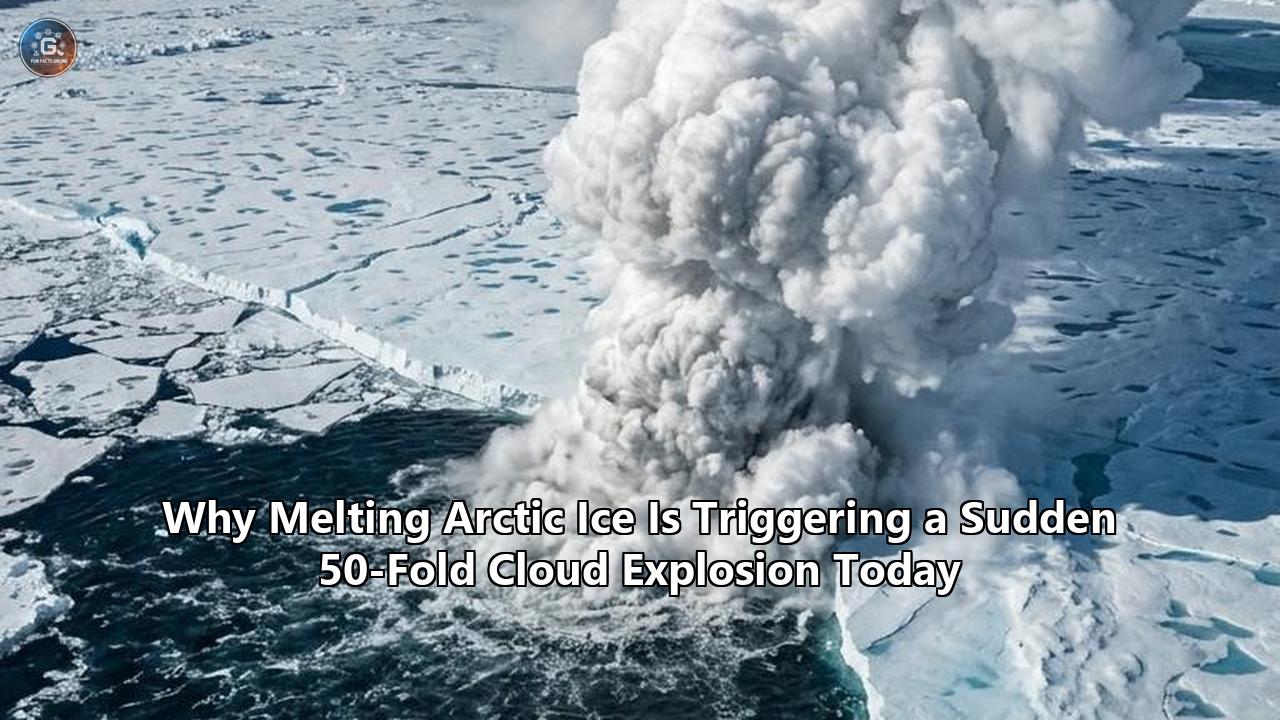
Measurements taken along the retreating sea ice edge in the Davis Strait and the Greenland Sea have revealed a rapid, previously unquantified atmospheric phenomenon: as Arctic sea ice retreats, sunlight hitting the newly exposed, nutrient-rich marginal ice zone triggers an explosive chemical chain reaction that multiplies cloud-forming particles by up to fifty times within a single day.
Published in Nature Geoscience, an observational study led by researchers from the University of Birmingham alongside teams from the Plymouth Marine Laboratory, the Spanish National Research Council (CSIC), and Chinese academic institutions has provided the first direct, open-ocean confirmation of a process that had previously only been observed within controlled laboratory chambers at CERN. By deploying high-resolution atmospheric mass spectrometers aboard the British research vessel RRS Discovery, the expedition tracked aerosol particle concentrations surging from background baselines of approximately 50 particles per cubic centimeter to more than 1,500 particles per cubic centimeter in less than 24 hours.
+-----------------------------------------------------------------------------------------+
|                THE MARGINAL ICE ZONE (MIZ) AEROSOL-CLOUD CASCADE                         |
+-----------------------------------------------------------------------------------------+
|                                                                                         |
|      Solar Radiation (UV & Visible)                                                     |
|            │         │         │                                                        |
|            ▼         ▼         ▼                                                        |
|      ┌─────────────────────────────┐                                                    |
|      │  Thinning Ice & Open Water  │ ──► Phytoplankton & Microalgal Blooms              |
|      └──────────────┬──────────────┘                                                    |
|                     │ Biological & Photochemical Emissions                              |
|                     ▼                                                                   |
|      ┌──────────────────────────────────────────────────────────────┐                   |
|      │ Volatile Marine Precursors:                                  │                   |
|      │  • Iodine Vapors (I2, CH3I, CH2I2)                           │                   |
|      │  • Dimethyl Sulfide (DMS) ──► SO2 ──► Sulfuric Acid (H2SO4)  │                   |
|      │  • Biogenic Volatile Organic Compounds (VOCs)                │                   |
|      └──────────────────────────────┬───────────────────────────────┘                   |
|                                     │ Photolytic Oxidation                              |
|                                     ▼                                                   |
|      ┌──────────────────────────────────────────────────────────────┐                   |
|      │ Rapid Multicomponent Nucleation (< 3 nm clusters):           │                   |
|      │  • Iodic / Iodous Acids (HIO3, HIO2) + H2SO4                 │                   |
|      │  • Formation rate: >80% of sunny melt days                   │                   |
|      └──────────────────────────────┬───────────────────────────────┘                   |
|                                     │ Condensation Growth                               |
|                                     ▼                                                   |
|      ┌──────────────────────────────────────────────────────────────┐                   |
|      │ Iodine-Oxygenated Organic Molecules (I-OOMs):                │                   |
|      │  • Rapid growth from molecular scale past 20–70 nm           │                   |
|      │  • Activation into Cloud Condensation Nuclei (CCN)           │                   |
|      └──────────────────────────────┬───────────────────────────────┘                   |
|                                     │ Ambient Water Vapor Uptake                        |
|                                     ▼                                                   |
|      ┌──────────────────────────────────────────────────────────────┐                   |
|      │ 50-Fold Surge in Cloud Condensation Nuclei (CCN)             │                   |
|      │   Baseline: ~50 cm⁻³  ──►  Post-Burst: >1,500 cm⁻³           │                   |
|      └──────────────────────────────┬───────────────────────────────┘                   |
|                                     │ Cloud Microphysics Alteration                     |
|                                     ▼                                                   |
|      ┌──────────────────────────────────────────────────────────────┐                   |
|      │ Dense, Low-Level Marine Stratiform Cloud Layers              │                   |
|      └──────────────────────────────────────────────────────────────┘                   |
|                                                                                         |
+-----------------------------------------------------------------------------------------+
This sudden burst in cloud condensation nuclei (CCN)—the microscopic airborne seeds essential for water vapor to condense into liquid droplets—fundamentally alters the atmospheric physics of the polar boundary layer. The discovery introduces an urgent imperative to reassess climate projections: as rising global temperatures accelerate the loss of summer pack ice, the expanding surface area of the marginal ice zone is generating its own local weather and cloud systems at an unprecedented scale.
"Our findings provide the first real-world validation of a recently identified atmospheric chemistry mechanism involving iodine oxoacids and sulfuric acid," said co-author Dr. James Brean, Assistant Professor in Atmospheric Science at the University of Birmingham. "Until now, this process had only been demonstrated in laboratory experiments at the CLOUD chamber at CERN. Near the ice edge, we watched the number of particles capable of forming cloud droplets rise fifty-fold in a single day. As the Arctic warms and more ice edge is exposed, this mechanism becomes increasingly dominant".
The implications of this finding are deeply polarized. In atmospheric physics, an abrupt multiplication of cloud droplets can trigger two diametrically opposed feedback loops: it can either create highly reflective cloud shields that deflect incoming solar radiation back into space, or it can form dense thermal blankets that trap longwave infrared heat over the melting sea ice, accelerating polar ice loss. Understanding which of these competing thermodynamic processes will dominate requires an exhaustive comparison of the underlying chemical pathways, observational technologies, climate modeling frameworks, and proposed geoengineering interventions.
The Marginal Ice Zone as an Atmospheric Chemical Engine
To comprehend why the marginal ice zone (MIZ)—the dynamic transition region where open ocean meets fractured pack ice—acts as an aerosol catalyst, atmospheric scientists must look at the biochemical transformations occurring within melting sea ice. For decades, the classical model of marine aerosol generation assumed that sea spray emissions (mechanical lofting of salt crystals by wind and breaking waves) and the oxidation of marine dimethyl sulfide (DMS) into sulfuric acid were the primary natural sources of CCN over pristine oceans.
The RRS Discovery campaign demonstrated that the chemistry of the Arctic boundary layer behaves under an entirely distinct set of rules. As sunlight penetrates thinning multiyear and first-year ice, vast colonies of microalgae and phytoplankton concentrated in brine channels and under-ice melt ponds experience rapid photobiological stimulation. These organisms release large pulses of volatile organic compounds alongside organic and inorganic halogens, primarily molecular iodine ($I_2$), methyl iodide ($CH_3I$), and diiodomethane ($CH_2I_2$).
                                NUCLEATION PRECURSOR DYNAMICS

  Classical Marine Pathway:
  [Phytoplankton] ──► DMS (g) ──► SO₂ ──► H₂SO₄ (g) ──► Slow Nucleation (Requires NH₃/Amines)

  Polar Marginal Ice Zone Pathway:
  [Sub-Ice Algae] ──► Iodine Vapors (I₂, CH₂I₂) ──► HIO₃ / HIO₂ ┐
                                                                 ├─► Ultrafast Nucleation (<1 hour)
  [Phytoplankton] ──► DMS (g) ──────────────────► H₂SO₄ (g)    ─┘
                                                                 │
  [Surface SML]   ──► Biogenic VOCs ───────────► I-OOMs ─────────┴─► Rapid Growth to CCN (>70 nm)
When these volatile compounds escape into the polar boundary layer, solar ultraviolet radiation rapidly dissociates them, initiating a cascade of gas-phase photochemical reactions:
- Photolytic Cleavage and Oxidation: Molecular iodine dissociates rapidly in the presence of ambient ozone ($O_3$), producing iodine monoxide ($IO$) radicals, which subsequently oxidize into higher-order iodine oxoacids, primarily iodic acid ($HIO_3$) and iodous acid ($HIO_2$).
- Synergistic Multi-Component Nucleation: Unlike sulfuric acid, which requires stabilizing bases such as ammonia ($NH_3$) or alkylamines to nucleate efficiently in warm air, iodic acid exhibits an exceptional molecular binding efficiency. It forms stable, self-clustering neutral and ionic molecular complexes with sulfuric acid molecules at extremely low precursor concentrations.
- Rapid Organic Condensation via I-OOMs: The Birmingham-led team documented a previously unobserved class of chemical species: iodine-containing oxygenated organic molecules (I-OOMs). These semi-volatile and low-volatility biogenic organic molecules condense onto the newly nucleated sub-3-nanometer clusters, accelerating their physical growth past the critical 20-to-70-nanometer activation threshold required to function as cloud condensation nuclei.
This multi-component chemical process proved remarkably widespread: the research team recorded active new particle formation on more than 80% of sunny days during the late-spring and early-summer observational period. The rate of aerosol particle formation outpaced conventional sulfate-ammonia nucleation rates observed in temperate mid-latitude oceans by orders of magnitude.
Because polar marine air is exceptionally clean—containing negligible background concentrations of mineral dust or industrial soot—the sudden input of these condensable iodine vapors bypasses the traditional condensation sink. Instead of coating pre-existing dust particles, the vapors create billions of new molecular clusters from scratch, explaining why the ice-edge atmosphere experiences a 50-fold multiplication of cloud seeds in a matter of hours.
Radiative Tug-of-War: Shortwave Cooling vs. Longwave Greenhouse Forcing
The fundamental scientific question emerging from the Nature Geoscience discovery is whether this aerosol-driven cloud burst will mitigate or accelerate Arctic warming. Clouds are the largest source of uncertainty in global climate projections because they simultaneously manipulate both sides of Earth's radiative energy balance. In the Arctic, this dual behavior creates a profound thermodynamic tug-of-war.
+--------------------------------------------------------------------------------------------------+
|                    COMPETING RADIATIVE FORCINGS OF ARCTIC CLOUD EXPLOSIONS                       |
+--------------------------------------------------------------------------------------------------+
| Radiative Metric            | Shortwave Albedo Forcing (Cooling)  | Longwave Emissivity Forcing (Warming)|
+-----------------------------+-------------------------------------+--------------------------------------+
| Physical Mechanism          | Twomey Effect: High CCN splits      | Thermal Infrared Trapping: Low-level |
|                             | available water into smaller, more  | liquid-phase clouds act as near-ideal|
|                             | numerous droplets, increasing       | blackbodies, re-emitting surface     |
|                             | cloud optical depth and reflectance | heat back downward to the ice sheet. |
+-----------------------------+-------------------------------------+--------------------------------------+
| Primary Temporal Domain     | May to July (Peak solar elevation,  | August to April (Late summer melt,   |
|                             | high continuous daylight insolation)| autumn freeze-up, and polar night).  |
+-----------------------------+-------------------------------------+--------------------------------------+
| Underlying Surface Contrast | Dark open ocean (Surface albedo     | High-albedo sea ice and snow pack    |
|                             | ~0.06; cloud albedo ~0.60 to 0.80). | (Surface albedo ~0.80; cloud albedo  |
|                             | Net cooling is maximized here.      | provides zero shortwave contrast).   |
+-----------------------------+-------------------------------------+--------------------------------------+
| Cloud Thermodynamic Phase   | Droplets remain liquid or mixed-    | Supercooled liquid droplets persist  |
|                             | phase; high optical cross-section.  | at temperatures down to -38°C,       |
|                             |                                     | preventing surface radiative cooling.|
+-----------------------------+-------------------------------------+--------------------------------------+
| Net Energy Balance Impact   | Localized negative forcing          | Pan-Arctic positive forcing          |
|                             | (Up to -35 W/m² during peak noon).  | (Sustained +40 to +80 W/m² net).     |
+-----------------------------+-------------------------------------+--------------------------------------+
The Shortwave Albedo Hypothesis (Negative Feedback)
Advocates of the negative feedback hypothesis rely on classical cloud microphysics defined by the Twomey effect. When a fixed volume of atmospheric moisture condenses within an environment containing a 50-fold surplus of CCN, the moisture is distributed across a significantly larger quantity of smaller droplets. This shifts the droplet size distribution toward smaller effective radii ($r_e$), vastly expanding the total surface area and optical depth ($\tau$) of the cloud deck.
Above dark, open ocean waters exposed by sea ice retreat—where seawater has an albedo of approximately 0.06 (absorbing 94% of incident sunlight)—the formation of bright, high-albedo stratus clouds (reflecting 60% to 80% of sunlight) generates a substantial negative shortwave forcing. During the height of the Arctic summer (June to early July), continuous 24-hour daylight maximizes this cooling potential, theoretically slowing the rate of open-water thermal absorption.
The Longwave Greenhouse Trapping Paradigm (Positive Feedback)
The opposing, and widely supported, thermodynamic model demonstrates that the Arctic radiative balance is overwhelmingly governed by longwave infrared dynamics rather than shortwave reflection. Because the Arctic experiences low solar zenith angles even at the summer solstice, incoming shortwave radiation is naturally attenuated through a longer atmospheric path length.
Furthermore, as sea ice breaks up, vast areas remain surrounded by bright, snow-covered floes with an albedo exceeding 0.80. Bright clouds positioned over high-albedo surfaces provide negligible additional shortwave reflection. However, these low-altitude clouds alter the longwave thermal budget:
- Supercooled Liquid Water Emissivity: Research published in polar atmospheric journals has confirmed that Arctic clouds containing supercooled liquid water droplets behave almost like ideal blackbody radiators. They absorb the longwave thermal radiation emitted by the warming ocean and re-radiate that heat back toward the surface.
- Inhibition of Autumn Freezing: During late summer, autumn, and the months-long polar night, solar insolation drops to zero. Throughout this prolonged darkness, the shortwave cooling capacity of clouds vanishes entirely, while their longwave thermal trapping capacity remains fully active.
- The Cloud-Ice Self-Sustaining Cycle: The persistent blanket of low-level liquid clouds suppresses the radiative cooling of open water, delaying the autumn freeze-up. This delayed freeze leaves the ocean exposed to the atmosphere for a longer duration, fostering larger algal blooms, higher seasonal iodine and sulfur outgassing, and sustained particle nucleation events.
                     THE EXPANDING ARCTIC ICE-CLOUD CLIMATE LOOP

                        Rising Atmospheric & Ocean Temperatures
                                          │
                                          ▼
                             Arctic Sea Ice Retreats
                        (Expands Marginal Ice Zone Area)
                                          │
                    ┌─────────────────────┴─────────────────────┐
                    ▼                                           ▼
          Increased Light Penetration                 Exposed Marine Water
          & Phytoplankton Growth                     & Iodine/DMS Emissions
                    └─────────────────────┬─────────────────────┘
                                          │
                                          ▼
                      Photochemical Oxidation & I-OOM Production
                                          │
                                          ▼
                    50-Fold Surge in Cloud Condensation Nuclei
                                          │
                                          ▼
                     Formation of Dense, Liquid-Phase Clouds
                                          │
                                          ▼
                    Increased Longwave Infrared Thermal Trapping
                        (Suppresses Autumn Freeze-Up)
                                          │
                                          └─────────────────────► [Accelerated Ice Loss]
When evaluating the annualized radiation budget across the Arctic basin, empirical studies suggest that the net longwave warming effect dominates over the shortwave cooling effect for eight to nine months of the year. Consequently, the explosive particle generation driven by melting ice threatens to accelerate Arctic amplification, locking the polar marine ecosystem into an intensified melting cycle.
Understanding the balance of these opposing radiative forces is crucial for assessing how arctic ice melting clouds interact with broader global climate dynamics.
Observing the Invisible: Sea-Vessel Profiling vs. Orbital Satellite Sensing
The discovery of this 50-fold cloud seed explosion has sparked debate over the optimal scientific architectures required to monitor polar atmospheric transformations. The tension centers on the trade-offs between ultra-high-resolution, ship-based in-situ chemical measurements and continuous, pan-Arctic satellite remote sensing.
+------------------------------------------------------------------------------------------------------+
|                     OBSERVATIONAL PLATFORM COMPARATIVE TRADE-OFF MATRIX                              |
+------------------------------------------------------------------------------------------------------+
| Operational Parameter      | In-Situ Marine Vessels             | Orbital Remote Sensing Satellites  |
|                            | (e.g., RRS Discovery, RV Polarstern)| (e.g., EarthCARE, PolSIR, CALIPSO) |
+----------------------------+------------------------------------+------------------------------------+
| Molecular Speciation       | Complete (Chemical Ionization Mass | Non-existent (Measures only bulk   |
|                            | Spectrometry detects HIO₃, I-OOMs) | optical depth, phase, backscatter) |
+----------------------------+------------------------------------+------------------------------------+
| Particle Size Threshold    | Sub-nanometer resolution (Tracks   | Blind to sub-micron precursors;    |
|                            | clusters from 1 nm to 2.5 nm)      | detects droplets only >1–5 µm      |
+----------------------------+------------------------------------+------------------------------------+
| Spatial Coverage           | Highly localized (Linear vessel    | Pan-Arctic coverage (Daily polar   |
|                            | transect across a single strait)   | orbital tracks across 360° basin)  |
+----------------------------+------------------------------------+------------------------------------+
| Temporal Baseline          | Episodic (Limited to 4-to-8 week   | Multi-year continuous operational  |
|                            | seasonal summer expeditions)       | monitoring through polar night     |
+----------------------------+------------------------------------+------------------------------------+
| Boundary Layer Sensitivity | Pristine sampling within lowest    | Severe ground-clutter interference |
|                            | 10 meters of ocean-air interface   | in lowest 500 meters of atmosphere |
+----------------------------+------------------------------------+------------------------------------+
| Financial / Risk Profile   | Extreme charter costs; hazardous   | High upfront launch capital; zero  |
|                            | navigation in moving pack ice      | navigational operational risk      |
+----------------------------+------------------------------------+------------------------------------+
In-Situ Marine Campaigns
The Nature Geoscience discovery was made possible only through specialized, shipboard mass spectrometry platforms deployed during the 2022 RRS Discovery cruise across the Davis Strait.
- Strengths: Using Nitrate-Chemical Ionization Atmospheric Pressure Interface Time-of-Flight Mass Spectrometers (Nitrate-CI-APi-TOF-MS), researchers detected short-lived reactive trace gases at parts-per-quadrillion concentrations. In-situ instrumentation is capable of resolving the earliest seconds of molecular clustering, capturing the exact transition from gaseous iodic acid molecules into 1.5-nanometer embryonic clusters.
- Weaknesses: Marine research vessels are constrained by severe geographic and meteorological bottlenecks. Ships cannot safely penetrate deep, unnavigable multiyear pack ice during active storm systems, and campaigns are largely limited to brief summer operating windows. A single vessel moving at 10 knots provides a 1D line of data across an ocean basin that spans over 14 million square kilometers, creating severe spatial data gaps.
                           THE OBSERVATIONAL BLIND SPOT

  Altitude (m)
   10,000 ┼─────────────────────────────────────────────────────────────┐
          │                                                             │
    5,000 ┼                  ORBITAL SATELLITE DOMAIN                   │
          │             (EarthCARE ATLID / CPR Systems)                 │
    1,000 ┼                                                             │
          ├─────────────────────────────────────────────────────────────┤
      500 ┼── Satellite Ground-Clutter Blind Spot / Radar Noise ───────┤
          │                                                             │
      100 ┼                 IN-SITU SHIPBOARD DOMAIN                    │
          │             (RRS Discovery / Mass Spectrometry)             │
        0 ┴─────────────────────────────────────────────────────────────┘
          0 nm                20 nm               70 nm               1 µm
                             Aerosol Particle Diameter
Orbital Remote Sensing Systems
To capture the basin-wide scale of polar cloud formation, space agencies rely on sun-synchronous polar-orbiting satellites, including the Earth Clouds, Aerosols and Radiation Explorer (EarthCARE) mission—equipped with Atmospheric Lidar (ATLID) and Cloud Profiling Radar (CPR)—alongside NASA's Polarized Submillimeter Ice-cloud Radiometer (PolSIR) mission.
- Strengths: Satellites provide comprehensive pan-Arctic observations, passing over the polar cap multiple times daily to map cloud fractional coverage, cloud-top heights, optical thickness, and cloud thermodynamic phase (discriminating between ice crystals and supercooled liquid droplets).
- Weaknesses: Satellite instruments suffer from a critical observational blind spot within the lowest 500 meters of the polar boundary layer. Radar and lidar pulses experience severe surface-clutter interference near the ice-ocean interface, blinding orbital sensors to the ultra-low-altitude marine fog and stratus layers where iodine-driven nucleation occurs. Furthermore, orbital sensors cannot detect aerosol particles smaller than approximately 100 nanometers, rendering them incapable of observing the initial new-particle formation bursts that trigger the cloud explosion.
Controlled Simulation Facilities (The CERN CLOUD Approach)
A third competing approach relies on large-scale indoor environmental simulation chambers, most notably the Cosmics Leaving Outdoor Droplets (CLOUD) facility at CERN.
- Strengths: CLOUD allows researchers to isolate chemical variables with atomic precision. Scientists inject precisely controlled ratios of synthetic air, iodic acid, ozone, sulfur dioxide, and biogenic organics into an electropolished, ultra-clean 26.1-cubic-meter chamber, bombarding the mixture with artificial pion beams from the CERN Proton Synchrotron to simulate galactic cosmic ray ionization.
- Weaknesses: Chamber simulations cannot replicate the dynamic physical chaos of the actual marginal ice zone: variable wind shear, breaking waves, oceanic surface microlayer dynamics, and the living ecosystem of sub-ice algae producing complex mixtures of organic molecules.
Bridging the gap between CERN’s molecular precision and orbital satellites’ planetary breadth required the RRS Discovery’s direct oceanographic campaign—validating the laboratory chemistry within the real-world Arctic environment.
The Modeling Crisis: CMIP6 Omissions vs. Next-Generation Halogen Architectures
The realization that melting sea ice triggers localized 50-fold aerosol surges exposes a fundamental gap in modern climate modeling. The global climate simulations driving the Intergovernmental Panel on Climate Change (IPCC) Sixth Assessment Report (AR6)—known collectively as CMIP6 (Coupled Model Intercomparison Project Phase 6)—largely lack the chemical architecture needed to simulate this iodine-organic nucleation pathway.
+----------------------------------------------------------------------------------------------------+
|                         CLIMATE MODEL ARCHITECTURE COMPARATIVE PROFILES                            |
+----------------------------------------------------------------------------------------------------+
| Architectural Parameter     | CMIP6 Legacy Frameworks            | Next-Gen Halogen-Aerosol Models |
|                             | (e.g., CESM2, UKESM1, MPI-ESM)     | (e.g., WRF-Chem Halogen, GEOS-Chem-EAM)|
+-----------------------------+------------------------------------+---------------------------------+
| Nucleation Chemistry        | H₂SO₄-NH₃ binary/ternary only;     | Multi-component: HIO₃ + H₂SO₄ + |
|                             | Assumes near-zero polar CCN        | biogenic VOC condensation       |
+-----------------------------+------------------------------------+---------------------------------+
| Marginal Ice Zone Coupling  | Static ocean-ice boundary;         | Dynamically coupled biological  |
|                             | Constant prescribed aerosol fields | halogen emissions at ice edge   |
+-----------------------------+------------------------------------+---------------------------------+
| Cloud Phase Representation  | Strong bias: overestimates ice     | High-fidelity supercooled       |
|                             | fraction in winter clouds          | liquid-phase parameterization   |
+-----------------------------+------------------------------------+---------------------------------+
| Computational Cost          | Standard baseline                  | ~3.5x to 6x computational cost  |
|                             | (1x HPC node-hours)                | per simulated model year        |
+-----------------------------+------------------------------------+---------------------------------+
| Climate Sensitivity ($ECS$) | Underestimates polar cloud-induced | Yields accelerated Arctic       |
| Accuracy                    | thermal feedback by ~25% to 40%    | amplification tipping points    |
+-----------------------------+------------------------------------+---------------------------------+
Why Current Climate Models Fail in the Arctic
In most CMIP6 models, polar aerosol formation is treated through simplified, parameter-sparse approximations. Marine aerosol production is typically tied directly to wind-driven sea spray or simple, linearized sulfur-cycle schemes where DMS slowly converts to sulfate aerosols.
Because the pristine Arctic air contains very low levels of industrial ammonia or sulfur dioxide, these legacy models assume the Arctic boundary layer is an "aerosol desert" during the melt season. Consequently, the models predict that cloud formation over retreating sea ice is limited by a shortage of condensation nuclei.
                               THE CMIP6 MODELING BLIND SPOT

  CMIP6 Simplified Simulation:
  [Ice Melts] ──► [Open Ocean Water] ──► [Assumed "Aerosol Desert"] ──► Low Cloud Droplet Density
                                                                         (Incorrect Radiative Output)

  Observed Real-World Pathway:
  [Ice Melts] ──► [Biogenic Halogen Surge] ──► [50x CCN Explosion] ───► High-Density Liquid Clouds
                                                                         (Enhanced Longwave Trapping)
Observations from the RRS Discovery demonstrate that the Arctic atmosphere is not aerosol-limited; it is chemically active. When models fail to account for iodine-driven nucleation, they incorrectly predict cloud droplet numbers, cloud effective radii, and cloud optical depths.
A recent evaluation of 30 CMIP6 models against satellite observations found that 21 of the 30 models suffered from a persistent bias: they severely overestimated the fraction of ice crystals in Arctic clouds while underestimating the presence of supercooled liquid water. Because liquid droplets are vastly more efficient at trapping longwave thermal radiation than ice crystals, these models underestimate the present-day warming potential of polar clouds.
                CMIP6 MODEL BIAS VS. REAL-WORLD SATELLITE OBSERVATIONS

  CMIP6 Model Simulation Bias (21 of 30 Models):
  ┌────────────────────────────────────────────────────────────────────────┐
  │ Ice Crystal Dominance (70%)             │ Liquid Droplets (30%)        │
  └────────────────────────────────────────────────────────────────────────┘
  ▲ Overestimates ice fraction; underestimates longwave thermal trapping.

  Actual Real-World Satellite & In-Situ Observations:
  ┌────────────────────────────────────────────────────────────────────────┐
  │ Ice Crystals (25%)   │ Supercooled Liquid Droplets (75%)               │
  └────────────────────────────────────────────────────────────────────────┘
  ▲ Liquid dominance acts as a thermal infrared radiator, driving warming.
The Cost and Complexity of Next-Generation Modeling
Integrating the newly discovered chemical mechanisms into the upcoming CMIP7 modeling cycle is computationally intensive. Simulating the complex atmospheric lifecycle of iodine oxoacids and I-OOMs requires:
- Adding dozens of reactive halogen and volatile organic chemical reactions to atmospheric chemistry modules.
- Implementing dynamic, size-resolved aerosol microphysics capable of tracking particle growth across bin sizes ranging from 1 nanometer to several micrometers.
- Dynamically coupling atmospheric models to marine biogeochemical models that track under-ice algal production and halogen gas exchange at the ice-ocean boundary.
Climate modeling centers such as the National Center for Atmospheric Research (NCAR) and the European Centre for Medium-Range Weather Forecasts (ECMWF) face a challenging trade-off: running these fully coupled halogen-aerosol chemistry simulations increases high-performance computing (HPC) costs by 350% to 600% per simulated model year.
However, omitting these mechanisms leaves climate models fundamentally miscalibrated, obscuring the speed at which the Arctic is transitioning toward seasonal ice-free conditions. Accurately accounting for arctic ice melting clouds is now recognized as a vital requirement for resolving these computational biases.
Geoengineering Under Scrutiny: Natural Iodine Bursts vs. Intentional Cloud Brightening
The discovery that natural biochemical processes can trigger a 50-fold surge in cloud-forming particles has intensified debates over marine geoengineering. As scientists search for interventions to preserve polar ice, intentional atmospheric modification proposals are being weighed directly against this newly uncovered natural particle factory.
+----------------------------------------------------------------------------------------------------+
|                         POLAR GEOENGINEERING COMPARATIVE ASSESSMENT                                |
+----------------------------------------------------------------------------------------------------+
| Intervention Strategy       | Marine Cloud Brightening (MCB)     | Surface Albedo Enhancement      |
|                             | (e.g., Salt-particle atomizers)    | (e.g., Hollow glass micro-beads)|
+-----------------------------+------------------------------------+---------------------------------+
| Targeted Mechanism          | Injects sea-salt aerosols to boost | Spreads floating reflective     |
|                             | droplet count and shortwave albedo | silica spheres directly on ice  |
+-----------------------------+------------------------------------+---------------------------------+
| Interaction with Halogens   | High risk: salt aerosol delivery   | Neutral: minimal direct impact  |
|                             | alters background iodine chemistry | on boundary layer chemistry     |
+-----------------------------+------------------------------------+---------------------------------+
| Ecological Consequences     | Unknown: alters boundary layer     | High: bioaccumulation in krill; |
|                             | photo-oxidation and nutrient cycling| blocks sunlight from sub-ice flora|
+-----------------------------+------------------------------------+---------------------------------+
| Scalability & Logistics     | Requires massive, automated        | Requires thousands of metric    |
|                             | ship fleets across Arctic basin    | tons of synthetic materials     |
+-----------------------------+------------------------------------+---------------------------------+
| Reversibility               | Rapid: aerosols wash out via       | Extremely difficult: materials  |
|                             | precipitation within 3 to 7 days   | settle onto benthic ocean floor |
+-----------------------------+------------------------------------+---------------------------------+
Marine Cloud Brightening (MCB)
Marine Cloud Brightening proposes deploying fleets of autonomous, wind-powered vessels equipped with specialized micro-nozzles to spray atomized sea-salt droplets into the marine boundary layer. The objective is identical to the Twomey effect: increase aerosol concentrations to make clouds more reflective.
- Trade-Offs: Artificially deploying salt aerosols into an environment already undergoing natural, iodine-driven nucleation creates unpredictable chemical dynamics. Salt particles provide a large pre-existing surface area—a condensation sink—that scavenges volatile iodine oxoacids and sulfuric acid vapors before they can form brand-new particles.
- The Counter-Productive Risk: If industrial salt injections inadvertently suppress natural iodine nucleation while increasing the lifespan of low-altitude liquid clouds into the autumn, MCB could amplify winter longwave greenhouse trapping rather than summer shortwave reflection.
                 UNINTENDED GEOENGINEERING CHEMICAL COMPETITION

  Natural Marginal Ice Zone Mechanism:
  [Iodine Vapors] ──► Rapid Pure Nucleation ──► High-Density Fine Droplets

  Artificial Marine Cloud Brightening Interference:
  [Injected Salt Aerosols] ──► Scavenges Free Iodine Vapors (Acts as Condensation Sink)
                           └──► Alters Natural Nucleation Pathways
                           └──► Unpredictable Cloud Optical Depths & Extended Autumn Lifetimes
Surface Albedo Modification (The Silica Bead Approach)
An alternative geoengineering concept, championed by groups such as the Arctic Ice Project, advocates spreading thin layers of hollow, reflective silica glass microspheres over young sea ice to increase its albedo and prevent melting.
- Trade-Offs: While this approach avoids directly altering atmospheric gas chemistry, it presents severe ecological hazards. Spreading synthetic materials over vast ice surfaces blocks sunlight from penetrating the water column, disrupting the photosynthetic microalgae that form the foundation of the Arctic food web.
- Furthermore, by suppressing algal metabolic activity, this intervention would reduce natural biological emissions of iodine and sulfur compounds, inadvertently altering the Arctic's natural cloud cycle.
Cirrus Cloud Thinning (CCT)
Cirrus Cloud Thinning targets high-altitude, cold ice clouds rather than low-altitude liquid stratus clouds. By seeding cirrus clouds with efficient ice-nucleating particles (such as bismuth tri-iodide), scientists aim to force ice crystals to grow rapidly, fall out of the sky, and reduce high-altitude cloud cover, allowing more longwave heat to escape into space.
- Trade-Offs: Cirrus thinning does nothing to address the low-level, iodine-generated marine clouds forming within the lowest kilometer of the Arctic boundary layer. If low-level clouds remain optically thick and liquid-rich, thinning high-altitude cirrus clouds yields minimal net cooling at the surface, as the escape path for infrared radiation remains blocked below.
Hemispheric Ramifications: Arctic Amplification and Mid-Latitude Weather
The transformation of the Arctic's aerosol and cloud environment extends far beyond polar latitudes. The rapid creation of dense, highly emissive cloud decks over the marginal ice zone alters the thermodynamic structure of the Northern Hemisphere.
+--------------------------------------------------------------------------------------------------+
|                  ARCTIC-MIDLATITUDE TELECONNECTION CASCADE                                       |
+--------------------------------------------------------------------------------------------------+
|                                                                                                  |
|   Expanded Marginal Ice Zone ──► 50x Cloud Particle Surge ──► Enhanced Longwave Heat Trapping    |
|                                                                                                  |
|                                                │                                                 |
|                                                ▼                                                 |
|                               Reduced Pole-to-Equator Thermal Gradient                           |
|                                                │                                                 |
|                                                ▼                                                 |
|                                   Jet Stream Deceleration & Meandering                           |
|                                                │                                                 |
|                         ┌──────────────────────┴──────────────────────┐                          |
|                         ▼                                             ▼                          |
|           Quasi-Stationary Rossby Waves                 Intensified Atmospheric Rivers           |
|                         │                                             │                          |
|                         ▼                                             ▼                          |
|         Prolonged Heat Domes & Flash Droughts         Severe Winter Cold Air Outbreaks           |
|           (Mid-Latitude Summer Impacts)                 (Mid-Latitude Winter Impacts)            |
|                                                                                                  |
+--------------------------------------------------------------------------------------------------+
The Polar Jet Stream Disruption
Earth's polar jet stream—the high-altitude, west-to-east atmospheric current that steers weather systems across North America, Europe, and Asia—is driven by the temperature differential between the cold Arctic and warmer mid-latitude regions.
When the marginal ice zone generates extensive cloud covers that trap infrared heat, polar surface temperatures rise at more than three times the global average rate—a phenomenon known as Arctic amplification. This rapid warming weakens the thermal gradient between the Arctic and the mid-latitudes, reducing the zonal speed of the jet stream.
Instead of maintaining a stable, tight circular path around the pole, the decelerated jet stream develops exaggerated, undulating north-south meanders known as Rossby waves. These slow-moving waves frequently stall in place, locking weather systems into persistent configurations:
- Summer Blocking Highs: Persistent high-pressure systems become anchored over continental landmasses, causing extended heat domes, agricultural droughts, and severe wildfire seasons across Canada, Siberia, and the Mediterranean.
- Winter Polar Vortex Displacements: When deep, undulating atmospheric wave troughs destabilize the polar vortex, Arctic air masses are driven south into temperate regions, triggering extreme winter freezes and infrastructure failure across North America and Eurasia.
Distinct Atlantic vs. Pacific Polar Basin Dynamics
The atmospheric impacts of this cloud generation process vary considerably across different sectors of the Arctic:
                            BASIN REGIONAL COMPARISON

   Pacific Arctic Sector (Chukchi / Beaufort)   Atlantic Arctic Sector (Fram Strait / Barents)
  ┌──────────────────────────────────────────┐ ┌──────────────────────────────────────────┐
  │ • Broad, shallow continental shelves     │ │ • Deep oceanic gateways; warm inflow     │
  │ • Dominated by seasonal sea-ice loss     │ │ • High sea spray & volatile DMS mixing   │
  │ • Intense localized iodine pulses        │ │ • Strong interactions with North Atlantic│
  │ • Traps heat over melting coastal ice    │ │   cyclones and moisture transport        │
└──────────────────────────────────────────┘ └──────────────────────────────────────────┘- The Atlantic Gateway (Fram Strait and Barents Sea): In this sector, warm, saline Atlantic water penetrates deep into the Arctic basin. The meeting of open water, fractured ice, and dynamic storm tracks drives strong vertical mixing, lofting marine iodine and sulfur emissions high into the troposphere, where they interact with North Atlantic cyclone tracks.
- The Pacific Gateway (Chukchi and Beaufort Seas): Here, broad, shallow continental shelves warm rapidly during the summer months. Thinning sea ice and extensive melt pond formation trigger intense localized pulses of algal halogens, creating thick, persistent marine stratus blankets that trap heat directly over critical coastal ice reserves.
Understanding how regional emissions drive arctic ice melting clouds is critical for anticipating mid-latitude weather extremes and updating regional forecasting models.
Governance, Policy Hurdles, and What to Watch Next
The discovery that melting Arctic ice triggers a 50-fold cloud-forming aerosol surge exposes serious gaps in international climate governance and polar environmental management. As the boundary between natural feedback loops and proposed geoengineering interventions blurs, international bodies face complex legal and regulatory challenges.
+------------------------------------------------------------------------------------------------------+
|                     INTERNATIONAL GOVERNANCE & POLICY FRAMEWORK LANDSCAPE                            |
+------------------------------------------------------------------------------------------------------+
| Governing Body / Agreement   | Current Policy Stance              | Key Limitations & Vulnerabilities|
+-----------------------------+------------------------------------+----------------------------------+
| Arctic Council              | Coordinates scientific research    | Geopolitically strained; lacks   |
| (AMAP Working Group)        | and environmental monitoring       | binding regulatory enforcement   |
+-----------------------------+------------------------------------+----------------------------------+
| London Convention /         | Imposes strict de facto moratoria  | Definitions focus on ocean waste |
| London Protocol             | on marine geoengineering trials    | disposal; ambiguous on aerosols  |
+-----------------------------+------------------------------------+----------------------------------+
| UN Convention on Biological | Restricts climate interventions    | Lacks technical mechanisms to    |
| Diversity (CBD Decision X/33)that alter marine ecosystems        | regulate atmospheric halogens    |
+-----------------------------+------------------------------------+----------------------------------+
| WMO Global Atmosphere Watch | Oversees standardized baseline     | Severe lack of permanent polar   |
| (GAW Program)               | aerosol observation networks       | atmospheric chemistry stations   |
+-----------------------------+------------------------------------+----------------------------------+
Regulatory and Geopolitical Impasses
Current international frameworks are poorly equipped to address rapid changes in polar atmospheric chemistry:
- The Geoengineering Gray Zone: The London Protocol restricts deliberate ocean fertilization and marine modifications. However, it provides ambiguous guidelines on small-scale tropospheric aerosol injection experiments, leaving international regulators divided over whether Marine Cloud Brightening tests in polar waters violate international law.
- Geopolitical Fragmentation in the Arctic Council: Following geopolitical fractures among polar nations, coordinated atmospheric monitoring across the pan-Arctic basin has experienced significant data-sharing disruptions. Russian meteorological stations, which monitor nearly half of the Arctic Ocean's coastline, are increasingly isolated from Western scientific data networks, creating major data gaps across the Siberian Arctic.
Critical Milestones and Future Research
To resolve the uncertainties uncovered by the Nature Geoscience paper, atmospheric researchers have outlined several critical milestones for the coming observational seasons:
- Direct Integration into CMIP7 Fast-Track Schemes: Modeling teams are developing reduced-complexity chemical parameterizations of the iodine-sulfur-organic nucleation pathway. Incorporating these parameterizations into Earth System Models will be essential for refining projections of the Arctic's first ice-free summer.
- Deployment of Autonomous Airborne Dropsonde Arrays: Research institutions are developing long-range, autonomous polar drones equipped with miniaturized chemical sensors. These drones will fly continuous low-altitude transects through the marginal ice zone to sample the elusive lowest 100 meters of the boundary layer that orbital satellites cannot resolve.
- Refined Projections of the "First Ice-Free Arctic Summer": With multi-model ensembles projecting an ice-free Arctic summer by the late 2020s or 2030s under multiple emissions scenarios, resolving whether cloud bursts provide net cooling or net warming is critical for establishing the true timeline of Arctic sea-ice loss.
                                  PROJECTED RESEARCH TIMELINE

  2026                 2027                 2028                 2029                 2030
   │                    │                    │                    │                    │
   ▼                    ▼                    ▼                    ▼                    ▼
 [Discovery         [Autonomous          [EarthCARE /         [CMIP7 Full         [Targeted
  Validation:        Drone Array          PolSIR Cross-        Halogen-Aerosol     Ice-Free Arctic
  RRS Discovery]     Deployments]         Validation]          Integration]        Summer Models]
The Evolving Arctic Sky
The confirmation that melting Arctic sea ice triggers an explosive, 50-fold surge in cloud-forming particles overturns the longstanding view of the Arctic atmosphere as a chemically passive environment. Instead, the retreat of pack ice turns the marginal ice zone into an active biochemical reactor—where marine microalgae, volatile iodine vapours, and solar radiation combine to create vast fields of low-level, cloud-seeding aerosols.
+--------------------------------------------------------------------------------------------------+
|                            THE ARCTIC ATMOSPHERIC TRANSITION                                     |
+--------------------------------------------------------------------------------------------------+
|                                                                                                  |
|   HISTORICAL VIEW:                                     EMERGING SCIENTIFIC REALITY:              |
|   • Chemically inert polar boundary layer              • Highly reactive biochemical reactor     |
|   • "Aerosol desert" limited by CCN scarcity           • Explosive 50x iodine particle surges    |
|   • Simple sea spray and sulfate dynamics              • Complex I-OOM and halocarbon chemistry  |
|   • Clouds assumed to be mostly ice crystals           • Supercooled liquid dominance            |
|   • Prescribed static climate model fields             • Dynamic, self-amplifying climate loops  |
|                                                                                                  |
+--------------------------------------------------------------------------------------------------+
This phenomenon exposes the limits of legacy climate modeling and underscores the trade-offs of proposed marine geoengineering concepts. Because supercooled liquid droplets in low-altitude polar clouds act as powerful thermal absorbers, this newly discovered process is far more likely to serve as an accelerating warming feedback loop than an albedo-cooling shield.
As the Arctic summer ice pack continues to thin and retreat, the expanding marginal ice zone will play an increasingly prominent role in shaping polar and mid-latitude climate patterns. Understanding the subtle molecular chemistry taking place over open polar leads has become an urgent scientific priority—revealing that as Earth's frozen caps recede, the sky above them is being fundamentally transformed.
Reference:
- https://www.birmingham.ac.uk/news/2026/melting-sea-ice-combines-with-arctic-ocean-to-make-clouds
- https://ecomagazine.com/news/research/melting-arctic-sea-ice-found-to-seed-clouds-through-new-chemical-process/
- https://timesofindia.indiatimes.com/science/scientists-discover-a-hidden-process-in-the-arctic-that-could-reshape-earths-future-climate-by-changing-cloud-cover/articleshow/132995557.cms
- https://pml.ac.uk/news/as-arctic-sea-ice-melts-it-can-produce-clouds-that-can-reduce-warming-but-what-happens-next-for-the-climate/
- https://www.facebook.com/euronews/posts/experts-say-cleaner-air-melting-arctic-ice-and-subtle-changes-in-cloud-formation/1187944726714189/
- https://aktuelles.uni-frankfurt.de/english/climate-research-rapid-formation-of-iodic-particles-over-the-arctic-more-clouds-could-cause-ice-to-melt-faster/
- https://cpo.noaa.gov/solid-aerosols-in-arctic-atmosphere-could-impact-cloud-formation-and-climate/
- https://scitechdaily.com/melting-sea-ice-could-be-changing-the-clouds-above-the-arctic/
- http://www.sciencedaily.com/releases/2026/08/260816044839.htm
- https://www.youtube.com/watch?v=JNBFJe_VgJU
- https://pmc.ncbi.nlm.nih.gov/articles/PMC9209516/
- https://www.facebook.com/physorg/posts/at-the-arctic-ice-edge-cloud-forming-particles-rose-50-fold-in-a-day-as-sunlight/1530731912415525/
- https://www.nipr.ac.jp/english/info/notice/20250127.html