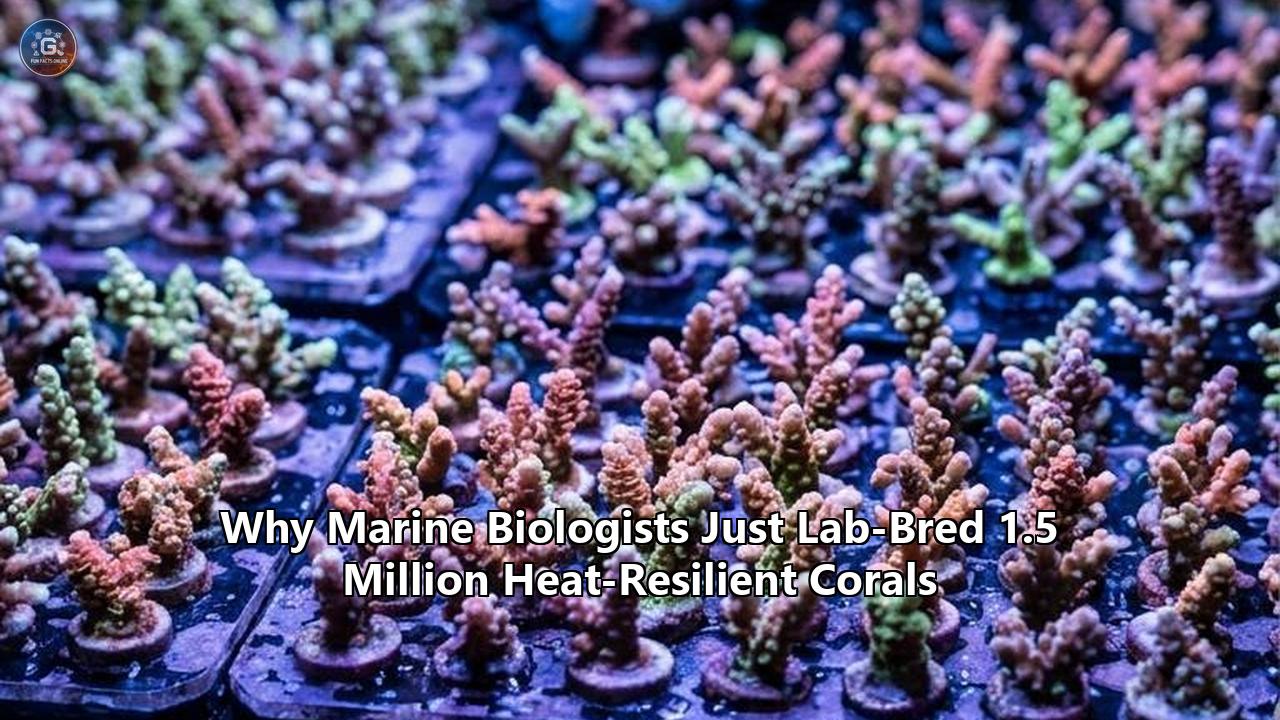
During the opening week of August, an alliance of twelve marine research institutions, aquariums, and federal science teams concluded an unprecedented synchronized operation across Florida’s coastal laboratories: the assisted fertilization and laboratory rearing of more than 1.5 million heat-resilient coral embryos.
The effort brought together researchers from the University of Miami’s Rosenstiel School of Marine, Atmospheric, and Earth Science, Mote Marine Laboratory & Aquarium, The Florida Aquarium, The Reef Institute, and the Smithsonian Marine Station. Working under a targeted initiative funded by the National Oceanic and Atmospheric Administration (NOAA), the scientific coalition monitored the synchronous mass-spawning windows of surviving wild and nursery-held colonies. Over seven intensive nights, biologists executed 116 unique, directional genetic crosses using gametes collected from 25 elkhorn (Acropora palmata) and 36 staghorn (Acropora cervicornis) parental genotypes that had withstood recent marine heatwaves.
The resulting batch yielded over 61,000 viable elkhorn larvae and 47,000 staghorn larvae, alongside hundreds of thousands of developing coral embryos now distributed across five specialized land-based biosecure facilities.
“What we have done over a few weeks would have never happened without human intervention,” stated Celia Leto, Senior Biologist and Manager of the Coral Reproduction Laboratory at Mote Marine Laboratory. “The sheer number of gametes collected, and larvae produced is a testament to the preparation, expertise, and collaboration of everyone involved.”
This intervention marks a tactical turning point in marine conservation biology. Coral propagation has historically relied on asexual fragmentation—cutting adult colonies into small pieces to grow clones in offshore nurseries. However, back-to-back global bleaching crises and extreme water temperatures have demonstrated that clone-based restoration leaves replanted reefs uniformly vulnerable to thermal stress and disease. The production of 1.5 million genetically recombined embryos represents a shift toward industrial-scale assisted evolution and sexual reproduction, engineered deliberately to rescue foundational reef ecosystems from functional extinction.
The Biological Crisis: Reproductive Collapse and the Thermal Threshold
To understand why marine scientists must manually cross coral gametes in sterile petri dishes, one must examine the ecological collapse that has unfolded across tropical shallow-water reefs over the past four decades.
Corals are sessile invertebrates whose reproductive biology relies almost entirely on synchronized broadcast spawning. Once a year, triggered by lunar cycles, sea temperatures, and sunset cues during late summer, entire populations release millions of buoyant gamete bundles—containing both sperm and eggs—simultaneously into the water column. For fertilization to occur naturally, gamete density must remain extraordinarily high. When ocean currents disperse gametes too rapidly before they meet, or when mature colonies are separated by wide stretches of dead reef, fertilization rates collapse.
[ Natural Broadcast Spawning ]
   │
   ├─► High Colony Density ──► Concentrated Gametes ──► High Fertilization Rate (Viable Larvae)
   │
   └─► Low Colony Density  ──► Gamete Dilution     ──► Reproductive Failure (Allee Effect)
In ecological modeling, this population density threshold is known as the Allee effect. Decades of habitat fragmentation caused by coastal development, deteriorating water quality, and outbreaks of Stony Coral Tissue Loss Disease (SCTLD) had already reduced wild populations of Acropora palmata and Acropora cervicornis by more than 90 percent throughout the Western Atlantic and Caribbean.
The catastrophic marine heatwaves between 2023 and 2025 pushed these ecosystems past an ecological breaking point. During the peak of the 2023 heat dome, sea surface temperatures around the Florida Keys reached 38.4°C (101.1°F) at Manatee Bay, maintaining temperatures above 31°C for over 40 consecutive days. This extreme anomaly triggered the fourth global coral bleaching event recorded by NOAA, affecting approximately 84 percent of the world’s reef areas.
Across shallow inshore and mid-channel reefs in the Florida Keys and Dry Tortugas, mortality among branching Acropora corals approached 98 to 100 percent. The surviving colonies were left isolated across hundreds of kilometers of coastline. When the annual spawning window opened, the remaining wild corals released gametes into vast expanses of open water where the probability of successful cross-fertilization had dropped near zero.
Without human intervention to collect, isolate, and hand-fertilize these gametes, natural sexual reproduction for these critically endangered reef builders had effectively stopped across major swaths of their historical range. The scale of this effort signals an operational pivot for heat-resilient coral restoration, shifting the focus from simply maintaining existing live tissue to actively engineering genetic resilience into incoming generations.
What Went Wrong: The Limits of Natural Evolutionary Pace
Coral reefs occupy less than 0.1 percent of the ocean floor, yet they harbor more than 25 percent of all marine species, sustain coastal fisheries that feed hundreds of millions of people, and provide critical breakwater protection that attenuates up to 97 percent of incoming wave energy during major storms. Their demise triggers immediate ecological and socio-economic consequences.
       ┌──────────────────────────────────────────────────────────┐
       │             Unmitigated Ocean Warming                    │
       └────────────────────────────┬─────────────────────────────┘
                                    │
                                    ▼
       ┌──────────────────────────────────────────────────────────┐
       │               Mass Thermal Bleaching Events              │
       │     (Breakdown of Coral-Symbiodiniaceae Holobiont)       │
       └────────────────────────────┬─────────────────────────────┘
                                    │
                                    ▼
       ┌──────────────────────────────────────────────────────────┐
       │               95%+ Branching Coral Mortality             │
       └────────────────────────────┬─────────────────────────────┘
                                    │
                                    ▼
       ┌──────────────────────────────────────────────────────────┐
       │                   Reproductive Arrest                    │
       │    (Allee Effect: Surviving colonies isolated at sea)    │
       └────────────────────────────┬─────────────────────────────┘
                                    │
                                    ▼
       ┌──────────────────────────────────────────────────────────┐
       │               Structural Framework Loss                  │
       │   - Fisheries nursery collapse                           │
       │   - Shoreline wave attenuation drops by up to 97%        │
       │   - Coastal economic damage into billions of dollars     │
       └──────────────────────────────────────────────────────────┘
The underlying evolutionary problem is a temporal mismatch. Corals have survived for hundreds of millions of years, adapting through glacial cycles and gradual shifts in ocean chemistry. However, the current rate of anthropogenically driven ocean warming is occurring orders of magnitude faster than the natural multi-generational adaptation rate of long-lived, slow-maturing colonial organisms.
The Physiological Anatomy of Bleaching
The coral animal is not an individual organism in the classical sense, but a meta-organism known as a holobiont. The foundational relationship exists between the coral polyp (the cnidarian animal host) and photosynthetic microalgae belonging to the family Symbiodiniaceae, which reside within the coral's gastrodermal tissues.
- Metabolic Translocation: Under stable thermal regimes, these microscopic endosymbionts photosynthesize, providing up to 90 percent of the coral animal's daily metabolic energy requirements in the form of glycerol, glucose, and amino acids. In return, the coral host provides inorganic nutrients (ammonium, nitrate, and phosphate) and a protected, high-light environment.
- Thermal Breakdown: When water temperatures exceed local summer maximums by just 1°C to 1.5°C for sustained periods, the photosynthetic machinery inside the microalgae breaks down. Specifically, the photosystem II complex within the chloroplast thylakoid membranes becomes damaged by excess excitation energy.
- Oxidative Toxicity: Instead of producing sugars, the damaged algal symbionts churn out cytotoxic reactive oxygen species (ROS), including singlet oxygen, hydrogen peroxide, and superoxide radicals.
- Symbiont Expulsion: To protect its own cells from severe oxidative damage and apoptosis, the coral host is forced to expel the algae through cellular exocytosis or host cell detachment.
- Starvation and Mortality: Stripped of the pigmented symbionts, the coral tissue becomes completely transparent, revealing the brilliant white calcium carbonate skeleton underneath. While a bleached coral is not immediately dead, it is in an acute state of metabolic starvation. If elevated water temperatures persist for weeks, the coral exhausts its energetic lipid reserves, succumbs to opportunistic pathogens, and experiences rapid necrotic tissue loss.
The Genetic Bottleneck of Clonal Propagation
For the past twenty years, restoration groups responded to this decline by creating underwater offshore nurseries. Divers harvested wild fragments, hung them on submerged PVC pipe "trees," and grew them rapidly into vast mono-specific clonal gardens.
While this technique generated tens of thousands of outplanted corals, it suffered from a hidden structural defect: it multiplied biomass without generating new genetic diversity. When unprecedented marine heatwaves struck in 2023 and 2024, entire offshore nurseries containing thousands of clonal fragments died in a matter of days because every clone shared the exact same genetic vulnerabilities.
Marine biologists realized that passive conservation and asexual cloning could no longer secure reef survival. The only viable path forward was to accelerate natural evolutionary processes—breeding thermally tolerant parents to generate genetically novel offspring equipped to withstand higher baseline temperatures.
The Solution: Selective Breeding and the Science of Assisted Evolution
The mass breeding of 1.5 million coral embryos is the physical manifestation of assisted evolution—a discipline focused on accelerating natural evolutionary trajectories via human-guided interventions. In coral biology, advancing the science behind heat-resilient coral restoration requires decoding the genetic architecture of thermal tolerance and exploiting natural phenotypic variations that already exist within wild populations.
                     Selective Breeding Workflow

  [ Wild Population Assessment via CBASS Thermal Stress Assays ]
                                │
                                ▼
         [ Identify Upper 10% Thermally Tolerant Genotypes ]
                                │
                                ▼
  [ Controlled Synchronous Spawning in Biosecure Aquaculture Tanks ]
                                │
                                ▼
  [ Directional Gamete Crosses: 116 Unique Pairings (Heterosis) ]
                                │
                                ▼
  [ Inoculation with Thermally Robust Symbionts (Durusdinium trenchii) ]
                                │
                                ▼
         [ 1.5 Million Embryos -> Resilient Larval Cohorts ]
Phenotypic Screening and Thermal Stress Assays
Thermal resilience is not uniform across a coral reef. Even during mass bleaching events, individual colonies often remain pigmented and healthy while immediately adjacent colonies of the exact same species bleach and die.
To identify top-performing parental stock, scientists utilize the Coral Bleaching Automated Stress System (CBASS). Developed as a rapid, mobile diagnostic tool, CBASS allows researchers on research vessels to subject small branch tips from hundreds of distinct coral colonies to standardized acute heat profiles—ramping water temperatures up to 36°C or 38°C over short durations.
By measuring photochemical efficiency through Pulse-Amplitude-Modulated (PAM) fluorometry and tracking cellular stress markers, researchers identify the upper 5 to 10 percent of thermally tolerant colonies within a region.
Directional Crosses and Heterosis
In the Florida operation, scientists did not simply dump collected gametes into a single collective tank. Instead, they isolated gamete bundles from 61 genetically mapped, thermally screened parent colonies.
Using high-precision micropipettes in mobile clean labs, technicians separated sperm from eggs, washed them to prevent self-fertilization, and executed 116 distinct, directional crosses. The crossing matrix was engineered to achieve three distinct goals:
- Maximizing Heterosis (Hybrid Vigor): Combining distinct, distant survivor lineages to promote favorable genetic combinations that mask deleterious recessive mutations.
- Preserving Broad Genetic Diversity: Avoiding inbreeding depression by systematically crossing unrelated genotypes identified through high-density SNP (single nucleotide polymorphism) arrays.
- Selecting for Heritable Thermal Tolerance: Passing down additive genetic traits responsible for thermal endurance.
Controlled selective breeding trials have demonstrated that crossing two heat-tolerant parent colonies yields offspring with significantly higher thermal survival margins than crosses between sensitive parents. Research from Newcastle University’s Coralassist Lab published in Nature Communications demonstrated that selective breeding of adult corals can enhance acute heat tolerance within a single generation, raising the survival threshold during heat stress by up to 1°C-week of thermal accumulation.
The Symbiont Factor: Inoculating with Thermotolerant Microalgae
Host coral genetics account for only half of the thermal resilience equation; the identity of the endosymbionts is equally consequential.
                                Coral Larva
                   (Aposymbiotic / Clear of Microalgae)
                                    │
               ┌────────────────────┴────────────────────┐
               │                                         │
               ▼                                         ▼
   Uptake: Cladocopium goreaui               Uptake: Durusdinium trenchii
  (Thermal Threshold: ~30°C - 31°C)         (Thermal Threshold: ~32°C - 34°C)
               │                                         │
               ▼                                         ▼
  High growth rate in cooler water;         Moderate growth rate; increases thermal
  bleaches under marine heatwaves           bleaching threshold of host by 1°C to 2°C
Most branching broadcast-spawning corals produce aposymbiotic larvae—meaning the larvae are born free of microalgae and must acquire their endosymbionts from the surrounding seawater after settlement. In natural settings, juvenile corals often take up Cladocopium species, which provide rapid growth rates in cooler waters but bleach when temperatures approach 30°C to 31°C.
In modern bio-secure rearing facilities, researchers alter this uptake process. During the early larval and recruit settlement phases, young corals are deliberately inoculated with monocultures of Durusdinium trenchii (formerly Clade D). Durusdinium trenchii is a specialized, thermally robust dinoflagellate that maintains photosynthetic integrity at temperatures up to 34°C.
Corals colonized predominantly by Durusdinium exhibit an increased thermal bleaching threshold of 1.0°C to 2.0°C compared to those hosting Cladocopium, providing an immediate physiological cushion against summer marine heatwaves.
Beneficial Microbes and Coral Probiotics
Beyond algal symbionts, scientists at the Australian Institute of Marine Science (AIMS) and collaborating institutions are actively inoculating newly bred larvae with customized cocktails of Beneficial Microorganisms for Corals (BMCs).
These bacterial consortia—consisting of specialized strains of Pseudoalteromonas, Halomonas, and Cobetia—act as marine probiotics. They colonize the coral's surface mucus layer, where they degrade cytotoxic reactive oxygen species, fix nitrogen, and competitively exclude pathogenic marine bacteria such as Vibrio coralliilyticus, which flourish in warm, degrading waters.
The Engineering Challenge: Scaling Larval Propagation to Industrial Levels
Producing 1.5 million embryos requires moving past basic marine ecology into the domain of high-throughput bioengineering. Traditionally, coral larval culturing was constrained by heavy labor requirements: researchers used small plastic basters to transfer delicate embryos between glass beakers, facing mortality rates exceeding 99 percent during the transition from free-swimming larvae to settled benthic polyps.
Bridging the gap between ecological research and ecosystem-scale rehabilitation requires scaling up heat-resilient coral restoration from laboratory petri dishes to ocean hectares.
┌─────────────────────────────────────────────────────────────────────────┐
│                      Industrial Scaling Pipeline                        │
├────────────────────────────┬────────────────────────────────────────────┤
│ Technology                 │ Operational Function                       │
├────────────────────────────┼────────────────────────────────────────────┤
│ Automated Photoperiod      │ Replicating environmental and lunar cues   │
│ Rearing Tanks (SeaSim)     │ indoors to induce controlled, out-of-      │
│                            │ season coral spawning on demand.           │
├────────────────────────────┼────────────────────────────────────────────┤
│ The Autospawner System     │ Automated, high-volume fertilization tanks │
│                            │ optimizing sperm concentration and gamete  │
│                            │ washing without manual labor.              │
├────────────────────────────┼────────────────────────────────────────────┤
│ Bio-Engineered Substrates  │ 3D ceramic and carbonate settlement plugs  │
│ (Seeding Units)            │ engineered with micro-crevices to shield   │
│                            │ polyps from grazing and biofouling.        │
├────────────────────────────┼────────────────────────────────────────────┤
│ Acoustic Larval Cues       │ Underwater speaker arrays playing healthy  │
│                            │ reef acoustic soundscapes to attract and   │
│                            │ trigger rapid larval settlement.           │
├────────────────────────────┼────────────────────────────────────────────┤
│ Cryopreservation Gene      │ Vitrification of coral sperm at -196°C to  │
│ Banks                      │ preserve elite genetic profiles for        │
│                            │ decades, overcoming geographical distance. │
└────────────────────────────┴────────────────────────────────────────────┘
Automated Aquaculture and Controlled Spawning Facilities
Facilities such as the National Sea Simulator (SeaSim) in Australia and land-based laboratories at The Florida Aquarium and Mote Marine Laboratory utilize fully automated aquaculture systems. Microprocessors regulate LED lighting spectra to replicate seasonal day-length shifts, solar angles, and lunar cycles with microsecond precision, while titanium heat exchangers control water temperatures within 0.1°C tolerances.
These environmental controls allow biologists to induce natural spawning behaviors on predictable schedules inside biosecure indoor facilities, decoupling reproduction from unpredictable offshore sea conditions.
To process the massive volume of gametes, researchers developed automated fertilization systems, such as the Autospawner. This technology handles the critical gamete-washing steps, regulates sperm concentration to prevent polyspermy (the lethal fertilization of an egg by multiple sperm cells), and transfers developing embryos directly into specialized flow-through rearing conical tanks with minimal handling.
Micro-Topography Substrates and "Self-Seeding" Units
A major historic bottleneck in coral propagation has been post-settlement mortality. When free-swimming planula larvae settle onto flat, bare rock, they are quickly eaten by parrotfish, smothered by turf algae, or smothered by sediment.
To overcome this attrition, organizations like SECORE International and AIMS engineer specialized settlement substrates—often called "coral seeding units" or settlement devices. Manufactured from specialized non-toxic ceramics, calcium carbonate composites, or carbon-negative bio-cements, these star-shaped or tetrahedral structures are designed with specific surface physics:
           /\  <-- Pointed ridges prevent unit from landing upside down
          /  \
         / /\ \ <-- Micro-crevices protect settled polyps from grazers
        / /  \ \
/_/____\_\ <-- Rough, CCA-coated base facilitates fast attachment- Micro-grooves and Crevices: Grooves measuring 1 to 2 millimeters provide physical refugia where delicate coral recruits can settle and grow without being scraped away by grazing herbivores.
- Surface Chemistry: The substrates are pre-conditioned in ocean tanks to cultivate Crustose Coralline Algae (CCA) and specialized bacterial biofilms that emit chemical cues that signal swimming larvae to settle.
- Self-Stabilizing Geometry: The multi-pronged, three-dimensional geometric shapes are weighted so that when dropped from boats or surface drones over degraded reefs, they fall through the water column and lodge securely into natural cracks and voids in the reef matrix without requiring manual cementing by scuba divers.
Acoustic Enrichment
Larvae are not passive particles adrift in currents; they are active swimmers equipped with cilia, chemosensory receptors, and the ability to detect environmental sounds. Recent deployments in the Caribbean and the Galápagos have demonstrated that playing underwater audio recordings of healthy, biodiverse reefs (characterized by the continuous crackling of snapping shrimp and low-frequency fish vocalizations) significantly accelerates larval settlement rates on prepared substrates.
Acoustic enrichment tools increase the percentage of larvae settling onto stable target substrates by up to 200 percent compared to silent or degraded control environments.
Cryopreservation and Genetic Bio-Banking
Because mass spawning occurs during narrow windows lasting only a few nights per year, scientists cannot always transfer fresh sperm between geographically distant reef tracts in time.
To overcome this constraint, teams led by the Smithsonian National Zoo and Conservation Biology Institute have developed cryopreservation protocols for coral germplasm. Using specialized cryoprotectant solutions and controlled vitrification techniques, biologists freeze coral sperm in liquid nitrogen at -196°C.
These genetic repositories act as living biobanks. Cryopreserved sperm collected from resilient parent corals in the southern Caribbean can be thawed years later and used to fertilize freshly spawned eggs from distinct populations thousands of miles away, expanding the global gene pool and preserving rare alleles against localized catastrophic mortality events.
Deployment Strategy: The Mission: Iconic Reefs Framework and Global Parallels
The generation of 1.5 million embryos marks only the first phase of an extensive multi-year operational pipeline. Translating laboratory breeding successes into persistent reef frameworks requires carefully timed nursery stages and strategic field deployment.
                     Field Deployment Timeline

  August 2026:
  Laboratory fertilization generates 1.5 million embryos
       │
       ▼
  Month 1 to 6 (Fall 2026 - Spring 2027):
  Larval settlement onto engineered ceramic substrates;
  Inoculation with Durusdinium trenchii and beneficial probiotics
       │
       ▼
  Month 6 to 18 (Spring 2027 - Fall 2027):
  Ex-situ land nursery grow-out and monitoring;
  Micro-fragment fusion acceleration to form multi-polyp juvenile colonies
       │
       ▼
  Month 18 to 24 (Spring 2028 - Summer 2028):
  Acclimatization in mid-water ocean nurseries;
  Genotyping and tracking mark applications (Nile Blue / SNP barcoding)
       │
       ▼
  Late 2028 and Beyond:
  Permanent deployment to Mission: Iconic Reefs target restoration sites
  (Carysfort Reef, Sombrero Reef, Cheeca Rocks, Eastern Dry Rocks)
Under the current management plan, the 108,000 surviving elkhorn and staghorn larvae will spend their initial six months in ultra-filtered, biosecure land-based nursery systems. Here, automated water treatment platforms eliminate predatory flatworms, boring sponges, and macroalgae while maintaining optimized pH and nutrient profiles to maximize calcification rates.
Once juvenile colonies reach structural stability, they enter a two-year nursery grow-out program. During this phase, many will undergo micro-fragmentation—a process where small colonies are divided into single-polyp units that grow up to 50 times faster than natural rates and fuse together into a mature, cohesive tissue base.
Between late 2027 and 2028, these laboratory-reared, thermally selected cohorts will be transported to deep, offshore mid-water nurseries for marine hardening before being permanently outplanted. Their destinations include designated high-priority zones under NOAA’s Mission: Iconic Reefs restoration framework—such as Carysfort Reef, Sombrero Reef, Cheeca Rocks, and Eastern Dry Rocks—as well as protected waters within the Kristin Jacobs Coral Aquatic Preserve.
By integrating genetic selection directly into heat-resilient coral restoration plans across the Florida Keys, scientists aim to establish self-sustaining, genetically diverse breeding populations capable of resuming natural sexual reproduction in the wild.
┌─────────────────────────────────────────────────────────────────────────┐
│                    Global Assisted Evolution Programs                   │
├────────────────────┬────────────────────────────────────────────────────┤
│ Region / Program   │ Primary Interventions                              │
├────────────────────┼────────────────────────────────────────────────────┤
│ Florida Keys /     │ Synchronized laboratory multi-parent crosses,      │
│ NOAA & Mote        │ Symbiodiniaceae inoculation, micro-fragmentation,  │
│                    │ and long-term biobanking of Acropora│
├────────────────────┼────────────────────────────────────────────────────┤
│ Great Barrier Reef │ RRAP "Moving Corals" initiative, capturing wild    │
│ / AIMS & CSIRO     │ spawn slicks, automated Autospawner larval         │
│                    │ culturing, and high-volume vessel seeding│
├────────────────────┼────────────────────────────────────────────────────┤
│ Red Sea / CORDAP & │ Identifying hyper-thermally adapted genotypes from │
│ KAUST              │ warm northern waters to transfer traits to more    │
│                    │ vulnerable lower-latitude reefs     │
├────────────────────┼────────────────────────────────────────────────────┤
│ Western Pacific /  │ Cross-breeding deep lagoon corals adapted to       │
│ Palau CORALASSIST  │ extreme diurnal temperature swings with exposed    │
│                    │ barrier reef populations            │
└────────────────────┴────────────────────────────────────────────────────┘
Similar large-scale initiatives are accelerating internationally:
- The Great Barrier Reef (Australia): The Reef Restoration and Adaptation Program (RRAP), a consortium including AIMS, CSIRO, and the Great Barrier Reef Foundation, is piloting the mass release of hundreds of millions of wild-captured and laboratory-enhanced larvae via the "Moving Corals" project. RRAP researchers are using Nile blue and neutral red vital dyes to visually track whether millions of reseeded larvae successfully settle and survive across offshore reef complexes.
- The Red Sea and Arabian Gulf: Scientists operating through the G20 Coral Research and Development Accelerator Platform (CORDAP) and King Abdullah University of Science and Technology (KAUST) are studying naturally occurring super-corals that survive in summer temperatures surpassing 35°C, using these lineages to identify specific genetic variants that can be introduced to vulnerable Indo-Pacific and Caribbean stocks.
- Palau and the Western Pacific: The CORALASSIST lab, working alongside the Palau International Coral Reef Center, continues to track multi-generational heatwave survival among selectively bred Acropora digitifera colonies, testing whether selective advantages persist over multi-year ocean deployments.
Critical Debates, Energetic Trade-offs, and Ecological Limits
Despite the success of producing 1.5 million embryos, the rapid expansion of assisted evolution and selective breeding has sparked serious technical and ethical discussions within marine biology and conservation policy.
                Physiological and Ecological Trade-offs

  Enhanced Thermal Tolerance (Durusdinium Symbionts / Heat Genes)
                           │
         ┌─────────────────┴─────────────────┐
         │                                   │
         ▼                                   ▼
  [ Energetic Trade-off ]            [ Genetic Trade-off ]
  - Slower calcification rates       - Risk of selective sweep
  - Lower baseline lipid reserves    - Potential loss of disease resistance
  - Thinner skeletal density         - Dilution of local adaptations
The Metabolic Cost of Thermal Resilience
Evolutionary biology demonstrates that adaptations rarely come without trade-offs. Organisms allocate finite metabolic budgets across growth, calcification, immune response, and thermal defense.
Corals hosting Durusdinium trenchii or expressing elevated baseline heat-shock protein levels often exhibit reduced calcification rates—growing significantly slower than their heat-sensitive counterparts hosting Cladocopium. Furthermore, colonies optimized to withstand acute high-temperature pulses can exhibit thinner, less dense aragonite skeletons, making them more susceptible to bioerosion and physical breakage during severe hurricane events.
Restoration practitioners face a critical balance: breeding colonies with maximum heat resilience might unintentionally select for specimens that produce lower overall reef volume or possess reduced total fecundity.
Genetic Monocultures vs. Ecosystem Complexity
A central risk in assisted reproductive interventions is the potential for an unintended selective sweep. If restoration programs over-index on a narrow set of genetic markers associated with heat endurance, they risk bottlenecking other vital survival traits—such as resistance to emerging bacterial pathogens, tolerance to ocean acidification, or resilience to heavy sediment run-off.
This concern is why the recent Florida spawning event placed heavy emphasis on executing 116 distinct, multi-parental directional crosses rather than propagating a few high-performing lineages. Maintaining high genetic variance is the only safeguard against future environmental variables that laboratory assays cannot fully simulate.
The Scale Gap and Decarbonization Mandate
The most critical debate centers on ecological scale. While 1.5 million embryos is an impressive biological achievement, tropical coral reefs cover roughly 284,000 square kilometers globally. Even survival rates as high as 10 percent would yield 150,000 colonies—a substantial number for local rehabilitation, but a drop in the ocean compared to the billions of colonies lost across global marine heatwaves.
Prominent marine scientists—including Liam Lachs, James Guest, and Madeleine van Oppen—consistently emphasize that active restoration is a defensive bridging strategy, not a cure for climate change.
Selective breeding can raise coral thermal thresholds by an estimated 1°C to 2°C. However, if global greenhouse gas emissions drive ocean temperatures beyond that buffer, even the hardiest selectively bred strains will reach physiological collapse.
As the authors of the Nature Communications Coralassist study concluded, selective breeding buys crucial time for ecosystems by preserving structural biodiversity and genetic reservoirs, but it cannot succeed in the absence of rapid global carbon mitigation.
What to Watch Next: Milestones and Emerging Frontiers
The progress of this cohort of 1.5 million corals will be closely tracked by marine laboratories worldwide as a case study in large-scale assisted reproductive technology. Over the next several years, multiple research milestones will determine the long-term viability of this strategy:
- Larval Settlement and Post-Metamorphic Mortality Tracking (2026–2027): Determining the baseline survival percentage of the 108,000 elkhorn and staghorn larvae across the five participating institutions will establish realistic efficiency benchmarks for automated larval rearing platforms.
- In-Situ Thermal Challenge Validation (Summer 2027): Once juvenile colonies reach the one-year mark, subsets of each of the 116 genetic crosses will undergo standardized CBASS thermal stress assays to quantify how effectively thermal tolerance was inherited by the offspring.
- Deployment Survivorship Metrics (2028–2030): The true performance test begins when colonies are permanently outplanted across Mission: Iconic Reefs target locations. Researchers will track whether lab-bred recruits can resist wild marine heatwaves and outcompete invasive turf algae without continuous diver maintenance.
- CRISPR and Functional Genomics: Beyond conventional selective breeding, synthetic biology platforms funded by organizations like CORDAP are working to identify the precise quantitative trait loci (QTL) responsible for calcification under elevated temperatures. While releasing gene-edited corals directly into open marine environments remains subject to strict regulatory barriers, genomic mapping is already helping scientists identify top-performing wild candidates with higher precision.
- AI-Assisted Site Selection and Habitat Modeling: CORDAP has launched a $1.5 million initiative to deploy artificial intelligence decision support systems. These algorithms combine satellite sea surface temperature data, high-resolution hydrodynamic modeling, and bathymetric mapping to identify marine thermal refugia—localized areas where upwelling or deep-water currents create natural cool zones—pinpointing the optimal locations to outplant selectively bred corals.
The mass breeding of 1.5 million heat-resilient coral embryos reflects the urgent reality of contemporary marine conservation. Passive protection alone is no longer sufficient to safeguard marine ecosystems against rapid environmental change. By combining genomic selection, automated aquaculture, and ecosystem-scale deployment pipelines, scientists are actively intervening to prevent the collapse of the planet's most biodiverse marine habitats.
The coming years will reveal whether this blend of biotechnology and active ecology can stabilize degraded reef frameworks and preserve functional marine ecosystems for the generations ahead.
Reference:
- https://news.miami.edu/rosenstiel/stories/2026/08/floridas-leading-coral-experts-unite-in-historic-effort-to-restore-floridas-coral-reef.html
- https://www.resilience.org/stories/2026-05-11/heat-resistant-corals-could-help-reefs-adapt-to-climate-change/
- https://www.researchgate.net/publication/396833390_Heat-driven_functional_extinction_of_Caribbean_Acropora_corals_from_Florida's_Coral_Reef
- https://www.facebook.com/OURNewsREV/videos/atlantis-opened-a-coral-gene-bank-a-bold-move-to-protect-bahamian-coral-reefs-th/3979668365579925/
- https://e360.yale.edu/features/selective-breeding-coral-climate-change
- https://www.youtube.com/watch?v=c08ZLDfwP2s
- https://research.csiro.au/marine-restoration-nbs/research-themes/active-restoration-and-nature-based-solutions/rrap-moving-corals/
- https://www.facebook.com/MoteMarineLab/videos/-new-research-from-mote-is-helping-advance-the-future-of-coral-reef-restorationi/2225255328246917/
- https://sea-technology.com/1-5-million-grant-to-establish-coral-gene-bank-study-coral-diseases
- https://cordap.org/usd1-5-million-to-develop-an-ai-powered-decision-tool-for-coral-reef-conservation/
- https://erc.europa.eu/news-events/news/scientists-have-successfully-bred-corals-improve-their-heat-tolerance
- https://www.researchgate.net/publication/314164757_Shifting_paradigms_in_restoration_of_the_world's_coral_reefs
- https://www.facebook.com/portholecruise/posts/what-happens-when-rising-ocean-temperatures-threaten-coral-restoration-efforts-t/1486403836848848/
- https://www.aoml.noaa.gov/projects/coral-restoration-and-resilience/
- https://www.businessinsider.com/coral-reef-bleaching-ocean-acidification-solutions-2018-4
- https://www.buildingcoral.com/news/world-oceans-day-a-spotlight-on-the-worlds-reefs-today-and-every-day
- https://royalsocietypublishing.org/rspb/article/292/2056/20251817/234668/Selective-breeding-enhances-coral-heat-tolerance
- https://e360.yale.edu/digest/selective-breeding-coral-study
- https://www.oceansciencetechnology.com/news/aims-researchers-prepare-for-great-barrier-reef-coral-spawning/
- https://cordap.org/the-unexpected-solutions-to-save-coral-reefs-worldwide/
- https://www.youtube.com/watch?v=uFCojXVAKyw
- https://pmc.ncbi.nlm.nih.gov/articles/PMC9725161/
- https://www.biorxiv.org/content/10.1101/2022.04.04.485987v1.full
- https://pmc.ncbi.nlm.nih.gov/articles/PMC8782467/