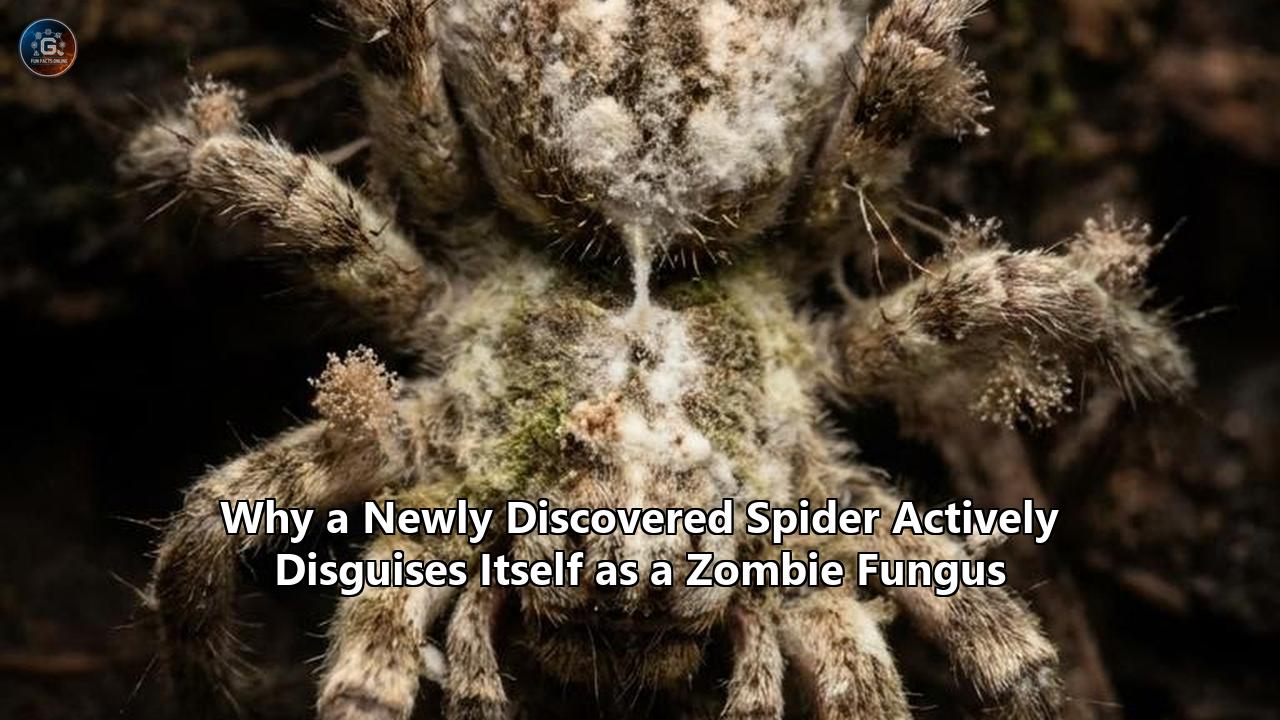
Deep in the cloud forests of the Ecuadorian Amazon, an evolutionary secret has been unmasked, rewriting the boundaries of natural deception. In the Llanganates-Sangay Corridor—a rugged stretch of the Andes known for its dizzying concentration of unique species—scientists have formally described a previously unknown arachnid that does not merely camouflage itself, but actively performs a macabre masquerade. The species, christened Taczanowskia waska, represents the first documented case in scientific history of an arachnid mimicking the exact appearance of a deadly, mind-controlling fungus that preys on its own kind.
The formal description of the species, published in the taxonomic journal Zootaxa by an international team of researchers, has ignited a wave of excitement across the global scientific community. This remarkable spider disguises as fungus to outsmart both the predators that would eat it and the prey it seeks to consume, turning a symbol of arachnid doom into a highly effective shield and weapon.
The revelation is the culmination of a classic scientific detective story, one that escalated from a routine nighttime jungle walk to a crowd-sourced citizen science breakthrough, before finally leading researchers to the dusty cabinets of a German museum to uncover a century-old taxonomic ghost.
The Grim Blueprint: How Zombie Fungi Hijack the Forest
To understand why a living spider would evolve to resemble a rotting corpse, one must first look at the horrifying biology of the parasite it mimics. For millions of years, tropical rainforests have been the staging ground for a silent, microscopic war waged by entomopathogenic fungi—pathogens that specialize in killing insects and arachnids.
Among the most notorious of these are fungi in the family Cordycipitaceae, popularized in modern culture by the post-apocalyptic franchise The Last of Us. While the genus Ophiocordyceps famously targets ants, forcing them to climb to optimal heights to disperse fungal spores, a closely related genus called Gibellula specializes exclusively in targeting spiders.
Fungal Infection Timeline (Gibellula):
[Spore lands on cuticle] ➔ [Penetrates exoskeleton] ➔ [Behavioral manipulation] ➔ [Host climbs under leaf] ➔ [Death & mycelial growth] ➔ [Spore-bearing conidiophores erupt]
When a microscopic Gibellula spore lands on a spider's outer shell, it germinates, sending invasive filaments called hyphae drilling through the tough cuticle. Once inside, the fungus slowly consumes the spider’s internal organs while chemically hijacking its nervous system.
This "extended phenotype" of the parasite forces the normally secretive, reclusive spider to abandon its hiding spots and climb to highly visible areas—specifically the undersides of leaves or elevated structures. There, the spider anchors itself firmly, dies, and becomes a launchpad for the fungus.
Within days of the host's death, the fungus erupts outward. It covers the spider’s shriveled corpse in a thick, velvety layer of white or pale yellow mycelium. From this fungal shroud, elongated, stalk-like structures known as conidiophores (or tubercles) emerge. These stalks act like biological cannons, raining spores down onto the forest floor below to infect a new generation of unsuspecting arachnids.
The resulting structure is unmistakable to any jungle dweller: a pale, fuzzy, clearly dead spider corpse sprouting thread-like yellow or white tendrils. For visual predators like birds, lizards, and larger arachnids, these carcasses are highly unpalatable, devoid of nutritional value, and potentially loaded with toxic fungal metabolites. They are, in essence, the forest’s warning signs of decay.
August 2025: A Puzzling Discovery in Mera, Ecuador
The first spark of the current discovery was struck during a wet night in August 2025. Alexander Griffin Bentley, a herpetologist and co-founder of the Ecuadorian conservation organization Waska Amazonía, was leading a guided nature excursion through a protected 100-hectare research site in Mera, Pastaza. Bentley's primary expertise lies in tracking the frogs, snakes, and lizards of the Amazonian understory, but his sharp eyes are always tuned to the oddities of the rainforest night.
Chronology of a Breakthrough:
- Aug 2025: Alexander Bentley discovers a "living fungal corpse" in Mera, Ecuador.
- Sept 2025: Photos uploaded to iNaturalist spark debate; experts recognize the genus Taczanowskia.
- Oct 2025: David Ricardo Díaz-Guevara conducts field and lab observations on the living specimen.
- Dec 2025: Nadine Dupérré identifies a matching unidentified specimen from 1903 in Germany.
- Feb 2026: Zootaxa publishes the formal description of Taczanowskia waska.
Peering beneath a broad, low-hanging leaf, Bentley spotted what appeared to be a textbook example of a Gibellula infection. A small spider was suspended upside down, its body enveloped in a pale, creamy coat that looked exactly like fungal mold. Most telling of all, two long, delicate, pale-yellow tendrils—resembling the spore-sprouting conidiophores of a mature Gibellula fungus—extended from the back of its abdomen.
"I was convinced it was a cordyceps," Bentley later recalled in an interview with the CBC program As It Happens. "I thought it was the spider infected with the fungus that had somehow survived the whole infection process and was still alive."
To confirm whether the zombie pathogen had completed its grim work, Bentley gently nudged the leaf. What happened next shattered his expectations.
Instead of remaining a stiff, dry, sporulating monument of death, the "fungal corpse" suddenly contracted its legs, shifted its position, and crawled to the other side of the leaf with remarkable agility. It was very much alive, completely free of parasitic infection, and highly responsive.
Puzzled by how a healthy spider could possess such realistic fungal morphology, Bentley photographed the creature from multiple angles, taking careful note of its position under the leaf and its refusal to move even when the leaf was turned completely upside down. He knew he had found something extraordinary, but understanding why this peculiar spider disguises as fungus in the first place would require pulling in experts from across the globe.
The Crowd-Sourced Breakthrough: From iNaturalist to National Collections
Recognizing that he was looking at an evolutionary enigma, Bentley uploaded his high-resolution photographs to the citizen science platform iNaturalist late in the summer of 2025. This move catalyzed a rapid escalation of the investigation.
On iNaturalist, a global network of amateur naturalists, mycologists, and professional arachnologists dissects obscure observations daily. Within hours of Bentley’s post, the comment section under the photos became a hotbed of academic debate.
Initially, several users suggested the spider might indeed be suffering from a bizarre, early-stage fungal infection that had spared its vital motor functions. However, seasoned arachnid taxonomists quickly stepped in to correct the course. They pointed out that the pale, chalky coloring was not a superficial layer of mold, but the spider’s actual, living exoskeleton. Furthermore, the long, yellow, thread-like structures were not fungal fruiting bodies, but specialized anatomical projections of the abdomen known as tubercles.
"Other specialists quickly replied that this is an incredible organism," Bentley said. "It’s not infected. There’s no fungus involved. This is the spider, and it’s almost definitely a new species to science."
The digital trail soon reached David Ricardo Díaz-Guevara, a prominent biologist and curator of the national arachnid collection at the National Institute of Biodiversity (INABIO) in Quito, Ecuador. Díaz-Guevara is one of the world's foremost experts on rare South American spiders, particularly those belonging to the family Araneidae (orb-weavers).
Díaz-Guevara recognized the spider in Bentley’s photos as belonging to Taczanowskia, a genus so obscure and rarely encountered that it borders on legendary among arachnologists. Established by German arachnologist Eugen von Keyserling in 1879, the genus had only seven known species scattered across South America and Mexico. Because these spiders spend their lives hidden in the dense canopy or tucked under leaves, decades often pass between sightings of a single specimen.
Díaz-Guevara immediately traveled from Quito to Mera to join Bentley in the field. Together, they located the specimen and brought it into a laboratory setting for meticulous morphological analysis.
They confirmed that the spider was a female with highly distinct physical traits that set it apart from all other known Taczanowskia species. Yet, to write a watertight scientific description that would stand up to peer review, they needed to compare their living specimen with historical reference material. This requirement shifted the front lines of the story from the damp Amazonian understory to the historic scientific archives of Europe.
Unlocking the Museum Vaults: The 123-Year-Old Bolivian Ghost
To bridge the gap between their fresh field observations and the historical record, Díaz-Guevara and Bentley partnered with Dr. Nadine Dupérré, a renowned arachnologist, taxonomist, and scientific illustrator based at the Museum of Nature Hamburg, part of the Leibniz Institute for the Analysis of Biodiversity Change (LIB) in Germany.
Dupérré’s task was to comb through the museum’s vast, historic wet collections—jars of preserved specimens preserved in ethanol, some dating back to the 19th century—to see if this bizarre "fungal spider" had ever been collected before.
Deep within the archives of the Hamburg Museum, Dupérré made a stunning discovery. She pulled out an old glass jar containing a single, pale, unidentified female spider that had been collected in Bolivia in the year 1903.
For 123 years, the specimen had sat in silent darkness, its label blank, its revolutionary evolutionary secret completely overlooked. Early naturalists had likely looked at the pale, distorted body and dismissed it as a damaged or diseased specimen of little value.
The Life of a Century-Old Specimen:
[Collected in Bolivia, 1903] ➔ [Placed in alcohol jar] ➔ [Shipped to Hamburg Museum] ➔ [Left unidentified for 123 years] ➔ [Discovered by Nadine Dupérré in 2025] ➔ [Confirmed as Taczanowskia waska in 2026]
When Dupérré examined the Bolivian specimen under a microscope and compared it to Díaz-Guevara’s morphological drawings and Bentley’s field photographs from Ecuador, the match was perfect. Both specimens exhibited the exact same unusual physical traits:
- A flattened, wider-than-long abdomen.
- A pair of highly elongated, flexible, unsclerotized (soft) abdominal tubercles.
- Creamy, pale coloration punctuated by irregular black-and-yellow markings.
The discovery of the 1903 specimen was a massive breakthrough. It proved that this was not a localized mutation or a freak anomaly of the Ecuadorian forest, but a stable, wide-ranging species that had successfully utilized this disguise across the South American continent for at least a century.
On February 26, 2026, the team officially published their findings in Zootaxa in a paper titled “The Cordyceps spider”: Taczanowskia waska sp. nov. (Araneae: Araneidae), a new spider species and a novel case of mimicry of an araneopathogenic fungus (Cordycipitaceae: Gibellula). The species name, waska, was chosen to honor both the Waska Amazonía Foundation and the Kichwa word for "string" or "hanging vine," a nod to the long, string-like abdominal tubercles that define the spider's disguise.
Anatomical Deception: The Mechanics of the Fungal Disguise
The physical architecture of Taczanowskia waska is an absolute masterpiece of evolutionary engineering, revealing how the spider disguises as fungus through a mixture of coloration, micro-structures, and passive behavior.
Unlike typical orb-weaver spiders, which are built for hanging in the center of concentric, sticky webs, T. waska has abandoned web-weaving altogether. Its entire body has been radically remodeled to support its deceptive lifestyle.
Morphological Comparison: Spider vs. Fungus
┌───────────────────────────────────────┬───────────────────────────────────────┐
│ Taczanowskia waska (Spider)           │ Gibellula Fungus (Pathogen)           │
├───────────────────────────────────────┼───────────────────────────────────────┤
│ Pale, creamy cuticle with white hairs │ White, fuzzy mycelial growth on host  │
│ Two long, unsclerotized tubercles     │ Elongated, spore-bearing conidiophores│
│ Motionless posture under leaves       │ Fixed position under leaf veins       │
│ Translucent, folded legs              │ Shriveled, dead spider limbs          │
└───────────────────────────────────────┴───────────────────────────────────────┘
The first layer of the illusion is the spider's coloration and texture. The dorsal surface of its abdomen is primarily pale cream and white, covered in tiny, dense white hairs (setae). This creates a soft, fuzzy, matte texture that perfectly mimics the look of a moldy mycelial mat wrapping around a decaying corpse. This pale surface is interspersed with tiny, irregular blackish-brown dots and yellow patches.
The second, and most striking, layer of the disguise is the pair of tubercles extending from the rear of its abdomen. In other Taczanowskia species, abdominal tubercles are typically small, hard, nipple-like bumps.
In T. waska, however, these structures have evolved into long, soft, flexible, string-like appendages that sprout from two large yellow patches on the back of the abdomen. These mimic the conidiophores of Gibellula—the specific stalks that grow out of a dead spider’s body to release spores. Because they are unsclerotized, they sway slightly with the movement of the wind, just as a real fungal stalk would.
The third layer of the deception is postural. When resting, T. waska pulls its legs tightly against its body. The legs themselves are pale, almost translucent, with sparse black markings on the joints.
By folding its limbs inward, the spider completely obscures its outline as an eight-legged animal. To any observer looking up from below, the creature appears to be nothing more than an amorphous, fuzzy, yellow-and-white clump of fungal rot clinging to the leaf vein.
Finally, the spider’s behavior cements the performance. Throughout the daylight hours, T. waska remains completely motionless on the underside of a leaf.
This is not a random choice of resting place; the underside of leaves is the exact micro-habitat where Gibellula fungi force their dying hosts to anchor themselves to prevent being washed away by heavy Amazonian rains. By occupying this precise ecological niche and maintaining absolute stillness, the spider aligns its behavior perfectly with the spatial patterns of the pathogen it mimics.
The Evolutionary Calculus: Batesian vs. Aggressive Mimicry
The discovery of Taczanowskia waska raises profound questions about the exact evolutionary pathway by which this spider disguises as fungus. What are the select pressures that would drive an animal to look like a deadly pathogen?
Biologists analyzing the discovery have proposed two primary, non-exclusive theories: Batesian mimicry (defense) and aggressive mimicry (offense).
Dual Evolutionary Pressures:
┌───────────────────────────────┐     ┌───────────────────────────────┐
│       BATESIAN MIMICRY        │     │      AGGRESSIVE MIMICRY       │
│  (Predator Avoidance/Defense) │     │  (Prey Capture/Luring/Attack) │
├───────────────────────────────┤     ├───────────────────────────────┤
│ Birds, lizards, and wasps     │     │ Flying insects and moths do   │
│ avoid fungal corpses as dry,  │     │ not fear dead, decaying debris│
│ toxic, and zero-nutrition.    │     │ and fly within striking range.│
└───────────────────────────────┘     └───────────────────────────────┘
Batesian Mimicry: The "Do Not Eat Me" Shield
Batesian mimicry occurs when an entirely harmless, edible species evolves to resemble a dangerous, toxic, or unpalatable species to avoid predation. In the rainforest canopy, small spiders are constantly hunted by highly visual predators, including insectivorous birds (like antbirds and manakins), tree-dwelling lizards, and parasitic pompilid wasps (spider wasps).
To these predators, a healthy spider is a prime, protein-rich meal. However, a spider corpse that has been overtaken by a parasitic fungus is the exact opposite: it is dry, devoid of nutrients, and packed with toxic, bitter chemical compounds produced by the fungus.
Eating a fungus-ridden corpse could also expose the predator to active spores. Consequently, birds and lizards have evolved a strong, instinctual aversion to eating anything that looks like a moldy, sporulating carcass.
By mimicking the pale, thread-sprouting appearance of a Gibellula-killed spider, T. waska exploits this predator aversion. A passing bird scanning the underside of a leaf for food will spot the spider, register it as a useless, toxic chunk of mold, and fly past without a second glance.
"Over time," Díaz-Guevara explained, "the spider has evolved to realize that if it mimics something that is dead, the chances of being hunted are low."
Aggressive Mimicry: The Perfect Ambush
While self-defense is a powerful evolutionary driver, the fungal disguise likely serves an equally important offensive purpose. Unlike typical spiders that weave sticky webs to trap insects, all members of the genus Taczanowskia are active ambush hunters. They hunt by staying completely still and striking at passing prey with incredible speed.
Taczanowskia Web-less Hunting Strategy:
[Produce moth-attracting pheromones] ➔ [Sit motionless in fungal disguise] ➔ [Moth approaches unthreatened] ➔ [Strike with specialized front leg claws] ➔ [Secure prey mid-air]
To facilitate this, Taczanowskia spiders possess a highly specialized hunting apparatus. Their first two pairs of legs are exceptionally long and powerful, armed with a long ventral row of tiny, sharp, almost imperceptible spines. At the tip of these legs are highly enlarged, hook-like claws.
Because they cannot rely on a web to stop prey, they must convince their prey to fly directly into their striking zone. This is where the aggressive mimicry comes into play.
Many flying insects, particularly moths, are highly sensitive to predators and will actively avoid webs or active spiders. However, they have no reason to fear a dead, moldy leaf-clump.
Furthermore, closely related spiders in the Mastophorines clade (such as the famous bolas spiders) are known to emit volatile chemical compounds that mimic the sex pheromones of female moths, drawing male moths directly toward them.
If T. waska utilizes a similar chemical lure, the target insect will fly toward the scent. As it approaches, it sees only what appears to be a harmless, decaying fungal growth on the underside of a leaf.
Sensing no danger, the insect flies directly past or even lands next to the "carcass". In a fraction of a second, the motionless "fungus" unfurls its long, powerful front legs, hooks the insect out of the air with its massive claws, and delivers a venomous bite.
A Skeptical Counterpoint
While the Batesian and aggressive mimicry hypotheses are highly compelling, some scientists urge caution before declaring the case closed. Andrew Swafford, an associate professor of biology at Middlebury College in Vermont who was not involved in the study, has expressed healthy skepticism about labeling the spider’s physical appearance as a direct copy of Gibellula.
"I didn't see a lot of compelling evidence that the elaborations on the abdomen serve as a form of camouflage or mimicry other than they look similar to cordyceps stalks to us humans," Swafford noted in a post-publication commentary.
Swafford points out that many spiders in the family Araneidae develop bizarre abdominal projections, spikes, and color patterns that may simply be structural or serve to disrupt the spider's outline, without necessarily evolutionary targeting a specific fungal model.
In his view, while the resemblance to a zombie fungus is striking to the human eye, rigorous field experiments are still required to prove that birds and insects actually perceive and react to T. waska as if it were a Gibellula infection.
The Global Horizon of Fungal Mimicry
The discovery of Taczanowskia waska has opened a fascinating new window into how little we still know about the interactions between spiders, fungi, and evolutionary mimicry. In their Zootaxa paper, Díaz-Guevara, Bentley, and Dupérré suggested that T. waska may not be a solitary outlier, but rather the tip of an unmapped biological iceberg.
By combing through global databases, citizen science platforms like iNaturalist, and personal nature blogs, the researchers identified at least four other undescribed or highly enigmatic spider species across the globe that exhibit striking, unexplained similarities to araneopathogenic fungi:
- Vietnam (Huong National Park): An unidentified species of Araneidae photographed in 2013, displaying a pale, mold-like body and long abdominal extensions.
- Uganda: An undescribed species of the genus Acantharachne that mimics the exact pale, beaded appearance of a localized fungal infection.
- Madagascar: Exechocentrus lancearius, a highly rare spider with long, spine-like abdominal projections that closely mirror the growth patterns of tropical spider-killing fungi.
- Brazil (Coastal Rainforest): Mastophora leucacantha, an ambush spider whose pale, tuberous body appears to mimic the encrusted, sporulating remnants of a fungal victim.
Potential Global Hotspots of Fungal Mimicry:
┌───────────────────────┬───────────────────────────────┬───────────────────────────────┐
│ Region                │ Spider Genus/Species          │ Mimicked Fungal Target        │
├───────────────────────┼───────────────────────────────┼───────────────────────────────┤
│ Ecuadorian Amazon     │ Taczanowskia waska            │ Gibellula spp.                │
│ Southeast Asia        │ Unidentified Araneidae        │ Tropical Cordycipitaceae      │
│ East Africa (Uganda)  │ Acantharachne sp.             │ Localized Gibellula variant   │
│ Madagascar            │ Exechocentrus lancearius      │ Specialized spider pathogens  │
│ Atlantic Forest       │ Mastophora leucacantha        │ Encrusted mycelial structures │
└───────────────────────┴───────────────────────────────┴───────────────────────────────┘
Every single one of these regions is a known hotspot for Gibellula and other Cordycipitaceae fungi. This geographic and morphological overlap suggests that "fungal mimicry" may be a widespread, yet completely overlooked, survival strategy that has evolved independently across multiple spider lineages worldwide.
What Happens Next? The Unresolved Questions
As the scientific community digests the implications of Taczanowskia waska, several critical mysteries remain unsolved, providing a clear roadmap for future research.
Finding the Lost Males
To date, every single specimen of T. waska ever identified—including the living specimen in Ecuador and the 123-year-old Bolivian specimen in Germany—has been female.
In many closely related orb-weaver groups, sexual dimorphism is extreme. Males are often a fraction of the size of females, possessing radically different morphology, coloration, and lifestyles.
Does the male T. waska also disguise itself as a zombie fungus, or is this high-stakes evolutionary masquerade reserved solely for the larger, slower females who must sit motionless for weeks to produce and protect their egg sacs? Finding and describing a male specimen is currently a top priority for Díaz-Guevara and his team.
Chemical and Behavioral Analysis
To definitively prove the "aggressive mimicry" hypothesis, researchers need to analyze the volatile chemical compounds emitted by T. waska. If the spider is indeed synthesizing synthetic moth pheromones, capturing these chemicals using gas chromatography-mass spectrometry (GC-MS) will confirm how it lures its prey without a web.
Additionally, high-speed infrared video recording in the wild is needed to capture the exact mechanics of its strike, which occurs too fast for the human eye to process.
The Race Against Time in the Llanganates-Sangay Corridor
The discovery of T. waska underscores how much of the Amazon’s biodiversity remains completely hidden from human eyes. But it also highlights the fragility of these rapidly disappearing ecosystems.
The Llanganates-Sangay Corridor is a narrow biological bridge connecting two major Ecuadorian national parks. It is currently under severe threat from agricultural expansion, illegal mining, and road construction.
For herpetologists like Alexander Bentley and the conservationists at Waska Amazonía, the discovery of this "zombie-mimic" spider is a powerful tool for environmental advocacy. It proves that even a small, 100-hectare patch of protected forest can harbor spectacular, world-first evolutionary marvels that have survived for millennia, only to face extinction just as we are beginning to recognize them.
"The discovery of Taczanowskia waska in what could be considered our 'backyard' illustrates the massive gap in our knowledge," Bentley noted. "It shows the urgent need to explore, document, and above all, protect what is right in front of us before it vanishes forever."
As researchers head back into the Ecuadorian night, searching beneath the leaves for the next living ghost, the scientific world watches with bated breath, reminded that in the depths of the rainforest, life's most brilliant trick is pretending to be dead.
Key Scientific References
- Díaz-Guevara, D. R., Bentley, A. G., & Dupérré, N. (2026). “The Cordyceps spider”: Taczanowskia waska sp. nov. (Araneae: Araneidae), a new spider species and a novel case of mimicry of an araneopathogenic fungus (Cordycipitaceae: Gibellula). Zootaxa, 5760(5), 563-576.
- Evans, H. C., et al. (2025). Gibellula attenboroughii sp. nov. (Cordycipitaceae): A new araneopathogenic fungus from Irish cave systems. Fungal Systematics and Evolution, 15, 45-58.
- Keyserling, E. (1879). Neue Spinnen aus Amerika. Verhandlungen der Kaiserlich-Königlichen Zoologisch-Botanischen Gesellschaft in Wien, 29, 293-349.
- Levi, H. W. (1996). The genus Taczanowskia of the orb-weaver spider family Araneidae (Araneae). Anales del Instituto de Biología Universidad Nacional Autónoma de México, Serie Zoología, 67, 183-195.
Reference:
- https://www.sciencedaily.com/releases/2026/06/260617032201.htm
- https://www.discovermagazine.com/new-spider-species-appears-to-mimic-a-deadly-fungus-to-fool-prey-and-predators-48949
- https://www.nationalgeographic.pt/mundo-animal/aranha-que-imita-fungo-the-last-of-us-investigador-explica-seu-curioso-comportamento_7036
- https://scitechdaily.com/scientists-discover-strange-new-spider-species-that-disguises-itself-as-a-fungus/
- https://gizmodo.com/last-of-us-spider-pretends-to-be-a-zombie-fungus-and-its-bizarrely-brilliant-2000736362
- https://www.vice.com/en/article/freaky-new-spider-disguises-itself-as-zombie-fungus-to-hunt-prey/
- https://pmc.ncbi.nlm.nih.gov/articles/PMC11508666/
- https://gizmodo.com/last-of-us-spider-pretends-to-be-a-zombie-fungus-and-its-bizarrely-brilliant-2000736362
- https://www.discovermagazine.com/new-zombie-fungus-is-infecting-and-killing-spiders-in-irish-caves-47044
- http://dailyparasite.blogspot.com/2025/03/gibellula-agroflorestalis.html
- https://a-z-animals.com/articles/how-a-hidden-fungus-outsmarts-spidersand-why-its-named-for-david-attenborough/
- https://www.sciencealert.com/scientists-discover-a-fungus-turning-spiders-into-zombies
- https://www.abenteuer-regenwald.de/wissen/aktuelles-aus-dem-regenwald/news/2026/spinne-tarnt-sich-als-schimmelpilz
- https://en.wikipedia.org/wiki/Taczanowskia_waska
- https://www.researchgate.net/figure/Taczanowskia-waska-sp-nov-preserved-in-ethanol-a-female-holotype-dorsal-view-B_fig1_401254813
- https://www.discovermagazine.com/new-spider-species-appears-to-mimic-a-deadly-fungus-to-fool-prey-and-predators-48949
- https://gizmodo.com/last-of-us-spider-pretends-to-be-a-zombie-fungus-and-its-bizarrely-brilliant-2000736362
- https://mapress.com/zt/article/view/zootaxa.5397.2.11
- https://www.miragenews.com/spider-mimics-parasitic-fungus-scientists-find-1694226/
- https://en.wikipedia.org/wiki/Taczanowskia
- https://britishspiders.org.uk/system/files/library/050407.pdf
- https://www.discovermagazine.com/new-spider-species-appears-to-mimic-a-deadly-fungus-to-fool-prey-and-predators-48949
- http://novataxa.blogspot.com/2026/04/taczanowskia.html
- https://treatment.plazi.org/id/E0648788-FFA5-1B2E-B296-6732F0FBFE54
- https://mapress.com/zt/article/view/zootaxa.5760.5.4
- https://www.researchgate.net/publication/354780954_Phylogenetic_placement_of_the_spider_genus_Taczanowskia_Araneae_Araneidae_and_description_of_a_new_species_from_Ecuador
- https://idw-online.de/en/news868818
- https://en.wikipedia.org/wiki/Gibellula_attenboroughii