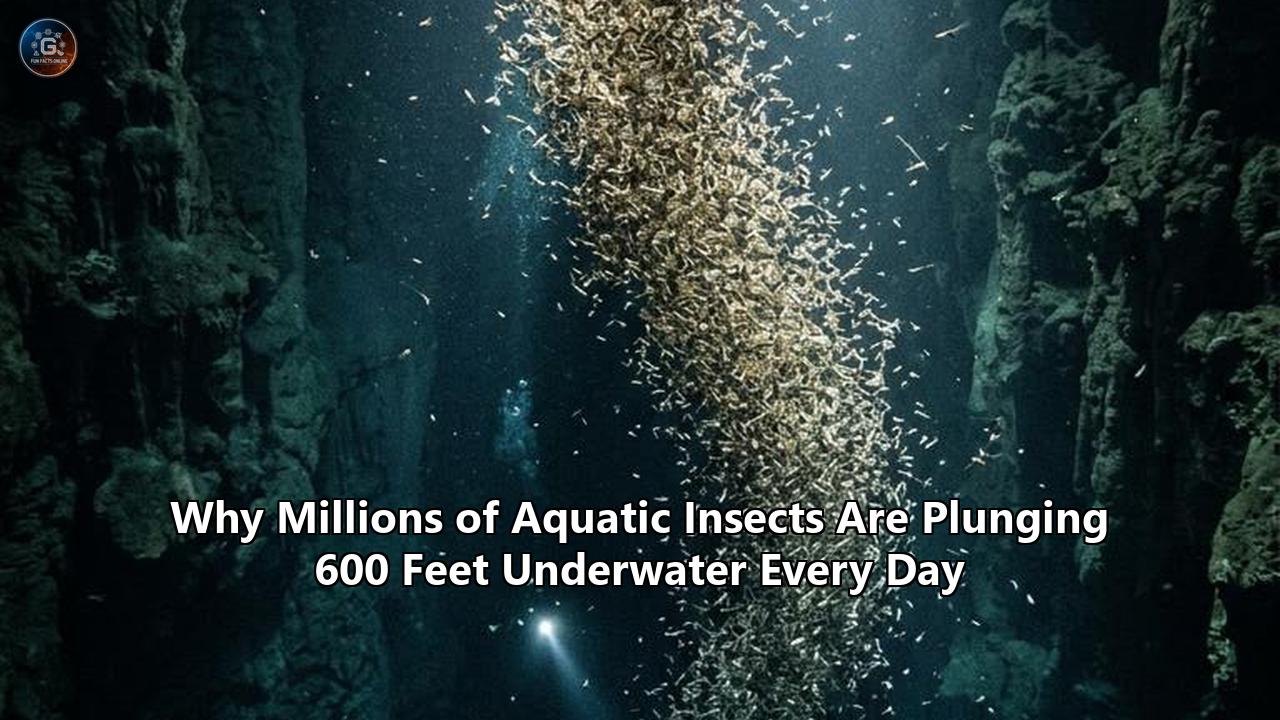
Over 200 meters beneath the glittering surface of Lake Malawi, deep within a dark, oxygen-starved "dead zone" where fish immediately suffocate, lies an unexpected inhabitant: billions of transparent insect larvae.
In a study published in the journal Science, a team of researchers from the University of British Columbia (UBC) revealed that the larvae of the lake fly Chaoborus edulis—commonly known as phantom midges—execute a daily vertical migration exceeding 600 feet (200 meters) into the depths of East Africa's second-deepest lake. By daylight, these 1-centimeter-long glasslike organisms plunge into anoxic waters to evade hungry surface predators; by night, they rise en masse back to the surface to feed on zooplankton.
The discovery upends a century-old biological rule. For decades, evolutionary biologists argued that insects never colonized the deep open oceans because their air-filled respiratory systems would implode under crushing hydrostatic pressures. However, by deploying advanced benthic sonar systems at the bottom of Lake Malawi and placing living larvae inside hyperbaric pressure chambers in the laboratory, UBC zoologists Dr. Philip Matthews and Dr. Evan McKenzie demonstrated that these tiny creatures possess reinforced, pH-driven air sacs capable of withstanding pressures found more than half a kilometer (1,600 feet) underwater—far deeper than their daily commute.
This revelation reframes our understanding of aquatic insects behavior and solves a long-standing ecological puzzle regarding the physical limits of insect survival in deep-water environments.
The Implosion Barrier: Why Insect Biology Was Thought to Fail at Depth
To grasp the significance of this news, one must look at a long-standing paradox in natural history: insects rule the land and fresh waters, accounting for more than 60 percent of all aquatic animal species and over 80 percent of terrestrial fauna, yet they are almost entirely absent from the pelagic open ocean.
For more than a century, the primary scientific explanation for this oceanic absence centered on hydrostatic pressure and respiratory architecture. Unlike vertebrates, which rely on closed circulatory systems with iron-rich hemoglobin to transport oxygen dissolved in blood, insects breathe through a branching network of air-filled internal tubes called tracheae.
In shallow ponds or streams, this system functions efficiently. But open-water environments require organisms to perform Diel Vertical Migration (DVM)—a daily synchronized commute where animals descend into deep water during the day to hide from visual predators like fish, then ascend to food-rich surface waters under the cover of darkness.
          SURFACE WATER (0–20m)
          Nighttime Feeding Zone: Zooplankton, Algae
          =========================================
                             ^
                             |  Night Ascend
                             |  (To Feed)
          MIDWATER GAUNTLET  |
          Predatory Pelagic Fish (Cichlids / Utaka)
                             |  Daytime Descend
                             |  (To Hide)
                             v
          =========================================
          ANOXIC HYPOLIMNION (>200m / 600+ ft)
          Daytime Refuge: Zero Oxygen, Toxic to Fish
          *Chaoborus edulis* survives via Anaerobic Malate Pathway
Biologists calculated that if an insect attempted a deep vertical migration in open water, the exponential increase in hydrostatic pressure—adding approximately one atmosphere of pressure for every 10 meters of depth—would compress the air inside its flexible tracheal tubes. At depths exceeding 50 to 100 meters, this pressure was expected to flatten the body, crush internal respiratory walls, cause irreversible loss of buoyancy, and plunge the organism to its death.
This theoretical threshold was known as the "implosion barrier". Because open ocean pelagic zones routinely demand migrations to depths of hundreds or thousands of meters to escape surface predators, the implosion barrier was deemed an impassable evolutionary wall for insects.
The discovery in Lake Malawi shatters that assumption.
Sonar Mapping Lake Malawi’s Deepest Commuters
Lake Malawi, stretching over 350 miles along the East African Rift, is one of the world's ancient meromictic lakes. Because its deep waters do not mix with surface layers, the lake is permanently stratified. Below 200 meters, the water is entirely devoid of dissolved oxygen—a permanent anoxic hypolimnion where fish and most macro-invertebrates cannot survive.
To investigate how Chaoborus edulis navigates this extreme environment, the UBC research team anchored specialized high-frequency sonar instruments to the lake floor. Sonar systems emit acoustic pulses through the water column; when those sound waves hit objects with a different density than surrounding water—such as the soft bodies of fish or gas-filled organs inside tiny invertebrates—they bounce back as detectable acoustic echoes.
The acoustic profile gathered by Dr. Matthews and Dr. McKenzie revealed an incredible phenomenon occurring every 24 hours:
- At Dawn (05:30–06:30): Billions of C. edulis larvae abandon the sunlit surface layers. Moving in vast, coordinated swarms, they descend through the water column, passing through midwater layers dominated by pelagic cichlid fish.
- At Depth (08:00–16:00): The swarm crosses the 200-meter boundary line, penetrating deep into the oxygen-free, toxic hypolimnion. Here, at a depth exceeding 600 feet, where light is non-existent and hydrostatic pressure reaches 21 times atmospheric pressure at sea level, the larvae come to rest.
- At Dusk (18:00–19:00): As light fades from the lake surface, the sonar recorded the larvae rising en masse, crossing back through the predatory fish zone to spend the night grazing on zooplankton near the surface.
TIME OF DAY    DEPTH RANGE        ENVIRONMENTAL CONDITIONS      LARVAL ACTIVITY
-------------------------------------------------------------------------------------
00:00 - 05:00  0 - 30 meters      Oxygenated, High Food Density  Active Surface Feeding
05:30 - 07:30  30 - 180 meters    Transition Zone (Fish Active)  Rapid Downward Descent
08:00 - 17:00  200 - 250+ meters  Anoxic "Dead Zone" (>21 atm)   Daytime Predator Refuge
17:30 - 19:30  180 - 30 meters    Transition Zone (Gauntlet)     Synchronized Ascent
20:00 - 23:59  0 - 30 meters      Oxygenated, High Food Density  Active Surface Feeding
"Deploying sonar to the bottom of Lake Malawi gave us a seat in the front row of one of the most extreme daily migrations on Earth," noted lead author Dr. Philip Matthews during the release of the findings. "We were looking at billions of tiny, fragile insects spending their days in a location where biological text books insisted they could not exist."
Unlocking the Physiological Mystery: Resilin and the pH Engine
How can a transparent, soft-bodied insect larva withstand 300 pounds per square inch of hydrostatic pressure without collapsing, while retaining the ability to adjust its depth without swimming?
The answer lies in a remarkable physiological modification. Chaoborus larvae have largely abandoned the extensive internal network of air tubes seen in other insects. Instead, their respiratory system is reduced to two pairs of rigid, kidney-shaped air sacs situated at the front and rear ends of their body. These sacs do not supply oxygen to tissues; instead, they function precisely like the ballast tanks of a submarine.
                     PARTS OF A PHANTOM MIDGE LARVA (*Chaoborus edulis*)

   Anterior Air Sacs                                             Posterior Air Sacs
       (Ballast)                                                     (Ballast)
         [oo]======= Transparent Glasslike Body Cuticle =======[oo]
          ||                                                           ||
          \/                                                           \/
  pH-Responsive Resilin Wall                                   pH-Responsive Resilin Wall
  (Swells in Alkaline / Contracts in Acidic)                   (Swells in Alkaline / Contracts in Acidic)
In typical aquatic organisms with swim bladders, such as fish, gas is actively pumped into or out of a bladder via secretor glands and specialized blood vessels. But insects lack red blood cells and closed circulatory vessels. They cannot transport dissolved gas through blood to inflate an internal bladder.
Instead, Chaoborus edulis utilizes a chemo-mechanical engine driven by a specialized rubber-like protein called resilin.
The Resilin Mechanism Explained
Resilin is an elastomeric protein famous in entomology for its extraordinary elasticity and energy storage. It allows fleas to jump hundreds of times their height and enables dragonfly wings to flex millions of times without fatigue. In Chaoborus edulis, resilin is densely woven directly into the structural walls of the air sacs.
The UBC researchers discovered that the larva controls its buoyancy by altering the pH of the fluid surrounding the air sac walls:
- To Sink (Decreasing Volume): The larva secretes hydrogen ions (protons) into the tissue surrounding the air sacs, driving the localized environment into an acidic state. This drop in pH causes the resilin matrix within the sac walls to rapidly contract, drawing water out of the protein matrix. As the wall contracts, it mechanically compresses the internal gas volume, reducing the larva's overall displacement and causing it to sink effortlessly into the deep lake.
- To Rise (Increasing Volume): The larva exports protons, shifting the local fluid toward an alkaline state. The resilin matrix absorbs water, swelling outward like a hydrated sponge. This outward expansion mechanically stretches the air sac, expanding its volume against the surrounding water pressure, lowering the larva's overall density, and causing it to float upward toward the surface.
                            THE CHEMO-MECHANICAL pH CYCLE

       +--------------------------------------------------------------------+
       |                                                                    |
       |     Alkaline Shift (pH Increases) ---> Resilin Matrix Swells      |
       |                                              |                     |
       |                                              v                     |
       |                                   Air Sac Expands Volumetrically   |
       |                                              |                     |
       |                                              v                     |
       |                                   Larva Density Decreases          |
       |                                              |                     |
       |                                              v                     |
       |                                   FLOAT UPWARD (Ascent)            |
       |                                                                    |
       +--------------------------------------------------------------------+
       |                                                                    |
       |     Acidic Shift (pH Decreases)   ---> Resilin Matrix Contracts    |
       |                                              |                     |
       |                                              v                     |
       |                                   Air Sac Compresses Volumetrically|
       |                                              |                     |
       |                                              v                     |
       |                                   Larva Density Increases          |
       |                                              |                     |
       |                                              v                     |
       |                                   SINK DOWNWARD (Descent)          |
       |                                                                    |
       +--------------------------------------------------------------------+
This chemical engine allows the larva to execute massive vertical journeys with virtually zero muscular effort or kinetic energy expenditure. The larva does not need to swim continuously for 600 feet; it simply adjusts its internal chemistry and lets gravity and buoyancy do the physical work.
Pushing the Limits in Pressure Chambers
To discover the absolute structural threshold of these air sacs, Dr. McKenzie constructed specialized miniaturized hyperbaric pressure chambers. Living Chaoborus edulis larvae collected from Lake Malawi were placed inside the chambers, and the hydrostatic pressure was progressively raised to simulate extreme oceanic depths.
The results stunned the research team. The air sacs inside early larval stages resisted implosion down to depths of 100 meters, while mature fourth-instar larvae withstood pressures exceeding 40 to 50 atmospheres—the equivalent of being submerged 400 to 500 meters (1,300 to 1,600 feet) under water—before the air sac walls structurally failed.
This proved that the air sac structures are over-engineered for the larva's daily 200-meter dive, completely disproving the theory that physical pressure limits prevent insects from surviving deep water plunges.
"The idea that insects couldn't enter deep water because their breathing tubes would cave in is officially dead," said Dr. Evan McKenzie, co-author of the study. "These air sacs are tough enough to take a beating far deeper than any dive these insects actually make in nature."
               DEPTH CAPABILITIES vs. IMPLOSION THRESHOLDS

   Depth (Meters)
   0m +----------------------------------------------------------------+ (Surface)
      |                                                                |
 100m +----------------------- Instar 1-2 Limit (~100m) --------------+
      |                                                                |
 200m +======================= LAKE MALAWI DAILYCommute (~200m) ======+
      |                       (Actual Biological Commute)              |
 300m +----------------------------------------------------------------+
      |                                                                |
 400m +----------------------------------------------------------------+
      |                                                                |
 500m +----------------------- Instar 4 Implosion Threshold (>450m) ---+
      |                       (Laboratory Hyperbaric Limit)            |
      +----------------------------------------------------------------+
Ecological Significance: The Deep Anoxic Sanctuary and Food Web Dynamics
The ability of Chaoborus edulis to plunge into deep, oxygenless waters reshapes our understanding of aquatic insects behavior in lake ecosystems.
In most freshwater environments, the oxygen minimum zone or anoxic hypolimnion is viewed as a biological wasteland. Without oxygen, complex animal life quickly experiences metabolic arrest and death. However, C. edulis has turned this environmental threat into its ultimate ecological shield.
The Anaerobic Survival Strategy
When C. edulis larvae enter Lake Malawi's anoxic zone at 200 meters, they do not simply endure the lack of oxygen; they switch their metabolism entirely. Most animals rely on aerobic respiration, using oxygen as an electron acceptor to generate adenosine triphosphate (ATP) via mitochondrial oxidative phosphorylation. When deprived of oxygen, typical organisms rapidly accumulate toxic lactic acid or run out of energy.
Chaoborus larvae, however, possess a specialized biochemical adaptation known as the anaerobic malate pathway. Upon entering oxygen-deprived waters, the larvae suppress their overall metabolic rate and ferment glycogen stores into malate and succinate. This metabolic bypass allows them to generate enough ATP to maintain basic cellular functions and physiological structural integrity for up to 12 to 14 hours in completely oxygen-free water.For the larvae, spending daylight hours in an anoxic dead zone provides an absolute refuge:
- Visual Isolation: Sunlight penetrates Lake Malawi down to approximately 80–100 meters. Below 200 meters, it is pitch black, rendering the near-transparent larvae invisible.
- Predator Exclusion: Pelagic fish species in Lake Malawi, such as open-water cichlids (Ramphochromis and Diplotaxodon species), rely strictly on aerobic respiration. If a fish chases a Chaoborus larva below the 200-meter oxygen boundary, the fish risks rapid hypoxia and suffocation. The larvae effectively hide inside a chemical safe house where their main predators cannot enter.
                             THE DAILY COMMUTE GAUNTLET

   SURFACE (0-30m)           [Night] Larvae graze on Copepods & Rotifers
   -----------------------------------------------------------------------------
   LIGHT BOUNDARY (~100m)    [Day] Sunlight allows fish to hunt visually
   -----------------------------------------------------------------------------
   FISH BOUNDARY (~180m)     *Utaka* and Cichlid predators wait in midwater
   =============================================================================
   OXYGEN BOUNDARY (200m)    CRITICAL THRESHOLD: Oxygen drops to ZERO
   =============================================================================
   ANOXIC REFUGE (>200m)     [Day] Larvae rest safely; zero oxygen excludes fish
The Trophic Cascade and "Kungu Cakes"
At dusk, the dynamic reverses. As the larvae rise back to the surface, they must pass through a dense gauntlet of predatory cichlids waiting just above the anoxic boundary line. Acoustic recordings show intense feeding activity along this ecological transition zone during twilight hours.
The larvae that successfully cross the gauntlet spend the night feeding heavily on zooplankton, including copepods, cladocerans, and rotifers. By consuming enormous quantities of primary consumers and then migrating deep into the lake, C. edulis acts as a biological elevator, transferring vast amounts of carbon, nitrogen, and phosphorus between surface waters and the deep hypolimnion.
                            LAKE MALAWI TROPHIC CASCADE

             Human Communities (Harvesting Adult Swarms)
                                  ^
                                  | (Kungu Cakes)
                          Adult Midge Emergence
                                  ^
                                  |
    Pelagic Fish (Cichlids) <--- Larvae (*Chaoborus edulis*) ---> Deep Sediment Carbon Export
                                  ^
                                  |
                           Zooplankton (Copepods/Daphnia)
                                  ^
                                  |
                           Phytoplankton / Algae
When environmental conditions trigger mass pupation, trillions of adult midges emerge synchronously from Lake Malawi’s surface. The emerging insects form dark, towering swarms that stretch hundreds of feet into the air, looking from miles away like massive plumes of smoke rising off the lake.
For centuries, local lakeside communities in Malawi, Mozambique, and Tanzania have monitored these seasonal swarms. Using fine-mesh nets swept through the air, residents harvest millions of adult midges, compressing them into dense, protein-rich patties known locally as Kungu cakes or Kungu burgers. These cakes are sun-dried and fried, serving as a vital, low-cost source of dietary protein, iron, and essential fatty acids for local populations.
The deep daily dives of C. edulis larvae are therefore directly linked to human food security and community nutrition across the East African Rift Valley.
Re-evaluating the Marine Paradox: Why Are There Still No Insects in the Ocean?
If hydrostatic pressure does not crush an insect's air-filled organs, and if insects can survive in oxygen-free deep water, a critical scientific question re-emerges: Why haven't insects colonized the open ocean?
With the collapse of the "implosion barrier" hypothesis, evolutionary biologists and marine ecologists are turning their attention to alternative physiological, chemical, and ecological bottlenecks that keep insects restricted to terrestrial and freshwater habitats.
+-----------------------------------------------------------------------------------+
|                        THE REVISED OCEANIC INSECT PARADOX                         |
+-----------------------------------------------------------------------------------+
|  DISPROVED HYPOTHESIS:                                                            |
|  x Hydrostatic Pressure Implosion Barrier                                         |
|    (Proved false by *C. edulis* surviving >40-50 atm pressure)                    |
+-----------------------------------------------------------------------------------+
|  CURRENT LEADING HYPOTHESIS BOTTLENECKS:                                          |
|  1. Osmoregulation & High Salinity Stress                                         |
|  2. Ancient Crustacean Competitive Exclusion                                      |
|  3. Open-Ocean Surface Wave Dynamics & Egg-Laying Limitations                     |
|  4. Biochemical Toxicity of Marine Hemolymph Ion Balance                          |
+-----------------------------------------------------------------------------------+
1. Osmoregulation and Salinity Stress
Freshwater environments contain low ionic concentrations, requiring aquatic insects to retain ions and excrete excess water through specialized Malpighian tubules and anal papillae. The open ocean, by contrast, has a salinity of approximately 35 parts per thousand (ppt). Maintaining osmotic balance in seawater requires hyper-specialized salt-excreting mechanisms that most insect cuticles and excretory systems cannot support. While a few insect species (such as Halobates sea skaters) live on the oceanic surface film, virtually none can handle full submersion in hypersaline marine waters.
2. Ancient Crustacean Niche Competition
Insects and crustaceans share a common evolutionary lineage. When insects first evolved from land-dwelling ancestors nearly 400 million years ago and attempted to re-enter aquatic environments, the world's oceans were already densely populated by highly adapted marine crustaceans, including krill, copepods, amphipods, and stomatopods. These crustaceans already dominated every pelagic, benthic, and abyssal niche. Insects found ample vacant ecological opportunities in newly forming freshwater lakes and rivers, but faced impenetrable competition in established marine ecosystems.
3. Surface Tension and Wave Hydrodynamics
Most aquatic insects must surface at specific points in their life cycle to molt, mate, or lay eggs. Fresh waters feature calm bays, littoral vegetation, and stable surface conditions. Ocean surfaces, by contrast, are subject to unrelenting wind, open waves, and heavy turbulence. An insect attempting to emerge as a winged adult on the open ocean surface risks immediate drowning or destruction by surface drag forces.
Applied Science: Bio-Inspired Materials and Technological Innovation
The unraveling of Chaoborus edulis biology extends far beyond entomology and limnology. The discovery of a pH-driven, pressure-resistant chemo-mechanical engine made of resilin has ignited immediate interest among materials scientists, soft robotics engineers, and bio-technologists.
                                 APPLIED TECHNOLOGIES

   *Chaoborus* Resilin Engine  -->  pH-Responsive Synthetic Hydrogels
                               -->  Actuator-Free Artificial Muscles
                               -->  Variable-Buoyancy Autonomous Submersibles
                               -->  Targeted Smart Drug Delivery Capsules
1. pH-Powered Resilin Smart Materials and Artificial Muscles
Synthetic materials that expand or contract in response to chemical stimuli without requiring electrical power are highly sought after in bio-engineering. Resilin boasts an energy recovery efficiency exceeding 92 to 97 percent, making it superior to almost all man-made rubbers.
Engineers at several biotechnology institutions are synthesizing bio-inspired polymers that mimic the alternating structural layers of Chaoborus air sacs. These materials can be used to construct:
- Micro-Actuators: Soft robotic limbs that flex, extend, or grip purely based on minor changes in surrounding chemical pH, eliminating the need for internal motors, batteries, or wiring.
- Artificial Muscles: Biomedical prosthetics driven by localized biochemical reactions, providing high power-to-weight ratios without generating heat.
- Smart Drug Delivery Systems: Microscopic capsules built with resilin-like walls that remain compressed while circulating in neutral blood, but expand and release therapeutic compounds when encountering acidic tumor microenvironments.
2. Low-Energy Autonomous Underwater Vehicles (AUVs)
Current oceanographic submersibles and gliders rely on complex mechanical pumps, hydraulic bladders, or electric motors to alter their displacement and control buoyancy. These systems consume significant battery power, limiting the operational lifespan of underwater drones.
By reverse-engineering the chemo-mechanical engine of C. edulis, marine roboticists are designing chemical ballast systems. These systems adjust micro-vehicle density using reversible pH reactions across elastic membranes. Such submersibles could drift vertically through ocean water columns for months or years on minimal power, gathering environmental data from the deep sea at a fraction of current operational costs.
3. Dual-Frequency Acoustic Monitoring for Lake Management
The UBC study also demonstrated how dual-frequency acoustic sonar (combining 38 kHz and 200 kHz frequencies) can differentiate between fish biomass and dense invertebrate swarms in deep lakes.
               ACOUSTIC FREQUENCY SEPARATION FOR LAKE MONITORING

   Frequency (kHz)   Target Detected                   Application
   ----------------------------------------------------------------------------------
   38 kHz            Pelagic Fish Echoes Only          Accurate Fish Stock Assessment
   200 kHz           Fish + Insect Larval Echoes       Invertebrate Swarm Mapping
   Differential      (200 kHz minus 38 kHz Signal)     Isolated Invertebrate Biomass
Because 38 kHz sonar waves pass through tiny insect larvae without reflecting, but bounce strongly off fish swim bladders, comparing 38 kHz and 200 kHz echo signals allows limnologists to isolate insect migrations from fish stocks. This dual-frequency method is now being deployed in lakes worldwide to track how commercial overfishing, climate warming, and pollution affect lower-trophic food webs.
Practical Solutions for Environmental Management and Conservation
As scientists uncover the mechanisms behind this deep-diving phenomenon, natural resource leaders and conservationists in East Africa are implementing action plans to protect Lake Malawi’s delicate pelagic ecosystem.
The discovery highlights how tightly interwoven deep-water chemical dynamics are with surface fisheries and human livelihoods. Environmental organizations and government bodies across Malawi, Mozambique, and Tanzania are launching targeted initiatives:
+-----------------------------------------------------------------------------------+
|                  LAKE MALAWI ECOSYSTEM ACTION AND PROTECTION PLAN                 |
+-----------------------------------------------------------------------------------+
|  ACTION 1: Establishment of Deep-Water Water Quality Monitoring Stations          |
|  - Continuous tracking of thermal stratification and oxycline depth variations.   |
|                                                                                   |
|  ACTION 2: Commercial Trawling Depth Regulations                                  |
|  - Restricting industrial net depths to preserve midwater fish-larvae gauntlets.  |
|                                                                                   |
|  ACTION 3: Sustainable "Kungu Cake" Emergence Harvesting Protocols               |
|  - Regulating adult insect collection to avoid collapse of local insect stock.    |
|                                                                                   |
|  ACTION 4: Agricultural Runoff Control in Upper Lake Catchments                   |
|  - Reducing fertilizer loads to prevent hyper-eutrophication and oxycline shifts. |
+-----------------------------------------------------------------------------------+
1. Protecting the Oxycline Boundary
The 200-meter oxygen boundary—the oxycline—is vital for keeping C. edulis protected from predatory fish during the day. If surface agricultural runoff introduces high levels of nitrogen and phosphorus into Lake Malawi, it could accelerate algal blooms. Extreme eutrophication shifts oxycline depths upward, shrinking the vertical room available for midwater fish and threatening the balance of the ecosystem. Regional authorities are establishing water chemistry monitoring networks along the lake’s shoreline to catch agricultural runoff early and protect the water column structure.
2. Regulating Midwater Trawling
Pelagic cichlid species like Utaka are heavily fished by commercial trawlers. If overfishing decimates these midwater fish, larval populations of C. edulis could explode, leading to intense grazing on zooplankton. This could reduce zooplankton populations, allowing algae to bloom uncontrolled and clouding Lake Malawi's clear waters. Fisheries departments are using the UBC team's sonar data to map fish feeding depths and establish sustainable net depth limits for commercial fishing vessels.
3. Monitoring Climate-Driven Thermal Stratification
Lake Malawi relies on stable thermal layers to maintain its stratified hypolimnion. As global climate patterns warm surface waters, the temperature gap between top and bottom water layers increases, altering deep mixing events and nutrient transport. Environmental monitoring teams are placing deep-water temperature sensor arrays throughout the lake to observe how climate change impacts aquatic insects behavior and the daily vertical migration elevator.
What to Watch Next: The Future of Deep-Water Entomology
The UBC study published in Science marks the beginning of a broader effort to explore deep-water insect survival. Researchers across the globe are turning their attention to deep lakes, extreme freshwater environments, and genetic sequencing to answer newly emerging questions:
- Exploring Other Ancient Deep Lakes: Researchers are planning sonar and specimen-collection expeditions to Lake Baikal in Russia (the world's deepest lake at 1,642 meters) and Lake Tanganyika in East Africa (1,470 meters deep). Scientists suspect that other undescribed midge species or endemic aquatic invertebrates may be utilizing similar pH-driven swim bladders to execute deep dives.
- Decoding the Resilin Gene Assembly: Geneticists are working to sequence the specific genes that produce the reinforced resilin matrix in Chaoborus edulis air sacs. Identifying the exact amino acid sequences responsible for such high pressure resistance could enable bioengineers to mass-produce synthetic resilin variants using recombinant bacterial fermentation.
- In Situ High-Pressure Microscopy: Marine biologists are designing submersed pressure-rated camera systems to observe C. edulis larvae in real time as they alter their air sac volumes at a depth of 200 meters, capturing the precise speed and physical flexing of the pH-powered engine in the wild.
- Mapping Paleo-Insect Fossils: Paleontologists are re-examining freshwater fossil deposits from the Mesozoic Era to check whether ancient aquatic insects possessed reinforced air sacs. This could help determine if deep-diving behaviors evolved multiple times over evolutionary history.
The discovery that billions of tiny insects plunge 600 feet underwater every day shatters long-held assumptions about the limits of insect life. By proving that soft-bodied, glasslike larvae can endure crushing hydrostatic pressures using pH-responsive protein engines, scientists have rewritten core biological concepts, opened new frontiers in material science, and highlighted the remarkable resilience of life in the deep waters of our planet.
Reference:
- https://eastleighvoice.co.ke/africa/383469/scientists-discover-lake-malawi-insects-surviving-more-than-200-metres-below-the-surface
- https://www.eurekalert.org/news-releases/1136802
- https://www.eurekalert.org/news-releases/1136634
- https://www.sciencealert.com/scientists-solve-the-mystery-of-why-some-insects-can-float-in-water
- https://science.ubc.ca/news/ubc-zoologist-solves-100-year-old-mystery-floating-phantom-midge
- https://blog.limnology.wisc.edu/2022/07/13/tiny-invertebrates-and-the-great-aquatic-migration/
- https://www.alr-journal.org/articles/alr/pdf/2009/03/alr021-09.pdf
- https://www.popsci.com/environment/insects-survive-water-pressure/
- https://en.wikipedia.org/wiki/Chaoborus
- https://pdfs.semanticscholar.org/c962/bb5ce8dba5231824dc66564e32cd17823cd0.pdf
- https://people.se.cmich.edu/mcnau1as/zooplankton%20web/chaoborus/chaoborus.htm
- https://uwm.edu/field-station/bug-of-the-week/phantom-midge-redux/
- https://www.jyi.org/2006-september/2017/10/15/prey-selection-by-chaoborus-in-the-field-and-laboratory
- https://www.cambridge.org/core/journals/aquatic-living-resources/article/abs/discriminating-the-diel-vertical-migration-of-fish-and-chaoborus-flavicans-larvae-in-a-lake-using-a-dualfrequency-echo-sounder/980FE99981C7A4F16EBB5FFA5037AFC0