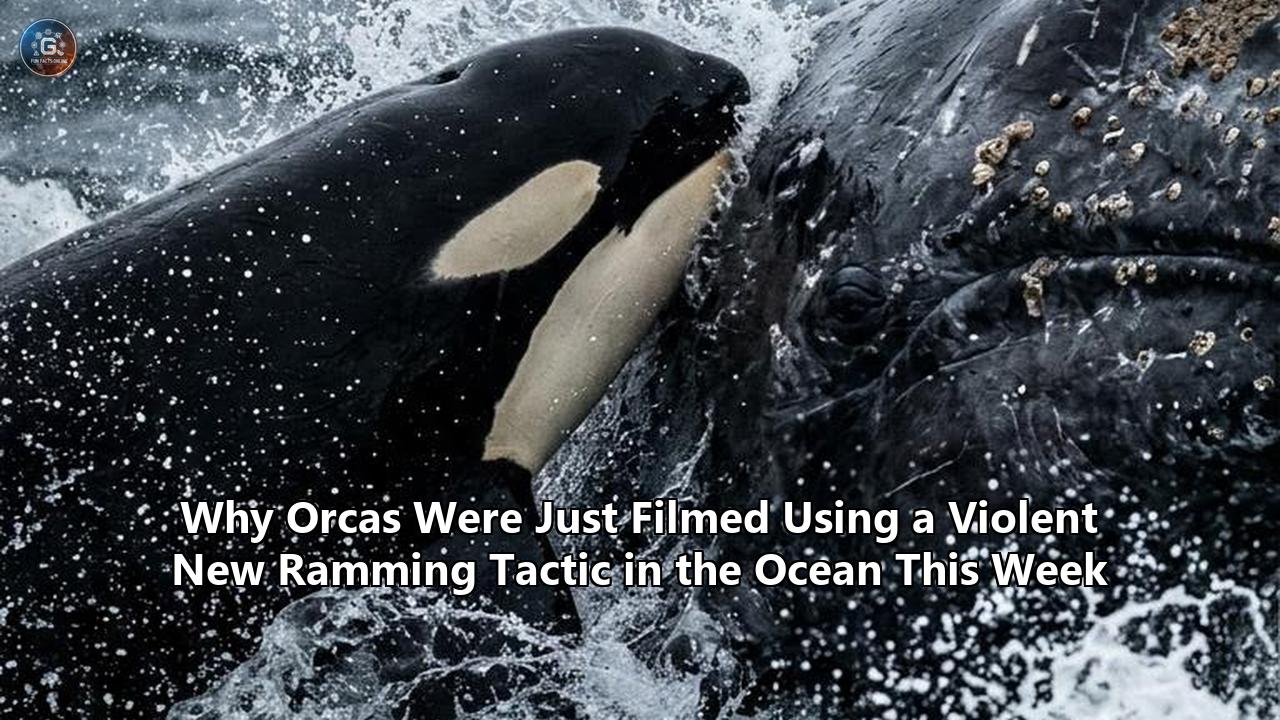
High-resolution underwater footage released by marine scientists has revealed a previously undocumented, highly destructive hunting and processing tactic used by killer whales: the "hold-to-ram" maneuver.
In video captured off Cabo San Lucas in the Gulf of California and published in Frontiers in Ethology, a adult female orca (Orcinus orca) was documented gripping the tough rear end—the clavus—of a massive, 2,000-kilogram sharp-tail sunfish (Masturus lanceolatus), anchoring the target firmly in the water column. Seconds later, a second adult male orca accelerated into a high-speed torpedo run, slamming directly into the anchored target at full force. The resulting impact created an explosive underwater shockwave, shattering the sunfish carcass into a cloud of bite-sized tissue fragments.
┌────────────────────────────────────────────────────────────────────────┐
│                        "HOLD-TO-RAM" MANEUVER                          │
│                                                                        │
│   1. ANCHORING PHASE              2. KINETIC ACCELERATION PHASE        │
│   ┌──────────┐                    ┌──────────┐  ──► High Speed         │
│   │ Anchor   │ ──► Holds Clavus   │ Torpedo  │  ──► (~30 km/h)          │
│   │ Orca     │     (Sunfish)      │ Orca     │                         │
│   └────┬─────┘                    └────┬─────┘                         │
│        │                               │                               │
│        ▼                               ▼                               │
│   ┌──────────────────────────────────────────┐                         │
│   │  TARGET: 2,000 kg Sharp-tail Sunfish     │                         │
│   └──────────────────────────────────────────┘                         │
│                                │                                       │
│   3. DISINTEGRATION PHASE      ▼                                       │
│   ┌──────────────────────────────────────────┐                         │
│   │ HIGH-IMPACT COLLISION ──► TISSUE EXPLOSION│                         │
│   │ ──► Bite-sized fragments for juveniles    │                         │
│   └──────────────────────────────────────────┘                         │
└────────────────────────────────────────────────────────────────────────┘
The discovery provides the first direct photographic evidence of orcas using biological kinetic impact as a coordinated processing tool. It also offers vital mechanical insights into a broader, deeply troubling trend that has alarmed mariners across the globe: the propensity of killer whales to use violent ramming techniques against both marine life and human vessels.
While news headlines have framed recent ocean encounters as a sudden wave of marine hostility, behavioral scientists, hydrodynamicists, and naval architects are piecing together a far more complex picture. From the Gulf of California to the Strait of Gibraltar, these deliberate ramming events represent a sophisticated convergence of cognitive planning, social learning, mechanical force leverage, and acoustic coordination.
The Physics of Impact: How an Apex Predator Weaponizes Mass
To understand why orcas are employing ramming tactics, one must first examine the extreme biomechanics required for a marine mammal to deliver a high-velocity collision without causing self-inflicted cranial trauma.
An adult killer whale weighs between 3,000 and 6,000 kilograms and can achieve burst speeds exceeding 30 kilometers per hour (8.3 meters per second). When an orca accelerates into a target, the kinetic energy ($KE$) transferred during impact is calculated using standard classical mechanics:
$$KE = \frac{1}{2} m v^2$$
For a 4,000 kg orca impacting an object at 8.3 m/s, the kinetic energy generated at the moment of contact exceeds 137,000 Joules. For context, this is equivalent to the impact energy of a light utility vehicle striking a concrete barrier at 40 km/h.
Kinetic Energy Comparison at Impact
┌───────────────────────────┬───────────────────────────────────────────┐
│ Event                     │ Kinetic Energy (Joules)                   │
├───────────────────────────┼───────────────────────────────────────────┤
│ Handgun Muzzle Energy     │ ~1,000 J                                  │
│ 50 BMG Heavy Rifle        │ ~18,000 J                                 │
│ 4-Ton Orca at 30 km/h     │ ~137,800 J                                │
│ Sedan Impact at 50 km/h   │ ~140,000 J                                │
└───────────────────────────┴───────────────────────────────────────────┘
When an animal generates energy of this magnitude, the force must be absorbed or directed away from its own skeletal framework. The skeletal anatomy of Orcinus orca features several structural adaptations that enable high-impact collisions:
- Dense Cranial Rostrum: The maxilla and premaxilla bones forming the snout are unusually thick and densely ossified, functioning as a structural battering ram.
- Fibrous Melon Damping: Located directly ahead of the cranium, the melon—a lipid-rich organ primarily used for echolocation—contains a outer matrix of dense collagen fibers. This matrix acts as a hydrodynamic shock absorber, dispersing peak deceleration forces across the front of the skull.
- Fused Cervical Vertebrae: Unlike many other cetaceans that retain flexible necks to navigate complex environments, the first three to four cervical vertebrae in killer whales are frequently fused. This structural rigidity transforms the skull, neck, and anterior torso into a single, reinforced column, minimizing spinal shear forces during high-speed impacts.
During the newly filmed "hold-to-ram" event in the Gulf of California, these biomechanical adaptations were deployed alongside precise tactical teamwork.
"We immediately knew we were witnessing something highly unusual due to the magnitude of the tissue explosion," said Erick Higuera, a marine biologist, wildlife cinematographer, and executive director of Orcas México who co-authored the study published in Frontiers in Ethology. "When you go back to the footage, frame by frame, you realize one orca was stabilizing the sunfish while the other carried out the blow. This wasn't a random attack, but a highly coordinated processing technique by multiple individuals."
From Prey Processing to Sailing Vessels: Decoding "Orcas Ramming Boats"
While the Pacific footage demonstrates orcas using ramming to shatter rigid prey, mariners along the Atlantic coast of Europe and North Africa have experienced a parallel phenomenon involving man-made structures. Since May 2020, a distinct subpopulation of killer whales inhabiting the Iberian Peninsula has been involved in hundreds of documented incidents involving orcas ramming boats.
According to data compiled by the Grupo de Trabajo Orca Atlántica (GTOA), over 670 vessel interactions have occurred between the Strait of Gibraltar and the Bay of Biscay, resulting in severe structural damage to hundreds of sailing yachts and the sinking of at least five vessels.
Iberian Orca Interaction Timeline (2020–2026)
┌──────┬───────────────────────────────────────────┬────────────────────┐
│ Year │ Documented Interaction Count              │ Notable Escalations│
├──────┼───────────────────────────────────────────┼────────────────────┤
│ 2020 │ 52 reported interactions                  │ Initial Gladis pod │
│ 2021 │ 197 reported interactions                 │ Spread to juveniles│
│ 2022 │ 207 reported interactions                 │ Multiple rudders   │
│ 2023 │ ~150 reported interactions                │ Sinking of yachts  │
│ 2024 │ 100+ reported interactions                │ Shift in migration │
│ 2025 │ Regional coastal spikes (Galicia)         │ Estuary probing    │
│ 2026 │ Continued localized incidents             │ Strategic warnings │
└──────┴───────────────────────────────────────────┴────────────────────┘
Mainstream media accounts often attribute these encounters to vengeance or environmental retaliation. However, underwater visual inspections and structural failure analyses of damaged vessels reveal a far more calculated, mechanical reality.
When engaging with sailing vessels, killer whales do not strike hulls at random. Instead, they focus almost exclusively on the vessel's steering system: the spade rudder.
               HOW ORCAS TARGET SAILBOAT RUDDERS

                  ┌────────────────────────┐
                  │    Sailing Vessel Hull │
                  └───────────┬────────────┘
                              │
                    ┌─────────┴────────┐ ◄── Transom / Stern
                    │  Steering Stock  │
                    └─────────┬────────┘
                              │
                    ┌─────────▼────────┐
                    │    RUDDER BLADE  │ ◄── Primary Impact Target
                    └─────────┬────────┘
                              ▲
                              │ ◄── Lateral Head Push / Leverage
                      [ Orca Rostrum ]
The Mechanical Failure Chain
- Stealth Approach from the Stern: The orcas approach slow-moving, medium-sized sailboats (typically 30 to 50 feet in length) quietly from behind, avoiding the bow wave.
- Rostrum Pressing and Torque Application: Rather than delivering a full-speed, open-water ramming strike, an individual orca swims alongside the stern, places its dense rostrum against the trailing edge or flat side of the rudder blade, and pushes laterally.
- Leverage Force and Quadrant Shear: By applying continuous, lateral force, the whale uses the rudder blade as a mechanical lever. This places immense rotational torque on the vertical steering stock inside the boat's hull.
- Structural Disintegration: The applied force snaps the internal quadrant gears, bends stainless-steel stock shafts, or fractures the composite fiberglass blade. Once the rudder blade breaks or swings freely, the target loses hydrodynamic resistance—at which point the whales typically lose interest and swim away.
"They don't care if it's a sailboat or a motorboat—they look for the rudders to break them," explains Dr. Renaud de Stephanis, a veteran marine biologist and president of the Spanish conservation research group CIRCE. "They just push it with their head until they break it, and that's it."
In incidents where vessels actually sank—such as the destruction of the 50-foot sailboat Alboran Cognac in May 2024 or the Polish yacht Grazie Mamma II—the sinkings were structural accidents rather than intentional destructions. The sustained lateral forcing on the rudder stock fractured the fiberglass seal where the stock penetrates the hull (the rudder log), allowing catastrophic water ingress into the bilge.
Three Scientific Theories: Why Are Orcas Ramming?
The discovery of the Pacific "hold-to-ram" prey processing technique has reignited an intense scientific debate regarding the underlying motivations behind cetacean ramming behaviors. Researchers across international institutions have put forward three primary hypotheses to explain why these complex physical tactics emerge and persist within distinct killer whale subcultures.
┌────────────────────────────────────────────────────────────────────────┐
│               THREE SCIENTIFIC HYPOTHESES FOR RAMMING                  │
├────────────────────────────────────────────────────────────────────────┤
│ 1. THE FOOD PROCESSING HYPOTHESIS                                      │
│    • Ramming functions as mechanical mastication for tough or bulky    │
│      prey (e.g., sharp-tail sunfish, bluefin tuna).                    │
│    • Allows calves and juveniles with weaker jaw forces to feed on     │
│      disintegrated fragments.                                          │
├────────────────────────────────────────────────────────────────────────┤
│ 2. THE TUNA HUNTING SIMULATOR HYPOTHESIS                               │
│    • Vessel rudders serve as artificial physical proxies for Atlantic  │
│      bluefin tuna (Thunnus thynnus).                                   │
│    • Juveniles practice hydrodynamic tracking, pushing, and tail-slapping│
│      on stationary rudder blades.                                      │
├────────────────────────────────────────────────────────────────────────┤
│ 3. THE CULTURAL FAD / PLAY HYPOTHESIS                                  │
│    • Ramming is a non-functional social trend spread by juvenile       │
│      imitation and play behavior.                                      │
│    • High prey availability leaves young orcas with excess time and     │
│      metabolic energy to explore novel objects.                        │
└────────────────────────────────────────────────────────────────────────┘
1. The Food Processing Hypothesis (Mechanical Mastication)
The findings published by Kathryn Ayres and her team at Beneath the Waves highlight a crucial biological constraint: orcas cannot chew their food. Unlike terrestrial carnivores equipped with specialized molars to shear muscle and crush bone, killer whales possess homodont, conical teeth designed strictly for grasping and tearing prey.
When targeting large, thick-skinned marine species—such as the sharp-tail sunfish or adult bluefin tuna—an orca faces a physical boundary. A 2,000-kilogram sunfish possesses a thick, leathery dermal layer covered in a tough, gelatinous matrix known as the capsule.
For younger calves and juveniles whose jaw muscles and tooth row spacing are insufficient to tear this tough hide, the carcass is effectively inedible.
By using the "hold-to-ram" strategy, the pod transforms kinetic impact into a tool for mechanical mastication. The anchor whale stabilizes the mass, preventing it from slipping away through the water column, while the ramming whale applies focused kinetic energy.
This impact exceeds the ultimate tensile strength of the sunfish's dermal capsule, shattering the body into small, accessible fragments that younger pod members can readily consume.
  TENSILE STRESS DISTRIBUTIONS DURING "HOLD-TO-RAM"

    Anchor Orca Grip (Clavus) ───────► [====== CARCASS ======] ◄────── Kinetic Ramming Strike
                                              │
                                              ▼
                                    Internal Shear Stress
                                              │
                                              ▼
                                  Structural Disintegration
                                              │
                                              ▼
                                 Plume of Micro-Fragments
2. The Tuna Hunting Simulator Hypothesis
A second compelling theory, advanced by Dr. Bruno Díaz López and researchers at the Bottlenose Dolphin Research Institute (BDRI), connects the behavior of orcas ramming boats directly to prey hunting mechanics.
The Iberian killer whale subpopulation relies almost exclusively on Atlantic bluefin tuna (Thunnus thynnus). Bluefin tuna are among the fastest, most agile fish in the ocean, capable of reaching speeds up to 70 km/h and weighing over 400 kilograms. To catch a tuna, an orca must chase it into deep water, exhaust it, and often deliver physical head-butts or tail-slaps to stun or incapacitate the fish before consuming it.
Using spatial computer models that mapped over 500 vessel interactions against bluefin tuna migration corridors, BDRI researchers discovered a near-perfect environmental overlap. As bluefin tuna populations recovered off the coasts of Spain and Portugal due to strict fishing quotas, young orcas found themselves with abundant food and reduced foraging stress.
Dr. Díaz López suggests that sailboat rudders act as artificial practice targets. To a young, developing orca, a sailboat moving through the water at 5 to 8 knots creates a trailing hydrodynamic wake and a responsive, movable surface (the rudder) that strikingly mimics the physical feedback of a large, swimming tuna.
By approaching the boat, pushing the rudder, and resisting the water pressure created by the moving hull, juvenile orcas refine the motor skills, spatial coordination, and physical strength required to hunt live bluefin.
  PREY TARGET VS. VESSEL PROXY COMPARISON
  ┌───────────────────────────┬───────────────────────────┐
  │ Atlantic Bluefin Tuna     │ Sailboat Rudder           │
  ├───────────────────────────┼───────────────────────────┤
  │ Speed: 20–70 km/h         │ Speed: 10–15 km/h         │
  │ Hydrodynamic Resistance   │ High Water Resistance     │
  │ Lateral Tail Movement     │ Rotational Blade Pivot    │
  │ High Muscle Density       │ Fiberglass/Metal Stock    │
  └───────────────────────────┴───────────────────────────┘
3. The Cultural Fad and Play Hypothesis
A third hypothesis, supported by the International Whaling Commission (IWC) joint workshop report, frames these behaviors as non-functional cultural fads—essentially social games that spread through observational learning.
Killer whales possess complex cultural traditions. Specific pods maintain unique vocal dialects, distinct foraging techniques, and specific social behaviors that are passed down across generations. Crucially, orcas are also prone to temporary, non-adaptive behavioral fads.
In 1987, a famous behavioral trend swept through three distinct pods in Puget Sound, Pacific Northwest: a female orca began carrying a dead, decaying salmon on her nose, balancing it like a hat. Within weeks, the behavior spread across multiple pods, with dozens of whales wearing "salmon hats." Several months later, the trend abruptly vanished and was not observed again for decades.
  ORCA CULTURAL BEHAVIORAL TRANSMISSION

     [ Novel Innovation ] ──► (Initiated by 1–2 Individuals)
              │
              ▼
    [ Observational Learning ] ──► (Peer-to-Peer Peer Pressure / Play)
              │
              ▼
     [ Pod-Wide Adoption ] ──► (Becomes Dominant Social Fad)
              │
              ▼
   [ Persistence or Cessation ] ──► (Sustained Tradition OR Sudden Drop)
"This looks like play," states Dr. Naomi Rose, a senior scientist in marine mammal biology at the Animal Welfare Institute who participated in the international task force. "It's a very dangerous game they're playing, obviously. But it's a game. If they wanted to sink the boats, they'd be sinking the boats. They are exceptionally smart animals."
The play hypothesis is strongly supported by demographic data: of the roughly 40 to 50 individuals comprising the Iberian killer whale population, the vast majority of rudder interactions are carried out by a small group of juveniles and teenagers.
To a bored, highly social marine mammal equipped with extraordinary intelligence and physical power, a vessel's rudder is an interactive water toy that responds dynamically to touch, makes loud creaking noises inside the hull, and ultimately breaks with a satisfying mechanical snap.
Technical Analysis: High-Resolution Footage and Cetacean Cognitive Mapping
To capture the footage that revealed the Pacific "hold-to-ram" tactic, researchers relied on a combination of high-frame-rate underwater cameras, custom GoPro extension rigs, acoustic hydrophone arrays, and aerial drone photogrammetry.
Analyzing high-speed video frame-by-frame allows researchers to measure precise physical metrics that were impossible to evaluate from surface observations alone.
Frame-by-Frame Breakdown of Gulf of California Ramming Video
┌─────────────┬────────────────────────────────────────────────────────┐
│ Time Code   │ Observed Physical Event                                │
├─────────────┼────────────────────────────────────────────────────────┤
│ T + 0.00s   │ Female orca maneuvers behind sharp-tail sunfish.       │
│ T + 1.40s   │ Female clamps jaws onto the sunfish clavus.            │
│ T + 2.10s   │ Adult male initiates power-stroke fluke beats at 15m.  │
│ T + 3.80s   │ Male reaches peak velocity (~8.5 m/s) on straight line.│
│ T + 4.20s   │ Female releases clavus grip 15 cm prior to impact.     │
│ T + 4.25s   │ Male impacts sunfish midsection with head/rostrum.     │
│ T + 4.30s   │ Acoustic thud registered on hydrophone (185 dB peak).  │
│ T + 4.50s   │ Tissue fragmentation cloud expands radially.           │
│ T + 6.00s   │ Juvenile orca enters impact field to consume debris.   │
└─────────────┴────────────────────────────────────────────────────────┘
The temporal precision required for this maneuver reveals sophisticated cognitive processing. For an animal to release its grip milliseconds before a 4-ton pod-mate strikes at full speed requires:
- Shared Intentionality: Both individuals must understand the precise end goal of the action (shattering the prey target rather than killing it).
- Spatial-Temporal Mapping: The anchoring whale must calculate the incoming speed, vector, and deceleration distance of the ramming whale, releasing the prey at the exact moment necessary to avoid taking the hit herself.
- Acoustic Synchronization: Underwater audio recordings captured burst-pulse vocalisations immediately before impact, suggesting the whales use real-time acoustic cues to coordinate the strike timing.
"This requires acute spatial awareness, acoustic communication, and a shared understanding of physics," explains study co-author Erick Higuera. "It shows that orcas can mentally map out a multistep tactical plan and execute it with military precision."
The Ecological Ripple Effect: Microbiome Dispersal and Ocean Health
Beyond the obvious mechanical and behavioral implications, the discovery of prey ramming reveals a previously overlooked biochemical interaction between apex predators and ocean ecosystems.
When an orca shatters a sharp-tail sunfish carcass, the force does not merely tear muscle tissue; it disintegrates the dermal layer and dispersal capsule. The paper published in Frontiers in Ethology highlights that sunfish skin hosts a highly distinct, specialized microbiome composed of specialized microbial taxa.
  MICROBIAL AND NUTRIENT DISPERSAL CASCADES

     [ High-Impact Ramming Event ]
                  │
                  ▼
   [ Disintegration of Dermal Layer ]
                  │
                  ▼
   [ Rapid Radial Dispersion of Microbiome ]
                  │
                  ├───────────────────────────────┐
                  ▼                               ▼
     [ Local Marine Water Column ]      [ Direct Ingestion ]
                  │                               │
                  ▼                               ▼
    [ Planktonic Nutrient Shift ]     [ Orca Gut Flora Enrichment ]
When this tissue is violently fragmented, millions of host-specific microbes are released instantaneously into the surrounding water column, altering localized nutrient chemistry.
Researchers hypothesize that this mechanical breakdown serves two distinct ecological functions:
- Facilitated Ingestion: The dispersal of skin tissues prevents the accumulation of indigestible dermal mucilage in the digestive tracts of young whales.
- Microbial Transfer: Ingesting smaller, highly fragmented pieces of sunfish skin allows juvenile killer whales to expose their gut flora to specific microbes, potentially providing nutritional or immune-regulating benefits.
This finding underscores how top-down predation mechanics extend far beyond the immediate predator-prey dynamic, directly shaping localized microbial communities and nutrient cycles.
Maritime Response: The Geopolitics and Policy of Dealing with Ramming Orcas
The ongoing trend of orcas ramming boats has created a legal, economic, and safety nightmare for maritime authorities in Europe and North Africa. The Strait of Gibraltar is one of the busiest shipping lanes on Earth, navigated by tens of thousands of commercial freighters, fishing vessels, and private yachts annually.
┌────────────────────────────────────────────────────────────────────────┐
│             MARITIME CONFLICT & POLICY LANDSCAPE                       │
├────────────────────────────────────────────────────────────────────────┤
│ LEGAL CONSTRAINTS                                                      │
│ • Iberian Killer Whale Status: Subpopulation Critically Endangered     │
│   (IUCN Red List).                                                     │
│ • Total Population: ~40 to 50 individuals.                             │
│ • Protection: Strictly protected under CITES, EU Habitats Directive,  │
│   and Spanish/Portuguese environmental law.                            │
│ • Criminal Penalty: Harming, deterrent pyrotechnics, or shooting at    │
│   orcas carries severe prison terms and heavy fines.                   │
├────────────────────────────────────────────────────────────────────────┤
│ MARINER MITIGATION ATTEMPTS                                            │
│ • Acoustic Pingers: FAILED (functioned as "dinner bells" attracting    │
│   curious juveniles).                                                  │
│ • Sand/Noise Suppression: FAILED (ineffective against determined orcas)│
│ • Rudder Cones: MIXED RESULTS (slender plastic sleeves designed to     │
│   eliminate physical grip edges).                                      │
│ • Shallow Water Escape Protocol: SUCCESSFUL (moving inside <50m depth) │
└────────────────────────────────────────────────────────────────────────┘
The Spanish Ministry for Ecological Transition (MITECO), together with Portuguese marine authorities (ICNF) and the International Whaling Commission, has been forced to navigate a delicate balance between human maritime safety and species preservation.
The Evolution of Operational Advice for Sailors
When incidents began escalating in 2020, maritime safety agencies initially advised sailors to immediately drop sail, stop the vessel, turn off all electronic depth sounders, and hold the wheel firmly. The logic was simple: a stationary, silent boat would lose its interactive appeal, causing the whales to lose interest.
That strategy proved disastrous. A stationary boat with a fixed, locked rudder provided the ideal target for young orcas. Without resistance from forward momentum, the whales could easily apply lateral leverage to the rudder blade, snapping stock shafts with minimal physical effort.
In early 2024, after reviewing data from hundreds of interactions, international scientific advisory panels reversed their official guidelines:
- Do Not Stop the Vessel: Mariners are now advised to maintain course and speed if safe to do so, heading immediately toward shallow waters.
- The 50-Meter Rule: Data indicates that Iberian killer whales overwhelmingly operate in deep open waters where they hunt bluefin tuna. If a vessel reaches water shallower than 50 meters, the orcas almost always abandon the interaction and return to deep water.
- Avoid Violent Retaliation: The use of firecrackers, acoustic harassment devices, or physical weapons against the whales is strictly illegal under European law. Furthermore, marine biologists point out that hostile actions can provoke aggressive defensive responses from adult whales in the pod.
  EVOLUTION OF RECOMMENDED MARINER PROTOCOLS

  OLDER PROTOCOL (2020–2023) [DISPROVEN]
  [ Detect Orcas ] ──► [ Stop Engine ] ──► [ Lock Rudder ] ──► [ Wait Silently ]
                                                                      │
                                                                      ▼
                                                          (Rudder Easily Snapped)

  CURRENT PROTOCOL (2024–PRESENT) [APPROVED]
  [ Detect Orcas ] ──► [ Maintain Speed ] ──► [ Steer to <50m Depth ] ──► [ Whales Abandon Interaction ]
Innovative Hardware Countermeasures
Naval engineers and scientists have also tested physical boat modifications to reduce the frequency of interactions:
- Rudder Protection Cones: Soft, flexible plastic or rubber cones installed at the top and bottom of the rudder blade eliminate sharp grip points, making it difficult for an orca to get physical leverage with its rostrum.
- Symmetrical Dummy Rudders: Researchers led by Dr. Renaud de Stephanis deployed experimental boats towing non-functional dummy rudders equipped with underwater cameras. The tests confirmed that once a rudder loses resistance or breaks away cleanly, the whales immediately lose interest, proving that the physical feedback of resistance is the primary driver of the behavior.
What Happens Next: The Future of Cetacean Cultural Evolution
The footage from the Gulf of California and the ongoing incidents along the Iberian coast mark a turning point in how scientists view cetacean intelligence, mechanics, and culture. We are witnessing real-time cultural evolution within wild animal populations—a process where novel physical behaviors are invented, refined, and socially transmitted across entire populations.
                      GLOBAL ORCA RAMMING HOTSPOTS

           [ Pacific Coast - Gulf of California ]
           • Target: Sharp-tail Sunfish (2,000 kg)
           • Technique: "Hold-to-Ram" Anvil Strategy
           • Primary Function: Prey Shattering / Feed Facilitation

                                │
                                ▼
           [ Atlantic Coast - Strait of Gibraltar / Galicia ]
           • Target: Sailboat Rudders / Bluefin Tuna
           • Technique: Lateral Rostrum Leverage / Head-Butting
           • Primary Function: Social Play / Hunting Practice
As research teams deploy increasingly advanced tools—including continuous satellite tag arrays, high-frequency hydrophone monitoring networks, and AI-driven image analysis—several crucial questions remain at the forefront of marine science:
- Cross-Pod Transmission: Will the "hold-to-ram" prey processing technique observed in the Pacific spread to other distinct killer whale ecotypes, such as the mammal-eating Transient (Biggs) orcas or Antarctic ice-hunting pods?
- Longevity of the Boat Fad: Will the juvenile Iberian orcas involved in orcas ramming boats abandon the behavior as they reach physical maturity, or will they pass the tradition down to their own offspring, establishing boat-ramming as a permanent cultural trait of the subpopulation?
- Coexistence Strategies: Can human maritime technology adapt quickly enough to design ships and rudders that can withstand or deter physical interactions without harming a critically endangered marine mammal population?
What is clear is that killer whales possess an extraordinary ability to analyze physical structures, master hydrodynamic forces, and execute complex tactical plans. Whether breaking open a 2-ton sunfish in the Sea of Cortez or snapping a composite rudder blade in the Atlantic, Orcinus orca continues to prove that it is not merely a force of nature, but a tactical innovator operating at the highest levels of animal cognition.
Key Takeaways and Scientific Overview
- The Pacific Discovery: A new study published in Frontiers in Ethology details the "hold-to-ram" tactic, where one orca holds a 2,000 kg sunfish steady while another rams it at full speed to shatter the carcass into manageable food fragments.
- Extreme Physics: An adult killer whale striking a target at 30 km/h generates over 137,000 Joules of kinetic energy, utilizing a reinforced snout, fused cervical vertebrae, and a shock-absorbing melon matrix to deliver devastating force safely.
- Understanding Vessel Interactions: The phenomenon of orcas ramming boats off the coast of Spain and Portugal is driven primarily by juvenile whales using leverage to break sailboat rudders—a behavior linked to social play, boredom, or target practice for hunting fast-moving bluefin tuna.
- Updated Mariner Guidance: Maritime authorities strongly advise sailors encountering orcas to maintain speed and navigate immediately to shallow waters under 50 meters depth, rather than stopping the vessel.
Reference:
- https://www.frontiersin.org/news/2026/07/23/orcas-ramming-worlds-heaviest-fish-explodes
- https://www.smithsonianmag.com/smart-news/video-captures-orcas-ramming-a-sunfish-so-hard-it-explodes-the-mysterious-behavior-might-be-a-form-of-play-or-juvenile-care-180989153/
- https://www.theguardian.com/environment/2026/jul/23/orcas-ramming-prey-hard-explodes-playing-game
- https://en.wikipedia.org/wiki/Iberian_orca_attacks
- https://www.nationalgeographic.com/animals/article/orcas-killer-whales-ramming-boats-spain-cultural-behavior
- https://www.livescience.com/animals/orcas/orcas-may-be-ramming-boats-as-target-practice-toys-scientists-suggest
- https://www.businessinsider.com/orca-rammings-experts-2-different-theories-behavior-cant-agree-2023-6
- https://oceanographicmagazine.com/news/orcas-filmed-ramming-sunfish-so-hard-it-explodes/
- https://www.kpbs.org/news/science-technology/2026/07/24/video-scientists-watch-orcas-ram-a-sunfish-so-hard-it-explodes
- https://www.youtube.com/watch?v=O7qlWuc9vNE
- https://bugwomanlondon.com/2025/10/24/iberian-whales-and-boat-attacks-the-latest-theories/
- https://www.youtube.com/shorts/EJEwKZvSLm8