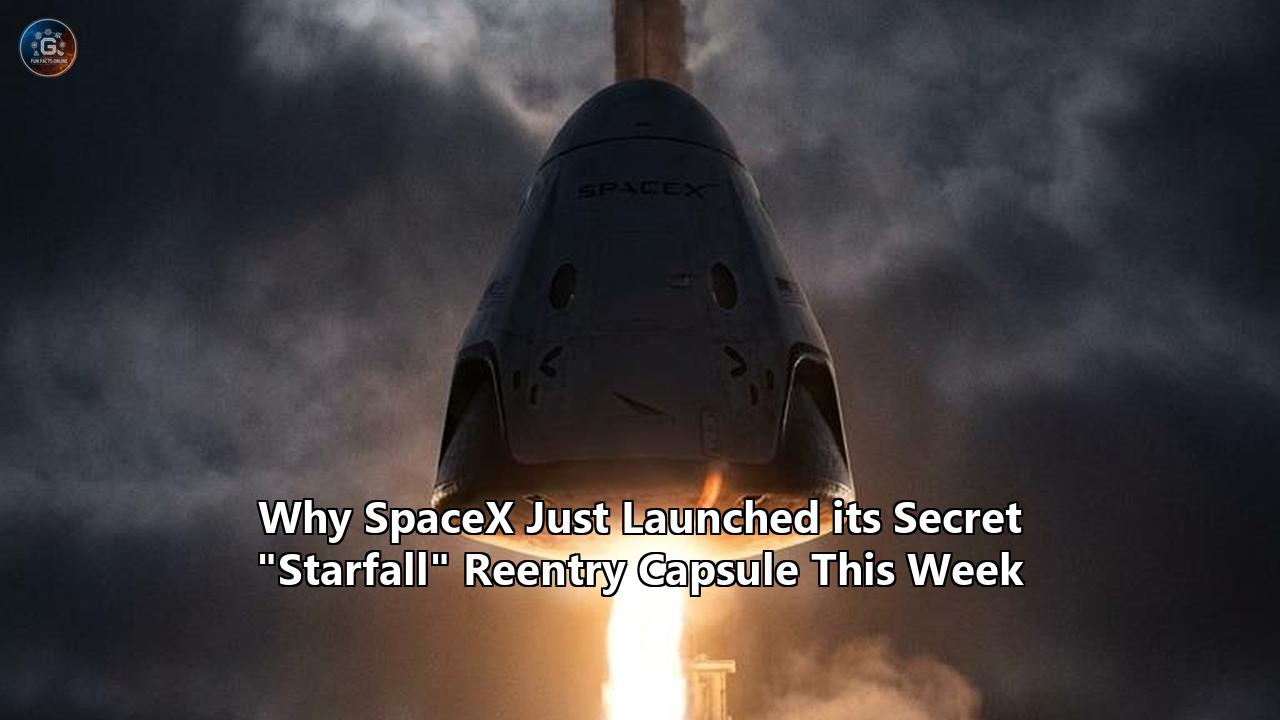
The Florida sky had barely begun to brighten on Tuesday, June 23, 2026, when a Falcon 9 rocket ignited its nine Merlin 1D engines at Cape Canaveral’s Space Launch Complex 40 (SLC-40). At exactly 6:53 a.m. EDT, the vehicle surged off the pad, carrying a payload that represented SpaceX's most significant and secretive hardware debut in years.
Publicly, the flight was designated as the debut of a technology demonstration. However, the conduct of the launch immediately signaled that this was no ordinary operational flight. Approximately ten minutes after liftoff, immediately following the flawless landing of the first-stage booster B1078 on the autonomous droneship A Shortfall of Gravitas in the Atlantic Ocean, SpaceX abruptly terminated its live broadcast.
No views of the second stage were shown. No live telemetry of the orbital insertion was provided. The deliberate media blackout is a protocol typically reserved for highly classified national security missions conducted on behalf of the National Reconnaissance Office or the Space Force. Yet, this was a proprietary commercial spacecraft.
Three hours later, at 10:01 a.m. EDT, SpaceX released a brief confirmation: the uncrewed Starfall capsule had been successfully deployed into low-Earth orbit.
The launch of the first SpaceX Starfall mission marks the critical turning point of a narrative that has quietly unfolded behind closed doors, through complex regulatory skirmishes, and within the classified corridors of the Pentagon. By putting this unique, disk-shaped vehicle into orbit, SpaceX has officially entered the race to dominate the emerging market of orbital manufacturing and rapid global logistics.
The path to this week's launch reveals a calculated escalation, transforming SpaceX from a simple launch provider into an end-to-end owner of the orbital return value chain.
Phase I: The Whisper Campaign in Hawthorne (July 2025)
The story of the SpaceX Starfall mission began to surface in July 2025, when reports emerged of a highly confidential internal project underway at SpaceX’s headquarters in Hawthorne, California.
For years, the commercial space sector had focused almost exclusively on the "upleg" of spaceflight—getting mass into orbit as cheaply and frequently as possible. Through the rapid reuse of the Falcon 9 and the development of the Starship architecture, SpaceX had successfully commoditized launch. However, a major bottleneck remained: the "downleg". Returning materials safely from orbital speeds back to Earth’s surface remained an expensive, highly complex, and tightly restricted capability.
+------------------------------------------------------------+
|                THE CHRONOLOGICAL ESCALATION               |
+------------------------------------------------------------+
|                                                            |
|  [JULY 2025]                                               |
|  First leaks of a confidential "reentry capsule" project   |
|  focused on orbital manufacturing.                         |
|                                                            |
|  [MAY 2026]                                                |
|  FAA publishes Final Environmental Assessment; FCC filings |
|  reveal Starlink integration and disk-shaped design.       |
|                                                            |
|  [JUNE 15, 2026]                                           |
|  FAA Operations Advisory officially schedules the debut    |
|  launch from Cape Canaveral.                               |
|                                                            |
|  [JUNE 23, 2026]                                           |
|  Falcon 9 B1078 launches Starfall Demo; webcast is cut,    |
|  and capsule is deployed into low-Earth orbit.             |
|                                                            |
+------------------------------------------------------------+
Historically, the only reliable commercial vehicle capable of returning significant cargo from orbit was SpaceX's own Dragon capsule. But Dragon is designed to meet the rigorous safety standards of human spaceflight or the precise, multi-million-dollar cargo schedules of the International Space Station (ISS). It is physically large, operationally complex, and far too expensive to support a high-cadence, mass-produced industrial pipeline.
Meanwhile, a small group of agile startups had begun attempting to fill this niche. Companies like Varda Space Industries demonstrated that certain high-value materials—specifically small-molecule pharmaceuticals, protein crystals, semiconductors, and specialized optical fibers—can be manufactured with far fewer defects in a weightless environment. Varda’s W-Series "Winnebago" capsules successfully returned processed materials to Earth, proving that the market existed.
However, these startups faced a fundamental economic reality: they were entirely dependent on SpaceX to launch their recovery capsules.
In mid-2025, SpaceX leadership realized that operating merely as a launch "landlord" was a strategic missed opportunity. By vertically integrating both the launch infrastructure and the return capsule, SpaceX could offer an end-to-end orbital factory and return service. The confidential project, code-named "Starfall," was initiated to design a mass-producible, low-profile, uncrewed reentry capsule that could return up to a metric ton of cargo per flight—dramatically undercutting the cost structures of every startup in the sector.
Phase II: The Paper Trail (May 2026)
For nearly ten months, SpaceX managed to keep the physical details of the Starfall vehicle under wraps. That secrecy evaporated in May 2026, when the regulatory requirements of spaceflight forced the project into the public record.
The first major break occurred when the Federal Aviation Administration (FAA) published its Final Environmental Assessment (EA) and an accompanying Record of Decision. The document officially granted SpaceX approval to conduct its first two prototype Starfall reentry test flights, with landing zones located in international waters within the Pacific Ocean, approximately 1,300 kilometers (700 nautical miles) off the coasts of California and Mexico.
Shortly after the FAA publication, a series of Federal Communications Commission (FCC) filings revealed the technical systems of the prototype vehicles. The most striking detail was the integration of high-performance Starlink Earth station terminals directly onto the reentry capsule.
   TYPICAL REENTRY PLASMA BLACKOUT
   [Spacecraft]  ===>  ( ionized plasma gas )  ==/=>  [Ground Stations / GPS]

   STARFALL REENTRY SOLUTION
   [Starlink Terminal] ===> [Directional Phased Array] ===> [Overhead Starlink Constellation]
   (Ionized plasma wake is bypassed via real-time upward data link)
In traditional aerospace engineering, spacecraft undergoing atmospheric reentry experience a "plasma blackout phase". As the vehicle plunges into the upper atmosphere at hypersonic speeds (typically exceeding Mach 25), the extreme friction compresses and superheats the air, stripping electrons from gas molecules. This creates a dense envelope of ionized plasma around the vehicle that acts as a Faraday cage, completely blocking radio signals. For several critical minutes, the vehicle is completely blind and cut off from mission control.
SpaceX’s FCC filings showed that the company intended to use the overhead Starlink constellation to solve this problem. By mounting active, directional phased-array Starlink antennas on the upper, cooler side of the capsule—where the plasma wake is thinnest—SpaceX aimed to maintain continuous, high-bandwidth telemetry directly through the plasma blackout phase. If successful, it would mark a significant leap forward in reentry communication physics, providing real-time data streaming during the most hazardous portion of the flight.
Phase III: The Immediate Countdown (June 15, 2026)
The transition from regulatory approval to operational deployment moved at typical SpaceX speed. On June 15, 2026, the FAA released an operations advisory for a targeted mission Net June 21, 2026.
Marine safety notices and airspace restriction coordinates soon followed, tracing a precise path. The launch was slated to head southeast from Cape Canaveral, putting the second stage into a high-inclination orbit. Simultaneously, SpaceX’s recovery fleet began mobilizing on the opposite side of the continent, preparing to deploy retrieval vessels to the open waters of the Pacific Ocean.
The choice of the launch vehicle and booster configuration further highlighted the importance of the flight. SpaceX selected Booster B1078—one of the most experienced workhorses in its fleet. Preparing for its 29th flight, B1078 carried a pedigree that included NASA’s Crew-6 mission to the ISS, the USSF-124 national security flight, and dozens of Starlink deployments.
By assigning a highly proven booster to the debut SpaceX Starfall mission, SpaceX minimized the risk of launch vehicle failure, ensuring that all engineering focus remained squarely on the performance of the uncrewed capsule during its orbit and subsequent descent.
Phase IV: The Execution (June 23, 2026)
On Tuesday, June 23, the countdown proceeded without a single technical hold. The weather forecast, monitored by the Space Force’s 45th Weather Squadron, remained 95 percent favorable.
At T-minus 0, the Falcon 9 rose from SLC-40. The ascent followed a standard trajectory, with the first stage performing its burn before separating 2.5 minutes into the flight. B1078 executed a flawless entry burn and landed safely on the deck of A Shortfall of Gravitas.
But as the booster touched down, the public broadcast ended. Behind the scenes, the second stage continued its burn, inserting the Starfall capsule into a temporary low-Earth orbit of approximately 180 by 600 kilometers at an inclination of 56.1 degrees.
The mission profile utilized a highly integrated orbital plan. Because the Starfall capsule lacks its own primary rocket engine, it cannot perform an independent deorbit burn to drop out of orbit. Instead, the capsule remained securely attached to the Falcon 9 second stage during its coast phase.
After coasting for approximately 1.5 orbits (around 2.5 hours), the second stage's Merlin Vacuum engine fired one final time, performing a precise retro-burn to lower the trajectory’s perigee deep into the Earth's lower atmosphere.
  [Falcon 9 Second Stage] + [Starfall Capsule]
           \
            \__ (1) Coast Phase (1.5 Orbits)
             \
              \__ (2) Second Stage Deorbit Burn
               \
                \__ (3) Pyrotechnic Jettison of Starfall
                 \
                  *====> [Starfall Capsule Reentry Arc]
                   \
                    *---> [Second Stage Atmospheric Demise]
With the descent trajectory established, the second stage jettisoned the Starfall capsule. The second stage then fell back to Earth, burning up entirely over the uninhabited expanse of the Pacific Ocean.
The Starfall capsule, now flying solo, used its integrated attitude control system to orient its massive carbon-fiber heat shield toward the oncoming atmospheric wall, initiating its high-speed descent.
The Mechanical Anatomy of the Disk: Why "Flat" is the New Conical
The physical design of the Starfall capsule represents a fundamental shift in reentry vehicle architecture. For decades, spacecraft designers have favored the blunt, conical "gumdrop" shape. From Apollo and Gemini to SpaceX’s own Dragon and Varda’s Winnebago, the cone shape has been the gold standard. Cones provide excellent aerothermal stability and automatically orient themselves during aerodynamic deceleration.
Starfall completely abandons this form factor. It is a flat, circular disk measuring 3.1 meters (10.2 feet) in diameter and just 0.75 meters (2.5 feet) in height.
             CROSS-SECTION COMPARISON: CONICAL VS. FLAT DISK

       Dragon / Varda (Conical)                Starfall (Disk-Shaped)

                /\                                 +---------------+
               /  \   <-- Payload Space            |  Payload Bay  | <-- 1,000 kg Capacity
              /____\                               +---------------+
             (______) <-- Heat Shield              \_______________/ <-- 700 kg Heat Shield
This disk-shaped geometry was selected to optimize structural efficiency and volumetric cargo packing. By spreading the vehicle’s mass over a wider, flatter surface area, SpaceX has created a capsule that maximizes the internal payload bay volume relative to its total dry weight.
The vehicle has an empty dry mass of approximately 2,100 kilograms (4,630 pounds). It is constructed as a two-part split assembly:
- The Aluminum Top Plate (1,400 kg): This upper half comprises the primary structural frame and contains the internal cargo bay. The bay measures 2.5 by 1.5 by 0.5 meters, providing a rectangular envelope optimized for standard industrial and scientific equipment racks. It also houses the parachute recovery systems.
- The Carbon-Fiber Heat Shield (700 kg): The lower half is a heavy-duty, high-performance thermal protection system wrapped in advanced ablative materials to withstand the extreme temperatures of atmospheric friction.
Because the disk shape is aerodynamically less self-stabilizing than a cone, Starfall relies heavily on an active orientation network. Embedded within the heat shield are two large, 151-liter composite overwrapped pressure vessels (COPVs) filled with compressed nitrogen gas, alongside several smaller 9-liter auxiliary bottles.
These gas reserves feed a series of high-precision, cold-gas attitude control thrusters. Throughout the atmospheric plunge, the capsule’s onboard flight computer fires these nitrogen jets in millisecond bursts to maintain the precise pitch, roll, and yaw angles required to keep the heat shield aligned against the hypersonic airflow.
+------------------------------------+------------------------------------+
| SPECIFICATION                      | DETAILS                            |
+------------------------------------+------------------------------------+
| External Dimensions                | Diameter: 3.1m | Height: 0.75m     |
+------------------------------------+------------------------------------+
| Empty Dry Mass                     | 2,100 kg (4,630 lbs)               |
+------------------------------------+------------------------------------+
| Structure Split                    | Top Plate: 1,400 kg (Aluminum)     |
|                                    | Heat Shield: 700 kg (Carbon-Fiber) |
+------------------------------------+------------------------------------+
| Payload Capacity                   | 1,000 kg (2,205 lbs)               |
+------------------------------------+------------------------------------+
| Payload Bay Dimensions             | 2.5m x 1.5m x 0.5m                 |
+------------------------------------+------------------------------------+
| Guidance & Propulsion              | Cold-Gas Nitrogen Thrusters        |
|                                    | (No Chemical Propulsion)           |
+------------------------------------+------------------------------------+
| Deceleration System                | Pilot Chute, Drogue Chute,         |
|                                    | Single Main Parachute              |
+------------------------------------+------------------------------------+
| Communication Systems              | Phased-Array Starlink Terminals    |
+------------------------------------+------------------------------------+
The deceleration and landing sequence is equally unique. Once the capsule successfully navigates the high-heating phase and drops to subsonic speeds, the 700 kg carbon-fiber heat shield is mechanically jettisoned.
Immediately afterward, the top plate deploys its parachute sequence: a small pilot chute extracts a drogue parachute to stabilize the capsule, followed by the deployment of a single, large main parachute.
By jettisoning the heavy heat shield prior to splashdown, SpaceX achieves two critical objectives:
- Reduced Descent Weight: It reduces the mass that the main parachute must support, allowing for a slower, gentler splashdown that protects delicate cargo.
- Separate Component Retrieval: It allows recovery teams to retrieve both the heat shield and the cargo platform independently. This makes it far easier to inspect and reuse the thermal protection hardware, bypassing the saltwater contamination that often ruins integrated heat shields.
The Strategic Disruption: Landlord Becomes Competitor
The launch of the SpaceX Starfall mission represents a direct challenge to a market that has long been dominated by venture-backed aerospace startups.
Over the past three years, companies like Varda Space Industries, Inversion Space, and Outpost Space have raised tens of millions of dollars to build automated, in-space manufacturing laboratories. These startups pitched a clear business model: leverage cheap rideshare launches (primarily via SpaceX’s Transporter missions) to send small, automated factories into orbit, crystallize advanced pharmaceuticals or manufacture high-purity semiconductors, and then bring them down in proprietary, custom reentry capsules.
But these startups operated at a tiny scale. Varda’s Winnebago capsule, for instance, weighs roughly 120 kilograms and can only return a payload of tens of kilograms per flight. The physical limitations of these small capsules meant that the unit economics of space manufacturing remained incredibly high, restricting the market to ultra-rare, high-margin pharmaceutical formulations like the HIV drug Ritonavir.
       RETURN CAPACITY COMPARISON: STARTUPS VS. SPACEX STARFALL

   Varda Winnebago
   [=] ~15-50 kg Cargo Return

   SpaceX Starfall
   [==================================================] 1,000 kg Cargo Return (30x-50x larger)
By debuting Starfall, SpaceX is leveraging its vertical integration to fundamentally disrupt this landscape. With a return capacity of 1,000 kilograms, Starfall can bring back dozens of times more cargo than its closest competitor.
This massive jump in scale fundamentally alters the economics of orbital manufacturing. It shifts the industry from highly expensive, artisanal-scale pharmaceutical trials to high-volume, commercial-scale production runs.
Furthermore, SpaceX’s position as the primary launch provider gives it an insurmountable competitive advantage. Startups must pay SpaceX millions of dollars to launch their capsules to orbit.
SpaceX, however, can fly its own Starfall capsules on Falcon 9 or Starship as internal filler payloads, effectively reducing its launch costs to near zero.
This "landlord to competitor" dynamic has sent shockwaves through the space investment community. By controlling both the ascent and descent infrastructure, SpaceX is positioned to capture the vast majority of the service revenue generated by the emerging orbital economy.
With the International Space Station slated for retirement in the late 2020s, SpaceX is pitching Starfall as the primary uncrewed successor—a fleet of highly standardized, mass-produced, autonomous orbital factories that can loiter in space indefinitely before returning their products on demand.
The Pentagon's Shadow: Dual-Use and Rapid Global Cargo
While commercial in-space manufacturing is the primary public narrative surrounding the Starfall program, the military implications of this week's launch are highly significant. The intense secrecy surrounding the June 23 launch broadcast strongly points to an active partnership with the United States military—specifically the U.S. Space Force and the Air Force Research Laboratory (AFRL).
For years, the Pentagon has funded the "Rocket Cargo" program, a national security initiative aimed at leveraging commercial rockets to deliver up to 100 tons of critical military equipment, humanitarian aid, or tactical gear anywhere on Earth within 90 minutes.
While the ultimate goal of Rocket Cargo involves the point-to-point flight of massive vehicles like Starship, the operational logistics of landing a 120-metric-ton liquid methane rocket in a contested environment are incredibly complex.
                        MILITARY USE CASE: ORBITAL CACHING

   [ Falcon 9 / Starship ] ===> Launches multiple Starfall units into LEO
                                         |
                                         v
   [ Orbital Cache ] ==========> Starfall capsules loiter silently in space
                                         |
                                         +---> Tactical crisis occurs on Earth
                                         |
   [ Rapid Reentry ] ==========> Target capsule commanded to deorbit
                                         |
                                         v
   [ Precision Splashdown ] ===> Splashes down off-coast; retrieved by special forces
Starfall provides the Pentagon with a much more practical, near-term solution for rapid global logistics. Rather than trying to land a giant starship on a runway or a launch pad, the military can utilize Starfall as a tactical, uncrewed orbital cache.
Under this operational concept:
- Pre-positioned Logistics: Dozens of Starfall capsules, loaded with up to 1,000 kilograms of high-value supplies—such as specialized communication terminals, drone replacement parts, critical medical supplies, or precision munitions—are launched into orbit.
- Silent Loitering: These capsules loiter silently in orbit for months, requiring no active fuel or complex maintenance.
- On-Demand Tactical Drop: When a tactical crisis erupts anywhere on the globe, the military can command a specific Starfall capsule to deorbit. The second stage of an on-call rocket or an orbital tug performs the deorbit burn, and the capsule reenters the atmosphere on a pre-planned trajectory.
- Stealthy Ocean Splashdown: The capsule splashes down in international waters near the crisis zone, where it is retrieved by forward-deployed naval assets or special operations teams.
This point-to-point orbital delivery capability offers major strategic advantages. Because Starfall is uncrewed and lands in the ocean, it bypasses the geopolitical and diplomatic complications of flying over or landing within sovereign foreign airspace.
Furthermore, the flat, low-profile disk shape of the capsule possesses a very low radar cross-section. When combined with the high thermal signature of hypersonic reentry, a flat disk performing non-ballistic lifting maneuvers is incredibly difficult for traditional early-warning radar networks to track. This makes Starfall an exceptionally stealthy, rapid supply mechanism for contested or denied environments.
Looking West: What Happens Next?
Following the successful launch of the inaugural SpaceX Starfall mission, all eyes are now focused on the Pacific Ocean. The first prototype capsule is currently orbiting the Earth, undergoing a series of system checkouts, thermal evaluations, and orbital maneuvers.
SpaceX has not publicly disclosed the exact duration of this first flight. However, regulatory filings suggest that the reentry and recovery phase will occur within the week.
When the command to return is issued, the mission will enter its most critical phase. As the capsule plunges through the atmosphere at Mach 25 over the Pacific Ocean, engineers will be closely monitoring the active Starlink telemetry link.
If the phased-array antennas successfully stream high-definition diagnostic data through the wall of ionized plasma, it will solve one of the longest-standing engineering hurdles in the history of aerospace flight.
                       THE ROADMAP FOR STARFALL SCALING

      [Phase 1: Validation]  ======> This week's Pacific reentry tests.
                                         |
      [Phase 2: Multi-Pack]  ======> Starship launches carrying 4+ Starfall
                                     capsules on a single satellite bus.
                                         |
      [Phase 3: Integration] ======> Direct physical return from Starmind
                                     AI compute nodes in low-Earth orbit.
Looking beyond this initial test flight, SpaceX’s long-term plan involves integrating Starfall directly with its massive Starship launch system.
While a Falcon 9 can easily loft a single Starfall capsule, the scale of Starship will allow for a highly proliferated deployment strategy. During its initial public roadshow presentations, SpaceX showcased a concept graphic depicting a heavy-duty satellite bus featuring slots for up to four Starfall capsules.
This multi-pack configuration would allow a single Starship to carry several independent automated manufacturing factories into orbit at once. Each capsule could loiter for different durations, run different industrial processes, and deorbit independently to different locations around the world.
There is also a fascinating structural connection to SpaceX’s recently announced "Starmind" project—a planned orbital AI compute constellation slated to consist of up to one million nodes in low-Earth orbit.
As these orbital supercomputers process petabytes of national security and commercial data, they will occasionally require physical hardware updates, secure encryption key swaps, or the physical retrieval of high-value experimental processor cores. Starfall is the natural return-leg infrastructure for this vast, space-based digital empire.
The debut of Starfall marks the end of the era of simple rocket delivery. By launching a mass-producible, high-capacity, disk-shaped reentry vehicle, SpaceX has laid the physical foundation for a continuous, high-volume, circular economy in space.
Whether delivering advanced pharmaceuticals to a retrieval boat or dropping critical tactical gear to a military unit, the flat disk that rose silently over Cape Canaveral this week is poised to redefine how humanity moves goods across the frontier of space.
Reference:
- https://www.spacex.com/launches/starfalldemo
- https://spaceflightnow.com/2026/06/23/live-coverage-spacex-to-launch-reentry-capsule-demo-mission-called-starfall/
- https://keeptrack.space/x-report/spacex-brief-2026-06-24
- https://www.supercluster.com/launches/starfall-demo
- https://spaceflightnow.com/2026/06/23/live-coverage-spacex-to-launch-reentry-capsule-demo-mission-called-starfall/
- https://www.space.com/space-exploration/launches-spacecraft/spacex-launching-its-1st-starfall-reentry-capsule-early-on-june-23-watch-it-live
- https://www.space.com/space-exploration/launches-spacecraft/what-is-starfall-a-look-at-spacexs-mysterious-new-return-capsule
- https://starship-spacex.fandom.com/wiki/Starfall
- https://www.teslarati.com/spacex-starfall-spacecraft-demo-launch/
- https://starship-spacex.fandom.com/wiki/Starfall
- https://en.wikipedia.org/wiki/SpaceX_Starfall
- https://payloadspace.com/spacex-starfall-demo-provides-validation-for-reentry-startups/
- https://www.varda.com/platform
- https://universemagazine.com/en/a-previously-unknown-spacex-spacecraft-enters-the-commercial-market/
- https://www.futurespaceflight.com/spacecraft/w-series-varda-space.html
- https://www.reddit.com/r/spacex/comments/1ua3t4i/starfall_demo_mission_launching_on_june_23rd/
- https://www.youtube.com/watch?v=IrVeYmLouSU
- https://english.news.cn/20260624/f09d3e96f10b4fba8b486d3d4ef1048f/c.html
- https://newatlas.com/space-systems/starfall-capsules-orbital-supply-depot/
- https://universemagazine.com/en/a-previously-unknown-spacex-spacecraft-enters-the-commercial-market/
- https://satnews.com/2026/06/10/spacexs-secret-starfall-capsule-wins-faa-approval-for-pacific-reentry-tests/
- https://en.taibo.cn/p/25783711
- https://www.defensenews.com/space/2025/05/14/varda-lands-third-space-capsule-carrying-key-hypersonic-flight-data/
- https://payloadspace.com/dods-big-bet-on-1-hour-space-cargo-delivery/
- https://www.factoriesinspace.com/varda-space
- https://www.space.com/space-exploration/launches-spacecraft/what-is-starfall-a-look-at-spacexs-mysterious-new-return-capsule
- https://apps.fcc.gov/els/GetAtt.html?id=315004&x=.