In a wind-swept outcrop of southwestern North Dakota known as the Tanis site, a 1.3-meter-thick band of mud, silt, and glass preserves the final hours of the Cretaceous Period. For four decades, geologists visited this layer to document the immediate devastation wrought by a 12-kilometer-wide asteroid that slammed into the Yucatán Peninsula 66 million years ago. They mapped shock-fractured quartz, measured iridium spikes, and calculated the blast radius of an impact that liberated energy equivalent to 100 trillion tons of TNT.
Yet, a critical gap remained in the catastrophe's timeline. While scientists knew that 75% of all species on Earth perished in the aftermath, they fiercely debated the precise killing mechanism that snuffed out the non-avian dinosaurs. Was it a blanket of sulfur gas derived from vaporized ocean salts? Soot from sweeping continental forest fires? Or fine debris from the shattered crust itself?
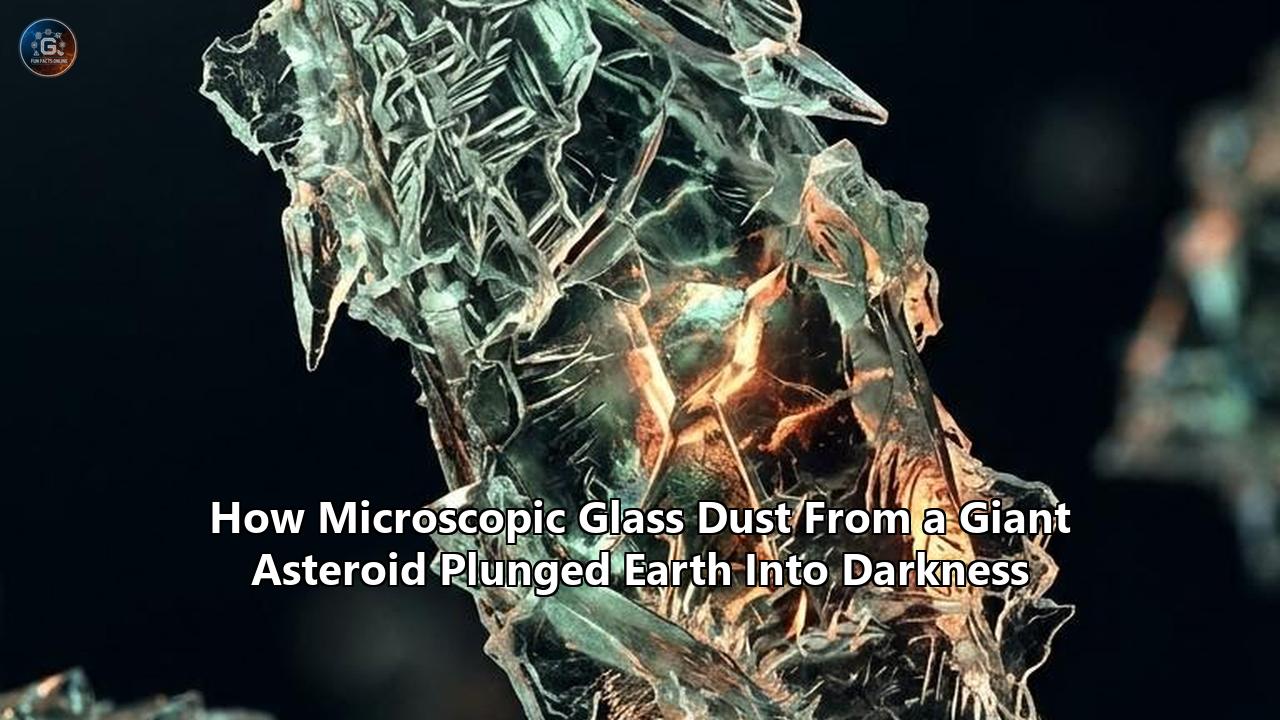
A series of high-resolution sediment analyses and paleoclimate simulations led by researchers at the Royal Observatory of Belgium (ROB) and Vrije Universiteit Brussel solved this fundamental puzzle. By subjecting North Dakota sediment samples to advanced laser-diffraction grain-size analysis, scientists uncovered vast quantities of sub-micrometer silicate dust—microscopic glass and shattered granite derived from deep within Earth's target rock.
When plugged into Earth system models, the findings revealed that these invisible, glass-like grains were the true orchestrators of global collapse. Suspended in the upper atmosphere, this microscopic shroud shut down global photosynthesis within two weeks, held the planet in near-total blackout for almost two years, and lingered in the sky for a decade and a half.
The precise sequence of how asteroid dust earth darkness unfolded across the Cretaceous globe was long shielded by missing geological data, but the evidence trail recovered from ancient mud layers now provides an unfiltered look at the mechanics of planetary extinction.
THE CHICXULUB ATMOSPHERIC PROFILE
================================================================================
Altitude
 (km)
100 +------------------------------------------------------------------+
    |  MICRO-SILICATE DUST PLUME (Residence: ~15 Years)                |
 80 |  - Fine glass & pulverized granite (0.8–8.0 µm)                  |
    |  - Trapped solar radiation, caused global darkness & cooling     |
 60 +------------------------------------------------------------------+
    |  SULFUR AEROSOLS (Residence: ~8–9 Years)                         |
 40 |  - Derived from vaporized anhydrite/gypsum targets                |
    +------------------------------------------------------------------+
 20 |  WILDFIRE SOOT LAYER (Residence: ~5–8 Years)                     |
    |  - Black carbon from continental firestorms                      |
  0 +------------------------------------------------------------------+
    |//////////////////// EARTH SURFACE (Temp drop: -15°C) /////////////
================================================================================
The Crime Scene in the Badlands
The investigation that exposed the true role of microscopic glass dust began not in space, but in the fossilized riverbanks of North Dakota. The Tanis deposit represents a unique geological event: a freshwater estuary that was struck by seismic surge waves minutes to hours after the impact in Mexico, trapping plants, fish, and dinosaur remains in a rapidly deposited cocktail of mud and impact debris.
Geologist Pim Kaskes and his colleagues at Vrije Universiteit Brussel targeted a specific, millimeter-thick band within the deposit. Previous studies had treated this ejected layer as a homogeneous mass of soot and coarse mineral fragments. However, Kaskes' team utilized laser-diffraction particle analysis, a technique that passes laser beams through liquid-suspended sediments to measure particle dimensions down to the nanometer scale.
What they discovered challenged decades of climate assumptions.
Mixed among larger impact spherules—glassy droplets formed when molten rock cooled in flight—were billions of ultra-fine silicate particles measuring between 0.8 and 8.0 micrometers in diameter. For scale, a human hair is roughly 70 micrometers thick. These grains were fine enough to remain suspended in air indefinitely under normal atmospheric conditions.
"Previous climate models assumed that silicate dust thrown up by the asteroid was relatively coarse, meaning it would fall out of the atmosphere within days or weeks," said Dr. Cem Berk Senel, a planetary scientist at the Royal Observatory of Belgium and lead author of the study. "Because of that assumption, dust was largely dismissed as a minor contributor to the long-term impact winter. But when we analyzed the actual particle sizes from the rock record, we realized the dust was far finer than anyone had accounted for. That single detail changed everything."
GRAIN-SIZE DISTRIBUTION IN IMPACT EJECTA
================================================================================
Particle Type        Size Range (µm)    Atmospheric Residence   Primary Effect
--------------------------------------------------------------------------------
Coarse Spherules     > 100 µm           Hours to Days          Thermal re-entry heat
Sulfur Droplets      0.1 - 1.0 µm       8 - 9 Years            Acid rain, solar reflectance
Wildfire Soot        0.05 - 0.5 µm      5 - 8 Years            Light absorption
Silicate Glass Dust  0.8 - 8.0 µm       Up to 15 Years         Photosynthesis shutdown,
                                                               persistent darkness
================================================================================
Retracing the Atmospheric Debate: Sulfur vs. Soot vs. Silicates
To understand why this microscopic measurement proved so explosive, one must look at the history of impact geology.
When Luis and Walter Alvarez first proposed the impact hypothesis in 1980, they pointed to elevated levels of iridium—an element abundant in asteroids but rare in Earth's crust—found in global clay layers. They hypothesized that a giant dust cloud created a prolonged darkness that starved the biosphere.
However, as computer modeling matured in the 1990s and 2000s, atmospheric physicists encountered a problem. Coarse dust particles settle out of the stratosphere quickly due to gravity. If the asteroid only kicked up coarse rock fragments, the sky would have cleared in a matter of months—not long enough to drive a planetary-scale biological crash.
To explain the mass extinction, researchers shifted their focus to two other candidates:
- Sulfur Dioxide Gas: The Chicxulub asteroid struck a shallow marine basin rich in gypsum and anhydrite rocks. The impact vaporized these sulfur-rich targets, releasing an estimated 320 gigatons of sulfur gas into the stratosphere, where it condensed into sulfate aerosols that reflected incoming sunlight.
- Wildfire Soot: The initial heat pulse ignited global forest fires, burning millions of acres of vegetation and pumping up to 15 gigatons of fine black carbon soot into the skies.
For nearly twenty years, the scientific consensus favored sulfur and soot as the primary drivers of the "impact winter". Fine rock dust was treated as an afterthought.
The ROB team’s laser-diffraction measurements dismantled that consensus. The sediment layers proved that the asteroid had pulverized the underlying continental basement rock—granite and gneiss rich in quartz and feldspar—into a fine silicate flour.
By feeding these refined grain dimensions into advanced earth system models, scientists illuminated how asteroid dust earth darkness actually operated on a planetary scale. The fine glass dust was not merely a side effect; it was the dominant atmospheric driver.
The Physics of Shadow: How 2,000 Gigatons of Glass Blanket the Earth
When the 12-kilometer asteroid struck Earth at an angle of roughly 45 to 60 degrees, it did not simply punch a hole in the ground. It instantly vaporized itself and an estimated 200,000 cubic kilometers of crustal rock.
A high-temperature plasma plume blasted upward at speeds exceeding 10 kilometers per second, shooting well beyond the atmosphere into low-Earth orbit. As this superheated plume cooled, vaporized minerals condensed into microscopic droplets of liquid rock. These quenched in flight, solidifying into tiny silicate glass spheres and fine, jagged mineral grains.
ASTEROID IMPACT & DUST TRANSPORT TIMELINE
================================================================================
Time After Impact  Physical Event
--------------------------------------------------------------------------------
T + 0 Seconds      12 km asteroid strikes Yucatan at 20 km/s.
T + 5 Minutes      Vaporization plume expands into low-Earth orbit.
T + 2 Hours        Re-entry of thermal spherules superheats lower atmosphere.
T + 14 Days        Silicate dust veil encircles the entire globe.
T + 20 Days        Photosynthetically Active Radiation drops to < 1% of normal.
T + 620 Days       Photosynthesis remains entirely halted worldwide.
T + 15 Years       Silicate dust slowly settles; sky transparency restores.
T + 20 Years       Global surface temperatures recover to pre-impact levels.
================================================================================
The mass of this fine silicate dust was staggering. The researchers calculated that roughly 2,000 gigatons—2 trillion metric tons—of micrometric silicate dust were injected into the stratosphere and mesosphere.
"The sheer speed of global dispersal was breathtaking," explained Dr. Philippe Claeys, a planetary scientist at Vrije Universiteit Brussel and co-author of the research. "Atmospheric circulation patterns spread this fine particulate cloud across both hemispheres in a matter of days. Within two weeks, the entire globe was enveloped in a high-altitude dust blanket that completely obscured the Sun."
GLOBAL SOLAR RADIATION ABSORPTION POST-IMPACT
================================================================================
Radiation Level (%)
100% |=================================================== Pre-Impact Sunlight
 80% |
 60% |
 40% |
 20% |
  0% +----+----+----+----+----+----+----+----+----+----+----+
     T=0  2W   1M   6M   1Y  620D  3Y   5Y   10Y  15Y  20Y
     [Photosynthesis Threshold: ~1% Solar Flux Required]
     - Days 14 to 620: Solar flux remains BELOW 1% (Complete Darkness)
================================================================================
The optical depth of the atmosphere surged. Light levels at Earth’s surface plummeted by more than 99.9%. To an observer on the ground, the sun was not merely dimmed; it was deleted. The mid-day sky became darker than a full-moon night.
Thermal Inferno to Deep Freeze: The Two-Phase Shock
Recent work by planetary scientists Brandon Johnson and Alexandria Johnson at Purdue University added another crucial piece to this atmospheric puzzle. Their research demonstrated that before the world plunged into enduring darkness and cold, it suffered a brief, searing heat pulse.
As the heavier impact debris fell back into Earth’s atmosphere from space, millions of molten spherules frictionally heated the upper air like trillions of tiny meteors.
"For the first few hours after impact, the upper atmosphere was superheated to hundreds of degrees," noted Brandon Johnson. "This created an intense pulse of thermal infrared radiation that reached the ground. It was like turning an overhead broiler on for the entire planet. Anything on the surface that couldn't seek shelter—underground, in deep water, or inside caves—was subjected to extreme heat stress."
THE TWO-PHASE ATMOSPHERIC CATASTROPHE
================================================================================
PHASE 1: THE THERMAL PULSE (First 2 to 24 Hours)
--------------------------------------------------------------------------------
- Atmospheric Friction: Ejecta re-entering atmosphere generates intense IR heat.
- Surface Temperatures: Spike dramatically; ignites global forest fires.
- Direct Victims: Exposed surface organisms, canopy plants, large animals.

PHASE 2: THE GLASS-DUST BLACKOUT (Weeks to 15 Years)
--------------------------------------------------------------------------------
- Solar Blockade: 2,000 gigatons of 0.8–8.0 µm silicate dust seals atmosphere.
- Photosynthesis Collapse: Sunlight drops below critical 1% threshold for 620 days.
- Thermal Plunge: Surface temperatures drop by 15°C (27°F); impact winter begins.
================================================================================
This thermal flash ignited widespread wildfires, generating black carbon soot. But as the re-entry flash subsided, the finer, sub-micrometer glass dust suspended high in the stratosphere took over the climate system.
Instead of allowing the planet to cool back down to its normal tropical Cretaceous baseline, the combination of soot, sulfur, and fine silicate dust formed an impenetrable shield that blocked incoming solar heat.
Earth's average surface temperature dropped by roughly 15 degrees Celsius (27 degrees Fahrenheit). Tropical paradise regions became temperate zones, while temperate regions plunged into sub-freezing conditions. The planet entered a sustained impact winter.
The 620-Day Silent Cataclysm: Shutdown of Photosynthesis
While the cold was devastating, the paleoclimate simulations revealed that the absolute "kill mechanism" was the complete loss of solar energy needed to drive photosynthesis.
Plants and photosynthetic microbes require a minimum amount of light—known as Photosynthetically Active Radiation (PAR)—to convert carbon dioxide and water into sugars. When PAR drops below roughly 1% of normal daylight, photosynthesis halts entirely.
ATMOSPHERIC RESIDENCE AND RECOVERY PROFILE
================================================================================
Component          Peak Mass      Atmospheric Half-Life   Photosynthetic Impact
--------------------------------------------------------------------------------
Sulfur Aerosols    ~320 Gigatons  8 - 9 Years             Moderate regional reduction
Wildfire Soot      ~15 Gigatons   5 - 8 Years             Acute early darkening
Silicate Glass Dust ~2,000 Gigatons 15 Years              Complete global shutdown
                                                          (620 Days Total Zero)
================================================================================
The ROB climate simulations produced a stark timeline:
- Day 1 to 14: Sunlight levels collapse across the globe.
- Day 14: Global PAR drops below the 1% critical threshold. Photosynthesis stops completely across all landmasses and oceans.
- Day 14 to Day 620: For almost two full years (620 days), global photosynthesis remains at zero. No plant on land, no kelp in shallow seas, and no phytoplankton in the open ocean can generate new organic carbon.
- Year 2 to Year 4: Sunlight slowly returns above the critical threshold, but primary productivity remains severely depressed.
- Year 15: Silicate dust finally clears completely from the atmosphere via slow atmospheric settling and precipitation scavenging.
The cascade of ecological destruction triggered by asteroid dust earth darkness left no biome untouched.
TROPHIC CASCADE OF THE CRETACEOUS EXTINCTION
================================================================================
[GLASS DUST SKY SHROUD]
       |
       v  (Blocks >99.9% Solar Light)
[PHOTOSYNTHESIS SHUTDOWN (620 Days)]
       |
       +-----------------------------------+
       |                                   |
       v                                   v
[OCEANIC CRASH]                     [TERRESTRIAL CRASH]
Phytoplankton die in days.           Plants & ferns wither.
       |                                   |
Zooplankton starve.                  Herbivorous dinos starve
       |                                   | (Triceratops, Edmontosaurus)
Ammonites & marine reptiles perish   Carnivorous dinos perish
(Mosasaurus, Plesiosaurs).           (Tyrannosaurus rex).
================================================================================
The Ocean Collapse
In the oceans, microscopic phytoplankton—the base of the marine food web—have life cycles measured in days or weeks. Without sunlight, plankton populations collapsed almost overnight. Microscopic shell-building organisms like coccolithophores and planktonic foraminifera died by the trillions.
Ammonites—coiled mollusks that fed on plankton—starved rapidly. Apex predators like mosasaurs and giant plesiosaurs, deprived of their prey chains, followed within months.
The Land Collapse
On land, green foliage withered in total darkness. Massive herbivorous dinosaurs like Triceratops, Edmontosaurus, and Ankylosaurus required hundreds of pounds of fresh vegetation daily. As forests transformed into decaying graveyards, herbivores starved.
Apex predators like Tyrannosaurus rex scavenged on the mounting piles of carcasses, but as those food supplies decomposed or ran out, the carnivores perished as well.
"It was a war of attrition," said Dr. Steve Brusatte, a paleontologist at the University of Edinburgh who was not directly involved in the study but reviewed its findings. "The asteroid didn't hunt down every dinosaur in a single afternoon. It pulled the plug on the power supply of the entire planet. Once you cut off photosynthesis for two years, the biological machinery of Earth simply breaks down."
The Physics of Suspension: Why Glass Dust Outlasted Sulfur
A crucial question remained for the research team: Why did fine silicate dust remain in the atmosphere so much longer than sulfur aerosols or soot?
The answer lies in the physics of particle dynamics within the stratosphere.
Sulfur dioxide gas reacts with water vapor in the atmosphere to form liquid sulfuric acid droplets. Over time, these droplets collide, coalesce into larger drops, and fall out as acid rain. The typical atmospheric residence time for sulfur aerosols is roughly 8 to 9 years.
Wildfire soot consists of porous, carbon-based aggregates. While effective at absorbing light, soot particles are prone to chemical degradation by ozone and rain-scavenging in the upper troposphere, limiting their lifespan to roughly 5 to 8 years.
Silicate dust, by contrast, is chemically inert, solid, and extremely durable. When rock is pulverized into the 0.8 to 8.0-micrometer range, the particles are small enough that gravity exerts negligible downward force relative to high-altitude convective currents. They act almost like gas molecules, buoyed by stratospheric winds.
ATMOSPHERIC RESIDENCE OF EXTINCTION DRIVERS
================================================================================
Material Type           Atmospheric Residence Time   Primary Clearing Mechanism
--------------------------------------------------------------------------------
Sulfur Aerosols         8 to 9 Years                Acid precipitation
Wildfire Soot           5 to 8 Years                Tropospheric rain-scavenging
Silicate Glass Dust     Up to 15 Years              Gravitational settling & coagulation
================================================================================
"Silicate dust is essentially finely powdered glass and granite," explained Dr. Özgür Karatekin, a planetary scientist at the Royal Observatory of Belgium. "It doesn't dissolve, it doesn't break down chemically, and it doesn't easily cluster into heavier clumps at high altitudes. Our models show that while sulfur cleared out within a decade, fine silicate dust remained suspended for up to 15 years. The total recovery of pre-impact surface temperatures took more than 20 years."
Anatomy of Survival: Who Made It Through and Why?
If the world was wrapped in total darkness for two years and subjected to a 15-year cold snap, how did anything survive?
The survival pattern across the K-Pg boundary provides striking independent confirmation of the glass-dust model.
SURVIVAL STRATEGIES AT THE K-Pg BOUNDARY
================================================================================
SURVIVING GROUPS                   NON-SURVIVING GROUPS
--------------------------------------------------------------------------------
Small Burrowing Mammals            Non-Avian Dinosaurs (Large Body Size)
- Fed on seeds, roots, insects     - High caloric demand, live plant dependency

Avian Dinosaurs (Early Birds)      Pterosaurs (Flying Reptiles)
- Beaked species eating seeds      - Dependent on active marine/land prey

Crocodilians & Turtles             Giant Marine Reptiles (Mosasaurus)
- Low metabolic rate, detritus     - High metabolic rate, apex ocean prey

Freshwater Organisms               Planktonic Ocean Species
- Aquatic detritus food chains     - Direct light dependency for food web
================================================================================
1. The Seed Eaters
While green plants withered, their seeds remained viable in the frozen soil. Small, feathered avian dinosaurs—the ancestors of modern birds—possessed toothless beaks uniquely adapted for cracking hard seeds. They could forage through the dark, frozen forest floor for buried seed caches long after live leaves disappeared. Toothless birds survived; toothed birds perished.
2. The Detritus Feeders
Organisms in freshwater rivers and lakes fared significantly better than those in the open ocean. Freshwater ecosystems rely heavily on detritus—dead organic matter washing into the water from riverbanks. Fungi, bacteria, aquatic insects, and detritus-eating fish could feed on rotting material for years without sunlight.
3. The Low-Metabolism Burrowers
Ectothermic reptiles like crocodilians, freshwater turtles, and snakes possessed low metabolic rates. They could survive months without food by entering torpor state, huddled in muddy burrows or beneath riverbed sediments where temperatures remained insulated from the freezing atmospheric air.
4. Early Mammals
Cretaceous mammals were small, shrew-like creatures that spent much of their lives underground or in hollow logs. They were omnivorous or insectivorous, feeding on worms, grubs, and rotting plant matter. Their small body size required far fewer total calories than a 10-ton dinosaur, and their burrowing habits protected them from both the initial heat flash and the freezing winds that followed.
Modern Planetary Defense: Lessons from Ancient Glass Dust
Understanding the mechanics of asteroid dust earth darkness has profound implications beyond ancient history, offering key parameters for modern impact hazard modeling.
Organizations like NASA and the European Space Agency (ESA) routinely track Near-Earth Objects (NEOs). While kilometer-scale asteroid impacts occur only once every tens or hundreds of millions of years, smaller impacts—objects between 100 meters and 1 kilometer wide—occur on far shorter timescales.
IMPACT SCALES AND CLIMATIC IMPLICATIONS
================================================================================
Asteroid Size    Impact Frequency     Expected Atmospheric Consequence
--------------------------------------------------------------------------------
10 to 15 km      ~100 Million Years   Global 15-year dust veil, 620-day darkness,
                                      mass extinction.
1 km             ~500,000 Years       Regional darkness, global agricultural
                                      disruption, multi-year cold snap.
100 meters       ~10,000 Years        Localized devastation, regional dust plume,
                                      no global extinction threat.
================================================================================
"The Chicxulub study shows us that when evaluating the hazard of an asteroid strike, we cannot look only at the physical impact crater or kinetic blast," said Dr. Karatekin. "We have to look at the geology of the target site and the fine-grained particle production. An asteroid striking granite-rich target rock will throw up vast amounts of microscopic silicate dust, creating disproportionately severe global atmospheric consequences compared to an impact in ocean sediment."
The data gathered from the Tanis sediment layers and the Royal Observatory of Belgium models are currently being incorporated into modern impact mitigation scenarios. By measuring how micro-scale glass dust behaves at upper-atmospheric altitudes, scientists can better predict the climate impact of medium-scale space rock strikes and refine nuclear winter models.
What Comes Next on the Scientific Frontier
While the glass-dust model has resolved long-standing questions, planetary scientists and geologists are actively expanding their investigations.
FUTURE RESEARCH FRONTIERS
================================================================================
Target Area             Objective
--------------------------------------------------------------------------------
ICDP Peak Ring Cores    Analyze deep target rocks from Chicxulub crater to measure
                        the exact proportion of glass vs. crystalline silicates.
Global K-Pg Mapping     Sample ejecta sites in Europe, Asia, and New Zealand to verify
                        global uniformity of 0.8–8.0 µm dust distribution.
High-Altitude Models    Refine modern stratospheric wind simulations to improve
                        nuclear winter and impact hazard forecasts.
================================================================================
Researchers are preparing new drill-core campaigns targeting the peak ring of the Chicxulub crater under the International Continental Scientific Drilling Program (ICDP). By analyzing the melt rocks trapped deep within the crater, geologists hope to measure the exact ratio of vaporized quartz to molten target granite produced in the opening seconds of the impact.
Concurrently, research teams are deploying high-resolution grain-size analysis to K-Pg sediment sites in Europe, New Zealand, and Japan to confirm that the 0.8 to 8.0-micrometer silicate dust fraction recorded in North Dakota is distributed uniformly around the globe.
Sixty-six million years after an invisible veil of microscopic glass dust snuffed out the Cretaceous world, modern analytical science has finally laid bare the step-by-step evidence trail. The dinosaurs did not perish in a single blast, but under an opaque sky that refused to let the light back in.
Reference:
- https://www.livescience.com/planet-earth/dust-from-the-dino-killing-impact-ushered-in-years-of-global-darkness
- https://www.chinadailyhk.com/hk/article/358891
- https://ig.utexas.edu/news/2021/asteroid-dust-found-in-crater-closes-case-of-dinosaur-extinction/
- https://www.sci.news/paleontology/chicxulub-asteroid-impact-heat-wildfires-14957.html
- https://www.sci.news/paleontology/chicxulub-asteroid-dust-12406.html
- https://www.astro.oma.be/en/dust-played-a-major-role-in-dinosaur-demise/
- https://www.discovermagazine.com/did-a-dust-plume-kill-the-dinosaurs-45708
- https://www.smithsonianmag.com/smart-news/dust-may-have-triggered-the-global-winter-that-killed-the-dinosaurs-180983165/
- https://www.purdue.edu/newsroom/2026/Q3/dinosaur-killing-asteroid-also-created-a-dust-cloud-that-insulated-earth-charbroiling-cretaceous-creatures/
- https://www.curtin.edu.au/news/media-release/cosmic-glass-found-only-in-australia-reveals-ancient-asteroid-impact/