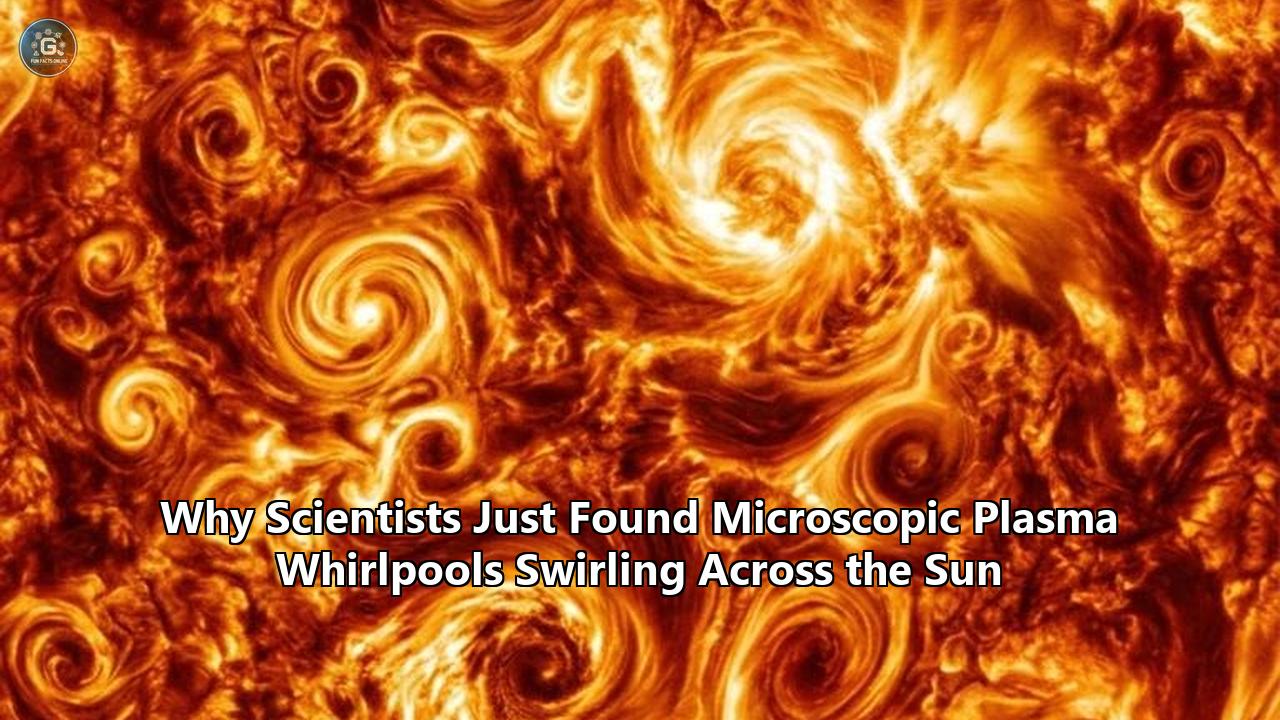
On August 5, 2026, an international research team published findings in Nature revealing the discovery of microscopic plasma whirlpools swirling across the visible surface of the Sun. Captured by the U.S. National Science Foundation’s Daniel K. Inouye Solar Telescope (DKIST) on Maui, Hawaii, these tiny, high-energy vortices measure as small as 19 to 20 kilometers across. Resolving structures of this scale on the solar disk—located roughly 148 million kilometers from Earth—is equivalent to detecting a single euro coin from a distance of 180 kilometers.
Led by scientists from the NSF National Solar Observatory (NSO), Germany’s Max Planck Institute for Solar System Research (MPS), and the High Altitude Observatory (HAO), the study delivers the first direct observational proof of widespread Kelvin-Helmholtz instabilities (KHI) occurring in the solar photosphere.
The discovery addresses long-standing questions in solar astrophysics. For decades, theoretical models predicted that small-scale velocity shear at the boundaries of solar convective cells should form wave-like spiraling vortices. Yet, solar observatories lacked the spatial resolution and temporal frame rates required to observe them directly.
By merging high-speed, 416-nanometer blue-continuum optical imaging with 3D magnetohydrodynamic (MHD) supercomputer simulations, researchers confirmed that these micro-vortices act as microscopic mechanical engines. They continuously twist and tangle solar magnetic field lines, driving magnetic energy transport, accelerating magnetic flux diffusion, and offering a concrete physical mechanism for how energy flows from the cool solar surface into the multi-million-degree outer atmosphere.
  +-------------------------------------------------------------------+
  |               SOLAR PHOTOSPHERE: GRANULATION MATRIX               |
  |                                                                   |
  |   +--------------------+               +--------------------+     |
  |   |   SOLAR GRANULE    |               |   SOLAR GRANULE    |     |
  |   | (Hot Upwelling)    |               | (Hot Upwelling)    |     |
  |   | Velocity: ~2-4 km/s|               | Velocity: ~2-4 km/s|     |
  |   +---------+----------+               +----------+---------+     |
  |             |                                     |               |
  |             v                                     v               |
  |     =======================================================       |
  |     INTERGRANULAR LANE / MAGNETIC ELEMENT INTERFACE       |       |
  |                                                                   |
  |     Plasma Shear Boundary:  V_upwell  !=  V_lane (Stationary) |       |
  |     -------------------------------------------------------       |
  |                                                                   |
  |     --->  Kelvin-Helmholtz Instability Triggered  <---            |
  |                                                                   |
  |           🌀 20 km Plasma Whirlpool Formed 🌀                      |
  |           - Shear-induced spiraling vortex                        |
  |           - Mechanical twisting of magnetic flux lines            |
  |           - Excitation of small-scale torsional waves             |
  |                                                                   |
  +-------------------------------------------------------------------+
Observational Paradigms: Ground-Based Optical Giants vs. Spaceborne Instruments
Detecting these micro-scale vortices highlights a fundamental divide in observational astronomy: the trade-offs between ground-based optical telescopes and spaceborne solar observatories.
The Ground-Based Heavyweight: Inouye Solar Telescope (DKIST)
The 4-meter primary mirror of DKIST, situated atop the Haleakalā volcano in Maui, represents a major leap in solar optical engineering. Gathering light across a 4-meter aperture allows DKIST to achieve a theoretical diffraction limit of roughly 0.015 arcseconds in the visible spectrum, corresponding to spatial features on the Sun as small as 18 to 20 kilometers.
To achieve this, DKIST relies on an adaptive optics system featuring a deformable mirror controlled by high-speed actuators. This system measures and corrects for atmospheric turbulence hundreds of times per second, effectively countering the optical degradation caused by Earth's atmosphere.
Equipped with high-speed cameras operating at up to 740 frames per second, DKIST captured 47 individual micro-vortices during a single observing run on April 14, 2025, tracking their movement across intergranular lanes near a magnetized sunspot.
- Key Advantage: Aperture scale. Spaceborne telescopes cannot currently transport a 4-meter primary mirror or its cooling infrastructure into orbit.
- Key Limitation: Atmospheric interference windows. Even with advanced adaptive optics, ground observatories face variable seeing conditions, thermal turbulence generated by solar heating of the observatory dome, and daylight operational constraints.
Spaceborne Platforms: SDO, Solar Orbiter, and Parker Solar Probe
Spaceborne instruments operate under very different physical constraints. NASA’s Solar Dynamics Observatory (SDO), positioned in a geostationary orbit, provides continuous, uninterrupted coverage of the solar disk across multiple extreme ultraviolet (EUV) wavelengths. However, SDO’s primary instruments, such as the Atmospheric Imaging Assembly (AIA) and the Helioseismic and Magnetic Imager (HMI), possess apertures of approximately 20 centimeters. This limits SDO's spatial resolution to roughly 350 to 1,000 kilometers per pixel. While SDO excels at monitoring global active regions and coronal mass ejections (CMEs), 20-kilometer structures remain undetectable within its pixels.
ESA and NASA’s Solar Orbiter approaches the Sun as close as 0.28 astronomical units (AU). Operating closer to the target improves its effective spatial resolution, allowing instruments like the Extreme Ultraviolet Imager (EUI) to resolve coronal structures down to ~150 kilometers. Even so, payload size and weight limits prevent Solar Orbiter from carrying primary mirrors large enough to resolve sub-50-kilometer photospheric features.
NASA’s Parker Solar Probe takes a direct approach by flying through the outer coronal atmosphere, measuring local magnetic fields, electric fields, and plasma density in situ. While Parker provides precise temporal measurement of particle distribution functions and magnetic switchbacks, it lacks direct imaging capabilities for the solar surface, leaving it blind to the optical geometry of photospheric fluid motion.
+-------------------------------------------------------------------------------------------+
|                          OBSERVATIONAL TRADEOFF COMPARISON                                |
+------------------------+-------------------------------+----------------------------------+
| PARAMETER              | DKIST (Ground-Based Giant)    | SDO / SOLAR ORBITER (Spaceborne) |
+------------------------+-------------------------------+----------------------------------+
| Primary Aperture       | 4.0 meters                    | 0.10 to 0.20 meters              |
| Spatial Resolution     | ~19–20 kilometers             | ~150–1,000 kilometers            |
| Primary Wavelengths    | Visible (416 nm) to Near-IR   | Extreme Ultraviolet (EUV), X-ray |
| Temporal Coverage      | Intermittent (Seeing dependent)| 24/7 Continuous Monitoring       |
| Atmospheric Distortion | Corrected via Adaptive Optics | Zero (Space Vacuum Environment)  |
| Primary Physics Domain | Sub-resolution fluid shear    | Global topology, CME origin      |
+------------------------+-------------------------------+----------------------------------+
Without DKIST’s 4-meter optical aperture, the existence of direct plasma whirlpools on sun surfaces would have remained a purely theoretical concept, hidden within sub-pixel averaging on spaceborne instruments.
Physical Dynamics: Fluid Velocity Shear vs. Magnetic Field Lines
The physical mechanism behind these microscopic vortices centers on fluid shear at the boundary of solar convection cells.
       CONVECTIVE UPWELLING                  STATIONARY MAGNETIC FLUX TUBE
    (Hot, Unmagnetized Plasma)                 (Strongly Magnetized Region)
      Velocity: 2.0 to 4.0 km/s                   Velocity: Near Zero
                |                                         |
                |                                         |
                v                                         v
   +------------------------+                 +------------------------+
   |                        |                 |                        |
   |                        |                 |                        |
   +------------------------+                 +------------------------+
                            \                 /
                             \               /
                              v             v
                    +-------------------------------+
                    |  KELVIN-HELMHOLTZ INTERFACE   |
                    |                               |
                    |  - Velocity Shear Delta       |
                    |  - Shear Instability Growth   |
                    |  - Spiraling Vortex Roll-Up   |
                    |  - Instability Wavelength:    |
                    |    50 to 65 km                |
                    +-------------------------------+
The solar photosphere is characterized by thermal convection. Hot plasma rises from the solar interior within bright convective cells called granules, which span between 500 and 2,000 kilometers in diameter. As the plasma cools at the surface, it flows laterally toward the dark intergranular lanes before sinking back into the interior.
When these horizontal plasma streams encounter strong concentrations of magnetic flux—such as magnetic elements surrounding sunspots—a velocity shear interface forms. The unmagnetized plasma moves horizontally at velocities between 2.0 and 4.0 kilometers per second, while the adjacent magnetized plasma remains anchored by strong magnetic fields.
This velocity mismatch across the fluid boundary initiates the Kelvin-Helmholtz instability. As the faster-moving plasma slides past the stationary or slower-moving magnetized plasma, small perturbations along the interface grow exponentially. The fluid shear rolls the boundary layer into spiraling wave patterns, forming localized vortices.
The DKIST observations revealed that these vortices typically exhibit diameters between 25 and 170 kilometers, with an average spacing (instability wavelength) of 50 to 65 kilometers. The vortices drift horizontally along intergranular boundaries at speeds ranging from 0.67 to 3.0 kilometers per second.
      FIELD LINE UNTWISTED                     FIELD LINE TWISTED BY VORTEX
           (Low Energy)                              (High Stored Energy)

                |                                           S  S
                |                                          S    S
                |                                         S      S
                |                                          S    S
                |                                           S  S
                |                                            S
                |                                           S  S
                |                                          S    S
                |                                         S      S
                |                                          S    S
                |                                           S  S
                v                                           v
    [No Stressed Magnetic Field]               [High Magnetic Torsion / Tension]
These swirling flows alter the local magnetic geometry. In a high-beta plasma environment like the lower photosphere—where kinetic gas pressure dominates over magnetic pressure—the fluid motion forces magnetic field lines to follow the plasma flow.
As a vortex spins, it drags anchored magnetic field lines with it, twisting them into tight helical configurations. This mechanical twisting acts like coiling a rubber band: it continuously stores magnetic tension and builds up free magnetic energy.
Theoretical Models: Reconnection vs. Wave-Driven Energy Transport
The discovery of photospheric Kelvin-Helmholtz vortices directly impacts a long-standing debate in astrophysics: how the Sun transfers energy from its 5,500°C surface into the outer atmosphere (the corona), where temperatures climb above 1,000,000°C.
Two primary theories have sought to explain this heating process.
+-------------------------------------------------------------------------------------------+
|                          ENERGY TRANSPORT THEORY COMPARISON                               |
+------------------------+-------------------------------+----------------------------------+
| ATTRIBUTE              | MAGNETIC RECONNECTION MODEL   | WAVE-DRIVEN / VORTEX MODEL       |
+------------------------+-------------------------------+----------------------------------+
| Primary Mechanism      | Magnetic field line snapping  | Shear-induced fluid twisting     |
| Energy Release Mode    | Explosive intermittent bursts | Continuous kinetic conversion    |
| Required Trigger       | Anti-parallel field alignment | Velocity shear across boundaries |
| Spatial Scale          | Micro to macroscopic loops    | Microscopic (10–50 kilometers)   |
| Primary Wave Output    | Thermal heat, energetic ions  | Torsional Alfvén waves           |
| Primary Location       | Upper Chromosphere & Corona   | Photosphere into Lower Corona    |
+------------------------+-------------------------------+----------------------------------+
1. The Magnetic Reconnection (Nanoflare) Paradigm
Formulated by Eugene Parker in 1988, the nanoflare model posits that convective motions slowly shuffle the footpoints of magnetic loops on the solar surface. Over time, these field lines become tangled in the upper atmosphere.
When adjacent magnetic fields of opposing polarity are forced together, they undergo rapid magnetic reconnection. The magnetic field lines snap and realign, releasing stored magnetic energy into thermal heat and kinetic acceleration in localized micro-bursts called nanoflares.
- Strengths: Explains the high temperatures observed in impulsive flare events and coronal loops.
- Historical Weakness: Classic models assumed footpoint shuffling occurred over broad, smooth convective scales (hundreds of kilometers). They lacked a clear mechanism to explain how magnetic stress could accumulate rapidly enough on sub-second timescales to sustain continuous, background coronal heating.
2. The Wave-Driven & Vortex Instability Paradigm
The wave heating model proposes that fluid turbulence at the solar surface continuously generates magnetohydrodynamic waves—specifically Alfvén waves—that propagate upward along magnetic field lines into the chromosphere and corona. As these waves travel into lower-density regions, they dissipate their energy through turbulent cascade, heating the surrounding plasma.
- Strengths: Provides a continuous source of background heating throughout quiet solar regions.
- Historical Weakness: Standard acoustic or transverse kink waves reflect back toward the photosphere due to steep density gradients in the solar transition region, preventing sufficient energy from reaching the upper corona.
       +----------------------------------------------------------------+
       |               SYNTHESIZED DUAL-PARADIGM ENGINE                 |
       +----------------------------------------------------------------+
       |                                                                |
       |  1. Granular Velocity Shear (KHI Hydro-Instability)            |
       |     |                                                          |
       |     v                                                          |
       |  2. Microscopic Plasma Whirlpool (~20 km Vortex)                 |
       |     |                                                          |
       |     v                                                          |
       |  3. Mechanical Twisting of Photospheric Magnetic Lines          |
       |     |                                                          |
       |     +-----------------------------------+                      |
       |     |                                   |                      |
       |     v                                   v                      |
       |  4A. Excitation of Torsional       4B. Rapid Coiling & Local  |
       |      Alfvén Waves (Pumping           Micro-Reconnection        |
       |      Energy Upward)                  (Photospheric Nanoflares) |
       |     |                                   |                      |
       |     +-----------------------------------+                      |
       |     |                                                          |
       |     v                                                          |
       |  5. Continuous Sustained Heating of Chromosphere & Corona      |
       |                                                                |
       +----------------------------------------------------------------+
The direct observation of plasma whirlpools on sun surfaces bridges these competing theories. The observational data shows that the Kelvin-Helmholtz instability converts kinetic fluid energy directly into magnetic tension on sub-50-kilometer scales.
As these 20-kilometer vortices spin, they generate localized torsional Alfvén waves—magnetic twisting waves that propagate upward along field lines with minimal reflection. At the same time, the dense packing of these spinning vortices forces adjacent mini-flux tubes to twist against each other, driving localized micro-reconnection (photospheric nanoflares).
Rather than acting as separate mechanisms, fluid shear, torsional wave excitation, and magnetic reconnection operate as a single continuous energy transport chain.
Empirics vs. Models: DKIST Optical Data vs. 3D MHD Simulations
A key aspect of the August 2026 discovery was the tight agreement between empirical optical observations and numerical magnetohydrodynamic (MHD) simulations.
  EMPIRICAL DKIST OBSERVATION                    3D MURaM SUPERCOMPUTER MODEL
(FastCam 416 nm Optical Photons)               (Multi-Billion-Cell MHD Grid)

    +-----------------------+                      +-----------------------+
    | Real Solar Surface    |                      | Ideal/Resistive MHD   |
    | Photospheric Physics  |                      | Fluid Equations       |
    +-----------+-----------+                      +-----------+-----------+
                |                                              |
                |   Instability Wavelength: 50–65 km           |
                |   Vortex Sizes: 25–170 km (Fringes ~20 km)   |
                |   Drift Speeds: 0.67–3.0 km/s                |
                v                                              v
    +----------------------------------------------------------------------+
    |             CROSS-VALIDATED PHOTOSPHERIC PLASMA PHYSICS               |
    +----------------------------------------------------------------------+
Empirical Observations via DKIST
Using the FastCam instrument operating at 416 nanometers (a wavelength in the blue spectral continuum sensitive to photospheric brightness variations), the team analyzed temporal sequences of active regions near sunspots.
- Target Region: Active region near sunspots, recorded on April 14, 2025.
- Resolved Features: Fringed structures and dark striations along granule boundaries measuring down to 19–20 kilometers.
- Vortex Statistics: 47 distinct vortices analyzed. Measured diameters ranged from 25 to 170 kilometers, with horizontal velocities between 0.67 and 3.0 kilometers per second.
- Instability Wavelength: Spacing between adjacent vortex curls measured between 50 and 65 kilometers.
3D Magnetohydrodynamic (MHD) Simulations
To verify whether these fringed striations were true physical plasma vortices or optical artifacts caused by atmospheric speckle reconstruction, the team ran high-resolution 3D MHD simulations using codes such as MURaM (Max Planck University of Chicago Radiative MHD).
- Grid Resolution: Multi-billion grid points modeling radiative transport, convective fluid dynamics, and partial ionization effects across a domain representing the upper convection zone and lower atmosphere.
- Simulated Boundary Physics: The model recreated convective upwellings adjacent to concentrated magnetic flux elements (1,000–2,000 Gauss).
- Match with Observational Data: The numerical models naturally generated Kelvin-Helmholtz instabilities along the simulated granule edges. The predicted vortex sizes (20–150 km), drift velocities (0.5–3.2 km/s), and instability wavelengths (50–65 km) matched the DKIST FastCam observations.
+-------------------------------------------------------------------------------------------+
|                      OBSERVATION VS. SIMULATION METHODOLOGY                               |
+------------------------+-------------------------------+----------------------------------+
| FEATURE                | DKIST FASTCAM (416 NM)        | 3D MURaM MHD CODE                |
+------------------------+-------------------------------+----------------------------------+
| Data Source            | Solar Photons (Empirical)     | Supercomputer Numerical Grid     |
| Diagnostic Variable    | Radiant Intensity / Contrast  | Vector Velocity, B-field, Density|
| Line-of-Sight Effects  | Subject to Optical Depth Tau  | Full 3D Volumetric Slicing       |
| Spatial Limit          | Telescope Diffraction (~19 km)| Grid Cell Spacing (~5–10 km)     |
| Primary Output         | Real Physical Confirmation    | Full Thermodynamic & B-field Context|
+------------------------+-------------------------------+----------------------------------+
This alignment between optical observations and numerical fluid simulations confirms that the detected structures are genuine physical features of the solar photosphere, providing a clear benchmark for sub-grid solar physics models.
Multi-Scale Implications: Microscopic Fluid Shear vs. Global Solar Forecasting
The discovery of micro-vortices highlights a persistent challenge in solar physics: bridging the gap between microscopic plasma dynamics and global space weather activity.
   MICROSCOPIC LAYER (20 km)                      MACROSCOPIC LAYER (>100,000 km)
  [Photospheric KHI Vortices]                     [Global Active Regions / CMEs]
               |                                                |
               v                                                v
 +----------------------------+                  +----------------------------+
 | Local Magnetic Field       |                  | Macro-Scale Magnetic Loops |
 | Line Twisting & Tangling   |                  | Stressed Energy Reservoirs |
 +--------------+-------------+                  +--------------+-------------+
                |                                               |
                +----------------------+------------------------+
                                       |
                                       v
                     +------------------------------------+
                     | SPACE WEATHER FORECASTING ENGINE   |
                     |                                    |
                     | - Micro-turbulence speeds magnetic |
                     |   diffusion by 10x to 100x         |
                     | - Rapid field reconfiguration      |
                     | - Enhanced flare trigger accuracy  |
                     +------------------------------------+
The Fast Magnetic Diffusion Paradox
Classical magnetohydrodynamic theory faced a major problem regarding solar magnetic field evolution. Based on classical plasma resistivity (Ohmic dissipation), magnetic fields on the Sun should diffuse very slowly—taking weeks or months to mix across active regions.
In reality, satellite observations show solar active regions reorganizing, merging, and dissipating over hours or days. Traditional models could not explain this rapid magnetic flux transport.
The detection of plasma whirlpools on sun boundaries resolves this discrepancy. Kelvin-Helmholtz vortices efficiently churn adjacent magnetized and non-magnetized plasma layers together.
This chaotic fluid mixing breaks large magnetic structures into progressively smaller filaments. At these sub-kilometer scales, ambient plasma resistivity acts much more rapidly, accelerating effective magnetic field diffusion by a factor of 10 to 100 compared to classical predictions.
CLASSICAL RESISTIVE DIFFUSION (Slow)         KHI VORTEX-DRIVEN MIXING (Fast)
  +---------------------------------+          +---------------------------------+
  | Magnetized  | Unmagnetized      |          | Magnetized  | Unmagnetized      |
  | Plasma Zone | Plasma Zone       |          | Plasma Zone | Plasma Zone       |
  |             |                   |          |         🌀  |  🌀               |
  |  Strict Laminar Boundary        |          |   Chaotic Turbulent Intermixing |
  +---------------------------------+          +---------------------------------+
  [Diffusion time: Weeks/Months]               [Diffusion time: Hours/Days]
Space Weather Forecasting Implications
Global space weather models—such as those operated by NOAA's Space Weather Prediction Center and the European Space Agency—rely on magnetograms to calculate free magnetic energy and assess solar flare risks.
Historically, these operational models treated sub-pixel photospheric interactions as a smooth, uniform background. By ignoring sub-50-kilometer fluid shear, models frequently misjudged the buildup rate of magnetic strain prior to major eruptions.
+-------------------------------------------------------------------------------------------+
|                      SPACE WEATHER PARADIGM COMPARISON                                    |
+------------------------+-------------------------------+----------------------------------+
| METRIC                 | TRADITIONAL GLOBAL MODELS     | NEXT-GEN MULTI-SCALE MODELS      |
+------------------------+-------------------------------+----------------------------------+
| Spatial Grid Unit      | > 500 kilometers              | < 20 kilometers                  |
| Magnetic Boundary      | Laminar / Static Resistivity  | Turbulent KHI Vortex-Driven      |
| Flux Diffusion Rate    | Calculated via Ohmic Dissip.  | Turbulent Cascade Transport      |
| Free Energy Buildup    | Modeled via Macro Shear       | Micro-vortex Twisting Integrated |
| Flare Trigger Timing   | Statistical Forecast Window   | Deterministic Instability Growth |
+------------------------+-------------------------------+----------------------------------+
Integrating microscopic Kelvin-Helmholtz vortex dynamics into space weather models allows astrophysicists to better quantify how much energy is continuously transferred into upper atmospheric magnetic field lines.
This improved physical grounding is expected to enhance predictions of solar flare triggers, coronal mass ejection velocities, and geomagnetic storm arrival times on Earth.
Comparative Matrix: Key Observatories and Simulation Systems
+-----------------------------------------------------------------------------------------------------------------------------------+
|                                Comprehensive Solar Plasma Diagnostic Matrix                                                       |
+-------------------+--------------------+----------------------+-------------------+-----------------------+-----------------------+
| SYSTEM / TOOL     | OPERATIONAL TYPE   | SPATIAL RESOLUTION   | TEMPORAL CADENCE  | PRIMARY PHYSICS       | KEY LIMITATION        |
+-------------------+--------------------+----------------------+-------------------+-----------------------+-----------------------+
| NSF DKIST         | Ground Optical/IR  | ~19–20 km            | Up to 740 fps     | Photospheric fluid    | Intermittent seeing   |
| (FastCam 416 nm)  | Haleakalā, Maui    | (0.015 arcsec)       | (Sub-second)      | shear & micro-vortices| windows & narrow FOV  |
+-------------------+--------------------+----------------------+-------------------+-----------------------+-----------------------+
| NASA SDO          | Geostationary Space| ~350–1,000 km        | 12 seconds        | Global magnetic disk  | Limited mirror size   |
| (AIA / HMI)       | Satellite          | (0.6 arcsec/pixel)   | (Continuous 24/7) | mapping & flare loops | misses sub-100 km KHI |
+-------------------+--------------------+----------------------+-------------------+-----------------------+-----------------------+
| ESA Solar Orbiter | Deep Space Probe   | ~150–200 km          | Seconds to Minutes| Close-range EUV       | Limited bandwidth &   |
| (EUI / PHI)       | Perihelion 0.28 AU | (At closest approach)| (Orbital passes)  | & solar wind origin   | mirror size           |
+-------------------+--------------------+----------------------+-------------------+-----------------------+-----------------------+
| Parker Solar      | In-Situ Heliospheric| Local particle scale | Sub-millisecond   | Direct coronal plasma | No optical surface    |
| Probe (FIELDS/SWEAP) Perihelion < 0.05 AU | (In-situ magnetic B) | (Continuous sampling)| sampling & switchbacks| imaging payload       |
+-------------------+--------------------+----------------------+-------------------+-----------------------+-----------------------+
| MURaM 3D MHD      | Supercomputing     | ~5–10 km             | Model time-step   | Radiative MHD fluid   | Computational limits  |
| Simulation Code   | Numerical Model    | (Grid cell size)     | (Deterministic)   | equations & transport | & artificial boundary |
+-------------------+--------------------+----------------------+-------------------+-----------------------+-----------------------+
Future Directions: Unresolved Questions in Solar Physics
The observational confirmation of photospheric plasma vortices opens several new avenues for solar research.
                                NEXT-GEN RESEARCH ROADMAP

   +---------------------------------------------------------------------------------+
   | 1. AUTOMATED MACHINE LEARNING DETECTORS                                         |
   |    Systematic scanning of DKIST datasets to quantify global vortex populations. |
   +---------------------------------------+-----------------------------------------+
                                           |
                                           v
   +---------------------------------------------------------------------------------+
   | 2. SPECTROPOLARIMETRIC MAGNETIC INVERSION                                       |
   |    Direct 3D vector magnetic field mapping inside individual 20 km vortices.    |
   +---------------------------------------+-----------------------------------------+
                                           |
                                           v
   +---------------------------------------------------------------------------------+
   | 3. MULTI-OBSERVATORY SYNCHRONIZED CAMPAIGNS                                     |
   |    Matching DKIST photospheric shear data with Solar Orbiter EUV coronal responses.|
   +---------------------------------------+-----------------------------------------+
                                           |
                                           v
   +---------------------------------------------------------------------------------+
   | 4. SUB-10-KILOMETER KINETIC SIMULATIONS                                         |
   |    Coupling radiative MHD with Particle-in-Cell (PIC) sub-grid models.          |
   +---------------------------------------------------------------------------------+
Key research priorities going forward include:
- Automated Vortex Population Mapping: Researchers plan to deploy automated computer vision algorithms across DKIST observations. Mapping vortex density across quiet solar regions, coronal hole footpoints, and sunspot penumbrae will help determine whether Kelvin-Helmholtz instabilities are a continuous global phenomenon or localized to active regions.
- Direct Polarimetric Vector Field Measurements: While the August 2026 discovery relied primarily on high-speed intensity imaging at 416 nanometers, future observing runs will utilize DKIST’s Visible Spectro-Polarimeter (ViSP) and Diffraction-Limited Near-Infrared Spectropolarimeter (DL-NIRSP). These instruments will allow researchers to measure full Stokes vectors ($I, Q, U, V$) within a single 20-kilometer vortex, providing direct 3D maps of magnetic twisting.
- Multi-Spacecraft Coordinated Campaigns: Scientists are planning joint observation campaigns pairing DKIST’s high-resolution photospheric imaging with Solar Orbiter’s coronal EUV observations and Parker Solar Probe’s in-situ magnetic measurements. Tracking a single magnetic flux tube from its photospheric shear roots up into the outer heliosphere could directly confirm how kinetic shear energy converts into solar wind acceleration.
- Refining Kinetic Plasma Simulations: Current radiative MHD codes assume plasma behaves as a continuous fluid. At scales near 1 to 10 kilometers, ion gyroradius effects and collisionless plasma kinetics become dominant. Combining MHD models with Particle-in-Cell (PIC) kinetic simulations will help clarify how sub-kilometer turbulence dissipates energy into individual ions and electrons.
Understanding these microscopic mechanisms is reshaping our picture of solar dynamics.
By confirming that 20-kilometer plasma whirlpools on sun boundaries drive fundamental energy transport, astrophysicists are building a clearer, physically complete model of our star—one that traces the flow of energy from tiny surface vortices to massive solar eruptions that ripple across the solar system.
References & Data Sources
- Nature Study (August 2026): "Ubiquitous Kelvin–Helmholtz instabilities driving plasma mixing on the Sun." Authors: Research collaboration involving NSF National Solar Observatory, Max Planck Institute for Solar System Research (MPS), and High Altitude Observatory (HAO).
- Observational Facility: NSF Daniel K. Inouye Solar Telescope (DKIST), Haleakalā Observatory, Maui, Hawaii. Primary Optical Data: FastCam Blue-Continuum Imaging at 416 nm.
- Simulation Framework: MURaM Radiative MHD Code (Max Planck Institute for Solar System Research / High Altitude Observatory).
- Space Missions for Comparison: NASA Solar Dynamics Observatory (SDO/AIA/HMI), ESA/NASA Solar Orbiter (EUI/PHI), NASA Parker Solar Probe (FIELDS/SWEAP).
- Key Researchers Cited: Dr. Michiel van Noort (MPS), Dr. David Kuridze (NSO), Dr. Friedrich Wöger (NSO), Dr. Matthias Rempel (HAO), Dr. David Boboltz (NSO).
Reference:
- https://www.sciencenews.org/article/tiny-swirls-sun-trigger-solar-flares
- https://www.sciencedaily.com/releases/2026/08/260807035142.htm
- https://www.sci.news/astronomy/inouye-solar-telescope-plasma-vortices-sun-14974.html
- https://www.thebrighterside.news/post/small-whirlpool-like-structures-reveal-how-the-sun-stores-and-releases-energy/
- https://www.reddit.com/r/astrophysics/comments/1vgflw1/researchers_have_directly_imaged_20kilometerwide/
- https://www.techspot.com/news/113377-sharpest-ever-images-sun-reveal-tiny-plasma-whirlpools.html
- https://www.facebook.com/fromquarktoquasars/videos/the-clearest-view-of-the-sun-yet-showed-us-this-scientists-used-the-worlds-most-/28377243125207117/
- https://www.youtube.com/watch?app=desktop&v=KlVxmmJX16c
- https://www.facebook.com/trtworld/videos/new-images-captured-by-the-worlds-most-powerful-solar-telescope-offer-the-highes/1467752221442182/
- https://www.mpg.de/26900660/tiny-vortices-discovered-on-the-sun-s-surface
- https://www.facebook.com/physorg/posts/tiny-plasma-vortices-have-been-visualized-on-the-suns-surface-for-the-first-time/1531506772338039/
- https://www.livemint.com/science/neverseenbefore-images-show-sun-is-teeming-with-tiny-whirling-vortices-heres-why-its-a-groundbreaking-discovery-11785982733688.html