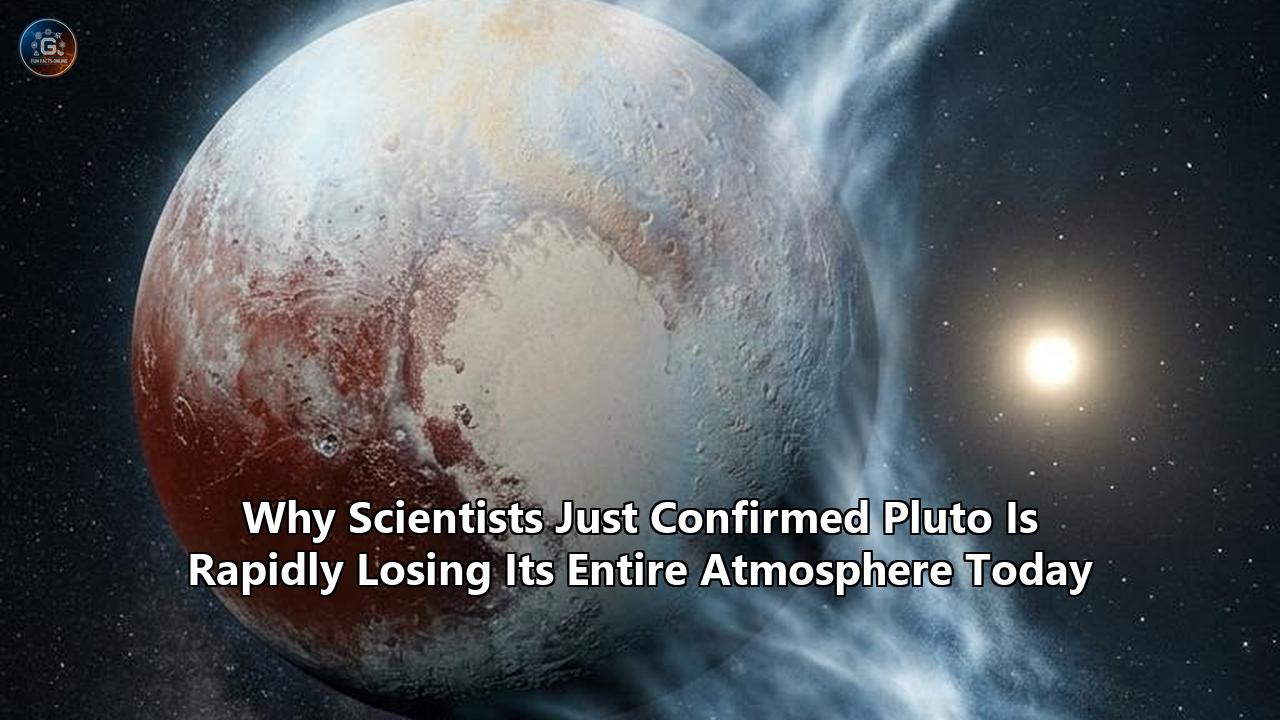
After decades of theoretical predictions and intense debate among planetary scientists, confirmation has arrived: Pluto’s thin atmosphere has officially entered a state of rapid contraction and collapse.
In a study published in The Planetary Science Journal, an international team led by Dr. Amanda Sickafoose of the Planetary Science Institute documented a steep 16% drop in Pluto’s surface atmospheric pressure between mid-2021 and July 2023. The findings mark the first observational confirmation that the dwarf planet’s nitrogen-dominated envelope is freezing out directly onto its surface as Pluto recedes from the Sun along its 248-year elliptical orbit.
The measurements put an end to a long-standing puzzle. When NASA’s New Horizons spacecraft executed its flyby in July 2015, atmospheric pressure at Pluto’s surface was roughly 10 to 11 microbars—roughly 100,000 times less dense than Earth’s atmosphere at sea level, but double the value measured during ground-based observations in the late 1980s. For years, models struggled to explain why Pluto’s atmosphere continued to expand and stabilize long after the dwarf planet passed its closest point to the Sun (perihelion) in 1989.
The latest dataset, derived from 10 distinct stellar occultation events observed between 2017 and 2023, shows that the post-perihelion plateau has broken. Pluto's atmosphere is now deflating at an unprecedented rate, offering a rare, direct look at how solar distance governs Pluto atmosphere loss and seasonal collapse.
      PLUTO'S ATMOSPHERIC PRESSURE TIMELINE (1988–2026)

  Pressure (Microbars)
    12 |                                  +--- Plateau ---+
    10 |                                 /                 \
     8 |                                /                   \  <-- 16% Drop (2021-2023)
     6 |                               /                     \
     4 |                      +-------+                       v
     2 |  +------------------+                                 ... Active Collapse
     0 +--+------------------+--------+--------+--------+--------+
        1988                2000     2015     2021     2023    2026+
        (Perihelion: 1989)          (New Horizons)
The Clausius-Clapeyron Physics Behind the "Big Freeze"
To understand why Pluto’s atmosphere is collapsing now, one must look at the extreme thermodynamics of volatile ices operating near absolute zero. Pluto’s atmosphere consists predominantly of molecular nitrogen ($N_2$), with trace amounts of methane ($CH_4$) and carbon monoxide ($CO$). Unlike Earth, where the atmosphere rests on a solid surface without changing phase, Pluto’s gaseous atmosphere exists in vapor-pressure equilibrium with solid volatile ices deposited on its surface.
This equilibrium is governed by the Clausius-Clapeyron relation, which describes the phase transition between solid and gas:
$$\frac{dP}{dT} = \frac{L}{T \Delta v}$$
Where $P$ is vapor pressure, $T$ is temperature, $L$ is the latent heat of sublimation, and $\Delta v$ is the change in specific volume between the solid and gas phases.
Because the latent heat of sublimation for solid nitrogen at temperatures around 35 to 40 Kelvin is extremely high relative to the ambient thermal energy, the vapor pressure of nitrogen is an exponential function of temperature:
$$P_{\text{vap}}(T) \propto \exp\left(-\frac{L}{R T}\right)$$
This mathematical relationship creates extreme sensitivity. A surface temperature drop of just 1.5 to 2 Kelvin causes the vapor pressure of nitrogen to drop by more than half.
When Pluto passed perihelion in 1989, it sat approximately 29.7 Astronomical Units (AU) from the Sun. It is currently traveling toward its aphelion at 49.3 AU, where it will arrive in the year 2114. As sunlight intensity fades inversely with the square of the distance ($1/r^2$), the average solar radiation flux hitting Pluto’s surface drops by more than 60% across its orbit.
Why, then, did the atmosphere continue to swell between 1989 and 2015? The answer lies in thermal inertia and global nitrogen ice transport. As Pluto moved away from the Sun, its sub-solar point shifted toward high southern latitudes due to its steep axial tilt of 122.5 degrees. Solar energy began heating deep reservoirs of nitrogen ice that had been locked in complete darkness for over a century. The sublimation of these freshly exposed ice sheets pumped massive volumes of nitrogen gas into the atmosphere, masking the cooling trend occurring elsewhere on the planet.
By 2021, that thermal reservoir effect reached its limit. The sub-solar latitude moved past the most volatile-rich equatorial deposits, and the overall cooling of the planet began to dominate. Atmospheric nitrogen started condensing back onto the ground at a rate faster than surface ices could sublimate, triggering a runaway collapse.
Anatomy of an Occultation: Measuring a Shadow from 3 Billion Miles Away
Because Pluto is roughly 2,376 kilometers in diameter and sits billions of miles away, even the most advanced space instruments—including the Hubble Space Telescope and the James Webb Space Telescope (JWST)—cannot directly resolve the structural thickness of its lower atmosphere in optical light. The planet appears as little more than a resolve-limited point of light.
To bypass this physical barrier, astronomers rely on stellar occultations. As Pluto travels across the night sky, it occasionally passes directly in front of a faint background star. To an observer on Earth, Pluto acts as a tiny disc casting a shadow that sweeps across the Earth's surface at velocity vectors often exceeding 20 kilometers per second.
                          STELLAR OCCULTATION GEOMETRY

          Distant Star
             *
              \
               \
                \         Pluto & Atmosphere
                 \        +----+
                  \------|  O  |---- Shadow Path across Earth
                         +----+    \
                                    \
                                     v [Ground Telescopes Array]
During an occultation, telescopes on Earth record the precise brightness of the star over time, generating a high-precision photometric light curve.
- The Atmospheric Gradient: As the background star approaches the outer edge of Pluto's atmospheric limb, starlight is not immediately blocked. Instead, it refracts through the gas layers. The light dims gradually in proportion to the atmospheric density profile, yielding a characteristic "U-shaped" curve.
- The Scale Height ($H$): By fitting the slope of the dimming curve, scientists calculate the atmospheric scale height using the formula:
$$H = \frac{k_B T}{\mu g}$$
Where $k_B$ is the Boltzmann constant, $T$ is local atmospheric temperature, $\mu$ is mean molecular weight, and $g$ is surface gravity.
- The Central Flash: If an observer sits precisely along the geometric center line of Pluto’s shadow, starlight from all points of Pluto’s atmosphere refracts simultaneously toward the center, creating a sudden, bright spike in the middle of the light curve—a "W-shaped" curve.
                     OCCULTATION LIGHT CURVES

    Normalized
    Brightness
      1.0 |-------\                         /------- (Unocculted Star)
          |        \                       /
          |         \        /\           /          <-- Central Flash Peak
      0.5 |          \      /  \         /               (W-shaped curve)
          |           \____/    \_______/
      0.0 +-----------------------------------------
          0s               Middle Time          120s
In the study led by Dr. Sickafoose, the research team analyzed 10 occultations spanning from 2017 to 2023. Collecting precise photometry across multiple observatories scattered around the world required microsecond-level GPS synchronization, rapid-frame-rate CCD/CMOS detectors, and precise astrometric predictions.
The technical breakthrough in the 2026 paper was the ability to decouple the effects of clear gas refraction from light extinction caused by atmospheric haze. The team calculated that while upper atmospheric pressure (above 80 km altitude) decreased by approximately 7% between 2015 and 2022, the pressure near the surface—where complex organic haze resides—dropped by a staggering 16% over the 2021–2023 observation window.
| Observation Period | Upper Atmosphere Pressure Change | Total Surface Pressure Change | Observational Basis |
|---|---|---|---|
| 1988 – 2015 | +100% (Steady Rise) | +100% (Steady Rise) | Multi-site Occultations & New Horizons Flyby |
| 2015 – 2021 | Plateau (<2% Variation) | Plateau (<2% Variation) | Ground/Airborne Occultations (SOFIA) |
| 2021 – 2023 | -7% (Upper Clear Gas) | -16% (Haze-Corrected Surface) | 10 Stellar Occultation Network Analysis |
The Haze Paradox & JWST's Unexpected Role in Pluto Atmosphere Loss
While stellar occultations map the macro-level deflation of Pluto's atmospheric volume, space-based infrared observations have uncovered a deeper thermodynamic cooling engine operating inside the air itself.
Data obtained by the James Webb Space Telescope (JWST) showed that photochemical hazes act as a primary thermal regulator for the dwarf planet. These findings confirmed a long-debated hypothesis proposed by Prof. Xi Zhang of the University of California, Santa Cruz.
                     PLUTO'S THERMAL & HAZE ENGINE

    Solar UV Radiation
         |  |  |
         v  v  v
   +-------------------------------------------------------+
   | UPPER ATMOSPHERE: UV photodissociates Methane (CH4)   |
   | Hydrocarbon molecules polymerize into THOLIN HAZES   |
   +-------------------------------------------------------+
         |
         v
   +-------------------------------------------------------+
   | MESOSPHERE (20-40 km): Hazes radiate in Mid-Infrared  |
   | Atmospheric cooling to 70 Kelvin (-203°C)             |
   +-------------------------------------------------------+
         |
         +--> Accelerates surface ice deposition (Collapse)
         |
         +--> Absorbs solar energy --> Energetic escape of CH4
              (1.3 kg/s) transferred to Charon's poles
Pluto’s atmosphere is not a clean, transparent gas; it is choked with multi-layered hydrocarbon hazes (complex organic macromolecules known as tholins). These hazes form when solar ultraviolet radiation strikes methane ($CH_4$) and nitrogen ($N_2$) molecules high in the atmosphere, breaking their molecular bonds and initiating cascade reactions that build acetylene, ethylene, ethane, and complex nitrile compounds.
The JWST mid-infrared spectrograph observed strong emission signatures from these haze particles. The mechanism works through two opposing phenomena:
- Mesospheric Cooling Engine: Solid haze particles excel at absorbing energy and re-radiating it at mid-infrared wavelengths into space. This net thermal emission cools Pluto’s mesosphere down to roughly 70 Kelvin (-203°C / -334°F). By chilling the middle layers of the atmosphere, the haze accelerates the downward transport of nitrogen gas, driving condensation onto the cold surface below.
- Photochemical Heating & Hydrodynamic Leakage: While the haze network chills the lower gas column, individual haze particles high in the atmosphere absorb ultraviolet photons, heating up localized gas pockets. This provides light gas molecules with enough kinetic energy to overcome Pluto’s weak surface gravity ($g \approx 0.62\text{ m/s}^2$).
This mechanism creates a steady driver of non-thermal Pluto atmosphere loss. Measurements derived from New Horizons instruments and refined by JWST reveal that Pluto loses approximately 1.3 kilograms of methane every second to outer space.
A portion of this escaping gas never leaves the system. Roughly 2.5% of the escaping methane gas is gravitationally captured by Pluto’s large, tidally locked moon, Charon. Charon’s cold polar regions trap this escaping methane, where ambient solar radiation synthesizes it into dark red tholin deposits—creating the famous reddish pole nicknamed Mordor Macula.
This atmospheric exchange—where gas leaks from a planet directly onto its orbiting satellite—is a unique process in solar system science.
                    PLUTO-CHARON ATMOSPHERIC TRANSFER

      PLUTO                                         CHARON
   +---------+                                   +----------+
   | Cooling | -- Methane Escape (1.3 kg/s) ---> | Captures |
   | Surface |                                   | Escaping |
   | Nitrogen| <--- [16% Drop in Pressure]       | Methane  |
   +---------+                                   +----------+
                                                      |
                                                      v
                                             Red Tholins Formed
                                            (Mordor Macula Pole)
Sputnik Planitia: The 1,000-Kilometer Thermal Flywheel
Any deep examination of Pluto’s atmospheric collapse must account for the giant geological feature that delayed this collapse for decades: Sputnik Planitia.
Sputnik Planitia is an enormous, heart-shaped basin spanning more than 1,000 kilometers across and plunging 3 kilometers deep into Pluto's crust. Filling this basin is an ice sheet composed of solid nitrogen, carbon monoxide, and methane. This ice sheet is not a static crust; it is a convective glacier driven by faint internal decay heat, organized into cellular convection pattern blocks 20 to 40 kilometers wide.
                          SPUTNIK PLANITIA CROSS-SECTION

       Atmosphere (Nitrogen, Methane, Carbon Monoxide Gas)
   ~~~~~~~~~~~~~~~~~~~~~~~~~~~~~~~~~~~~~~~~~~~~~~~~~~~~~~~~~~~~~~~~~
       ^^^^^^^^  Sublimation Gas  |  Condensation Ice  v v v v
   -----------------------------------------------------------------
     [ Nitrogen Ice Sheet: ~3 km deep, convective cells ]
     [ Surface Temp: ~38 K ]
   -----------------------------------------------------------------
     Pluto's Water-Ice Crust & Radiogenic Subsurface Mantle
Sputnik Planitia acts as the primary reservoir for Pluto's atmosphere, functioning like a global thermal flywheel. The vast mass of nitrogen ice stores heat energy, damping out short-term fluctuations in surface temperature.
The Seasonal Ice Cycle Mechanics
- Sub-Solar Heating: When solar rays strike Sputnik Planitia directly, the nitrogen ice temperature increases by fractions of a Kelvin, releasing immense volumes of nitrogen gas into the atmosphere via sublimation.
- Latent Heat Cooling: Sublimation requires energy, which extracts heat from the ice sheet and prevents the surface temperature from spiking wildly.
- Global Transport: As Pluto recedes from the Sun, the sub-solar point moves off Sputnik Planitia toward regions with lower total volatile ice inventories. Without the continuous thermal input over Sputnik Planitia, condensation begins to outweigh sublimation planet-wide.
Planetary scientists had long debated whether Sputnik Planitia held enough thermal momentum to prevent Pluto’s atmosphere from freezing out entirely. The 16% pressure drop documented between 2021 and 2023 demonstrates that even Sputnik Planitia cannot prevent atmospheric collapse as solar distance increases. The nitrogen ice reservoir continues to cool, and the rate of gas sublimation is dropping precipitously across the region.
Shadow Chasing: The Field Expeditions Behind the Data
The high-precision data behind these findings required immense effort from research teams. Predicting and capturing stellar occultations by Pluto is one of the most difficult observational challenges in astronomy.
Because Pluto's shadow path on Earth is only as wide as the planet itself (~2,370 km), the track across Earth's surface is narrow. A positional error in Pluto's orbit of just 10 milliarcseconds—equivalent to predicting the width of a dime seen from 200 miles away—can shift the projected shadow track by hundreds of kilometers, causing ground-based telescopes to miss the event entirely.
                   OCCULTATION SHADOW TRACK ON EARTH

        +-------------------------------------------------------+
        |                 Earth's Surface                       |
        |                                                       |
        |      ===========================================>     |
        |           Pluto Shadow Path (~2,370 km wide)          |
        |                                                       |
        |   [Telescope 1]     [Telescope 2]      [Telescope 3]  |
        |   (Limb Chord)      (Central Flash)    (Limb Chord)   |
        +-------------------------------------------------------+
To secure the dataset published in The Planetary Science Journal, scientists organized field campaigns spanning several continents:
- Precise Astrometry: Months before a predicted occultation, astrometric teams use large-aperture observatories—such as the United States Naval Observatory and the Gaia space mission catalogue—to re-measure the target star’s coordinates and Pluto's orbital trajectory down to sub-milliarcsecond precision.
- Deploying Mobile Arrays: Once the shadow path is finalized, researchers deploy arrays of small, high-speed portable telescopes (such as 0.35-meter to 0.5-meter automated optical systems) across the projected track. For critical occultations between 2017 and 2023, teams were dispatched to remote deserts in Chile, Australia, South Africa, and rural parts of North America.
- Primary Observatories Integration: Ground arrays are anchored by fixed research facilities, including the Gemini South Telescope in Chile, the Southern Astrophysical Research (SOAR) Telescope, and the SPECULOOS network.
- The Loss of Airborne Observatories: Collecting this data became significantly harder following the retirement of NASA's Stratospheric Observatory for Infrared Astronomy (SOFIA) in late 2022. SOFIA, a modified Boeing 747SP carrying a 2.7-meter telescope, could fly above 99% of Earth's atmospheric water vapor and move directly into the center of Pluto’s shadow over open oceans. Without SOFIA, researchers must rely entirely on land-based telescope networks, making successful observations subject to local weather conditions.
                      PLUTO OCCULTATION NETWORKS

    Platform/Facility        Aperture Range      Strategic Role
    --------------------     --------------      ------------------------------
    SOFIA (Retired 2022)      2.7 meters          Mid-ocean central flash tracking
    Gemini South / SOAR       4.0 - 8.1 meters    High signal-to-noise photometry
    SPECULOOS Network         0.1 - 1.0 meters    Multi-site chord coverage
    Mobile Portable Arrays    0.35 - 0.5 meters   Densely spaced track interception
The logistical coordination required to capture these events is formidable. Teams must set up equipment in hostile terrain, align optics under tight deadlines, sync time codes to millisecond precision, and operate in freezing weather—all for an observation window that often lasts less than two minutes. A single cloud passing overhead at the moment of occultation can ruin months of planning.
Global Warming on Earth vs. Deep Winter on Pluto
The rapid condensation of Pluto’s atmosphere highlights a stark contrast in planetary science: while Earth experiences global warming driven by greenhouse gas retention, Pluto undergoes severe global cooling driven by orbital mechanics and phase changes.
               EARTH VS. PLUTO ATMOSPHERIC FORCING

  PROPERTY                  EARTH                         PLUTO
  ------------------------  ----------------------------  ----------------------------
  Primary Driver            Infrared Gas Trapping (CO2)   Orbital Recession (1/r^2)
  Phase Change Dynamic      Stable Gas Phase              Direct Freeze-out (Gas->Solid)
  Thermal Balance           Net Positive Absorption       Net Radiative Loss (Hazes)
  Pressure Scale Change     Fractional Changes            Exponential (-16% in 2 Years)
Pluto's seasonal cycle plays out over 248 Earth years. Entire atmospheric cycles unfold over decades rather than months. The current collapse is not an unexpected anomaly; it is a fundamental feature of the dwarf planet's long-term climate cycle.
Yet, watching an entire planet’s atmosphere freeze onto its surface in real time provides an invaluable baseline for fundamental planetary physics. The data gathered from Pluto atmosphere loss measurements directly informs atmospheric models for other icy bodies in the outer solar system, including Neptune's giant moon Triton, as well as distant Kuiper Belt dwarf planets like Eris, Makemake, and Haumea, which follow even more eccentric orbits.
What Happens Next: The Final Descent Into Hard Vacuum
As Pluto continues its journey toward aphelion, its atmosphere is projected to enter its final phase of collapse over the coming decades.
               PLUTO'S ATMOSPHERIC TIMELINE INTO DEEP WINTER

  2015           2021-2023        2030s            2040s-2114
   |                 |              |                  |
   v                 v              v                  v
  Flyby            Initial       Severe             Total Atmospheric
  Peak Pressure    Collapse      Depletion          Freeze-Out
  (~11 microbars)  (-16% Drop)   (Haze Clears)      (Hard Vacuum Surface)
Planetary scientists anticipate several key milestones as Pluto moves deeper into winter:
1. Atmospheric Thinning Acceleration (2026–2035)
As surface temperatures drop another 1 to 2 Kelvin, nitrogen condensation will accelerate. Pressure is projected to decline from its current level down to under 1 microbar by the mid-2030s. As the gas thins, the high-altitude organic haze layers will settle onto the ground. The brilliant blue atmospheric halo imaged by New Horizons in 2015 will gradually clear, leaving behind a transparent, ultra-thin nitrogen atmosphere.
2. Loss of the Central Flash Signal
As the atmosphere thins, its index of refraction will drop. Within the next decade, ground-based stellar occultations will no longer produce the central flash phenomenon. The light curves recorded by observatories will transition from "W-shaped" profiles back into sharp "U-shaped" or step-function drop-offs, marking the transition to an airless body.
3. Total Freeze-Out (Mid-21st Century to Aphelion)
By the time Pluto reaches its furthest point from the Sun in 2114, models predict its surface atmospheric pressure could drop to near zero. The once-dynamic atmosphere will exist almost entirely as a layer of nitrogen, methane, and carbon monoxide frost coating the bedrock. The surface will enter a deep freeze that will last until Pluto turns back toward the Sun, initiating a new global thaw in the 23rd century.
                       FUTURE TELESCOPE CAPABILITIES

    Observatory / Mission        Status             Pluto Research Goal
    ------------------------     ----------------   -----------------------------------
    JWST (Cycle 5+)              Active             Mid-IR surface ice composition
    Extremely Large Telescope    Under Construction Direct imaging of surface frost shifts
    Thirty Meter Telescope       Planned            High-resolution stellar occultations
    Persephone Concept Mission   Proposed Flagship  Orbital mapping of collapsed frozen atmosphere
Astronomers are preparing to monitor the remaining stages of this collapse using the next generation of ground and space observatories. The 39-meter Extremely Large Telescope (ELT) under construction in Chile, alongside the Giant Magellan Telescope (GMT), will provide the optical resolution needed to track seasonal surface frost shifts across Pluto's regions.
At the same time, planetary scientists are pushing space agencies to consider a dedicated return mission. While New Horizons provided a quick snapshot of Pluto during its warm summer phase, concept proposals—such as the Persephone flagship mission—aim to send an orbiter back to Pluto in the 2040s or 2050s. Such a spacecraft would study the world in its frozen, atmosphere-free state, providing a complete view of how a planet breathes across its centuries-long orbit.
For now, ground-based observers continue to watch the distant dwarf planet, tracking every dimming star to record the final breaths of an atmosphere freezing out into the deep cold of the outer solar system.
Reference:
- https://gizmodo.com/plutos-atmosphere-may-finally-be-starting-to-collapse-2000794537
- https://skycr.org/2026/08/03/pluto-atmosphere-collapse-occultations/
- https://www.sci.news/astronomy/plutos-atmosphere-14963.html
- https://medium.com/nakshatra/plutos-last-breath-388d5c7b786e
- https://www.swri.org/newsroom/press-releases/swri-scientists-confirm-decrease-pluto-s-atmospheric-density
- https://earthsky.org/space/pluto-losing-atmosphere-winter/
- https://www.space.com/astronomy/james-webb-space-telescope/plutos-hazy-skies-are-making-the-dwarf-planet-even-colder-james-webb-space-telescope-finds
- https://astrobiology.com/2025/06/17/cooling-effects-of-plutos-haze-confirmed-by-james-webb-telescope-data/