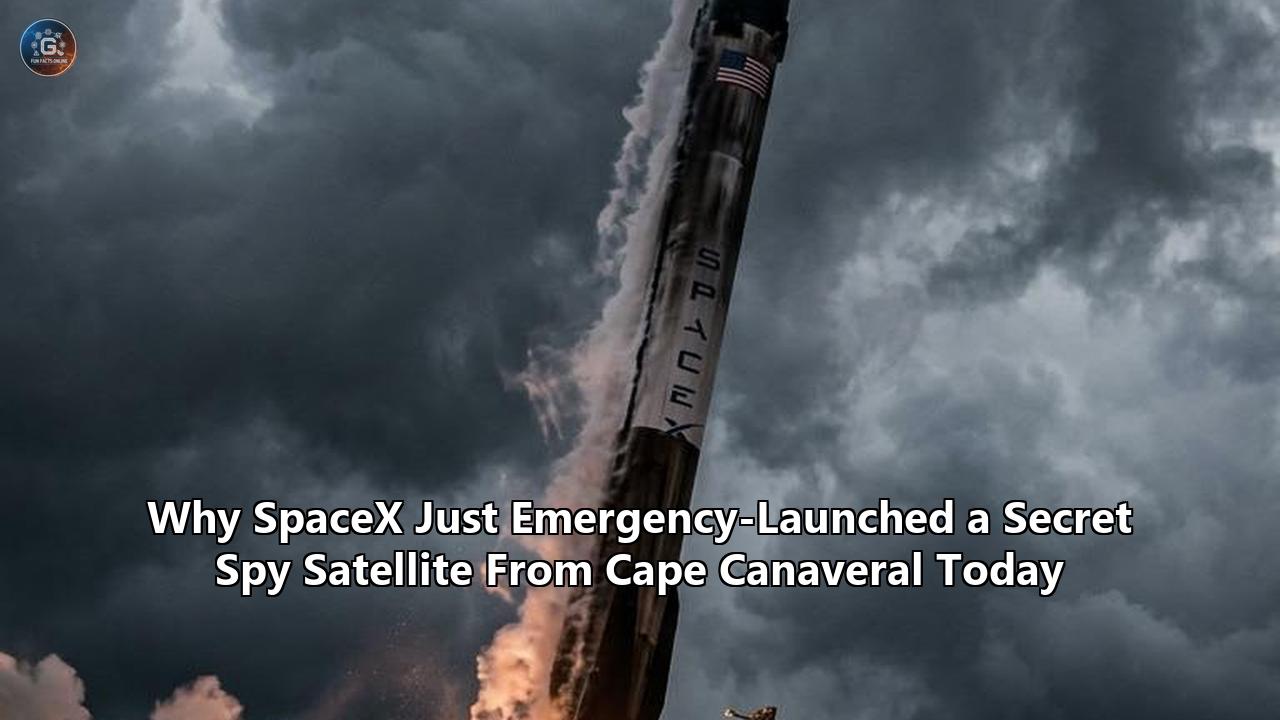
A Falcon 9 rocket ignited its nine Merlin 1D engines at Space Launch Complex 40 at Cape Canaveral Space Force Station, cutting through the pre-dawn darkness to send a top-secret payload into orbit.
The mission, designated NROL-95, was conducted for the National Reconnaissance Office (NRO) in close coordination with the U.S. Space Force’s Space Systems Command (SSC). Within eight and a half minutes of liftoff, the Falcon 9’s first-stage booster—serial number B1096, making its seventh flight—executed a flawless Return to Launch Site (RTLS) maneuver, touching down at Landing Zone 2. The resulting double sonic boom reverberated across Florida’s Space Coast, signaling the completion of the booster's primary job. Up above, the rocket's second stage accelerated out of telemetry view, carrying a high-priority asset into an undisclosed orbit.
While the NRO routinely places reconnaissance assets into space, NROL-95 was not a standard, long-planned operational flight. Behind the curtain of official secrecy, today's liftoff represents a rapid-response deployment driven by urgent national security needs. By analyzing orbital trajectories, payload mass restrictions, contractor award timelines, and mission iconography, a clear picture emerges: the U.S. intelligence community just used SpaceX to rapidly fill a critical intelligence gap over an increasingly unstable geopolitical theater.
The Trajectory Blueprint: Decoding the Flight Profile
To understand why NROL-95 flew today—and why it lifted off from Cape Canaveral rather than Vandenberg Space Force Base—one must examine the physics of the launch trajectory.
Throughout early 2026, the NRO focused its launch cadence on building out its "proliferated architecture"—a massive, multi-shell constellation composed of hundreds of smaller, lower-cost imagery and signals intelligence satellites. The previous three NRO missions this year (NROL-105 in January, NROL-172 in May, and NROL-179 in June) all launched from SLC-4E at Vandenberg Space Force Base in California. Those flights headed due south into high-inclination polar orbits, providing global, repeating coverage ideal for broad surveillance.
NROL-95 broke that pattern entirely. Liftoff occurred from Florida's Space Coast along a north-easterly trajectory. This inclination profile places the spacecraft into a mid-inclination low Earth orbit (LEO), roughly between 51.6 degrees and 63 degrees relative to the equator.
NRO Launch Cadence (2026)
--------------------------------------------------------------------------------
Mission    Launch Date     Launch Site      Trajectory        Primary Focus
--------------------------------------------------------------------------------
NROL-105   Jan 16, 2026    Vandenberg       Polar (South)     Proliferated Shell
NROL-172   May 11, 2026    Vandenberg       Polar (South)     Proliferated Shell
NROL-179   Jun 19, 2026    Vandenberg       Polar (South)     Proliferated Shell
NROL-95    Jul 30, 2026    Cape Canaveral   Northeast (Mid)   Tactical Insertion
--------------------------------------------------------------------------------
A mid-inclination orbit trade-off is telling:
- What it sacrifices: Global coverage over the Arctic and Antarctic caps.
- What it gains: Dramatically higher revisit frequency over key temperate latitudes—specifically Eastern Europe, the Middle East, the South China Sea, and the Korean Peninsula.
Instead of passing over a target zone twice every 24 hours as a polar satellite does, a mid-inclination spacecraft can pass over tactical regions multiple times per day.
Furthermore, SpaceX opted for a Return-to-Launch-Site booster recovery rather than landing on a autonomous spaceport drone ship downrange. An RTLS recovery requires the Falcon 9 first stage to execute three distinct engine burns: a boostback burn to reverse its horizontal velocity back toward Florida, an entry burn to break through the dense atmosphere, and a landing burn for touchdown at LZ-2.
Because the booster must retain substantial fuel reserves to fly itself back to the coast, the payload mass capacity of the Falcon 9 is significantly constrained. In an RTLS configuration, the Falcon 9 Block 5 can deliver roughly 4,000 to 5,500 kilograms into low Earth orbit—far below its maximum drone-ship capacity of ~17,500 kilograms.
This mass ceiling provides crucial hardware context. The SpaceX secret spy satellite launched today is not one of the NRO’s legacy, bus-sized optical reconnaissance systems (such as the school-bus-sized KH-11 Kennen series, which weigh upward of 14,000 kilograms and require heavy-lift configurations). Instead, NROL-95 is a compact, highly specialized spacecraft engineered for immediate tactical insertion.
Patch Iconography and Mission Hardware: The "Ferret" Resurgence
While the NRO maintains strict operational security regarding payload specifications, mission insignia often contain deliberate, coded nods to historical lineage and payload purpose. The official patch for NROL-95 features a ferret standing atop a podium, emblazoned with the phrase "We Are the Champions".
In the terminology of military space history, the term "Ferret" has a specific meaning. During the Cold War, the U.S. Air Force and NRO operated a series of electronic intelligence (ELINT) spacecraft officially designated as "Ferrets." Their primary mission was to fly through contested airspace to detect, map, and analyze Soviet radar emissions, surface-to-air missile (SAM) tracking arrays, and air defense command networks. By "ferreting out" enemy radar frequencies and pulse-repetition rates, these satellites allowed western strike planners to program radar warning receivers and electronic countermeasures.
+-------------------------------------------------------------------+
|                        NROL-95 PAYLOAD ARCHITECTURE                |
|                                                                   |
|  +-----------------------+             +-----------------------+  |
|  |     SIGINT/ELINT      |             |   SB-AMTI SYNTHETIC   |  |
|  |   RF-RECEIVER ARRAY   |             |    APERTURE RADAR     |  |
|  | Mapping adversary radar|             | Tracking moving ships |  |
|  | & electronic emissions|             |  & aircraft in LEO    |  |
|  +-----------+-----------+             +-----------+-----------+  |
|              |                                     |              |
|              +------------------+------------------+              |
|                                 |                                 |
|                    +------------v------------+                    |
|                    | HIGH-SPEED OPTICAL LINK |                    |
|                    | Inter-satellite laser   |                    |
|                    | routing to Joint Force  |                    |
|                    +-------------------------+                    |
+-------------------------------------------------------------------+
Modern combat zones—most notably Eastern Europe, the Red Sea, and the Taiwan Strait—are characterized by dense electronic warfare environments. GPS signals are jammed across thousands of square miles, and mobile radar emitters dynamically turn on and off to evade anti-radiation missiles.
The inclusion of the ferret emblem strongly points toward a specialized Signals Intelligence (SIGINT) or Electronic Intelligence payload designed for radio frequency (RF) mapping. Such a payload likely features:
- Deployable Ultra-Wideband Antenna Arrays: Lightweight, mesh-style reflector dishes designed to capture low-power RF emissions across frequencies ranging from UHF up to the X and Ku bands.
- Onboard Digital Signal Processing (DSP): AI-accelerated edge computing hardware capable of filtering out localized civilian RF noise in real time, pinpointing the precise location of air defense radars and mobile EW jamming trucks.
- Space-Based Airborne Moving Target Indication (SB-AMTI): Advanced Synthetic Aperture Radar (SAR) capabilities capable of tracking moving surface ships and airborne objects through cloud cover, rain, and synthetic smoke screens.
The arrival of an updated RF-ferreting asset in a mid-inclination orbit gives battlefield commanders real-time tracking of adversary air defense assets without waiting for broader, polar-orbiting constellations to rotate back into view.
Tactical Responsive Space: The Shift from Years to Days
Historically, procuring and launching a national security satellite was a notoriously slow process. Developing a flagship NRO satellite typically took 7 to 12 years, involved billions of dollars in expenditure, and required months of pad preparation.
If an operational satellite suffered an electrical failure, was degraded by direct-energy anti-satellite (ASAT) weapons, or was eclipsed by sudden geopolitical shifts, national leaders faced prolonged intelligence gaps.
NROL-95 illustrates the maturation of Tactical Responsive Space (TacRS) capabilities. Over the past three years, the U.S. Space Force and the NRO have systematically restructured launch procurement models to enable rapid payload integration.
Traditional vs. Tactical Responsive Space Acquisition
--------------------------------------------------------------------------------
Attribute               Legacy NRO Acquisition        Tactical Responsive Space
--------------------------------------------------------------------------------
Procurement Cycle       7 to 12 Years                 2 to 6 Months
Payload Architecture    Monolithic (Multi-ton)        Modular / Proliferated
Launch Provider         Custom Heavy Lifters          Standardized Commercial (Falcon 9)
Pad Integration         Months of Processing          Days to Weeks
Operational Objective   10+ Year Lifespan             Targeted Operational Need
--------------------------------------------------------------------------------
Rather than building a bespoke rocket for a bespoke payload, SpaceX provides a standardized, assembly-line launch system. The Falcon 9 first stage (Booster B1096) that flew today previously supported six other missions—including NROL-77, IMAP, GPS III-9, and CRS-34. It last flew on May 15, undergoing inspection, refurbishing, and static testing in just 76 days.
When the intelligence community identified an immediate requirement for enhanced RF sensing over a specific theater, the NRO did not need to wait for a new rocket to be built. Payload integration engineers used standardized fairing interfaces, secured the SpaceX secret spy satellite inside SLC-40's processing hangar, mated it to the Falcon 9 upper stage, and rolled it to the pad within a narrow operational window.
This responsiveness fundamentally shifts military calculations. If an adversary attempts to blind or jam an existing intelligence asset, the Space Force can launch a functional replacement or supplement into orbit within weeks.
The $17 Billion Backdrop: Contract Mechanics Behind the Mission
The execution of NROL-95 did not happen in a vacuum; it occurred amidst a massive expansion of Department of Defense commercial launch contracts.
Just 24 hours before NROL-95 cleared the pad on July 30, Space Systems Command (SSC) announced two major task orders awarded to SpaceX valued at $1.6 billion under the National Security Space Launch (NSSL) Phase 3 Lane 1 contract vehicle. These task orders cover 18 upcoming Falcon 9 launches through 2027 dedicated to the Space Force’s Space-Based Sensing and Targeting (SBST) portfolio.
Contract Structure: NSSL Phase 3 Strategy
--------------------------------------------------------------------------------
Program Segment       Contract Ceiling       Primary Objectives
--------------------------------------------------------------------------------
Phase 3 Lane 1        $17.0 Billion          Rapid acquisition, commercial-style
                      (Expanded July 2026)   launches to LEO/MEO; quick task order
                                             turnarounds (e.g., SBST, TacRS).

Phase 3 Lane 2        Multi-Billion          Heavy-lift, high-energy orbits (GEO,
                      (Competitive)          Molniya, Direct insertion); highly
                                             complex, must-go missions.
--------------------------------------------------------------------------------
The procurement timeline leading up to today's launch shows how quickly military space acquisition is moving:
- July 17, 2026: The Department of Defense expanded the NSSL Phase 3 Lane 1 contract ceiling by $11.4 billion—raising the total program ceiling from $5.6 billion to $17 billion. This massive expansion increased the planned number of Lane 1 launches from 60 to 170 between 2025 and 2034.
- July 29, 2026: SSC publicly announced $1.6 billion in task orders assigned to SpaceX to support sensing, missile tracking, target identification, and tactical communications. Col. Eric Zarybnisky, acting portfolio acquisition executive for Space Access, noted that SSC established an unprecedented two-month turnaround from requirement identification to task order award.
- July 30, 2026 (3:10 a.m. EDT): SpaceX launched NROL-95 from Cape Canaveral.
The Space Force’s Lane 1 procurement model treats space launch more like a commercial logistics service than a traditional defense contract. By maintaining a pool of pre-qualified, flight-proven boosters and standardized upper stages, SpaceX allows defense acquisition officers to issue a task order and launch a classified SpaceX secret spy satellite in a fraction of the time required by legacy contractors.
Geopolitical Drivers: The Counterspace Threat Matrix
The decision to launch NROL-95 today is tied directly to evolving counterspace threats from foreign powers.
Over the past 24 months, intelligence agencies have monitored a significant surge in adversary counterspace activities. These include:
1. Co-Orbital Antisatellite Operations
Adversary "inspector" satellites, such as Russia's Cosmos series, have demonstrated aggressive Rendezvous and Proximity Operations (RPO) in low Earth orbit. These spacecraft maneuver within kilometers—sometimes hundreds of meters—of sensitive U.S. national security satellites, utilizing diagnostic optical sensors, electronic signal interceptors, or potential physical manipulators to inspect or disrupt operations.
2. High-Powered Terrestrial Directed Energy
Ground-based anti-satellite laser stations located in East Asia and Central Asia have targeted low-orbit optical reconnaissance satellites. While not necessarily destroying the spacecraft, these directed-energy systems can temporarily blind focal plane sensors, rendering electro-optical reconnaissance platforms useless while passing over target sites.
3. Airborne and Ground-Based RF Jamming
Broadband radio frequency jammers deployed in active conflict zones routinely saturate military communications frequencies and commercial synthetic aperture radar signals.
Counterspace Threat vs. Architectural Response
--------------------------------------------------------------------------------
Adversary Threat Vector           U.S. Architectural Defense Response
--------------------------------------------------------------------------------
Co-Orbital Inspector Craft        Proliferation: Harder to track/target hundreds
                                  of smaller assets simultaneously.

Terrestrial Laser Blinding        Multi-Spectral Diversification: Shifting from
                                  pure optical to RF/SAR ELINT payloads.

RF Jamming & EW Arrays            Tactical Insertion: Deploying quick-reaction
                                  nodes (e.g., NROL-95) to track active emitters.
--------------------------------------------------------------------------------
In this environment, relying solely on a small number of ultra-expensive, exquisite satellites creates a central point of failure. If an adversary blinds a billion-dollar optical asset or maneuvers an inspector craft alongside an intercept receiver, American joint force commanders face a loss of battlefield visibility.
Deploying a specialized SpaceX secret spy satellite into a customized mid-inclination orbit negates these counterspace tactics. If an adversary maneuvers against existing U.S. constellation assets, the Space Force can place a new sensing node overhead within days, restoring situational awareness before an adversary can capitalize on a temporary window of advantage.
Thermal, Structural, and Ascent Engineering Details
Accomplishing a secret mission under strict operational timelines requires meticulous payload integration and fairing engineering.
During ascent, a satellite is subjected to intense environmental stresses: violent acoustic vibrations, structural loads reaching several Gs of longitudinal acceleration, and aerodynamic heating along the outer fairing skin.
SpaceX Falcon 9 Ascent Profile (NROL-95 Configuration)
--------------------------------------------------------------------------------
Flight Event               Time Elapsed (T+)    Velocity / Alt / Status
--------------------------------------------------------------------------------
Liftoff (SLC-40)           T+00:00              1.7M lbs Thrust / Ground Level
Max Q (Max Aero Stress)    T+01:12              Supersonic Transit / High Dynamic Press
MECO (Main Engine Cutoff)  T+02:14              9 M1D Engines Shutdown
Stage Separation           T+02:18              Pneumatic Pushers Separate Stages
MVac Ignition (Stage 2)    T+02:25              Merlin Vacuum Engine Ignites
Fairing Jettison           T+03:15              Classified / Blackout Initiated
Booster Landing (LZ-2)     T+08:30              RTLS Complete / Sonic Booms
Payload Insertion          Classified           Insertion into Initial Orbit
--------------------------------------------------------------------------------
For national security payloads like NROL-95, SpaceX utilizes specialized fairing processing procedures at its Cape Canaveral facilities:
- RF Shielding and Attenuation: The interior of the 5.2-meter payload fairing is lined with specialized radio frequency acoustic blankets. These suppress internal acoustic energy and prevent unintended RF signal leakages from the satellite while sitting on the pad or during initial stage flight, keeping its transmission frequencies classified before deployment.
- Environmental Control Systems (ECS): Classified payloads are ultra-sensitive to particulate contamination and humidity. While inside the payload fairing on Pad 40, conditioned Class 8 cleanroom air is continuously pumped through umbilical lines to prevent microscopic dust particles from settling on delicate optical lenses or radar antenna feeds.
- Thermal Protection: Because NROL-95 launched along a northeast trajectory, the upper stage experienced prolonged thermal exposure to upper-atmospheric friction before reaching exo-atmospheric altitudes. Thermal coatings on the payload adapter ensure heat does not bleed into the satellite's hypergolic propulsion systems or cryogenic cooling loops.
Approximately three minutes into flight—shortly after second-stage ignition—the fairing halves were jettisoned. Because NRO missions operate under strict operational blackouts, SpaceX terminated its live broadcast commentary at fairing separation, withholding orbital telemetry, altitude figures, and second-stage engine shutdown timing.
What Amateur Satellite Trackers Are Watching For Next
While official sources provide zero information regarding the final orbit of NROL-95, an international network of independent, amateur satellite observers and radio astronomers has already mobilized.
Within hours of launch, tracker networks monitor the skies using specialized low-light optical cameras, wide-field telephoto rigs, and software-defined radio (SDR) receivers. Here is how independent analysts will locate and track the spacecraft in the coming days:
Amateur Tracking Workflow for Classified Payloads
--------------------------------------------------------------------------------
Step 1: Trajectory Vectoring   Mapping launch time, pad location, and initial
                               heading (Northeast burn from Cape Canaveral).

Step 2: Optical Pass Searching Deploying automated camera arrays along predicted
                               orbital paths during dusk/dawn twilight passes.

Step 3: RF Frequency Hunting   Scanning S-band (2.2–2.3 GHz) and X-band
                               (8.0–8.4 GHz) spectra for telemetry carrier signals.

Step 4: TLE Generation          Calculating Two-Line Element (TLE) datasets to
                               predict future passes and identify orbit shape.
--------------------------------------------------------------------------------- Calculating the Initial Insertion Orbit: By calculating the launch azimuth from Cape Canaveral (roughly 45 to 55 degrees northeast), trackers can narrow down the orbital inclination within 0.5 degrees.
- Optical Search Grids: During dusk and dawn, when low-Earth orbit satellites reflect sunlight against a dark night sky, automated camera arrays across North America and Europe scan the predicted orbital plane. Once the spacecraft is optically spotted, observers record its precise right ascension and declination.
- Radio Frequency Intercepts: Amateur radio operators scan known military downlink frequency bands—specifically the S-band (2200 to 2300 MHz) for telemetry and the X-band (8000 to 8400 MHz) for high-speed data downlinks. Finding these carrier signals provides definitive proof of an active payload pass and helps pin down orbital period.
- Determining the Orbital Class: If the satellite settles into a ~300 to ~500-kilometer circular orbit, it strongly indicates an operational LEO sensing or ELINT platform. If trackers observe the upper stage relighting to lift the satellite into an elliptical Molniya orbit or a higher medium Earth orbit (MEO), it points toward a localized signal-relay or continuous-stare reconnaissance asset.
Within 48 to 72 hours, these tracking networks will publish preliminary Two-Line Element (TLE) orbital sets, revealing to the world the precise altitude, eccentricity, and inclination of today's launch.
The New Reality of Orbital Power Projection
The emergency deployment of NROL-95 from Space Launch Complex 40 marks a clear shift in how space power is deployed.
By combining the NRO’s miniaturized sensor hardware with SpaceX’s flight-proven Falcon 9 fleet and the Space Force’s rapid acquisition contracts, the U.S. defense establishment has demonstrated an operational capability that was impossible a decade ago: identifying an orbital intelligence gap and filling it in real time.
As the Space Force continues to fund its $17 billion Phase 3 Lane 1 framework and prepares for the future integration of SpaceX's massive Starship platform, the paradigm of military space access has fundamentally changed. Satellites are no longer vulnerable, static national assets meant to sit unchanged in orbit for a decade. They are now dynamic, rapidly replaceable nodes in an adaptive, space-based intelligence network.
The sonic booms that echoed over Cape Canaveral early this morning were more than just the sound of a Falcon 9 booster returning to land. They were proof that when a tactical intelligence gap opens anywhere in the world, the launch pad is already loaded, ready to respond.
Reference:
- https://www.youtube.com/watch?v=5cokZJ3XQW0
- https://www.space.com/space-exploration/launches-spacecraft/spacex-falcon-9-spy-satellite-launch-nrol-95
- https://www.ntd.com/spacex-carries-spy-satellite-into-orbit_1163144.html
- https://talkoftitusville.com/2026/07/29/falcon-9-launching-classified-nro-payload-overnight-expect-a-sonic-boom-locally/
- https://www.clickorlando.com/news/space-news/2025/12/09/spacex-to-launch-national-security-payload-from-floridas-space-coast/
- https://keeptrack.space/space-brief/space-brief-2026-07-30
- https://www.afcea.org/signal-media/us-space-force-launch-sensing-and-targeting-capabilities
- https://breakingdefense.com/2026/07/spacex-wins-1-6b-to-launch-space-force-sensing-and-targeting-sats/
- https://keeptrack.space/x-report/spacex-brief-2026-07-30
- https://spaceflightnow.com/2026/06/12/live-coverage-spacex-to-launch-final-starlink-mission-as-it-begins-publicly-trade-its-stock-on-the-nasdaq-for-the-first-time/