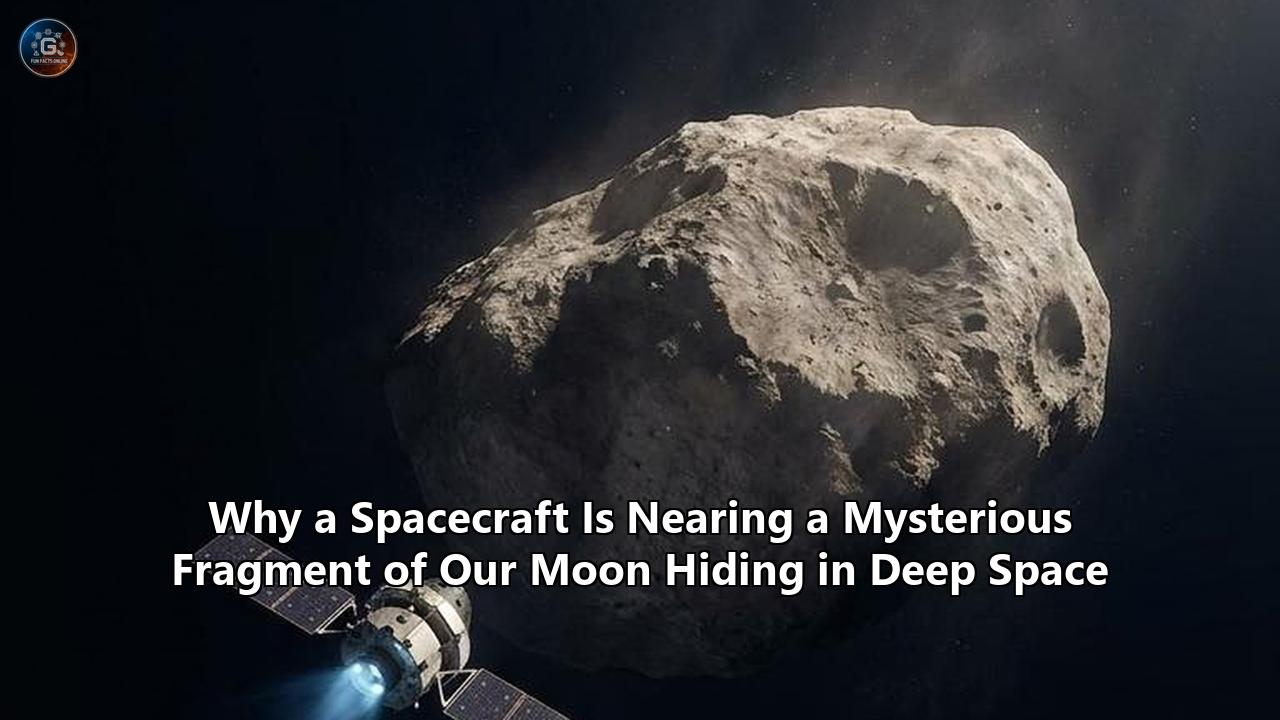
On June 7, 2026, deep within the gravitational shallows of the Earth-Moon system, a silent robotic rendezvous is unfolding that could fundamentally rewrite our understanding of the cosmic neighborhood. The China National Space Agency’s (CNSA) robotic spacecraft, Tianwen-2, is executing a series of precise thruster firings to enter orbit around 469219 Kamoʻoalewa. This Ferris-wheel-sized space rock—measuring between 40 and 100 meters across—is not a typical asteroid. For decade-long stretches, it shadows Earth, acting as a "quasi-satellite" that orbits the Sun while remaining bound to our planet’s orbital path.
For years, astronomers have suspected that this enigmatic body is actually a long-lost fragment of our Moon, blasted into deep space by an ancient meteoroid impact. Yet, on the literal eve of Tianwen-2’s arrival, a sharp scientific dispute has erupted over the object's true identity. Recent laboratory reanalyses from planetary scientists in Beijing suggest the rock might not be of lunar origin at all, but rather a standard asteroid disguised by millions of years of extreme solar radiation.
This mystery has transformed a routine mapping run into an urgent, high-stakes investigation. Deciding whether Kamoʻoalewa is a stray piece of our closest neighbor or a heavily weathered visitor from the main asteroid belt is about more than just satisfying scientific curiosity. The answer has massive implications for future space resource extraction, deep-space navigation, and planetary defense. Ground-based instruments have taken us as far as they can; resolving this conflict is the primary driver behind why this ambitious moon fragment space mission has captured the attention of the global space community.
The Celestial Ghost: Why This Fragment Evaded Us for So Long
To understand why Kamoʻoalewa remains such a profound mystery, one must first grasp the immense physical and logistical challenges involved in studying it. Discovered in 2016 by the Pan-STARRS 1 telescope atop Haleakalā in Hawaii, the object was named Kamoʻoalewa, a Hawaiian term originating from a traditional creation chant that alludes to an offspring that travels on its own. Despite its relatively close proximity—at its nearest, it approaches within about 9 million miles of Earth, or roughly 38 times the distance to the Moon—it is a spectacularly difficult target to observe.
       [Sun]
         │
         │
         ▼
     [Earth]  ◄── 9 Million Miles ──►  [Kamoʻoalewa]
        ▲                              (Quasi-Satellite Orbit)
        │
      [Moon] (True Satellite)
At its brightest, Kamoʻoalewa is roughly 4 million times fainter than the dimmest star visible to the naked human eye. Because of its tilted and eccentric orbit, it is only visible from Earth for a brief window of a few weeks every April. Even then, analyzing it requires the light-gathering power of the world’s largest ground-based observatories, such as the Large Binocular Telescope on Mount Graham in Arizona.
Aside from the physical difficulty of seeing the object, its orbital dynamics are highly unusual. Typical near-Earth objects (NEOs) pass through our sector of space at high relative velocities, averaging around 20 kilometers per second. Kamoʻoalewa, however, drifts past at a sluggish 2 to 5 kilometers per second relative to the Earth-Moon system. It occupies a delicate dynamical state, constantly transitioning between a quasi-satellite orbit—where it loops around the L1 and L2 Lagrange points—and a horseshoe orbit that stretches between the L4 and L5 Lagrange points.
This low relative velocity strongly implies a shared origin with the Earth-Moon system. According to orbital modeling by planetary scientist Renu Malhotra at the University of Arizona, it is highly improbable that a standard asteroid from the main belt would spontaneously drop into such a stable, Earth-mimicking orbit. However, Kamoʻoalewa's current orbit is not permanent; calculations show it arrived in this configuration roughly 500 years ago and will likely be kicked out into a different trajectory in another 300 years.
The temporary nature of its orbit raises a critical challenge: if Kamoʻoalewa is indeed a piece of our Moon, how did it get there, how many more of these "ghosts" are lurking undetected in cis-lunar space, and what does their existence mean for the stability of our immediate cosmic neighborhood?
The Scientific Rift: Lunar Offspring or Cosmic Impostor?
The prevailing theory regarding Kamoʻoalewa’s origin was established in 2021. A research team led by Ben Sharkey and Vishnu Reddy at the University of Arizona utilized the Large Binocular Telescope to analyze the light reflected off the asteroid’s surface. They discovered that the object’s reflectance spectrum matched lunar silicates almost perfectly—specifically, the highly weathered soils brought back from the Moon’s surface by NASA’s Apollo 14 and the Soviet Union's Luna 24 missions.
To reinforce this hypothesis, subsequent researchers conducted sophisticated numerical simulations. In 2023, a study demonstrated that a high-energy meteoroid impact on the Moon could blast debris into space with enough velocity to escape lunar gravity but not enough to escape the Earth-Moon system entirely. The simulations indicated that a tiny fraction of this ejecta could settle into a stable quasi-satellite orbit. The prime suspect for this cosmic collision is the Giordano Bruno crater, a 22-mile-wide impact site on the lunar far side that formed relatively recently—between 1 million and 10 million years ago.
  [Meteoroid Impact] ──► [Giordano Bruno Crater (Far Side)]
                                  │
                                  ▼ (Ejecta blasted into space)
                        [Escapes Lunar Gravity]
                                  │
                                  ▼ (Captured by Earth-Sun Orbit)
                        [Kamoʻoalewa Quasi-Satellite]
However, this elegant narrative was thrown into disarray in late May 2026. A research team led by Yang Li, a planetary scientist at the Chinese Academy of Sciences' Institute of Geochemistry, published a study that directly challenged the lunar ejecta hypothesis. Li’s team reanalyzed Kamoʻoalewa’s spectral data and argued that the asteroid’s unusual, highly reddened color could be explained without invoking any lunar material.
The core of the dispute lies in how space weathered materials are interpreted. When rocks in vacuum-exposed environments are bombarded by solar wind and micrometeorites, their surfaces undergo chemical and physical changes. This process, known as space weathering, creates nanophase iron particles that darken the surface and turn its reflected light a distinct red color.
Li's team performed laboratory experiments using high-energy lasers to simulate millions of years of space weathering on LL chondrites—a common class of low-iron, stony meteorites originating from the main asteroid belt. They found that heavily weathered LL chondrites produced the exact same spectroscopic signature, shallow absorption dips, and extreme red coloring observed on Kamoʻoalewa.
Furthermore, they pointed out that Kamoʻoalewa’s light spectrum looks like a more severely weathered version of Itokawa, the stony S-type asteroid visited by Japan’s Hayabusa probe in 2010. If this interpretation holds, Kamoʻoalewa is not a piece of our Moon, but rather a battered sibling of the Flora family of asteroids that migrated from the main belt.
This scientific division exposes a glaring gap in our understanding of space weathering. If S-type asteroids can mimic lunar soil signatures so closely when subjected to prolonged radiation, then our current methods for classifying near-Earth objects are deeply flawed. Conversely, if Kamoʻoalewa is a moon fragment, then the Moon has been shedding sizable chunks of its crust far more recently than geologists assumed. This unresolved debate is why the current moon fragment space mission is of paramount importance to the scientific community; only an up-close, in-situ investigation can definitively settle the matter.
Engineering the Unprecedented: The Battle of Near-Zero Gravity
Designing a spacecraft to rendezvous with and sample an object like Kamoʻoalewa is an engineering challenge of the highest order. Landing on a massive celestial body like Mars or the Moon relies on gravity to hold the spacecraft down. On a 100-meter-wide asteroid, however, gravity is virtually non-existent.
The gravitational pull on Kamoʻoalewa is so weak that any traditional landing attempt would cause the spacecraft to bounce off the surface and drift back into the void of space. Compounding this problem is the object’s incredibly rapid rotation. Photometric observations reveal that Kamoʻoalewa completes a full rotation on its axis every 28 minutes.
  [Tianwen-2 Spacecraft]
          │
          ▼  (Synchronizing with 28-minute rotation)
     ╭─────────╮
  ◀──│  100m   │──►  (Centrifugal forces push loose dust outward)
     │  Rock   │
     ╰─────────╯
This rapid spin creates significant centrifugal forces, meaning that any loose dust or regolith on the surface is barely clinging to the rock. For a visiting spacecraft, this creates a double hazard:
- The rapid rotation makes landing a highly dynamic, unstable maneuver, as the spacecraft must synchronize its motion perfectly with the spinning surface.
- The surface may be highly swept of loose soil, or conversely, surrounded by a faint, hazardous cloud of electrostatic dust levitating just above the asteroid.
Because Kamoʻoalewa is too small and distant to resolve clearly from Earth, the engineers designing Tianwen-2 had to design its sampling systems without knowing what the surface actually looks like. As Chen Chunliang, an engineering expert at the China Aerospace Science and Technology Corporation (CASC), explained, the asteroid's precise shape, local topography, and surface mechanical properties were complete wildcards. Designing a mechanical system that can safely interact with a fast-spinning, low-gravity target under these conditions required developing entirely new methods of robotic interaction.
To overcome these physical challenges, engineers equipped Tianwen-2 with a versatile, multi-pronged sampling payload. The spacecraft does not rely on a single landing method. Instead, it utilizes two distinct techniques:
- Touch-and-Go (TAG): This method, refined by previous missions like Japan's Hayabusa2 and NASA’s OSIRIS-REx, involves the spacecraft descending slowly toward the surface, making contact for only a fraction of a second. Upon contact, a specialized collection arm will fire a burst of pressurized nitrogen gas to kick up loose surface dust (regolith) into a collection chamber before immediately firing its thrusters to back away.
- Anchor-and-Attach: If the surface of Kamoʻoalewa is solid, unyielding rock rather than loose soil—as Yang Li's LL chondrite model suggests—the TAG method will not work. To account for this, Tianwen-2 features a series of micro-anchors. Upon making contact, these anchors will drill directly into the bedrock, securing the spacecraft to the spinning asteroid and allowing a core drill to extract physical samples of the subsurface material.
To prepare for these maneuvers, researchers at the Qian Xuesen Laboratory of Space Technology went as far as creating custom physical simulants, designated QLS-1, 2, and 3. These synthetic materials mimic different possible compositions of Kamoʻoalewa's soil, allowing engineers to rigorously test the drilling and anchoring mechanisms in simulated low-gravity vacuum chambers on Earth.
A Ten-Year Odyssey: The Technical Journey of Tianwen-2
The Tianwen-2 mission is a masterful display of orbital mechanics and long-term deep-space planning. The 2,100-kilogram spacecraft, manufactured by the China Academy of Space Technology (CAST), represents China’s first dedicated attempt to sample a near-Earth asteroid.
The journey began on May 28, 2025, when a Long March 3B rocket lifted off from the Xichang Satellite Launch Center in southwest China. The launch was highly unusual; it marked the first time a Long March 3B was utilized to send a payload directly out of Earth's gravity well. To break free of Earth’s gravitational pull, the rocket had to push the spacecraft past escape velocity, reaching speeds of over 11.2 kilometers per second.
The precision required for this initial launch was extraordinary. Because Kamoʻoalewa is such a small target, even a minor error of 1 meter per second during the rocket's second-stage burn would have resulted in a positional error of up to 100 million kilometers by the time the spacecraft reached the asteroid's orbit. Engineers at CASC famously described the targeting precision as equivalent to shooting a basketball from Shanghai and hitting a hoop in Beijing.
  [May 2025: Launch] ──► [June 2026: Rendezvous] ──► [Late 2026: Sampling]
                                                            │
  [Jan 2035: Comet 311P] ◄── [Late 2027: Earth Return] ◄────╯
Following its successful launch, Tianwen-2 spent just over a year in a transfer orbit, utilizing highly efficient solar electric propulsion to match Kamoʻoalewa's path. Now that the spacecraft has arrived in June 2026, the mission enters its most critical phase.
Over the next several months, Tianwen-2 will not immediately attempt to land. Instead, it will hover in a series of close-proximity "formation-flying" orbits, using its suite of 11 advanced scientific instruments to conduct remote sensing. These instruments include:
- High-resolution multispectral and color cameras to map the surface down to the millimeter scale.
- Thermal infrared spectrometers to measure the temperature fluctuations of the rock as it spins, revealing how porous the surface material is.
- A laser altimeter to build a highly precise 3D model of the asteroid's shape.
- A mass spectrometer to sniff out any volatile chemical compounds, such as water vapor or organic molecules, escaping from the surface.
Once a safe, scientifically lucrative sampling site is selected, the spacecraft will execute its descent and collection maneuvers in late 2026. If successful, the probe will secure at least 100 grams of material.
In April 2027, Tianwen-2 will fire its main engines to begin its journey back to Earth. By late 2027, as it flies past our planet, it will release a heavily shielded sample return capsule directly into the atmosphere, which will parachute down to a landing site in Inner Mongolia.
However, the main spacecraft's journey will not end there. Utilizing the remaining propellant and a gravitational assist from the Earth flyby, the main bus will continue into deep space. It will embark on an eight-year cruise toward the main asteroid belt. By January 2035, it is scheduled to rendezvous with its secondary target: 311P/PanSTARRS.
This target is an active comet-like asteroid that periodically sprouts multiple dust tails. Studying 311P/PanSTARRS up close will give planetary scientists a rare look at a hybrid celestial body, helping to answer fundamental questions about how water and organic compounds were delivered to the early Earth.
The Broader Horizon: Geopolitics, Resources, and Planetary Defense
While the scientific community eagerly awaits the data that will resolve the debate over Kamoʻoalewa’s origin, the implications of this moon fragment space mission extend far beyond academic circles. The success of this flight sits at the intersection of three major areas of global interest: resource prospecting, planetary defense, and deep-space geopolitics.
1. Cis-Lunar Space as a Resource Hub
If Kamoʻoalewa is indeed a piece of the Moon, it represents a massive paradigm shift for space resource extraction. One of the greatest challenges of establishing a permanent human presence in space is the cost of moving materials. Dragging resources off the surface of the Earth, or even the Moon, requires overcoming a deep gravity well, which demands immense amounts of rocket propellant.
A 100-meter-wide quasi-satellite with near-zero gravity offers a highly lucrative alternative. If Kamoʻoalewa is comprised of lunar material, it could contain valuable volatiles, metals, and water-bearing minerals. Extracting these resources from an object with negligible gravity is exponentially easier and cheaper. Water harvested from such a body could be split into hydrogen and oxygen to create rocket fuel, effectively turning quasi-satellites into refueling stations for missions headed to Mars and the outer solar system.
2. Planetary Defense and Asteroid Structure
Understanding what Kamoʻoalewa is made of is critical for planetary defense. Near-Earth objects of this size are difficult to detect but pose a serious regional hazard. If an object measuring 100 meters across were to impact Earth, it would release energy equivalent to a multi-megaton nuclear weapon, capable of destroying a major metropolitan area.
To deflect a threatening asteroid, we must know its internal structure. Is it a solid, monolithic block of lunar basalt, or is it a loose "rubble pile" of chondritic debris held together by weak gravity? A kinetic impactor (like NASA's DART mission) hitting a solid monolith will react very differently than if it hits a porous rubble pile, which might simply absorb the impact like a sponge. The structural data returned by Tianwen-2 will refine our deflection models, ensuring we are better prepared if a similarly sized threat is ever detected on a collision course with Earth.
3. Deep-Space Geopolitics and Capabilities
On a geopolitical level, the mission is a clear demonstration of China's rapidly maturing deep-space capabilities. Over the past several years, the CNSA has moved at an industrial pace. In 2025, China set a national record with 92 space launches, a number that surpasses the monthly frequency of the American Apollo program at its peak.
  Annual Space Launches (2024 vs 2025)
  ──────────────────────────────────────
  2024: ██████████████ 68 Launches
  2025: █████████████████████ 92 Launches (+35%)
By successfully navigating to, orbiting, and sampling a tiny, fast-spinning quasi-satellite, China is demonstrating mastery of cislunar logistics. Cislunar space—the region of space between the Earth and the Moon—is poised to become the primary economic and strategic arena of the mid-21st century. The ability to precisely intercept and manipulate small, co-orbital bodies gives any nation a distinct advantage in establishing orbital infrastructure, communication relays, and resource pipelines.
The Path Forward: What to Watch For Next
As Tianwen-2 begins its close-proximity operations around Kamoʻoalewa, the next few months will be filled with critical milestones. For planetary scientists and space enthusiasts alike, there are three key developments to watch for:
- First Close-Up Images: Within the next few weeks, the CNSA is expected to release the first high-resolution images of Kamoʻoalewa. These images will immediately provide vital clues about its origin. If the surface is heavily cratered, jagged, and shows evidence of flow-like features, it will support the lunar ejecta hypothesis. If it looks like a loose, gravelly rubble pile similar to Itokawa or Bennu, the S-type asteroid theory will gain significant ground.
- The Sampling Maneuver: Scheduled for late 2026, the descent and sample collection will be a nail-biting test of autonomous robotic systems. The spacecraft must execute the entire maneuver without human intervention due to the multi-second radio delay between Earth and the probe.
- Sample Analysis in 2027: Once the sample return capsule lands in late 2027, laboratories worldwide will scramble to analyze the material. Microscopic, isotopic, and mineralogical tests on just a few grains of Kamoʻoalewa’s dust will definitively reveal its parent body. If the sample contains high concentrations of volatile elements or isotopic ratios identical to Apollo samples, we will know for certain that we have retrieved a piece of our Moon.
Ultimately, Kamoʻoalewa represents a bridge between our past and our future. Whether it is a runaway child of our Moon or a deeply weathered traveler from the far reaches of the solar system, it is a reminder that Earth does not travel through the void alone. The data harvested by this ambitious moon fragment space mission will ripple through planetary science for decades, changing how we view our closest neighbor, how we protect our home planet, and how we take our next steps into the deep-space frontier.
Reference:
- https://en.wikipedia.org/wiki/Tianwen-2
- https://en.wikipedia.org/wiki/469219_Kamo%CA%BBoalewa
- https://www.earth.com/news/china-is-chasing-an-asteroid-that-may-not-be-a-piece-of-the-moon-after-all/
- https://www.lbto.org/near-earth-asteroid-might-be-a-lost-fragment-of-the-moon/
- https://www.livescience.com/space/space-exploration/coolest-space-missions-coming-in-2025
- https://www.hawaii.edu/news/2026/06/05/uh-discovered-kamooalewa/
- https://www.sci.news/astronomy/earths-quasi-satellite-kamooalewa-10266.html
- https://www.techexplorist.com/near-earth-asteroid-piece-moon/76330/
- https://spacepolicyonline.com/news/china-launches-tianwen-2-asteroid-sample-return-mission/
- https://www.cnhi.com/rss_feed/the-conversation-expect-a-slate-of-exciting-space-missions-in-2025/
- https://en.clickpetroleoegas.com.br/the-tianwen-2-probe-will-land-on-a-near-earth-quasi-satellite-asteroid-to-collect-unprecedented-samples-in-2026-chinas-first-mission-on-a-sp-davila/
- https://www.astronomy.com/space-exploration/tianwen-2-launch-china-begins-10-year-mission-to-kamo%CA%BBoalewa-and-311p-pan-starrs/