Deep beneath the serene, pale-blue clouds of Uranus and the cobalt-tinted skies of Neptune lies a chaotic realm of extreme physics that has baffled planetary scientists for more than three decades. These distant worlds, historically classified as ice giants, are far from quiet. Instead, their interiors are planetary pressure cookers where elements like carbon, hydrogen, and oxygen are subjected to forces so intense that the conventional laws of chemistry simply collapse.
In a discovery published in Nature Communications, scientists predicted that a completely unknown, bizarre state of matter is hiding within these outermost planets of our solar system. The study, led by computational physicists Cong Liu and Ronald Cohen of the Carnegie Institution for Science alongside Jian Sun, reveals that carbon hydride ($CH$)—a simple chemical compound highly abundant inside these planets—enters an exotic, "quasi-one-dimensional superionic" phase under extreme planetary conditions.
Unlike any state of matter experienced on Earth, this phase behaves simultaneously like a solid and a liquid. While carbon atoms lock themselves into a rigid, helical crystalline framework resembling microscopic spiral staircases, hydrogen atoms flow through this structure like a fluid, restricted to traveling strictly along these spiral pathways.
This highly directional, or anisotropic, movement of atoms represents a fundamental shift in our understanding of how matter inside ice giants behaves under millions of atmospheres of pressure and temperatures comparable to the surface of the Sun. Furthermore, it offers a compelling solution to one of the most persistent mysteries in planetary science: why Uranus and Neptune possess strangely lopsided, offset, and highly asymmetric magnetic fields.
The Misleading Label of the "Ice Giants"
To understand why this state of matter exists, we must first dismantle a common planetary misnomer. Since the historic flybys of Voyager 2 in the late 1980s, Uranus and Neptune have been designated as "ice giants". This term was adopted to distinguish them from the "gas giants," Jupiter and Saturn, which are comprised almost entirely of hydrogen and helium.
However, the word "ice" is deeply misleading to the layperson. In planetary science, "ices" refer to volatile chemical compounds with freezing points above about 100 Kelvin, such as water ($H_2O$), methane ($CH_4$), and ammonia ($NH_3$).
While these elements may exist as frozen solids in the frigid void of interplanetary space, they are anything but cold inside Uranus and Neptune.
Planetary Profile: Uranus vs. Neptune Interior Structure
+-------------------------------------------------------------+
| 1. Atmosphere: Outer envelope of Hydrogen, Helium & Methane  |
+-------------------------------------------------------------+
| 2. Mantle: Scorching fluid "slurry" of water, ammonia,      |
|    and decomposed carbon-hydrogen compounds (The "Hot Ices")|
+-------------------------------------------------------------+
| 3. Core: High-density rocky and metallic center             |
+-------------------------------------------------------------+
Beneath their relatively thin outer atmospheres of molecular hydrogen, helium, and methane, Uranus and Neptune boast vast, deep mantles that comprise roughly 60 percent of their total masses. Far from being solid glaciers, these mantles are composed of a superheated, high-density, electrically conducting fluid slurry.
In these deep interior regions, temperatures soar between 4,000 and 6,000 Kelvin (about 6,740 to 10,340 degrees Fahrenheit), while pressures reach an astronomical 500 to 3,000 gigapascals (GPa). For context, one gigapascal is roughly 10,000 times the atmospheric pressure at sea level on Earth.
The pressures deep inside Uranus and Neptune are therefore between 5 million and 30 million times our atmospheric pressure. Under these conditions, classifying matter inside ice giants as simply "gas," "liquid," or "solid" becomes entirely obsolete. Instead, the intense compression forces molecules to lose their individual identities, stripping atoms of their electrons and forcing them into exotic, hybridized phases of matter.
Chemistry Under Extreme Pressure: Methane and Diamond Rain
Within this scorching mantle slurry, methane ($CH_4$) behaves in ways that would be impossible in any Earth-bound environment. As you descend deeper into the planet, the crushing gravitational force of the giant worlds drives the planetary pressure past 95 gigapascals. At this threshold, the chemical bonds holding the carbon and hydrogen atoms together in a methane molecule begin to fail.
Under static conditions, the carbon atoms are squeezed so tightly that they undergo a phase transition, recrystallizing into a highly dense crystalline allotrope of carbon: diamond. Because diamond is denser than the surrounding mixture of water and ammonia, it literally rains downward through the planet's mantle.
This phenomenon, commonly known as "diamond rain," was long hypothesized by theorists and eventually demonstrated in laboratory shock-wave experiments using intense laser beams.
      Methane (CH₄)
           │
           ▼  (Pressure > 95 GPa)
   +-------+-------+
   │               │
   ▼               ▼
Carbon         Hydrogen
(Diamonds)     (Released)
   │               │
   ▼ (Sinks)       ▼
"Diamond Rain"  Carbon Hydride (CH) Formation
                   │
                   ▼  (Pressure > 1,100 GPa)
              Quasi-1D Superionic State
As these billions of carats of microscopic diamonds sink toward the planet’s rocky core, they leave behind hydrogen-rich chemical residues. At even higher pressures—exceeding 1,100 gigapascals (more than 11 million times Earth's atmospheric pressure)—these remaining carbon and hydrogen atoms are forced together to form carbon hydride ($CH$).
Until the Carnegie team’s computational breakthrough, the behavior of carbon hydride in these deep, high-pressure environments remained one of the great unknowns of outer-system planetary physics. It is precisely at this deep boundary layer where the newly discovered state of matter is predicted to exist.
What is Superionic Matter?
To appreciate why a quasi-one-dimensional superionic state is so unusual, we must first look at the broader concept of superionic matter.
Historically, superionic states are described as a "surrealist limbo" of materials science. They are materials that occupy a strange middle ground between solids and liquids.
In a typical solid, such as the ice in a freezer, all of the constituent atoms are locked into a rigid, repeating three-dimensional crystalline lattice, vibrating in place but unable to move. In a typical liquid, the atoms or molecules have broken their bonds entirely, moving past one another in a disordered, fluid fashion.
In a superionic material, these two states occur simultaneously within the same substance:
- The Solid Component: One species of atom remains locked within a rigid, crystalline structural lattice.
- The Liquid Component: Another species of atom breaks its chemical bonds entirely, flowing freely through the solid lattice like a liquid.
Superionic Water (Ice XVIII/XX)       Quasi-1D Superionic Carbon Hydride
+---------------------------------+   +---------------------------------+
|   O   O   O   O   O   O   O     |   |    C====C====C====C====C====C   |
|     H+  H+  H+  H+  H+  H+      |   |    ║  / \  / \  / \  / \  / ║   |
|   O   O   O   O   O   O   O     |   |    H+  H+  H+  H+  H+  H+  H+   |
|     H+  H+  H+  H+  H+  H+      |   |    ║ \ / \ / \ / \ / \ / \  ║   |
|   O   O   O   O   O   O   O     |   |    C====C====C====C====C====C   |
+---------------------------------+   +---------------------------------+
| * Oxygen (O) forms solid 3D cubic|   | * Carbon (C) forms solid 1D helical|
|   lattice.                      |   |   chains.                       |
| * Hydrogen (H+) flows freely in |   | * Hydrogen (H+) flows strictly     |
|   all 3 dimensions.             |   |   along the helical pathways.   |
+---------------------------------+   +---------------------------------+
This state was first predicted theoretically for water in 1988. In superionic water ice, known scientifically as Ice XVIII and Ice XX, the larger oxygen atoms are compressed into a highly stable, rigid cubic lattice. Meanwhile, the highly energetic hydrogen atoms—effectively raw protons—lose their local bonds and flow freely through the empty channels of the oxygen structure.
Because these positively charged hydrogen ions can migrate throughout the solid, superionic ice is an exceptional conductor of electricity, behaving more like a metal than typical ice.
In 2018, physicists at Lawrence Livermore National Laboratory (LLNL) and the University of California, Berkeley, successfully created superionic water ice on Earth for the first time. Using giant, high-energy laser facilities at the University of Rochester, they blasted liquid water with shockwaves, instantly compressing it to millions of atmospheres of pressure while heating it to thousands of degrees.
For a fraction of a billionth of a second, before the sample was vaporized, X-ray diffraction patterns confirmed the existence of this solid-liquid hybrid of water, proving that the most exotic phases of matter inside ice giants may actually be the dominant forms of water in our outer solar system.
The New Twist: The Spiral Highways of Hydrogen
While superionic water ice relies on a three-dimensional oxygen framework that allows hydrogen to diffuse freely in all directions, the newly discovered phase of carbon hydride possesses a highly distinct, geometrically complex architecture.
In their Nature Communications paper, Cong Liu and Ronald Cohen used high-performance supercomputing models to simulate the behavior of carbon hydride ($CH$) at temperatures and pressures that exceed even those of superionic water.
Molecular Architecture of Quasi-1D Superionic CH
      _..._          _..._         <- Ordered Carbon Hexagonal Frame
    .'     '.      .'     '.
   /   C===C \    /   C===C \      <- Carbon atoms (Yellow) form outer chains
  |   / \ / \ |  |   / \ / \ |
  |  H   H   H|  |  H   H   H|     <- Hydrogen ions (Blue) form inner helical path
   \   \   / /    \   \   / /
    '.___.._'      '.___.._'
         \            /
          \__________/             <- Highly directional flow along z-axis
At pressures above 1,100 gigapascals, carbon and hydrogen do not form simple crystalline matrices or isotropic fluids. Instead, the carbon atoms organize themselves into an ordered, hexagonal crystal framework.
But these are not standard block-like crystals. The carbon atoms form long, parallel, helical (corkscrew-like) chains stretching through the material.
Within this structural framework, the hydrogen atoms organize themselves into their own corresponding spiral paths. As the temperature is raised between 4,000 and 6,000 Kelvin, the hydrogen atoms transition into a superionic state, but with a highly unusual restriction: their motion is not fully three-dimensional.
Instead of wandering randomly in any direction through the crystal, the hydrogen atoms are chemically constrained to move preferentially along the well-defined helical pathways embedded within the carbon structure. The hydrogen ions slide effortlessly up and down these microscopic spiral "highways" (along the z-axis of the crystal), while their movement perpendicular to the spirals is restricted mostly to rotating in place in the transverse (xy) plane.
"This newly predicted carbon-hydrogen phase is particularly striking because the atomic motion is not fully three-dimensional," study author Ronald Cohen explained. "Instead, hydrogen moves preferentially along well-defined helical pathways embedded within an ordered carbon structure."
This directional confinement is why the material is described as "quasi-one-dimensional" superionic matter. It behaves like a solid along certain physical dimensions, yet flows like a liquid in another.
Because the flow of electrically charged protons is heavily restricted to these spiral paths, the physical properties of this phase are highly directional, or anisotropic. It conducts heat and electricity exceptionally well along the direction of the carbon spirals, but acts as a relative insulator in other directions. This highly directional conductivity is a physical characteristic that could completely rewrite the physics of planetary magnetic fields.
Decoding the Magnetic Chaos of Uranus and Neptune
The discovery of a highly directional superionic layer of carbon hydride could finally solve one of the most glaring, decades-old anomalies of the outer solar system: the bizarre magnetic structures of the ice giants.
To understand why Uranus and Neptune are so strange, we can look at the magnetic fields of other planets in our solar system:
1. The Terrestrial Dynamo (Earth)
Earth's magnetic field is a relatively neat, symmetrical dipole, akin to a giant bar magnet placed near the center of the planet. It is tilted by a modest 11 degrees relative to Earth’s axis of rotation, and the magnetic lines of force exit and enter near the geographic poles. This field is generated deep within the Earth by the geodynamo—a process where the heat from the solid inner core drives convective churning in the outer liquid core of molten iron and nickel, conducting electrical currents as the planet spins.
2. The Metallic Gas Dynamos (Jupiter and Saturn)
Jupiter and Saturn also possess powerful, highly symmetrical magnetic fields that are well-aligned with their rotation axes. These fields are generated deep within their vast interiors, where crushing pressures force molecular hydrogen to transition into metallic hydrogen—a state where hydrogen molecules are packed so tightly that their electrons flow freely, creating a highly conductive, convective liquid ocean that acts as a massive electrical dynamo.
       Planetary Dynamo Comparison: Earth vs. Uranus

       EARTH (Symmetric Dynamo)         URANUS (Asymmetric Dynamo)

              North Pole                        North Pole
                 ▲                                 ▲
                 │                                 │
             .-""""-.                          .-""""-.
           .'  \  /  '.                      .'        '.
          /     \/     \                    /   \        \
     <───[===] Core [===]───>             [===] Core      \
          \     /\     /                    \   /          \
           '.  /  \  .'                      '.           .'
             '-____-'                          '-____-'
                 │                                 │   \
                 ▼                                 ▼    ▼
             South Pole                        South Pole \
                                                        Magnetic Axis
                                                        (Tilted 59° & Offset!)
* Symmetrical dipole.                     * Highly tilted & asymmetric.
* Generated in deep central iron core.    * Generated in outer mantle shell.
* Aligned near rotational axis.           * Highly multi-polar.
3. The Ice Giant Anomalies (Uranus and Neptune)
When Voyager 2 flew past Uranus in 1986 and Neptune in 1989, its magnetometers recorded data that shocked planetary scientists:
- Uranus: The magnetic field is tilted by a staggering 59 degrees away from its rotational axis. Even more bizarrely, the field does not pass through the center of the planet; it is offset from the geographic center by about one-third of the planet’s radius.
- Neptune: The magnetic field is tilted by 47 degrees relative to its rotational axis, and it is offset from the center by more than half of the planet's radius.
As a result of these extreme tilts and offsets, the magnetic fields of Uranus and Neptune do not look like neat bar magnets. Instead, they are highly asymmetric, chaotic, and multi-polar, possessing strong quadrupole and octupole components—essentially, they have multiple North and South poles scattered across their surfaces.
If you were to stand on Uranus with a compass, the needle would not point toward the geographic north pole; it would point wildly toward random spots on the southern hemisphere, shifting dynamically as the planet rotates.
For decades, planetary geophysicists have struggled to model a dynamo that could produce such a lopsided field. The prevailing theory suggests that the magnetic fields of Uranus and Neptune are not generated deep in their cores, but rather in a thin, convective outer shell of "hot ice" within their mantles.
However, standard models of fluid convection assume that the electrically conducting fluid is isotropic—meaning it conducts electricity equally in all directions.
This is where the quasi-one-dimensional superionic carbon hydride phase comes in.
If a layer of the mantle contains this highly directional, spiraling superionic material, the electrical currents will not flow in simple, spherical convective loops. Instead, the flow of protons is funneled along the helical carbon pathways, creating highly localized, directional corridors of high electrical and thermal conductivity.
This directional restriction breaks the spherical symmetry of the planet's internal heat flow and electrical conduction, preventing the formation of a clean, centered dipole field. Instead, it drives chaotic, off-center convective patterns, naturally leading to the tilted, asymmetric, and multi-polar magnetic fields observed by Voyager 2.
Supercomputers as Deep-Space Probes
One of the most remarkable aspects of this discovery is how it was achieved. The interior of an ice giant is an environment completely unreachable by physical spacecraft. Even the hardiest deep-space probes would be instantly crushed, melted, and chemically dissolved long before reaching the depths where these pressures exist.
Furthermore, recreating these conditions in an Earth-bound laboratory is an extraordinary experimental hurdle.
Comparison of High-Pressure Physics Techniques
+----------------------+----------------------------+--------------------------------+
| Metric               | Diamond Anvil Cells (DACs) | Laser-Driven Shock Compression |
+----------------------+----------------------------+--------------------------------+
| Static / Dynamic     | Static (constant pressure) | Dynamic (shockwave)            |
| Maximum Pressure     | ~300 - 400 GPa             | Up to several thousand GPa     |
| Maximum Temperature  | ~3,000 - 4,000 Kelvin      | >10,000 Kelvin                 |
| Duration of State    | Indefinite                 | Picoseconds to nanoseconds     |
| Sample Volume        | Microscopic (microns)      | Microscopic thin-foil          |
| Primary Limitation   | Diamonds crack at high GPa | State decays almost instantly  |
+----------------------+----------------------------+--------------------------------+
Traditionally, high-pressure physicists rely on two primary methods to study matter under extreme conditions:
1. Diamond Anvil Cells (DACs)
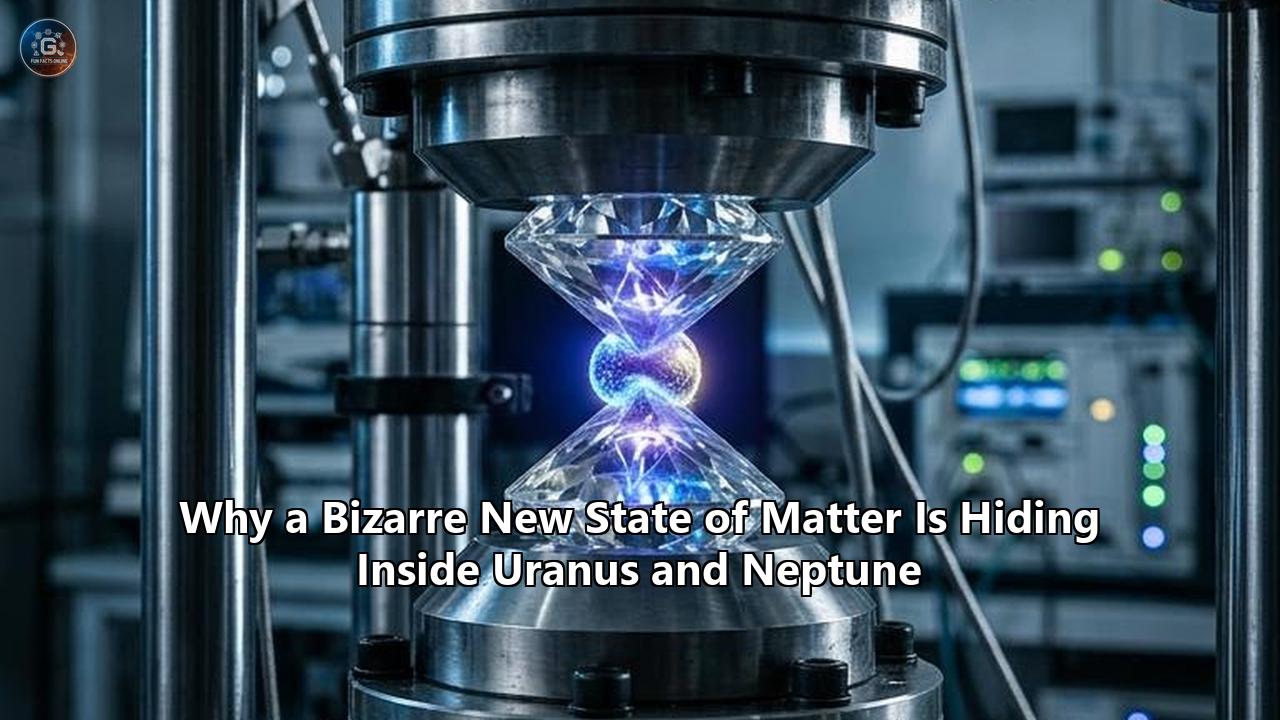
In a diamond anvil cell, a tiny sample of material is placed between the polished tips of two gem-grade diamonds, which are then squeezed together using mechanical force. Because pressure is force divided by area, the microscopic size of the diamond tips allows scientists to reach static pressures of several hundred gigapascals. However, diamonds themselves are prone to cracking under extreme force, and heating the sample to the temperatures found inside Uranus and Neptune (exceeding 5,000 Kelvin) using lasers often causes the diamonds to react chemically with the sample or structurally fail.
2. Laser-Driven Shock Compression
To reach the multi-megabar pressures and solar-surface temperatures required to simulate ice giant mantles, researchers use high-energy laser facilities like the National Ignition Facility (NIF) or the Omega Laser Facility. By focusing massive ultraviolet laser beams onto a target, they launch a high-velocity shockwave that compresses and heats the material. While this method can easily reach 1,000 GPa or more, the extreme state of matter only persists for a fraction of a billionth of a second before the sample is dynamically destroyed, leaving an incredibly narrow window to capture structural data using ultrafast X-ray pulses.
Because of these steep physical limitations, Cong Liu and Ronald Cohen turned to high-performance supercomputers, transforming them into digital planetary probes.
Using advanced quantum-mechanical modeling tools based on Density Functional Theory (DFT)—which calculates the electronic structures and chemical bonds of atoms from first principles—the researchers simulated the exact quantum interactions of carbon and hydrogen atoms under extreme compression.
However, traditional quantum simulations are computationally expensive, often limited to modeling only a few dozen atoms for extremely brief windows of time. To overcome this, the researchers integrated advanced machine-learning algorithms into their workflow.
By training artificial neural networks on quantum-mechanical data, they created highly accurate interatomic potentials. These machine-learning models allowed them to simulate the dynamic thermodynamic behavior of thousands of interacting atoms over much longer timescales, capturing the subtle, complex phase transitions that would otherwise remain invisible in smaller quantum simulations.
This combination of quantum physics and machine learning computed this bizarre state of matter into virtual existence. It allowed the team to map out the exact phase boundary where carbon hydride transitions from a conventional high-pressure solid into the quasi-one-dimensional superionic spiral phase, offering a level of atomic-level detail that no physical laboratory experiment on Earth can match.
The Broader Cosmic Context: Understanding Exoplanets
While this discovery is vital for resolving the mysteries of Uranus and Neptune, its implications stretch far beyond our local solar system.
We are currently living in a golden age of exoplanetary discovery. Astronomers have confirmed the existence of more than 6,000 planets orbiting distant stars.
     Exoplanet Population Distribution by Size (Approx.)

     Earth-sized / Super-Earths:  ████████ 25%
     Sub-Neptunes / Ice Giants:   ██████████████████ 55%  <-- Most common!
     Gas Giants (Jupiters):       ██████ 20%
Among this vast catalog, the most common types of worlds discovered are not rocky Earths or massive Jupiters. Instead, the universe is dominated by "sub-Neptunes" and "mini-Neptunes"—worlds that are roughly two to four times the size of Earth, whose bulk compositions are believed to be rich in volatile water, methane, and ammonia.
Consequently, characterizing the properties of matter inside ice giants is essential for understanding the dynamic processes, geological evolution, and potential habitability of the most common planets in the cosmos.
One of the key variables in determining whether an exoplanet can support life is the presence of a global magnetic field. On Earth, our magnetic field acts as a protective shield, deflecting the stream of charged particles from the Sun (the solar wind) and preventing our atmosphere from being slowly stripped away into space.
If sub-Neptune exoplanets are dominated by anisotropic, quasi-one-dimensional superionic materials like carbon hydride inside their mantles, their magnetic shields will look radically different from Earth's.
Their skewed, multi-polar magnetic fields would create complex magnetospheres, with field lines twisting into highly irregular shapes. Understanding how these asymmetric magnetic fields interact with stellar winds is crucial for astrobiologists trying to model exoplanetary climates, atmospheric retention, and surface radiation environments.
From Extraterrestrial Physics to Earth-Bound Technology
While the primary drive behind this research is planetary exploration, the discovery of highly directional superionic materials has sparked significant interest within the materials science community.
Superionic conductors are highly sought after on Earth for next-generation energy technologies, particularly in the development of solid-state batteries. Unlike standard lithium-ion batteries, which rely on liquid electrolytes that can leak or catch fire, solid-state batteries utilize solid superionic materials that allow lithium ions to flow freely through a rigid solid framework.
       Solid-State Battery Electrolyte Concept

            [Anode] ───► (Li+ Ions) ───► [Cathode]
                             │
                             ▼
             +───────────────────────────────+
             |  L i t h i u m   C h a n n e l |  <-- Highly directional,
             |  ============================ |      fast-ion conduction
             |  L i t h i u m   C h a n n e l |      prevents short circuits.
             +───────────────────────────────+
If materials scientists can synthesize structures with quasi-one-dimensional superionic properties at lower, manageable pressures on Earth, it could lead to highly advanced fast-ion conductors.
In a standard superionic conductor, ions diffuse in all directions, which can sometimes lead to microscopic structural defects (dendrites) that grow through the material and cause short circuits.
A material with highly directional, one-dimensional ion channels would allow engineers to steer the flow of ions with pinpoint precision, drastically improving charge times, structural stability, and energy density in industrial battery designs.
Thus, the extreme quantum simulations used to study the dark, crushing interiors of outer-system planets could help lay the theoretical groundwork for the green energy systems of the future.
Future Horizons: What We Must Watch For Next
The prediction of quasi-one-dimensional superionic carbon hydride represents a major leap in theoretical physics, but several key questions remain unanswered. As we look toward the coming decades of planetary exploration and materials science, several milestones will be critical for validating and expanding upon these findings:
1. The Multi-Component Mixture Problem
Real planetary interiors are not comprised of neat, isolated layers of pure compounds. Inside Uranus and Neptune, carbon hydride exists alongside vast quantities of superionic water ice and superionic ammonia.
How do these different superionic phases interact with one another? Do they remain stratified in distinct, separate layers, or do they mix into a complex "superionic slurry"?
Future computational studies will need to run even larger multi-component quantum simulations to model how water, carbon hydride, and ammonia behave when squeezed together into a single, unified system.
2. Laser-Shock Validation Experiments
The next major milestone for experimental physicists will be finding a way to synthesize and characterize this quasi-one-dimensional state in a laboratory.
Using ultra-powerful facilities such as the European X-ray Free-Electron Laser (European XFEL) or the Linac Coherent Light Source (LCLS) at SLAC, researchers will attempt to shock-compress hydrocarbon polymers (which mimic the carbon-to-hydrogen ratio of carbon hydride) to pressures exceeding 1,100 gigapascals.
By hitting the compressed samples with femtosecond-duration X-ray pulses, they hope to directly image the atomic structure, confirming whether the carbon framework indeed twists into the predicted helical shape while the hydrogen atoms begin their spiral migration.
Experimental Verification Pipeline at SLAC / European XFEL
+-----------------------------------------------------------+
| 1. Sample Prep: Target with precise Carbon-Hydrogen ratio |
+-----------------------------------------------------------+
| 2. Laser Blast: Multi-megabar shockwave targets sample     |
+-----------------------------------------------------------+
| 3. X-Ray Pulse: Femtosecond XFEL captures atomic structure|
+-----------------------------------------------------------+
| 4. Data Analysis: Search for helical carbon diffraction   |
+-----------------------------------------------------------+
3. The Uranus Orbiter and Probe (UOP) Flagship Mission
Ultimately, the most definitive test of these internal models will come from up-close exploration of the ice giants themselves.
In the planetary science community, interest is surging for a dedicated mission to the outer solar system. The 2023–2032 Planetary Science Decadal Survey prioritized NASA's proposed Uranus Orbiter and Probe (UOP) as the highest-priority new flagship mission.
If approved and funded, the UOP mission could launch in the early 2030s, utilizing a gravity assist from Jupiter to arrive at Uranus in the 2040s.
Uranus Orbiter and Probe (UOP) Mission Objectives
* Gravity Mapping: Map the interior density layers of Uranus.
* Atmospheric Probe: Drop a probe directly into the clouds to measure composition.
* Magnetometry: Perform high-resolution mapping of the lopsided magnetic field.
* Dynamos: Trace the exact boundaries of the planet's internal magnetic engine.
The spacecraft would perform two critical tasks to test the existence of superionic layers:
- The Atmospheric Probe: The probe will descend directly into Uranus’s atmosphere, measuring the precise isotopic ratios and abundances of carbon, hydrogen, nitrogen, and oxygen. This will provide the exact chemical constraints needed to refine the internal structural models.
- The Orbiter: Equipped with highly sensitive magnetometers and gravity-mapping instruments, the orbiter will measure the planet’s gravity field and magnetic signature in unprecedented detail as it orbits. By measuring the high-order magnetic moments (the quadrupole and octupole fields), scientists can map the depth, thickness, and conductivity of the internal dynamo layers, potentially confirming whether a highly directional, superionic layer of carbon hydride is indeed driving the planet’s magnetic asymmetric chaos.
The revelation that a highly structured, quasi-one-dimensional superionic state of carbon hydride can exist under the most hostile conditions imaginable shows us that the universe behaves in profoundly elegant ways under pressure. Far from being simple, chaotic mixtures of gas and liquid, the deep mantles of Uranus and Neptune may be home to beautifully ordered, microscopic helical structures, where protons glide along atomic spiral staircases.
As supercomputing, quantum theory, and deep-space exploration continue to converge, we are finally beginning to peer through the thick, colorful clouds of our solar system's outermost worlds, finding that the deep interior of an ice giant is far more exotic than anything we could have ever imagined.
Reference:
- https://carnegiescience.edu/depths-neptune-and-uranus-may-be-superionic
- https://letspace.be/article/a-new-quasi-1d-state-of-matter-could-be-hiding-inside-ice-giant-planets
- https://scitechdaily.com/scientists-uncover-strange-new-state-of-matter-inside-uranus-and-neptune/
- https://carnegiescience.edu/depths-neptune-and-uranus-may-be-superionic
- https://dailygalaxy.com/2026/04/strange-matter-inside-uranus-neptune/
- https://knowridge.com/2026/04/scientists-discover-bizarre-new-state-of-matter-deep-inside-uranus-and-neptune/
- https://www.iflscience.com/unconventional-superionic-state-of-matter-could-exist-deep-within-uranus-and-neptune-83208
- https://www.reddit.com/r/InterstellarKinetics/comments/1srqaiy/discovery_scientists_may_have_found_a_bizarre_new/
- https://www.universetoday.com/articles/a-new-quasi-1d-state-of-matter-could-be-hiding-inside-ice-giant-planets
- https://carnegiescience.edu/depths-neptune-and-uranus-may-be-superionic
- https://www.sciencedaily.com/releases/2026/04/260421042812.htm
- https://www.thebrighterside.news/post/scientists-discover-new-state-of-matter-inside-uranus-and-neptune/
- https://greekreporter.com/2026/04/23/new-state-matter-exist-inside-uranus-neptune/
- https://www.quantamagazine.org/black-hot-superionic-ice-may-be-natures-most-common-form-of-water-20190508/
- https://www6.slac.stanford.edu/news/2026-01-08-exotic-form-ice-just-got-weirder
- https://www.llnl.gov/article/45336/giant-lasers-crystallize-water-shockwaves-revealing-atomic-structure-superionic-ice
- https://www.gfz.de/en/press/news/details/evidence-of-superionic-ice-news-about-the-unusual-magnetic-fields-of-uranus-and-neptune
- https://www.smithsonianmag.com/smart-news/scientists-make-weird-ice-halfway-between-solid-and-liquid-180968053/
- https://www.llnl.gov/article/44081/first-experimental-evidence-superionic-ice
- https://www.sciencedaily.com/releases/2026/01/260112214308.htm
- https://www.supercomputingonline.com/latest/63120-how-hpc-is-revealing-alien-matter-deep-inside-ice-giants
- https://www.iflscience.com/unconventional-superionic-state-of-matter-could-exist-deep-within-uranus-and-neptune-83208
- https://arxiv.org/abs/2601.03659
- https://carnegiescience.edu/news/how-do-ice-giants-maintain-their-magnetic-fields
- https://universemagazine.com/en/depths-of-neptune-and-uranus-may-be-superionic/