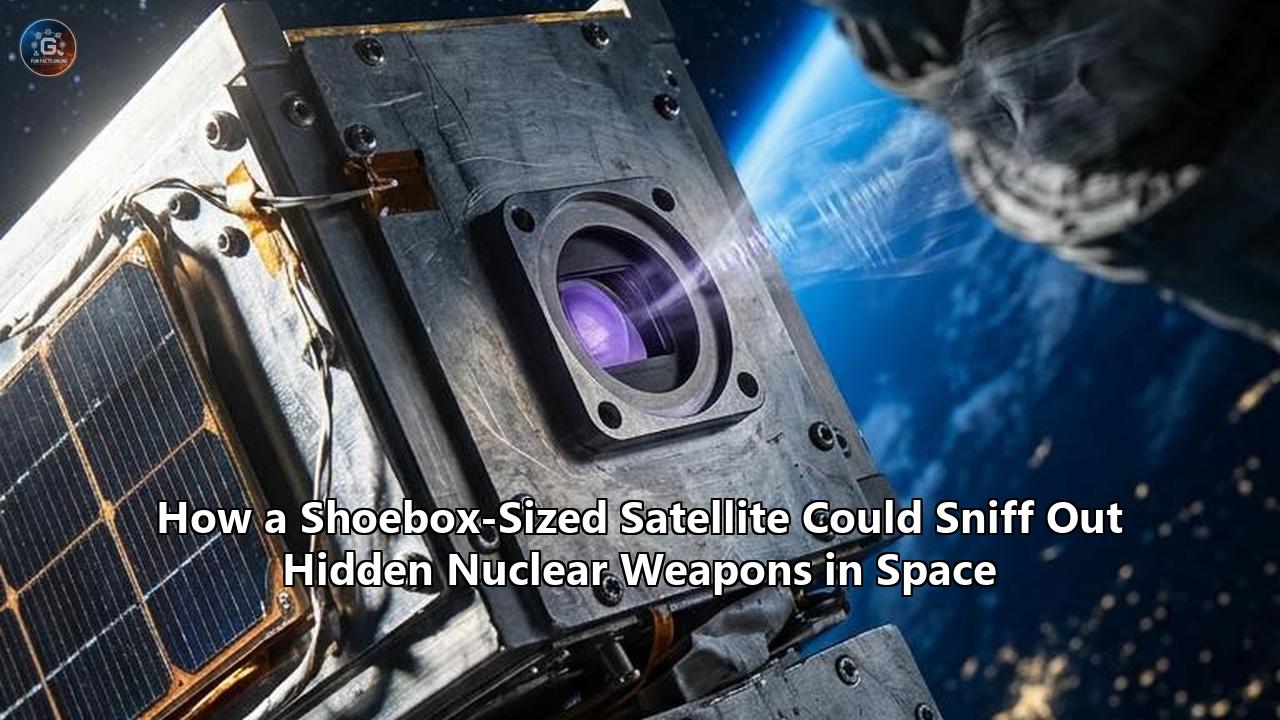
A study published in the journal Nature has unveiled a highly innovative method to solve one of the most perilous security loopholes of the modern age. Led by nuclear physicist Areg Danagoulian of the Massachusetts Institute of Technology (MIT), researchers have proposed a concept for a shoebox-sized satellite that can sniff out hidden nuclear warheads orbiting the Earth. Utilizing commercially available components and a highly specialized dual-sensor radiation detection system, this small satellite offers the first viable, unclassified method to inspect suspicious orbital payloads without resorting to hostile actions.
For decades, the global community has operated under a fragile system of trust regarding the weaponization of space. While treaties prohibit the placement of weapons of mass destruction in orbit, there has never been an objective, technical mechanism to verify compliance. As geopolitical rivalries intensify and Earth's orbit becomes crowded with thousands of critical communication, navigation, and national security satellites, the lack of verification tools has transformed from a diplomatic oversight into an existential vulnerability.
This newly proposed CubeSat concept leverages the harsh environment of space itself to unmask clandestine weapons. By utilizing naturally occurring cosmic protons trapped in Earth's magnetic field, the tiny inspector satellite can passively identify the heavy radioactive materials inside a nuclear warhead from kilometers away. This development could fundamentally alter the landscape of orbital defense, providing a physical mechanism to enforce international treaties and deter a catastrophic conflict in Low Earth Orbit.
The Great Verification Gap: The OST's Invisible Loophole
To understand the significance of this development, one must first look at the foundation of international space law. Negotiated at the height of the Cold War, the Outer Space Treaty of 1967 (OST) serves as the primary constitution for the cosmos. Ratified by 118 nations, including the United States, Russia, and China, Article IV of the treaty explicitly forbids signatories from placing in orbit around the Earth any objects carrying nuclear weapons or any other kinds of weapons of mass destruction.
Yet, the OST suffers from a glaring, systemic flaw: it contains no verification protocols. Unlike terrestrial arms control agreements like the New START treaty or the chemical weapons conventions—which rely on highly intrusive on-site inspections, material tagging, and cooperative monitoring—there is no mechanism to verify what is actually inside a satellite once the fairing of a rocket closes on the launchpad.
Historically, the international community has had no reliable means of detecting nuclear weapons in space before they are detonated. Once a payload is in orbit, it is effectively a black box. If a nation decides to disguise a thermonuclear warhead as a benign meteorological satellite, a communications relay, or a scientific laboratory, ground-based tracking systems are powerless to disprove the cover story. Optical telescopes can image the exterior of the spacecraft, and radar can determine its mass and orbital trajectory, but neither can peer through the satellite's aluminum skin to detect the presence of weapons-grade uranium or plutonium.
This complete lack of transparency has created a dangerous environment of suspicion. Without objective physical proof, any unexpected satellite launch into an unusual orbit can trigger worst-case military assumptions. Conversely, a state violating the treaty can easily dismiss accusations as baseless propaganda, knowing that its adversaries have no way to prove a violation without physically intercepting or destroying the spacecraft—acts that would themselves be interpreted as declarations of war.
The Kosmos 2553 Crisis and the Urgency of Space Weaponization
This theoretical vulnerability became a pressing national security crisis in February 2022, when Russia launched a mysterious satellite designated Kosmos 2553. While the Russian Ministry of Defense claimed the spacecraft was designed to test scientific instruments in high-radiation environments, United States intelligence agencies quickly issued classified warnings to Congress and international allies. The U.S. government asserted that Kosmos 2553 was actually a testbed for a highly specialized, nuclear-armed anti-satellite (ASAT) weapon.
What alarmed analysts most was the satellite’s highly unusual trajectory. Kosmos 2553 was placed into an orbit at an altitude of approximately 2,000 kilometers (1,200 miles)—putting it directly within the lower boundary of the inner Van Allen radiation belt.
+------------------------------------------------------------+
|             THE VAN ALLEN RADIATION BELT ZONE              |
|                                                            |
|  [Inner Belt]  <-- Kosmos 2553 Orbit (~2,000 km altitude)   |
|   Highly dense region of trapped, relativistic protons.    |
|   Normally avoided due to severe electronic degradation.   |
|                                                            |
|  [Low Earth Orbit] <-- Starlink, GPS, Earth Obs (~500 km)  |
|   Vulnerable to persistent radiation fallout from a blast.  |
+------------------------------------------------------------+
For conventional commercial or scientific satellites, this orbit is highly undesirable. The intense, constant bombardment of charged particles in the Van Allen belt rapidly degrades electronic components, shortening the operational lifespan of any spacecraft parked there. However, as MIT's Areg Danagoulian points out, this environment is highly strategic for deploying a orbital weapon.
If a thermonuclear device were detonated within the Van Allen belt, the high-energy electrons and radiation produced by the blast would be corralled and concentrated by the Earth’s magnetic field. Instead of dissipating harmlessly into deep space, this artificial radiation belt would persist for months or even years, repeatedly slicing through Low Earth Orbit and systematically frying the delicate electronics of thousands of unshielded satellites below.
The geopolitical fallout of such an event would be swift and global. The devastating consequences of an orbital detonation underscore why detecting nuclear weapons in space is no longer just a hypothetical arms-control exercise, but an existential necessity for modern infrastructure.
The Orbital Disaster: Starfish Prime in the Megaconstellation Era
The physical realities of a nuclear detonation in space are not theoretical; they were demonstrated during the Cold War. On July 9, 1962, the United States conducted the "Starfish Prime" test, detonating a 1.4-megaton thermonuclear warhead at an altitude of 400 kilometers (240 miles) above Johnston Island in the Pacific Ocean.
The results were catastrophic, even for an era with minimal space assets. The explosion created an intense electromagnetic pulse (EMP) that knocked out streetlights and telephone lines in Hawaii, some 1,450 kilometers (900 miles) away. More importantly, the blast injected highly energetic beta particles into the Earth's magnetosphere, creating an artificial radiation belt that lingered for years. This persistent radiation eventually destroyed at least one-third of all satellites in orbit at the time, including Telstar 1, the world’s first active communications satellite.
At the time of Starfish Prime, there were fewer than 100 active artificial satellites orbiting the Earth. Today, the orbital landscape is vastly different. Low Earth Orbit is populated by thousands of operational satellites. Society has become utterly dependent on these networks for:
- Global Broadband Communications: Megaconstellations like SpaceX's Starlink and Amazon's Project Kuiper beam high-speed internet to the most remote corners of the globe, supporting critical civilian, industrial, and military operations.
- Positioning, Navigation, and Timing (PNT): GPS, Galileo, and BeiDou networks synchronize global banking systems, direct commercial aviation, coordinate cargo shipping, and guide precision munitions.
- Earth Observation and Climate Monitoring: Satellites provide real-time weather forecasting, track environmental degradation, monitor agricultural outputs, and provide early warning of natural disasters.
- National Security Reconnaissance: Military forces rely on orbital platforms to detect missile launches, track troop movements, and verify terrestrial arms control agreements.
A modern space detonation would not simply knock out a handful of military payloads. It would destroy the global digital commons. The resulting "nuclear winter" in space would render Low Earth Orbit completely unusable for years, destroying trillions of dollars in infrastructure and crippling the global economy. Because of these immense stakes, the international community has urgently sought a way to identify orbital threats before a crisis erupts—but the physics of detection have long stood as an insurmountable barrier.
Why Conventional Inspection Methods Fail
The fundamental challenge of identifying a nuclear warhead in space lies in the physics of radioactive decay. Weapons-grade materials, such as highly enriched uranium-235 (HEU) or plutonium-239, are indeed radioactive, naturally emitting gamma rays and neutrons. However, these emissions are remarkably weak. Under normal conditions, the spontaneous fission rate of uranium-235 is extremely low, and plutonium warheads are heavily shielded to protect nearby electronic components and personnel.
At a distance of just 10 to 20 meters (30 to 65 feet), the passive radiation signature of a shielded nuclear warhead drops so low that it is completely indistinguishable from the natural, noisy background radiation of cosmic rays. To detect a weapon using standard radiation detectors, an inspector satellite would have to maneuver within mere meters of a target.
Such close-proximity operations are incredibly complex, highly dangerous, and politically explosive. Maneuvering an uninvited spacecraft within spitting distance of a highly classified military satellite owned by an adversary would immediately be interpreted as a hostile act. The target nation could reasonably assume the inspector was attempting to disable, hijack, or physically damage its payload, potentially triggering an immediate defensive kinetic or laser strike, leading to rapid military escalation on Earth.
To circumvent this, some defense theorists have proposed "active interrogation". In this scenario, an inspecting spacecraft would fire a high-energy particle beam or a stream of X-rays at the suspect satellite. This beam would penetrate the satellite's shielding, strike the nuclear material inside, and force it to undergo fission, releasing a highly visible flash of gamma rays and neutrons that could be detected from a safe distance.
However, active interrogation is highly escalatory. Firing high-energy radiation beams at an adversary's space assets is functionally indistinguishable from an electronic attack. It risks damaging the target's sensitive components, violating international law, and triggering an immediate military counter-response.
This is the great technical deadlock that has paralyzed space arms control for nearly sixty years: passive ground-based and space-based sensors cannot see inside a satellite, close passive flybys are too dangerous, and active space-based probing is highly provocative.
The Breakthrough: Let Cosmic Physics Do the Probing
The brilliance of the solution proposed by MIT's Areg Danagoulian lies in its ability to bypass this deadlock entirely by letting nature perform the active probing. Rather than firing a man-made particle beam at a suspect spacecraft, the proposed system utilizes the high-energy cosmic protons that are already naturally trapped within the Earth's inner Van Allen radiation belt.
Deep space is filled with cosmic rays—extremely high-energy protons traveling at relativistic speeds. When these protons encounter Earth, they are captured by the planet's magnetic field, concentrating into the Van Allen radiation belts. In the inner belt, these protons possess kinetic energies in the gigaelectronvolt (GeV) range.
When one of these relativistic, GeV-range protons strikes a heavy, highly dense atomic nucleus—such as the uranium-235 or plutonium-239 found in a nuclear warhead—it triggers a violent nuclear reaction known as proton-induced neutron spallation. The high-energy proton essentially crashes into the target nucleus, transferring immense energy and causing the nucleus to violently disintegrate or fission.
   Relativistic Proton
     (GeV Energy)
          │
          ▼
   +--------------+      Proton-Induced Spallation
   | Heavy Nuclei | ──────────────────────────────────► [ Massive Neutron Flux ]
   |  (U or Pu)   |                                      (10 to 40 Neutrons per collision)
   +--------------+
          ▲
          │  Contrast
   +--------------+
   | Light Alloys | ──────────────────────────────────► [ Minimal / No Neutrons ]
   | (Al, Plastic)|
   +--------------+
This spallation process is incredibly efficient. A single energetic proton colliding with a heavy uranium nucleus can knock loose anywhere from 10 to 40 secondary neutrons. Crucially, the light materials that make up the vast majority of standard satellites—such as structural aluminum, carbon fiber composites, copper wiring, and solar-panel silicon—have very small atomic nuclei. When relativistic protons strike these light materials, spallation is virtually non-existent, yielding almost no secondary neutrons.
If a satellite carries a significant mass of uranium or plutonium (such as the 95-kilogram core typical of a thermonuclear weapon), the natural cosmic proton bombardment will cause it to continuously emit a massive, highly distinctive cloud of secondary neutrons—amounting to an estimated 30 million neutrons per second.
By leveraging this natural cosmic bombardment, Danagoulian’s model transforms the harsh radiation environment of orbit from a hazard into a key asset for detecting nuclear weapons in space. Because the source of the probing beam is entirely natural cosmic radiation, an inspector satellite can remain completely passive. It does not need to emit any signals, beams, or active pulses; it simply "listens" for the telltale, directionally targeted neutron signature naturally radiating from the suspect satellite. The country operating the target satellite has zero physical or legal grounds to claim they are being attacked or actively harassed.
Inside the Shoebox: The Dual-Sensor CubeSat Architecture
To detect these secondary neutrons, Danagoulian’s paper proposes the deployment of a "9U" CubeSat. A CubeSat is a highly standardized class of nanosatellites built in modular, 10-centimeter cubes (referred to as "U" units). A 9U CubeSat measures approximately 30 by 30 by 10 centimeters—roughly the dimensions of a large shoebox or an encyclopedia.
Building the detector platform on a CubeSat scale is crucial for three major reasons:
- Affordability: Traditional military spy satellites cost hundreds of millions of dollars to build and launch. In contrast, CubeSats utilize commercial off-the-shelf (COTS) components, bringing the cost down to a fraction of a percent of a standard military payload.
- Deployability: Because they are lightweight and compact, dozens of CubeSats can be rideshared into orbit on a single commercial launch vehicle, allowing for the rapid deployment of an entire monitoring constellation.
- Political Deniability: Small, standardized scientific CubeSats are inherently non-threatening. They do not carry kinetic weapons, lasers, or heavy electronic warfare gear, making it impossible to portray them as offensive interceptors.
However, packing a sophisticated nuclear physics laboratory into a shoebox-sized chassis is an immense engineering challenge. The inner Van Allen radiation belt is an incredibly noisy environment, swarming with billions of charged protons and electrons. If a standard neutron detector were placed in this zone, the sheer volume of background charged particles would immediately saturate and blind the sensors, making it impossible to isolate the weak signal of neutrons coming from a target warhead.
To overcome this, the proposed CubeSat utilizes a highly innovative, dual-sensor hybrid architecture:
+-------------------------------------------------------------+
|             CUBESAT DUAL-DETECTOR ARCHITECTURE              |
|                                                             |
|   [ Incoming Cosmic Background ]   [ Incoming Signal ]      |
|         (Protons, Electrons)           (Neutrons Only)      |
|                 │                             │             |
|                 ▼                             ▼             |
|        +─────────────────+           +─────────────────+    |
|        | Diamond Detector|           | Diamond Detector|    |
|        |     (Fires)     |           |  (Does Not Fire)│    |
|        +─────────────────+           +─────────────────+    |
|                 │                             │             |
|                 ▼                             ▼             |
|        +─────────────────+           +─────────────────+    |
|        |Neutron Scintil. |           |Neutron Scintil. |    |
|        |     (Fires)     |           |     (Fires)     |    |
|        +─────────────────+           +─────────────────+    |
|                 │                             │             |
|                 ▼                             ▼             |
|          [DISCARD DATA]               [VALID NEUTRON]       |
+-------------------------------------------------------------+
The Central Scintillator
At the core of the sensor system are two parallel panels made up of pixels of neutron scintillators. These scintillators are specialized plastics or organic crystals that emit a tiny, brief flash of visible light whenever they are struck by a neutral neutron or a charged proton. Sensitive photodetectors register these light pulses and convert them into electrical signals.
The Diamond Cage
To prevent the background protons from corrupting the data, the central scintillators are sandwiched inside an outer "cage" composed of ultra-thin, synthetic single-crystal diamond detectors. Because diamond is extremely radiation-hard and has a high electrical bandgap, it is an exceptionally efficient detector for charged particles, but it is completely invisible to neutral neutrons.
This physical difference allows the CubeSat’s onboard processor to implement a simple, real-time veto logic:
- If both the outer diamond detector and the inner scintillator register a strike simultaneously, the incoming particle carries an electric charge (a background proton or electron). The system immediately discards this data point.
- If the inner scintillator registers a flash, but the surrounding diamond cage remains silent, the particle must be electrically neutral. This confirms the arrival of a neutron, and the data point is recorded.
Directional Resolution
By utilizing two parallel planes of these pixelated scintillator panels, the sensor is capable of acting like a pinhole camera for radiation. By calculating which specific pixels are struck in the front panel versus the rear panel, the onboard computer can reconstruct the exact directional vector of the incoming neutron flux. This allows the CubeSat to ignore background neutrons reflecting off the Earth’s atmosphere or deep-space cosmic rays, focusing its "vision" solely on the narrow angular window occupied by the target satellite.
Operational Scenarios: Shadowing vs. Flybys
In a practical orbital inspection scenario, a country or international verification body would identify a newly launched, suspicious satellite—such as a payload placed into a high-radiation orbit like Kosmos 2553. A dedicated 9U detection CubeSat would then be launched or maneuvered to rendezvous with the suspect target.
According to Danagoulian’s mathematical modeling, the inspection timeline is directly dictated by proximity.
The Shadowing Scenario (4-Kilometer Range)
If the CubeSat maintains a highly conservative, non-threatening distance of 4 kilometers (about 2.5 miles) from the suspect satellite, the physical separation prevents any risk of collision or interference. At this distance, the neutron flux is relatively diffuse. The CubeSat’s dual-sensor system would need to shadow the target satellite for approximately one week of continuous observation. Over this seven-day period, the sensor would accumulate enough valid neutron counts to verify the presence of a thermonuclear warhead with an extraordinary 99 percent statistical accuracy.
The Fast Flyby Scenario (1-Kilometer Range)
If diplomatic urgency requires a rapid answer, or if the target satellite is highly maneuverable, the CubeSat can be commanded to perform a closer pass. If the inspector satellite can safely close the distance to 1,000 meters (about 3,300 feet), the intensity of the incoming neutron flux increases exponentially. At this range, the system can confidently detect a nuclear weapon in just one hour. This would allow a single, rapid flyby to act as a definitive screening mechanism, immediately flagging a violation.
The Constellation Approach
For continuous, real-time global monitoring, the study proposes deploying a cooperative constellation of these tiny CubeSats. A network of ten strategically placed "sniffer" satellites could monitor multiple high-risk orbits simultaneously. If a suspect payload passes through their sector, the combined data from multiple sensors could verify the presence of a weapon in a matter of hours from the safer, non-provocative 4-kilometer distance, combining the high speed of a close flyby with the safety of a long-distance shadow.
Geopolitical and Diplomatic Implications
The realization of a physical method for detecting nuclear weapons in space could profoundly rewrite the geopolitics of orbital defense and arms control. Historically, arms control has been plagued by the "security dilemma," where defensive postures are easily misinterpreted as offensive preparations. The passive, low-cost nature of the CubeSat sniffer dismantles this dilemma.
                  OLD COLD WAR DILEMMA
+─────────────────────────────────────────────────────────+
| Active Probing / Close Interception = Hostile/Escalatory |
|                         OR                              |
| Complete Blindness / No Verification = Vulnerable Loophole |
+─────────────────────────────────────────────────────────+
                            │
                            ▼
                NEW PASSIVE CUBESAT SOLUTION
+─────────────────────────────────────────────────────────+
|   Passive Neutron Listening = Safe, Non-Threatening      |
|                         AND                              |
|   99% Verification Accuracy = Enforceable Space Treaties |
+─────────────────────────────────────────────────────────+
Establishing a Space verification Agency
Just as the Comprehensive Nuclear-Test-Ban Treaty Organization (CTBTO) operates a global network of seismic, infrasound, and radionuclide stations to ensure no nuclear explosion on Earth goes unnoticed, a similar international body could be established for outer space.
Armed with a fleet of standardized, low-cost 9U CubeSats, such an agency could conduct routine, unbiased inspections of any satellite orbiting in high-risk zones. If a nation launches a satellite into a highly radioactive orbit like the inner Van Allen belt, the international community would no longer have to rely on classified, unilateral intelligence reports from the United States or its allies. A neutral, international CubeSat could be dispatched to verify compliance, publishing the objective, unclassified physical data for the entire world to see.
Strategic Deterrence
The mere existence of a viable detection system acts as a powerful deterrent. Historically, nations have contemplated deploying clandestine orbital weapons because they believed they could hide them indefinitely behind a veil of diplomatic denial and commercial proprietary secrets.
If a state knows that any suspicious satellite will inevitably be shadowed and unmasked by a shoebox-sized probe within days of launch, the strategic utility of a secret orbital weapon evaporates. The violating nation would face severe international condemnation, economic sanctions, and the immediate legal termination of its space programs, all without ever achieving the element of surprise.
Overcoming the Remaining Technical Hurdles
While the underlying physics of proton-induced spallation and dual-sensor veto logic are sound, transferring this concept from mathematical simulations in Nature to a physical deployment in Earth orbit requires overcoming several formidable engineering challenges.
Radiation Hardening of COTS Electronics
The inner Van Allen belt is a notoriously hostile environment for small satellites. Most CubeSats are built using cheap, commercial-grade microprocessors and sensors that are highly vulnerable to Single Event Upsets (SEUs) and total ionizing dose (TID) damage.
If a 9U CubeSat is to survive the weeks or months required to rendezvous with, shadow, and analyze a suspect target in this high-radiation zone, its core systems—including its communications array, solar charging controllers, and thruster computers—must undergo specialized radiation hardening. While this increases the cost of the CubeSat relative to standard educational models, the cost remains a tiny fraction of a traditional monolithic satellite.
Micro-Propulsion and Guidance
Rendezvousing with an uncooperative satellite in the vastness of space requires highly precise orbital maneuvering. A 9U CubeSat has extremely limited space and mass capacity for fuel and thrusters.
To make this detection system practical, developers must integrate highly efficient micro-propulsion systems, such as miniature cold-gas thrusters, pulsed plasma thrusters, or electric electrospray propulsion. These systems must be capable of executing precise orbit-matching maneuvers, keeping the tiny inspector parked exactly 4 kilometers away from a target that may be actively trying to drift or change its orbit.
Countermeasures and Shielding
If the CubeSat sniffer becomes a reality, adversary nations will undoubtedly seek ways to bypass it. The most obvious countermeasure is shielding. Could a nation surround its space-based nuclear weapon with a thick layer of a light, hydrogen-rich material like polyethylene or water to absorb the secondary neutrons, or a heavy material like lead to block the incoming cosmic protons?
Fortunately, physics makes effective shielding in space highly impractical. To block relativistic, GeV-range cosmic protons or to absorb a massive flux of high-energy secondary neutrons would require shields that are meters thick and weigh tens of thousands of kilograms.
Adding such monumental weight to a satellite would require a massive, highly visible heavy-lift rocket launch, immediately flagging the payload to global tracking networks. Furthermore, a heavily shielded satellite would be an incredibly sluggish, unmaneuverable target, severely limiting its strategic utility and making it an obvious anomaly in space tracking catalogs.
What to Watch: The Next Steps for Space Non-Proliferation
As the international community grapples with the rapid weaponization of orbit, the focus now shifts from theoretical calculations to physical technology demonstrations. Over the next few years, several key milestones will determine whether this shoebox-sized satellite becomes the standard-bearer for space arms control:
- Prototype Construction and Vacuum Chamber Testing: Researchers must construct physical prototypes of the hybrid "diamond cage" and scintillator sensors. These prototypes will need to be exposed to high-energy proton and neutron beams at terrestrial particle accelerators, such as those at the Los Alamos National Laboratory or CERN, to verify the efficiency of the charged-particle veto logic under simulated orbital conditions.
- Demonstration Missions: A leading scientific university, space agency, or coalition of nations will need to fund a technology demonstration mission. This would involve launching a prototype 9U CubeSat into the inner Van Allen belt to measure the natural background neutron flux and verify that the directional sensor arrays can successfully operate in the real-world magnetosphere.
- Diplomatic Integration: Policymakers in Washington, Brussels, Geneva, and beyond must begin the arduous work of integrating space-based verification into international law. Discussions must be held on how to legally define "non-offensive proximity operations" and how to establish clear, internationally accepted protocols for deploying inspector satellites to resolve security disputes.
The publication of Areg Danagoulian's study has fundamentally changed the conversation around space security. By demonstrating that a low-cost, shoebox-sized satellite can harness the natural laws of cosmic physics to unmask the world's most destructive weapons, science has provided a concrete path forward.
The technical blueprint is now on the table. Whether the international community possesses the political courage and diplomatic foresight to build, launch, and deploy these orbital sentinels will ultimately decide whether Earth's orbit remains a peaceful domain of global progress or descends into a catastrophic theater of conflict.
Reference:
- https://www.natureasia.com/en/info/press-releases/detail/9381
- https://www.sciencenews.org/article/satellite-nuclear-weapons-space
- https://biz.chosun.com/en/en-science/2026/07/09/BVZMJILFWFGK7BDI2A4Q7JABKE/
- https://www.space.com/space-exploration/satellites/shoebox-sized-detector-satellites-could-sniff-out-a-nuclear-bomb-in-space
- https://news.mit.edu/2026/mit-researcher-proposes-way-to-detect-nuclear-weapons-in-space-0708
- https://physicsworld.com/a/satellite-based-sensor-system-designed-to-detect-nuclear-weapons-in-space/
- https://www.indiatoday.in/science/story/tiny-cubesat-detect-hidden-nuclear-weapons-space-outer-space-treaty-explained-2943916-2026-07-09
- https://www.columbiagorgenews.com/news/national/mit-scientist-invents-new-way-to-detect-nuclear-weapons-in-space/article_76f4c7e7-bd86-5dfc-8c44-92e7db22632d.html
- https://daily.dev/posts/l3a7g259d
- https://meduza.io/en/feature/2026/07/16/the-u-s-says-russia-is-building-a-nuclear-weapon-for-space-but-how-would-you-prove-there-s-a-warhead-inside-a-satellite-1-200-miles-up
- https://www.reddit.com/r/science/comments/1uqvjqx/a_shoeboxsized_satellite_could_expose_hidden/