On May 12, 2026, a landmark paper published in Physical Review Letters quietly upended three decades of orthodox gravitational physics. Entitled "Analytic Discrete Self-Similar Solutions of Einstein-Klein-Gordon at Large D," the study—co-authored by theoretical physicists Christian Ecker of Goethe University Frankfurt, alongside Florian Ecker and Daniel Grumiller of the Vienna University of Technology (TU Wien)—presented the first exact, "paper-and-pencil" mathematical formula describing the absolute boundary of gravitational collapse.
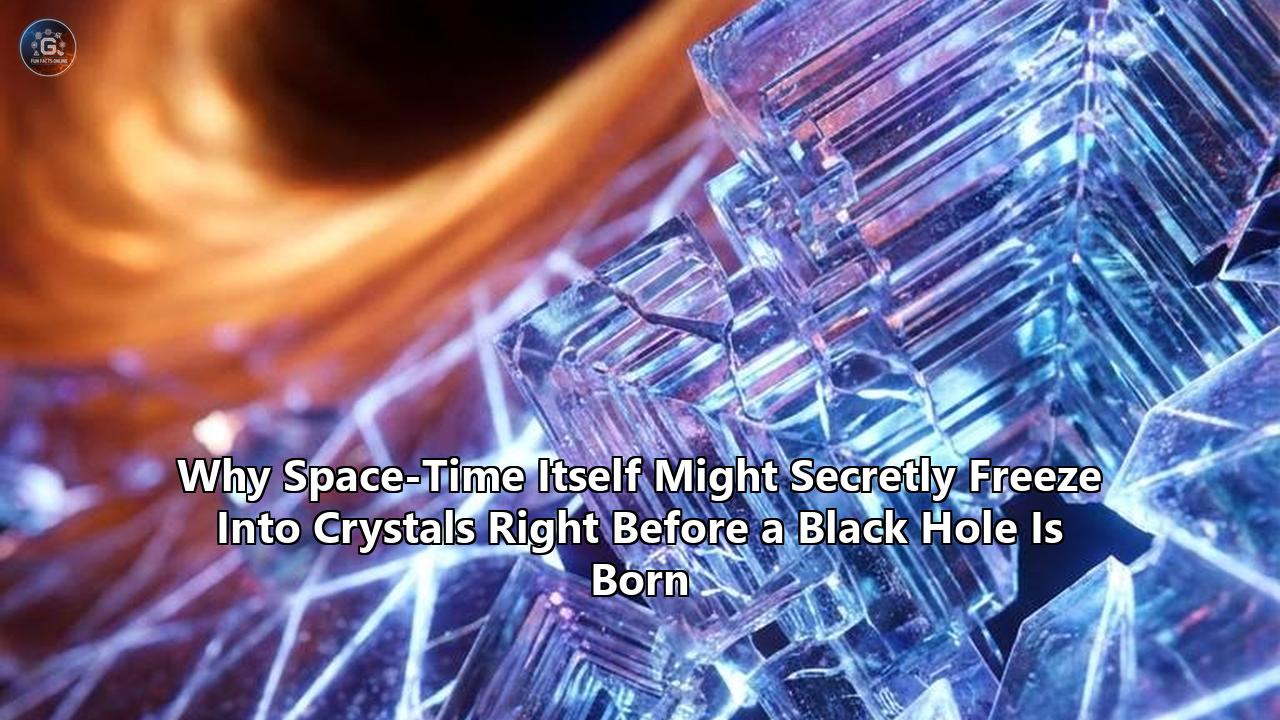
For thirty-three years, physicists had known only through brutal, supercomputer-driven numerical simulations that the threshold of black hole formation is governed by a bizarre, repeating pattern. Now, with an elegant mathematical formulation utilizing an infinite-dimensional spatial limit ($D \to \infty$), the German-Austrian team proved that right at this critical tipping point, the smooth fabric of spacetime undergoes a dramatic structural phase transition. It spontaneously freezes into a highly ordered, self-similar, repeating geometry: a "spacetime crystal".
Poised on a thermodynamic knife-edge, this transient crystalline state of space and time is so volatile that the injection of an infinitesimally small quantity of energy—the physical equivalent of a light tap on a glass of supercooled water—triggers an instantaneous, non-linear cascade. The crystal shatters, and its remains collapse to form a microscopic black hole.
This discovery does more than resolve a mathematical bottleneck that has persisted since 1993. It provides a rigorous, analytical foundation for the birth of primordial black holes in the early universe, calculates the exact scaling exponents of gravity under extreme conditions, and offers an entirely new lens through which we can understand how space, time, and information are woven together.
The Zero-Point Tipping Point: Spacetime Crystallization
In classical general relativity, gravity is not a force but a consequence of the geometry of spacetime. Massive objects warp the four-dimensional manifold of space and time, and that warppage dictates the trajectories of matter and light. When a massive star burns through its nuclear fuel, its outward radiation pressure drops. Gravity, unchecked, compresses the remaining core. If the core exceeds the Tolman-Oppenheimer-Volkoff limit—approximately $2.17$ solar masses—nothing in the known universe can halt its collapse, resulting in the birth of an astrophysical black hole.
Yet, Einstein’s field equations also permit a much more delicate, scale-free regime of collapse. This is "critical collapse," first mapped numerically in 1993 by Canadian physicist Matthew Choptuik.
| Physical System | Ordered Phase | Disordered / Dynamic Phase | Critical Boundary State |
|---|---|---|---|
| H₂O Molecules | Hexagonal Ice Crystal | Liquid Water | Supercooled Liquid (0°C) |
| Spacetime Curvature | Microscopic Black Hole | Dispersive Radiation | Spacetime Crystal (DSS State) |
To understand this phenomenon, imagine a spherical wave of pure energy—such as a massless scalar field—imploding toward a single central point in space. The fate of this wave depends entirely on its initial amplitude, represented by a control parameter $p$.
- *The Subcritical Regime ($p < p^$): If the initial energy amplitude is too low, the incoming wave will compress, generate a temporary region of strong gravitational curvature, and then completely disperse back out to infinity, leaving behind empty, flat Minkowski spacetime.
- The Supercritical Regime ($p > p^$): If the initial energy exceeds a critical value, the concentration of mass-energy within its own Schwarzschild radius is so high that an event horizon forms. A black hole is born, trapping the remaining energy inside its dark boundary.
- The Critical Tipping Point ($p = p^$): Exactly at the boundary between complete dispersion and black hole formation*, the system converges toward a universal, intermediate attractor. It is here, at the infinitely thin dividing line $p^$, that the Ecker-Ecker-Grumiller paper has mapped the existence of a "critical spacetime crystal".
                     [ Initial Scalar Wave (Parameter p) ]
                                      |
                     +----------------+----------------+
                     |                                 |
              Subcritical (p < p*)             Supercritical (p > p*)
                     |                                 |
         [ Complete Dispersion ]               [ Black Hole Born ]
                     |                                 |
                     +--------> [ p = p* ] <-----------+
                                (Tipping Point)
                                      |
                         [ SPACETIME CRYSTAL BORN ]
                                      |
                        +-------------+-------------+
                        |                           |
                 (No Intervention)             (Tiny Nudge, dE > 0)
                        |                           |
               [ Dissolves to Flat ]       [ Micro-Black Hole ]
As Daniel Grumiller explained, this state is physically analogous to liquid water held precisely at $0^\circ\text{C}$ ($32^\circ\text{F}$).
"Sometimes a tiny, seemingly insignificant cause is enough to trigger a huge and dramatic change. Take liquid water at zero degrees Celsius, for example. A very small change is enough to make the water freeze. The water molecules then spontaneously arrange themselves into a regular pattern and form an ice crystal."
In the critical gravitational state, spacetime behaves in exactly the same manner. Rather than remaining a chaotic, dynamically shifting well of energy, the gravitational field organizes its curvature into a highly structured, self-similar, repeating lattice. It "freezes" into a spacetime crystal.
This state is highly unstable. Left entirely alone, the quantum fluctuations of the surrounding field will eventually cause the crystal to dissolve, dispersing its energy harmlessly back into the cosmos. However, if an arbitrarily small perturbation—an energetic whisper, a single photon, or a fractional change in field density—nudges the system, the spacetime crystal undergoes an immediate collapse. The repeating geometric patterns snap together, locking behind a newborn event horizon.
The Mathematics of Critical Collapse: From Choptuik's 1993 Grids to the Large-D Limit
To appreciate why the May 2026 analytical formula is such a profound step forward, one must understand the sheer computational violence required to study critical collapse prior to this breakthrough.
When Matthew Choptuik set out to solve the Einstein-massless-Klein-Gordon system in spherical symmetry, he was dealing with a system of coupled, non-linear partial differential equations (PDEs). Under spherical symmetry, the spacetime metric can be written in double-null coordinates $(u, v)$ or in Schwarzschild-like coordinates:
$$ds^2 = -e^{2\sigma(r,t)} dt^2 + e^{2\lambda(r,t)} dr^2 + r^2 d\Omega^2_{D-2}$$
where $d\Omega^2_{D-2}$ represents the metric on a $(D-2)$-dimensional unit sphere. The matter source is a real, massless scalar field $\psi(r, t)$, whose energy-momentum tensor is given by:
$$T_{\mu\nu} = \partial_\mu \psi \partial_\nu \psi - \frac{1}{2} g_{\mu\nu} g^{\alpha\beta} \partial_\alpha \psi \partial_\beta \psi$$
The system of equations that dictates the evolution of this field consists of the Einstein field equations, $G_{\mu\nu} = 8\pi G T_{\mu\nu}$, coupled to the wave equation for the scalar field, $\square \psi = 0$.
The Phenomenon of Discrete Self-Similarity (DSS)
Choptuik’s simulations revealed that as the control parameter $p$ is fine-tuned closer and closer to $p^$, the collapsing scalar field begins to exhibit a property known as Discrete Self-Similarity (DSS).
Mathematically, a spacetime is discretely self-similar if there exists a coordinate system $(x, \tau)$ in which all dimensionless physical quantities $Z(x, \tau)$ are periodic in the logarithmic time variable $\tau$:
$$\tau = -\ln(t_ - t)$$
$$x = \frac{r}{t_ - t}$$
where $t_$ is the accumulation time of the collapse (the moment the singularity would form). The periodicity of the system is characterized by a universal constant called the echoing period, denoted by $\Delta$:
$$Z(x, \tau + \Delta) = Z(x, \tau)$$
In four-dimensional spacetime ($D=4$), Choptuik’s simulations yielded a highly precise value for this echoing period:
$$\Delta \approx 3.445453$$
This echoing period has a staggering physical implication. The spatial and temporal structures of the collapsing wave repeat themselves on progressively smaller scales. Each successive "echo" of the wave is smaller in both its spatial extent and its duration by a factor of:
$$e^\Delta = e^{3.445453} \approx 31.36$$
As the collapse zooms toward the central point, the wave configuration is replicated on a scale $31.36$ times smaller, then $983.4$ times smaller, then $30,845$ times smaller, and so on, cascading downward in an infinite, fractal geometric progression toward a central, naked singularity.
Scale Echoing Cascade (Factor of 31.36 per step):
========================================================================
Echo 0 (Initial Scale):  |-------------------- r --------------------|
Echo 1 (Zoom 31.36x):                         |-- r/31 --|
Echo 2 (Zoom 983x):                              |-r/983-|
Echo 3 (Zoom 30,845x):                             |...|
========================================================================
Singularity Point:                                  (0) -> Curvature = ∞
The Computational Bottleneck
For three decades, resolving this behavior numerically was one of the most demanding tasks in computational astrophysics. Because the scale of the collapse shrinks by a factor of over $30$ with each echo, standard static spatial grids quickly run out of resolution.
To track the collapse over just 4 or 5 echoes, a simulation must resolve features that span more than 6 orders of magnitude in spatial scale. This required the development of Adaptive Mesh Refinement (AMR). AMR algorithms dynamically insert nested, higher-resolution sub-grids around the center of the collapse.
At each successive hierarchy level, the grid spacing is halved. To resolve the Choptuik solution to a level where the universal constants could be extracted with high precision, researchers had to run simulations with:
- Over 15 levels of nested grid refinement.
- Effective grid resolutions exceeding $1:10^9$ near the center.
- Real-time monitoring of the local curvature scalar $R = g^{\mu\nu} R_{\mu\nu}$, which spikes by factors of $10^{15}$ or more during the late-stage echoes.
Because of the highly non-linear, chaotic nature of Einstein's field equations, these simulations were prone to numerical instability. A tiny round-off error at Level 2 of the grid would propagate exponentially, destroying the self-similarity by Level 5. Consequently, physicists could only study this regime computationally, with no analytical proof that these repeating patterns were true, mathematically stable solutions of general relativity rather than numerical artifacts.
Bypassing Supercomputers via the Large-D Limit
The breakthrough achieved by Christian Ecker, Florian Ecker, and Daniel Grumiller in 2026 was to bypass these supercomputers entirely through a clever mathematical reform: treating the number of spatial dimensions $D$ as a free, continuous variable that can be taken to infinity ($D \to \infty$).
[ Einstein's Field Equations in D=4 ]
  (Non-linear PDEs, highly coupled, analytically insolvable)
                  |
                  |  (Treat Dimension D as continuous parameter: D -> ∞)
                  v
[ General Relativity in the Large-D Limit ]
  (Gravitational fields collapse into infinitely thin membranes;
   Radial gradients scale as O(D), Angular gradients scale as O(1))
                  |
                  |  (Decoupling of radial/angular degrees of freedom)
                  v
[ Leading-Order (LO) Simplification ]
  (Field equations reduce to a single, tractable ODE: β(τ))
                  |
                  |  (Solve analytically for periodic β(τ))
                  v
[ Exact "Paper-and-Pencil" Solution for the Spacetime Crystal ]
This "Large-D" technique, originally developed by physicists like Roberto Emparan in the mid-2010s, exploits a unique geometric simplification. When the number of spatial dimensions becomes very large, the gravitational field of a compact object becomes highly localized. The radial gradient of the gravitational potential scales as $O(D)$, meaning that the gravitational force drops off extremely rapidly as one moves away from the source.
At the leading-order (LO) limit of $1/D$, the non-linear partial differential equations of general relativity decouple. The entire radial structure of the spacetime is compressed into an infinitely thin, highly dynamic membrane, and the field equations reduce to a system of ordinary differential equations (ODEs) that can be solved analytically.
By setting up the Einstein-massless-Klein-Gordon system in $D$ dimensions and performing a systematic expansion in powers of $1/D$, the Ecker-Ecker-Grumiller team found that the entire dynamic behavior of the critical collapse is encoded in a single, bounded function of the logarithmic self-similar time $\tau$:
$$\beta(\tau)$$
At leading order, the metric functions and the scalar field $\psi$ can be written explicitly in closed, algebraic forms as functions of $\beta(\tau)$ and a transformed radial coordinate.
The transition from a continuous, smooth collapse to a discretely repeating spacetime crystal is determined entirely by the boundary conditions of this function. If $\beta(\tau)$ is chosen to be a constant, the equations describe a Continuously Self-Similar (CSS) spacetime. But if $\beta(\tau)$ is periodic—meaning $\beta(\tau + \Delta) = \beta(\tau)$—the solution is Discretely Self-Similar (DSS).
This is the exact, analytic description of the Choptuik spacetime crystal, derived not with a cluster of supercomputers, but with a pen and a sheet of paper.
Anatomy of a Spacetime Crystal: Periodic Trajectories and Self-Similar Horizons
What does a critical spacetime crystal actually look like? It is not a static lattice of atoms frozen in space, like a diamond or a quartz crystal. Instead, it is a dynamic, highly ordered configuration of the gravitational field itself, where the very geometry of space and time oscillates with perfect, repeating periodicity.
In an ordinary spatial crystal, the physical properties of the material are invariant under discrete translations in space:
$$\mathbf{x} \to \mathbf{x} + \mathbf{a}$$
where $\mathbf{a}$ is a lattice vector. In a temporal crystal (first proposed by Frank Wilczek in 2012), the ground state of a quantum system undergoes spontaneous symmetry breaking to exhibit periodic oscillations in time:
$$t \to t + T$$
A critical spacetime crystal combines and generalizes these concepts within a relativistic framework. It is invariant under a joint, discrete scale translation of both space and time.
   Relativistic Symmetry Classifications:
   ----------------------------------------------------------------------
   Standard Crystal:          x  -->  x + a       (Spatial Translation)
   Time Crystal:              t  -->  t + T       (Temporal Translation)
   Spacetime Crystal:    (r, t)  -->  e^-Δ (r, t)  (Discrete Scale Translation)
   ----------------------------------------------------------------------
When we transform the coordinates to the logarithmic scale, this scale invariance is experienced as a periodic oscillation. The "lattice vectors" of the spacetime crystal are the discrete ticks of logarithmic time $\tau \to \tau + \Delta$, and the "atoms" of the crystal are the repeating peaks and troughs of gravitational curvature.
The Role of the Bounded Coordinate $\alpha$
To construct these solutions analytically, Ecker, Ecker, and Grumiller introduced a coordinates chart transformation that maps the infinite radial domain of the collapse onto a bounded interval:
$$\alpha \in [0, 1]$$
The coordinate $\alpha$ is defined such that $\alpha = 0$ corresponds to the spatial center of the collapse ($r = 0$), while $\alpha = 1$ represents the outer causal boundary. Through a series of algebraic transformations, they showed that the leading-order metric component $f^2(x, \tau)$—which dictates the local flow of time relative to space—can be written as:
$$f_{\text{LO}}^2(\alpha, \tau) = \frac{1 + \chi(\alpha)}{1 + \alpha_b(\tau) \chi(\alpha)}$$
where $\chi(\alpha)$ is a fixed, monotonic spatial profile function, and $\alpha_b(\tau)$ is a periodic function directly linked to the core scaling function $\beta(\tau)$:
$$\alpha_b(\tau + \Delta) = \alpha_b(\tau)$$
This simple, bounded coordinate map yields an astonishing geometric property: Inside-Outside Reciprocity.
Inside-Outside Reciprocity
The geometry of the spacetime crystal is divided into two distinct regions by a null hypersurface known as the Self-Similar Horizon (SSH). The SSH is the causal boundary where the scale-invariant "lattice vector" associated with the discrete self-similarity, $\partial_\tau$, changes its physical signature:
- Outside the SSH: The vector $\partial_\tau$ is timelike. The spacetime is dynamic, and observers can move freely in any direction.
- Inside the SSH: The vector $\partial_\tau$ becomes spacelike. In this region, the coordinate $\tau$ (logarithmic time) acts as a spatial coordinate, and the coordinate $x$ acts as a temporal coordinate. All trajectories are inexorably dragged toward the central singularity.
The Ecker-Ecker-Grumiller analysis revealed that the geometry on either side of this horizon is linked by a perfect, reciprocal inversion:
$$r \longleftrightarrow \frac{R_s^2}{r}$$
where $R_s$ is the characteristic radius of the self-similar horizon. Under this spatial inversion, the physical densities, curvature invariants, and field strengths are completely symmetric. If an observer measures a specific gravitational curvature at an outer ratio of $r/R_s = k$, an identical curvature exists at the inner ratio $R_s/r = k$.
This reciprocity means that the self-similar horizon is not a chaotic boundary where the laws of physics break down. Instead, it is the self-dual fixed point of a single, highly stable, bounded geometric map. The universe is essentially exposing its underlying code: a highly compressed density field forced into a repeating eigenmode.
The Phase Transition Analog: Why Spacetime "Freezes" Like Supercooled Water
The comparison of critical collapse to the phase transitions of condensed matter physics is not merely a conceptual metaphor; it is a precise mathematical equivalence.
In statistical mechanics, a second-order phase transition is characterized by a continuous change in the state of a system as a control parameter (such as temperature) passes through a critical point $T_c$. Near this critical point, the system’s order parameter $M$ (such as magnetization in a ferromagnet or density in a gas-liquid transition) follows a universal power-law scaling relation:
$$M \propto |T - T_c|^\beta$$
where $\beta$ is a critical exponent that depends only on the dimensionality and symmetry class of the system, not on its microscopic details.
       Thermodynamic Analogy of Critical Collapse:
       ------------------------------------------------------------------
       Statistical Mechanics:    M    ~ | T  -  T_c |^β
       Gravitational Collapse:   M_BH ~ | p  -  p^* |^γ
       ------------------------------------------------------------------
In the physics of black hole formation, the initial amplitude of the scalar wave $p$ plays the role of the temperature $T$, and the critical threshold $p^$ acts as the critical temperature $T_c$.
The Choptuik Scaling Relation
If we prepare an initial wave with $p > p^$ (the supercritical regime), a black hole will form. The mass of the resulting black hole, $M_{\text{BH}}$, does not jump abruptly from zero to some large value. Instead, because the scalar field has no intrinsic mass or length scale of its own, the black hole mass can be arbitrarily small.
Near the threshold, the black hole mass follows a universal power law:
$$M_{\text{BH}} \propto (p - p^)^\gamma$$
where $\gamma$ is the Choptuik critical exponent.
Just like the critical exponents of thermodynamics, $\gamma$ is universal. It is completely independent of the specific profile or shape of the initial scalar wave. Whether the initial wave is a smooth Gaussian envelope, a sharp step-function, or a multi-layered wave packet, the resulting black hole mass will scale with exactly the same exponent.
Through their $1/D$ analytical formulation, Ecker, Ecker, and Grumiller were able to calculate these critical exponents as continuous functions of the spacetime dimension $D$.
| Spacetime Dimension ($D$) | Echoing Period ($\Delta$) | Choptuik Exponent ($\gamma$) |
|---|---|---|
| $D = 3.05$ | $0.852$ (approx) | $0.082$ (approx) |
| $D = 4.00$ (Standard) | $3.445453$ | $0.373961$ |
| $D = 5.00$ | $3.221760$ | $0.413220$ |
| $D = 6.00$ | $3.011$ (approx) | $0.435$ (approx) |
| $D \to \infty$ (Limit) | $\Delta_{\infty} \approx 2.718$ (analytical) | $\gamma_{\infty} \approx 0.500$ (analytical) |
This table highlights a striking feature of the 2026 mathematical discovery. By treating $D$ as a continuous parameter, the researchers proved that the echoing period $\Delta$ reaches a distinct maximum near $D \approx 3.76$ before declining as $D$ increases.
As the dimensionality of the universe approaches 3 from above ($D \to 3^+$), both the echoing period and the Choptuik exponent vanish. This confirms a long-held suspicion: three-dimensional spacetime is too simple to support these complex, self-similar crystals because there are no local gravitational degrees of freedom (gravitons) in $D=3$ pure gravity.
The Knife-Edge Instability: Calculating the Cascade
The critical spacetime crystal sits at the exact boundary because it is a co-dimension one attractor in the phase space of general relativity.
In the language of dynamical systems, the phase space of a physical system is the multi-dimensional space containing all possible states of that system. An attractor is a region of phase space toward which the system naturally evolves.
- A standard stable attractor (such as a cold cup of coffee cooling to room temperature) has only attracting directions; no matter how you perturb it, it returns to the same state.
- A co-dimension one attractor (such as a needle balanced vertically on its tip) has an infinite number of attracting directions, but exactly one repelling (unstable) direction.
                       Phase Space Trajectories:
                       -------------------------
                       \                       /  <-- Attracting Directions
                        \                     /      (Infinitely Many)
                         \                   /
                          v                 v
                        [ SPACETIME CRYSTAL ]
                                  |
                                  |   <-- Unstable (Repelling) Direction
                                  |       (Exactly One)
                                  v
                        +---------+---------+
                        |                   |
                     (dE < 0)            (dE > 0)
                        |                   |
                        v                   v
               [ Flat Spacetime ]   [ Event Horizon ]
When an incoming wave of energy is fine-tuned close to $p^$, the infinitely many attracting directions pull the geometry of spacetime toward the ordered, repeating, crystalline DSS state. The system "hangs" there, oscillating periodically in logarithmic time.
But because there is exactly one unstable direction, this state cannot persist forever. The mathematical formulation of the unstable mode allows us to calculate the exact energetics of the collapse. The growth of the single unstable perturbation mode is dictated by an eigenvalue $\lambda_1 > 0$, which is directly related to the critical exponent:
$$\lambda_1 = \frac{1}{\gamma}$$
For our standard $D=4$ universe, with $\gamma \approx 0.373961$, this yields an instability growth rate of:
$$\lambda_1 \approx 2.674$$
This means that any perturbation away from the critical state grows exponentially in logarithmic time:
$$\delta(t) \propto (t_ - t)^{-\lambda_1} = (t_ - t)^{-2.674}$$
As the collapse approaches the accumulation point $t_$, the term $(t_ - t)$ approaches zero, causing the perturbation $\delta(t)$ to blow up with extreme velocity.
If the perturbation is negative ($p < p^$), the energy is pushed outward, and the crystal dissolves into flat space. But if the perturbation is positive ($p > p^$)—even by an amount as small as a single Planck-scale fluctuation ($10^{-35}$ meters)—the energy is forced inward.
The local energy density $\rho$ spikes. Within a fraction of a microsecond, the local curvature exceeds the threshold of the event horizon, locking the repeating structure behind a dark, classically stable boundary.
Primordial Implications: Microscopic Black Holes in the Early Universe
The realization that spacetime can freeze into highly structured crystals right before collapsing into a black hole is not merely an aesthetic triumph of mathematical physics. It has profound, quantitative consequences for our understanding of the early universe, specifically regarding the formation of Primordial Black Holes (PBHs).
In the standard cosmological model, the universe immediately after the Big Bang was an incredibly hot, dense plasma of particles. Unlike the modern universe, where black holes can only form when massive stars die (requiring at least several solar masses of material), the early universe was so dense that local fluctuations in density could trigger collapse directly.
Comparing Black Hole Formation Mechanisms:
========================================================================
Feature                 Stellar Core Collapse      Critical Spacetime Phase Transition
------------------------------------------------------------------------
Primary Driver:         Nuclear Fuel Depletion     Early Universe Density Fluctuations
Minimum Mass:           ~2.17 Solar Masses         No Minimum Limit (Down to Planck Mass)
Required Conditions:    Massive Star Death         Local Density Deviations (δρ/ρ ~ 10^-17)
Resulting Population:   Astrophysical BHs          Primordial Black Holes (PBHs)
========================================================================
During the radiation-dominated era—specifically during the first fraction of a second after inflation (e.g., $t \approx 10^{-23}$ seconds)—the average density of the universe was extremely high. If a region of space had a local density deviation $\delta\rho/\rho$ that exceeded a critical value, that region would undergo gravitational collapse.
The Scale-Free Mass Spectrum of Primordial Black Holes
Because the critical collapse process is scale-free, it allows for the creation of black holes of arbitrarily small mass. The mass of a primordial black hole formed via this critical phase transition is given by:
$$M_{\text{PBH}} = K M_H \left( \delta - \delta_c \right)^\gamma$$
where:
- $M_H$ is the horizon mass—the total mass contained within the cosmic horizon at that specific epoch (for $t \approx 10^{-23}$ seconds, $M_H \approx 10^{15}$ grams, roughly the mass of a medium-sized asteroid).
- $\delta = \delta\rho/\rho$ is the amplitude of the density fluctuation.
- $\delta_c$ is the critical density threshold above which collapse occurs.
- $K$ is a dimensionless scaling constant of order unity.
- $\gamma \approx 0.373961$ is the standard Choptuik exponent.
Because the scaling relation $( \delta - \delta_c )^\gamma$ can be made arbitrarily small by fine-tuning the density fluctuation $\delta$ close to the critical threshold $\delta_c$, this phase transition produces a highly unique, power-law mass distribution for primordial black holes.
Rather than having a narrow mass distribution clustered around the horizon mass $M_H$, the mass spectrum of PBHs formed near the critical threshold spans many orders of magnitude, reaching down to the Planck mass:
$$M_{\text{Planck}} = \sqrt{\frac{\hbar c}{G}} \approx 2.176 \times 10^{-5}\text{ grams}$$
Evaporation Dynamics and Primordial Remnants
Microscopic black holes are highly thermodynamic objects. According to Stephen Hawking’s 1974 discovery, black holes emit thermal radiation due to quantum field effects near the event horizon. The temperature of a black hole is inversely proportional to its mass:
$$T_H = \frac{\hbar c^3}{8\pi G M k_B}$$
For an asteroid-mass black hole ($M \approx 10^{15}\text{ grams}$), this temperature is incredibly high:
$$T_H \approx 1.2 \times 10^{11}\text{ Kelvin}$$
This is far hotter than the core of any active star. Such a microscopic black hole will rapidly radiate away its mass-energy through the emission of photons, neutrinos, and other subatomic particles. The lifetime of a black hole undergoing Hawking evaporation scales as the cube of its mass:
$$t_{\text{evap}} \approx \frac{5120\pi G^2 M^3}{\hbar c^4} \approx 10^{-26} \left( \frac{M}{1\text{ gram}} \right)^3\text{ seconds}$$
An asteroid-mass black hole of $10^{15}$ grams has an evaporation lifetime of:
$$t_{\text{evap}} \approx 10^{10}\text{ years}$$
This is roughly equivalent to the current age of the universe.
Hawking Evaporation Lifetimes:
========================================================================
Mass (grams)            Initial Temp (K)         Evaporation Lifetime
------------------------------------------------------------------------
1.0 * 10^-5 (Planck)    1.2 * 10^32 K            ~10^-43 seconds (Planck time)
1.0 * 10^3  (1 ton)     1.2 * 10^17 K            ~10^-17 seconds
1.0 * 10^15 (Asteroid)  1.2 * 10^11 K            ~10^10 years (Age of Universe)
2.0 * 10^33 (Solar)     6.0 * 10^-8 K            ~10^67 years
========================================================================
Any primordial black hole born from a spacetime crystal with a mass less than $10^{15}$ grams will have completely evaporated by the present day, ending its life in a highly energetic explosion of gamma rays. However, those born with a mass just above $10^{15}$ grams would be in the final stages of their lives today.
As they reach the end of their evaporation, these black holes should emit a highly characteristic burst of hard gamma rays and high-energy cosmic rays that can be searched for using modern space-based observatories such as the Fermi Gamma-ray Space Telescope.
Observational Signatures and the Future of Gravitational Wave Astronomy
If critical spacetime crystals exist, and if they were indeed responsible for a population of primordial black holes in the early universe, how can we prove it? The answer lies in two highly specific, measurable signatures: the mass-scaling staircase and the emission of high-frequency gravitational waves.
The Fine-Structure Staircase
In 1996, physicists Shahar Hod and Tsvi Piran discovered that the simple Choptuik power-law scaling $M_{\text{BH}} \propto (p - p^)^\gamma$ is actually an approximation. Because the critical solution is discretely self-similar rather than continuously self-similar, the mass of the newborn black holes should exhibit a periodic "fine-structure" superposed on top of the smooth power law:
$$\ln M_{\text{BH}} = \gamma \ln(p - p^) + f\left( \ln(p - p^) \right)$$
where $f(z)$ is a periodic function with a universal period denoted by $\varpi$:
$$\varpi = \frac{\Delta}{2\gamma}$$
Using the precise values derived for $D=4$ ($\Delta \approx 3.445453$, $\gamma \approx 0.373961$), we can calculate this period with high accuracy:
$$\varpi \approx \frac{3.445453}{2 \times 0.373961} \approx 4.6067$$
This periodic modulation causes the black hole mass scaling to resemble a highly unique, self-similar staircase. As the parameter $p$ approaches $p^$, the mass does not decrease smoothly; it plateaus at regular intervals, dropping in discrete, scale-invariant steps.
Mass-Scaling Staircase (The Hod-Piran Modulation):
========================================================================
Log(M_BH)
  ^
  |                  /-- Plateaus occur at intervals of exp(ϖ) ≈ 100x
  |               _/
  |             _/
  |           _/  <-- Staircase Steps
  |         _/
  |       _/
  |_____/
  +----------------------------------------------------> Log(p - p*)
========================================================================
If we can measure the mass distribution of a population of primordial black holes (for example, through gravitational microlensing surveys or by analyzing the mergers of asteroid-mass black holes), the presence of this Hod-Piran staircase would be a smoking-gun signature of critical black hole formation.
The step size of the staircase is directly determined by the echoing period of the spacetime crystal, providing a direct observational window into the geometry of the critical state.
High-Frequency Gravitational Waves
The rapid collapse of a spacetime crystal into a microscopic black hole is an inherently violent event. Although the system is spherically symmetric in its idealized mathematical formulation, any real physical collapse will have slight asymmetries. These non-spherical perturbations will couple to gravity, causing the collapsing crystal to emit a burst of gravitational waves.
Because the scale of the collapsing crystal is so small, these gravitational waves will have incredibly high frequencies. While modern laser interferometers like LIGO and Virgo are tuned to detect stellar-mass black hole mergers in the frequency band of $10\text{ Hz}$ to $1000\text{ Hz}$, the collapse of a spacetime crystal of mass $10^{15}$ grams would emit gravitational waves with frequencies in the gigahertz range ($10^9\text{ Hz}$ to $10^{11}\text{ Hz}$).
To detect these ultra-high-frequency gravitational waves (UHF-GWs), physicists are currently developing novel experimental setups, including:
- Bulk Acoustic Wave (BAW) Cavities: Devices that use quartz crystal resonators to detect high-frequency mechanical vibrations induced by passing gravitational waves.
- Superconducting Radio-Frequency (SRF) Cavities: Systems that exploit electromagnetic coupling to detect gravitational waves as they distort the electromagnetic field inside a highly resonant cavity.
- Optomechanical Sensors: Micro-scale systems that use laser light to monitor the positions of suspended nanoparticles or membranes with sub-attometer precision.
A detection of a coherent, high-frequency burst of gravitational waves with a periodic, self-similar echoing envelope would provide direct, empirical proof that space and time can indeed freeze into crystals before collapsing into the dark.
Reconciling the Quantum: Beyond General Relativity
While the 2026 Ecker-Ecker-Grumiller paper provides a complete analytical solution within the framework of classical general relativity, it also exposes the limits of our current theories.
In classical relativity, the self-similar cascade of the spacetime crystal continues indefinitely, focusing down to a point of infinite density and curvature. This is a singularity—a place where the laws of physics break down, and predictability is lost.
                [ Classical Spacetime Crystal Cascade ]
                                  |
                                  v  (Down to ~10^-35 meters)
                    [ THE PLANCK BARRIER SHIELD ]
                                  |
                +-----------------+-----------------+
                |                                   |
    [ Loop Quantum Gravity ]              [ String Theory ]
                |                                   |
      Spacetime is quantized;              Spacetime is smooth;
     minimum area element exists           finite string length
                |                                   |
                v                                   v
      [ QUANTUM PRESSURE ]                 [ HIGH-DIMENSIONAL ]
      (Halts the collapse)                 (Spacetime crystal
                |                           resolves into a D-brane)
                v                                   |
      [ "PLANCK STAR" BORN ]                        v
  (Frozen shard of the Big Bang)           [ NO SINGULARITY FORMS ]
To resolve this "theoretical horror," we must turn to quantum gravity. Two major frameworks—Loop Quantum Gravity (LQG) and String Theory—offer competing yet complementary descriptions of what happens when a spacetime crystal meets the quantum limit.
1. Loop Quantum Gravity: The Quantum Pressure Shield
In Loop Quantum Gravity, spacetime is not a smooth, continuous fabric. Instead, it is quantized. Space is made of discrete, fundamental "loops" or "nodes" woven together. The smallest possible area in LQG is the Planck area:
$$A_{\text{Planck}} = \frac{G \hbar}{c^3} \approx 2.6 \times 10^{-70}\text{ m}^2$$
Because space cannot be divided into pieces smaller than this limit, a collapsing spacetime crystal cannot cascade indefinitely.
As the scale of the crystal's echoes approaches the Planck length ($l_p \approx 1.6 \times 10^{-35}\text{ meters}$), a novel quantum effect emerges: quantum degeneracy pressure.
Just as the Pauli exclusion principle prevents electrons from occupying the same energy state—halting the collapse of a white dwarf star—the quantization of space prevents the geometric elements of spacetime from being squeezed any closer together.
This quantum pressure halts the collapse. Instead of forming a singularity, the core of the black hole is stabilized as a highly dense, non-singular object known as a Planck Star.
As Daniel Grumiller and his colleagues noted, a Planck Star is essentially a frozen shard of the Big Bang, held in a state of suspended animation by the extreme gravitational time dilation of the surrounding horizon.
2. String Theory: Higher-Dimensional Resolution
In String Theory, the fundamental constituents of the universe are not point-like particles but one-dimensional vibrating strings. The characteristic length scale of these strings, $l_s$, acts as a natural cutoff that prevents the formation of infinite densities.
String theory also naturally incorporates extra spatial dimensions. The mathematical trick used by Ecker, Ecker, and Grumiller—solving the Einstein-Klein-Gordon system in the large-D limit—is not merely a convenient mathematical shortcut. It is a reflection of the underlying structure of string theory, where higher-dimensional geometries (such as D-branes and Calabi-Yau manifolds) play a central role.
In a higher-dimensional stringy universe, a collapsing spacetime crystal does not contract to a point. Instead, as it reaches the string scale, the energy is redistributed across the extra dimensions. The crystal's geometric "echoes" are resolved into a highly stable, non-singular configuration of wrapped D-branes, effectively "smoothing out" the singularity before it can even form.
What to Watch: The Next Milestones in Gravitational Physics
The mathematical discovery of critical spacetime crystals has opened up a rich field of research, with several major milestones on the horizon over the next decade:
- Translating to Lower Dimensions: The current analytical formula is exact in the limit $D \to \infty$. The Ecker-Ecker-Grumiller team has already begun using systematic next-to-leading-order (NLO) and next-to-next-to-leading-order (NNLO) perturbation methods to translate these solutions back down to our four-dimensional universe ($D=4$) with high precision. Watching for the publication of these $D=4$ exact formulas will be the next major theoretical milestone.
- Primordial Black Hole Search via the Rubin Observatory: The NSF-DOE Vera C. Rubin Observatory, which achieved first light in June 2025, is currently executing its Legacy Survey of Space and Time (LSST). Over its ten-year run, LSST will monitor billions of stars for gravitational microlensing events. If primordial black holes formed via critical collapse exist in the dark matter halo of our galaxy, LSST’s data will map their mass distribution, potentially revealing the highly anticipated "staircase" signature of the spacetime crystal.
- Next-Generation Gravitational Wave Detectors: Ground-based observatories such as the Einstein Telescope (Europe) and Cosmic Explorer (USA), alongside the space-based LISA mission, are currently under design and construction. These instruments will possess the sensitivity required to detect the high-frequency gravitational-wave bursts and "echoes" emitted during the formation and evaporation of microscopic black holes, providing an empirical test of these higher-dimensional theories.
The confirmation that space and time can organize into a regular, repeating crystal-like structure before collapsing into a black hole has bridged the gap between the mathematics of general relativity and the thermodynamics of phase transitions.
Whether these spacetime crystals are eventually discovered lingering as primordial relics in our galaxy’s dark matter halo, or whether they remain beautiful mathematical symmetries locked within Einstein’s equations, they have forever changed our understanding of the delicate balance that exists at the edge of the dark. Space and time, it seems, do not go quietly into the night; they freeze into perfect, repeating order before disappearing behind the horizon.
Mathematical Appendix: The Leading-Order Large-D Field Equations
For readers wishing to delve into the precise mathematical structure of the May 2026 discovery, this appendix presents the leading-order (LO) equations of the Einstein-massless-Klein-Gordon system in the limit of large dimensions ($D \to \infty$), as derived by Ecker, Ecker, and Grumiller.
Under the large-D limit, we introduce a scaled radial coordinate $y$ defined by:
$$y = \left(\frac{r}{r_0}\right)^{D-3}$$
where $r_0(\tau)$ is a time-dependent reference scale. In this coordinate system, as $D \to \infty$, the metric functions and the scalar field are expanded in powers of $1/D$. The leading-order (LO) metric can be written in the form:
$$ds^2 = -A(y, \tau) d\tau^2 + \frac{B(y, \tau)}{D^2 y^2} dy^2 + \frac{r_0^2 e^{-2\tau}}{D^2} d\Omega^2_{D-2}$$
where the dimensionless metric coefficients $A(y, \tau)$ and $B(y, \tau)$ are given by the algebraic relations:
$$A(y, \tau) = 1 - \frac{1 + \beta(\tau)}{y} + \frac{\beta(\tau)}{y^2}$$
$$B(y, \tau) = \frac{1}{A(y, \tau)}$$
Here, $\beta(\tau)$ is the single, highly dynamic, bounded function of the logarithmic time coordinate $\tau$. The massless scalar field $\psi(y, \tau)$ at leading order satisfies a simplified wave equation that reduces to:
$$\partial_y \left[ y^2 A(y, \tau) \partial_y \psi \right] = 0$$
Integrating this equation with respect to $y$ yields the exact, closed-form analytic expression for the scalar field gradient:
$$\partial_y \psi(y, \tau) = \frac{C(\tau)}{y^2 A(y, \tau)}$$
where $C(\tau)$ is an integration constant determined by the boundary conditions at the self-similar horizon.
If $\beta(\tau)$ is periodic such that $\beta(\tau + \Delta) = \beta(\tau)$, these relations yield a self-consistent, analytic, discretely self-similar (DSS) solution to the complete, coupled Einstein-Klein-Gordon system—the exact mathematical formulation of the critical spacetime crystal.
Reference:
- https://thedebrief.org/scientists-reveal-a-bizarre-space-time-structural-phenomenon-that-could-be-creating-baby-black-holes/
- https://www.reddit.com/r/InterstellarKinetics/comments/1tkoso1/solved_physicists_at_tu_wien_and_goethe/
- https://scitechdaily.com/the-strange-spacetime-crystal-that-can-suddenly-turn-into-a-black-hole/
- https://www.sciencealert.com/spacetime-crystals-could-collapse-into-tiny-black-holes-wild-paper-explains
- https://www.eurekalert.org/news-releases/1129204
- https://www.space.com/astronomy/black-holes/strange-spacetime-crystals-could-give-birth-to-tiny-black-holes
- https://en.wikipedia.org/wiki/Black_hole
- https://www.universetoday.com/articles/when-spacetime-crystallises-a-black-hole-is-born
- https://www.space.com/astronomy/black-holes/strange-spacetime-crystals-could-give-birth-to-tiny-black-holes
- https://www.sciencealert.com/spacetime-crystals-could-collapse-into-tiny-black-holes-wild-paper-explains
- https://arxiv.org/html/2602.10185v2
- https://matwbn.icm.edu.pl/ksiazki/bcp/bcp41/bcp4119.pdf
- https://arxiv.org/html/2606.03751v1
- https://laplace.physics.ubc.ca/People/msnajdr/CRITICAL/crit.html
- https://www.researchgate.net/publication/235533946_Global_structure_of_Choptuik's_critical_solution_in_scalar_field_collapse
- https://arxiv.org/html/2601.14358v1
- https://www.researchgate.net/publication/400704450_Critical_spacetime_crystals_in_continuous_dimensions
- https://arxiv.org/abs/gr-qc/9604019
- https://www.thebrighterside.news/post/tiny-black-holes-may-form-out-of-a-crystal-like-state-in-spacetime/
- https://www.uni-frankfurt.de/en/newsroom/meldungen/webexklusiv/winzige-schwarze-loecher-kristalle-aus-raum-und-zeit
- https://www.youtube.com/watch?v=Wu8xNx4njoM
- https://arxiv.org/pdf/2601.14358
- https://medium.com/@m.alfaro.007/open-sourcing-the-universes-code-spacetime-crystals-at-the-edge-of-collapse-8564911e5afa
- https://www.reddit.com/r/astrophysics/comments/1i5ipx7/why_do_astrophysicists_think_time_stops_in_the/
- https://www.durham.ac.uk/departments/academic/mathematical-sciences/news/naked-singularities-how-quantum-black-holes-explain-why-we-dont-see-the-end-of-space-and-time/
- https://pmc.ncbi.nlm.nih.gov/articles/PMC5256106/
- https://www.eurekalert.org/news-releases/1076680
- https://timesofindia.indiatimes.com/science/scientists-crack-a-30-year-old-mystery-about-how-black-holes-form-without-a-dying-star/articleshow/131764704.cms
- https://arxiv.org/abs/gr-qc/9606087
- https://gizmodo.com/a-strange-black-hole-mystery-has-stumped-physicists-since-1993-researchers-may-finally-have-the-answer-2000762518
- https://aasnova.org/2026/06/16/aas-248-day-1/
- https://timesofindia.indiatimes.com/science/scientists-crack-a-30-year-old-mystery-about-how-black-holes-form-without-a-dying-star/articleshow/131764704.cms